EXPERIENCE
BRAND
LEADERS
2010
TAKE ME TO YOUR LEADER
Being a leading brand takes a lot more than it used to. In the old days, it was
enough to add a logo to a product and call it a brand.
Today, brands are more like verbs than they are like nouns. Of course there’s
still a solid product at the center, and brand identity matters (just ask Gap).
But what people remember more than anything is the set of experiences they
associate with the brand (both their own experiences and those of others that
they’ve heard about). And what people value most is when they see that a
brand puts them at the center—the brand defines (and redefines) itself around
how it’s used by its customers.
                                                                                         THE
                                                                                     BRANDS
That’s why we believe that the brands that lead in the 21st century will be
experience brands.
They’re the brands that turn a marketing channel into a point of
differentiation. They think through the product experience as much as the
                                                                                   THAT LEAD
product. They are people brands, lived and loved by those that represent              IN THE
                                                                                        21ST
them—their employees as well as self-elected brand passionates.


                                                                                    CENTURY
                                                                                      WILL BE
                                                                                  EXPERIENCE
                                                                                     BRANDS

                                                                                   2010: THE YEAR OF EXPERIENCE BRANDS   /2
This year we’ve worked to define experience brands. We’ve talked about
how experience brands follow a New engagement model and Leverage
owned media in a new way.
As we close out 2010, we offer snapshots of leading experience brands.
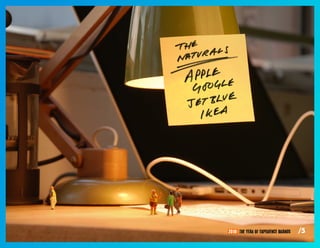
The following ten experience brand leaders include familiar brands that are
famous for putting as much emphasis on experience as on products. We call
these brands “the naturals”. We also include some up-and-coming brands that
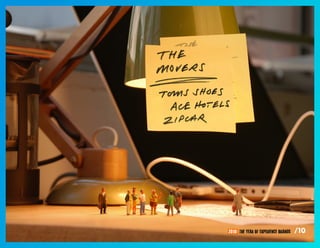
we call “the movers”—not only because they’re much smaller companies but
also because they’re moving our understanding of the very categories they
sell in as part of creating a distinctive experience. Finally, we highlight brands
that sell primarily to businesses to make the point that experience brands are
B2B as well as B2C.
This is just the beginning. In 2011 we will publish the first Index of Leading
Experience Brands, based on a combination of financial and business metrics
as well as input from experts in the field.
‘Til then, enjoy, and as always, please share your feedback.
                                                                                             LOOK FOR
Liz Bigham
SVP, Director of Brand Marketing
                                                                                            OUR INDEX
                                                                                            OF LEADING
                                                                                            EXPERIENCE
                                                                                               BRANDS
                                                                                               COMING
                                                                                             MAY 2011

                                                                                     2010: THE YEAR OF EXPERIENCE BRANDS   /3
2010: THE YEAR OF EXPERIENCE BRANDS   /4
2010: THE YEAR OF EXPERIENCE BRANDS   /5
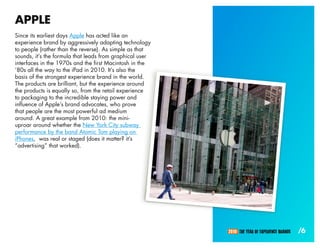
APPLE
Since its earliest days Apple has acted like an
experience brand by aggressively adapting technology
to people (rather than the reverse). As simple as that
sounds, it’s the formula that leads from graphical user
interfaces in the 1970s and the first Macintosh in the
‘80s all the way to the iPad in 2010. It’s also the
basis of the strongest experience brand in the world.
The products are brilliant, but the experience around
the products is equally so, from the retail experience
to packaging to the incredible staying power and
influence of Apple’s brand advocates, who prove
that people are the most powerful ad medium
around. A great example from 2010: the mini-
uproar around whether the New York City subway
performance by the band Atomic Tom playing on
iPhones, was real or staged (does it matter? it’s
“advertising” that worked).


                                                          2010: THE YEAR OF EXPERIENCE BRANDS   /6
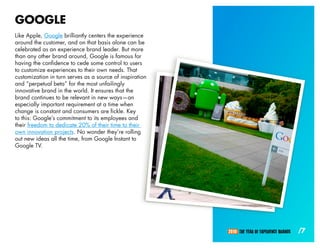
GOOGLE
Like Apple, Google brilliantly centers the experience
around the customer, and on that basis alone can be
celebrated as an experience brand leader. But more
than any other brand around, Google is famous for
having the confidence to cede some control to users
to customize experiences to their own needs. That
customization in turn serves as a source of inspiration
and “perpetual beta” for the most unfailingly
innovative brand in the world. It ensures that the
brand continues to be relevant in new ways—an
especially important requirement at a time when
change is constant and consumers are fickle. Key
to this: Google’s commitment to its employees and
their freedom to dedicate 20% of their time to their
own innovation projects. No wonder they’re rolling
out new ideas all the time, from Google Instant to
Google TV.


                                                          2010: THE YEAR OF EXPERIENCE BRANDS   /7
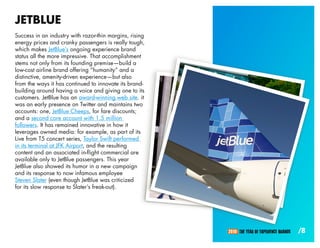
JETBLUE
Success in an industry with razor-thin margins, rising
energy prices and cranky passengers is really tough,
which makes JetBlue’s ongoing experience brand
status all the more impressive. That accomplishment
stems not only from its founding premise—build a
low-cost airline brand offering “humanity” and a
distinctive, amenity-driven experience—but also
from the ways it has continued to innovate its brand-
building around having a voice and giving one to its
customers. JetBlue has an award-winning web site. it
was an early presence on Twitter and maintains two
accounts: one, JetBlue Cheeps, for fare discounts;
and a second core account with 1.5 million
followers. It has remained innovative in how it
leverages owned media: for example, as part of its
Live from T5 concert series, Taylor Swift performed
in its terminal at JFK Airport, and the resulting
content and an associated in-flight commercial are
available only to JetBlue passengers. This year
JetBlue also showed its humor in a new campaign
and its response to now infamous employee
Steven Slater (even though JetBlue was criticized
for its slow response to Slater’s freak-out).


                                                         2010: THE YEAR OF EXPERIENCE BRANDS   /8
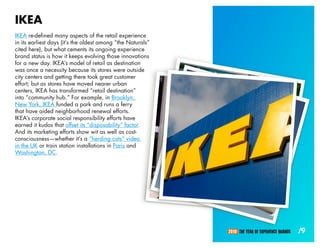
IKEA
IKEA re-defined many aspects of the retail experience
in its earliest days (it’s the oldest among “the Naturals”
cited here), but what cements its ongoing experience
brand status is how it keeps evolving those innovations
for a new day. IKEA’s model of retail as destination
was once a necessity because its stores were outside
city centers and getting there took great customer
effort; but as stores have moved nearer urban
centers, IKEA has transformed “retail destination”
into “community hub.” For example, in Brooklyn,
New York, IKEA funded a park and runs a ferry
that have aided neighborhood renewal efforts.
IKEA’s corporate social responsibility efforts have
earned it kudos that offset its “disposability” factor.
And its marketing efforts show wit as well as cost-
consciousness—whether it’s a “herding cats” video
in the UK or train station installations in Paris and
Washington, DC.


                                                             2010: THE YEAR OF EXPERIENCE BRANDS   /9
2010: THE YEAR OF EXPERIENCE BRANDS   /10
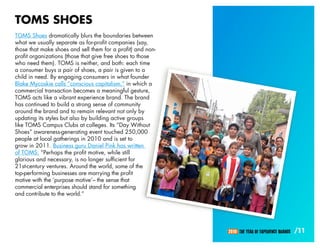
TOMS SHOES
TOMS Shoes dramatically blurs the boundaries between
what we usually separate as for-profit companies (say,
those that make shoes and sell them for a profit) and non-
profit organizations (those that give free shoes to those
who need them). TOMS is neither, and both: each time
a consumer buys a pair of shoes, a pair is given to a
child in need. By engaging consumers in what founder
Blake Mycoskie calls “conscious capitalism,” in which a
commercial transaction becomes a meaningful gesture,
TOMS acts like a vibrant experience brand. The brand
has continued to build a strong sense of community
around the brand and to remain relevant not only by
updating its styles but also by building active groups
like TOMS Campus Clubs at colleges. Its “Day Without
Shoes” awareness-generating event touched 250,000
people at local gatherings in 2010 and is set to
grow in 2011. Business guru Daniel Pink has written
of TOMS: “Perhaps the profit motive, while still
glorious and necessary, is no longer sufficient for
21st-century ventures. Around the world, some of the
top-performing businesses are marrying the profit
motive with the ‘purpose motive’– the sense that
commercial enterprises should stand for something
and contribute to the world.”


                                                             2010: THE YEAR OF EXPERIENCE BRANDS   /11
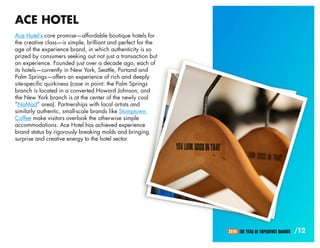
ACE HOTEL
Ace Hotel’s core promise—affordable boutique hotels for
the creative class—is simple, brilliant and perfect for the
age of the experience brand, in which authenticity is so
prized by consumers seeking out not just a transaction but
an experience. Founded just over a decade ago, each of
its hotels—currently in New York, Seattle, Portand and
Palm Springs—offers an experience of rich and deeply
site-specific quirkiness (case in point: the Palm Springs
branch is located in a converted Howard Johnson, and
the New York branch is at the center of the newly cool
“NoMad” area). Partnerships with local artists and
similarly authentic, small-scale brands like Stumptown
Coffee make visitors overlook the otherwise simple
accommodations. Ace Hotel has achieved experience
brand status by rigorously breaking molds and bringing
surprise and creative energy to the hotel sector.


                                                              2010: THE YEAR OF EXPERIENCE BRANDS   /12
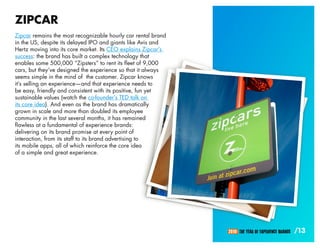
ZIPCAR
Zipcar remains the most recognizable hourly car rental brand
in the US, despite its delayed IPO and giants like Avis and
Hertz moving into its core market. Its CEO explains Zipcar’s
success: the brand has built a complex technology that
enables some 500,000 “Zipsters” to rent its fleet of 9,000
cars, but they’ve designed the experience so that it always
seems simple in the mind of the customer. Zipcar knows
it’s selling an experience—and that experience needs to
be easy, friendly and consistent with its positive, fun yet
sustainable values (watch the co-founder’s TED talk on
its core idea). And even as the brand has dramatically
grown in scale and more than doubled its employee
community in the last several months, it has remained
flawless at a fundamental of experience brands:
delivering on its brand promise at every point of
interaction, from its staff to its brand advertising to
its mobile apps, all of which reinforce the core idea
of a simple and great experience.


                                                               2010: THE YEAR OF EXPERIENCE BRANDS   /13
2010: THE YEAR OF EXPERIENCE BRANDS   /14
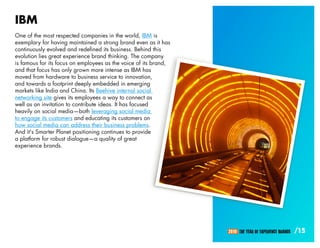
IBM
One of the most respected companies in the world, IBM is
exemplary for having maintained a strong brand even as it has
continuously evolved and redefined its business. Behind this
evolution lies great experience brand thinking. The company
is famous for its focus on employees as the voice of its brand,
and that focus has only grown more intense as IBM has
moved from hardware to business service to innovation,
and towards a footprint deeply embedded in emerging
markets like India and China. Its Beehive internal social
networking site gives its employees a way to connect as
well as an invitation to contribute ideas. It has focused
heavily on social media—both leveraging social media
to engage its customers and educating its customers on
how social media can address their business problems.
And it's Smarter Planet positioning continues to provide
a platform for robust dialogue—a quality of great
experience brands.


                                                                  2010: THE YEAR OF EXPERIENCE BRANDS   /15
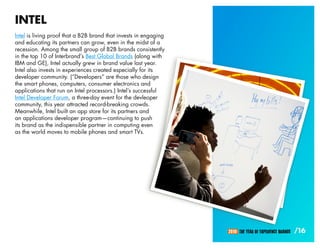
INTEL
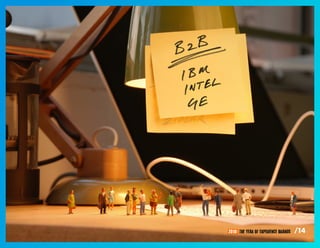
Intel is living proof that a B2B brand that invests in engaging
and educating its partners can grow, even in the midst of a
recession. Among the small group of B2B brands consistently
in the top 10 of Interbrand’s Best Global Brands (along with
IBM and GE), Intel actually grew in brand value last year.
Intel also invests in experiences created especially for its
developer community. (“Developers” are those who design
the smart phones, computers, consumer electronics and
applications that run on Intel processors.) Intel’s successful
Intel Developer Forum, a three-day event for the devleoper
community, this year attracted record-breaking crowds.
Meanwhile, Intel built an app store for its partners and
an applications developer program—continuing to push
its brand as the indispensible partner in computing even
as the world moves to mobile phones and smart TVs.


                                                                  2010: THE YEAR OF EXPERIENCE BRANDS   /16
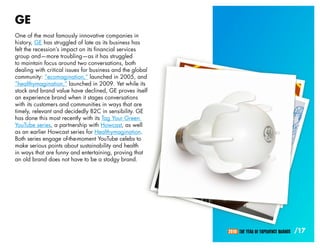
GE
One of the most famously innovative companies in
history, GE has struggled of late as its business has
felt the recession’s impact on its financial services
group and—more troubling—as it has struggled
to maintain focus around two conversations, both
dealing with critical issues for business and the global
community: “ecomagination,” launched in 2005, and
“healthymagination,” launched in 2009. Yet while its
stock and brand value have declined, GE proves itself
an experience brand when it stages conversations
with its customers and communities in ways that are
timely, relevant and decidedly B2C in sensibility. GE
has done this most recently with its Tag Your Green
YouTube series, a partnership with Howcast, as well
as an earlier Howcast series for Healthymagination.
Both series engage of-the-moment YouTube celebs to
make serious points about sustainability and health
in ways that are funny and entertaining, proving that
an old brand does not have to be a stodgy brand.


                                                           2010: THE YEAR OF EXPERIENCE BRANDS   /17
EXPERIENCE BRANDS
LEAD THE WAY
We started out 2010 predicting that this would be “the year of experience
brands.” That was an understatement: 2010 is just the beginning. Experience
brands will be the leaders in the century to come. They’ll be at the center of
what is a really exciting time to be in the business we’re in.
In 2011 we’ll continue the dialogue on experience brands, publishing the
world’s first Index of Experience Brand Leaders based on a combination of
financial analysis, marketing criteria and input from brand and marketing
experts. When we talk about experience brands, people want to know, who
are they? as well as, how can we benchmark our brand against experience
brand leaders? The Index will address questions like these, and enhance
the already robust dialogues we’ve had with our clients and peers about
experience brands in 2010.


                                                                                 2010: THE YEAR OF EXPERIENCE BRANDS   /18
SHARE THIS EXPERIENCE
If you like this article, please share it with your friends and colleagues

      SHARE ON DELICIOUS
      SHARE ON DIGG
      SHARE ON FACEBOOK
      SHARE ON LINKEDIN
      SHARE ON TWITTER
      SHARE VIA EMAIL


Follow @ jackmorton

For more information, contact Liz Bigham at
liz_bigham@jackmorton.com or 212-401-7212.


                                                                             2010: THE YEAR OF EXPERIENCE BRANDS   /19
JACK MORTON WORLDWIDE IS A GLOBAL BRAND
EXPERIENCE AGENCY. WE CREATE EXPERIENCES THAT
STRENGTHEN RELATIONSHIPS BETWEEN BRANDS AND THE
PEOPLE WHO MATTER MOST TO THEM—THEREBY HELPING OUR
CLIENTS BECOME TALKED-ABOUT EXPERIENCE BRANDS. RATED
AMONG THE TOP MARKETING SERVICE AGENCIES WORLDWIDE,
WE INTEGRATE LIVE AND ONLINE EXPERIENCES, DIGITAL AND
SOCIAL MEDIA, AND BRANDED 3D ENVIRONMENTS THAT
ENGAGE AND INSPIRE CONSUMERS, BUSINESS PARTNERS AND
EMPLOYEES. OUR STAFF WORK ACROSS THE US, EUROPE AND
ASIA-PACIFIC AS PART OF AN IDEAS-LED AGENCY CULTURE.

© Jack Morton Worldwide 2010


                                                        2010: THE YEAR OF EXPERIENCE BRANDS   /20

Brand experience examples and case studies

  • 1.
  • 2.
    TAKE ME TOYOUR LEADER Being a leading brand takes a lot more than it used to. In the old days, it was enough to add a logo to a product and call it a brand. Today, brands are more like verbs than they are like nouns. Of course there’s still a solid product at the center, and brand identity matters (just ask Gap). But what people remember more than anything is the set of experiences they associate with the brand (both their own experiences and those of others that they’ve heard about). And what people value most is when they see that a brand puts them at the center—the brand defines (and redefines) itself around how it’s used by its customers. THE BRANDS That’s why we believe that the brands that lead in the 21st century will be experience brands. They’re the brands that turn a marketing channel into a point of differentiation. They think through the product experience as much as the THAT LEAD product. They are people brands, lived and loved by those that represent IN THE 21ST them—their employees as well as self-elected brand passionates. CENTURY WILL BE EXPERIENCE BRANDS 2010: THE YEAR OF EXPERIENCE BRANDS /2
  • 3.
    This year we’veworked to define experience brands. We’ve talked about how experience brands follow a New engagement model and Leverage owned media in a new way. As we close out 2010, we offer snapshots of leading experience brands. The following ten experience brand leaders include familiar brands that are famous for putting as much emphasis on experience as on products. We call these brands “the naturals”. We also include some up-and-coming brands that we call “the movers”—not only because they’re much smaller companies but also because they’re moving our understanding of the very categories they sell in as part of creating a distinctive experience. Finally, we highlight brands that sell primarily to businesses to make the point that experience brands are B2B as well as B2C. This is just the beginning. In 2011 we will publish the first Index of Leading Experience Brands, based on a combination of financial and business metrics as well as input from experts in the field. ‘Til then, enjoy, and as always, please share your feedback. LOOK FOR Liz Bigham SVP, Director of Brand Marketing OUR INDEX OF LEADING EXPERIENCE BRANDS COMING MAY 2011 2010: THE YEAR OF EXPERIENCE BRANDS /3
  • 4.
    2010: THE YEAROF EXPERIENCE BRANDS /4
  • 5.
    2010: THE YEAROF EXPERIENCE BRANDS /5
  • 6.
    APPLE Since its earliestdays Apple has acted like an experience brand by aggressively adapting technology to people (rather than the reverse). As simple as that sounds, it’s the formula that leads from graphical user interfaces in the 1970s and the first Macintosh in the ‘80s all the way to the iPad in 2010. It’s also the basis of the strongest experience brand in the world. The products are brilliant, but the experience around the products is equally so, from the retail experience to packaging to the incredible staying power and influence of Apple’s brand advocates, who prove that people are the most powerful ad medium around. A great example from 2010: the mini- uproar around whether the New York City subway performance by the band Atomic Tom playing on iPhones, was real or staged (does it matter? it’s “advertising” that worked). 2010: THE YEAR OF EXPERIENCE BRANDS /6
  • 7.
    GOOGLE Like Apple, Googlebrilliantly centers the experience around the customer, and on that basis alone can be celebrated as an experience brand leader. But more than any other brand around, Google is famous for having the confidence to cede some control to users to customize experiences to their own needs. That customization in turn serves as a source of inspiration and “perpetual beta” for the most unfailingly innovative brand in the world. It ensures that the brand continues to be relevant in new ways—an especially important requirement at a time when change is constant and consumers are fickle. Key to this: Google’s commitment to its employees and their freedom to dedicate 20% of their time to their own innovation projects. No wonder they’re rolling out new ideas all the time, from Google Instant to Google TV. 2010: THE YEAR OF EXPERIENCE BRANDS /7
  • 8.
    JETBLUE Success in anindustry with razor-thin margins, rising energy prices and cranky passengers is really tough, which makes JetBlue’s ongoing experience brand status all the more impressive. That accomplishment stems not only from its founding premise—build a low-cost airline brand offering “humanity” and a distinctive, amenity-driven experience—but also from the ways it has continued to innovate its brand- building around having a voice and giving one to its customers. JetBlue has an award-winning web site. it was an early presence on Twitter and maintains two accounts: one, JetBlue Cheeps, for fare discounts; and a second core account with 1.5 million followers. It has remained innovative in how it leverages owned media: for example, as part of its Live from T5 concert series, Taylor Swift performed in its terminal at JFK Airport, and the resulting content and an associated in-flight commercial are available only to JetBlue passengers. This year JetBlue also showed its humor in a new campaign and its response to now infamous employee Steven Slater (even though JetBlue was criticized for its slow response to Slater’s freak-out). 2010: THE YEAR OF EXPERIENCE BRANDS /8
  • 9.
    IKEA IKEA re-defined manyaspects of the retail experience in its earliest days (it’s the oldest among “the Naturals” cited here), but what cements its ongoing experience brand status is how it keeps evolving those innovations for a new day. IKEA’s model of retail as destination was once a necessity because its stores were outside city centers and getting there took great customer effort; but as stores have moved nearer urban centers, IKEA has transformed “retail destination” into “community hub.” For example, in Brooklyn, New York, IKEA funded a park and runs a ferry that have aided neighborhood renewal efforts. IKEA’s corporate social responsibility efforts have earned it kudos that offset its “disposability” factor. And its marketing efforts show wit as well as cost- consciousness—whether it’s a “herding cats” video in the UK or train station installations in Paris and Washington, DC. 2010: THE YEAR OF EXPERIENCE BRANDS /9
  • 10.
    2010: THE YEAROF EXPERIENCE BRANDS /10
  • 11.
    TOMS SHOES TOMS Shoesdramatically blurs the boundaries between what we usually separate as for-profit companies (say, those that make shoes and sell them for a profit) and non- profit organizations (those that give free shoes to those who need them). TOMS is neither, and both: each time a consumer buys a pair of shoes, a pair is given to a child in need. By engaging consumers in what founder Blake Mycoskie calls “conscious capitalism,” in which a commercial transaction becomes a meaningful gesture, TOMS acts like a vibrant experience brand. The brand has continued to build a strong sense of community around the brand and to remain relevant not only by updating its styles but also by building active groups like TOMS Campus Clubs at colleges. Its “Day Without Shoes” awareness-generating event touched 250,000 people at local gatherings in 2010 and is set to grow in 2011. Business guru Daniel Pink has written of TOMS: “Perhaps the profit motive, while still glorious and necessary, is no longer sufficient for 21st-century ventures. Around the world, some of the top-performing businesses are marrying the profit motive with the ‘purpose motive’– the sense that commercial enterprises should stand for something and contribute to the world.” 2010: THE YEAR OF EXPERIENCE BRANDS /11
  • 12.
    ACE HOTEL Ace Hotel’score promise—affordable boutique hotels for the creative class—is simple, brilliant and perfect for the age of the experience brand, in which authenticity is so prized by consumers seeking out not just a transaction but an experience. Founded just over a decade ago, each of its hotels—currently in New York, Seattle, Portand and Palm Springs—offers an experience of rich and deeply site-specific quirkiness (case in point: the Palm Springs branch is located in a converted Howard Johnson, and the New York branch is at the center of the newly cool “NoMad” area). Partnerships with local artists and similarly authentic, small-scale brands like Stumptown Coffee make visitors overlook the otherwise simple accommodations. Ace Hotel has achieved experience brand status by rigorously breaking molds and bringing surprise and creative energy to the hotel sector. 2010: THE YEAR OF EXPERIENCE BRANDS /12
  • 13.
    ZIPCAR Zipcar remains themost recognizable hourly car rental brand in the US, despite its delayed IPO and giants like Avis and Hertz moving into its core market. Its CEO explains Zipcar’s success: the brand has built a complex technology that enables some 500,000 “Zipsters” to rent its fleet of 9,000 cars, but they’ve designed the experience so that it always seems simple in the mind of the customer. Zipcar knows it’s selling an experience—and that experience needs to be easy, friendly and consistent with its positive, fun yet sustainable values (watch the co-founder’s TED talk on its core idea). And even as the brand has dramatically grown in scale and more than doubled its employee community in the last several months, it has remained flawless at a fundamental of experience brands: delivering on its brand promise at every point of interaction, from its staff to its brand advertising to its mobile apps, all of which reinforce the core idea of a simple and great experience. 2010: THE YEAR OF EXPERIENCE BRANDS /13
  • 14.
    2010: THE YEAROF EXPERIENCE BRANDS /14
  • 15.
    IBM One of themost respected companies in the world, IBM is exemplary for having maintained a strong brand even as it has continuously evolved and redefined its business. Behind this evolution lies great experience brand thinking. The company is famous for its focus on employees as the voice of its brand, and that focus has only grown more intense as IBM has moved from hardware to business service to innovation, and towards a footprint deeply embedded in emerging markets like India and China. Its Beehive internal social networking site gives its employees a way to connect as well as an invitation to contribute ideas. It has focused heavily on social media—both leveraging social media to engage its customers and educating its customers on how social media can address their business problems. And it's Smarter Planet positioning continues to provide a platform for robust dialogue—a quality of great experience brands. 2010: THE YEAR OF EXPERIENCE BRANDS /15
  • 16.
    INTEL Intel is livingproof that a B2B brand that invests in engaging and educating its partners can grow, even in the midst of a recession. Among the small group of B2B brands consistently in the top 10 of Interbrand’s Best Global Brands (along with IBM and GE), Intel actually grew in brand value last year. Intel also invests in experiences created especially for its developer community. (“Developers” are those who design the smart phones, computers, consumer electronics and applications that run on Intel processors.) Intel’s successful Intel Developer Forum, a three-day event for the devleoper community, this year attracted record-breaking crowds. Meanwhile, Intel built an app store for its partners and an applications developer program—continuing to push its brand as the indispensible partner in computing even as the world moves to mobile phones and smart TVs. 2010: THE YEAR OF EXPERIENCE BRANDS /16
  • 17.
    GE One of themost famously innovative companies in history, GE has struggled of late as its business has felt the recession’s impact on its financial services group and—more troubling—as it has struggled to maintain focus around two conversations, both dealing with critical issues for business and the global community: “ecomagination,” launched in 2005, and “healthymagination,” launched in 2009. Yet while its stock and brand value have declined, GE proves itself an experience brand when it stages conversations with its customers and communities in ways that are timely, relevant and decidedly B2C in sensibility. GE has done this most recently with its Tag Your Green YouTube series, a partnership with Howcast, as well as an earlier Howcast series for Healthymagination. Both series engage of-the-moment YouTube celebs to make serious points about sustainability and health in ways that are funny and entertaining, proving that an old brand does not have to be a stodgy brand. 2010: THE YEAR OF EXPERIENCE BRANDS /17
  • 18.
    EXPERIENCE BRANDS LEAD THEWAY We started out 2010 predicting that this would be “the year of experience brands.” That was an understatement: 2010 is just the beginning. Experience brands will be the leaders in the century to come. They’ll be at the center of what is a really exciting time to be in the business we’re in. In 2011 we’ll continue the dialogue on experience brands, publishing the world’s first Index of Experience Brand Leaders based on a combination of financial analysis, marketing criteria and input from brand and marketing experts. When we talk about experience brands, people want to know, who are they? as well as, how can we benchmark our brand against experience brand leaders? The Index will address questions like these, and enhance the already robust dialogues we’ve had with our clients and peers about experience brands in 2010. 2010: THE YEAR OF EXPERIENCE BRANDS /18
  • 19.
    SHARE THIS EXPERIENCE Ifyou like this article, please share it with your friends and colleagues SHARE ON DELICIOUS SHARE ON DIGG SHARE ON FACEBOOK SHARE ON LINKEDIN SHARE ON TWITTER SHARE VIA EMAIL Follow @ jackmorton For more information, contact Liz Bigham at liz_bigham@jackmorton.com or 212-401-7212. 2010: THE YEAR OF EXPERIENCE BRANDS /19
  • 20.
    JACK MORTON WORLDWIDEIS A GLOBAL BRAND EXPERIENCE AGENCY. WE CREATE EXPERIENCES THAT STRENGTHEN RELATIONSHIPS BETWEEN BRANDS AND THE PEOPLE WHO MATTER MOST TO THEM—THEREBY HELPING OUR CLIENTS BECOME TALKED-ABOUT EXPERIENCE BRANDS. RATED AMONG THE TOP MARKETING SERVICE AGENCIES WORLDWIDE, WE INTEGRATE LIVE AND ONLINE EXPERIENCES, DIGITAL AND SOCIAL MEDIA, AND BRANDED 3D ENVIRONMENTS THAT ENGAGE AND INSPIRE CONSUMERS, BUSINESS PARTNERS AND EMPLOYEES. OUR STAFF WORK ACROSS THE US, EUROPE AND ASIA-PACIFIC AS PART OF AN IDEAS-LED AGENCY CULTURE. © Jack Morton Worldwide 2010 2010: THE YEAR OF EXPERIENCE BRANDS /20