1Health System Elements & ConnectionsJuly 19, 2011David H PetersJohns Hopkins University
2What Is A System?	An interaction of parts and their interconnections that come together for a purpose
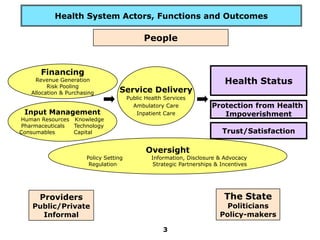
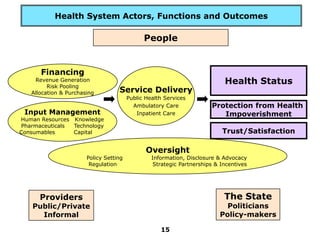
3Health System Actors, Functions and OutcomesPeopleFinancingRevenue GenerationRisk PoolingAllocation & PurchasingHealth StatusService DeliveryPublic Health ServicesAmbulatory CareInpatient CareProtection from Health ImpoverishmentInput ManagementHuman Resources	   KnowledgePharmaceuticals	     TechnologyConsumables          Capital       Trust/SatisfactionOversightPolicy Setting		Information, Disclosure & Advocacy Regulation 		Strategic Partnerships & IncentivesThe StatePoliticiansPolicy-makersProvidersPublic/PrivateInformal
4Who Produces Health?
The “Control Knobs” of Public Intervention in Health SystemsFinancing: how to raise money, pool funds, allocate and pay for health careOrganization: who delivers services and manages health systems inputs, and how they are deliveredOversight: how do you regulate and use information to change behavior of key actors5
6Health Financing: Key FunctionsRaising revenuesPooling resourcesAllocating and purchasing
7Changes in Organization (who does what, how)Service delivery point (clinics, hospitals)Government administrative area (district)Management unitProfessionCommunity OrganizationPriority program/disease
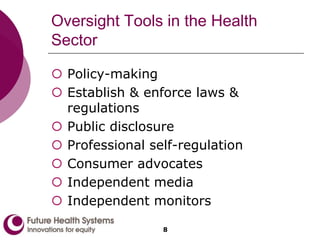
8Oversight Tools in the Health SectorPolicy-makingEstablish & enforce laws & regulationsPublic disclosureProfessional self-regulationConsumer advocatesIndependent mediaIndependent monitors
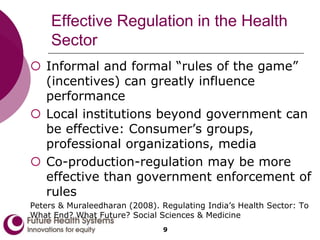
Effective Regulation in the Health SectorInformal and formal “rules of the game” (incentives) can greatly influence performanceLocal institutions beyond government can be effective: Consumer’s groups, professional organizations, mediaCo-production-regulation may be more effective than government enforcement of rulesPeters & Muraleedharan (2008). Regulating India’s Health Sector: To What End? What Future? Social Sciences & Medicine		9
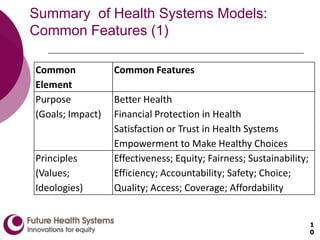
Summary  of Health Systems Models: Common Features (1)10
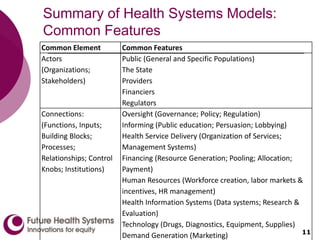
Summary of Health Systems Models: Common Features11
Making Connections: Systems ThinkingThe process of understanding how things influence each other in a system12
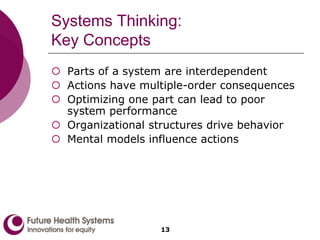
13Systems Thinking:Key ConceptsParts of a system are interdependentActions have multiple-order consequencesOptimizing one part can lead to poor system performanceOrganizational structures drive behaviorMental models influence actions
Making ConnectionsWill changes in one part of health system cause changes in other part of health systemOther actorsOther functionsOutcomes14
15Health System Actors, Functions and OutcomesPeopleFinancingRevenue GenerationRisk PoolingAllocation & PurchasingHealth StatusService DeliveryPublic Health ServicesAmbulatory CareInpatient CareProtection from Health ImpoverishmentInput ManagementHuman Resources	   KnowledgePharmaceuticals	     TechnologyConsumables          Capital       Trust/SatisfactionOversightPolicy Setting		Information, Disclosure & Advocacy Regulation 		Strategic Partnerships & IncentivesThe StatePoliticiansPolicy-makersProvidersPublic/PrivateInformal
Making Connections: Where to lookFollow people and organizations (actors)Follow the moneyFollow the informationAsk:How will different actors respond?What will happen to health services?What will happen to health system outcomes, for whom?16
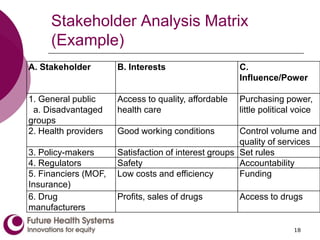
Following peopleIdentify “interests”Motivations, Incentives and AccountabilitiesIdentify “influence”Power, ResourcesConsider how intervention will affect people:Who will benefit, who will loseWho will “own”17
Stakeholder Analysis Matrix (Example)18
Following money and servicesWill change in financing affect health services?Volume of servicesQuality of servicesWho will provideWho will benefit from services19
Following informationWill information affect health services?Quality of servicesPrices for servicesWho will provideWho will benefit from services20
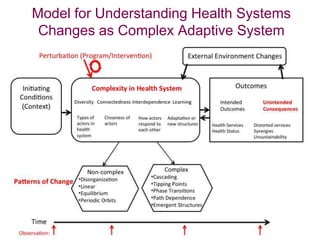
Incorporating Complexity21
Model for Understanding Health Systems Changes as Complex Adaptive System22
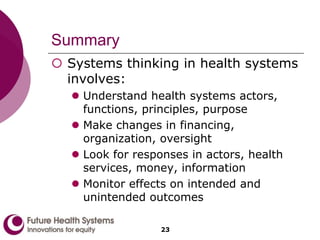
23SummarySystems thinking in health systems involves:Understand health systems actors, functions, principles, purposeMake changes in financing, organization, oversightLook for responses in actors, health services, money, informationMonitor effects on intended and unintended outcomes

Health system elements

  • 1.
    1Health System Elements& ConnectionsJuly 19, 2011David H PetersJohns Hopkins University
  • 2.
    2What Is ASystem? An interaction of parts and their interconnections that come together for a purpose
  • 3.
    3Health System Actors,Functions and OutcomesPeopleFinancingRevenue GenerationRisk PoolingAllocation & PurchasingHealth StatusService DeliveryPublic Health ServicesAmbulatory CareInpatient CareProtection from Health ImpoverishmentInput ManagementHuman Resources KnowledgePharmaceuticals TechnologyConsumables Capital Trust/SatisfactionOversightPolicy Setting Information, Disclosure & Advocacy Regulation Strategic Partnerships & IncentivesThe StatePoliticiansPolicy-makersProvidersPublic/PrivateInformal
  • 4.
  • 5.
    The “Control Knobs”of Public Intervention in Health SystemsFinancing: how to raise money, pool funds, allocate and pay for health careOrganization: who delivers services and manages health systems inputs, and how they are deliveredOversight: how do you regulate and use information to change behavior of key actors5
  • 6.
    6Health Financing: KeyFunctionsRaising revenuesPooling resourcesAllocating and purchasing
  • 7.
    7Changes in Organization(who does what, how)Service delivery point (clinics, hospitals)Government administrative area (district)Management unitProfessionCommunity OrganizationPriority program/disease
  • 8.
    8Oversight Tools inthe Health SectorPolicy-makingEstablish & enforce laws & regulationsPublic disclosureProfessional self-regulationConsumer advocatesIndependent mediaIndependent monitors
  • 9.
    Effective Regulation inthe Health SectorInformal and formal “rules of the game” (incentives) can greatly influence performanceLocal institutions beyond government can be effective: Consumer’s groups, professional organizations, mediaCo-production-regulation may be more effective than government enforcement of rulesPeters & Muraleedharan (2008). Regulating India’s Health Sector: To What End? What Future? Social Sciences & Medicine 9
  • 10.
    Summary ofHealth Systems Models: Common Features (1)10
  • 11.
    Summary of HealthSystems Models: Common Features11
  • 12.
    Making Connections: SystemsThinkingThe process of understanding how things influence each other in a system12
  • 13.
    13Systems Thinking:Key ConceptsPartsof a system are interdependentActions have multiple-order consequencesOptimizing one part can lead to poor system performanceOrganizational structures drive behaviorMental models influence actions
  • 14.
    Making ConnectionsWill changesin one part of health system cause changes in other part of health systemOther actorsOther functionsOutcomes14
  • 15.
    15Health System Actors,Functions and OutcomesPeopleFinancingRevenue GenerationRisk PoolingAllocation & PurchasingHealth StatusService DeliveryPublic Health ServicesAmbulatory CareInpatient CareProtection from Health ImpoverishmentInput ManagementHuman Resources KnowledgePharmaceuticals TechnologyConsumables Capital Trust/SatisfactionOversightPolicy Setting Information, Disclosure & Advocacy Regulation Strategic Partnerships & IncentivesThe StatePoliticiansPolicy-makersProvidersPublic/PrivateInformal
  • 16.
    Making Connections: Whereto lookFollow people and organizations (actors)Follow the moneyFollow the informationAsk:How will different actors respond?What will happen to health services?What will happen to health system outcomes, for whom?16
  • 17.
    Following peopleIdentify “interests”Motivations,Incentives and AccountabilitiesIdentify “influence”Power, ResourcesConsider how intervention will affect people:Who will benefit, who will loseWho will “own”17
  • 18.
  • 19.
    Following money andservicesWill change in financing affect health services?Volume of servicesQuality of servicesWho will provideWho will benefit from services19
  • 20.
    Following informationWill informationaffect health services?Quality of servicesPrices for servicesWho will provideWho will benefit from services20
  • 21.
  • 22.
    Model for UnderstandingHealth Systems Changes as Complex Adaptive System22
  • 23.
    23SummarySystems thinking inhealth systems involves:Understand health systems actors, functions, principles, purposeMake changes in financing, organization, oversightLook for responses in actors, health services, money, informationMonitor effects on intended and unintended outcomes