HPSR?
What is health policy and
systems research?
IHPSR Presentation 3
www.hpsa-africa.org
@hpsa_africa
www.slideshare.net/hpsa_africa
Introduction to Health Policy and
Systems Research
Outline
• Definition(s)
• Scope and nature
– describing and evaluating − health systems
and health policy lenses
– macro, meso, micro levels
– a systems orientation
• Methodological considerations
HPSR ‘seeks to understand and improve how
societies organize themselves in achieving collective
health goals, and how different actors interact in
the policy and implementation processes to
contribute to policy outcomes.
By nature, it is interdisciplinary, a blend of economics,
sociology, anthropology, political science, public health and
epidemiology that together draw a comprehensive
picture of how health systems respond and adapt
to health policies, and how health policies can shape
− and be shaped by − health systems and the
broader determinants of health’.
Gilson (ed.), 2012
• Distinguished by issues and questions
considered, not by a disciplinary base, and
includes:
– research focused on health services as well as
promotion of health
– concern for global and international issues as
well as national and sub-national issues
– research on or of policy – addresses politics of
health systems and health systems services
• Promotes work that explicitly seeks to
influence policy
Why and what policy focus?
• An applied research field that by definition
engages with policy:
– analysis of policy
– analysis for policy
• And focuses on both
– policy content/interventions
– processes of policy decision-making
The cutting edge of HPSR
Public Health
& Clinical
Sciences
Policy &
Practice
Social Sciences
HPSR
Both:
• Research on describing a system (how it works)
• Research on changing a system (how it changes/how
to change it)
Evaluation of current system
performance and of policies/
interventions intended to improve
system performance
Evaluation of the process of policy
making
(agenda setting, development and
implementation)
Defining features?
Research questions rooted in policy
and systems issues
• Health policy and how to implement it effectively
• System performance and how to improve it
– Focus on system as a whole
» consider one building block and its
interactions with others
» consider factors influencing system
Scope of HPSR
Health Policy
Content &
Instruments
Actors, Power &
Politics
Institutions, Interests
& Ideas
Health Systems
Hardware:
structure, technology,
resourcing
Software
Tangible: structures,
processes, systems
Intangible:
relationships,
communication, values
& norms
Policy Change
&
Health System
Development
Global &
National forces
Scope & nature of HPSR (continued)
HPSR is not:
• Clinical or basic science
• Only rooted in health economics or focused on
financing issues (though both important)
• Focused on disease distribution, causes and
interventions (but rather generic organisational and
societal‘structures’ through which interventions are
implemented)
Scope & nature (continued)
Specific services/disease programmes:
• Often a tracer for understanding systems issues e.g.
maternal health services; the impact of district
strengthening on child health outcomes
• May be researched because they have system wide
effects e.g. antiretroviral therapy
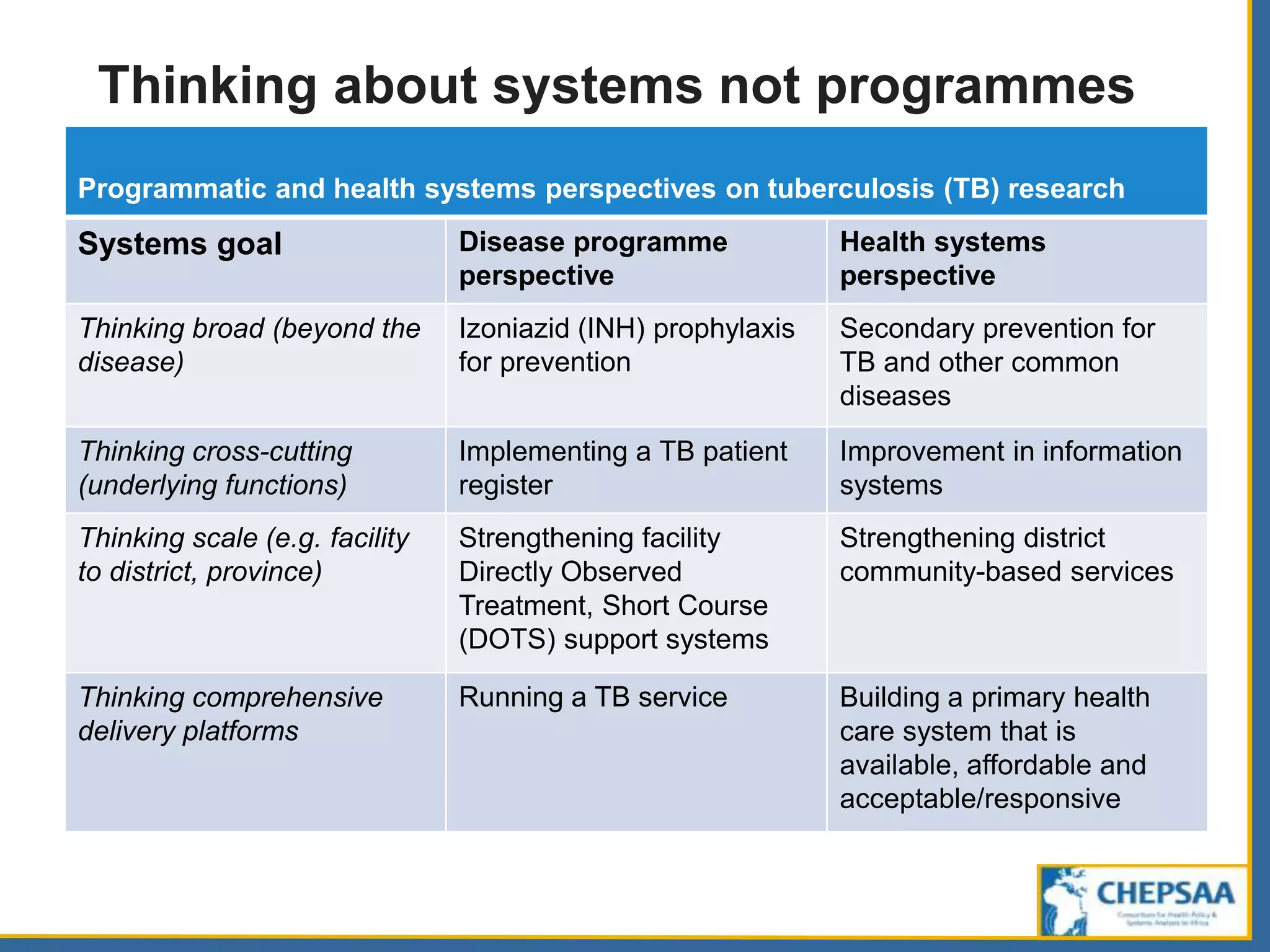
• Must think BEYOND the programme/service!
Programmatic and health systems perspectives on tuberculosis (TB) research
Systems goal Disease programme
perspective
Health systems
perspective
Thinking broad (beyond the
disease)
Izoniazid (INH) prophylaxis
for prevention
Secondary prevention for
TB and other common
diseases
Thinking cross-cutting
(underlying functions)
Implementing a TB patient
register
Improvement in information
systems
Thinking scale (e.g. facility
to district, province)
Strengthening facility
Directly Observed
Treatment, Short Course
(DOTS) support systems
Strengthening district
community-based services
Thinking comprehensive
delivery platforms
Running a TB service Building a primary health
care system that is
available, affordable and
acceptable/responsive
Thinking about systems not programmes
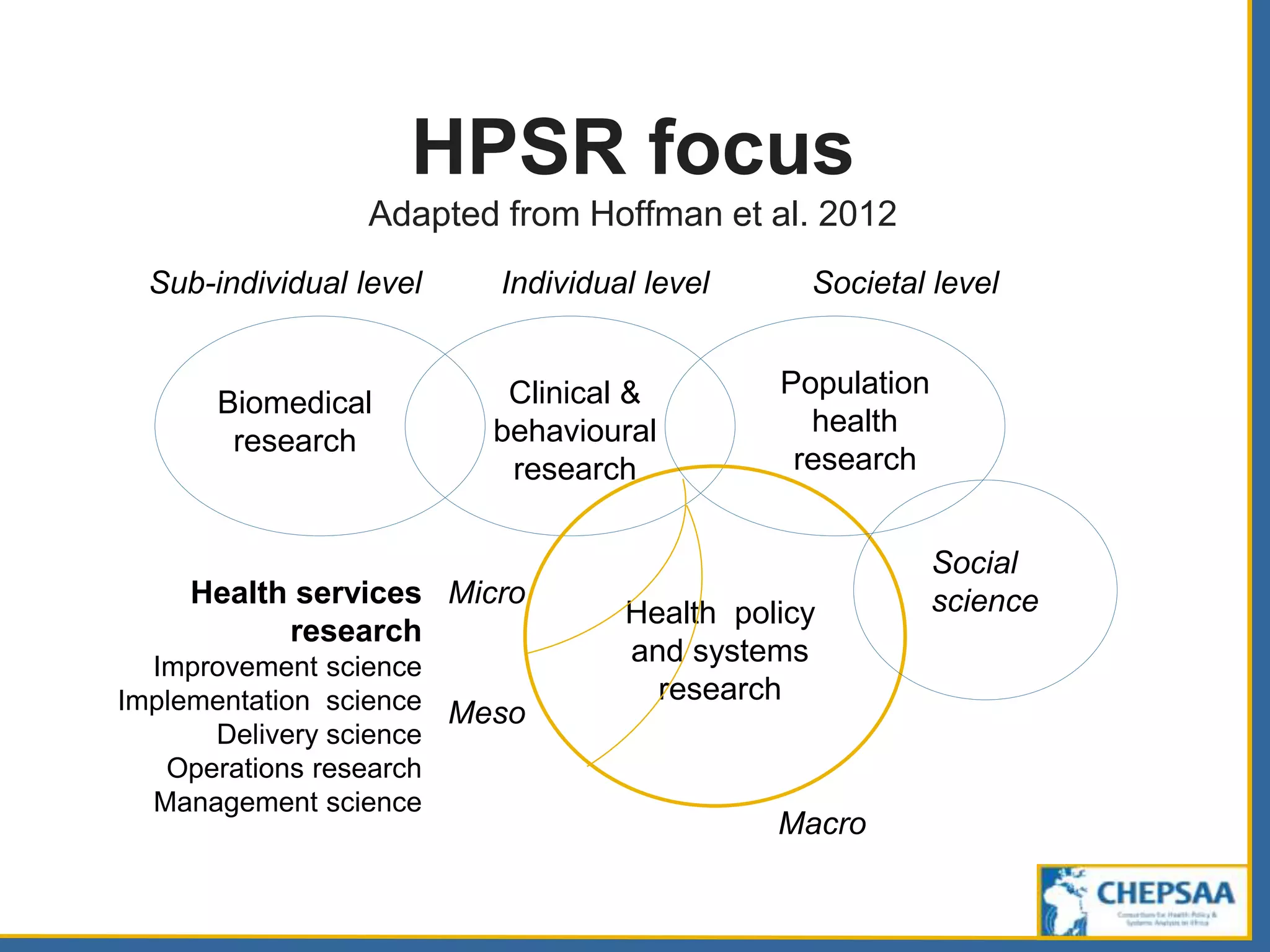
Thinking about levels
• Macro level
– architecture and oversight
• Meso level
– functioning of organisations (interventions or programmes as
tracers for that)
• Micro level
– the individual in the system
• Cross-level
– for example: how global influences shape architecture, so
influencing local systems and individuals’ behaviour
HPSR focus
Adapted from Hoffman et al. 2012
Health policy
and systems
research
Clinical &
behavioural
research
Population
health
research
Macro
Biomedical
research
Micro
Meso
Sub-individual level Individual level Societal level
Health services
research
Improvement science
Implementation science
Delivery science
Operations research
Management science
Social
science
MACRO level
Good health at low cost: 25 years on
Balabanova et al., 2011
Case studies of +ve ‘deviants’: Thailand, Bangladesh,
Ethiopia, Kyrgyzstan, Tamil Nadu
Methods
• Link outcomes with health system development
processes over long periods of time
• Multi-method
• Trends in human resources, financing
• Analysis of policy actors and processes
MESO level
Oomman et al, 2009
Oomman et al, 2009. The effects of global health initiatives on country health systems:
a review of the evidence from HIV/AIDS control. Health Policy and Planning, 24(4): 239–52
doi: 10.1093/heapol/czp025
MICRO level
Communication in policy implementation
Sheikh & Porter, 2010
‘Discursive gaps in the implementation of public
health policy guidelines in India: The case of HIV
testing.’
Sheikh K, Porter J (2010). Discursive gaps in the implementation of public health policy guidelines
in India: The case of HIV testing. Social Science & Medicine, 71(11):2005–2013.
HPSR methodological
considerations
Applied
• Starts with topic or problem rather than method (vs
epidemiology) or discipline
• ‘Real world’vs laboratory
• Policy relevant
No single methodological gold standard study
design
• Range of study designs or research strategies
depending on purpose and question
Methodology (continued)
Must consider complexity
• Investigator has little control over events
• Numerous interacting elements, open systems
(complex adaptive systems)
• Different actors with different experiences and
different questions: managers, citizens, patients
• Social phenomena important: culture, interests,
leadership, etc.
• Contextual influences
Rwashana, Williams & Neema, 2009
Methodology (continued)
No single methodological gold standard e.g. RCT
• Range of study designs or research strategies depending
on purpose and question
– cross-sectional
– longitudinal
– experimental
– case study
– ethnographic
– action research
Range of epistemologies (philosophies of knowledge)
• Different paradigms
– positivism, relativism, realism
Being systematic,
principled, ethical
• The four steps of HPSR
Step 1: Identify the research focus and questions
Step 2: Design the study
Step 3: Ensure research quality and rigour
Step 4: Apply ethical principles
Copyright
Funding
You are free:
To Share – to copy, distribute and transmit the work
To Remix – to adapt the work
Under the following conditions:
Attribution You must attribute the work in the manner
specified by the author or licensor (but not in any way that
suggests that they endorse you or your use of the work).
Non-commercial You may not use this work for commercial
purposes.
Share Alike If you alter, transform, or build upon this work,
you may distribute the resulting work but only under the same
or similar license to this one.
Other conditions
For any reuse or distribution, you must make clear to
others the license terms of this work.
Nothing in this license impairs or restricts the authors’
moral rights.
Nothing in this license impairs or restricts the rights of
authors whose work is referenced in this document.
Cited works used in this document must be cited following
usual academic conventions.
Citation of this work must follow normal academic
conventions. Suggested citation:
Introduction to Health Policy and Systems Research,
course presentation, Presentation 3. Copyright
CHEPSAA (Consortium for Health Policy & Systems
Analysis in Africa) 2014, www.hpsa-africa.org
www.slideshare.net/hpsa_africa
This document is an output from a project funded by the European Commission (EC) FP7-Africa (Grant no.
265482). The views expressed are not necessarily those of the EC.
The CHEPSAA partners
University of Dar Es Salaam
Institute of Development Studies
University of the Witwatersrand
Centre for Health Policy
University of Ghana
School of Public Health, Department of
Health Policy, Planning and Management
University of Leeds
Nuffield Centre for International Health and
Development
University of Nigeria Enugu
Health Policy Research Group & the
Department of Health Administration and
Management
London School of Hygiene and
Tropical Medicine
Health Economics and Systems Analysis
Group, Depart of Global Health & Dev.
Great Lakes University of Kisumu
Tropical Institute of Community Health and
Development
Karolinska Institutet
Health Systems and Policy Group,
Department of Public Health Sciences
University of Cape Town
Health Policy and Systems Programme,
Health Economics Unit
Swiss Tropical and Public Health
Institute
Health Systems Research Group
University of the Western Cape
School of Public Health

HPSR? What is health policy and systems research?

  • 1.
    HPSR? What is healthpolicy and systems research? IHPSR Presentation 3 www.hpsa-africa.org @hpsa_africa www.slideshare.net/hpsa_africa Introduction to Health Policy and Systems Research
  • 2.
    Outline • Definition(s) • Scopeand nature – describing and evaluating − health systems and health policy lenses – macro, meso, micro levels – a systems orientation • Methodological considerations
  • 3.
    HPSR ‘seeks tounderstand and improve how societies organize themselves in achieving collective health goals, and how different actors interact in the policy and implementation processes to contribute to policy outcomes. By nature, it is interdisciplinary, a blend of economics, sociology, anthropology, political science, public health and epidemiology that together draw a comprehensive picture of how health systems respond and adapt to health policies, and how health policies can shape − and be shaped by − health systems and the broader determinants of health’. Gilson (ed.), 2012
  • 4.
    • Distinguished byissues and questions considered, not by a disciplinary base, and includes: – research focused on health services as well as promotion of health – concern for global and international issues as well as national and sub-national issues – research on or of policy – addresses politics of health systems and health systems services • Promotes work that explicitly seeks to influence policy
  • 5.
    Why and whatpolicy focus? • An applied research field that by definition engages with policy: – analysis of policy – analysis for policy • And focuses on both – policy content/interventions – processes of policy decision-making
  • 6.
    The cutting edgeof HPSR Public Health & Clinical Sciences Policy & Practice Social Sciences HPSR
  • 7.
    Both: • Research ondescribing a system (how it works) • Research on changing a system (how it changes/how to change it) Evaluation of current system performance and of policies/ interventions intended to improve system performance Evaluation of the process of policy making (agenda setting, development and implementation)
  • 8.
    Defining features? Research questionsrooted in policy and systems issues • Health policy and how to implement it effectively • System performance and how to improve it – Focus on system as a whole » consider one building block and its interactions with others » consider factors influencing system
  • 9.
    Scope of HPSR HealthPolicy Content & Instruments Actors, Power & Politics Institutions, Interests & Ideas Health Systems Hardware: structure, technology, resourcing Software Tangible: structures, processes, systems Intangible: relationships, communication, values & norms Policy Change & Health System Development Global & National forces
  • 10.
    Scope & natureof HPSR (continued) HPSR is not: • Clinical or basic science • Only rooted in health economics or focused on financing issues (though both important) • Focused on disease distribution, causes and interventions (but rather generic organisational and societal‘structures’ through which interventions are implemented)
  • 11.
    Scope & nature(continued) Specific services/disease programmes: • Often a tracer for understanding systems issues e.g. maternal health services; the impact of district strengthening on child health outcomes • May be researched because they have system wide effects e.g. antiretroviral therapy • Must think BEYOND the programme/service!
  • 12.
    Programmatic and healthsystems perspectives on tuberculosis (TB) research Systems goal Disease programme perspective Health systems perspective Thinking broad (beyond the disease) Izoniazid (INH) prophylaxis for prevention Secondary prevention for TB and other common diseases Thinking cross-cutting (underlying functions) Implementing a TB patient register Improvement in information systems Thinking scale (e.g. facility to district, province) Strengthening facility Directly Observed Treatment, Short Course (DOTS) support systems Strengthening district community-based services Thinking comprehensive delivery platforms Running a TB service Building a primary health care system that is available, affordable and acceptable/responsive Thinking about systems not programmes
  • 13.
    Thinking about levels •Macro level – architecture and oversight • Meso level – functioning of organisations (interventions or programmes as tracers for that) • Micro level – the individual in the system • Cross-level – for example: how global influences shape architecture, so influencing local systems and individuals’ behaviour
  • 14.
    HPSR focus Adapted fromHoffman et al. 2012 Health policy and systems research Clinical & behavioural research Population health research Macro Biomedical research Micro Meso Sub-individual level Individual level Societal level Health services research Improvement science Implementation science Delivery science Operations research Management science Social science
  • 15.
    MACRO level Good healthat low cost: 25 years on Balabanova et al., 2011 Case studies of +ve ‘deviants’: Thailand, Bangladesh, Ethiopia, Kyrgyzstan, Tamil Nadu Methods • Link outcomes with health system development processes over long periods of time • Multi-method • Trends in human resources, financing • Analysis of policy actors and processes
  • 16.
    MESO level Oomman etal, 2009 Oomman et al, 2009. The effects of global health initiatives on country health systems: a review of the evidence from HIV/AIDS control. Health Policy and Planning, 24(4): 239–52 doi: 10.1093/heapol/czp025
  • 17.
    MICRO level Communication inpolicy implementation Sheikh & Porter, 2010 ‘Discursive gaps in the implementation of public health policy guidelines in India: The case of HIV testing.’ Sheikh K, Porter J (2010). Discursive gaps in the implementation of public health policy guidelines in India: The case of HIV testing. Social Science & Medicine, 71(11):2005–2013.
  • 18.
    HPSR methodological considerations Applied • Startswith topic or problem rather than method (vs epidemiology) or discipline • ‘Real world’vs laboratory • Policy relevant No single methodological gold standard study design • Range of study designs or research strategies depending on purpose and question
  • 19.
    Methodology (continued) Must considercomplexity • Investigator has little control over events • Numerous interacting elements, open systems (complex adaptive systems) • Different actors with different experiences and different questions: managers, citizens, patients • Social phenomena important: culture, interests, leadership, etc. • Contextual influences
  • 20.
  • 21.
    Methodology (continued) No singlemethodological gold standard e.g. RCT • Range of study designs or research strategies depending on purpose and question – cross-sectional – longitudinal – experimental – case study – ethnographic – action research Range of epistemologies (philosophies of knowledge) • Different paradigms – positivism, relativism, realism
  • 22.
    Being systematic, principled, ethical •The four steps of HPSR Step 1: Identify the research focus and questions Step 2: Design the study Step 3: Ensure research quality and rigour Step 4: Apply ethical principles
  • 23.
    Copyright Funding You are free: ToShare – to copy, distribute and transmit the work To Remix – to adapt the work Under the following conditions: Attribution You must attribute the work in the manner specified by the author or licensor (but not in any way that suggests that they endorse you or your use of the work). Non-commercial You may not use this work for commercial purposes. Share Alike If you alter, transform, or build upon this work, you may distribute the resulting work but only under the same or similar license to this one. Other conditions For any reuse or distribution, you must make clear to others the license terms of this work. Nothing in this license impairs or restricts the authors’ moral rights. Nothing in this license impairs or restricts the rights of authors whose work is referenced in this document. Cited works used in this document must be cited following usual academic conventions. Citation of this work must follow normal academic conventions. Suggested citation: Introduction to Health Policy and Systems Research, course presentation, Presentation 3. Copyright CHEPSAA (Consortium for Health Policy & Systems Analysis in Africa) 2014, www.hpsa-africa.org www.slideshare.net/hpsa_africa This document is an output from a project funded by the European Commission (EC) FP7-Africa (Grant no. 265482). The views expressed are not necessarily those of the EC.
  • 24.
    The CHEPSAA partners Universityof Dar Es Salaam Institute of Development Studies University of the Witwatersrand Centre for Health Policy University of Ghana School of Public Health, Department of Health Policy, Planning and Management University of Leeds Nuffield Centre for International Health and Development University of Nigeria Enugu Health Policy Research Group & the Department of Health Administration and Management London School of Hygiene and Tropical Medicine Health Economics and Systems Analysis Group, Depart of Global Health & Dev. Great Lakes University of Kisumu Tropical Institute of Community Health and Development Karolinska Institutet Health Systems and Policy Group, Department of Public Health Sciences University of Cape Town Health Policy and Systems Programme, Health Economics Unit Swiss Tropical and Public Health Institute Health Systems Research Group University of the Western Cape School of Public Health