Joe Kennedy
Kennedy Research, LLC
January 11, 2013
   Financial insolvency is likely to affect all of a state’s
    counterparties:
    ◦ Bondholders
    ◦ Retirees
    ◦ Current workers
    ◦ Beneficiaries of state services
   Businesses interact with states in many ways:
    ◦ As taxpayers (taxes are likely to go up)
    ◦ As suppliers (spending cuts will hurt investment and
       consumption)
    ◦ As participants in the general economy (economic
       uncertainty may slow the economy and lead to a loss in
       competitiveness)
   State insolvency is likely to have worse consequences if there
    is no plan to deal with it.

                                                    1/11/2013        2
   There are two explanations:
    ◦ Structural imbalances that exacerbate cyclical
      downturns.
    ◦ Bad policy combined with a growing time bomb in
      the form of retiree obligations.


                                           1/11/2013    3
   This is a political problem, not a fiscal one.
   Federalism has put states in a very difficult
    fiscal position:
    ◦ Social spending (education, Medicare,
      Unemployment Insurance) is constant or procyclical.
    ◦ States are relying more on procyclical income and
      sales taxes rather than property taxes.
    ◦ This means that state budgets worsen in townturns.
    ◦ Balanced budget requirements require states to
      cuts spending and increase taxes in the midst of
      recessions, making their problems worse.


                                            1/11/2013       4
   Does not explain why states generally fail to
    save in good times.
   Does not really explain why some states do
    better than others or why in good times some
    pass legislation that worsens their position in
    downturns.
   State borrowing limits are self-imposed.
    States presumably keep them because they
    benefit from lower interest rates.


                                        1/11/2013     5
   Long-term state fiscal problems are largely
    due to unwise policies in some states,
    particularly a lax attitude toward economic
    growth and the existence of large retirement
    obligations.

   While near-term fiscal problems are
    exacerbated by recessions, states eventually
    recover from them.


                                       1/11/2013   6
   Under Hamilton the federal government assumed
    much of the state debt caused by the
    Revolutionary War. Since then the federal
    government has not explicitly bailed out any
    state.
   In the 1840s many states had trouble paying off
    railroad and other debt.
   After the Civil War, many Southern states had
    trouble with debt obligations.
   After the Great Depression a number of states
    had fiscal problems and Arkansas defaulted.
    ◦ Popular opposition from solvent states killed an effort to
      get federal aid.


                                                  1/11/2013        7
   National averages are not helpful.
   The answer depends on several things:
    ◦ What is the discount rate for both funded and
      unfunded liabilities?
    ◦ Will states bail out subdivisions?
    ◦ Will the economy grow?
    ◦ Are employee benefits, especially health care, long-
      term commitments or do they expire with the latest
      collective bargaining agreement?
    ◦ Can the political process enact meaningful changes?
    ◦ Are liabilities measured as a percent of GDP or of
      revenues?


                                             1/11/2013       8
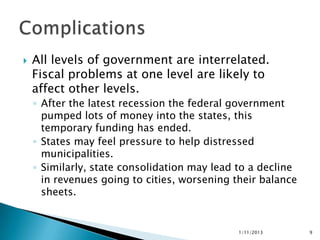
   All levels of government are interrelated.
    Fiscal problems at one level are likely to
    affect other levels.
    ◦ After the latest recession the federal government
      pumped lots of money into the states, this
      temporary funding has ended.
    ◦ States may feel pressure to help distressed
      municipalities.
    ◦ Similarly, state consolidation may lead to a decline
      in revenues going to cities, worsening their balance
      sheets.


                                              1/11/2013      9
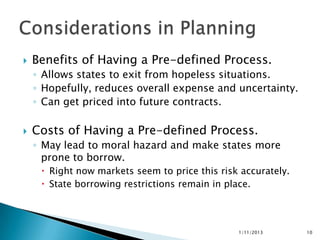
   Benefits of Having a Pre-defined Process.
    ◦ Allows states to exit from hopeless situations.
    ◦ Hopefully, reduces overall expense and uncertainty.
    ◦ Can get priced into future contracts.

   Costs of Having a Pre-defined Process.
    ◦ May lead to moral hazard and make states more
      prone to borrow.
      Right now markets seem to price this risk accurately.
      State borrowing restrictions remain in place.


                                                1/11/2013      10
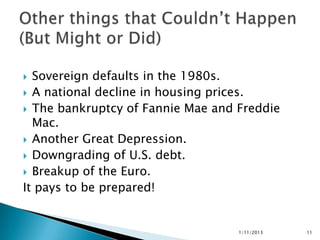
 Sovereign defaults in the 1980s.
 A national decline in housing prices.
 The bankruptcy of Fannie Mae and Freddie
  Mac.
 Another Great Depression.
 Downgrading of U.S. debt.
 Breakup of the Euro.
It pays to be prepared!


                                   1/11/2013   11
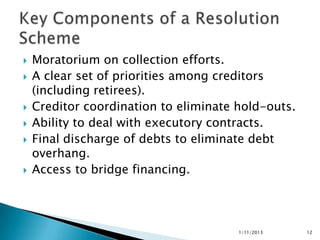
   Moratorium on collection efforts.
   A clear set of priorities among creditors
    (including retirees).
   Creditor coordination to eliminate hold-outs.
   Ability to deal with executory contracts.
   Final discharge of debts to eliminate debt
    overhang.
   Access to bridge financing.


                                       1/11/2013    12
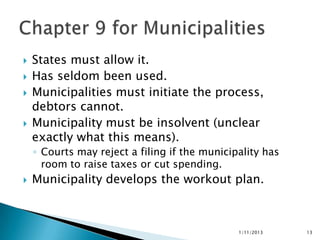
   States must allow it.
   Has seldom been used.
   Municipalities must initiate the process,
    debtors cannot.
   Municipality must be insolvent (unclear
    exactly what this means).
    ◦ Courts may reject a filing if the municipality has
      room to raise taxes or cut spending.
   Municipality develops the workout plan.


                                               1/11/2013   13
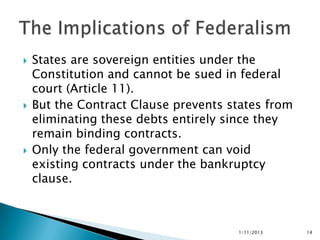
   States are sovereign entities under the
    Constitution and cannot be sued in federal
    court (Article 11).
   But the Contract Clause prevents states from
    eliminating these debts entirely since they
    remain binding contracts.
   Only the federal government can void
    existing contracts under the bankruptcy
    clause.


                                      1/11/2013    14
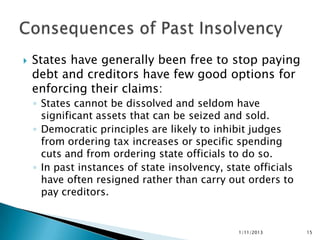
   States have generally been free to stop paying
    debt and creditors have few good options for
    enforcing their claims:
    ◦ States cannot be dissolved and seldom have
      significant assets that can be seized and sold.
    ◦ Democratic principles are likely to inhibit judges
      from ordering tax increases or specific spending
      cuts and from ordering state officials to do so.
    ◦ In past instances of state insolvency, state officials
      have often resigned rather than carry out orders to
      pay creditors.


                                                1/11/2013      15
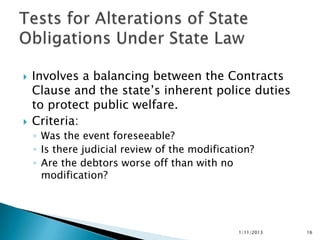
   Involves a balancing between the Contracts
    Clause and the state’s inherent police duties
    to protect public welfare.
   Criteria:
    ◦ Was the event foreseeable?
    ◦ Is there judicial review of the modification?
    ◦ Are the debtors worse off than with no
      modification?


                                               1/11/2013   16
   State must initiate it, voluntarily waiving its
    sovereign immunity (some question whether
    it can do this).
   State will develop the workout plan in
    consultation with creditors.
   Court will lack the authority to increase taxes,
    cut spending, or sell assets but will have the
    authority to discharge debt.


                                         1/11/2013     17
   Last debated in 2010. The debate was
    initiated by articles advocating a federal
    bankruptcy option and Meredith Whitney’s
    prediction of multiple state and local
    bankruptcies.
   Sources of opposition
    ◦ Unions (saw it as a threat to collective bargaining).
    ◦ Financial industry (argued that the bond market
      would over react and show much greater volatility).
    ◦ States (were fearful of having to pay higher rates)


                                               1/11/2013      18
   Advantages
    ◦ It may be that only the federal government can provide
      sufficient bridge financing.
    ◦ To the extent that policy changes are an explicit part of
      any restructuring, the federal government rather than
      the courts may be in the best position to negotiate and
      enforce them.
   Disadvantages
    ◦ May compromise the states’ ability to borrow as
      sovereign debtors.
    ◦ If widespread, it will likely to lead to a further
      centralization of power.
    ◦ Requires political support from health states.
    ◦ Congressional attention is likely only when there is an
      actual emergency.


                                                  1/11/2013       19
   Drawing attention to state finances may
    increase the pressure to deal with them in a
    timely way.
   Anticipation of a federal bailout gives
    opponents time to react.
   If there is a bailout, advance warning is likely
    to result in better policy conditions (as
    opposed to TARP) and lower cost shifting.
   Surprise often results in hurried and bad
    legislation.

                                         1/11/2013     20

Anticipating State Restructuring

  • 1.
    Joe Kennedy Kennedy Research,LLC January 11, 2013
  • 2.
    Financial insolvency is likely to affect all of a state’s counterparties: ◦ Bondholders ◦ Retirees ◦ Current workers ◦ Beneficiaries of state services  Businesses interact with states in many ways: ◦ As taxpayers (taxes are likely to go up) ◦ As suppliers (spending cuts will hurt investment and consumption) ◦ As participants in the general economy (economic uncertainty may slow the economy and lead to a loss in competitiveness)  State insolvency is likely to have worse consequences if there is no plan to deal with it. 1/11/2013 2
  • 3.
    There are two explanations: ◦ Structural imbalances that exacerbate cyclical downturns. ◦ Bad policy combined with a growing time bomb in the form of retiree obligations. 1/11/2013 3
  • 4.
    This is a political problem, not a fiscal one.  Federalism has put states in a very difficult fiscal position: ◦ Social spending (education, Medicare, Unemployment Insurance) is constant or procyclical. ◦ States are relying more on procyclical income and sales taxes rather than property taxes. ◦ This means that state budgets worsen in townturns. ◦ Balanced budget requirements require states to cuts spending and increase taxes in the midst of recessions, making their problems worse. 1/11/2013 4
  • 5.
    Does not explain why states generally fail to save in good times.  Does not really explain why some states do better than others or why in good times some pass legislation that worsens their position in downturns.  State borrowing limits are self-imposed. States presumably keep them because they benefit from lower interest rates. 1/11/2013 5
  • 6.
    Long-term state fiscal problems are largely due to unwise policies in some states, particularly a lax attitude toward economic growth and the existence of large retirement obligations.  While near-term fiscal problems are exacerbated by recessions, states eventually recover from them. 1/11/2013 6
  • 7.
    Under Hamilton the federal government assumed much of the state debt caused by the Revolutionary War. Since then the federal government has not explicitly bailed out any state.  In the 1840s many states had trouble paying off railroad and other debt.  After the Civil War, many Southern states had trouble with debt obligations.  After the Great Depression a number of states had fiscal problems and Arkansas defaulted. ◦ Popular opposition from solvent states killed an effort to get federal aid. 1/11/2013 7
  • 8.
    National averages are not helpful.  The answer depends on several things: ◦ What is the discount rate for both funded and unfunded liabilities? ◦ Will states bail out subdivisions? ◦ Will the economy grow? ◦ Are employee benefits, especially health care, long- term commitments or do they expire with the latest collective bargaining agreement? ◦ Can the political process enact meaningful changes? ◦ Are liabilities measured as a percent of GDP or of revenues? 1/11/2013 8
  • 9.
    All levels of government are interrelated. Fiscal problems at one level are likely to affect other levels. ◦ After the latest recession the federal government pumped lots of money into the states, this temporary funding has ended. ◦ States may feel pressure to help distressed municipalities. ◦ Similarly, state consolidation may lead to a decline in revenues going to cities, worsening their balance sheets. 1/11/2013 9
  • 10.
    Benefits of Having a Pre-defined Process. ◦ Allows states to exit from hopeless situations. ◦ Hopefully, reduces overall expense and uncertainty. ◦ Can get priced into future contracts.  Costs of Having a Pre-defined Process. ◦ May lead to moral hazard and make states more prone to borrow.  Right now markets seem to price this risk accurately.  State borrowing restrictions remain in place. 1/11/2013 10
  • 11.
     Sovereign defaultsin the 1980s.  A national decline in housing prices.  The bankruptcy of Fannie Mae and Freddie Mac.  Another Great Depression.  Downgrading of U.S. debt.  Breakup of the Euro. It pays to be prepared! 1/11/2013 11
  • 12.
    Moratorium on collection efforts.  A clear set of priorities among creditors (including retirees).  Creditor coordination to eliminate hold-outs.  Ability to deal with executory contracts.  Final discharge of debts to eliminate debt overhang.  Access to bridge financing. 1/11/2013 12
  • 13.
    States must allow it.  Has seldom been used.  Municipalities must initiate the process, debtors cannot.  Municipality must be insolvent (unclear exactly what this means). ◦ Courts may reject a filing if the municipality has room to raise taxes or cut spending.  Municipality develops the workout plan. 1/11/2013 13
  • 14.
    States are sovereign entities under the Constitution and cannot be sued in federal court (Article 11).  But the Contract Clause prevents states from eliminating these debts entirely since they remain binding contracts.  Only the federal government can void existing contracts under the bankruptcy clause. 1/11/2013 14
  • 15.
    States have generally been free to stop paying debt and creditors have few good options for enforcing their claims: ◦ States cannot be dissolved and seldom have significant assets that can be seized and sold. ◦ Democratic principles are likely to inhibit judges from ordering tax increases or specific spending cuts and from ordering state officials to do so. ◦ In past instances of state insolvency, state officials have often resigned rather than carry out orders to pay creditors. 1/11/2013 15
  • 16.
    Involves a balancing between the Contracts Clause and the state’s inherent police duties to protect public welfare.  Criteria: ◦ Was the event foreseeable? ◦ Is there judicial review of the modification? ◦ Are the debtors worse off than with no modification? 1/11/2013 16
  • 17.
    State must initiate it, voluntarily waiving its sovereign immunity (some question whether it can do this).  State will develop the workout plan in consultation with creditors.  Court will lack the authority to increase taxes, cut spending, or sell assets but will have the authority to discharge debt. 1/11/2013 17
  • 18.
    Last debated in 2010. The debate was initiated by articles advocating a federal bankruptcy option and Meredith Whitney’s prediction of multiple state and local bankruptcies.  Sources of opposition ◦ Unions (saw it as a threat to collective bargaining). ◦ Financial industry (argued that the bond market would over react and show much greater volatility). ◦ States (were fearful of having to pay higher rates) 1/11/2013 18
  • 19.
    Advantages ◦ It may be that only the federal government can provide sufficient bridge financing. ◦ To the extent that policy changes are an explicit part of any restructuring, the federal government rather than the courts may be in the best position to negotiate and enforce them.  Disadvantages ◦ May compromise the states’ ability to borrow as sovereign debtors. ◦ If widespread, it will likely to lead to a further centralization of power. ◦ Requires political support from health states. ◦ Congressional attention is likely only when there is an actual emergency. 1/11/2013 19
  • 20.
    Drawing attention to state finances may increase the pressure to deal with them in a timely way.  Anticipation of a federal bailout gives opponents time to react.  If there is a bailout, advance warning is likely to result in better policy conditions (as opposed to TARP) and lower cost shifting.  Surprise often results in hurried and bad legislation. 1/11/2013 20