
The Science of SuccessUsing Brain-based Principles to Get the Best From Yourself and Others
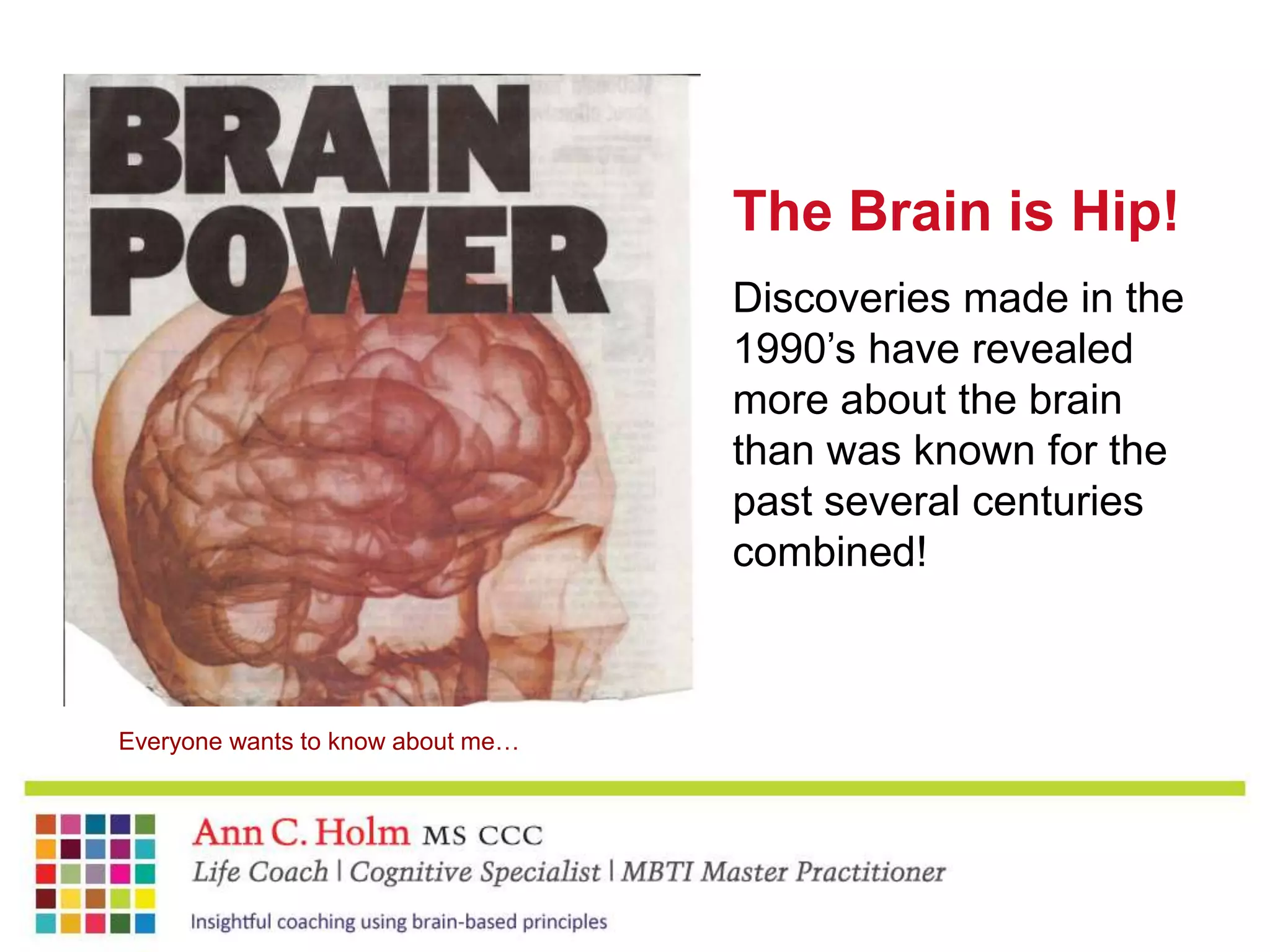
The Brain is Hip!Discoveries made in the 1990’s have revealed more about the brain than was known for the past several centuries combined!Everyone wants to know about me…
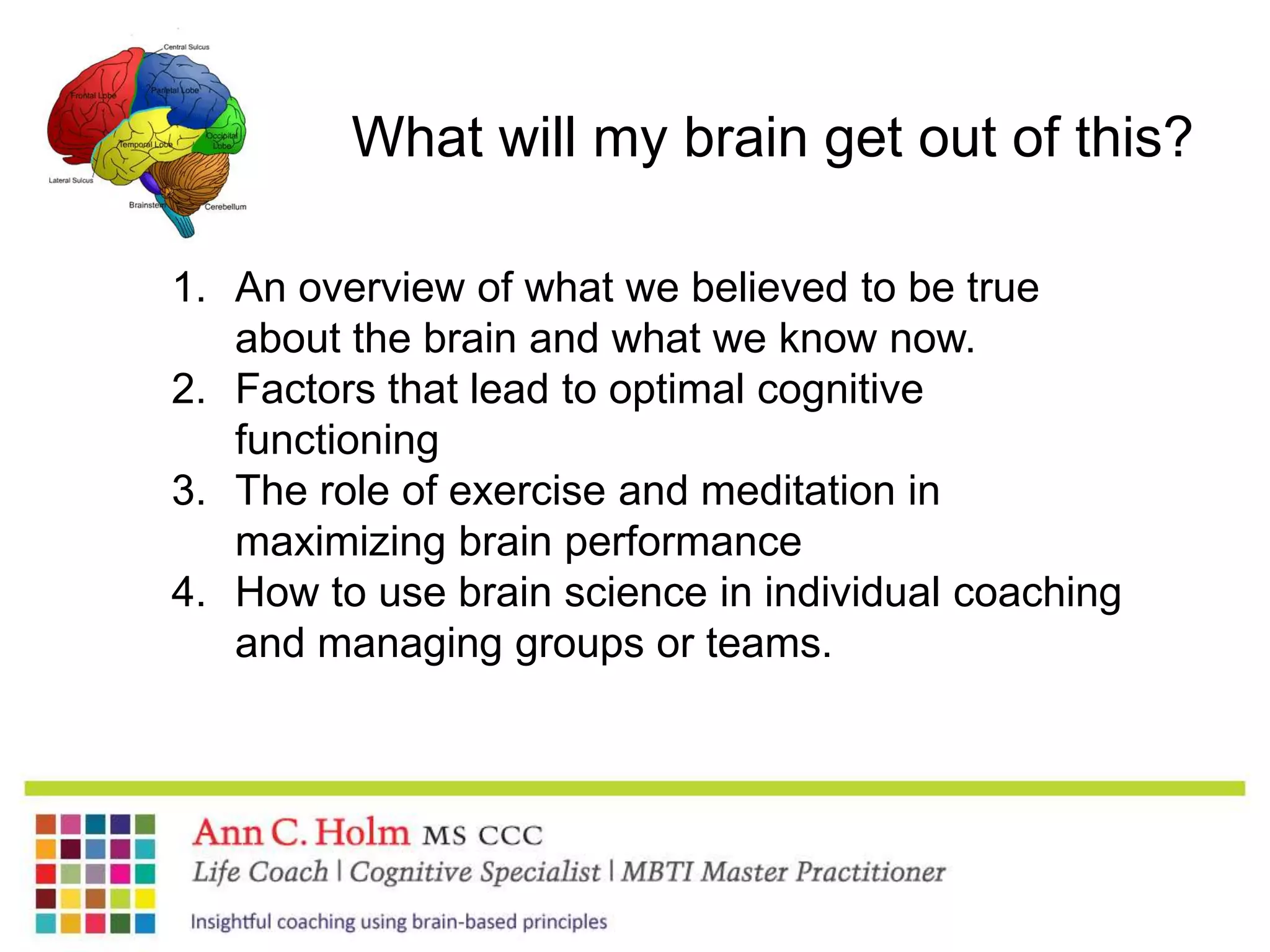
What will my brain get out of this?An overview of what we believed to be true about the brain and what we know now.Factors that lead to optimal cognitive functioningThe role of exercise and meditation in maximizing brain performanceHow to use brain science in individual coaching and managing groups or teams.
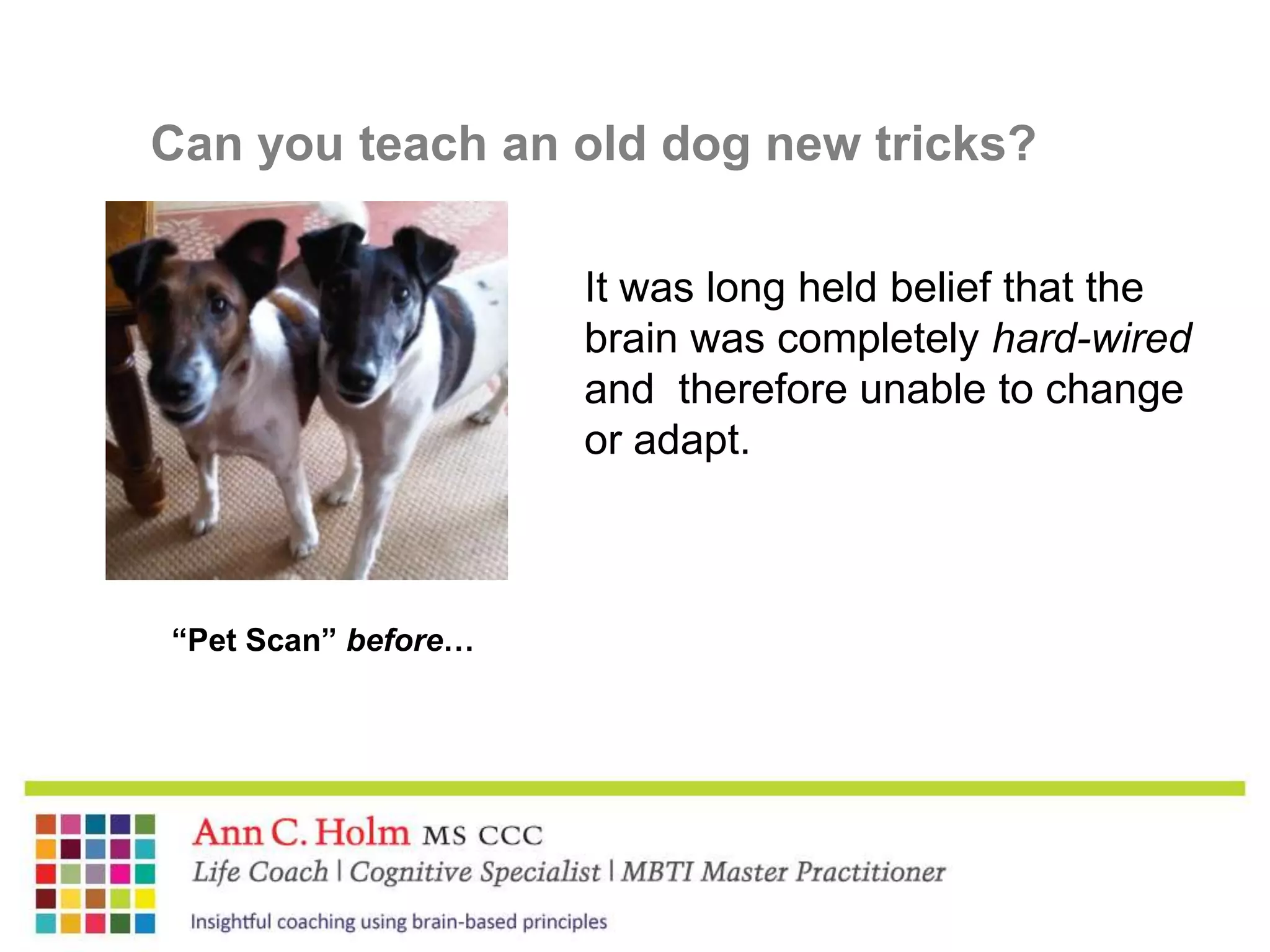
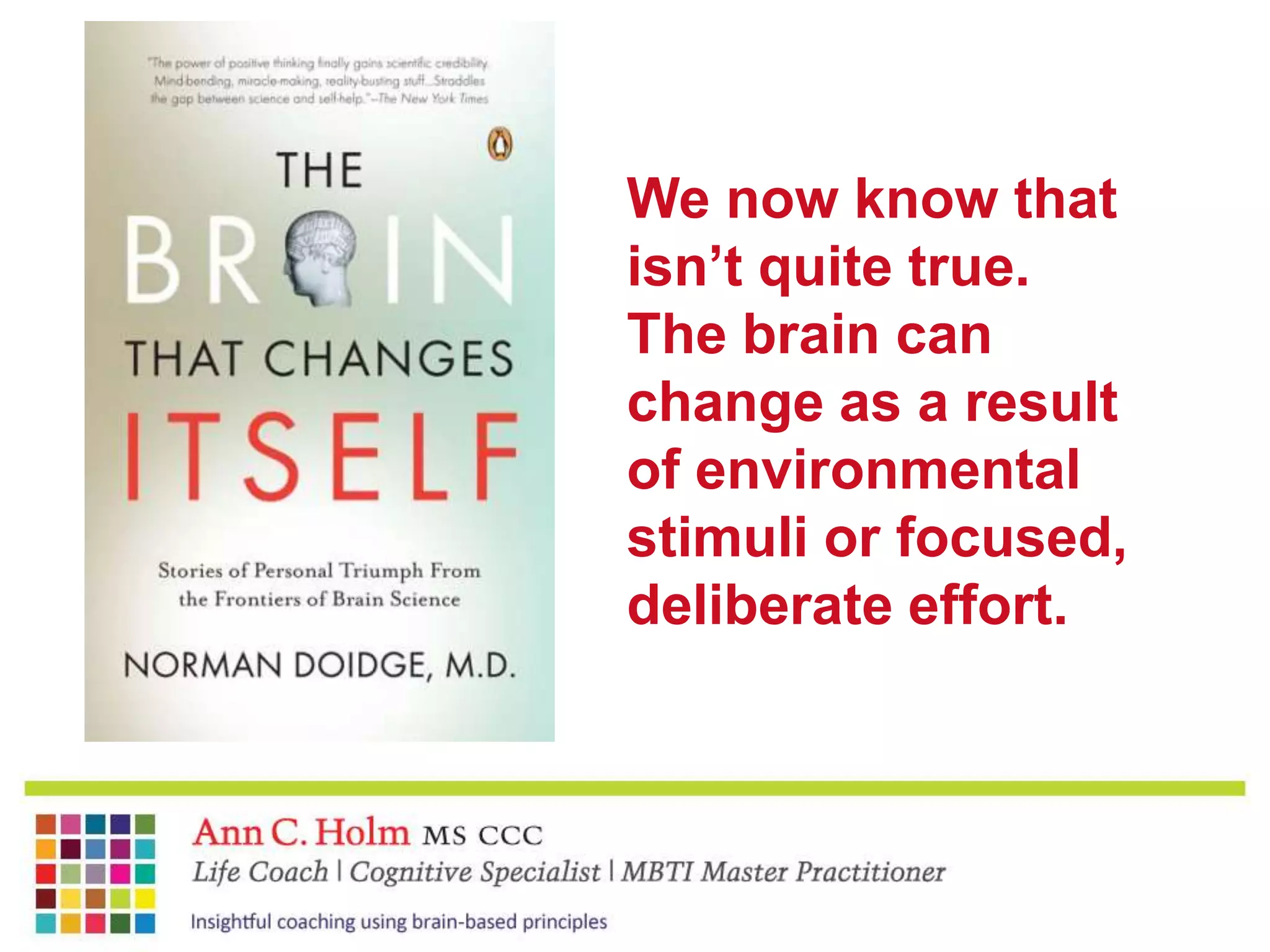
Can you teach an old dog new tricks?It was long held belief that the brain was completely hard-wired and therefore unable to change or adapt.“Pet Scan” before…
We now know that isn’t quite true. The brain can change as a result of environmental stimuli or focused, deliberate effort.
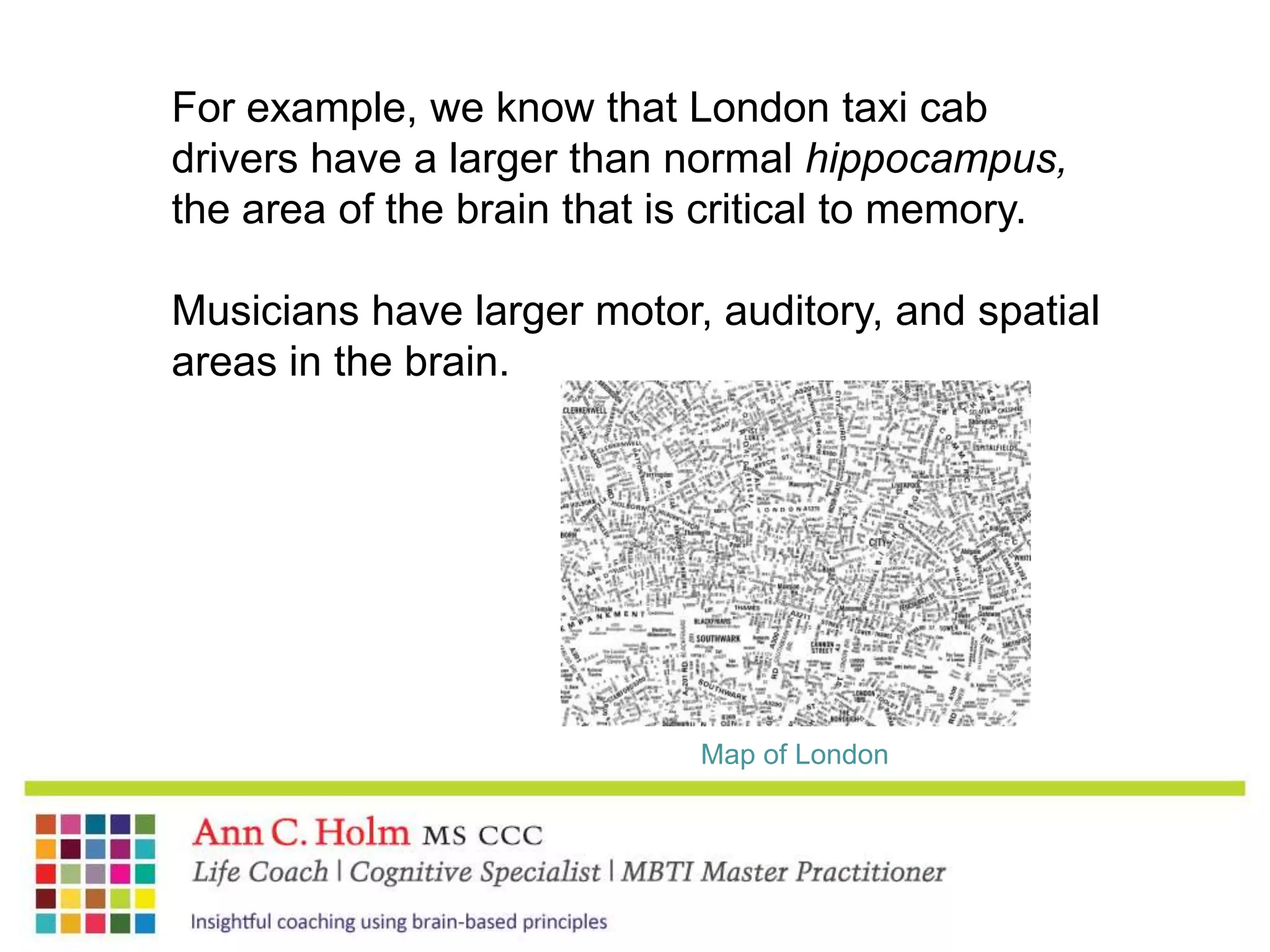
For example, we know that London taxi cab drivers have a larger than normal hippocampus, the area of the brain that is critical to memory.Musicians have larger motor, auditory, and spatial areas in the brain. Map of London
The brain isNeuroplastic.  There are physical changes that occur in the brain as a result of life experiences and/or deliberate development of a particular skill.You can teach an old dog new tricks!    “Pet Scan” after change!
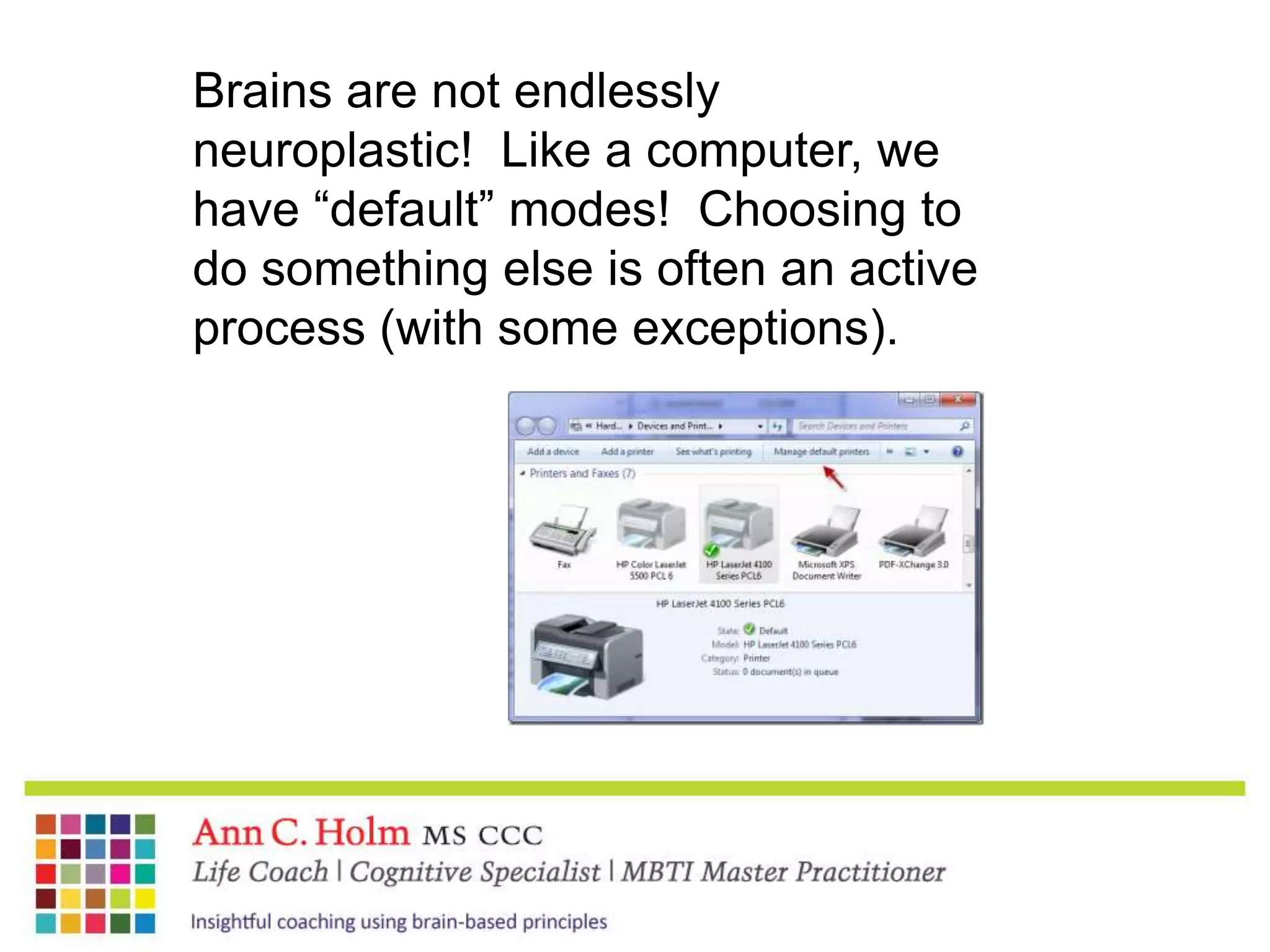
Brains are not endlessly neuroplastic!  Like a computer, we have “default” modes!  Choosing to do something else is often an active process (with some exceptions).
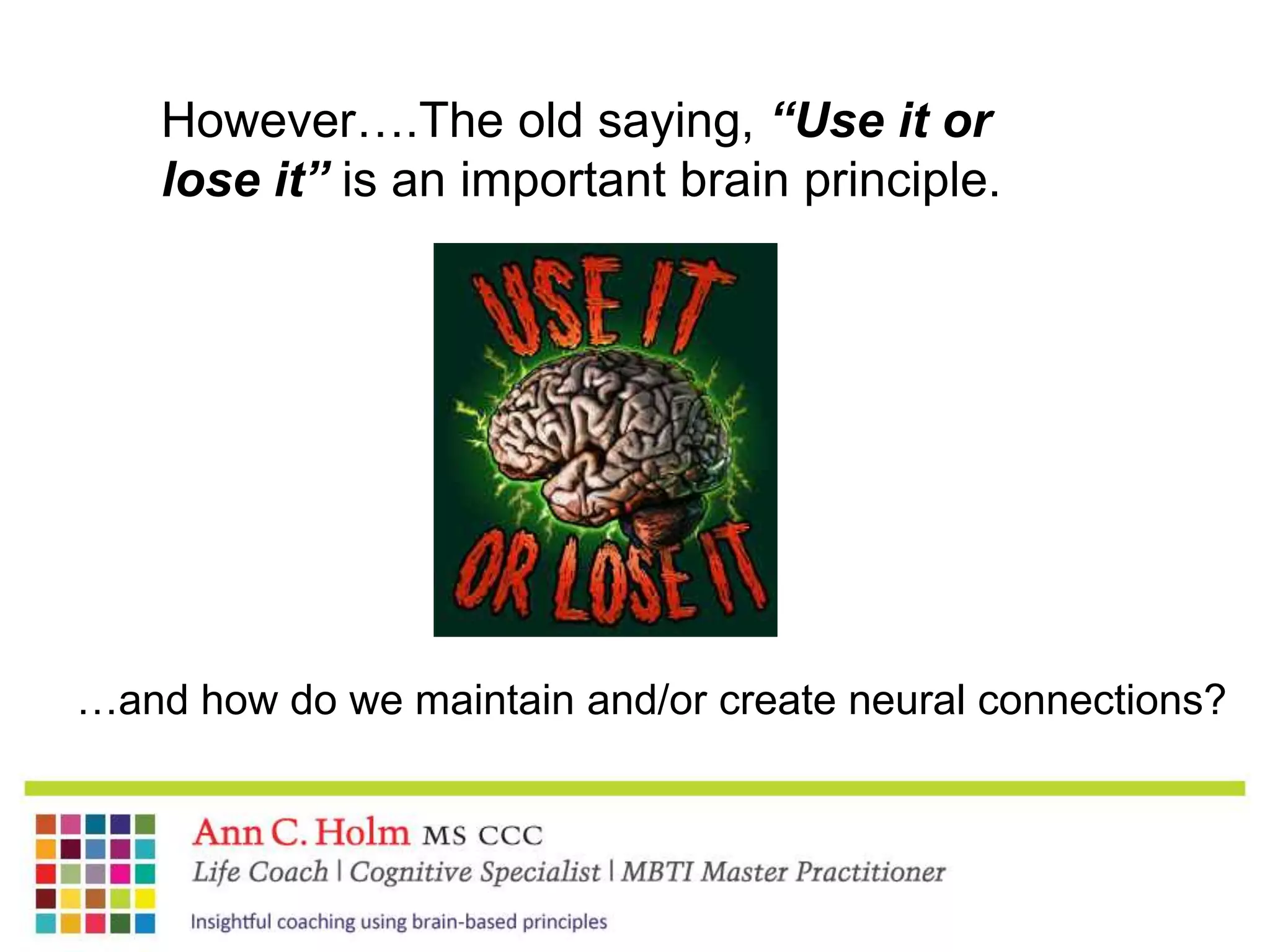
However….The old saying, “Use it or lose it” is an important brain principle.…and how do we maintain and/or create neural connections?
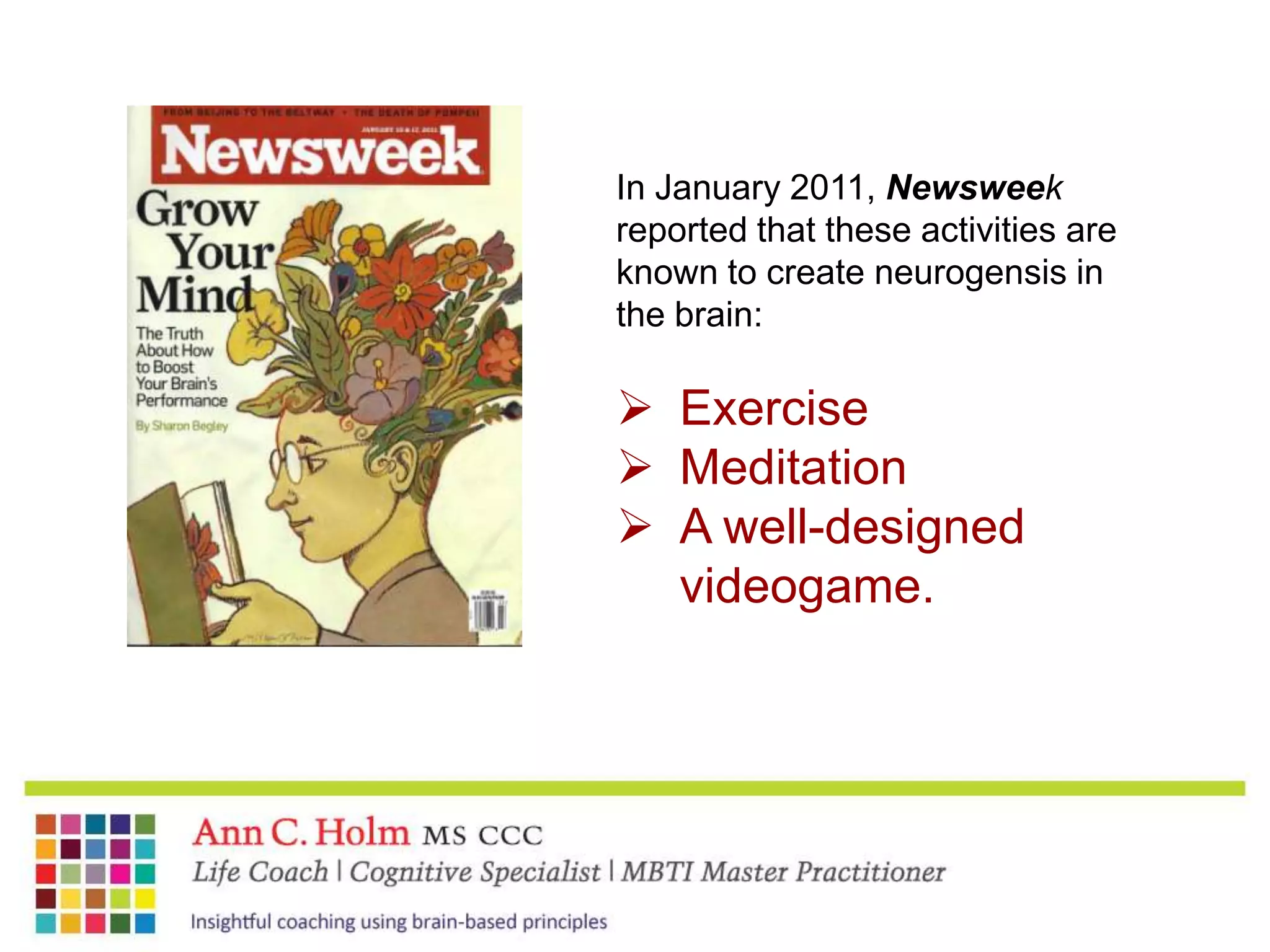
In January 2011, Newsweek reported that these activities are known to create neurogensis in the brain:Exercise
Meditation
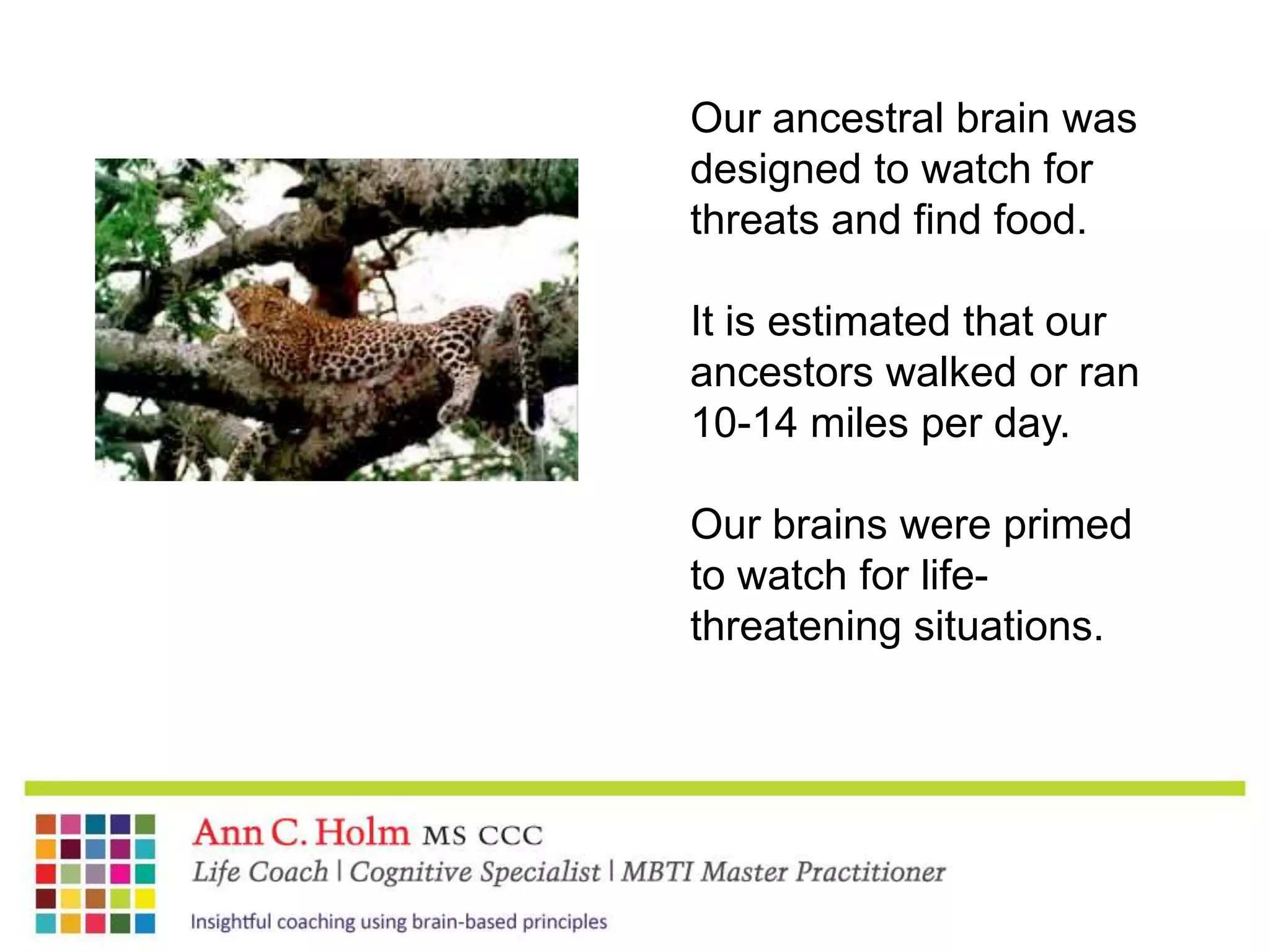
A well-designed videogame.Our ancestral brain was designed to watch for threats and find food.It is estimated that our ancestors walked or ran 10-14 miles per day.Our brains were primed to watch for life-threatening situations.
We need to exercise not only for our bodies but our brains!
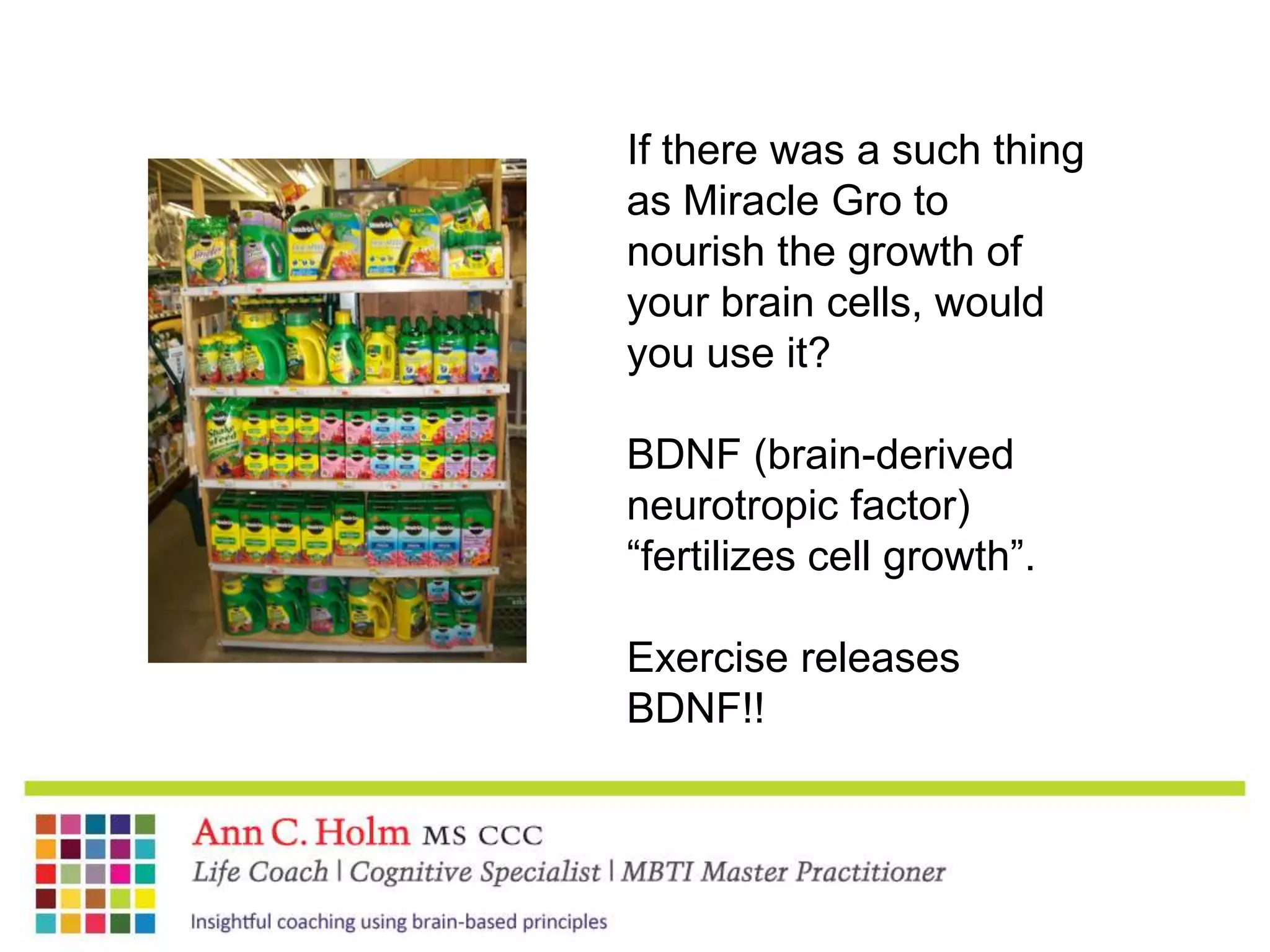
If there was a such thing as Miracle Gro to nourish the growth of your brain cells, would you use it?BDNF (brain-derived neurotropic factor) “fertilizes cell growth”. Exercise releases BDNF!!
Two more brainy reasons to exercise:The brain chemicals serotonin, dopamine and norepinephrine are released which result in mood stabilization, focus, and motivation. (From a survival standpoint, wouldn’t you want to be this way if you were stalking prey or avoiding danger?)
Exercise regulates cortisol, the stress hormone we need to respond to danger but too much of it damages neurons ESPECIALLY in the hippocampus. Meditation is brain training
The brain is active!
Increases focus, mindfulness, and cognitive flexibility
Can create awareness around tendencies to be fearful, anxious, or worried.“Just in case you’re wondering, I am not relaxing…”
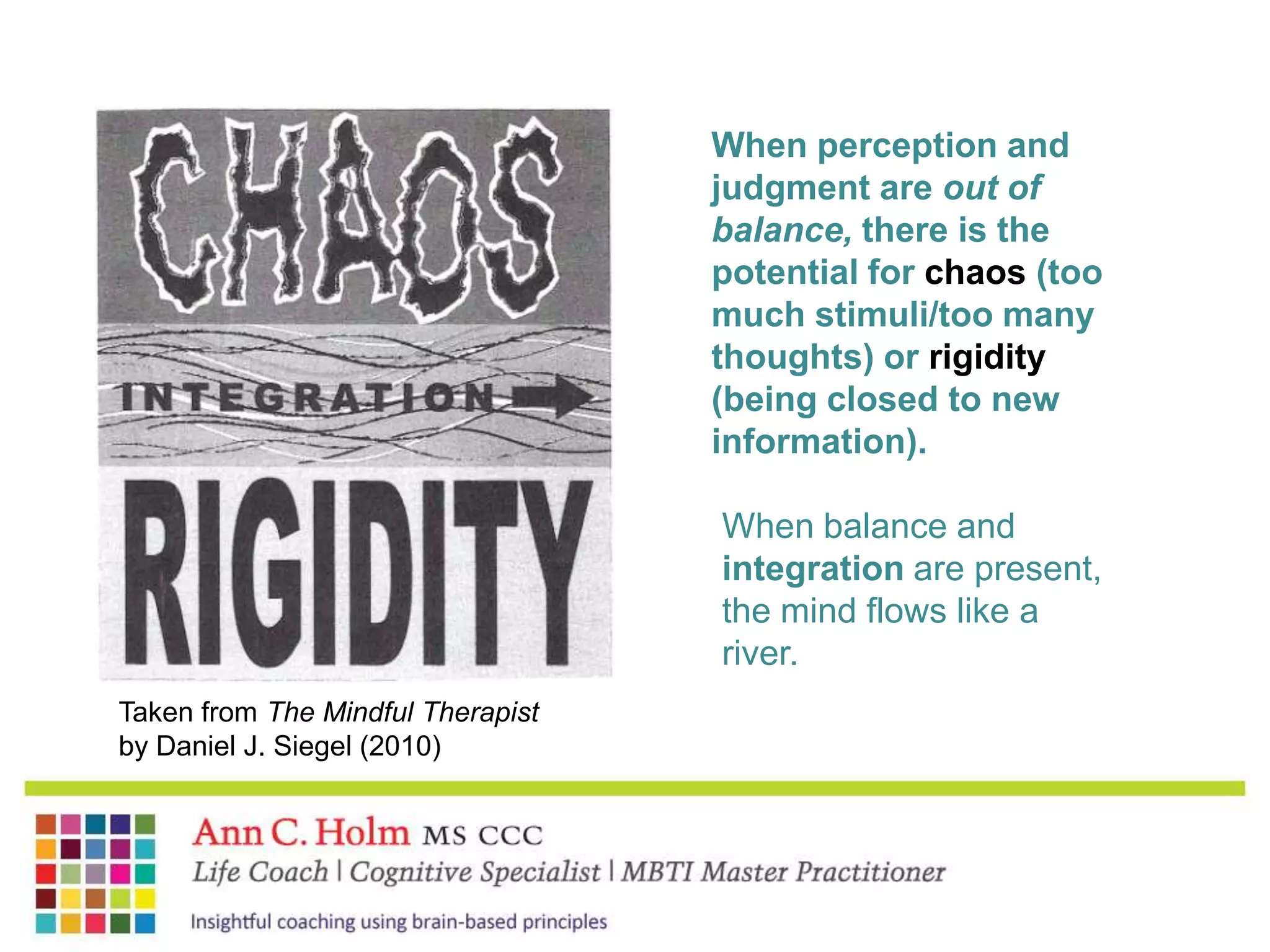
When perception and judgment are out of balance, there is the potential for chaos (too much stimuli/too many thoughts) or rigidity (being closed to new information).When balance and integration are present, the mind flows like a river.Taken from The Mindful Therapistby Daniel J. Siegel (2010)
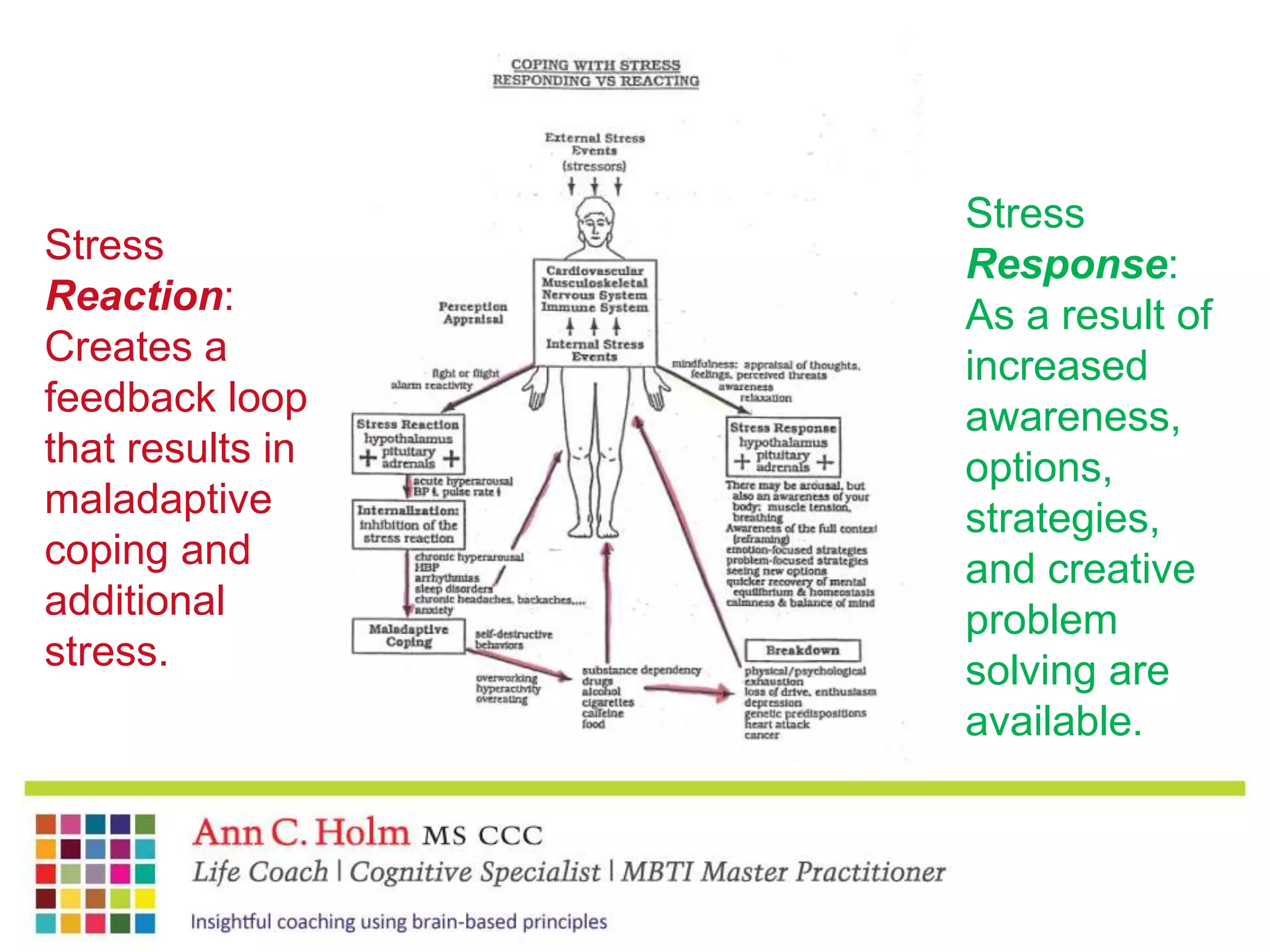
Stress Response:As a result of  increased awareness, options, strategies, and creative problem solving are available.Stress Reaction: Creates a feedback loop that results in maladaptive coping and additional stress.
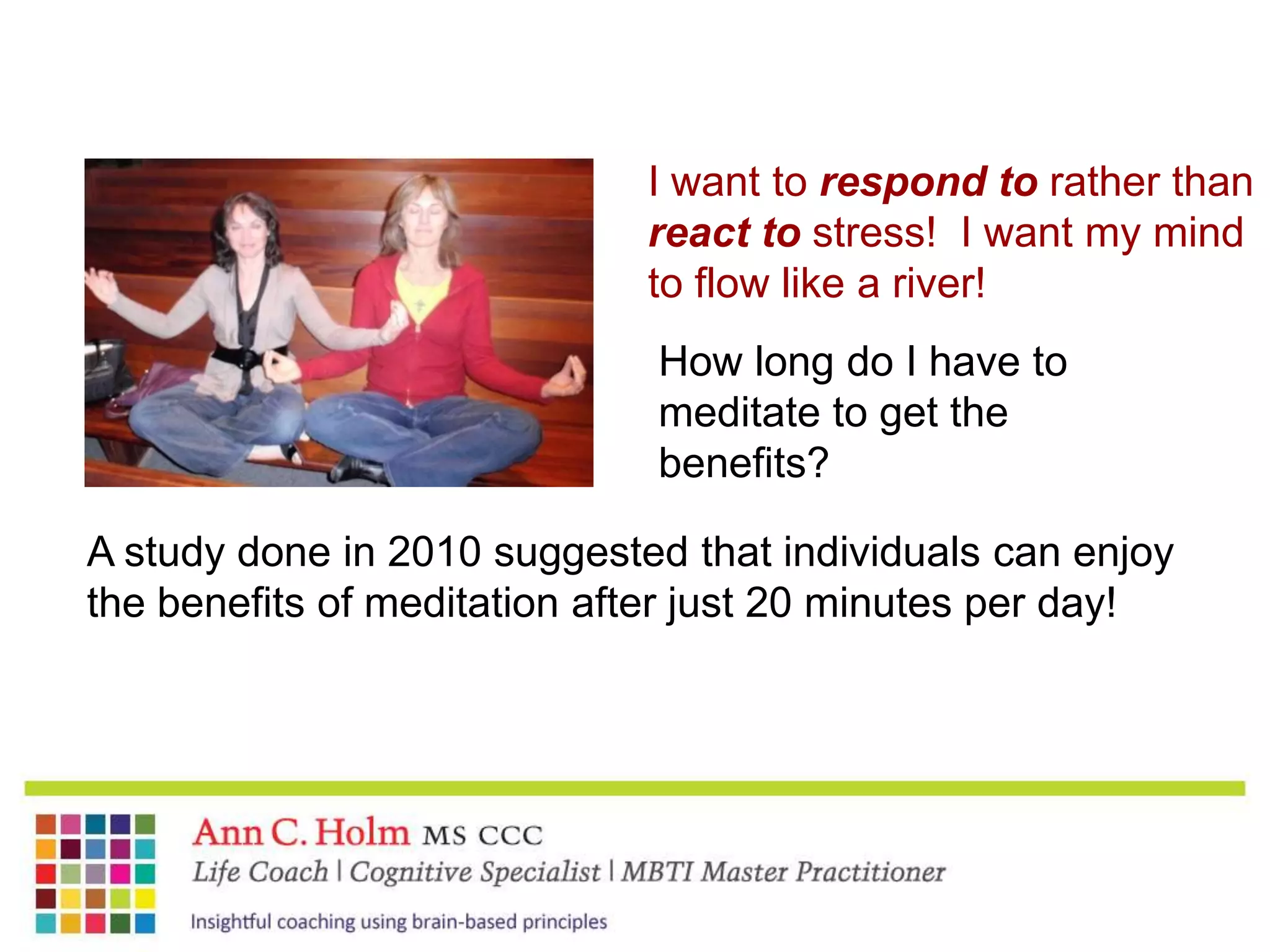
I want to respond to rather than react to stress!  I want my mind to flow like a river!How long do I have to meditate to get the benefits?A study done in 2010 suggested that individuals can enjoy the benefits of meditation after just 20 minutes per day!
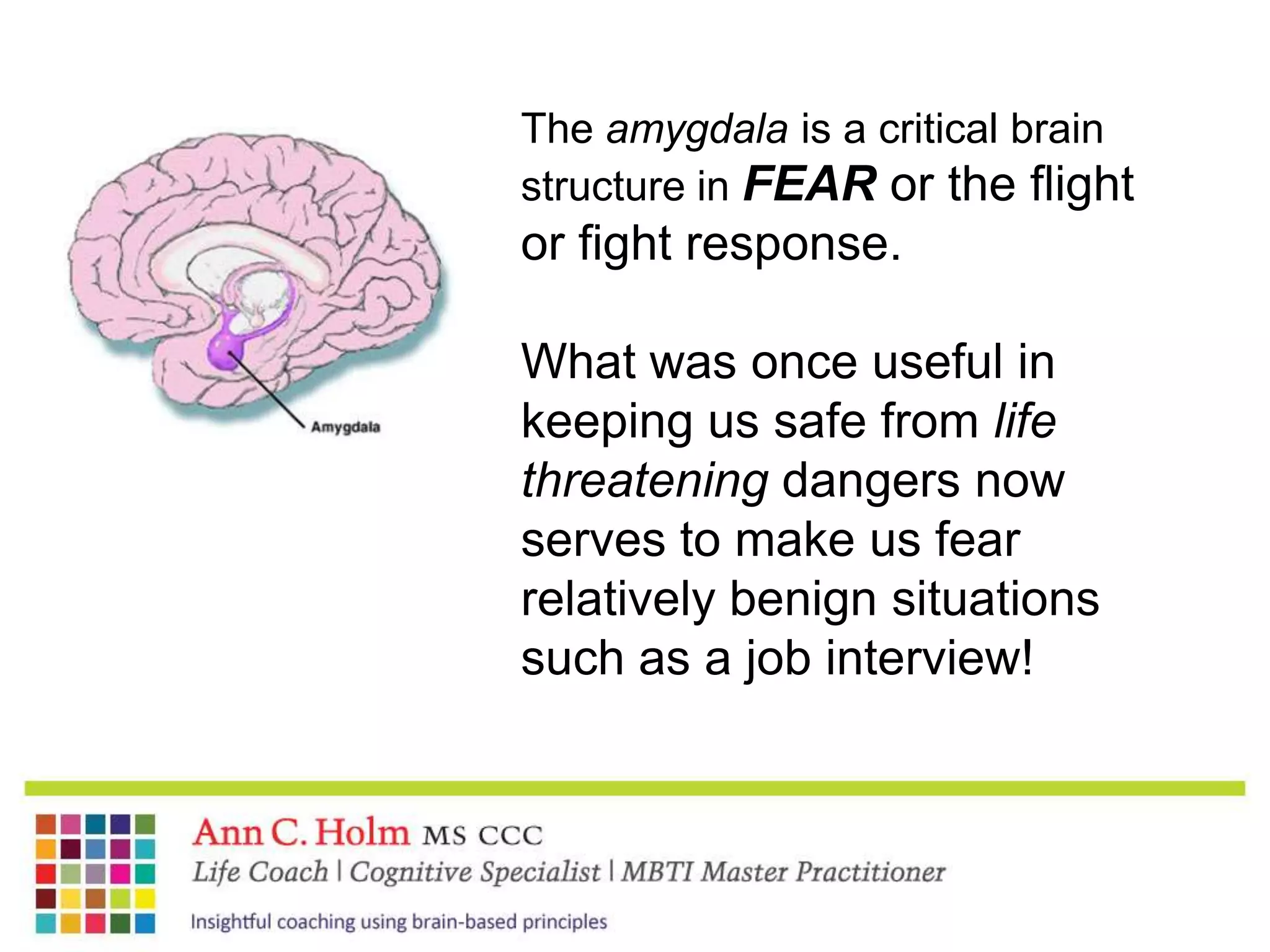
The amygdala is a critical brain structure in FEAR or the flight or fight response. What was once useful in keeping us safe from life threatening dangers now serves to make us fear relatively benign situations such as a job interview!
Fear is one of the most common reasons why clients fall short of goals or don’t make them at all.
Becoming aware of fears can be helpful:  Name and reframe in order to tame!
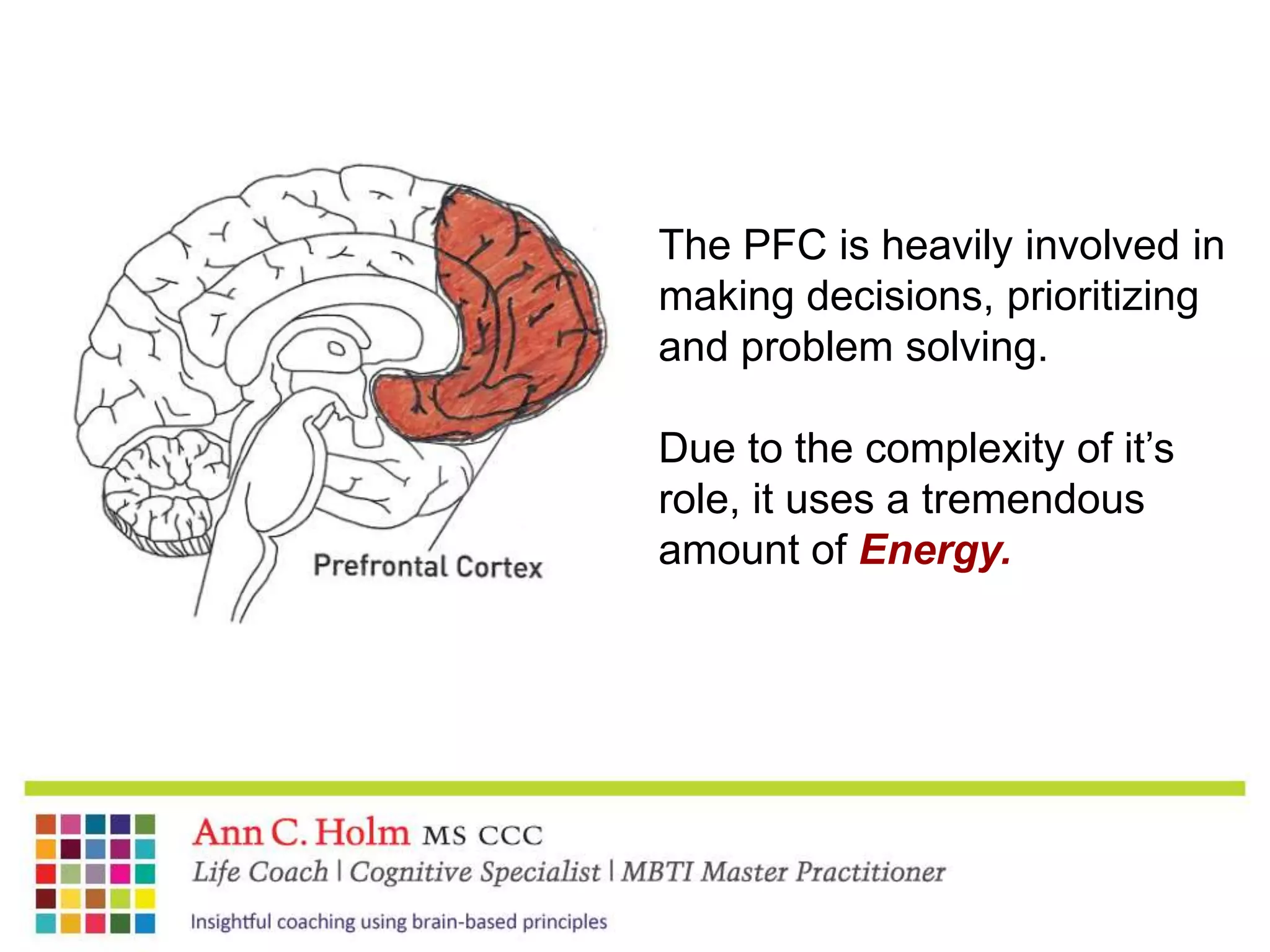
Meditation strengthens the brain fibers that connect the amygdala and limbic system to the prefrontal cortex which can override fear. The PFC is heavily involved in making decisions, prioritizing and problem solving.Due to the complexity of it’s role, it uses a tremendous amount of Energy.
Therefore, use the first part of your day to plan and prioritize your tasks
Responding to emails first thing in the morning is extremely taxing on the brain often leading to a tired, burned-out brain.
Every time you read an email, you have to make a decision- act, respond later, trash, forward it… all of these decisions use PFC energy.The prefrontal cortex is also involved in multi-tasking which is task switching in disguise.Studies show that when a person is interrupted, it takes 50% longer to accomplish a task and the there are 50% more errors.  Here’s why:1. To begin a task, blood rushes to the prefrontal cortex alerting the brain that it is about to shift attention to the particular task.2.Then the brain must search for the neurons to complete the task and then rouse the neurons to engage in the task.3. If the task is interrupted, the brain must now disengage from the task and re-engage in a different task.4. The brain has to search for different neurons to complete the task and rouse them to engage in the other task.
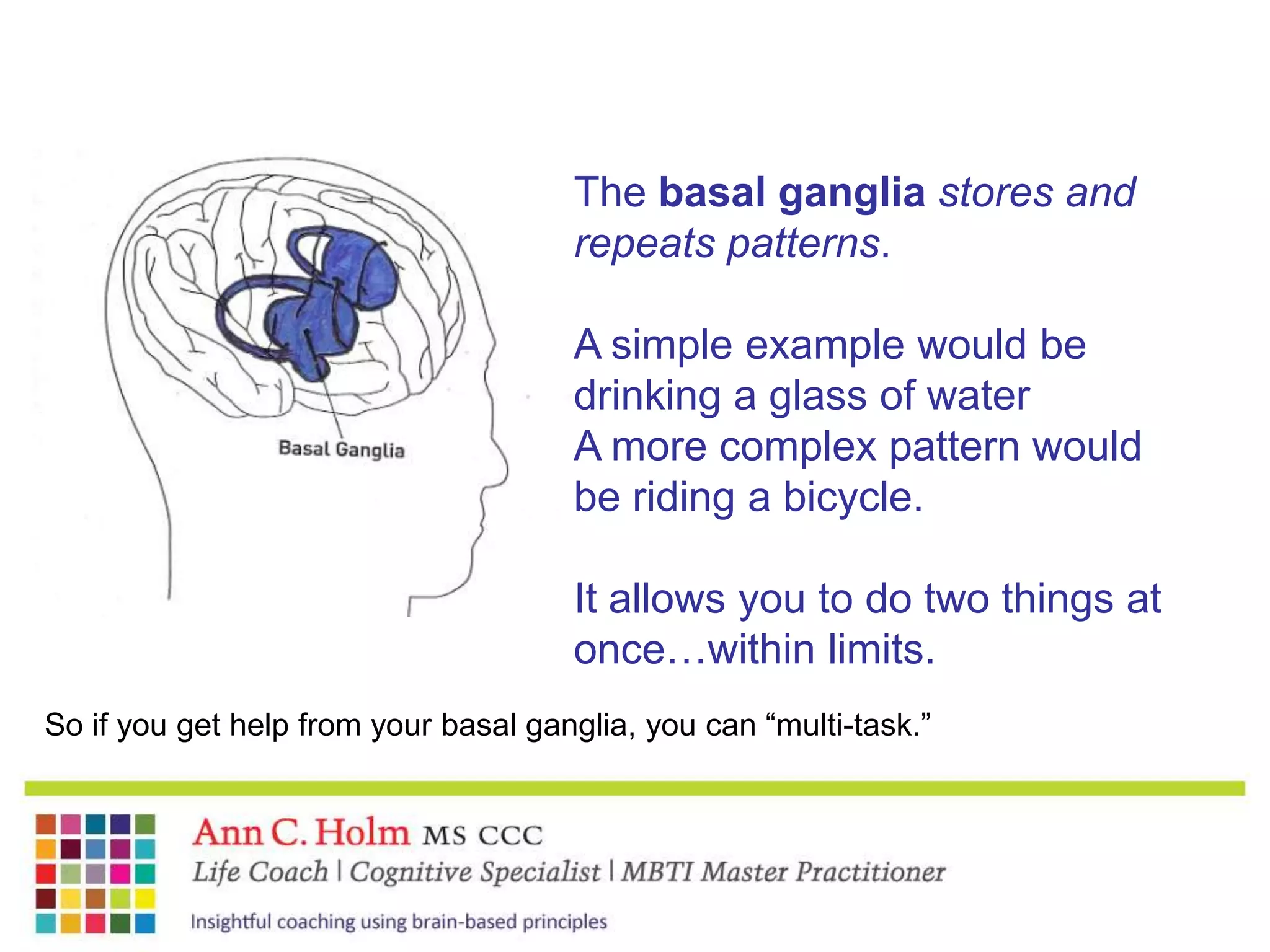
The basal ganglia stores and repeats patterns.A simple example would be drinking a glass of waterA more complex pattern would be riding a bicycle. It allows you to do two things at once…within limits.So if you get help from your basal ganglia, you can “multi-task.”
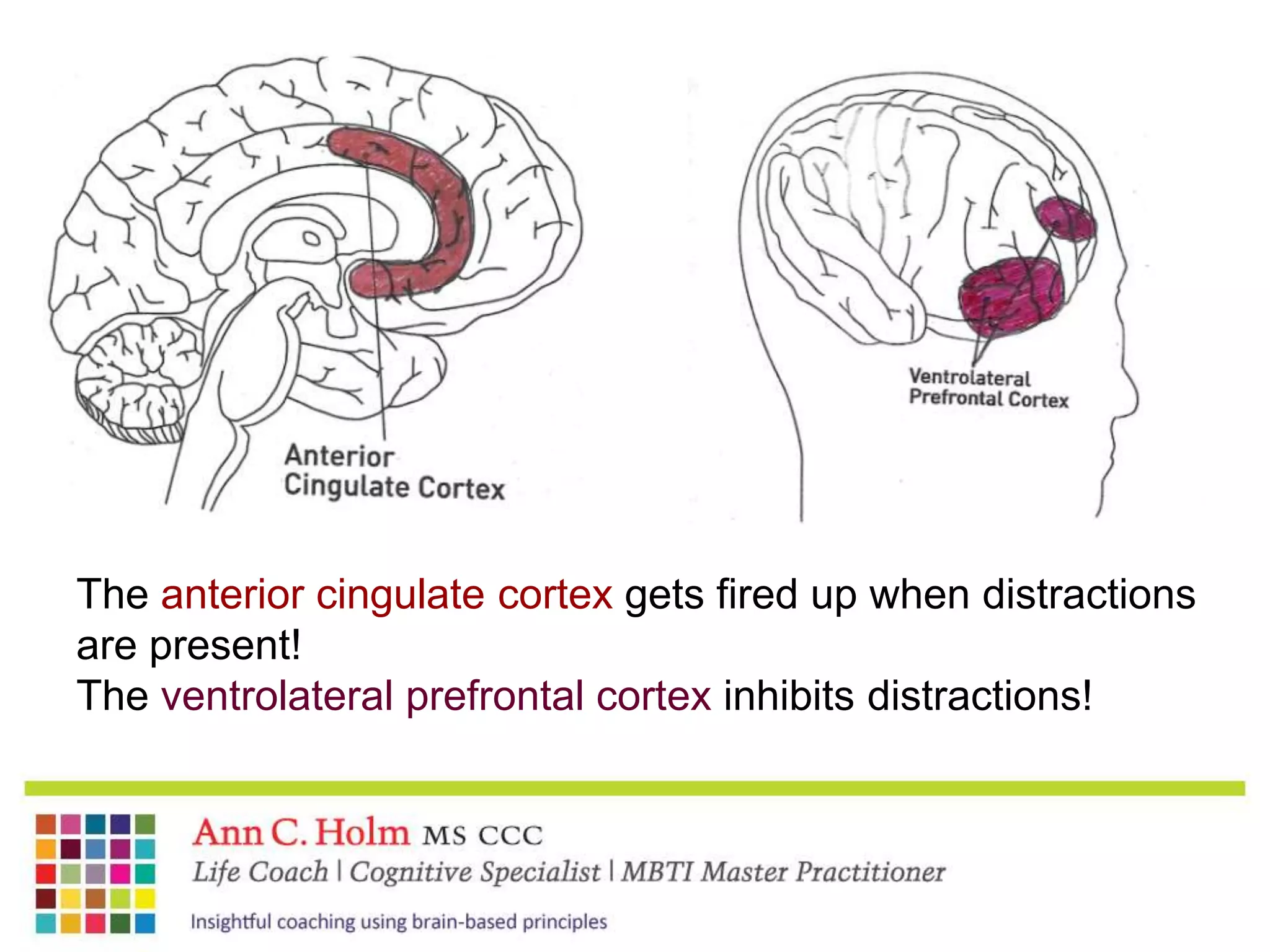
The anteriorcingulatecortex gets fired up when distractions are present!The ventrolateral prefrontal cortex inhibits distractions!
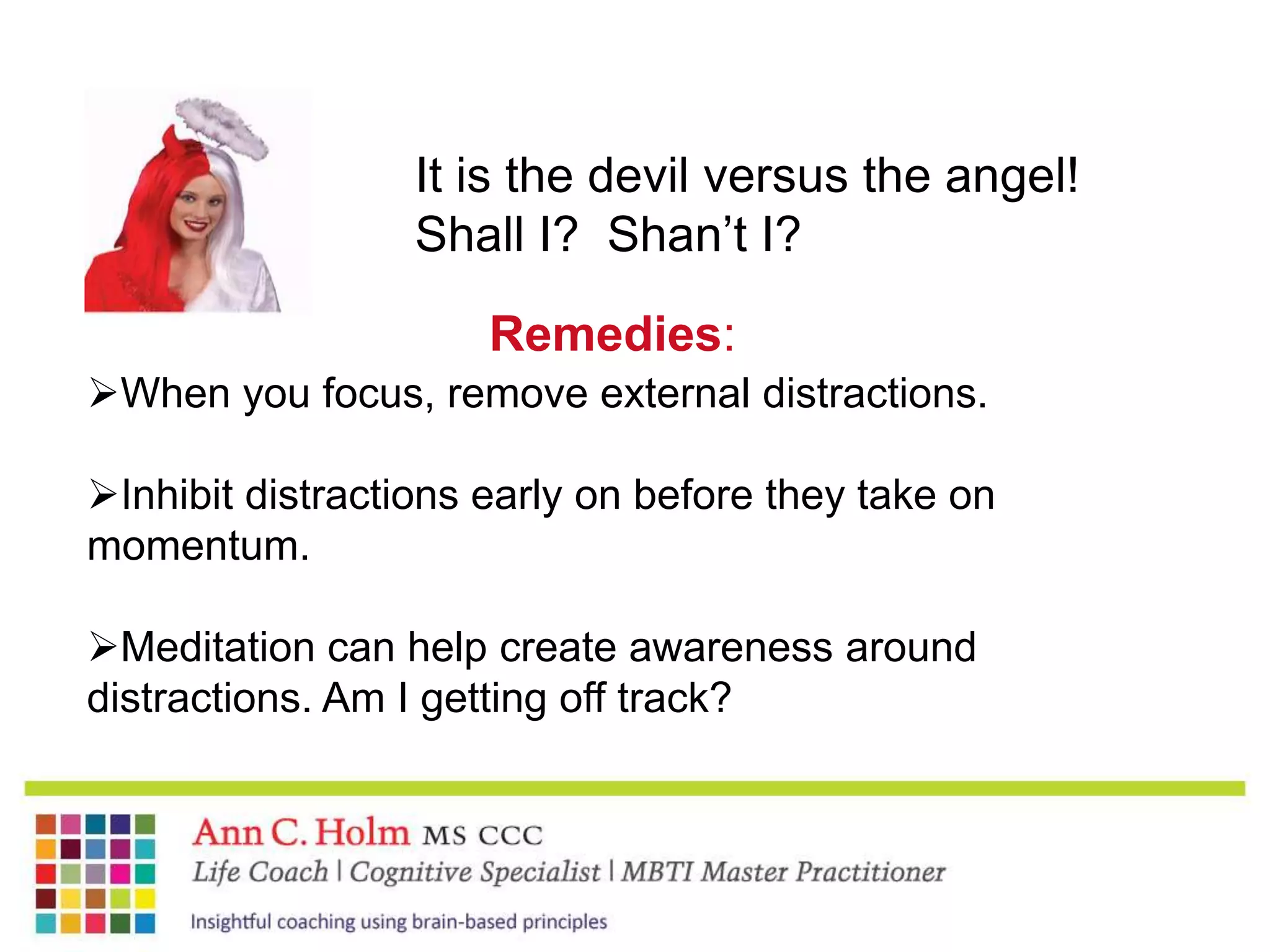
It is the devil versus the angel!Shall I?  Shan’t I?Remedies:When you focus, remove external distractions.
Inhibit distractions early on before they take on momentum.

The Science Of Success

  • 1.
    The Science ofSuccessUsing Brain-based Principles to Get the Best From Yourself and Others
  • 2.
    The Brain isHip!Discoveries made in the 1990’s have revealed more about the brain than was known for the past several centuries combined!Everyone wants to know about me…
  • 3.
    What will mybrain get out of this?An overview of what we believed to be true about the brain and what we know now.Factors that lead to optimal cognitive functioningThe role of exercise and meditation in maximizing brain performanceHow to use brain science in individual coaching and managing groups or teams.
  • 4.
    Can you teachan old dog new tricks?It was long held belief that the brain was completely hard-wired and therefore unable to change or adapt.“Pet Scan” before…
  • 5.
    We now knowthat isn’t quite true. The brain can change as a result of environmental stimuli or focused, deliberate effort.
  • 6.
    For example, weknow that London taxi cab drivers have a larger than normal hippocampus, the area of the brain that is critical to memory.Musicians have larger motor, auditory, and spatial areas in the brain. Map of London
  • 7.
    The brain isNeuroplastic. There are physical changes that occur in the brain as a result of life experiences and/or deliberate development of a particular skill.You can teach an old dog new tricks! “Pet Scan” after change!
  • 8.
    Brains are notendlessly neuroplastic! Like a computer, we have “default” modes! Choosing to do something else is often an active process (with some exceptions).
  • 9.
    However….The old saying,“Use it or lose it” is an important brain principle.…and how do we maintain and/or create neural connections?
  • 10.
    In January 2011,Newsweek reported that these activities are known to create neurogensis in the brain:Exercise
  • 11.
  • 12.
    A well-designed videogame.Ourancestral brain was designed to watch for threats and find food.It is estimated that our ancestors walked or ran 10-14 miles per day.Our brains were primed to watch for life-threatening situations.
  • 13.
    We need toexercise not only for our bodies but our brains!
  • 14.
    If there wasa such thing as Miracle Gro to nourish the growth of your brain cells, would you use it?BDNF (brain-derived neurotropic factor) “fertilizes cell growth”. Exercise releases BDNF!!
  • 15.
    Two more brainyreasons to exercise:The brain chemicals serotonin, dopamine and norepinephrine are released which result in mood stabilization, focus, and motivation. (From a survival standpoint, wouldn’t you want to be this way if you were stalking prey or avoiding danger?)
  • 16.
    Exercise regulates cortisol,the stress hormone we need to respond to danger but too much of it damages neurons ESPECIALLY in the hippocampus. Meditation is brain training
  • 17.
  • 18.
    Increases focus, mindfulness,and cognitive flexibility
  • 19.
    Can create awarenessaround tendencies to be fearful, anxious, or worried.“Just in case you’re wondering, I am not relaxing…”
  • 20.
    When perception andjudgment are out of balance, there is the potential for chaos (too much stimuli/too many thoughts) or rigidity (being closed to new information).When balance and integration are present, the mind flows like a river.Taken from The Mindful Therapistby Daniel J. Siegel (2010)
  • 21.
    Stress Response:As aresult of increased awareness, options, strategies, and creative problem solving are available.Stress Reaction: Creates a feedback loop that results in maladaptive coping and additional stress.
  • 22.
    I want torespond to rather than react to stress! I want my mind to flow like a river!How long do I have to meditate to get the benefits?A study done in 2010 suggested that individuals can enjoy the benefits of meditation after just 20 minutes per day!
  • 23.
    The amygdala isa critical brain structure in FEAR or the flight or fight response. What was once useful in keeping us safe from life threatening dangers now serves to make us fear relatively benign situations such as a job interview!
  • 24.
    Fear is oneof the most common reasons why clients fall short of goals or don’t make them at all.
  • 25.
    Becoming aware offears can be helpful: Name and reframe in order to tame!
  • 26.
    Meditation strengthens thebrain fibers that connect the amygdala and limbic system to the prefrontal cortex which can override fear. The PFC is heavily involved in making decisions, prioritizing and problem solving.Due to the complexity of it’s role, it uses a tremendous amount of Energy.
  • 27.
    Therefore, use thefirst part of your day to plan and prioritize your tasks
  • 28.
    Responding to emailsfirst thing in the morning is extremely taxing on the brain often leading to a tired, burned-out brain.
  • 29.
    Every time youread an email, you have to make a decision- act, respond later, trash, forward it… all of these decisions use PFC energy.The prefrontal cortex is also involved in multi-tasking which is task switching in disguise.Studies show that when a person is interrupted, it takes 50% longer to accomplish a task and the there are 50% more errors.  Here’s why:1. To begin a task, blood rushes to the prefrontal cortex alerting the brain that it is about to shift attention to the particular task.2.Then the brain must search for the neurons to complete the task and then rouse the neurons to engage in the task.3. If the task is interrupted, the brain must now disengage from the task and re-engage in a different task.4. The brain has to search for different neurons to complete the task and rouse them to engage in the other task.
  • 30.
    The basal gangliastores and repeats patterns.A simple example would be drinking a glass of waterA more complex pattern would be riding a bicycle. It allows you to do two things at once…within limits.So if you get help from your basal ganglia, you can “multi-task.”
  • 31.
    The anteriorcingulatecortex getsfired up when distractions are present!The ventrolateral prefrontal cortex inhibits distractions!
  • 32.
    It is thedevil versus the angel!Shall I? Shan’t I?Remedies:When you focus, remove external distractions.
  • 33.
    Inhibit distractions earlyon before they take on momentum.
  • 34.
    Meditation can helpcreate awareness around distractions. Am I getting off track?Now a word about SLEEP:All brain functions operate better with adequate sleep (7-8 hours/night)
  • 35.
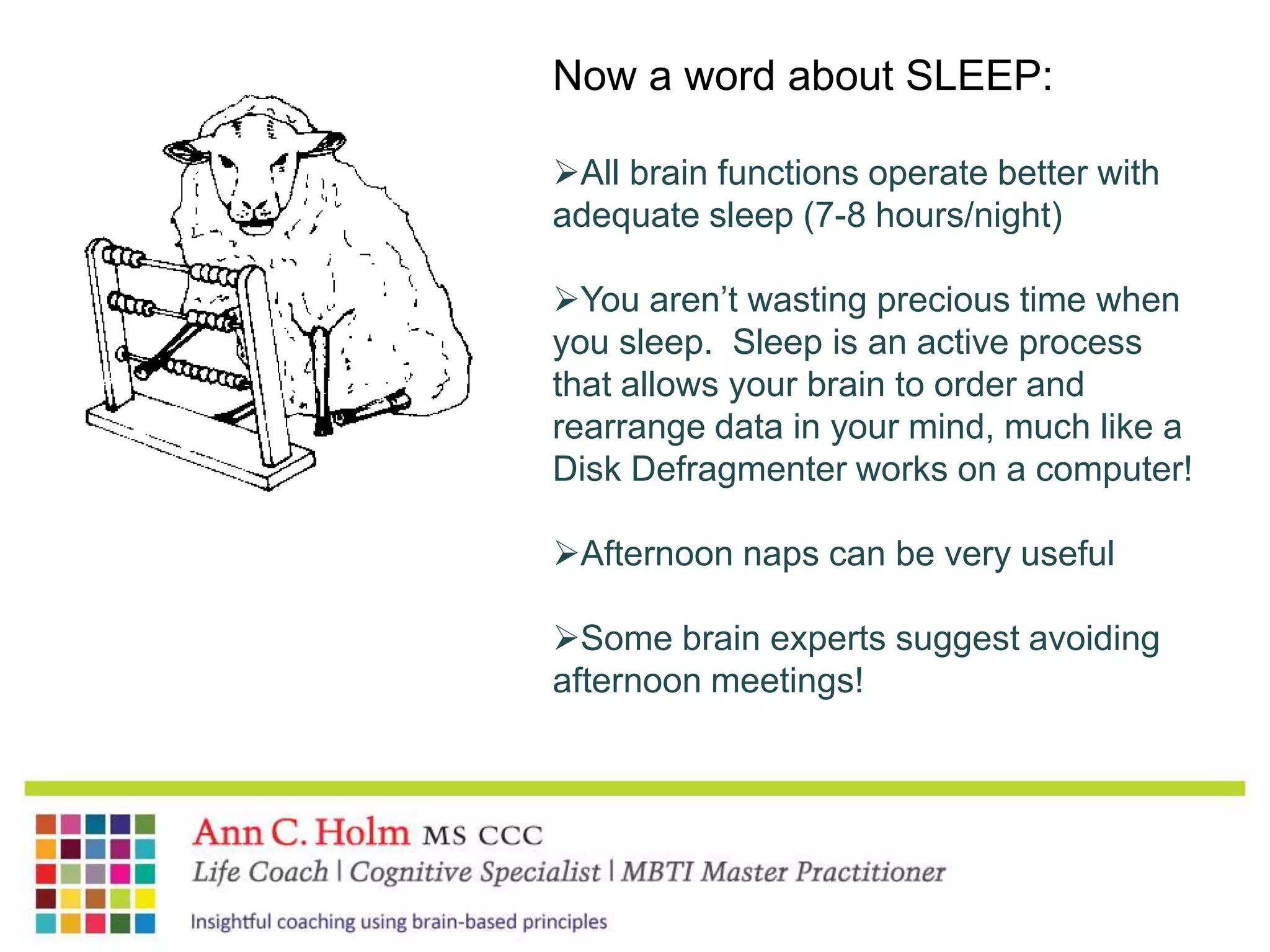
    You aren’t wastingprecious time when you sleep. Sleep is an active process that allows your brain to order and rearrange data in your mind, much like a Disk Defragmenter works on a computer!
  • 36.
    Afternoon naps canbe very useful
  • 37.
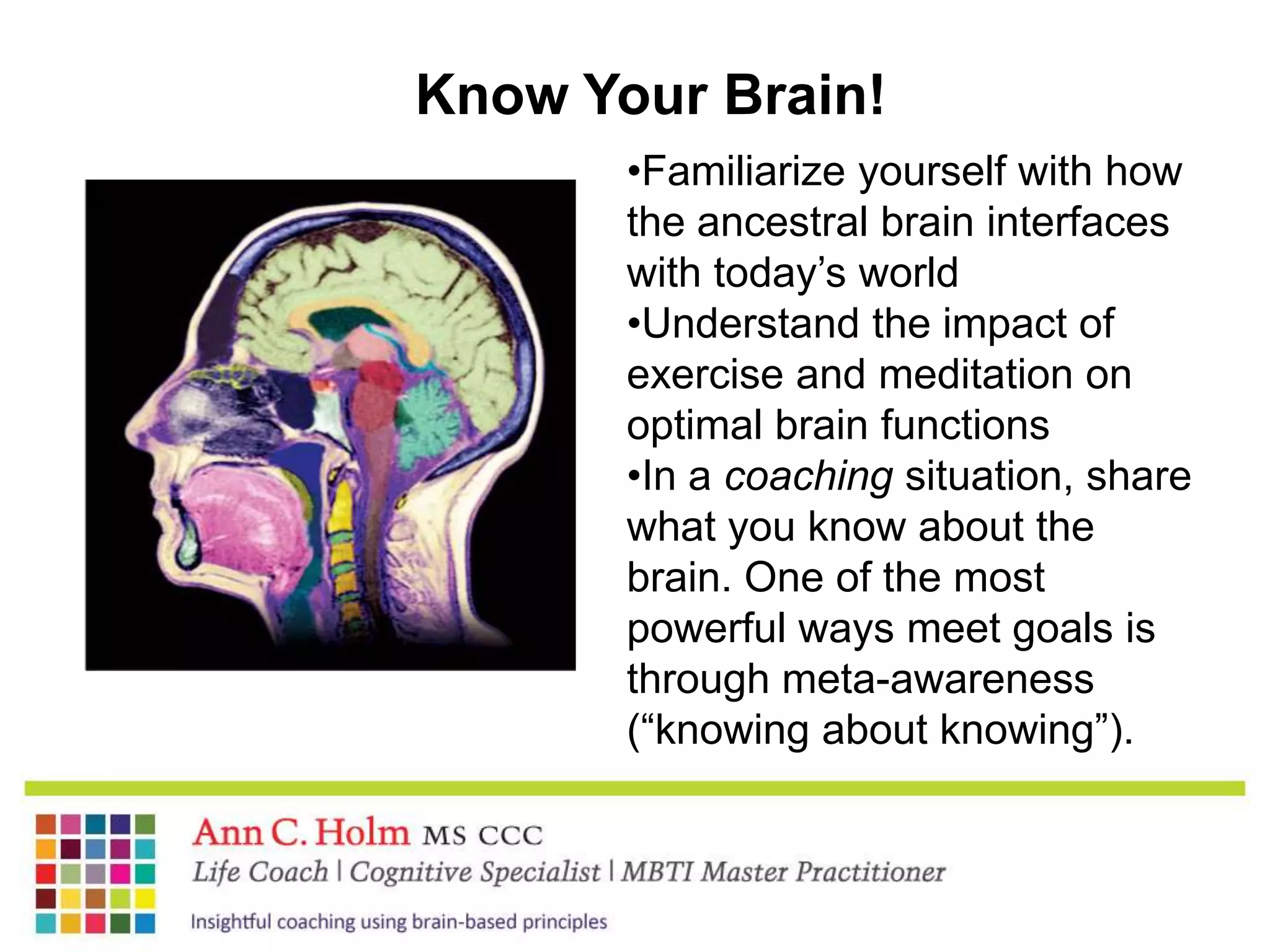
    Some brain expertssuggest avoiding afternoon meetings!Know Your Brain!Familiarize yourself with how the ancestral brain interfaces with today’s world
  • 38.
    Understand the impactof exercise and meditation on optimal brain functions
  • 39.
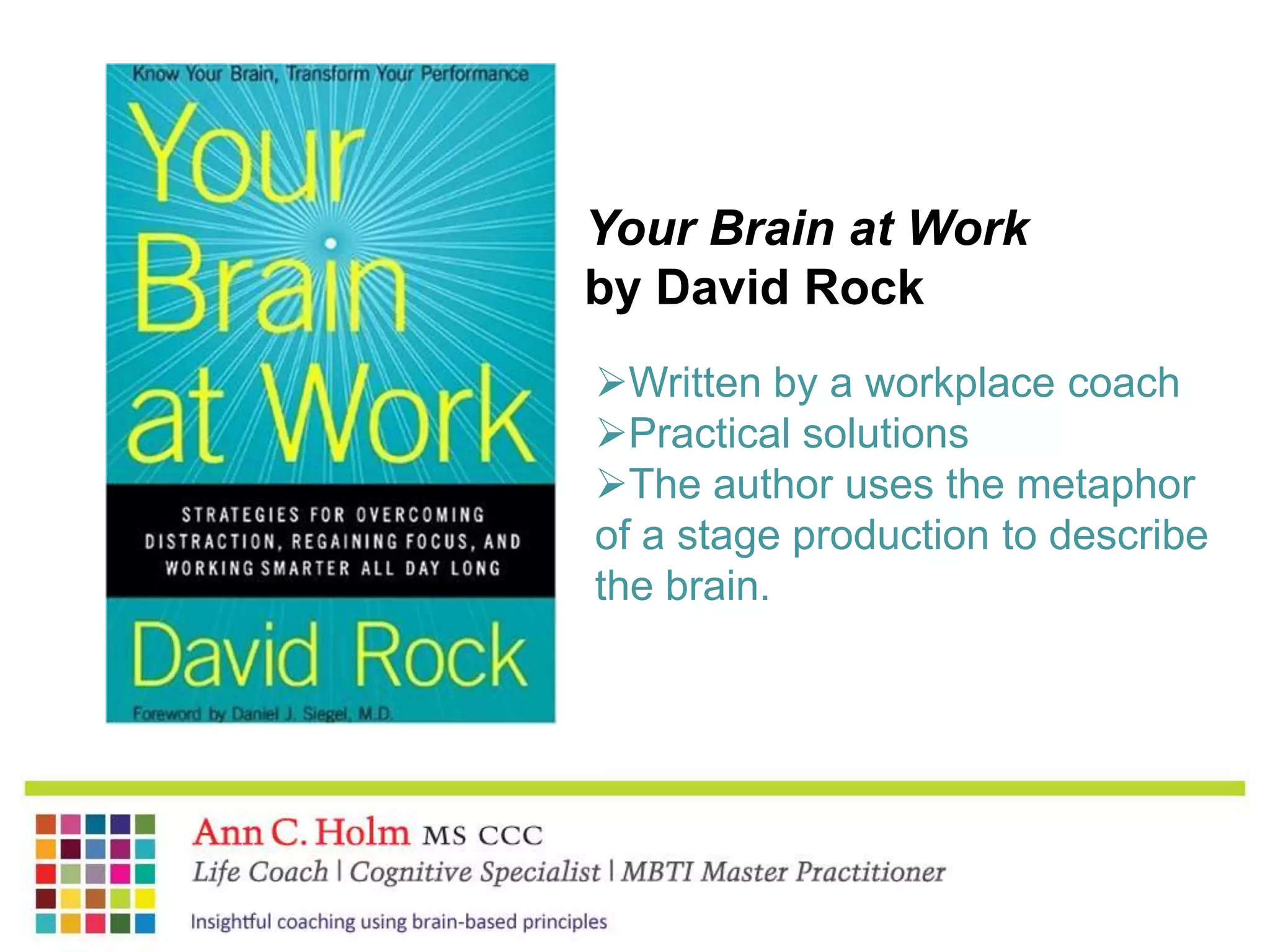
    In a coachingsituation, share what you know about the brain. One of the most powerful ways meet goals is through meta-awareness (“knowing about knowing”).Your Brain at Work by David RockWritten by a workplace coach
  • 40.
  • 41.
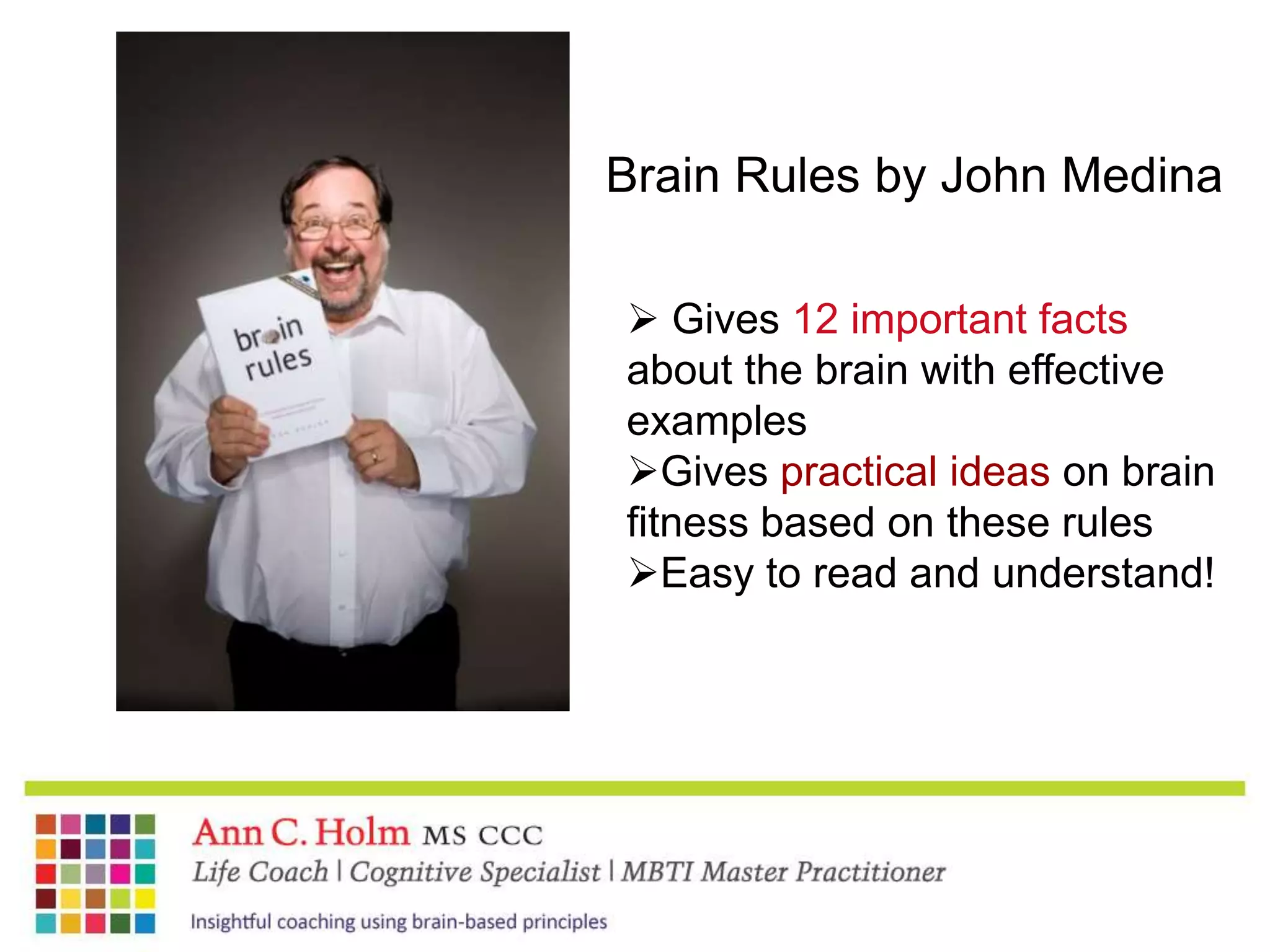
    The author usesthe metaphor of a stage production to describe the brain. Brain Rules by John Medina Gives 12important facts about the brain with effective examples
  • 42.
    Gives practical ideason brain fitness based on these rules
  • 43.
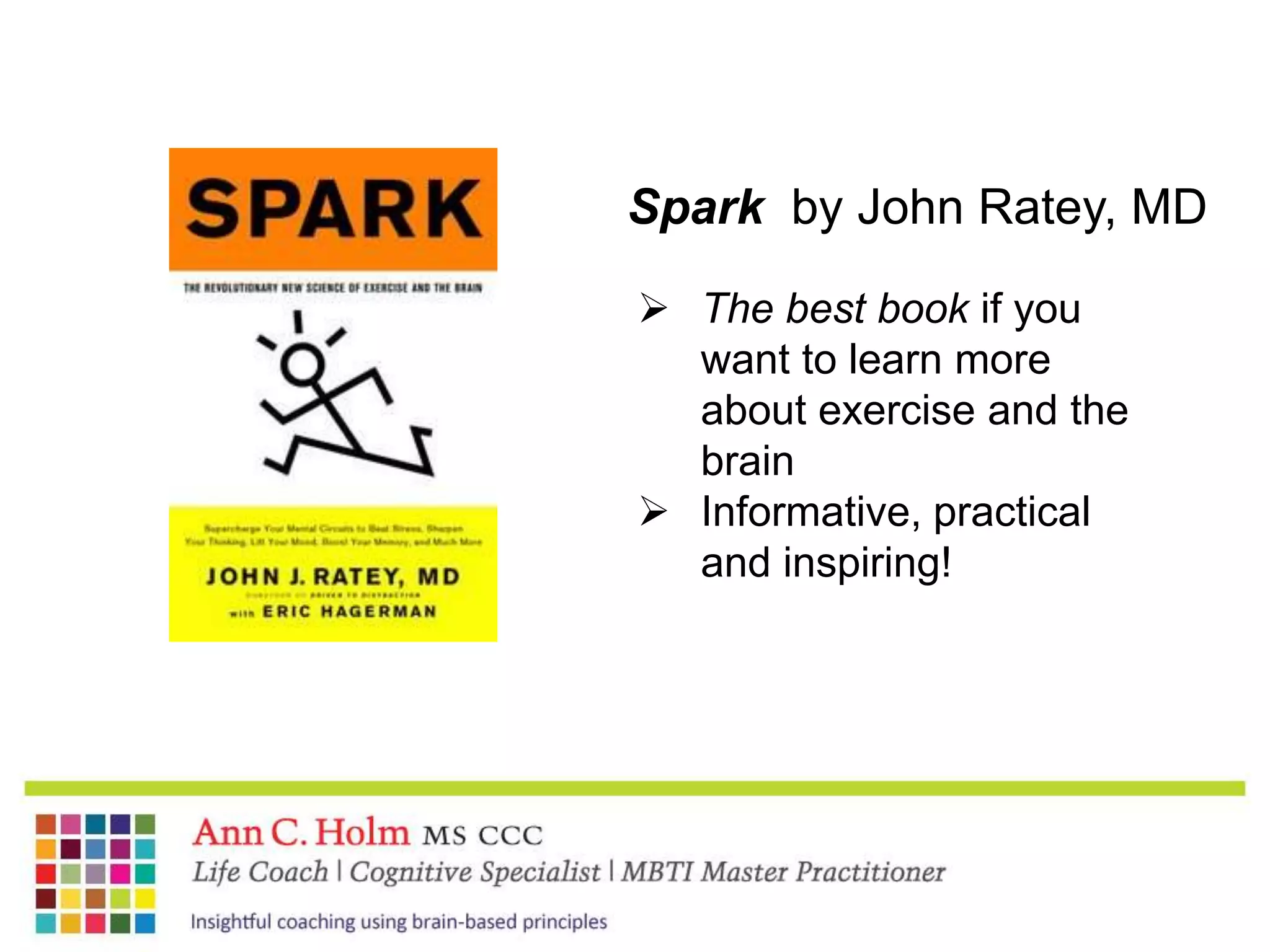
    Easy to readand understand! Spark by John Ratey, MDThe best book if you want to learn more about exercise and the brain
  • 44.
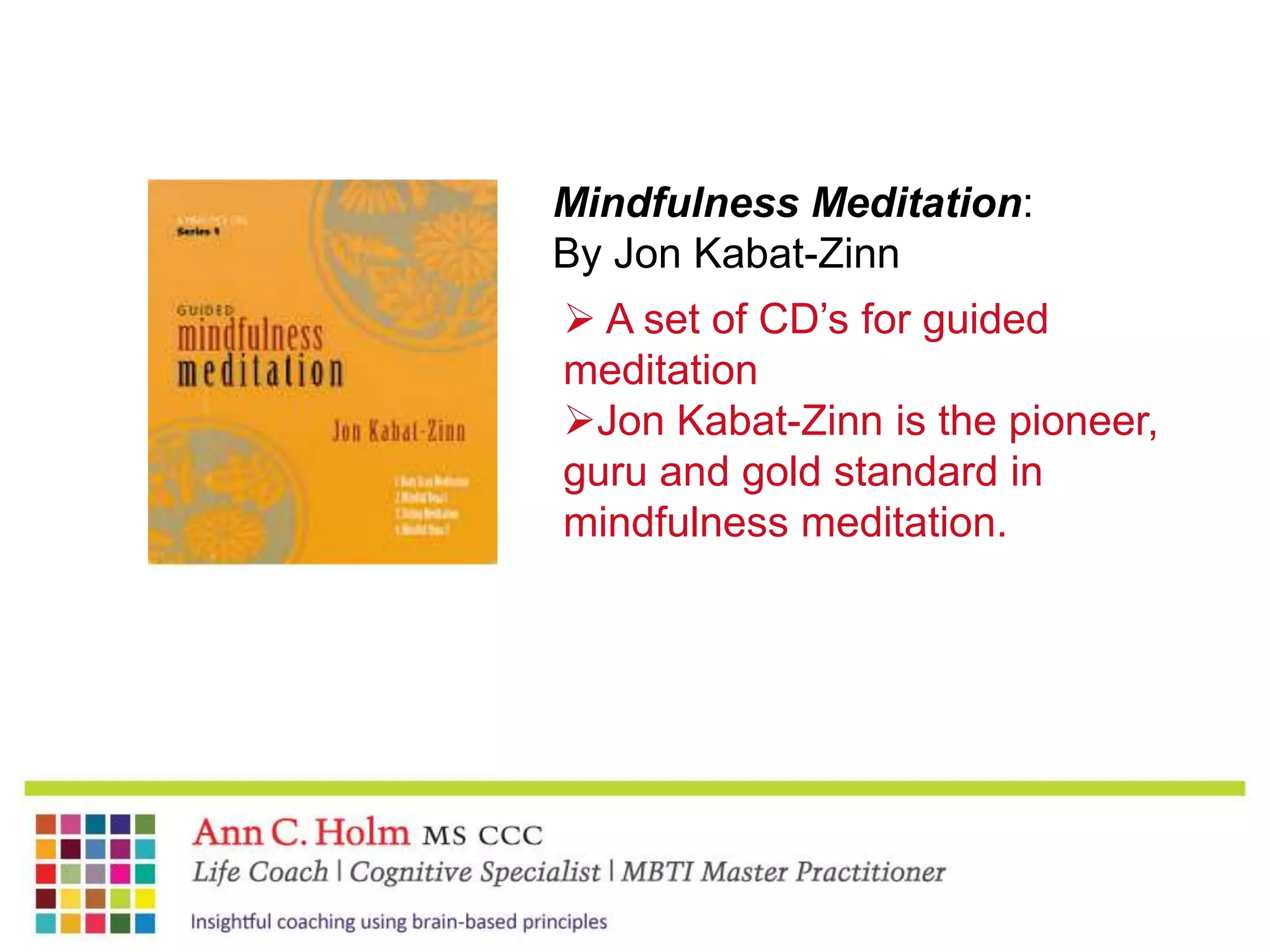
    Informative, practical andinspiring!Mindfulness Meditation: By Jon Kabat-Zinn A set of CD’s for guided meditation
  • 45.
    Jon Kabat-Zinn isthe pioneer, guru and gold standard in mindfulness meditation.Have a great summer! Learn something new everyday!