Future
HR Business Model
www.humanikaconsulting.com
Road to…Humanika Bisnis Digital
Pressure
HR is under pressure. Most HR-managers feel this. Budgets are cut and processes are criticized. HR needs to
reinvent itself. It needs to find ways to shape its own future. In the past we have lamented about the lack of
strategic “weight” within the company. I have worked for 2 decades in HR and I was always puzzled by this.
Lamentation is never the right option. We need to do something. And we can only gain influence by doing well the
things we are doing. But were we any good? Let’s face some brutal facts.
• According to a Gallup Survey, only 13% of employees worldwide are engaged. They are
outnumbered by the actively disengaged employees.
• 20% of workers in Europe report a poor mental well-being (5th European Working
Conditions Survey). In Belgium half of the employees experience a too high mental
workload (Securex Whitepaper).
• The ILO world of work 2013 survey reports a degradation of job quality between 2007-
2011. The change in job quality is determined by the change in the percentage of
temporary employees, the change in social benefits expenditure as share of total public
expenditure and the growth in the average hourly wages between 2007 and 2011 were
used.
• Long-term absenteeism is on the rise according to a Securex Research study and the
increase of long-term absenteeism is accelerating.
• Research on Karaseks Job quality model, consistently report low figures.
Wasted time
And the question is how we can do better. This situation
has been predicted 4 decades ago by Alvin Toffler in his
monumental book “Futureshock“. We are now where he
predicted us we would be. McGregor has defined in the
60ies human-centric style of leadership and organisation
in “the Human Side of Enterprise” and Shumacher
pleaded for economics as if people mattered in his book
“Small is Beautiful“. These and other books from the past,
have predicted our present and future state.
It seems we have been wasting 4 decades to find
ourselves in a difficult situation. So it’s time to act. If
people in HR really want, they can shape their own
future.
The Future
• Thinking about the future of how
employers will manage the employees
should make us humble. Indeed we know
the past and the present, but are
ignorant about the future.
• We can think about the future content:
what will be the tasks?
• And we can think about the process:
what will be our role?
What will be the tasks?
A research study by Boston Consulting Group revealed 6 tasks
for the future:
• Managing Talent: assessing quantitative and qualitative needs
for talent, managing the talent pipe-line.
• Managing Demographics: managing the loss of capacity and
knowledge, managing the ageing workforce
• Becoming a learning organisation: choosing a learning
strategy, boosting the number of on-the-job development
programs, measuring the return on investment.
• Managing work-life balance: determining what people need,
building programs that afford flexible working hours,
enhancing corporate social responsibility
• Managing Change and cultural transformation: determining
and shaping desired behaviours, ensuring top-management
support.
• Getting the fundamentals right: mastering people processes,
delivering on recruiting and staffing, transforming HR into a
strategic partner.
What will be HR role?
Role 1: The Architect
HR no longer owns the people processes.
Instead, HR becomes a facilitator or even
an architect. By creating the right context
in which people can be successful, HR
will deliver its greatest contribution. In
that sense HR is working on culture,
organisation, processes and
environment. The processes are not HR’s,
they belong to the company. Let’s also
not ignore the CEO’s increasing interest
in people, leadership and culture. The
CEO (or the board) is the owner of
people processes. HR takes on the role of
architect. HR will create organisations in
which leadership, cooperation,
innovation, entrepreneurship, … can
develop.
What will be HR role?
Role 2: The People and Digital Expert
But to be able to take on the role of architect, HR
needs know-how. In the recent past HR became a
generalist, but in future we will become experts, or
craftsmen. Instead of being a generalist, HR will
offer top-notch expertise about the people side of
the company. Apart from the more traditional
people related know-how, HR will have to master
the digital know-how: Social Media, HRIS,
Employee Self Service, information gathering, data-
analysis… HR will need to incorporate knowledge
and practices from other disciplines into its own
discipline: marketing, finance, service
management, … Learning from others is a great
opportunity for HR.
Role 3: The Coach
But HR should be aware of reification of people.
In the quest for a spot at the board table we
might have lost the contact to people. HR needs
to be(come) more empathic. Empathy means to
listen, try to understand and act upon that
understanding. And why should HR not
introduce kindness, compassion and humanity
into the corporate DNA? It’s like we need to
rediscover the human being behind the
employee ID again. This is not an appeal for
meaningless softness. Business needs to be
human in order to help people to be successful.
HR becomes a coach of the organisation, its
management and its employees. In the future it
will be the employee that will determine and
evaluate a company’s people strategy. Coaching
is a way of individualization of the people
strategy.
What will be HR role?
Role 4: The Data-Strategist
Like any other discipline, HR is
oriented towards results. HR will
work on becoming evidence-
based. That entails not only
looking for data to assess HR
interventions, but also planning
interventions based on available
scientific insights. There is not
much big data in HR today.
However, by analyzing the data we
have, we might be able to shape
the future of our profession.
What will be HR role?
Role 5: The advocate
HR leaves the backbench and becomes
an advocate of the importance of
people processes and results. The
people strategy is a part of the
company strategy. HR people are
gaining influence through their know-
how, their fact-based approach and
their proactive contribution to the
business results. Any business decision
has an impact on people and any
business strategy depends on the
quality of the people who execute it.
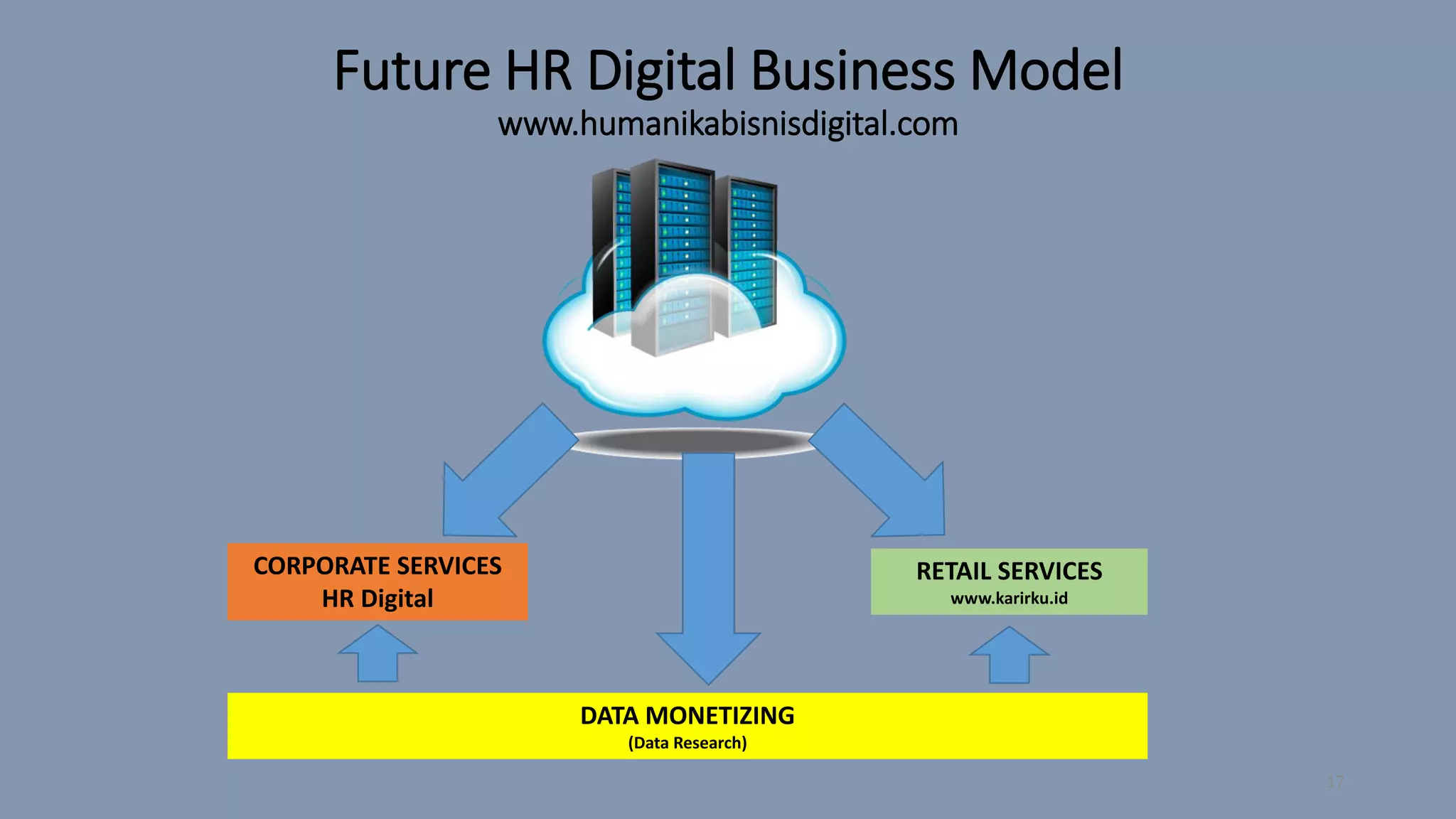
Future HR Digital Business Model
www.humanikabisnisdigital.com
17
CORPORATE SERVICES
HR Digital
RETAIL SERVICES
www.karirku.id
DATA MONETIZING
(Data Research)
HR Digital - “Taking Care Your Business”
www.humanikabisnisdigital.com
Integrated HR Process
Interactive
Recruitment Selection Development Career Counselling HRIS & Payroll
Features E-University HRIS E-Counselling E-Payment
Reports Talent and
Personality
Certification Dashboard
Parametric
(multi
company,
job title, and
job level
Self
Learning
Design
Data
Analysing
Live
Counselling
Payment
Gateway
Individual HR & Financial
RESEARCH
BASED
Integration
If HR is able to design organisations, based on
its profound knowledge of human behaviour,
combined with the necessary coaching
presence it has a bright future. We need to
take on these 5 roles, all at once. When I
presented this to a group of HR professionals,
it was clear that the role of coach and expert
were seen as the most important and
developed roles. This is good starting point for
any profession. But HR can expand its
influence by trying to look for evidence. And
this evidence can be used to build an HR
strategy through which HR can become the
advocate and the architect of the people side
of business. When we can do this, there will be
no lamentation needed.
Skills and Risks in The future
C U in The Future ! “The biggest impedient to a company’s future
success is its past success.”
Dan Schulman | CEO of PayPal
Learning and Giving for Better Indonesia

Habit: Future HR Digital Business Model

  • 1.
  • 3.
    Pressure HR is underpressure. Most HR-managers feel this. Budgets are cut and processes are criticized. HR needs to reinvent itself. It needs to find ways to shape its own future. In the past we have lamented about the lack of strategic “weight” within the company. I have worked for 2 decades in HR and I was always puzzled by this. Lamentation is never the right option. We need to do something. And we can only gain influence by doing well the things we are doing. But were we any good? Let’s face some brutal facts. • According to a Gallup Survey, only 13% of employees worldwide are engaged. They are outnumbered by the actively disengaged employees. • 20% of workers in Europe report a poor mental well-being (5th European Working Conditions Survey). In Belgium half of the employees experience a too high mental workload (Securex Whitepaper). • The ILO world of work 2013 survey reports a degradation of job quality between 2007- 2011. The change in job quality is determined by the change in the percentage of temporary employees, the change in social benefits expenditure as share of total public expenditure and the growth in the average hourly wages between 2007 and 2011 were used. • Long-term absenteeism is on the rise according to a Securex Research study and the increase of long-term absenteeism is accelerating. • Research on Karaseks Job quality model, consistently report low figures.
  • 4.
    Wasted time And thequestion is how we can do better. This situation has been predicted 4 decades ago by Alvin Toffler in his monumental book “Futureshock“. We are now where he predicted us we would be. McGregor has defined in the 60ies human-centric style of leadership and organisation in “the Human Side of Enterprise” and Shumacher pleaded for economics as if people mattered in his book “Small is Beautiful“. These and other books from the past, have predicted our present and future state. It seems we have been wasting 4 decades to find ourselves in a difficult situation. So it’s time to act. If people in HR really want, they can shape their own future.
  • 8.
    The Future • Thinkingabout the future of how employers will manage the employees should make us humble. Indeed we know the past and the present, but are ignorant about the future. • We can think about the future content: what will be the tasks? • And we can think about the process: what will be our role?
  • 10.
    What will bethe tasks? A research study by Boston Consulting Group revealed 6 tasks for the future: • Managing Talent: assessing quantitative and qualitative needs for talent, managing the talent pipe-line. • Managing Demographics: managing the loss of capacity and knowledge, managing the ageing workforce • Becoming a learning organisation: choosing a learning strategy, boosting the number of on-the-job development programs, measuring the return on investment. • Managing work-life balance: determining what people need, building programs that afford flexible working hours, enhancing corporate social responsibility • Managing Change and cultural transformation: determining and shaping desired behaviours, ensuring top-management support. • Getting the fundamentals right: mastering people processes, delivering on recruiting and staffing, transforming HR into a strategic partner.
  • 11.
    What will beHR role? Role 1: The Architect HR no longer owns the people processes. Instead, HR becomes a facilitator or even an architect. By creating the right context in which people can be successful, HR will deliver its greatest contribution. In that sense HR is working on culture, organisation, processes and environment. The processes are not HR’s, they belong to the company. Let’s also not ignore the CEO’s increasing interest in people, leadership and culture. The CEO (or the board) is the owner of people processes. HR takes on the role of architect. HR will create organisations in which leadership, cooperation, innovation, entrepreneurship, … can develop.
  • 12.
    What will beHR role? Role 2: The People and Digital Expert But to be able to take on the role of architect, HR needs know-how. In the recent past HR became a generalist, but in future we will become experts, or craftsmen. Instead of being a generalist, HR will offer top-notch expertise about the people side of the company. Apart from the more traditional people related know-how, HR will have to master the digital know-how: Social Media, HRIS, Employee Self Service, information gathering, data- analysis… HR will need to incorporate knowledge and practices from other disciplines into its own discipline: marketing, finance, service management, … Learning from others is a great opportunity for HR.
  • 13.
    Role 3: TheCoach But HR should be aware of reification of people. In the quest for a spot at the board table we might have lost the contact to people. HR needs to be(come) more empathic. Empathy means to listen, try to understand and act upon that understanding. And why should HR not introduce kindness, compassion and humanity into the corporate DNA? It’s like we need to rediscover the human being behind the employee ID again. This is not an appeal for meaningless softness. Business needs to be human in order to help people to be successful. HR becomes a coach of the organisation, its management and its employees. In the future it will be the employee that will determine and evaluate a company’s people strategy. Coaching is a way of individualization of the people strategy. What will be HR role?
  • 14.
    What will beHR role? Role 4: The Data-Strategist Like any other discipline, HR is oriented towards results. HR will work on becoming evidence- based. That entails not only looking for data to assess HR interventions, but also planning interventions based on available scientific insights. There is not much big data in HR today. However, by analyzing the data we have, we might be able to shape the future of our profession.
  • 15.
    What will beHR role? Role 5: The advocate HR leaves the backbench and becomes an advocate of the importance of people processes and results. The people strategy is a part of the company strategy. HR people are gaining influence through their know- how, their fact-based approach and their proactive contribution to the business results. Any business decision has an impact on people and any business strategy depends on the quality of the people who execute it.
  • 17.
    Future HR DigitalBusiness Model www.humanikabisnisdigital.com 17 CORPORATE SERVICES HR Digital RETAIL SERVICES www.karirku.id DATA MONETIZING (Data Research)
  • 18.
    HR Digital -“Taking Care Your Business” www.humanikabisnisdigital.com Integrated HR Process Interactive Recruitment Selection Development Career Counselling HRIS & Payroll Features E-University HRIS E-Counselling E-Payment Reports Talent and Personality Certification Dashboard Parametric (multi company, job title, and job level Self Learning Design Data Analysing Live Counselling Payment Gateway Individual HR & Financial RESEARCH BASED
  • 19.
    Integration If HR isable to design organisations, based on its profound knowledge of human behaviour, combined with the necessary coaching presence it has a bright future. We need to take on these 5 roles, all at once. When I presented this to a group of HR professionals, it was clear that the role of coach and expert were seen as the most important and developed roles. This is good starting point for any profession. But HR can expand its influence by trying to look for evidence. And this evidence can be used to build an HR strategy through which HR can become the advocate and the architect of the people side of business. When we can do this, there will be no lamentation needed.
  • 20.
    Skills and Risksin The future
  • 22.
    C U inThe Future ! “The biggest impedient to a company’s future success is its past success.” Dan Schulman | CEO of PayPal
  • 23.
    Learning and Givingfor Better Indonesia