All about business simulations
for leadership development.
      A starting place for talent management executives
      who’ve been asked to ‘find something that works.’
The problem:
How to make leadership
development perform .
               All large companies engage in leadership development training—
               with varying degrees of success. Talent managers are increasingly
               asked to deliver applicable RESULTS: relevant and engaging
               experiences for emerging and established business leaders.

               Training and development must organize leadership programs
               grounded in real business decisions and problem-solving. Instead
               of sitting in a classroom, reviewing case studies that may or may not
               resonate, your top brass wants leadership development to apply
               directly to your business, your industry... your on-the-ground, on-the-fly,
               decision making.


                                                         © Simulation Development Group
The choices:
‘Solutions’ abound.
Executive Education                        Business Simulations
Typically led by university professors,    Business simulations are widely used among
executive education programs sequester     the Fortune 500 to move learning from the
executives and senior leaders for class-   classroom to the real world. Simulation
room training. Content customization       programs let teams practice decision-making
varies by institution, and is highly de-   about actual problems they face. Executives
pendent on budget. Classes are typically   experience in real time how their decisions
taught by business theorists (i.e. aca-    affect one another and the bottom line.
demics), not business leaders.
                                           Programs vary widely based on the service

In-House Solutions                         provider. Examples include: 
                                           — Live, team-based simulations that
Some organizations, fearing a service         combine technology and live
provider simply can’t understand their        interaction.
business, or simply hoping to save         — Virtual-only simulations for solo
money, will choose to develop a               training.
leadership training curriculum in-house.   — Competitions in which teams use
                                              simulation programs to ‘win’ complex
                                              decision-making scenarios.
                                           — ‘Off-the-shelf’ solutions for immediate
                                              use, with no customization.
                                                                                         © Simulation Development Group
1
                                                                                                1


                                                                     11 001 0100 1011 01


                                                             01 0110 0110 1001 010 01


                                                                      10 011 1001 0100 1
                                                                             00 000 0110 1


                                                     01 0100 0001 1100 001 110 0110


                                                                      10 110 1010 0100 1
                                                                                   00 010 1


                                                            01 001 1101 1010 0010 110
                                                      11 010 0011 1010 0100 110 01


                                                                                        0 01
                                                              01 0110 0100 0100 1011 0


                                                        00 1010 1101 1001 101 1001 1


                                                                         00 010 0100 101
                                                                                      11 10


                                                       10 001 0110 1001 0100 011 10


                                                                 01 100 010 0010 1001
                                                                                             00


                                                                       10 1101 1001 0110
                                                                                              1
                                                                                     11 00
                                                                                              0


                                                                  0 10 100 10 01
                                                                                    01 101
                                                                                             0


                                                                                     1 100
                                                                             10 000 110
                                                                                          11


                                                                                           0
                                                                                          0


                                                                                        01
                                                                                        0


                                                               10 0011 1101 100 0
                                                                               10 11


                                                                                     01
Business Simulation


                                                                                      0
                                                                                     1


                                                                                     0
                                                                                   0


                                                                             11 10
                                                                                 1


                                                                     0 11 01
                                                                            1 1
                                                                       01 00


                                                                               0
                                                                       01 01


                                                                  01 00 11
                                                                               1


                                                                             0


                                                                          0
                                                                          0
                                                                 00 11


                                                                   0 0
                                                    10 10 10 10


                                                          00 010 10
         Sounds futuristic. What is it?


                                                                   0
                                                             0 0


                                                                0
                                                            1 1


                                                           1
                                                         00
                                                        0
         We’re accustomed to hearing that business simulation sounds like an idea from
         The Matrix. But rest-assured, it’s highly practical; simulations attempt to duplicate
         the type of learning that happens on the job, over years of experience. How does it
         happen?


         Technology: Custom simulations will model the decisions your company’s leaders
         face every day, and the complex effects of those decisions. Simulators are able to
         capture all the possible decisions an individual will make and quantify them.


         Business Acumen: The very best simulators are designed by business leaders with
         C-suite experience, not business theorists. Working together with your in-house
         experts, highly experienced simulation developers will capture the essential issues
         that drive your organization to grow and out-matneuver competitors—and then map
         those issues to a complex web of decisions.


         Live team-building: Best-in-class simulations take place live, not in cubicles. Your
         company will host a forum—one-day or multiple days—and break participants into
         teams. The goal: to design an experience that allows each individual to live a day in
         the life of your CEO. Simulations help employees step out of their own silos and
         understand multi-faceted, business-changing decision-making.

                                                                   © Simulation Development Group
Business Simulation
In practice, it looks like this:
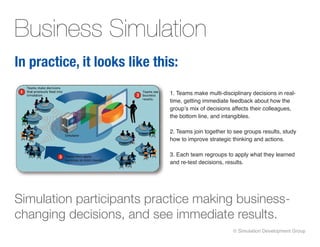
                              1. Teams make multi-disciplinary decisions in real-
                              time, getting immediate feedback about how the
                              group’s mix of decisions affects their colleagues,
                              the bottom line, and intangibles.

                              2. Teams join together to see groups results, study
                              how to improve strategic thinking and actions.

                              3. Each team regroups to apply what they learned
                              and re-test decisions, results.


Simulation participants practice making business-
changing decisions, and see immediate results.
                                                       © Simulation Development Group
Scenarios best-suited for sims.
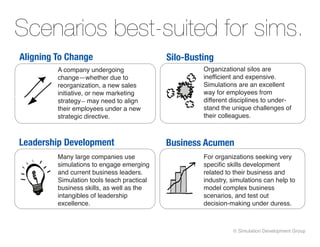
Aligning To Change                          Silo-Busting
         A company undergoing                        Organizational silos are
         change—whether due to                       inefficient and expensive.
         reorganization, a new sales                 Simulations are an excellent
         initiative, or new marketing                way for employees from
         strategy— may need to align                 different disciplines to under-
         their employees under a new                 stand the unique challenges of
         strategic directive.                        their colleagues.


Leadership Development                      Business Acumen
         Many large companies use                    For organizations seeking very
         simulations to engage emerging              specific skills development
         and current business leaders.               related to their business and
         Simulation tools teach practical            industry, simulations can help to
         business skills, as well as the             model complex business
         intangibles of leadership                   scenarios, and test out
         excellence.                                 decision-making under duress.


                                                               © Simulation Development Group
Business Simulation
                                                                                       Examples, please!
CASE STUDY: Fortune 500 Pharma Company Faces Talent Crisis
Talent management has become a critical risk for the com-           Executives gather and are organized into teams to consider
pany; a cohort of dozens of so-called Boomers within the            highly complex business problems: 
company—all senior executives with decades of pharma-               — What effect will regulation have on the lifetime value of the
ceutical management experience—is readying to retire
over the next 10 years. Management wants to identify a                 existing drug portfolio? 
program that will accelerate learning for targeted emerging         — How should sales and marketing adjust to these changing
leaders within the organization.                                       conditions? 

Talent development leaders study executive education pro-           — What pressures will R&D face given a smaller drug pipeline.
grams, but find that many of the lessons are consistent with an     — How will pricing strategies change in the coming decade?
MBA curriculum—which at least half of the targeted “emerging
leaders” are already pursuing or have completed outside of          Rather than attending a classroom discussion about how, in
work. What’s more, the academic curriculum lags real-world          theory, these issues will play out within their industry, execu-
changes in the industry. Management wants a training program        tives are practicing decision-making by making adjustments to
that will contend not only with the intangibles of leadership de-   pricing, for example, and learning how these adjustments may
velopment, but also the real-life, complex decisions facing sen-    affect other areas of the organization.
ior executives.
                                                                    And because executives are practicing their skills, rather than
The company hires a business simulation provider to develop a       engaged in a more passive memorization of skills, their lesson
customized solution that can manage the complexity of devel-        retention is higher, and their level of engagement is higher.
oping leaders in a fast-changing industry such as pharma. After
a short time period of development, the company is ready to go
live with their first simulation executive forum.

                                                                                                        © Simulation Development Group
Who’s involved from your org?
Subject Matter Experts (SMEs)
           Your simulation developers will solicit help from your internal subject matter experts.
           The actual people involved depend on the industry and training. For example, a
           simulation focused on operations optimization may include product engineers,
           manufacturing, logistics, and sales & marketing.


Business Strategists
           Include ‘big picture’ thinkers on your review team, whether from the C-suite or other
           senior, strategy-setting roles. These individuals will offer a better sense of how your
           organization’s disciplines (or ‘silos’) work together and how they malfunction. The
           simulation should try to uncover and combat some of these organizational ‘sticking
           points.’


Human Resources & Talent Development
           Your talent management team will likely serve as project managers, ensuring the var-
           ious stakeholders--both internal and external—maintain strong communications and
           ensuring the project is developing at the right speed.
What to look for in a
sim service provider.
            This isn’t hard...
            You may think hiring the right vendor is complicated because sim
            technology seems like a ‘black box.’ Actually, the hiring decision
            should be straightforward. Make sure to ‘check’ these three
            boxes

            Business leaders, not business ‘theorists.’
            Hire simulation developers who have on-the-ground business
            experience. These individuals will be responsible for knitting
            together all the issues your company faces, and delivering a
            highly functional, realistic decision-making simulation.

            Client references.
            The company you hire should have at least dozens of simulations
            completed, across many industries. Building simulations is an art
            and a science, and only companies with strong experience—and
            clients who believe in their work—should be on your short list.

            A great user experience.
            The best technology solutions are barely noticed by their users.
            Ensure your provider offers an easy-to-use interface, with rave
            reviews from client subject matter experts and users.
                                                     © Simulation Development Group
Want to learn more?
              Sign up for our weekly blog about
              business simulations and talent
              development.
                                  - OR -
              Call us to find out more about
              customized leadership simulations.

How to use business simulations for leadership training.

  • 1.
    All about businesssimulations for leadership development. A starting place for talent management executives who’ve been asked to ‘find something that works.’
  • 2.
    The problem: How tomake leadership development perform . All large companies engage in leadership development training— with varying degrees of success. Talent managers are increasingly asked to deliver applicable RESULTS: relevant and engaging experiences for emerging and established business leaders. Training and development must organize leadership programs grounded in real business decisions and problem-solving. Instead of sitting in a classroom, reviewing case studies that may or may not resonate, your top brass wants leadership development to apply directly to your business, your industry... your on-the-ground, on-the-fly, decision making. © Simulation Development Group
  • 3.
    The choices: ‘Solutions’ abound. ExecutiveEducation Business Simulations Typically led by university professors, Business simulations are widely used among executive education programs sequester the Fortune 500 to move learning from the executives and senior leaders for class- classroom to the real world. Simulation room training. Content customization programs let teams practice decision-making varies by institution, and is highly de- about actual problems they face. Executives pendent on budget. Classes are typically experience in real time how their decisions taught by business theorists (i.e. aca- affect one another and the bottom line. demics), not business leaders. Programs vary widely based on the service In-House Solutions provider. Examples include:  — Live, team-based simulations that Some organizations, fearing a service combine technology and live provider simply can’t understand their interaction. business, or simply hoping to save — Virtual-only simulations for solo money, will choose to develop a training. leadership training curriculum in-house. — Competitions in which teams use simulation programs to ‘win’ complex decision-making scenarios. — ‘Off-the-shelf’ solutions for immediate use, with no customization. © Simulation Development Group
  • 4.
    1 1 11 001 0100 1011 01 01 0110 0110 1001 010 01 10 011 1001 0100 1 00 000 0110 1 01 0100 0001 1100 001 110 0110 10 110 1010 0100 1 00 010 1 01 001 1101 1010 0010 110 11 010 0011 1010 0100 110 01 0 01 01 0110 0100 0100 1011 0 00 1010 1101 1001 101 1001 1 00 010 0100 101 11 10 10 001 0110 1001 0100 011 10 01 100 010 0010 1001 00 10 1101 1001 0110 1 11 00 0 0 10 100 10 01 01 101 0 1 100 10 000 110 11 0 0 01 0 10 0011 1101 100 0 10 11 01 Business Simulation 0 1 0 0 11 10 1 0 11 01 1 1 01 00 0 01 01 01 00 11 1 0 0 0 00 11 0 0 10 10 10 10 00 010 10 Sounds futuristic. What is it? 0 0 0 0 1 1 1 00 0 We’re accustomed to hearing that business simulation sounds like an idea from The Matrix. But rest-assured, it’s highly practical; simulations attempt to duplicate the type of learning that happens on the job, over years of experience. How does it happen? Technology: Custom simulations will model the decisions your company’s leaders face every day, and the complex effects of those decisions. Simulators are able to capture all the possible decisions an individual will make and quantify them. Business Acumen: The very best simulators are designed by business leaders with C-suite experience, not business theorists. Working together with your in-house experts, highly experienced simulation developers will capture the essential issues that drive your organization to grow and out-matneuver competitors—and then map those issues to a complex web of decisions. Live team-building: Best-in-class simulations take place live, not in cubicles. Your company will host a forum—one-day or multiple days—and break participants into teams. The goal: to design an experience that allows each individual to live a day in the life of your CEO. Simulations help employees step out of their own silos and understand multi-faceted, business-changing decision-making. © Simulation Development Group
  • 5.
    Business Simulation In practice,it looks like this: 1. Teams make multi-disciplinary decisions in real- time, getting immediate feedback about how the group’s mix of decisions affects their colleagues, the bottom line, and intangibles. 2. Teams join together to see groups results, study how to improve strategic thinking and actions. 3. Each team regroups to apply what they learned and re-test decisions, results. Simulation participants practice making business- changing decisions, and see immediate results. © Simulation Development Group
  • 6.
    Scenarios best-suited forsims. Aligning To Change Silo-Busting A company undergoing Organizational silos are change—whether due to inefficient and expensive. reorganization, a new sales Simulations are an excellent initiative, or new marketing way for employees from strategy— may need to align different disciplines to under- their employees under a new stand the unique challenges of strategic directive. their colleagues. Leadership Development Business Acumen Many large companies use For organizations seeking very simulations to engage emerging specific skills development and current business leaders. related to their business and Simulation tools teach practical industry, simulations can help to business skills, as well as the model complex business intangibles of leadership scenarios, and test out excellence. decision-making under duress. © Simulation Development Group
  • 7.
    Business Simulation Examples, please! CASE STUDY: Fortune 500 Pharma Company Faces Talent Crisis Talent management has become a critical risk for the com- Executives gather and are organized into teams to consider pany; a cohort of dozens of so-called Boomers within the highly complex business problems:  company—all senior executives with decades of pharma- — What effect will regulation have on the lifetime value of the ceutical management experience—is readying to retire over the next 10 years. Management wants to identify a existing drug portfolio?  program that will accelerate learning for targeted emerging — How should sales and marketing adjust to these changing leaders within the organization. conditions?  Talent development leaders study executive education pro- — What pressures will R&D face given a smaller drug pipeline. grams, but find that many of the lessons are consistent with an — How will pricing strategies change in the coming decade? MBA curriculum—which at least half of the targeted “emerging leaders” are already pursuing or have completed outside of Rather than attending a classroom discussion about how, in work. What’s more, the academic curriculum lags real-world theory, these issues will play out within their industry, execu- changes in the industry. Management wants a training program tives are practicing decision-making by making adjustments to that will contend not only with the intangibles of leadership de- pricing, for example, and learning how these adjustments may velopment, but also the real-life, complex decisions facing sen- affect other areas of the organization. ior executives. And because executives are practicing their skills, rather than The company hires a business simulation provider to develop a engaged in a more passive memorization of skills, their lesson customized solution that can manage the complexity of devel- retention is higher, and their level of engagement is higher. oping leaders in a fast-changing industry such as pharma. After a short time period of development, the company is ready to go live with their first simulation executive forum. © Simulation Development Group
  • 8.
    Who’s involved fromyour org? Subject Matter Experts (SMEs) Your simulation developers will solicit help from your internal subject matter experts. The actual people involved depend on the industry and training. For example, a simulation focused on operations optimization may include product engineers, manufacturing, logistics, and sales & marketing. Business Strategists Include ‘big picture’ thinkers on your review team, whether from the C-suite or other senior, strategy-setting roles. These individuals will offer a better sense of how your organization’s disciplines (or ‘silos’) work together and how they malfunction. The simulation should try to uncover and combat some of these organizational ‘sticking points.’ Human Resources & Talent Development Your talent management team will likely serve as project managers, ensuring the var- ious stakeholders--both internal and external—maintain strong communications and ensuring the project is developing at the right speed.
  • 9.
    What to lookfor in a sim service provider. This isn’t hard... You may think hiring the right vendor is complicated because sim technology seems like a ‘black box.’ Actually, the hiring decision should be straightforward. Make sure to ‘check’ these three boxes Business leaders, not business ‘theorists.’ Hire simulation developers who have on-the-ground business experience. These individuals will be responsible for knitting together all the issues your company faces, and delivering a highly functional, realistic decision-making simulation. Client references. The company you hire should have at least dozens of simulations completed, across many industries. Building simulations is an art and a science, and only companies with strong experience—and clients who believe in their work—should be on your short list. A great user experience. The best technology solutions are barely noticed by their users. Ensure your provider offers an easy-to-use interface, with rave reviews from client subject matter experts and users. © Simulation Development Group
  • 10.
    Want to learnmore? Sign up for our weekly blog about business simulations and talent development. - OR - Call us to find out more about customized leadership simulations.