MITSlogan Management Review
- Yash Patel
IIT Madras
What Is Marketing
Aggregation & Marketing
Disaggregation?
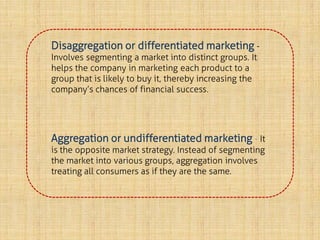
Disaggregation or differentiated marketing -
Involves segmenting a market into distinct groups. It
helps the company in marketing each product to a
group that is likely to buy it, thereby increasing the
company’s chances of financial success.
Aggregation or undifferentiated marketing - It
is the opposite market strategy. Instead of segmenting
the market into various groups, aggregation involves
treating all consumers as if they are the same.
The Key
Players
• Consumers
• Intermediaries
• Brand Managers
What Is The Present
Situation?
Analysis Of Brands-Aggregating
Markets
• Promises to deliver a clearly stated benefit
that sets it apart from the competitors
• Most valuable assets for many Companies
• Establishes differentiated value proposition
• Builds relationship with Consumers
• Advertising and promotion of brands drive
traffic and sales volume
Brands have become the
focal point
of many
company’s marketing efforts and are seen
as a source of market power, competitive
leverage and higher returns.
BUT
The information revolution is making
consumer disaggregation vastly more
efficient and profitable than Aggregation
Analysis Of Disaggregating
Markets
• Companies are developing means of interacting
with the consumers at the segment or even
individual level like direct marketing, one-to-one
marketing and information based marketing
• Many of the strategic and tactical tasks
entrusted to brands can be performed better, less
expensive and more profitably at the level of
consumer segments
Why Study This
Case?
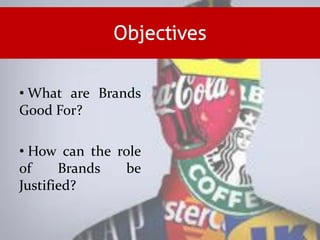
Objectives
• What are Brands
Good For?
• How can the role
of Brands be
Justified?
Examining Three Core
Areas Of Brand
Management
Consumer Relationship1
Companies employing Disaggregate
marketing are :
• Following Two Way Flow Of Communication
• Quicker to respond to Consumer Needs & Tailor
their Offerings to influence consumer buying
pattern
Consumer Relationship1
• Communication Costs are dramatically
reduced
• Hit rates increased through efficient
targeting
• Targeting consumers with marketing
communication only after their permission
and only when they are likely to buy leads
to increase in consumer satisfaction
Example
Launched the magazine Food &
Family, which delivers food-related
articles, recipes, editorials and
advertisements. It reaches the registered
consumers’ mailbox quarterly
(segmentation). It is personalized to the
individual consumer (disaggregation).
It has been launched as an effort to build
consumer relationships
Cost Of Program
They are set against the benefits of
reaching Kraft’s most loyal & profitable
consumers in a targeted manner,
providing opportunities to communicate
directly with them outside of traditional
channels. Some costs are defrayed by
Third party advertisers like Ford,
Tupperware, etc which are keen to tap into
such targeted exposure for their brands.
Two Central Facts Of
Disaggregation
1) Locus of consumer relationship likely to
shift from product brands toward a trusted
and credible umbrella brand or even to the
brand that is used as the platform for
communications
2) Tactical activities such as competitive
reactions, product-trial coupons and
selective promotions are implemented
with targeted consumers or segments
rather than at the brand level
Key Differences
Aggregation Marketing: Brands and Brand
managers compete which each other for
scarce budget; Mass media communication
Disaggregation Marketing: Manages the
consumers & consumer segments
profitably; Brands become team players
Channel Relationship2
Retailers’ Power
• Due to Large Size and Power
• Transformation from Location based
approach to adopting a relationship-
based approach
• Creates store-brand awareness
• Promote Private Label
• Building Store Loyalty
Marketers spent double on retailers’ listing
fees, facing fees, trade promotion and
cooperative advertising
BUT
The real THREAT is that they are feeding
their potential rivals for the consumer
relationship
To Eliminate It …
Disaggregation provides manufacturers
new medium to influence consumer
decision that is independent of the retailer.
It helps restore credibility to the
manufacturer’s claims to know and
understand the consumer better than
retailers do
BUT
Manufacturers must act quickly
as
Consumers prefer few relationship to
many
Manufacturers must act quickly
as
Consumers prefer few relationship to
many
Retailers are not sitting IDLE
Retailers used brands like Coca Cola and
Tide as magnets to attract customers to
the store…
Retailers used brands like Coca Cola and
Tide as magnets to attract customers to
the store…
But once the retailers began to use
disaggregate consumer data to drive
traffic, brands were seen as coarse and
expensive means for achieving traffic
volume
Example
Uses Loyalty Cards to personalize
consumers’ shopping experience
Launched its consumer information
based relationship in 2001 in UK
Example
Launched its consumer information
based relationship in 2001 in UK
BUT
Its consumer data covered only a
small slice of overall consumer data
SO…
Example
Launched its consumer information
based relationship in 2001 in UK
BUT
Its consumer data covered only a small
slice of overall consumer data
SO…
They merged their information with
TESCO
Example
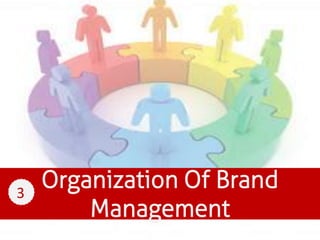
Organization Of Brand
Management
3
Now a days, entrenched brand
management organizations are proving to
be an impediment to the adoption of
consumer-level disaggregation initiatives
Example
Information based marketing program is treated as an
add-on to existing channels for reaching the consumer.
The brand manager, whose brands are featured in
disaggregate marketing campaigns, allocates budget to
fund the program. This method defines marketing as
another media choice, not a different way of doing
business.
The focus of Marketing efforts remains the brands, not
the Consumers
Brand Management
System
- Were designed for an era of mass marketing
-Not Suited to make good use of the tidal wave of
valuable consumer information that is available
- Like in the case of automobile industry, it has
been difficult to track consumer segment
information while pulling brand information
from the management system has been a much
easier game
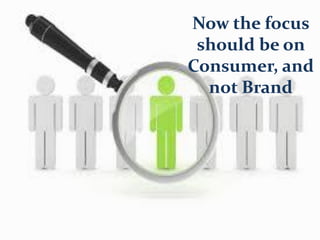
Now the focus
should be on
Consumer, and
not Brand
Switch to a consumer-centric
organization cannot happen
overnight…
To understand the nature of the
changes required, managers must
recognize the need for three
elements in any new structure…
1) Relationship building entity and
mechanism
2) Targeted communications that can exert
a tactical influence on consumer
behaviour
3) Obtaining expertise in new-product and
brand development so that the portfolio
of product brands can be continually
rejuvenated
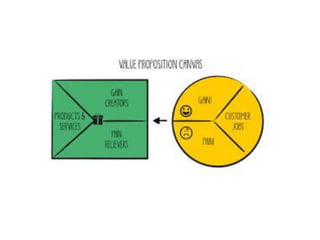
The Value
Proposition Of
Brands
The ability to communicate an
identical message to large numbers of
consumers makes brands ideal and
natural ally of mass production
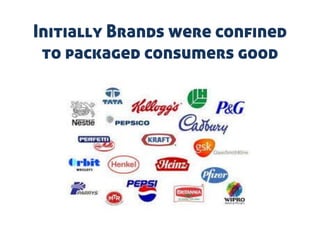
Initially Brands were confined
to packaged consumers good
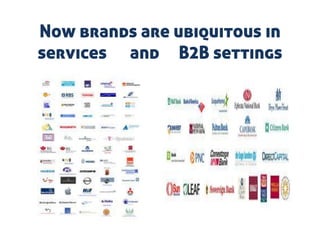
Now brands are ubiquitous in
services and B2B settings
So the Question on Brands
Still Prevails…
Are the Brands good in
this new information
environment??
- Disaggregation is proving to be an efficient
and profitable marketing approach
-The firms are quickly realizing that
disaggregation is not just an add-on to their
brand-focused organizations. It is a different
way of doing business that challenges brands
and brand-based organizational structures
- However, Brands are an excellent means of
developing and communicating a differential
value proposition in the market
So the final
decision
remains in
the hands of
the Company
To decide
On…
- Aggregation OR Disaggregation
- Find your Brand purpose
- Brand Level OR Customer Level
- To build a strong relationship with the
customers
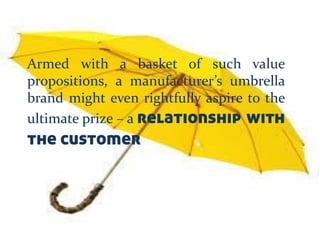
Armed with a basket of such value
propositions, a manufacturer’s umbrella
brand might even rightfully aspire to the
ultimate prize – a relationship with
the customer
Created by- Yash Patel, IIT Madras
During an internship by Prof. Sameer Mathur, IIM Lucknow

What are brands good for

  • 1.
    MITSlogan Management Review -Yash Patel IIT Madras
  • 2.
    What Is Marketing Aggregation& Marketing Disaggregation?
  • 3.
    Disaggregation or differentiatedmarketing - Involves segmenting a market into distinct groups. It helps the company in marketing each product to a group that is likely to buy it, thereby increasing the company’s chances of financial success. Aggregation or undifferentiated marketing - It is the opposite market strategy. Instead of segmenting the market into various groups, aggregation involves treating all consumers as if they are the same.
  • 4.
  • 5.
  • 6.
    What Is ThePresent Situation?
  • 7.
    Analysis Of Brands-Aggregating Markets •Promises to deliver a clearly stated benefit that sets it apart from the competitors • Most valuable assets for many Companies • Establishes differentiated value proposition • Builds relationship with Consumers • Advertising and promotion of brands drive traffic and sales volume
  • 8.
    Brands have becomethe focal point of many company’s marketing efforts and are seen as a source of market power, competitive leverage and higher returns.
  • 9.
    BUT The information revolutionis making consumer disaggregation vastly more efficient and profitable than Aggregation
  • 10.
    Analysis Of Disaggregating Markets •Companies are developing means of interacting with the consumers at the segment or even individual level like direct marketing, one-to-one marketing and information based marketing • Many of the strategic and tactical tasks entrusted to brands can be performed better, less expensive and more profitably at the level of consumer segments
  • 11.
  • 12.
    Objectives • What areBrands Good For? • How can the role of Brands be Justified?
  • 13.
    Examining Three Core AreasOf Brand Management
  • 14.
  • 15.
    Companies employing Disaggregate marketingare : • Following Two Way Flow Of Communication • Quicker to respond to Consumer Needs & Tailor their Offerings to influence consumer buying pattern Consumer Relationship1
  • 16.
    • Communication Costsare dramatically reduced • Hit rates increased through efficient targeting • Targeting consumers with marketing communication only after their permission and only when they are likely to buy leads to increase in consumer satisfaction
  • 17.
  • 18.
    Launched the magazineFood & Family, which delivers food-related articles, recipes, editorials and advertisements. It reaches the registered consumers’ mailbox quarterly (segmentation). It is personalized to the individual consumer (disaggregation). It has been launched as an effort to build consumer relationships
  • 19.
    Cost Of Program Theyare set against the benefits of reaching Kraft’s most loyal & profitable consumers in a targeted manner, providing opportunities to communicate directly with them outside of traditional channels. Some costs are defrayed by Third party advertisers like Ford, Tupperware, etc which are keen to tap into such targeted exposure for their brands.
  • 20.
    Two Central FactsOf Disaggregation 1) Locus of consumer relationship likely to shift from product brands toward a trusted and credible umbrella brand or even to the brand that is used as the platform for communications
  • 21.
    2) Tactical activitiessuch as competitive reactions, product-trial coupons and selective promotions are implemented with targeted consumers or segments rather than at the brand level
  • 22.
    Key Differences Aggregation Marketing:Brands and Brand managers compete which each other for scarce budget; Mass media communication Disaggregation Marketing: Manages the consumers & consumer segments profitably; Brands become team players
  • 23.
  • 24.
    Retailers’ Power • Dueto Large Size and Power • Transformation from Location based approach to adopting a relationship- based approach • Creates store-brand awareness • Promote Private Label • Building Store Loyalty
  • 25.
    Marketers spent doubleon retailers’ listing fees, facing fees, trade promotion and cooperative advertising BUT The real THREAT is that they are feeding their potential rivals for the consumer relationship
  • 26.
  • 27.
    Disaggregation provides manufacturers newmedium to influence consumer decision that is independent of the retailer. It helps restore credibility to the manufacturer’s claims to know and understand the consumer better than retailers do BUT
  • 28.
    Manufacturers must actquickly as Consumers prefer few relationship to many
  • 29.
    Manufacturers must actquickly as Consumers prefer few relationship to many Retailers are not sitting IDLE
  • 30.
    Retailers used brandslike Coca Cola and Tide as magnets to attract customers to the store…
  • 31.
    Retailers used brandslike Coca Cola and Tide as magnets to attract customers to the store… But once the retailers began to use disaggregate consumer data to drive traffic, brands were seen as coarse and expensive means for achieving traffic volume
  • 32.
    Example Uses Loyalty Cardsto personalize consumers’ shopping experience
  • 33.
    Launched its consumerinformation based relationship in 2001 in UK Example
  • 34.
    Launched its consumerinformation based relationship in 2001 in UK BUT Its consumer data covered only a small slice of overall consumer data SO… Example
  • 35.
    Launched its consumerinformation based relationship in 2001 in UK BUT Its consumer data covered only a small slice of overall consumer data SO… They merged their information with TESCO Example
  • 36.
  • 37.
    Now a days,entrenched brand management organizations are proving to be an impediment to the adoption of consumer-level disaggregation initiatives
  • 38.
    Example Information based marketingprogram is treated as an add-on to existing channels for reaching the consumer. The brand manager, whose brands are featured in disaggregate marketing campaigns, allocates budget to fund the program. This method defines marketing as another media choice, not a different way of doing business. The focus of Marketing efforts remains the brands, not the Consumers
  • 39.
    Brand Management System - Weredesigned for an era of mass marketing -Not Suited to make good use of the tidal wave of valuable consumer information that is available - Like in the case of automobile industry, it has been difficult to track consumer segment information while pulling brand information from the management system has been a much easier game
  • 40.
    Now the focus shouldbe on Consumer, and not Brand
  • 41.
    Switch to aconsumer-centric organization cannot happen overnight…
  • 42.
    To understand thenature of the changes required, managers must recognize the need for three elements in any new structure…
  • 43.
    1) Relationship buildingentity and mechanism 2) Targeted communications that can exert a tactical influence on consumer behaviour 3) Obtaining expertise in new-product and brand development so that the portfolio of product brands can be continually rejuvenated
  • 44.
  • 45.
    The ability tocommunicate an identical message to large numbers of consumers makes brands ideal and natural ally of mass production
  • 46.
    Initially Brands wereconfined to packaged consumers good
  • 47.
    Now brands areubiquitous in services and B2B settings
  • 49.
    So the Questionon Brands Still Prevails…
  • 50.
    Are the Brandsgood in this new information environment??
  • 51.
    - Disaggregation isproving to be an efficient and profitable marketing approach -The firms are quickly realizing that disaggregation is not just an add-on to their brand-focused organizations. It is a different way of doing business that challenges brands and brand-based organizational structures - However, Brands are an excellent means of developing and communicating a differential value proposition in the market
  • 52.
    So the final decision remainsin the hands of the Company To decide On…
  • 53.
    - Aggregation ORDisaggregation - Find your Brand purpose - Brand Level OR Customer Level - To build a strong relationship with the customers
  • 54.
    Armed with abasket of such value propositions, a manufacturer’s umbrella brand might even rightfully aspire to the ultimate prize – a relationship with the customer
  • 55.
    Created by- YashPatel, IIT Madras During an internship by Prof. Sameer Mathur, IIM Lucknow