Chapter
6-1
Chapter
6-2
CHAPTER 6
INVENTORIES
Accounting Principles, Eighth Edition
Chapter
6-3
1. Describe the steps in determining inventory
quantities.
2. Explain the accounting for inventories and apply the
inventory cost flow methods.
3. Explain the financial effects of the inventory cost
flow assumptions.
4. Explain the lower-of-cost-or-market basis of
accounting for inventories.
5. Indicate the effects of inventory errors on the
financial statements.
6. Compute and interpret the inventory turnover ratio.
Study Objectives
Chapter
6-4
Reporting and Analyzing Inventory
Taking a
physical
inventory
Determining
ownership of
goods
Classifying
Inventory
Determining
Inventory
Quantities
Inventory
Costing
Inventory
Errors
Statement
Presentation
and Analysis
Finished
goods
Work in
process
Raw materials
Specific
identification
Cost flow
assumptions
Financial
statement
and tax
effects
Consistent
use
Lower-of-
cost-or-
market
Income
statement
effects
Balance sheet
effects
Presentation
Analysis
Chapter
6-5
Classifying Inventory
One Classification:
Merchandise
Inventory
Three Classifications:
Raw Materials
Work in Process
Finished Goods
Merchandising
Company
Manufacturing
Company
Regardless of the classification, companies report all
inventories under Current Assets on the balance sheet.
Chapter
6-6
Physical Inventory taken for two reasons:
Perpetual System
1. Check accuracy of inventory records.
2. Determine amount of inventory lost (wasted raw
materials, shoplifting, or employee theft).
Periodic System
1. Determine the inventory on hand
2. Determine the cost of goods sold for the period.
Determining Inventory Quantities
LO 1 Describe the steps in determining inventory quantities.
Chapter
6-7
Involves counting, weighing, or measuring each
kind of inventory on hand.
Taken,
when the business is closed or when business
is slow.
at end of the accounting period.
Taking a Physical Inventory
Determining Inventory Quantities
LO 1 Describe the steps in determining inventory quantities.
Chapter
6-8
Goods in Transit
Purchased goods not yet received.
Sold goods not yet delivered.
Determining Ownership of Goods
Determining Inventory Quantities
LO 1 Describe the steps in determining inventory quantities.
Goods in transit should be included in the inventory of
the company that has legal title to the goods. Legal
title is determined by the terms of sale.
Chapter
6-9
Determining Inventory Quantities
LO 1 Describe the steps in determining inventory quantities.
Illustration 6-1
Ownership of the goods
passes to the buyer when
the public carrier accepts
the goods from the seller.
Ownership of the goods
remains with the seller
until the goods reach the
buyer.
Terms of Sale
Chapter
6-10
Goods in transit should be included in the
inventory of the buyer when the:
a. public carrier accepts the goods from the
seller.
b. goods reach the buyer.
c. terms of sale are FOB destination.
d. terms of sale are FOB shipping point.
Review Question
Determining Inventory Quantities
LO 1 Describe the steps in determining inventory quantities.
Chapter
6-11
Consigned Goods
•In some lines of business, it is common to hold
the goods of other parties and try to sell the
goods for them for a fee, but without taking
ownership of goods.
•These are called consigned goods.
Determining Ownership of Goods
Determining Inventory Quantities
LO 1 Describe the steps in determining inventory quantities.
Chapter
6-12
Unit costs can be applied to quantities on hand
using the following costing methods:
Specific Identification
First-in, first-out (FIFO)
Last-in, first-out (LIFO)
Average-cost
Inventory Costing
LO 2 Explain the accounting for inventories and
apply the inventory cost flow methods.
Cost Flow
Assumptions
Chapter
6-13
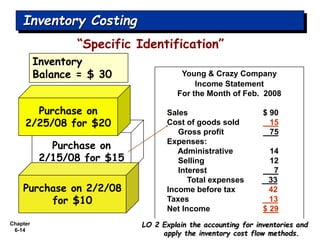
Young & Crazy Company makes the following purchases:
1. One item on 2/2/08 for $10
2. One item on 2/15/08 for $15
3. One item on 2/25/08 for $20
Young & Crazy Company sells one item on 2/28/08 for
$90. What would be the balance of ending inventory,
cost of goods sold, and net income for the month ended
Feb. 28, 2008, assuming the company used the Specific
Identification method to cost inventories and the item
purchased on 2/15/08 is sold? Assume a tax rate of
30%.
Example
Inventory Costing
LO 2 Explain the accounting for inventories and
apply the inventory cost flow methods.
Chapter
6-14
Purchase on
2/15/08 for $15
Young & Crazy Company
Income Statement
For the Month of Feb. 2008
Sales $ 90
Cost of goods sold 15
Gross profit 75
Expenses:
Administrative 14
Selling 12
Interest 7
Total expenses 33
Income before tax 42
Taxes 13
Net Income $ 29
“Specific Identification”
Inventory Costing
LO 2 Explain the accounting for inventories and
apply the inventory cost flow methods.
Inventory
Balance = $ 30
Purchase on 2/2/08
for $10
Purchase on
2/25/08 for $20
Chapter
6-15
An actual physical flow costing method in which
items still in inventory are specifically costed to
arrive at the total cost of the ending inventory.
Practice is relatively rare.
Most companies make assumptions (Cost Flow
Assumptions) about which units were sold.
Specific Identification Method
Inventory Costing
LO 2 Explain the accounting for inventories and
apply the inventory cost flow methods.
Chapter
6-16
LO 2 Explain the accounting for inventories and
apply the inventory cost flow methods.
Inventory Costing – Cost Flow Assumptions
Illustration 6-11
Use of cost flow methods in
major U.S. companies
Cost Flow Assumption
does not need to equal
Physical Movement of
Goods
Chapter
6-17
Young & Crazy Company makes the following purchases:
1. One item on 2/2/08 for $10
2. One item on 2/15/08 for $15
3. One item on 2/25/08 for $20
Young & Crazy Company sells one item on 2/28/08 for
$90. What would be the balance of ending inventory,
cost of goods sold, and net income for the month ended
Feb. 2008, assuming the company used the FIFO,
LIFO, and Average-cost flow assumptions? Assume a
tax rate of 30%.
Example
Inventory Costing – Cost Flow Assumptions
LO 2 Explain the accounting for inventories and
apply the inventory cost flow methods.
Chapter
6-18
Earliest goods purchased are first to be
sold.
Often parallels actual physical flow of
merchandise.
Generally good business practice to sell
oldest units first.
“First-In-First-Out (FIFO)”
LO 2 Explain the accounting for inventories and
apply the inventory cost flow methods.
Inventory Costing – Cost Flow Assumptions
Chapter
6-19
Purchase on
2/2/08 for $10
Purchase on
2/15/08 for $15
Purchase on
2/25/08 for $20
Inventory
Balance = $ 35
Young & Crazy Company
Income Statement
For the Month of Feb. 2008
Sales $ 90
Cost of goods sold 10
Gross profit 80
Expenses:
Administrative 14
Selling 12
Interest 7
Total expenses 33
Income before tax 47
Taxes 14
Net Income $ 33
“First-In-First-Out (FIFO)”
LO 2 Explain the accounting for inventories and
apply the inventory cost flow methods.
Inventory Costing – Cost Flow Assumptions
Chapter
6-20
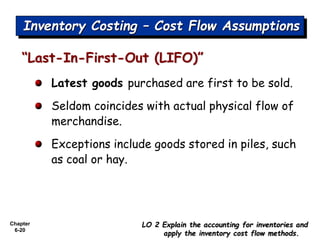
Latest goods purchased are first to be sold.
Seldom coincides with actual physical flow of
merchandise.
Exceptions include goods stored in piles, such
as coal or hay.
“Last-In-First-Out (LIFO)”
LO 2 Explain the accounting for inventories and
apply the inventory cost flow methods.
Inventory Costing – Cost Flow Assumptions
Chapter
6-21
Purchase on
2/2/08 for $10
Purchase on
2/15/08 for $15
Inventory
Balance = $ 25
Purchase on
2/25/08 for $20
Young & Crazy Company
Income Statement
For the Month of Feb. 2008
Sales $ 90
Cost of goods sold 20
Gross profit 70
Expenses:
Administrative 14
Selling 12
Interest 7
Total expenses 33
Income before tax 37
Taxes 11
Net Income $ 26
“Last-In-First-Out (LIFO)”
LO 2 Explain the accounting for inventories and
apply the inventory cost flow methods.
Inventory Costing – Cost Flow Assumptions
Chapter
6-22
Allocates cost of goods available for sale on
the basis of weighted average unit cost
incurred.
Assumes goods are similar in nature.
Applies weighted average unit cost to the
units on hand to determine cost of the ending
inventory.
“Average-Cost”
LO 2 Explain the accounting for inventories and
apply the inventory cost flow methods.
Inventory Costing – Cost Flow Assumptions
Chapter
6-23
Purchase on
2/2/08 for $10
Purchase on
2/15/08 for $15
Purchase on
2/25/08 for $20
Inventory
Balance = $ 30
Young & Crazy Company
Income Statement
For the Month of Feb. 2008
Sales $ 90
Cost of goods sold 15
Gross profit 75
Expenses:
Administrative 14
Selling 12
Interest 7
Total expenses 33
Income before tax 42
Taxes 13
Net Income $ 29
“Average Cost”
LO 2 Explain the accounting for inventories and
apply the inventory cost flow methods.
Inventory Costing – Cost Flow Assumptions
Chapter
6-24
FIFO
LO 3 Explain the financial effects of the inventory cost flow assumptions.
Inventory Costing – Cost Flow Assumptions
Sales $90 $90 $90
Cost of goods sold 10 15 20
Gross profit 80 75 70
Admin. & selling expense 33 33 33
Income before taxes 47 42 37
Income tax expense 14 13 11
Net income $33 $29 $26
Inventory balance $35 $30 $25
LIFO
Average
Comparative Financial Statement Summary
Chapter
6-25
In Period of Rising Prices, FIFO Reports:
FIFO
Inventory Costing – Cost Flow Assumptions
Highest
Lowest
Sales $90 $90 $90
Cost of goods sold 10 15 20
Gross profit 80 75 70
Admin. & selling expense 33 33 33
Income before taxes 47 42 37
Income tax expense 14 13 11
Net income $33 $29 $26
Inventory balance $35 $30 $25
LIFO
Average
LO 3 Explain the financial effects of the inventory cost flow assumptions.
Chapter
6-26
In Period of Rising Prices, LIFO Reports:
FIFO
Inventory Costing – Cost Flow Assumptions
Highest
Lowest
Sales $90 $90 $90
Cost of goods sold 10 15 20
Gross profit 80 75 70
Admin. & selling expense 33 33 33
Income before taxes 47 42 37
Income tax expense 14 13 11
Net income $33 $29 $26
Inventory balance $35 $30 $25
LIFO
Average
LO 3 Explain the financial effects of the inventory cost flow assumptions.
Chapter
6-27
The cost flow method that often parallels the
actual physical flow of merchandise is the:
a. FIFO method.
b. LIFO method.
c. average cost method.
d. gross profit method.
Review Question
Inventory Costing – Cost Flow Assumptions
LO 3 Explain the financial effects of the inventory cost flow assumptions.
Chapter
6-28
In a period of inflation, the cost flow method
that results in the lowest income taxes is the:
a. FIFO method.
b. LIFO method.
c. average cost method.
d. gross profit method.
Review Question
Inventory Costing – Cost Flow Assumptions
LO 3 Explain the financial effects of the inventory cost flow assumptions.
Chapter
6-29
Q6-12 Casey Company has been using the FIFO
cost flow method during a prolonged period of
rising prices. During the same time period,
Casey has been paying out all of its net income
as dividends. What adverse effects may
result from this policy?
Discussion Question
See notes page for discussion
Inventory Costing – Cost Flow Assumptions
LO 3 Explain the financial effects of the inventory cost flow assumptions.
Chapter
6-30
Using Cost Flow Methods Consistently
Inventory Costing
Method should be used consistently, enhances
comparability.
Although consistency is preferred, a company
may change its inventory costing method.
Illustration 6-14
Disclosure of change
in cost flow method
LO 3 Explain the financial effects of the inventory cost flow assumptions.
Chapter
6-31
Lower-of-Cost-or-Market
Inventory Costing
LO 4 Explain the lower-of-cost-or-market
basis of accounting for inventories.
When the value of inventory is lower than its cost
Companies can “write down” the inventory to
its market value in the period in which the
price decline occurs.
Market value = Replacement Cost
Example of conservatism.
Chapter
6-32
Lower-of-Cost-or-Market
Inventory Costing
LO 4 Explain the lower-of-cost-or-market
basis of accounting for inventories.
BE6-7 Alou Appliance Center accumulates the
following cost and market data at December 31.
Inventory Cost Market Lower of
Categories Data Data Cost or Market
Cameras 12,000
$ 12,100
$
Camcorders 9,500 9,700
VCRs 14,000 12,800
Compute the lower-of-cost-or-market valuation for the
company’s total inventory.
$ 12,000
9,000
12,800
$ 33,800
Chapter
6-33
Inventory Errors
LO 5 Indicate the effects of inventory errors on the financial statements.
Common Cause:
Failure to count or price inventory correctly.
Not properly recognizing the transfer of
legal title to goods in transit.
Errors affect both the income statement and
balance sheet.
Chapter
6-34
Inventory Errors
LO 5 Indicate the effects of inventory errors on the financial statements.
Inventory errors affect the computation of cost of
goods sold and net income.
Income Statement Effects
Illustration 6-17
Illustration 6-16
Chapter
6-35
Inventory Errors
LO 5 Indicate the effects of inventory errors on the financial statements.
Inventory errors affect the computation of cost of
goods sold and net income in two periods.
An error in ending inventory of the current period
will have a reverse effect on net income of the
next accounting period.
Over the two years, the total net income is correct
because the errors offset each other.
The ending inventory depends entirely on the
accuracy of taking and costing the inventory.
Income Statement Effects
Chapter
6-36
Inventory Errors
LO 5 Indicate the effects of inventory errors on the financial statements.
Incorrect Correct Incorrect Correct
Sales 80,000
$ 80,000
$ 90,000
$ 90,000
$
Beginning inventory 20,000 20,000 12,000 15,000
Cost of goods purchased 40,000 40,000 68,000 68,000
Cost of goods available 60,000 60,000 80,000 83,000
Ending inventory 12,000 15,000 23,000 23,000
Cost of good sold 48,000 45,000 57,000 60,000
Gross profit 32,000 35,000 33,000 30,000
Operating expenses 10,000 10,000 20,000 20,000
Net income 22,000
$ 25,000
$ 13,000
$ 10,000
$
2008 2009
($3,000)
Net Income
understated
$3,000
Net Income
overstated
Combined income for
2-year period is correct.
Illustration 6-18
Chapter
6-37
Understating ending inventory will overstate:
a. assets.
b. cost of goods sold.
c. net income.
d. owner's equity.
Review Question
Inventory Errors
LO 5 Indicate the effects of inventory errors on the financial statements.
Chapter
6-38
Inventory Errors
LO 5 Indicate the effects of inventory errors on the financial statements.
Effect of inventory errors on the balance sheet is
determined by using the basic accounting equation:.
Balance Sheet Effects
Illustration 6-16
Illustration 6-19
Chapter
6-39
Statement Presentation and Analysis
Balance Sheet - Inventory classified as current
asset.
Income Statement - Cost of goods sold subtracted
from sales.
There also should be disclosure of
1) major inventory classifications,
2) basis of accounting (cost or LCM), and
3) costing method (FIFO, LIFO, or average).
Presentation
LO 5 Indicate the effects of inventory errors on the financial statements.
Chapter
6-40
Statement Presentation and Analysis
Inventory management is a double-edged sword
1. High Inventory Levels - may incur high carrying
costs (e.g., investment, storage, insurance,
obsolescence, and damage).
2. Low Inventory Levels – may lead to stockouts and
lost sales.
Analysis
LO 6 Compute and interpret the inventory turnover ratio.
Chapter
6-41
Inventory turnover measures the number of times
on average the inventory is sold during the period.
Cost of Goods Sold
Average Inventory
Inventory
Turnover
=
Statement Presentation and Analysis
Days in inventory measures the average number of
days inventory is held.
Days in Year (365)
Inventory Turnover
Days in
Inventory
=
LO 6 Compute and interpret the inventory turnover ratio.
Chapter
6-42
BE6-9 At December 31, 2008, the following
information was available for J. Graff Company: ending
inventory $40,000, beginning inventory $60,000, cost
of goods sold $270,000, and sales revenue $380,000.
Calculate inventory turnover and days in inventory for
J. Graff Company.
Statement Presentation and Analysis
LO 6 Compute and interpret the inventory turnover ratio.
$270,000
($60,000 + 40,000) / 2
5.4
=
Inventory
Turnover
365
5.4
67.59
days
=
Days in
Inventory
Chapter
6-43
Inventory Cost Flow Methods in Perpetual Inventory
Systems
Illustration 6A-1
The following data from Houston Electronics will be used to
illustrate inventory costing under a perpetual system.
LO 7 Apply the inventory cost flow methods to perpetual inventory
records.
Chapter
6-44
Inventory Cost Flow Methods in Perpetual Inventory
Systems
Cost of goods sold
Ending inventory
Computation of cost of goods sold and ending inventory under FIFO
for Houston Electronics.
LO 7 Apply the inventory cost flow methods to perpetual inventory
records.
Illustration 6A-2
Chapter
6-45
Inventory Cost Flow Methods in Perpetual Inventory
Systems
Ending inventory
Computation of cost of goods sold and ending inventory under LIFO
for Houston Electronics.
LO 7 Apply the inventory cost flow methods to perpetual inventory
records.
Illustration 6A-3
Cost of goods sold
Chapter
6-46
Inventory Cost Flow Methods in Perpetual Inventory
Systems
Computation of cost of goods sold and ending inventory under moving
average for Houston Electronics.
LO 7 Apply the inventory cost flow methods to perpetual inventory
records.
Illustration 6A-4
Cost of goods sold Ending inventory
Chapter
6-47
“Copyright © 2008 John Wiley & Sons, Inc. All rights reserved.
Reproduction or translation of this work beyond that permitted
in Section 117 of the 1976 United States Copyright Act without
the express written permission of the copyright owner is
unlawful. Request for further information should be addressed
to the Permissions Department, John Wiley & Sons, Inc. The
purchaser may make back-up copies for his/her own use only
and not for distribution or resale. The Publisher assumes no
responsibility for errors, omissions, or damages, caused by the
use of these programs or from the use of the information
contained herein.”
Copyright

Wey_AP_8e_Ch06_Revised.pptx

  • 1.
  • 2.
  • 3.
    Chapter 6-3 1. Describe thesteps in determining inventory quantities. 2. Explain the accounting for inventories and apply the inventory cost flow methods. 3. Explain the financial effects of the inventory cost flow assumptions. 4. Explain the lower-of-cost-or-market basis of accounting for inventories. 5. Indicate the effects of inventory errors on the financial statements. 6. Compute and interpret the inventory turnover ratio. Study Objectives
  • 4.
    Chapter 6-4 Reporting and AnalyzingInventory Taking a physical inventory Determining ownership of goods Classifying Inventory Determining Inventory Quantities Inventory Costing Inventory Errors Statement Presentation and Analysis Finished goods Work in process Raw materials Specific identification Cost flow assumptions Financial statement and tax effects Consistent use Lower-of- cost-or- market Income statement effects Balance sheet effects Presentation Analysis
  • 5.
    Chapter 6-5 Classifying Inventory One Classification: Merchandise Inventory ThreeClassifications: Raw Materials Work in Process Finished Goods Merchandising Company Manufacturing Company Regardless of the classification, companies report all inventories under Current Assets on the balance sheet.
  • 6.
    Chapter 6-6 Physical Inventory takenfor two reasons: Perpetual System 1. Check accuracy of inventory records. 2. Determine amount of inventory lost (wasted raw materials, shoplifting, or employee theft). Periodic System 1. Determine the inventory on hand 2. Determine the cost of goods sold for the period. Determining Inventory Quantities LO 1 Describe the steps in determining inventory quantities.
  • 7.
    Chapter 6-7 Involves counting, weighing,or measuring each kind of inventory on hand. Taken, when the business is closed or when business is slow. at end of the accounting period. Taking a Physical Inventory Determining Inventory Quantities LO 1 Describe the steps in determining inventory quantities.
  • 8.
    Chapter 6-8 Goods in Transit Purchasedgoods not yet received. Sold goods not yet delivered. Determining Ownership of Goods Determining Inventory Quantities LO 1 Describe the steps in determining inventory quantities. Goods in transit should be included in the inventory of the company that has legal title to the goods. Legal title is determined by the terms of sale.
  • 9.
    Chapter 6-9 Determining Inventory Quantities LO1 Describe the steps in determining inventory quantities. Illustration 6-1 Ownership of the goods passes to the buyer when the public carrier accepts the goods from the seller. Ownership of the goods remains with the seller until the goods reach the buyer. Terms of Sale
  • 10.
    Chapter 6-10 Goods in transitshould be included in the inventory of the buyer when the: a. public carrier accepts the goods from the seller. b. goods reach the buyer. c. terms of sale are FOB destination. d. terms of sale are FOB shipping point. Review Question Determining Inventory Quantities LO 1 Describe the steps in determining inventory quantities.
  • 11.
    Chapter 6-11 Consigned Goods •In somelines of business, it is common to hold the goods of other parties and try to sell the goods for them for a fee, but without taking ownership of goods. •These are called consigned goods. Determining Ownership of Goods Determining Inventory Quantities LO 1 Describe the steps in determining inventory quantities.
  • 12.
    Chapter 6-12 Unit costs canbe applied to quantities on hand using the following costing methods: Specific Identification First-in, first-out (FIFO) Last-in, first-out (LIFO) Average-cost Inventory Costing LO 2 Explain the accounting for inventories and apply the inventory cost flow methods. Cost Flow Assumptions
  • 13.
    Chapter 6-13 Young & CrazyCompany makes the following purchases: 1. One item on 2/2/08 for $10 2. One item on 2/15/08 for $15 3. One item on 2/25/08 for $20 Young & Crazy Company sells one item on 2/28/08 for $90. What would be the balance of ending inventory, cost of goods sold, and net income for the month ended Feb. 28, 2008, assuming the company used the Specific Identification method to cost inventories and the item purchased on 2/15/08 is sold? Assume a tax rate of 30%. Example Inventory Costing LO 2 Explain the accounting for inventories and apply the inventory cost flow methods.
  • 14.
    Chapter 6-14 Purchase on 2/15/08 for$15 Young & Crazy Company Income Statement For the Month of Feb. 2008 Sales $ 90 Cost of goods sold 15 Gross profit 75 Expenses: Administrative 14 Selling 12 Interest 7 Total expenses 33 Income before tax 42 Taxes 13 Net Income $ 29 “Specific Identification” Inventory Costing LO 2 Explain the accounting for inventories and apply the inventory cost flow methods. Inventory Balance = $ 30 Purchase on 2/2/08 for $10 Purchase on 2/25/08 for $20
  • 15.
    Chapter 6-15 An actual physicalflow costing method in which items still in inventory are specifically costed to arrive at the total cost of the ending inventory. Practice is relatively rare. Most companies make assumptions (Cost Flow Assumptions) about which units were sold. Specific Identification Method Inventory Costing LO 2 Explain the accounting for inventories and apply the inventory cost flow methods.
  • 16.
    Chapter 6-16 LO 2 Explainthe accounting for inventories and apply the inventory cost flow methods. Inventory Costing – Cost Flow Assumptions Illustration 6-11 Use of cost flow methods in major U.S. companies Cost Flow Assumption does not need to equal Physical Movement of Goods
  • 17.
    Chapter 6-17 Young & CrazyCompany makes the following purchases: 1. One item on 2/2/08 for $10 2. One item on 2/15/08 for $15 3. One item on 2/25/08 for $20 Young & Crazy Company sells one item on 2/28/08 for $90. What would be the balance of ending inventory, cost of goods sold, and net income for the month ended Feb. 2008, assuming the company used the FIFO, LIFO, and Average-cost flow assumptions? Assume a tax rate of 30%. Example Inventory Costing – Cost Flow Assumptions LO 2 Explain the accounting for inventories and apply the inventory cost flow methods.
  • 18.
    Chapter 6-18 Earliest goods purchasedare first to be sold. Often parallels actual physical flow of merchandise. Generally good business practice to sell oldest units first. “First-In-First-Out (FIFO)” LO 2 Explain the accounting for inventories and apply the inventory cost flow methods. Inventory Costing – Cost Flow Assumptions
  • 19.
    Chapter 6-19 Purchase on 2/2/08 for$10 Purchase on 2/15/08 for $15 Purchase on 2/25/08 for $20 Inventory Balance = $ 35 Young & Crazy Company Income Statement For the Month of Feb. 2008 Sales $ 90 Cost of goods sold 10 Gross profit 80 Expenses: Administrative 14 Selling 12 Interest 7 Total expenses 33 Income before tax 47 Taxes 14 Net Income $ 33 “First-In-First-Out (FIFO)” LO 2 Explain the accounting for inventories and apply the inventory cost flow methods. Inventory Costing – Cost Flow Assumptions
  • 20.
    Chapter 6-20 Latest goods purchasedare first to be sold. Seldom coincides with actual physical flow of merchandise. Exceptions include goods stored in piles, such as coal or hay. “Last-In-First-Out (LIFO)” LO 2 Explain the accounting for inventories and apply the inventory cost flow methods. Inventory Costing – Cost Flow Assumptions
  • 21.
    Chapter 6-21 Purchase on 2/2/08 for$10 Purchase on 2/15/08 for $15 Inventory Balance = $ 25 Purchase on 2/25/08 for $20 Young & Crazy Company Income Statement For the Month of Feb. 2008 Sales $ 90 Cost of goods sold 20 Gross profit 70 Expenses: Administrative 14 Selling 12 Interest 7 Total expenses 33 Income before tax 37 Taxes 11 Net Income $ 26 “Last-In-First-Out (LIFO)” LO 2 Explain the accounting for inventories and apply the inventory cost flow methods. Inventory Costing – Cost Flow Assumptions
  • 22.
    Chapter 6-22 Allocates cost ofgoods available for sale on the basis of weighted average unit cost incurred. Assumes goods are similar in nature. Applies weighted average unit cost to the units on hand to determine cost of the ending inventory. “Average-Cost” LO 2 Explain the accounting for inventories and apply the inventory cost flow methods. Inventory Costing – Cost Flow Assumptions
  • 23.
    Chapter 6-23 Purchase on 2/2/08 for$10 Purchase on 2/15/08 for $15 Purchase on 2/25/08 for $20 Inventory Balance = $ 30 Young & Crazy Company Income Statement For the Month of Feb. 2008 Sales $ 90 Cost of goods sold 15 Gross profit 75 Expenses: Administrative 14 Selling 12 Interest 7 Total expenses 33 Income before tax 42 Taxes 13 Net Income $ 29 “Average Cost” LO 2 Explain the accounting for inventories and apply the inventory cost flow methods. Inventory Costing – Cost Flow Assumptions
  • 24.
    Chapter 6-24 FIFO LO 3 Explainthe financial effects of the inventory cost flow assumptions. Inventory Costing – Cost Flow Assumptions Sales $90 $90 $90 Cost of goods sold 10 15 20 Gross profit 80 75 70 Admin. & selling expense 33 33 33 Income before taxes 47 42 37 Income tax expense 14 13 11 Net income $33 $29 $26 Inventory balance $35 $30 $25 LIFO Average Comparative Financial Statement Summary
  • 25.
    Chapter 6-25 In Period ofRising Prices, FIFO Reports: FIFO Inventory Costing – Cost Flow Assumptions Highest Lowest Sales $90 $90 $90 Cost of goods sold 10 15 20 Gross profit 80 75 70 Admin. & selling expense 33 33 33 Income before taxes 47 42 37 Income tax expense 14 13 11 Net income $33 $29 $26 Inventory balance $35 $30 $25 LIFO Average LO 3 Explain the financial effects of the inventory cost flow assumptions.
  • 26.
    Chapter 6-26 In Period ofRising Prices, LIFO Reports: FIFO Inventory Costing – Cost Flow Assumptions Highest Lowest Sales $90 $90 $90 Cost of goods sold 10 15 20 Gross profit 80 75 70 Admin. & selling expense 33 33 33 Income before taxes 47 42 37 Income tax expense 14 13 11 Net income $33 $29 $26 Inventory balance $35 $30 $25 LIFO Average LO 3 Explain the financial effects of the inventory cost flow assumptions.
  • 27.
    Chapter 6-27 The cost flowmethod that often parallels the actual physical flow of merchandise is the: a. FIFO method. b. LIFO method. c. average cost method. d. gross profit method. Review Question Inventory Costing – Cost Flow Assumptions LO 3 Explain the financial effects of the inventory cost flow assumptions.
  • 28.
    Chapter 6-28 In a periodof inflation, the cost flow method that results in the lowest income taxes is the: a. FIFO method. b. LIFO method. c. average cost method. d. gross profit method. Review Question Inventory Costing – Cost Flow Assumptions LO 3 Explain the financial effects of the inventory cost flow assumptions.
  • 29.
    Chapter 6-29 Q6-12 Casey Companyhas been using the FIFO cost flow method during a prolonged period of rising prices. During the same time period, Casey has been paying out all of its net income as dividends. What adverse effects may result from this policy? Discussion Question See notes page for discussion Inventory Costing – Cost Flow Assumptions LO 3 Explain the financial effects of the inventory cost flow assumptions.
  • 30.
    Chapter 6-30 Using Cost FlowMethods Consistently Inventory Costing Method should be used consistently, enhances comparability. Although consistency is preferred, a company may change its inventory costing method. Illustration 6-14 Disclosure of change in cost flow method LO 3 Explain the financial effects of the inventory cost flow assumptions.
  • 31.
    Chapter 6-31 Lower-of-Cost-or-Market Inventory Costing LO 4Explain the lower-of-cost-or-market basis of accounting for inventories. When the value of inventory is lower than its cost Companies can “write down” the inventory to its market value in the period in which the price decline occurs. Market value = Replacement Cost Example of conservatism.
  • 32.
    Chapter 6-32 Lower-of-Cost-or-Market Inventory Costing LO 4Explain the lower-of-cost-or-market basis of accounting for inventories. BE6-7 Alou Appliance Center accumulates the following cost and market data at December 31. Inventory Cost Market Lower of Categories Data Data Cost or Market Cameras 12,000 $ 12,100 $ Camcorders 9,500 9,700 VCRs 14,000 12,800 Compute the lower-of-cost-or-market valuation for the company’s total inventory. $ 12,000 9,000 12,800 $ 33,800
  • 33.
    Chapter 6-33 Inventory Errors LO 5Indicate the effects of inventory errors on the financial statements. Common Cause: Failure to count or price inventory correctly. Not properly recognizing the transfer of legal title to goods in transit. Errors affect both the income statement and balance sheet.
  • 34.
    Chapter 6-34 Inventory Errors LO 5Indicate the effects of inventory errors on the financial statements. Inventory errors affect the computation of cost of goods sold and net income. Income Statement Effects Illustration 6-17 Illustration 6-16
  • 35.
    Chapter 6-35 Inventory Errors LO 5Indicate the effects of inventory errors on the financial statements. Inventory errors affect the computation of cost of goods sold and net income in two periods. An error in ending inventory of the current period will have a reverse effect on net income of the next accounting period. Over the two years, the total net income is correct because the errors offset each other. The ending inventory depends entirely on the accuracy of taking and costing the inventory. Income Statement Effects
  • 36.
    Chapter 6-36 Inventory Errors LO 5Indicate the effects of inventory errors on the financial statements. Incorrect Correct Incorrect Correct Sales 80,000 $ 80,000 $ 90,000 $ 90,000 $ Beginning inventory 20,000 20,000 12,000 15,000 Cost of goods purchased 40,000 40,000 68,000 68,000 Cost of goods available 60,000 60,000 80,000 83,000 Ending inventory 12,000 15,000 23,000 23,000 Cost of good sold 48,000 45,000 57,000 60,000 Gross profit 32,000 35,000 33,000 30,000 Operating expenses 10,000 10,000 20,000 20,000 Net income 22,000 $ 25,000 $ 13,000 $ 10,000 $ 2008 2009 ($3,000) Net Income understated $3,000 Net Income overstated Combined income for 2-year period is correct. Illustration 6-18
  • 37.
    Chapter 6-37 Understating ending inventorywill overstate: a. assets. b. cost of goods sold. c. net income. d. owner's equity. Review Question Inventory Errors LO 5 Indicate the effects of inventory errors on the financial statements.
  • 38.
    Chapter 6-38 Inventory Errors LO 5Indicate the effects of inventory errors on the financial statements. Effect of inventory errors on the balance sheet is determined by using the basic accounting equation:. Balance Sheet Effects Illustration 6-16 Illustration 6-19
  • 39.
    Chapter 6-39 Statement Presentation andAnalysis Balance Sheet - Inventory classified as current asset. Income Statement - Cost of goods sold subtracted from sales. There also should be disclosure of 1) major inventory classifications, 2) basis of accounting (cost or LCM), and 3) costing method (FIFO, LIFO, or average). Presentation LO 5 Indicate the effects of inventory errors on the financial statements.
  • 40.
    Chapter 6-40 Statement Presentation andAnalysis Inventory management is a double-edged sword 1. High Inventory Levels - may incur high carrying costs (e.g., investment, storage, insurance, obsolescence, and damage). 2. Low Inventory Levels – may lead to stockouts and lost sales. Analysis LO 6 Compute and interpret the inventory turnover ratio.
  • 41.
    Chapter 6-41 Inventory turnover measuresthe number of times on average the inventory is sold during the period. Cost of Goods Sold Average Inventory Inventory Turnover = Statement Presentation and Analysis Days in inventory measures the average number of days inventory is held. Days in Year (365) Inventory Turnover Days in Inventory = LO 6 Compute and interpret the inventory turnover ratio.
  • 42.
    Chapter 6-42 BE6-9 At December31, 2008, the following information was available for J. Graff Company: ending inventory $40,000, beginning inventory $60,000, cost of goods sold $270,000, and sales revenue $380,000. Calculate inventory turnover and days in inventory for J. Graff Company. Statement Presentation and Analysis LO 6 Compute and interpret the inventory turnover ratio. $270,000 ($60,000 + 40,000) / 2 5.4 = Inventory Turnover 365 5.4 67.59 days = Days in Inventory
  • 43.
    Chapter 6-43 Inventory Cost FlowMethods in Perpetual Inventory Systems Illustration 6A-1 The following data from Houston Electronics will be used to illustrate inventory costing under a perpetual system. LO 7 Apply the inventory cost flow methods to perpetual inventory records.
  • 44.
    Chapter 6-44 Inventory Cost FlowMethods in Perpetual Inventory Systems Cost of goods sold Ending inventory Computation of cost of goods sold and ending inventory under FIFO for Houston Electronics. LO 7 Apply the inventory cost flow methods to perpetual inventory records. Illustration 6A-2
  • 45.
    Chapter 6-45 Inventory Cost FlowMethods in Perpetual Inventory Systems Ending inventory Computation of cost of goods sold and ending inventory under LIFO for Houston Electronics. LO 7 Apply the inventory cost flow methods to perpetual inventory records. Illustration 6A-3 Cost of goods sold
  • 46.
    Chapter 6-46 Inventory Cost FlowMethods in Perpetual Inventory Systems Computation of cost of goods sold and ending inventory under moving average for Houston Electronics. LO 7 Apply the inventory cost flow methods to perpetual inventory records. Illustration 6A-4 Cost of goods sold Ending inventory
  • 47.
    Chapter 6-47 “Copyright © 2008John Wiley & Sons, Inc. All rights reserved. Reproduction or translation of this work beyond that permitted in Section 117 of the 1976 United States Copyright Act without the express written permission of the copyright owner is unlawful. Request for further information should be addressed to the Permissions Department, John Wiley & Sons, Inc. The purchaser may make back-up copies for his/her own use only and not for distribution or resale. The Publisher assumes no responsibility for errors, omissions, or damages, caused by the use of these programs or from the use of the information contained herein.” Copyright

Editor's Notes

  • #4 1. On the topic, “Challenges Facing Financial Accounting,” what did the AICPA Special Committee on Financial Reporting suggest should be included in future financial statements? Non-financial Measurements (customer satisfaction indexes, backlog information, and reject rates on goods purchases). Forward-looking Information Soft Assets (a company’s know-how, market dominance, marketing setup, well-trained employees, and brand image). Timeliness (no real time financial information)
  • #5 Service Cost - Actuaries compute service cost as the present value of the new benefits earned by employees during the year. Future salary levels considered in calculation. Interest on Liability - Interest accrues each year on the PBO just as it does on any discounted debt. Actual Return on Plan Assets - Increase in pension funds from interest, dividends, and realized and unrealized changes in the fair market value of the plan assets. Amortization of Unrecognized Prior Service Cost - The cost of providing retroactive benefits is allocated to pension expense in the future, specifically to the remaining service-years of the affected employees. Gain or Loss - Volatility in pension expense can be caused by sudden and large changes in the market value of plan assets and by changes in the projected benefit obligation. Two items comprise the gain or loss: difference between the actual return and the expected return on plan assets and, amortization of the unrecognized net gain or loss from previous periods
  • #30 Question 6-12 (textbook) Barto Company is using the FIFO method of inventory costing. Cecil Company is using the LIFO method. Under FIFO, the latest goods purchased remain in inventory. Thus, the inventory on the balance sheet should be close to current costs. The reverse is true of the LIFO method. Barto Company will have the higher gross profit because cost of goods sold will include a higher proportion of goods purchased at earlier (lower) costs.