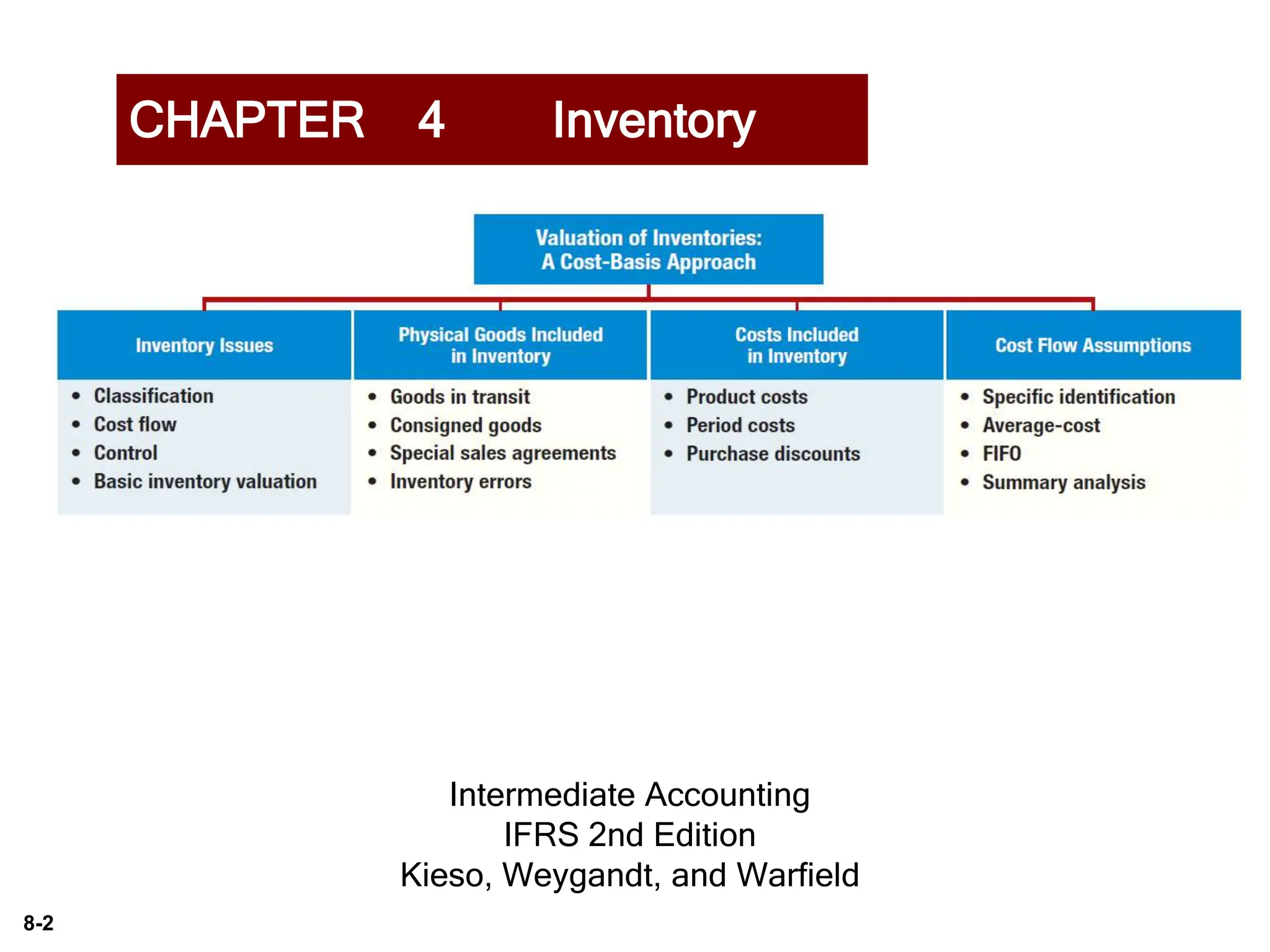
This document discusses accounting for inventories. It covers classifying inventory into raw materials, work in process and finished goods for manufacturing companies. It also discusses valuing inventory under the periodic and perpetual inventory systems. The document explains the basic issues in inventory valuation including determining ownership, costs included, and cost flow assumptions like specific identification, FIFO and average cost. It provides examples of applying inventory cost flow methods.
Slide
6-3
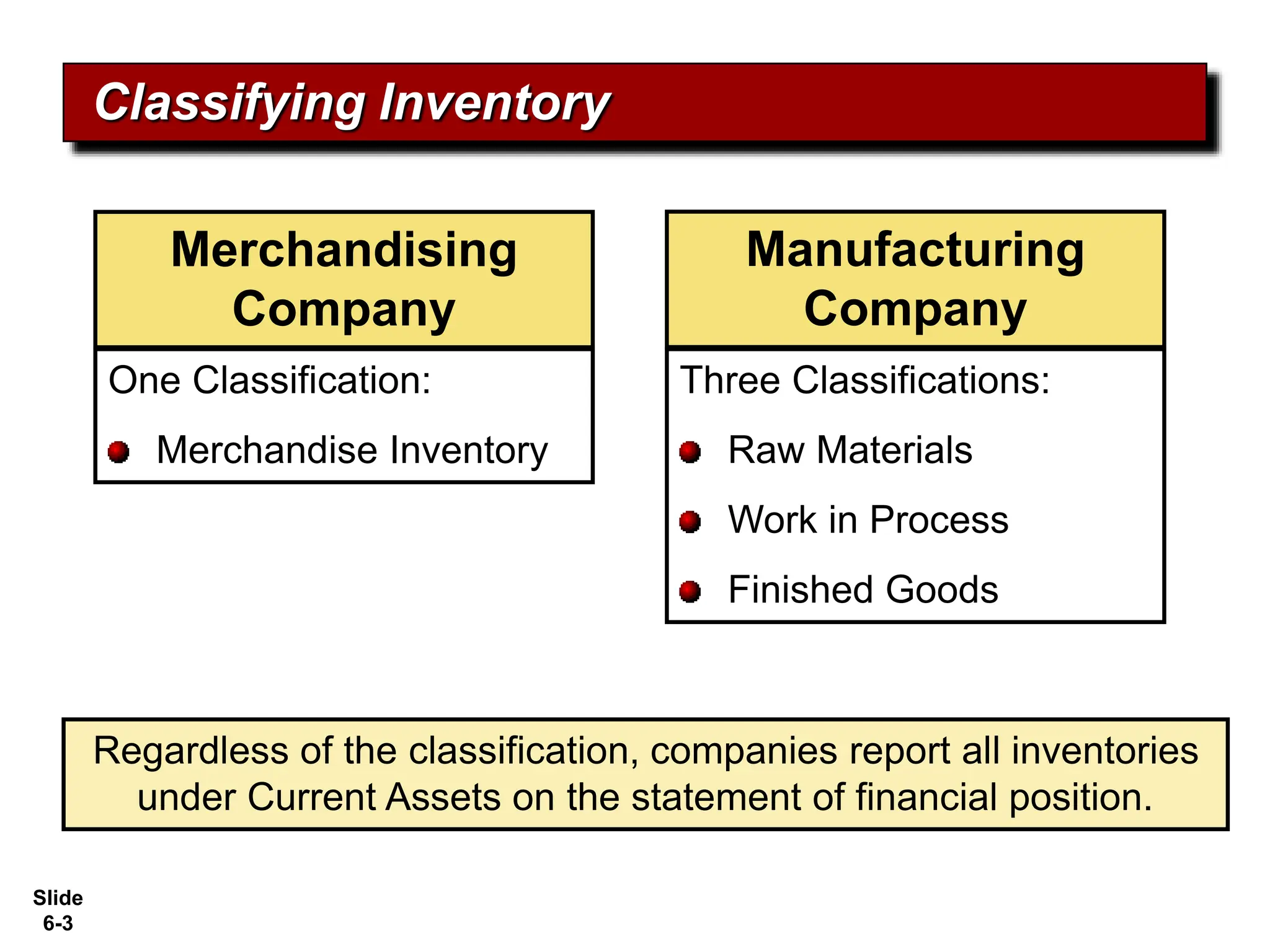
Classifying Inventory
One Classification:
MerchandiseInventory
Three Classifications:
Raw Materials
Work in Process
Finished Goods
Merchandising
Company
Manufacturing
Company
Regardless of the classification, companies report all inventories
under Current Assets on the statement of financial position.
4.
Slide
6-4
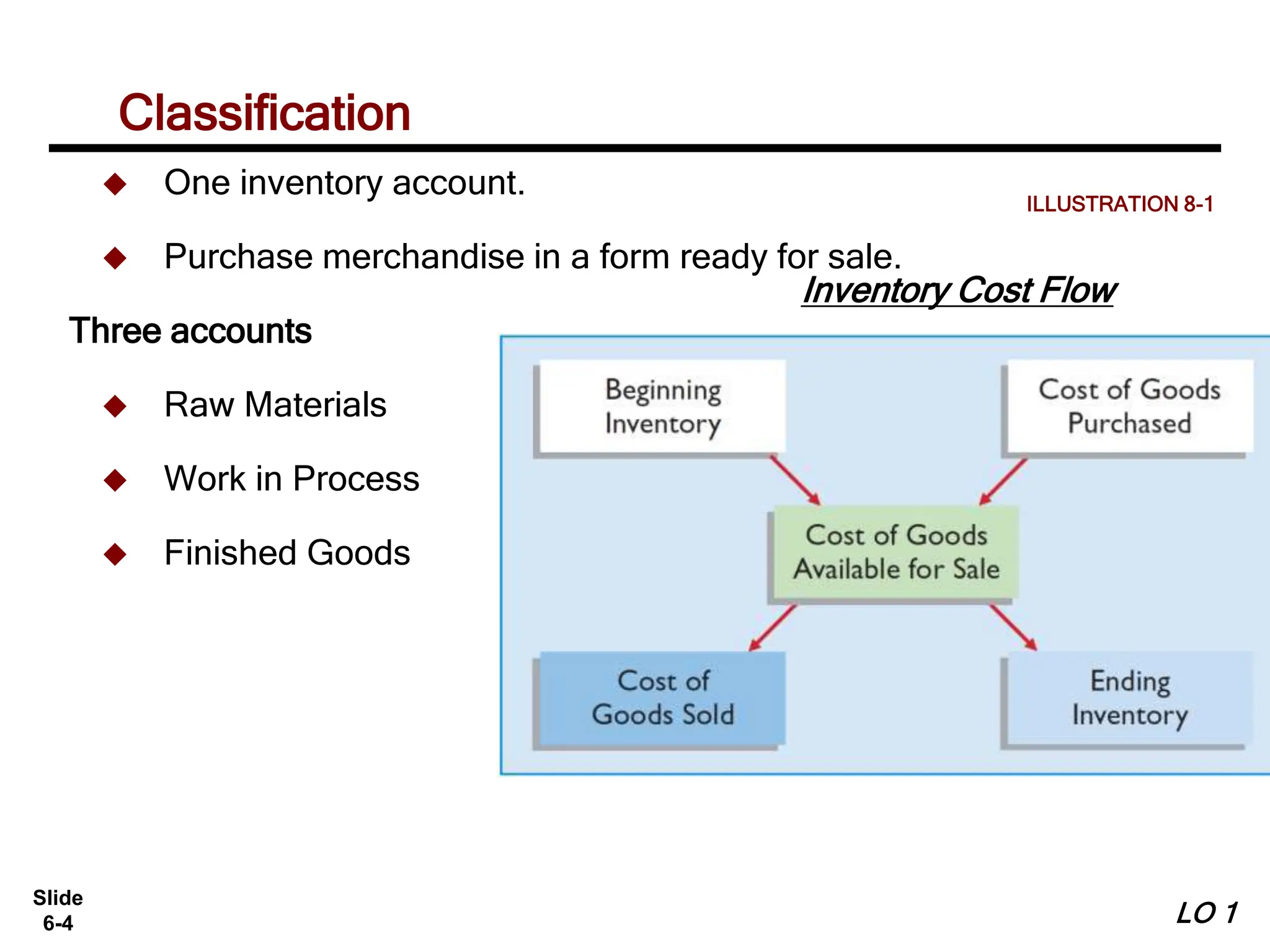
One inventoryaccount.
Purchase merchandise in a form ready for sale.
Three accounts
Raw Materials
Work in Process
Finished Goods
Classification
ILLUSTRATION 8-1
LO 1
Inventory Cost Flow
5.
Slide
6-5
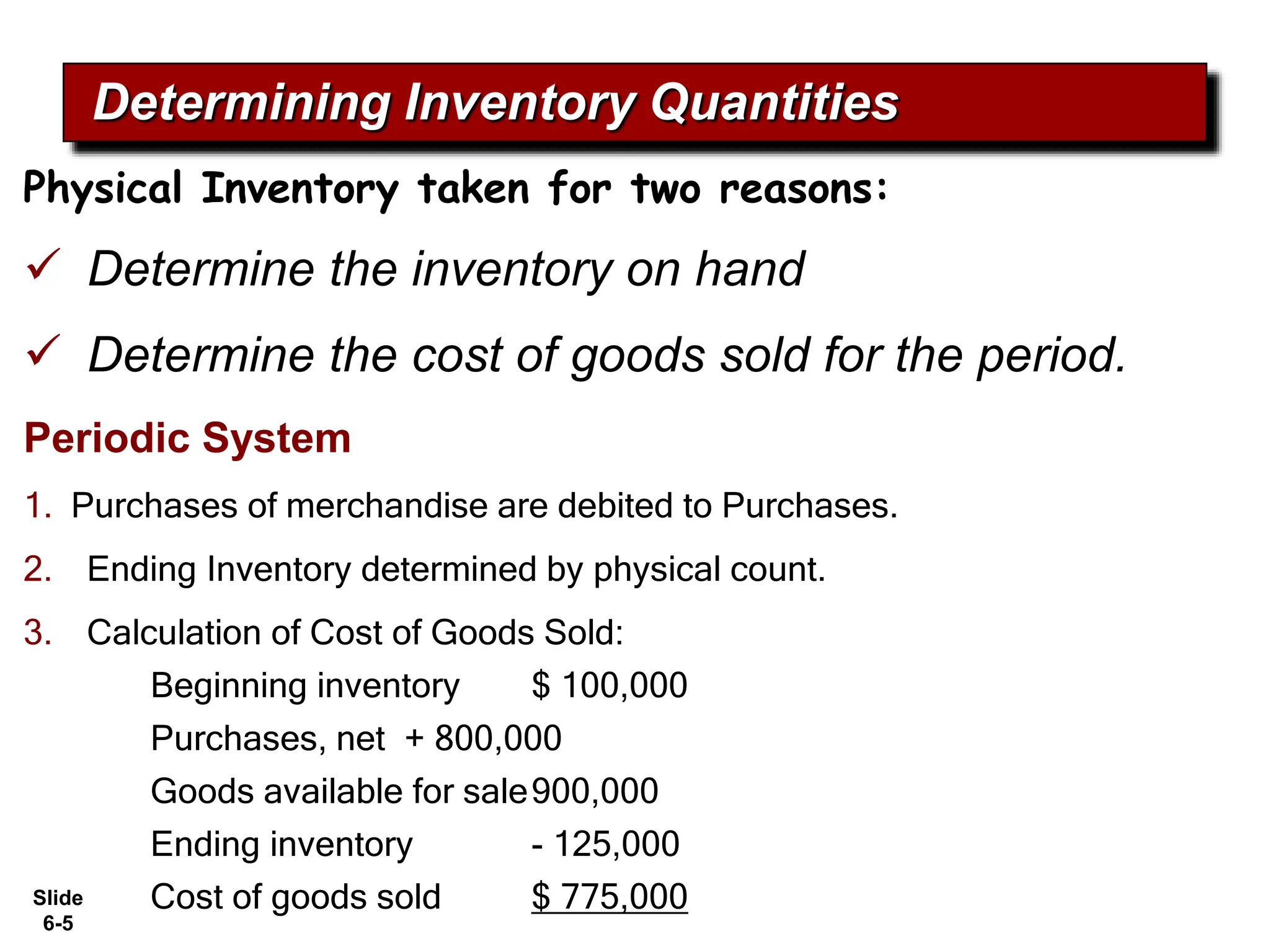
Physical Inventory takenfor two reasons:
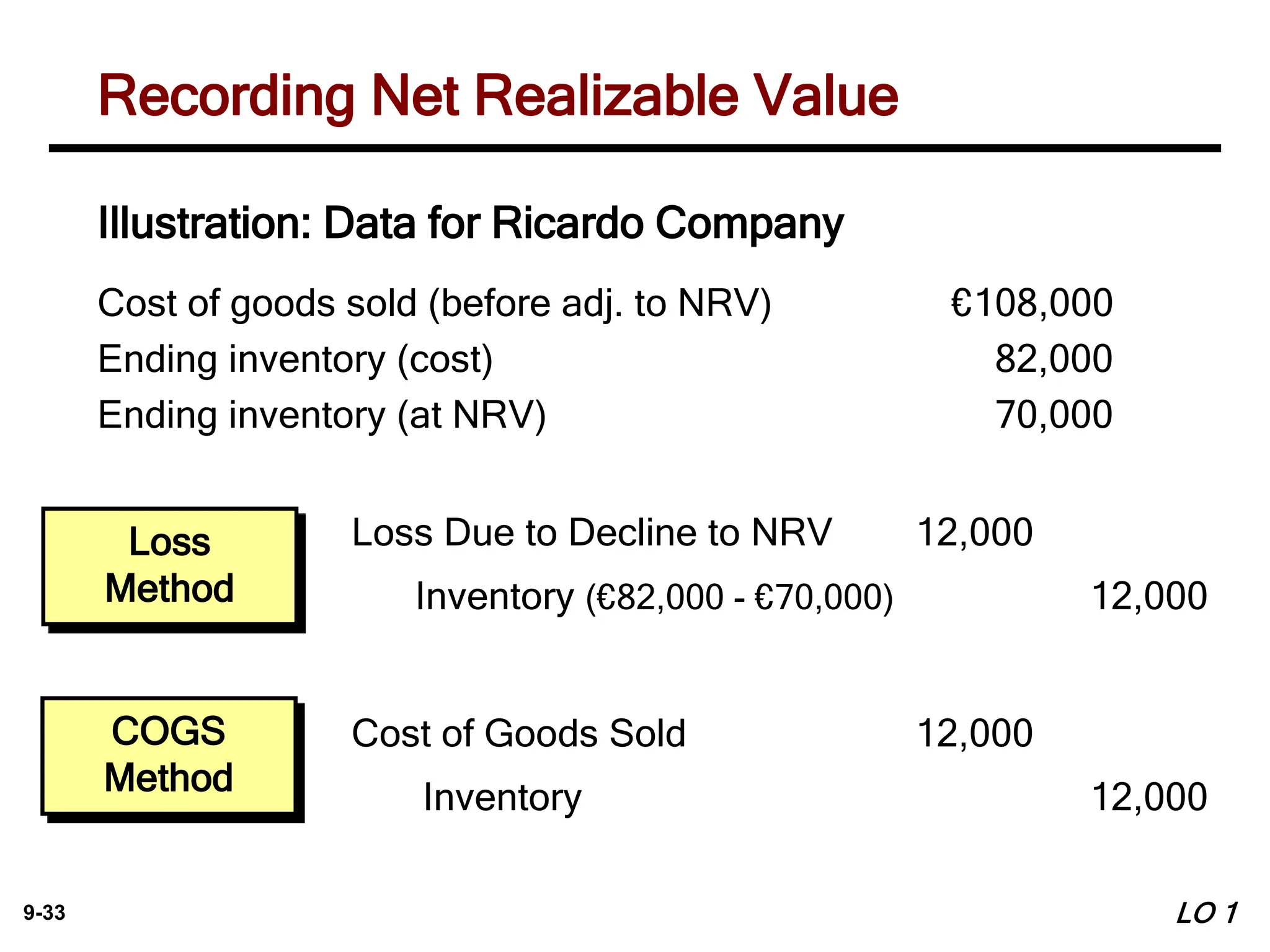
Determine the inventory on hand
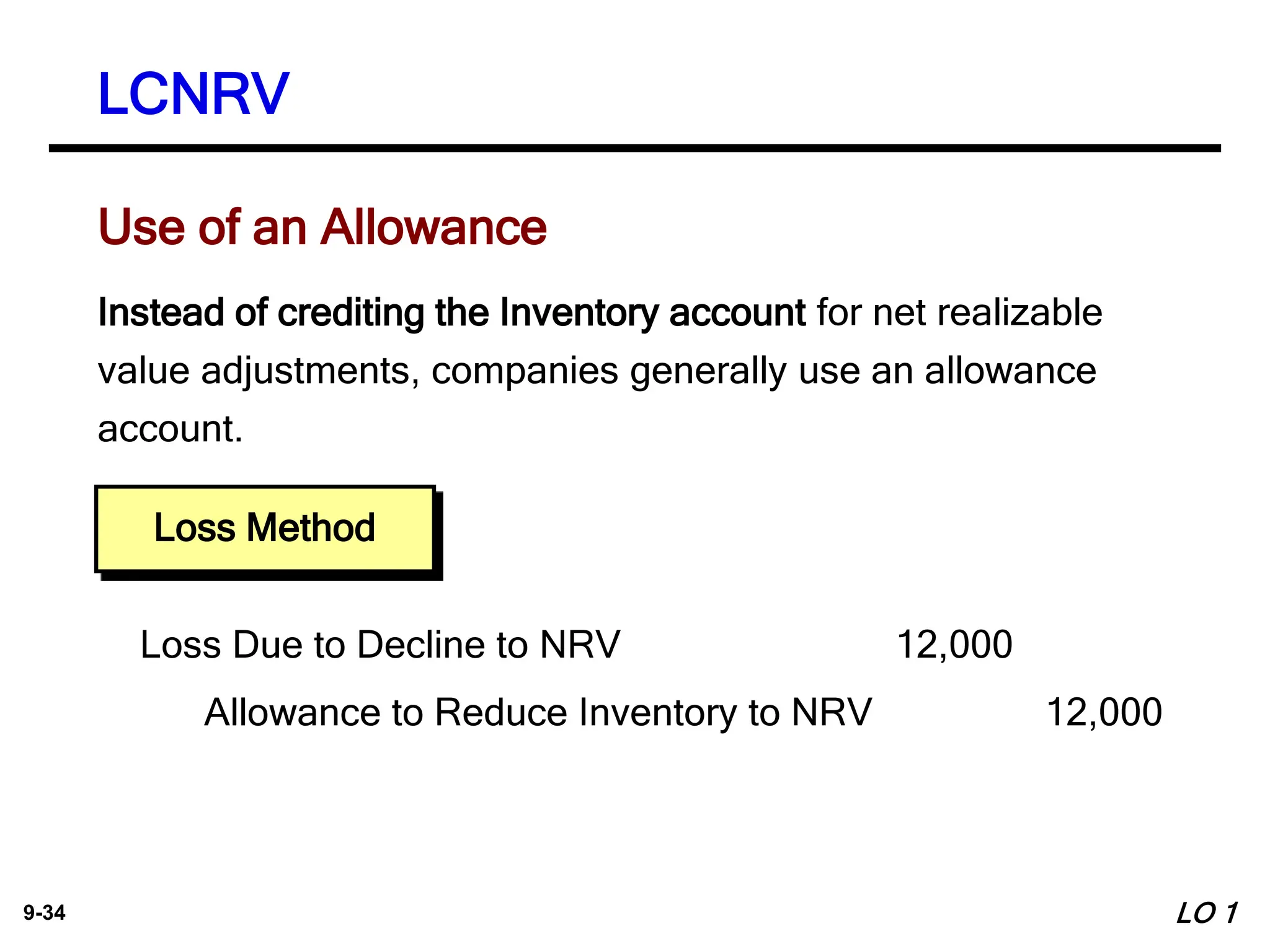
Determine the cost of goods sold for the period.
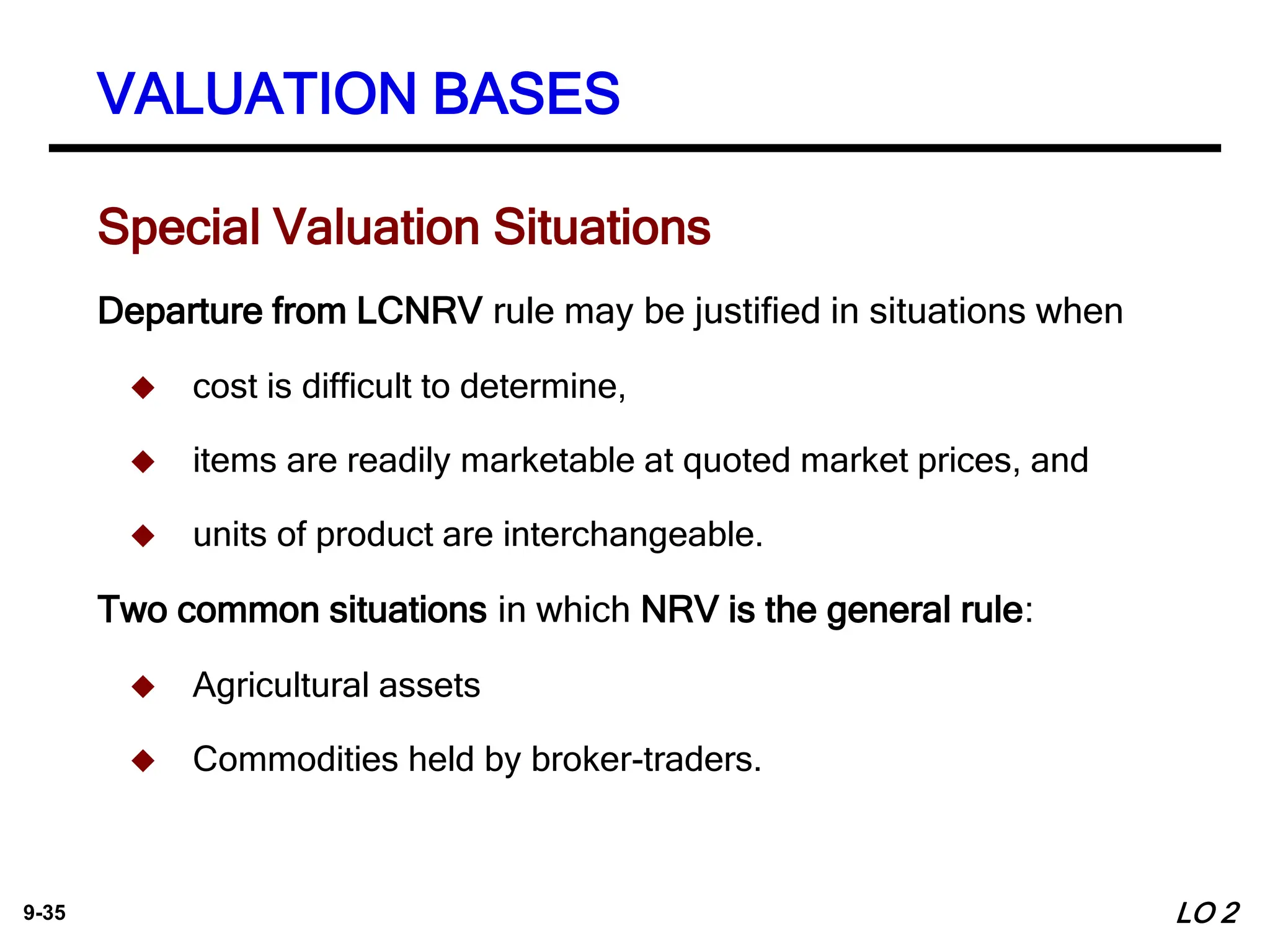
Periodic System
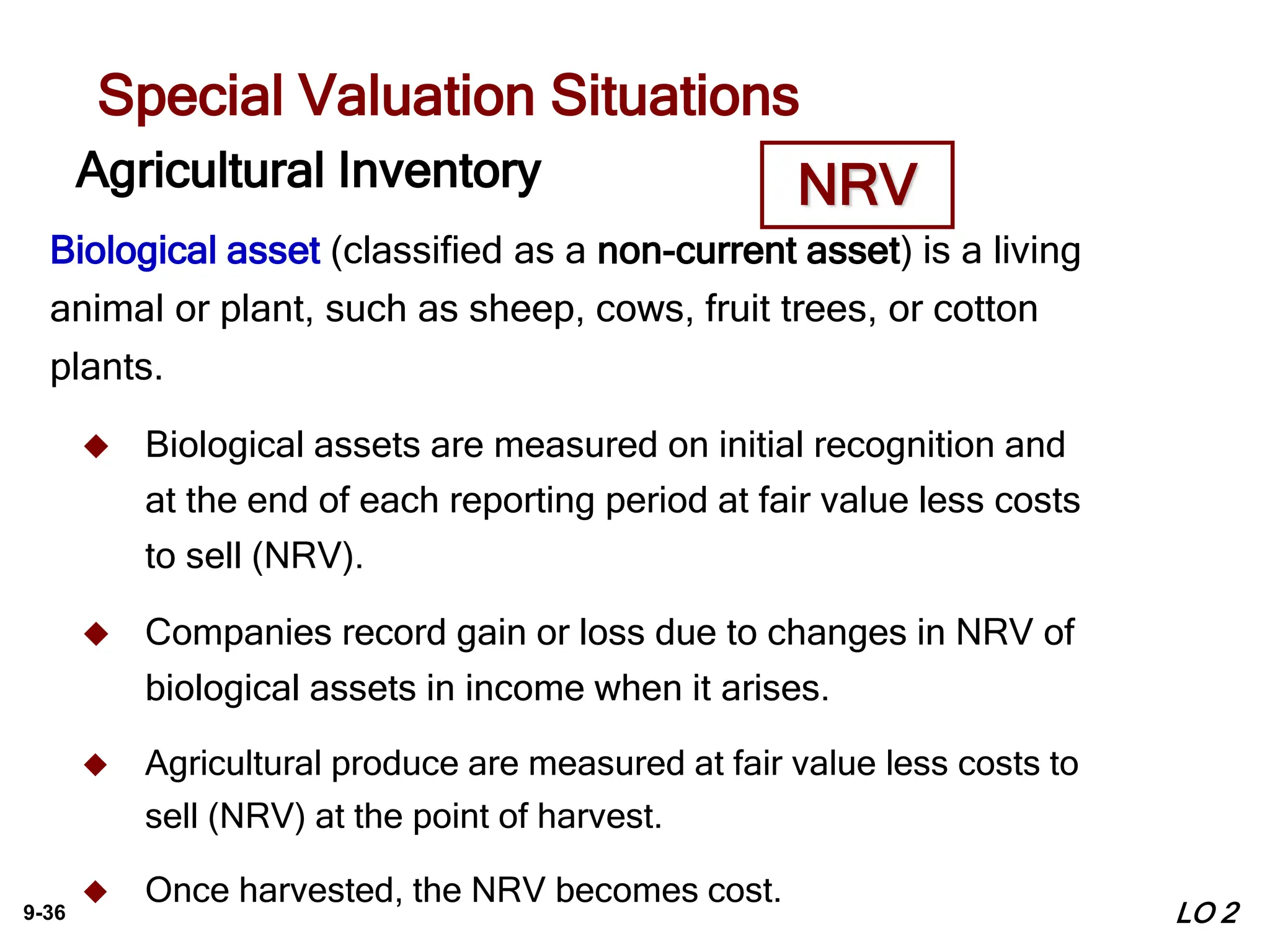
1. Purchases of merchandise are debited to Purchases.
2. Ending Inventory determined by physical count.
3. Calculation of Cost of Goods Sold:
Beginning inventory $ 100,000
Purchases, net + 800,000
Goods available for sale900,000
Ending inventory - 125,000
Cost of goods sold $ 775,000
Determining Inventory Quantities
6.
Slide
6-6
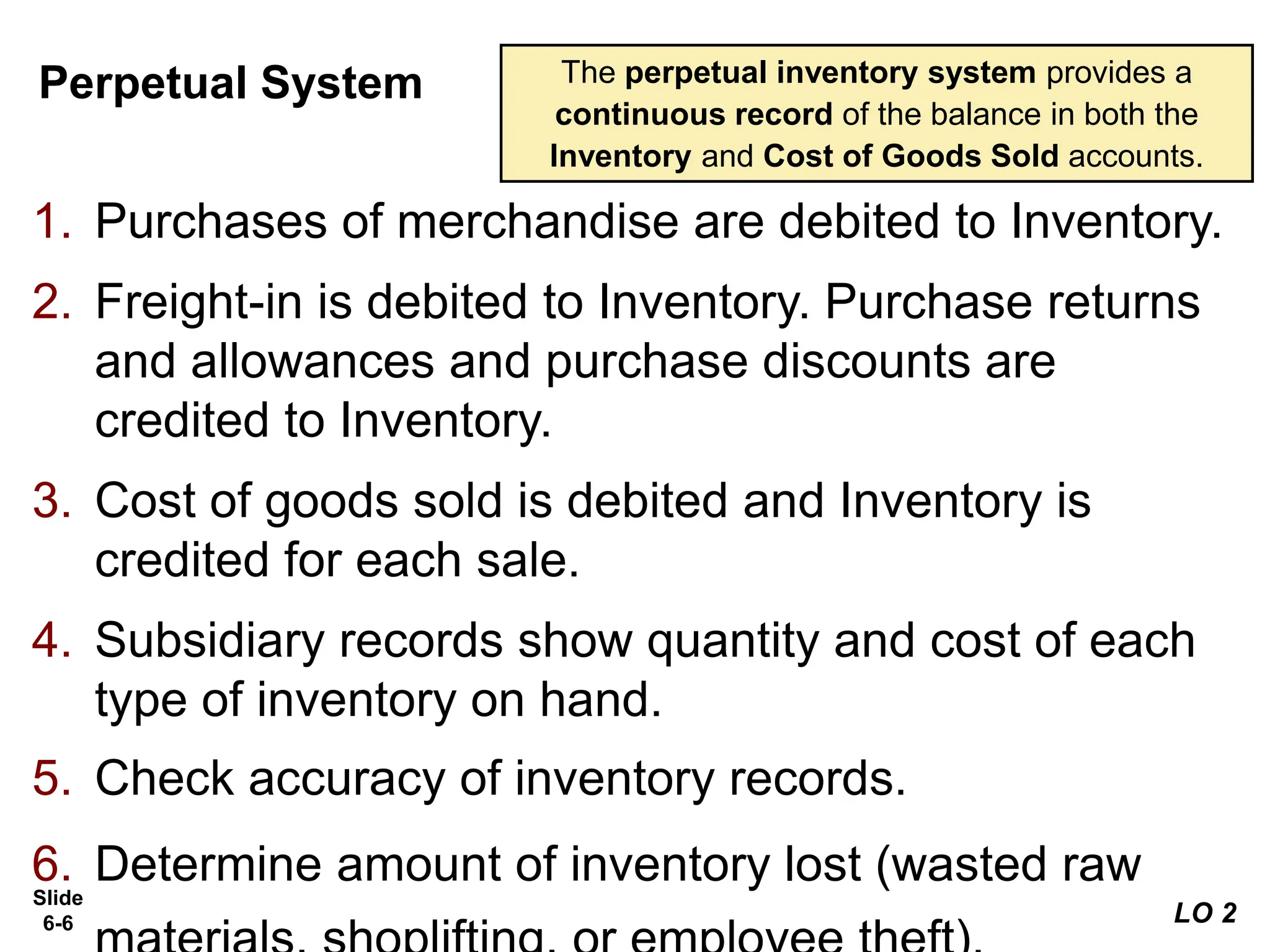
Perpetual System
1. Purchasesof merchandise are debited to Inventory.
2. Freight-in is debited to Inventory. Purchase returns
and allowances and purchase discounts are
credited to Inventory.
3. Cost of goods sold is debited and Inventory is
credited for each sale.
4. Subsidiary records show quantity and cost of each
type of inventory on hand.
5. Check accuracy of inventory records.
6. Determine amount of inventory lost (wasted raw
The perpetual inventory system provides a
continuous record of the balance in both the
Inventory and Cost of Goods Sold accounts.
LO 2
7.
Slide
6-7
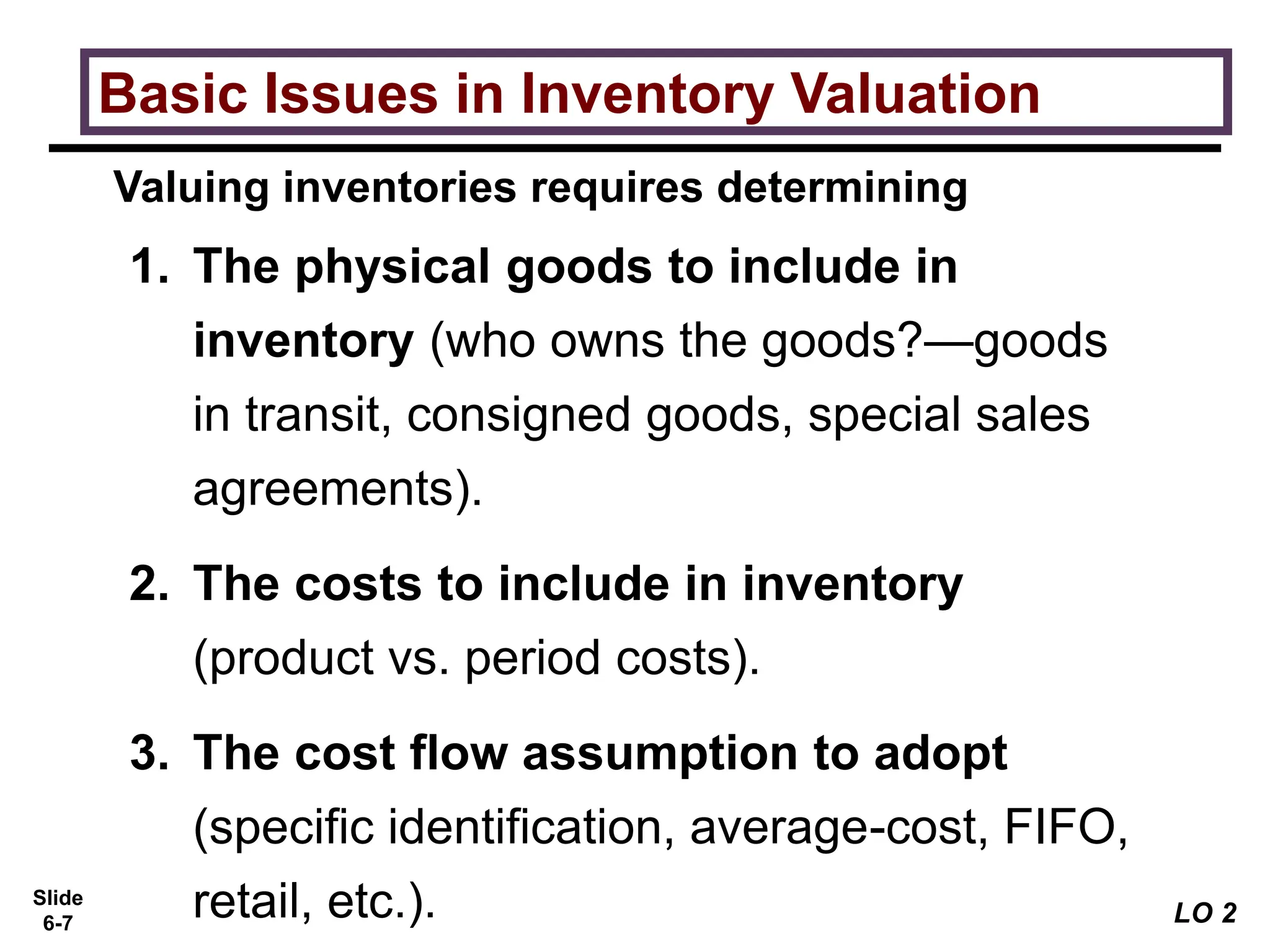
1. The physicalgoods to include in
inventory (who owns the goods?—goods
in transit, consigned goods, special sales
agreements).
2. The costs to include in inventory
(product vs. period costs).
3. The cost flow assumption to adopt
(specific identification, average-cost, FIFO,
retail, etc.).
Valuing inventories requires determining
Basic Issues in Inventory Valuation
LO 2
8.
Slide
6-8
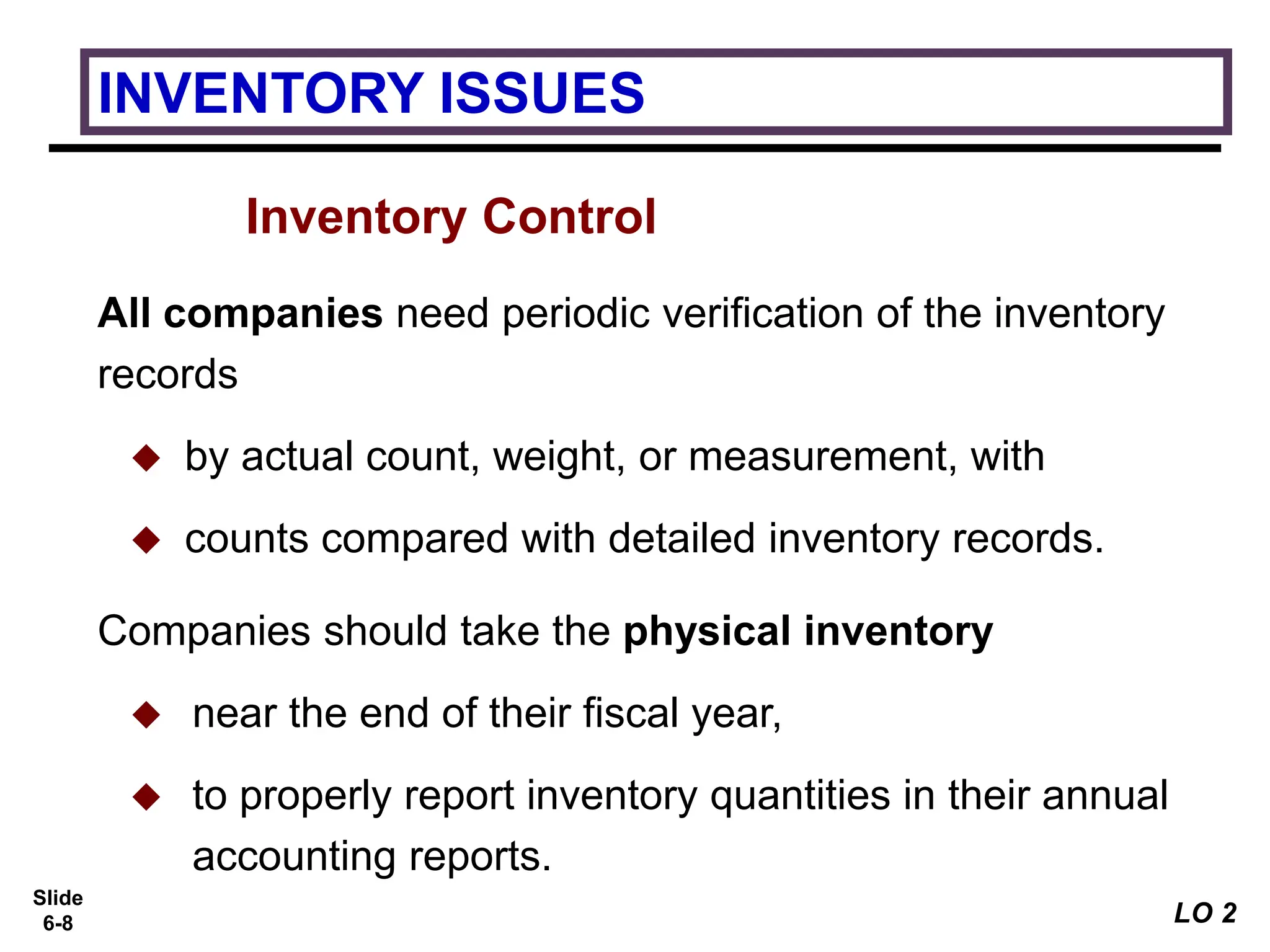
Inventory Control
All companiesneed periodic verification of the inventory
records
by actual count, weight, or measurement, with
counts compared with detailed inventory records.
Companies should take the physical inventory
near the end of their fiscal year,
to properly report inventory quantities in their annual
accounting reports.
INVENTORY ISSUES
LO 2
9.
Slide
6-9
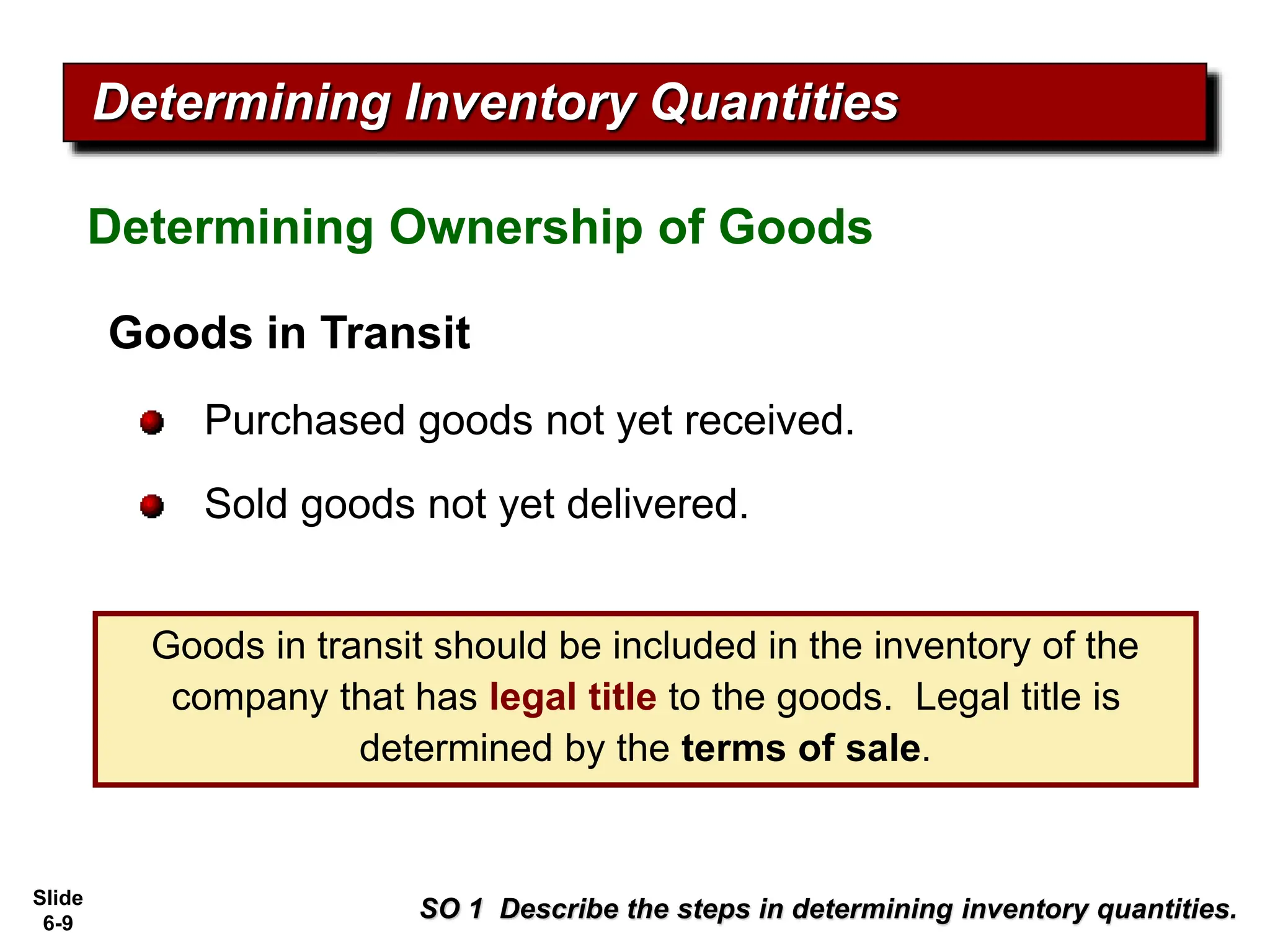
Goods in Transit
Purchasedgoods not yet received.
Sold goods not yet delivered.
Determining Ownership of Goods
Determining Inventory Quantities
SO 1 Describe the steps in determining inventory quantities.
Goods in transit should be included in the inventory of the
company that has legal title to the goods. Legal title is
determined by the terms of sale.
10.
Slide
6-10
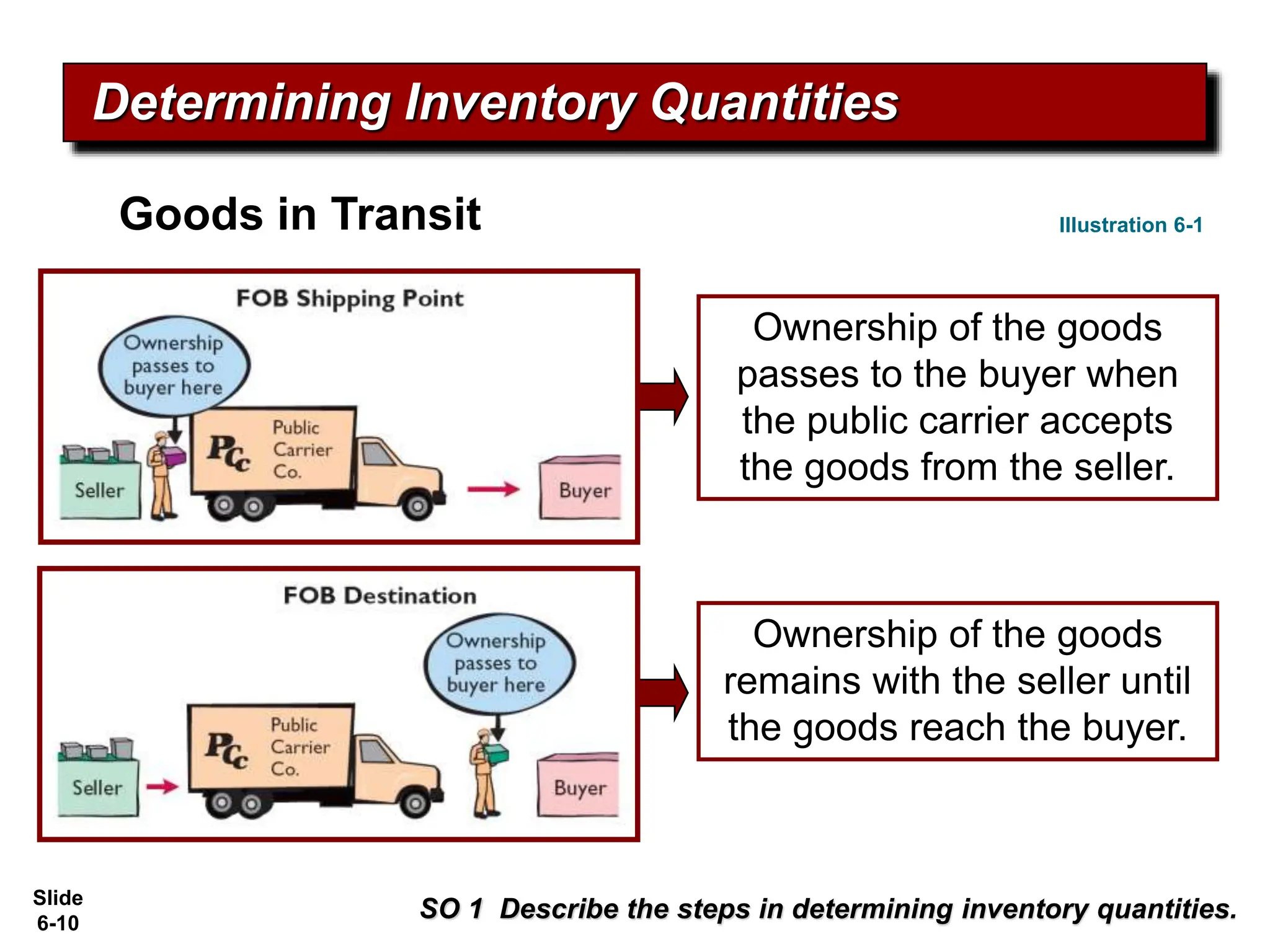
Determining Inventory Quantities
SO1 Describe the steps in determining inventory quantities.
Illustration 6-1
Ownership of the goods
passes to the buyer when
the public carrier accepts
the goods from the seller.
Ownership of the goods
remains with the seller until
the goods reach the buyer.
Goods in Transit
11.
Slide
6-11
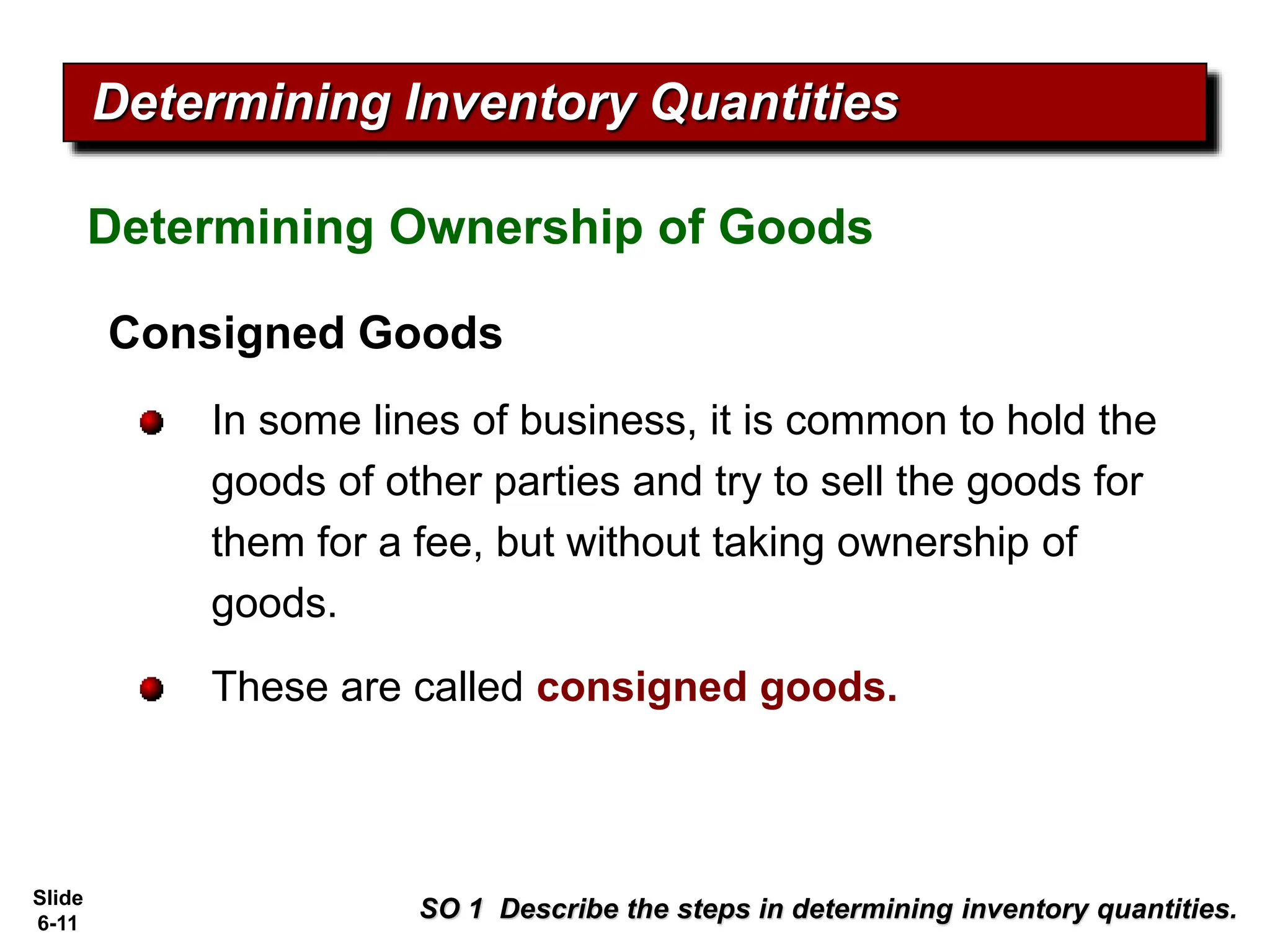
Consigned Goods
In somelines of business, it is common to hold the
goods of other parties and try to sell the goods for
them for a fee, but without taking ownership of
goods.
These are called consigned goods.
Determining Ownership of Goods
Determining Inventory Quantities
SO 1 Describe the steps in determining inventory quantities.
12.
Slide
6-12
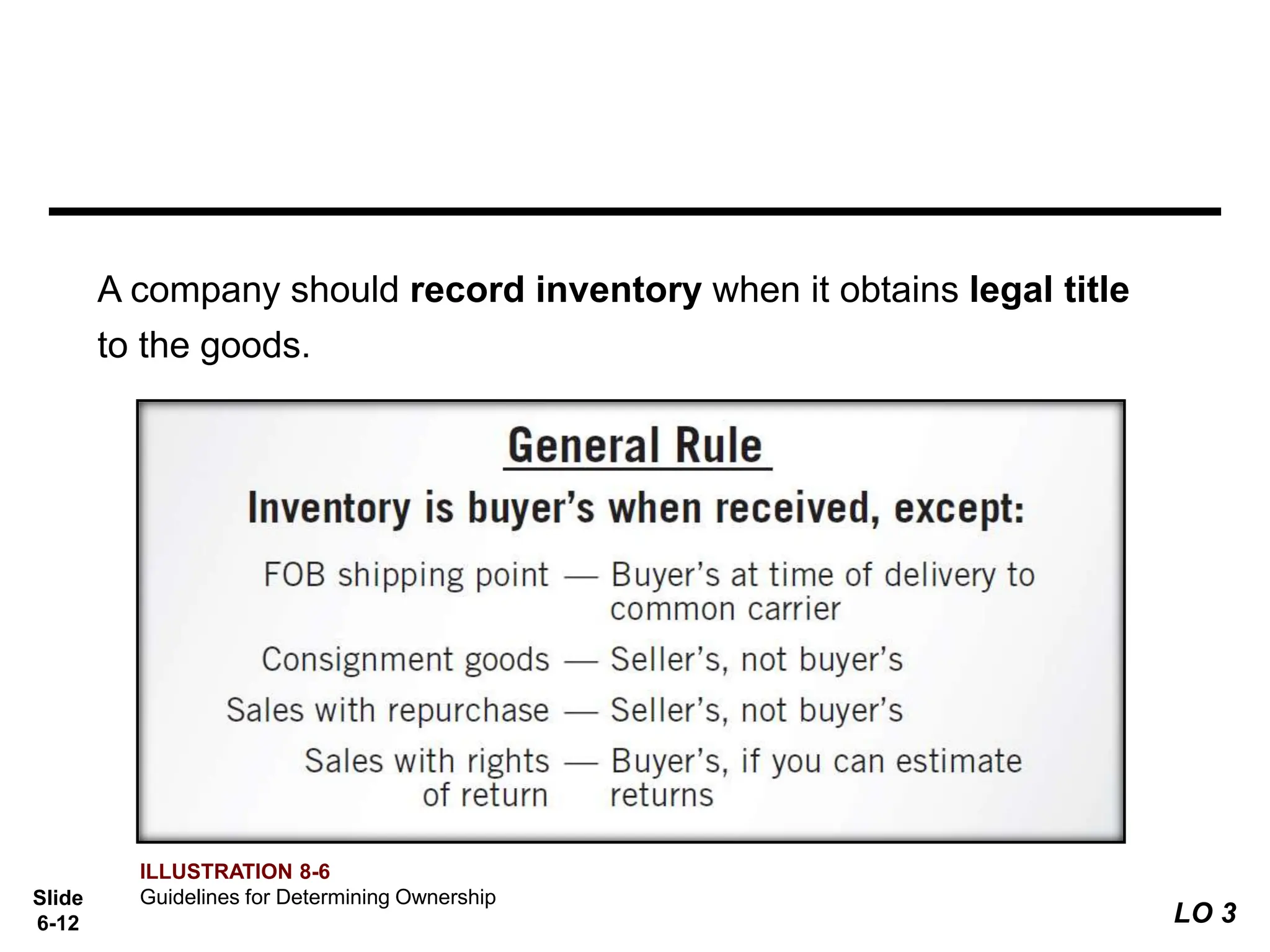
A company shouldrecord inventory when it obtains legal title
to the goods.
LO 3
ILLUSTRATION 8-6
Guidelines for Determining Ownership
13.
8-13
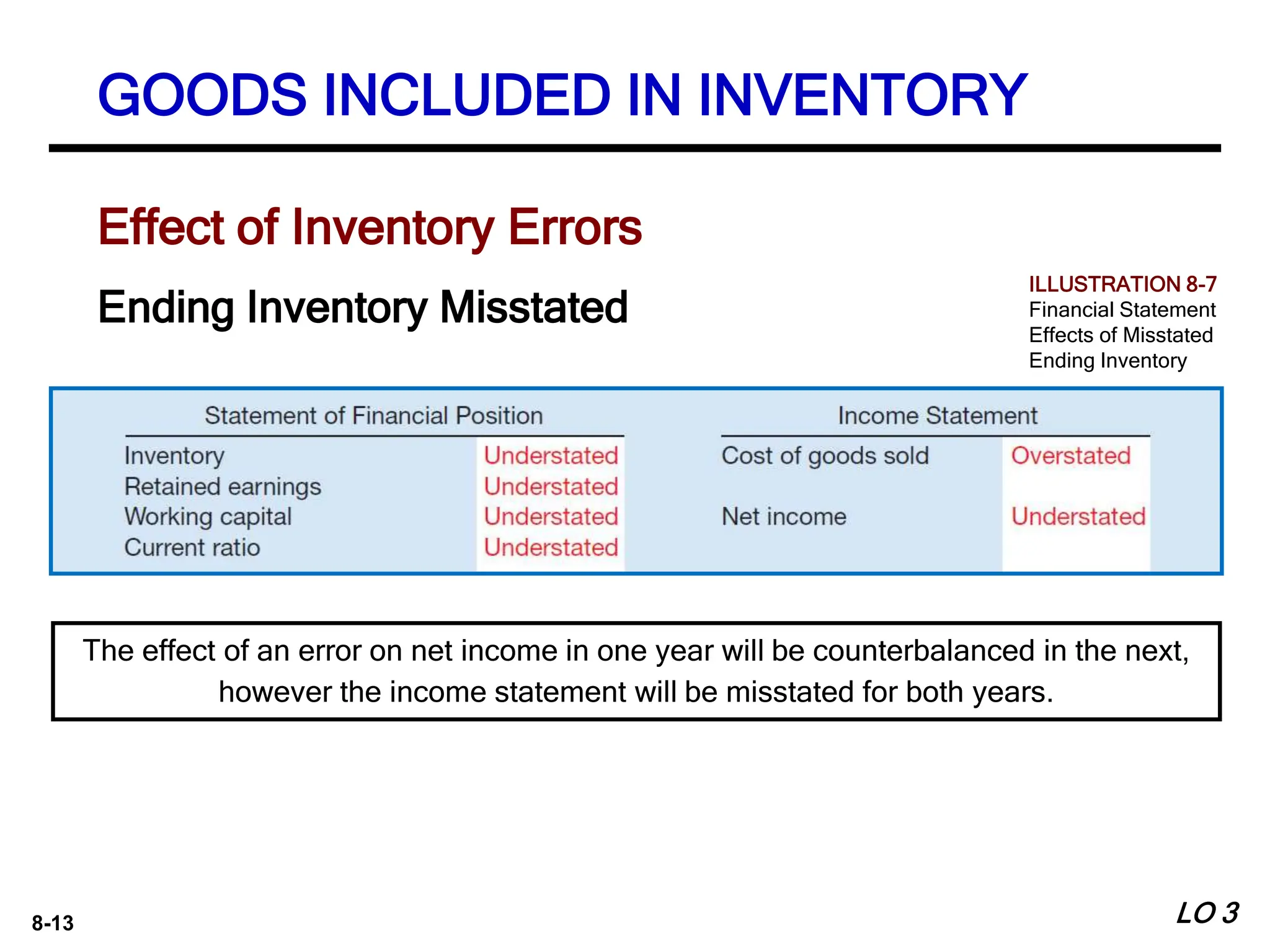
Effect of InventoryErrors
Ending Inventory Misstated
The effect of an error on net income in one year will be counterbalanced in the next,
however the income statement will be misstated for both years.
GOODS INCLUDED IN INVENTORY
LO 3
ILLUSTRATION 8-7
Financial Statement
Effects of Misstated
Ending Inventory
14.
8-14
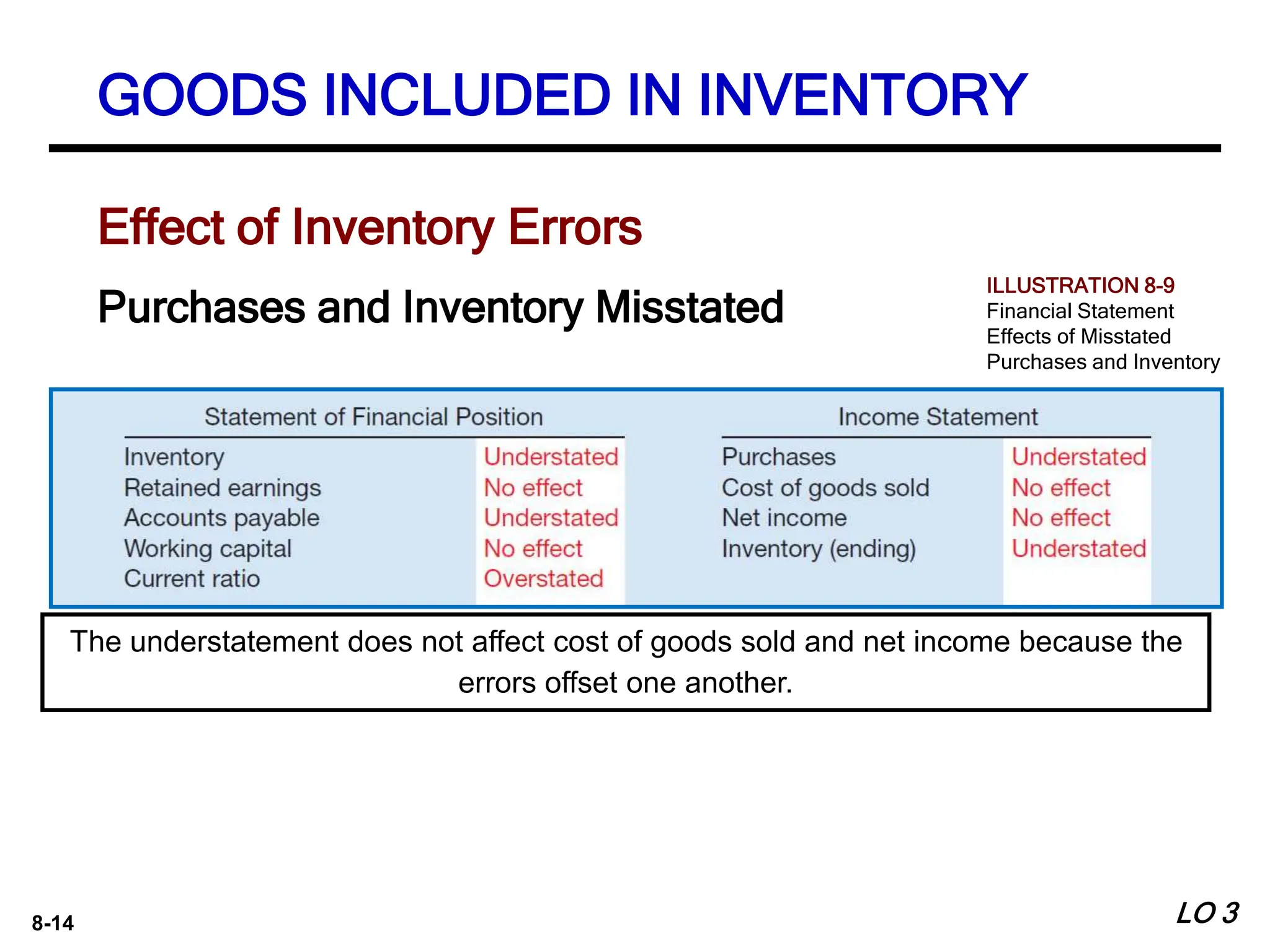
Effect of InventoryErrors
Purchases and Inventory Misstated
The understatement does not affect cost of goods sold and net income because the
errors offset one another.
GOODS INCLUDED IN INVENTORY
LO 3
ILLUSTRATION 8-9
Financial Statement
Effects of Misstated
Purchases and Inventory
15.
8-15
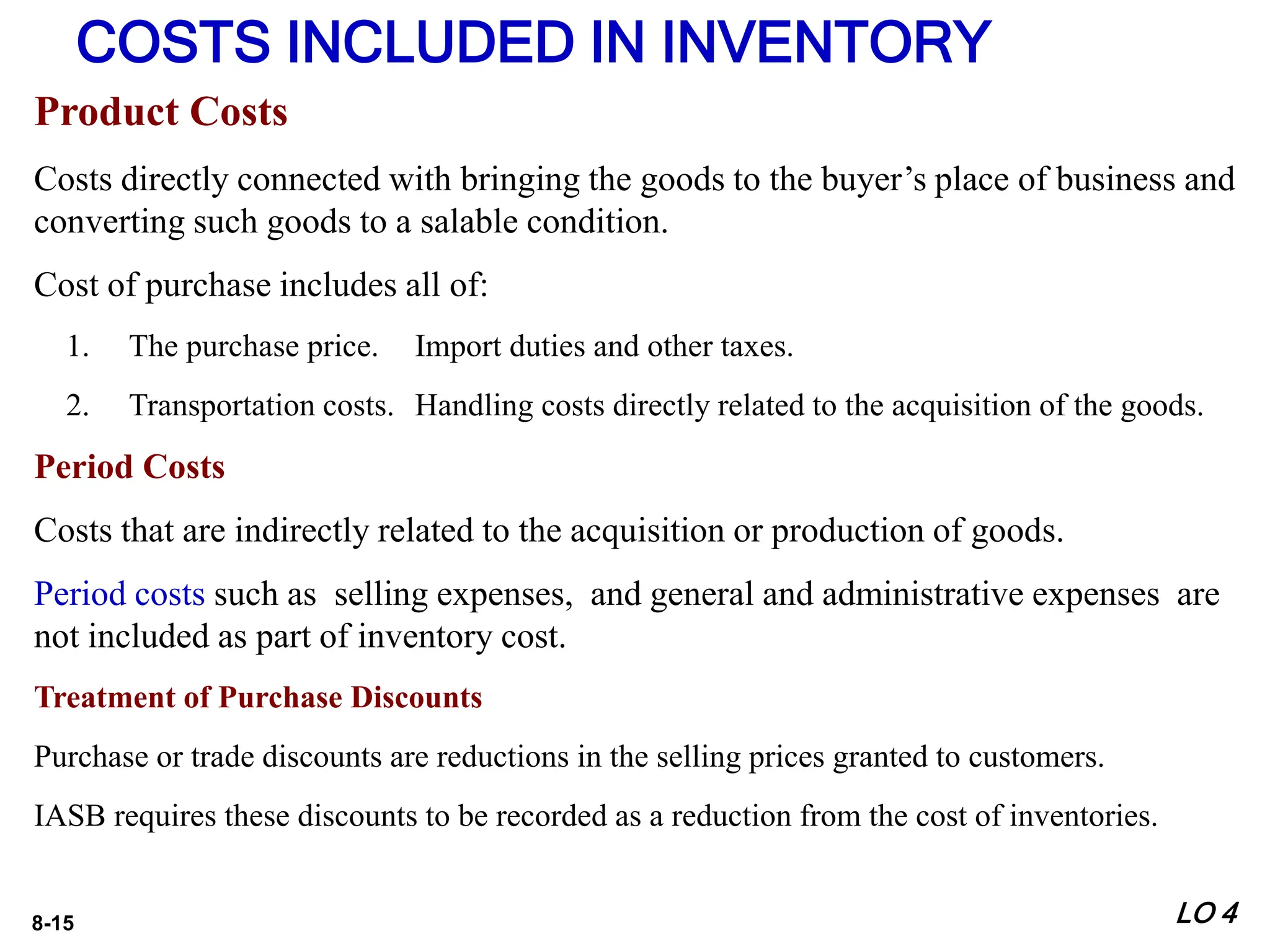
Product Costs
Costs directlyconnected with bringing the goods to the buyer’s place of business and
converting such goods to a salable condition.
Cost of purchase includes all of:
1. The purchase price. Import duties and other taxes.
2. Transportation costs. Handling costs directly related to the acquisition of the goods.
Period Costs
Costs that are indirectly related to the acquisition or production of goods.
Period costs such as selling expenses, and general and administrative expenses are
not included as part of inventory cost.
Treatment of Purchase Discounts
Purchase or trade discounts are reductions in the selling prices granted to customers.
IASB requires these discounts to be recorded as a reduction from the cost of inventories.
COSTS INCLUDED IN INVENTORY
LO 4
16.
Slide
6-16
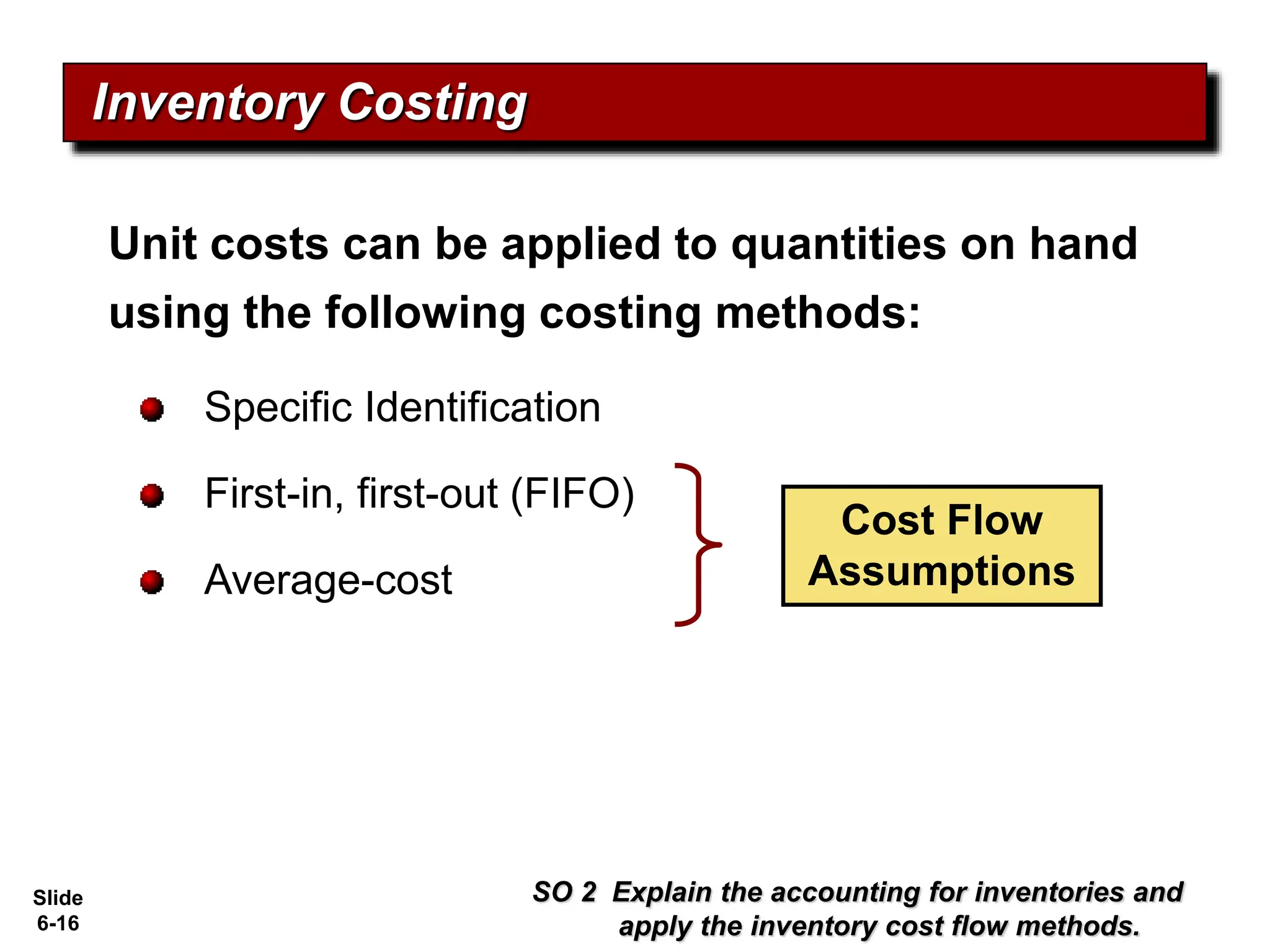
Unit costs canbe applied to quantities on hand
using the following costing methods:
Specific Identification
First-in, first-out (FIFO)
Average-cost
Inventory Costing
Cost Flow
Assumptions
SO 2 Explain the accounting for inventories and
apply the inventory cost flow methods.
17.
8-17
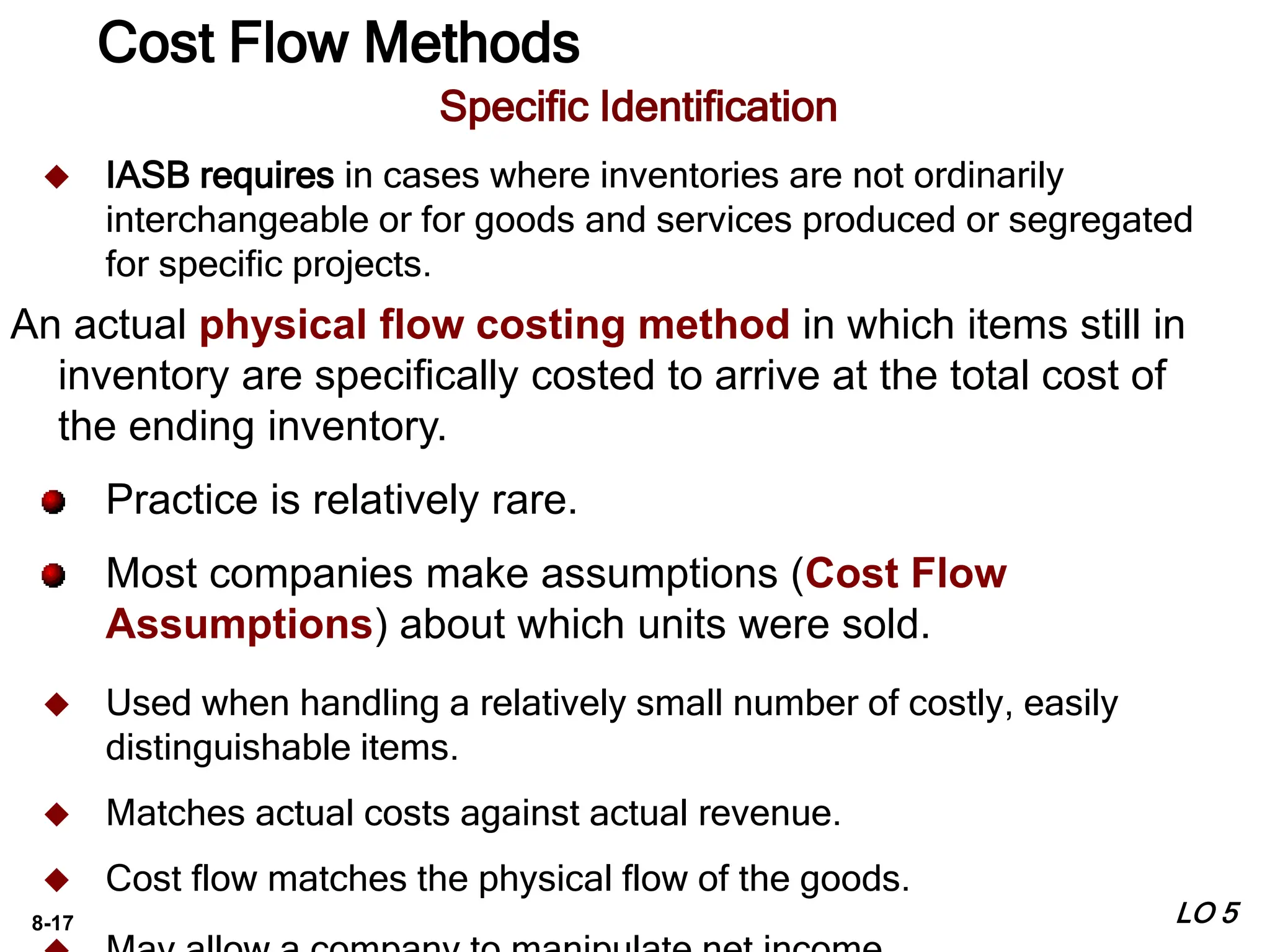
Specific Identification
IASBrequires in cases where inventories are not ordinarily
interchangeable or for goods and services produced or segregated
for specific projects.
An actual physical flow costing method in which items still in
inventory are specifically costed to arrive at the total cost of
the ending inventory.
Practice is relatively rare.
Most companies make assumptions (Cost Flow
Assumptions) about which units were sold.
Used when handling a relatively small number of costly, easily
distinguishable items.
Matches actual costs against actual revenue.
Cost flow matches the physical flow of the goods.
LO 5
Cost Flow Methods
18.
Slide
6-18
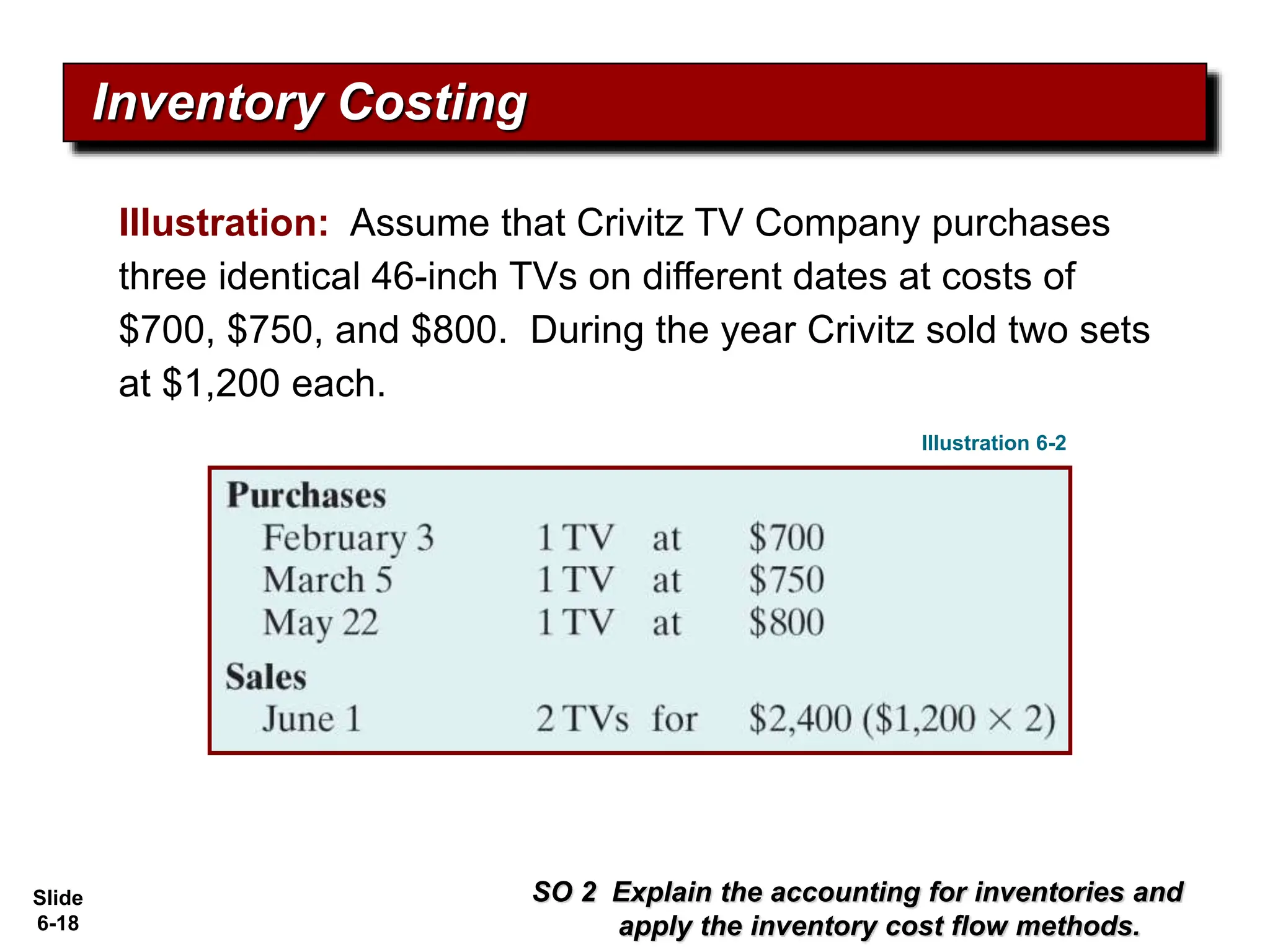
Illustration: Assume thatCrivitz TV Company purchases
three identical 46-inch TVs on different dates at costs of
$700, $750, and $800. During the year Crivitz sold two sets
at $1,200 each.
Inventory Costing
Illustration 6-2
SO 2 Explain the accounting for inventories and
apply the inventory cost flow methods.
19.
Slide
6-19
Inventory Costing
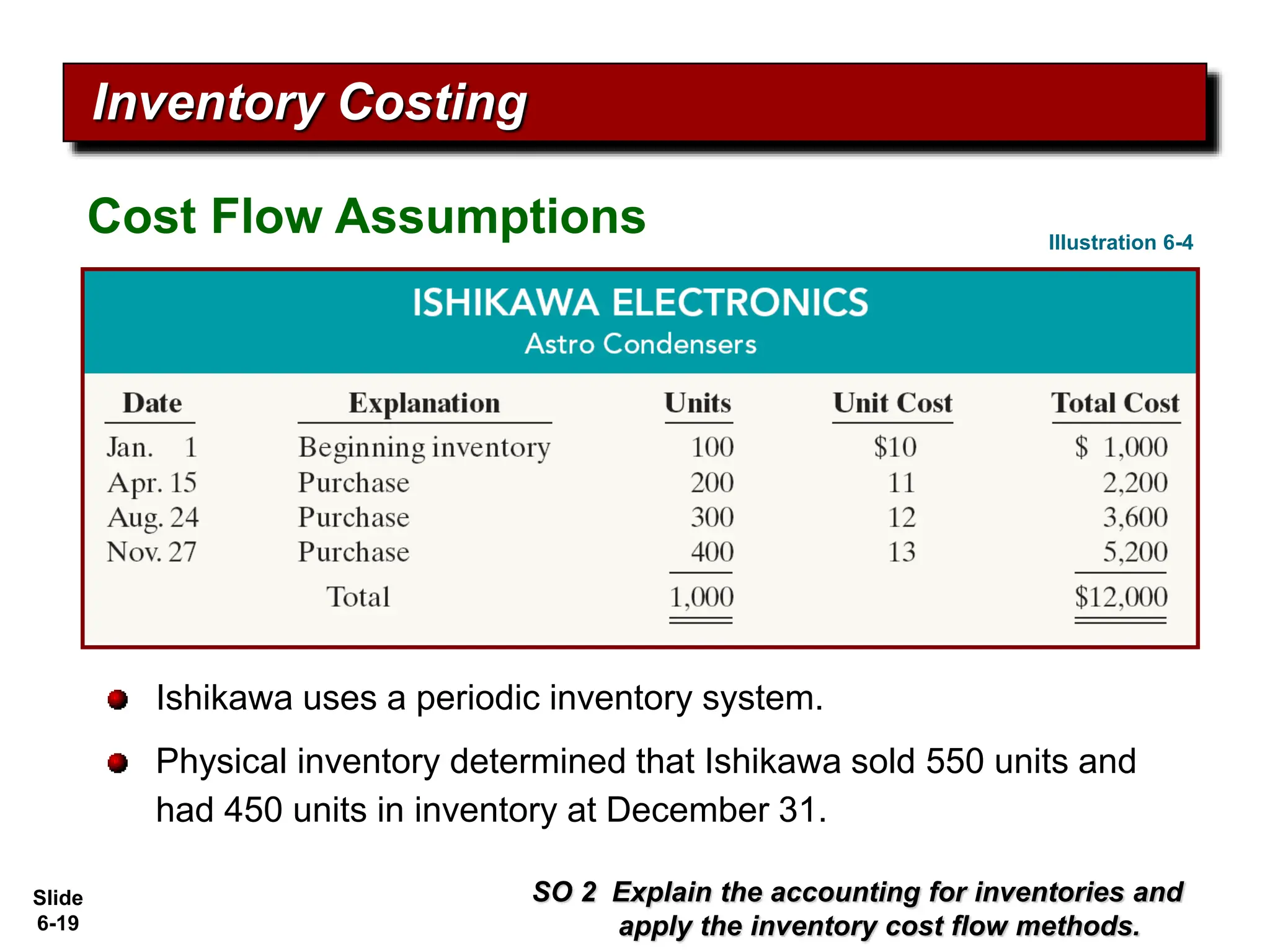
Ishikawa usesa periodic inventory system.
Physical inventory determined that Ishikawa sold 550 units and
had 450 units in inventory at December 31.
Illustration 6-4
SO 2 Explain the accounting for inventories and
apply the inventory cost flow methods.
Cost Flow Assumptions
20.
Slide
6-20
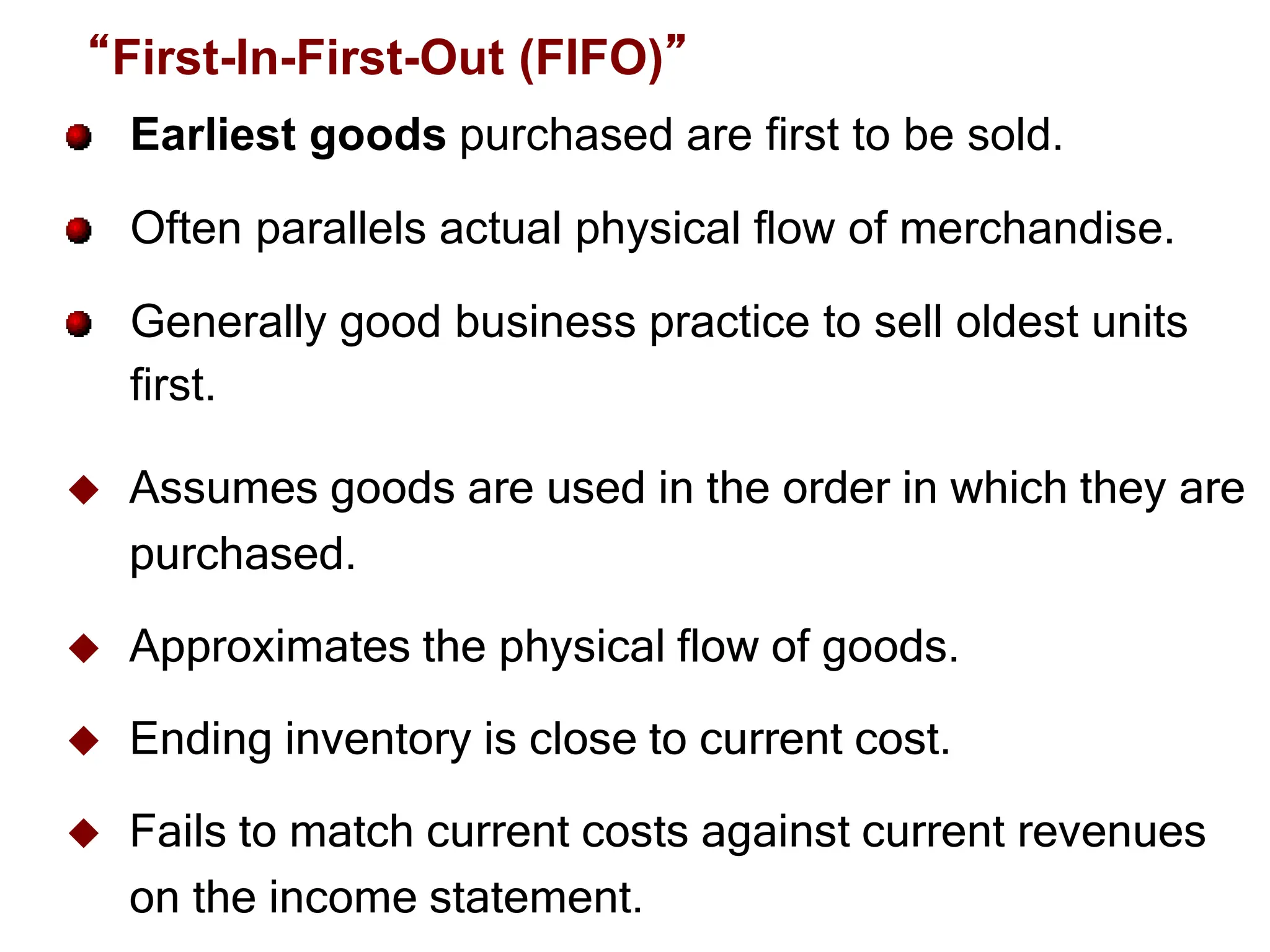
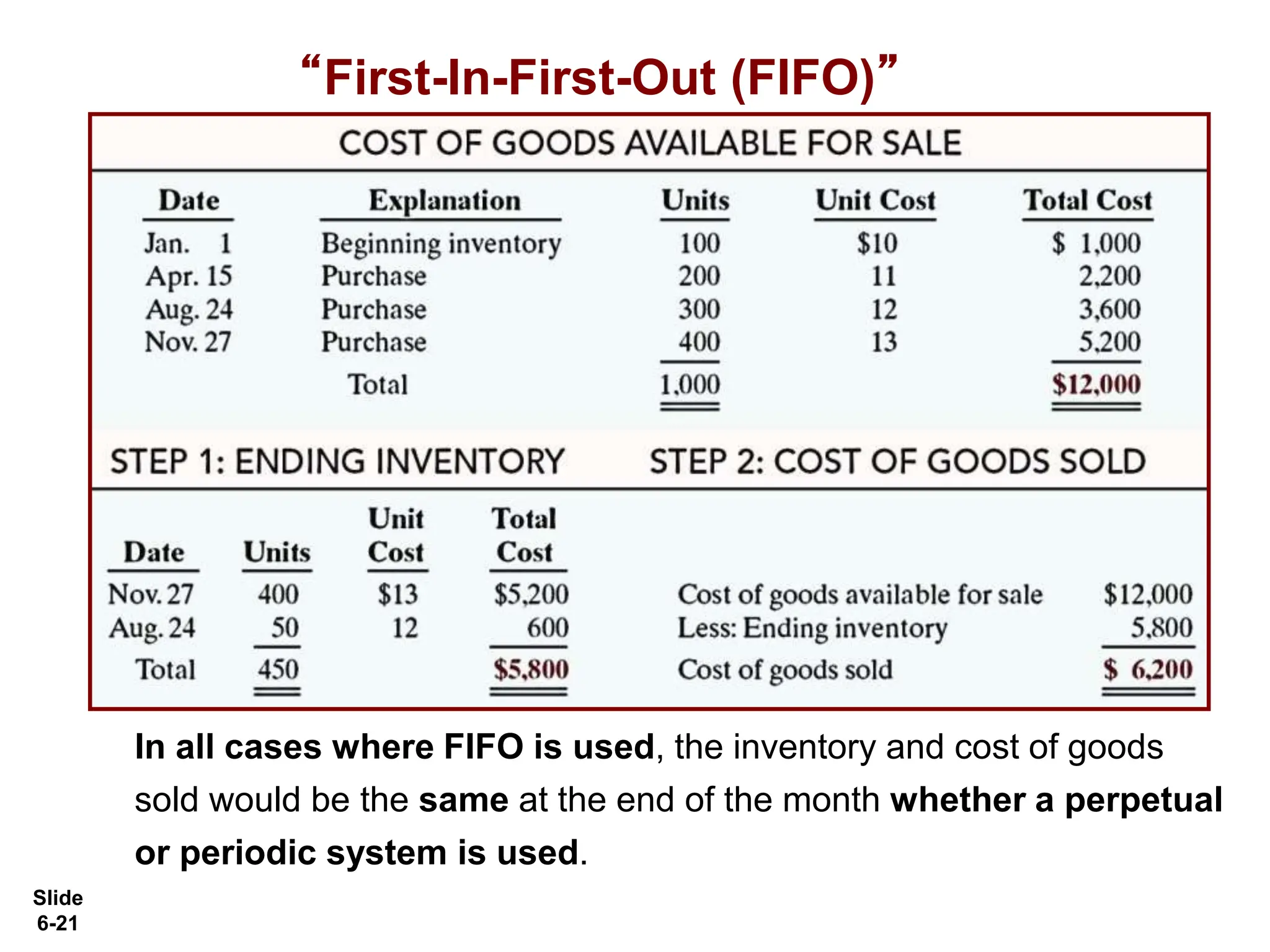
Earliest goods purchasedare first to be sold.
Often parallels actual physical flow of merchandise.
Generally good business practice to sell oldest units
first.
Assumes goods are used in the order in which they are
purchased.
Approximates the physical flow of goods.
Ending inventory is close to current cost.
Fails to match current costs against current revenues
on the income statement.
“First-In-First-Out (FIFO)”
21.
Slide
6-21
“First-In-First-Out (FIFO)”
In allcases where FIFO is used, the inventory and cost of goods
sold would be the same at the end of the month whether a perpetual
or periodic system is used.
22.
Slide
6-22
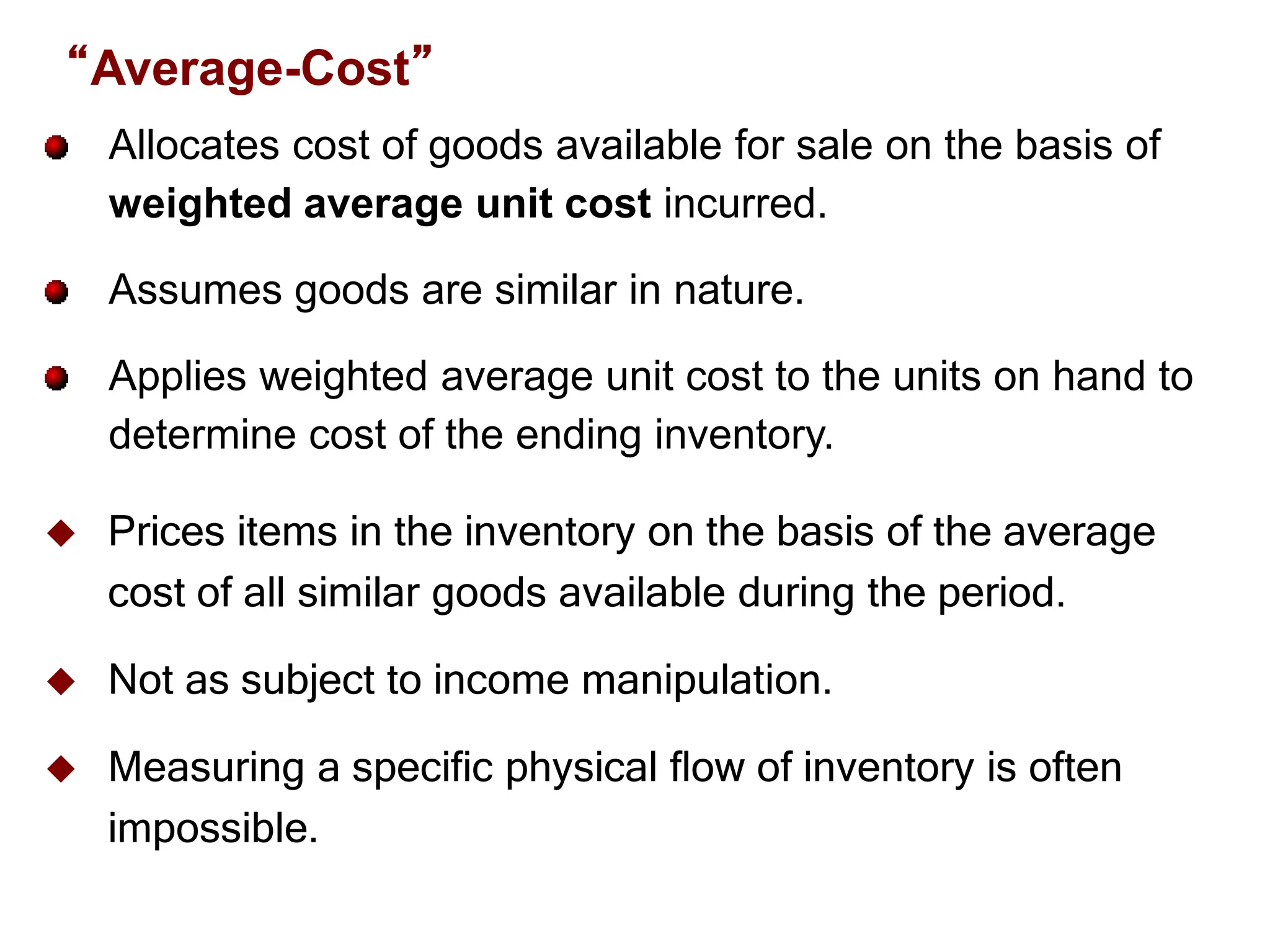
Allocates cost ofgoods available for sale on the basis of
weighted average unit cost incurred.
Assumes goods are similar in nature.
Applies weighted average unit cost to the units on hand to
determine cost of the ending inventory.
Prices items in the inventory on the basis of the average
cost of all similar goods available during the period.
Not as subject to income manipulation.
Measuring a specific physical flow of inventory is often
impossible.
“Average-Cost”
23.
Slide
6-23
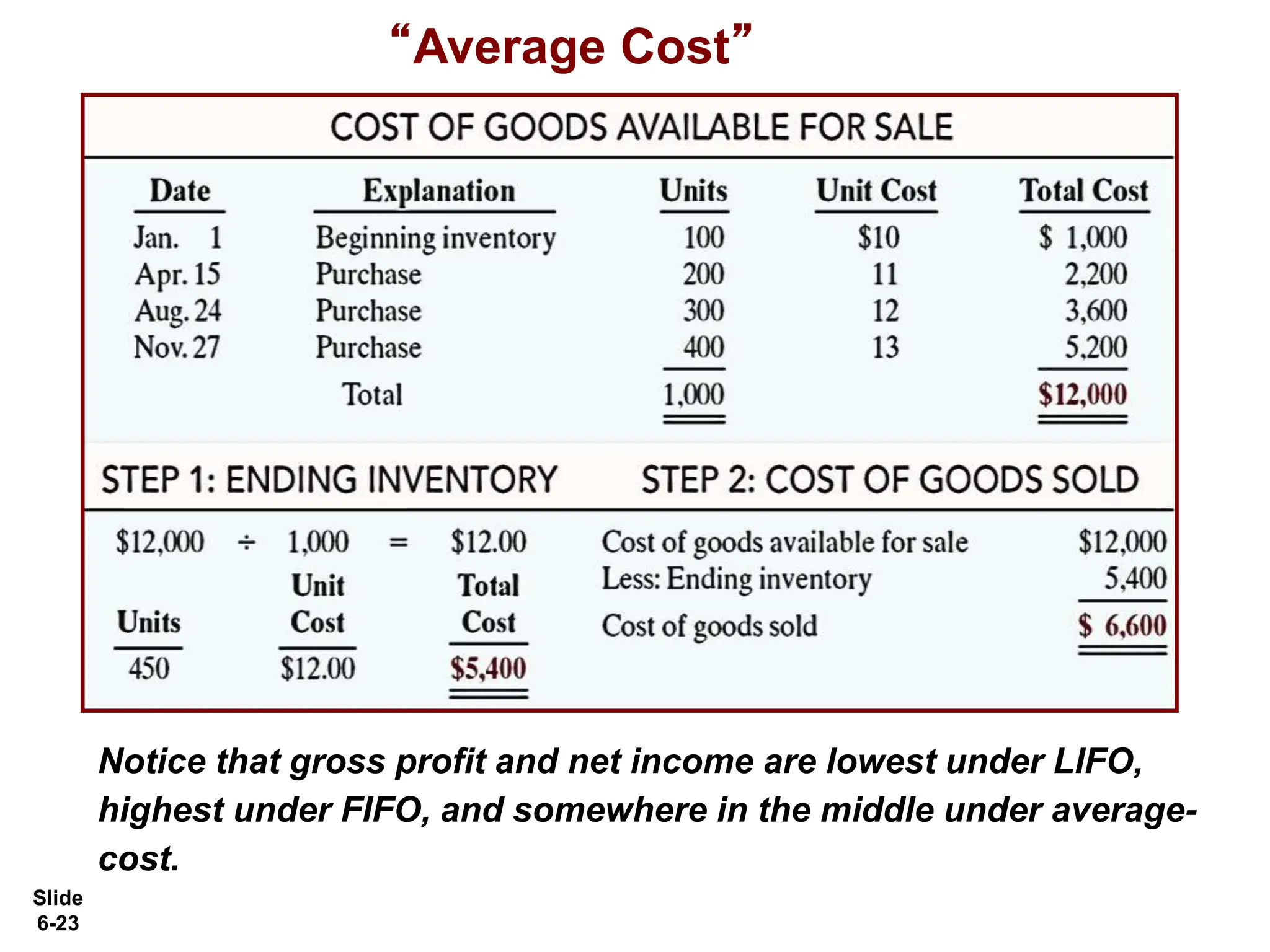
“Average Cost”
Notice thatgross profit and net income are lowest under LIFO,
highest under FIFO, and somewhere in the middle under average-
cost.
24.
Slide
6-24
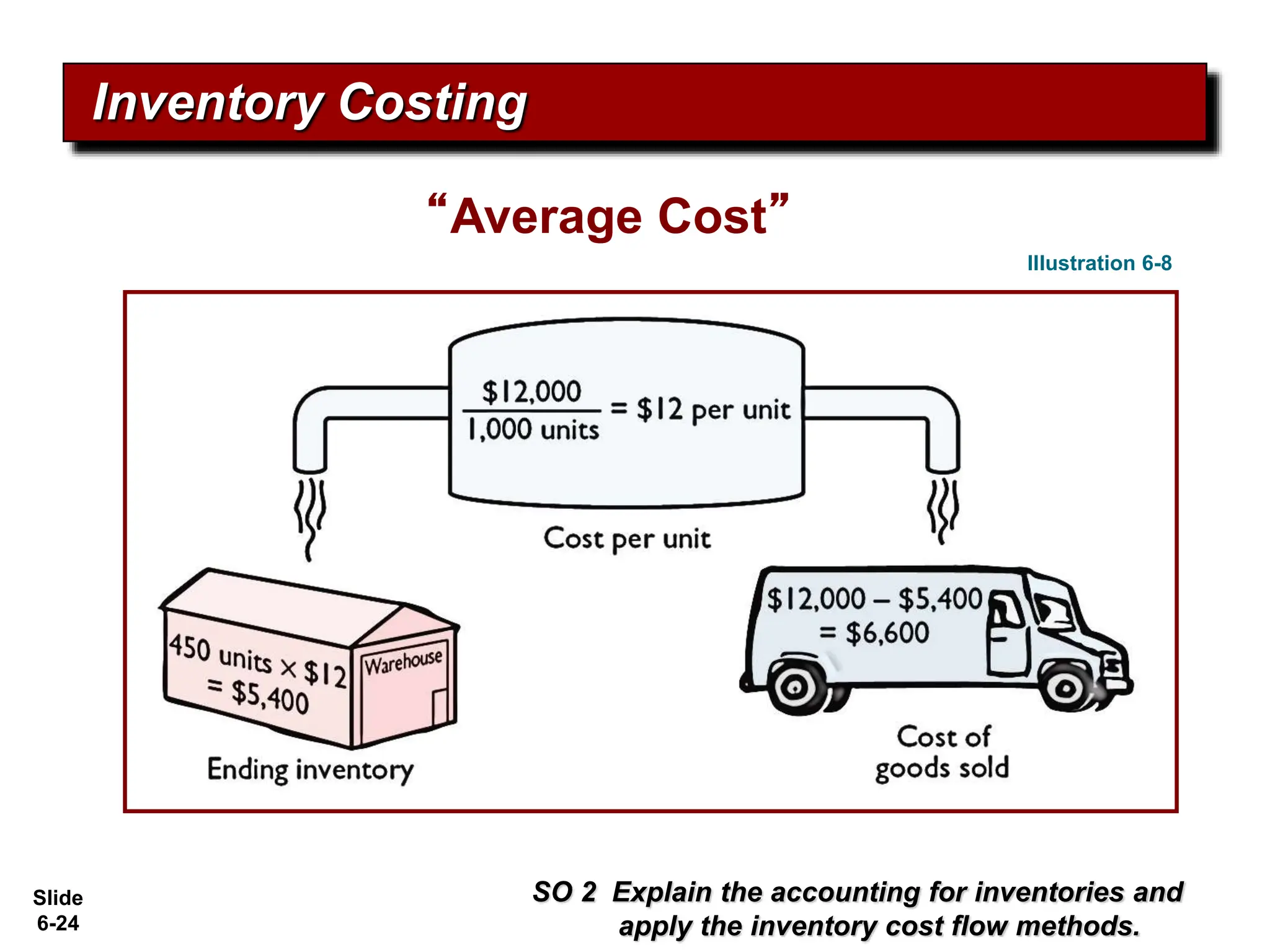
SO 2 Explainthe accounting for inventories and
apply the inventory cost flow methods.
Inventory Costing
“Average Cost”
Illustration 6-8
25.
Slide
6-25
Using Cost FlowMethods Consistently
Inventory Costing
Method should be used consistently, enhances
comparability.
Although consistency is preferred, a company may
change its inventory costing method.
SO 3 Explain the financial effects of the inventory cost flow assumptions.
26.
Slide
6-26
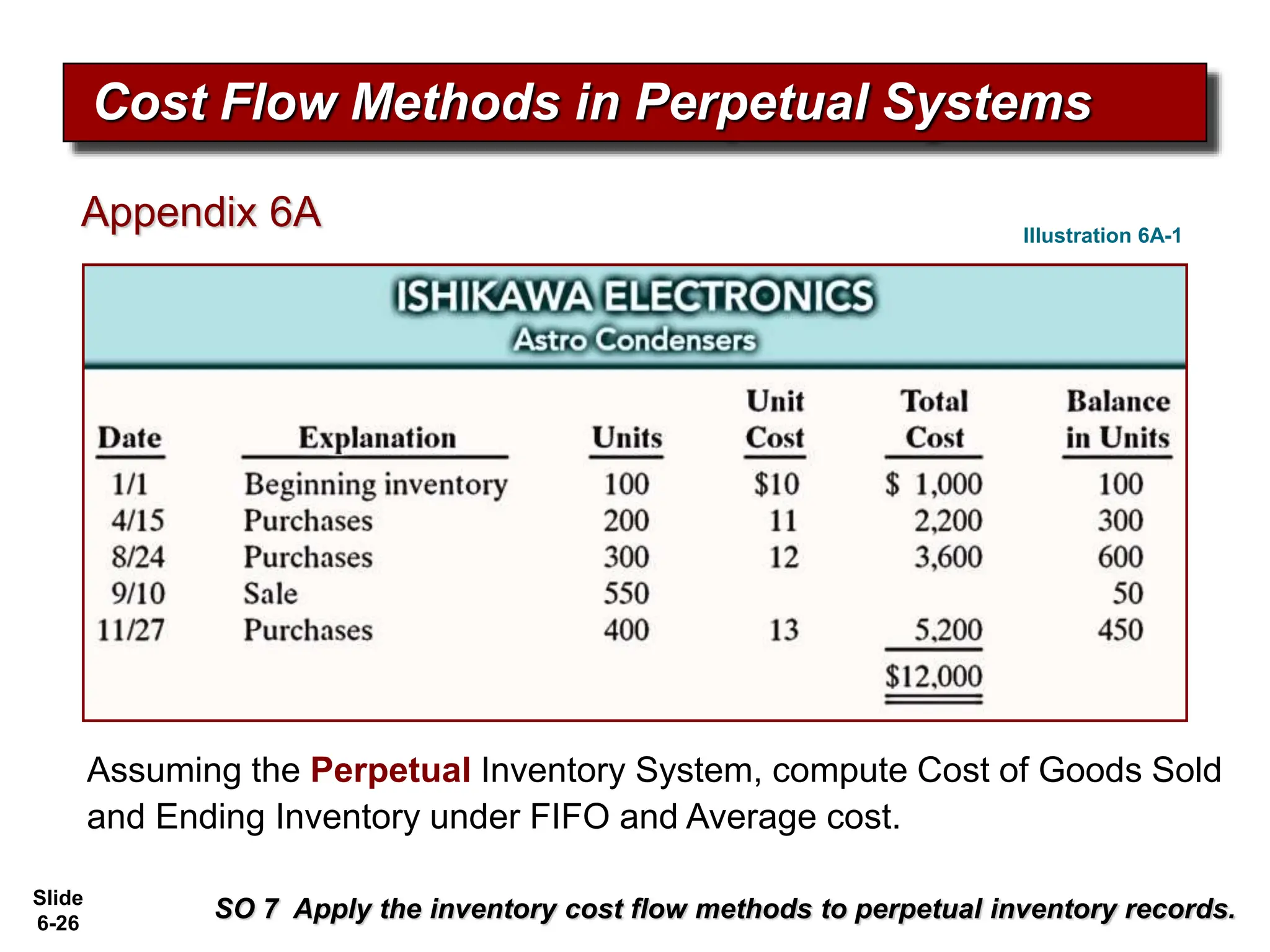
Cost Flow Methodsin Perpetual Systems
SO 7 Apply the inventory cost flow methods to perpetual inventory records.
Assuming the Perpetual Inventory System, compute Cost of Goods Sold
and Ending Inventory under FIFO and Average cost.
Appendix 6A Illustration 6A-1
27.
Slide
6-27
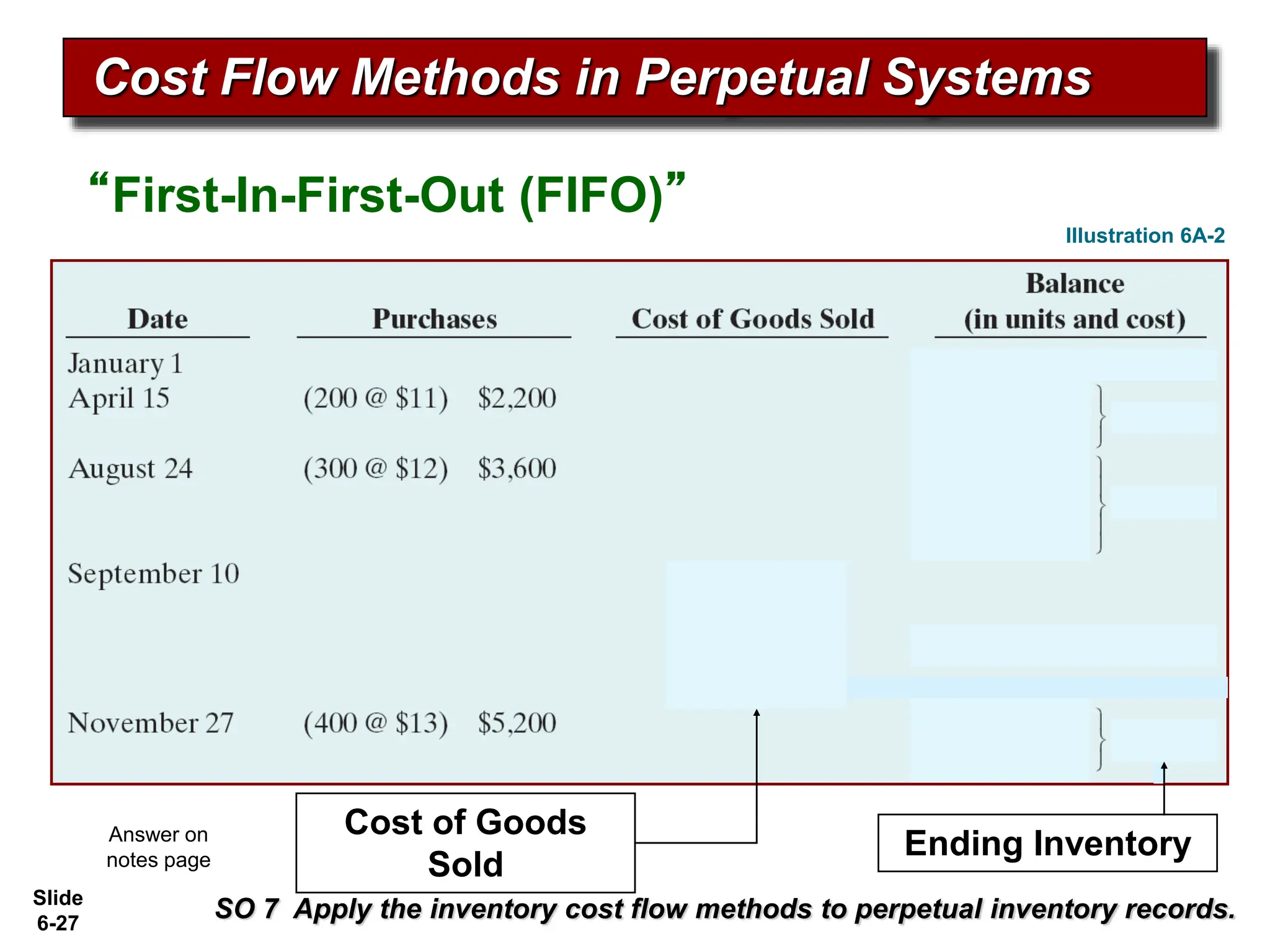
Cost Flow Methodsin Perpetual Systems
SO 7 Apply the inventory cost flow methods to perpetual inventory records.
“First-In-First-Out (FIFO)”
Cost of Goods
Sold
Ending Inventory
Illustration 6A-2
Answer on
notes page
28.
Slide
6-28
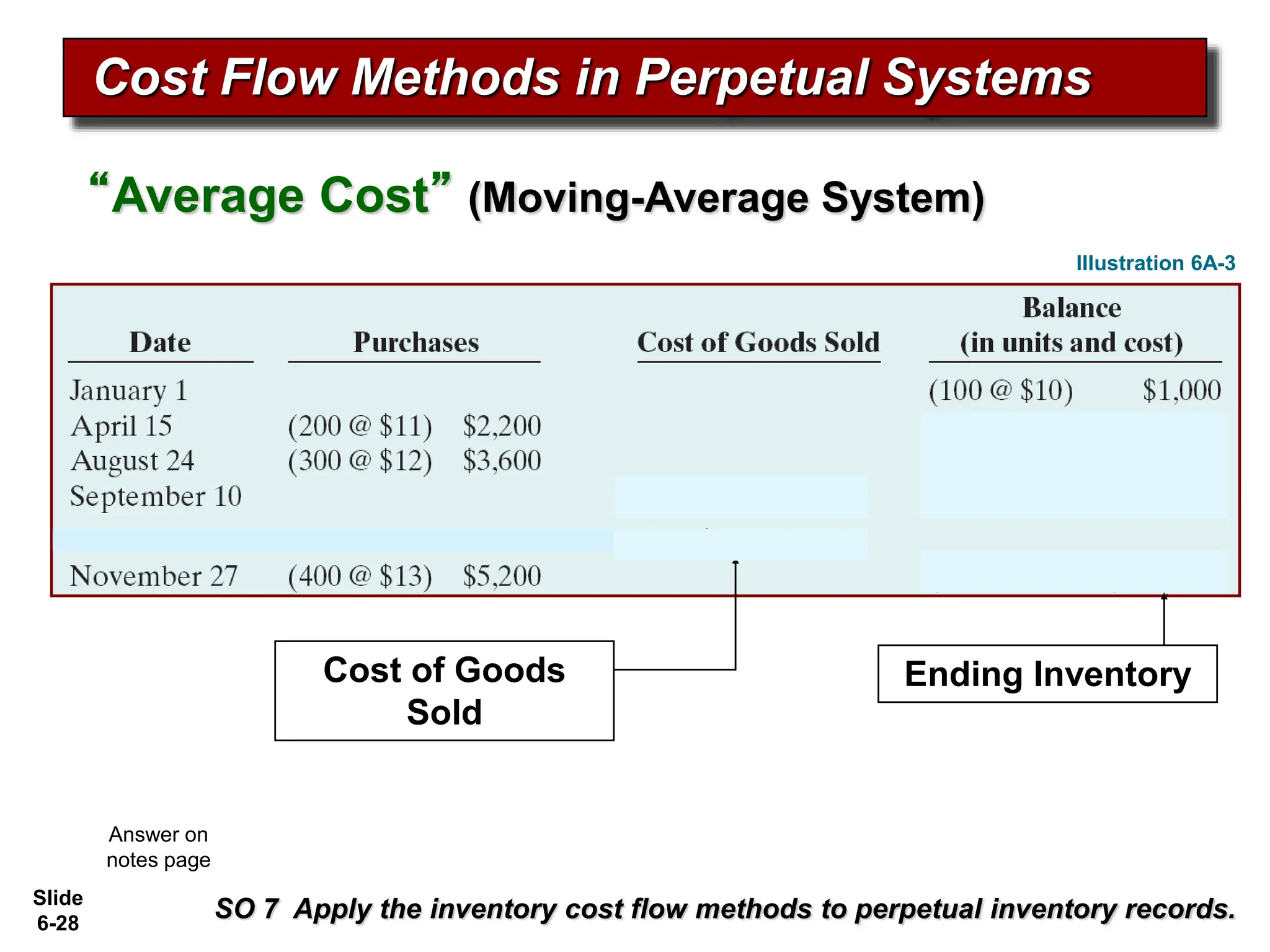
Cost Flow Methodsin Perpetual Systems
SO 7 Apply the inventory cost flow methods to perpetual inventory records.
“Average Cost” (Moving-Average System)
Illustration 6A-3
Cost of Goods
Sold
Ending Inventory
Answer on
notes page
29.
Slide
6-29
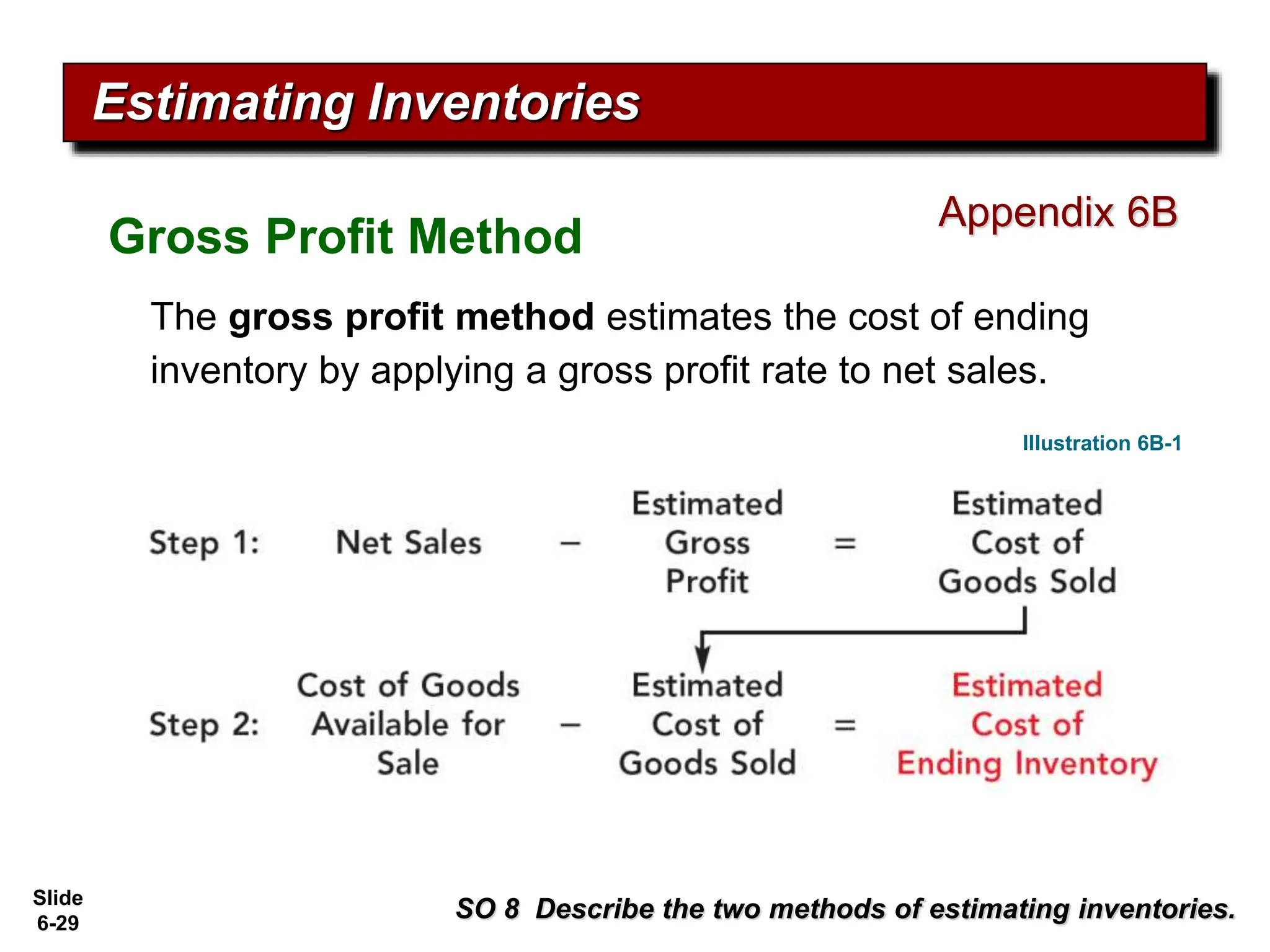
Estimating Inventories
The grossprofit method estimates the cost of ending
inventory by applying a gross profit rate to net sales.
Gross Profit Method
SO 8 Describe the two methods of estimating inventories.
Illustration 6B-1
Appendix 6B
30.
Slide
6-30
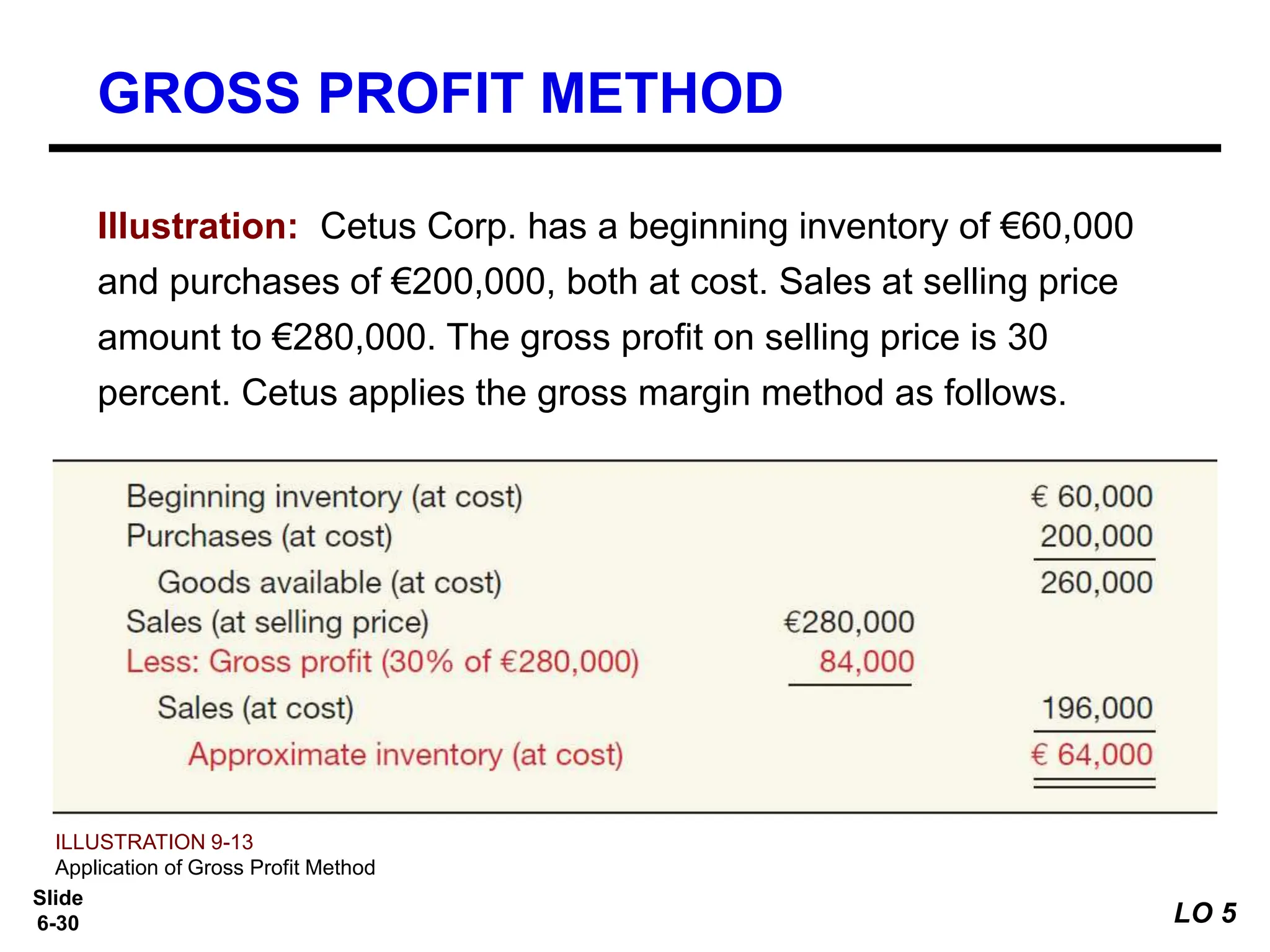
Illustration: Cetus Corp.has a beginning inventory of €60,000
and purchases of €200,000, both at cost. Sales at selling price
amount to €280,000. The gross profit on selling price is 30
percent. Cetus applies the gross margin method as follows.
GROSS PROFIT METHOD
ILLUSTRATION 9-13
Application of Gross Profit Method
LO 5
31.
9-31
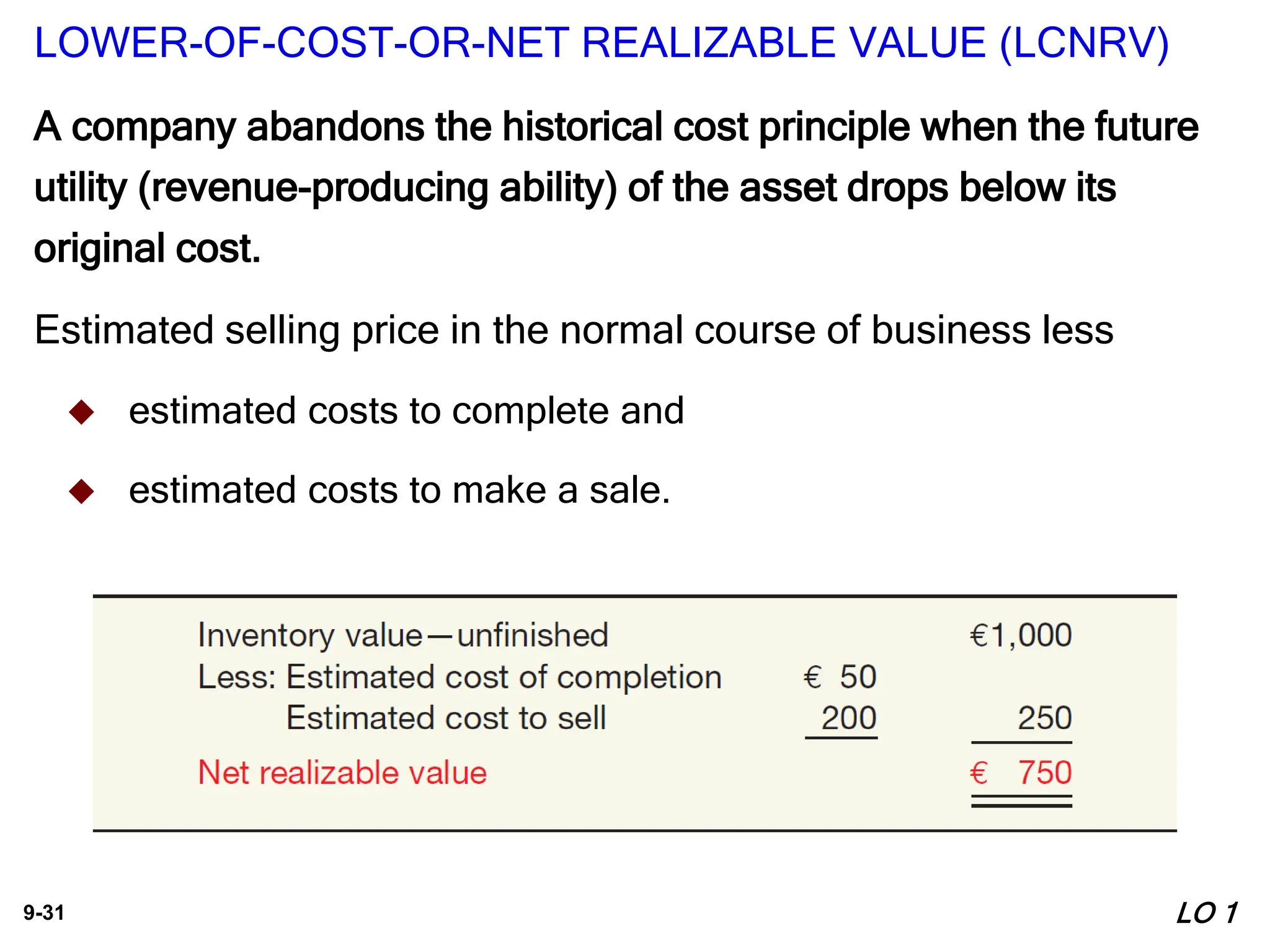
LOWER-OF-COST-OR-NET REALIZABLE VALUE(LCNRV)
A company abandons the historical cost principle when the future
utility (revenue-producing ability) of the asset drops below its
original cost.
Estimated selling price in the normal course of business less
estimated costs to complete and
estimated costs to make a sale.
LO 1
32.
9-32
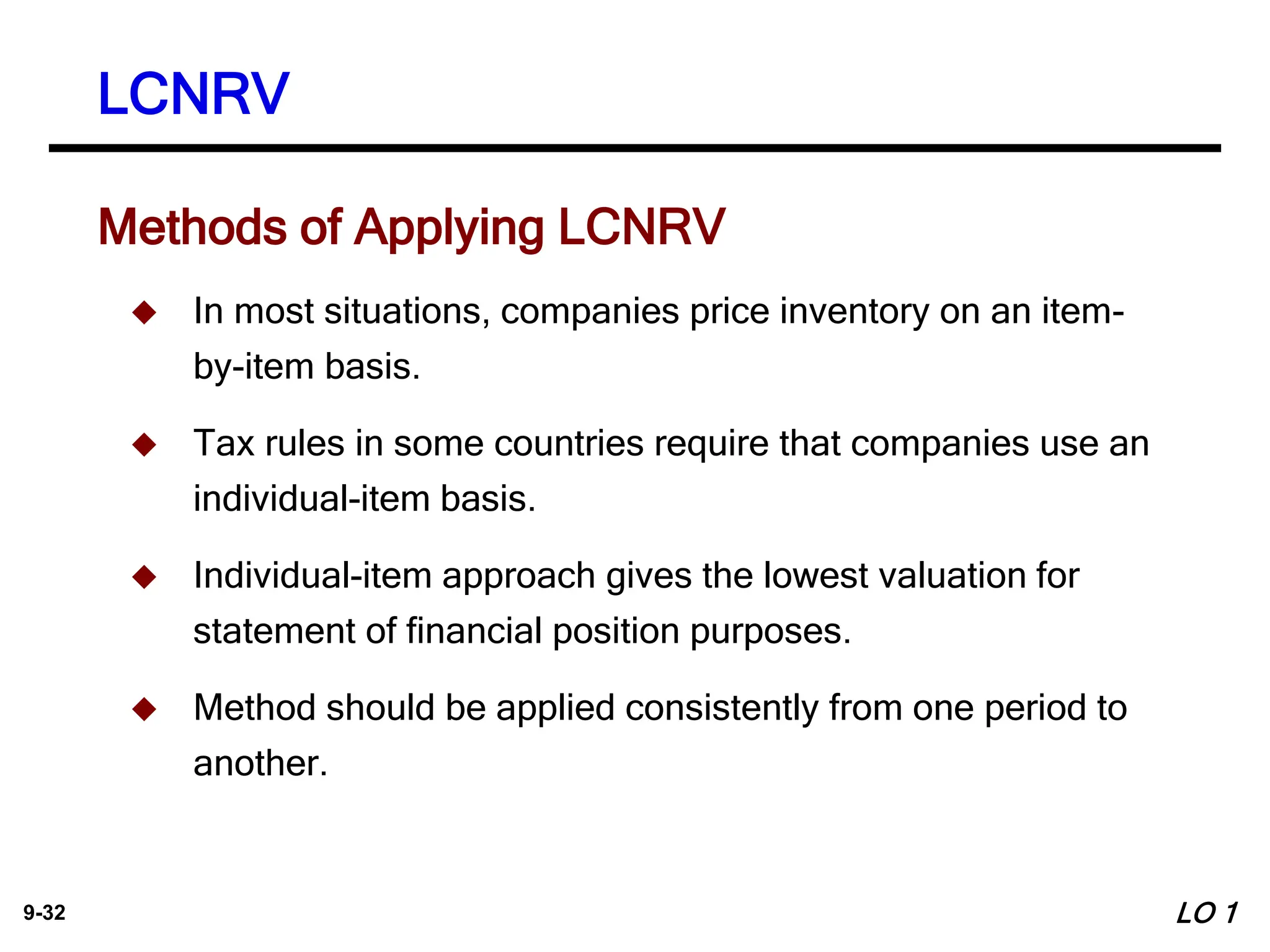
In mostsituations, companies price inventory on an item-
by-item basis.
Tax rules in some countries require that companies use an
individual-item basis.
Individual-item approach gives the lowest valuation for
statement of financial position purposes.
Method should be applied consistently from one period to
another.
Methods of Applying LCNRV
LCNRV
LO 1
33.
9-33
Cost of goodssold (before adj. to NRV) €108,000
Ending inventory (cost) 82,000
Ending inventory (at NRV) 70,000
Inventory (€82,000 - €70,000) 12,000
Loss Due to Decline to NRV 12,000
Inventory 12,000
Cost of Goods Sold 12,000
Loss
Method
COGS
Method
Illustration: Data for Ricardo Company
Recording Net Realizable Value
LO 1
34.
9-34
Use of anAllowance
Instead of crediting the Inventory account for net realizable
value adjustments, companies generally use an allowance
account.
Loss Due to Decline to NRV 12,000
Allowance to Reduce Inventory to NRV 12,000
Loss Method
LCNRV
LO 1
35.
9-35
Special Valuation Situations
Departurefrom LCNRV rule may be justified in situations when
cost is difficult to determine,
items are readily marketable at quoted market prices, and
units of product are interchangeable.
Two common situations in which NRV is the general rule:
Agricultural assets
Commodities held by broker-traders.
VALUATION BASES
LO 2
36.
9-36
Agricultural Inventory
Biological asset(classified as a non-current asset) is a living
animal or plant, such as sheep, cows, fruit trees, or cotton
plants.
Biological assets are measured on initial recognition and
at the end of each reporting period at fair value less costs
to sell (NRV).
Companies record gain or loss due to changes in NRV of
biological assets in income when it arises.
Agricultural produce are measured at fair value less costs to
sell (NRV) at the point of harvest.
Once harvested, the NRV becomes cost.
Special Valuation Situations
NRV
LO 2
37.
9-37
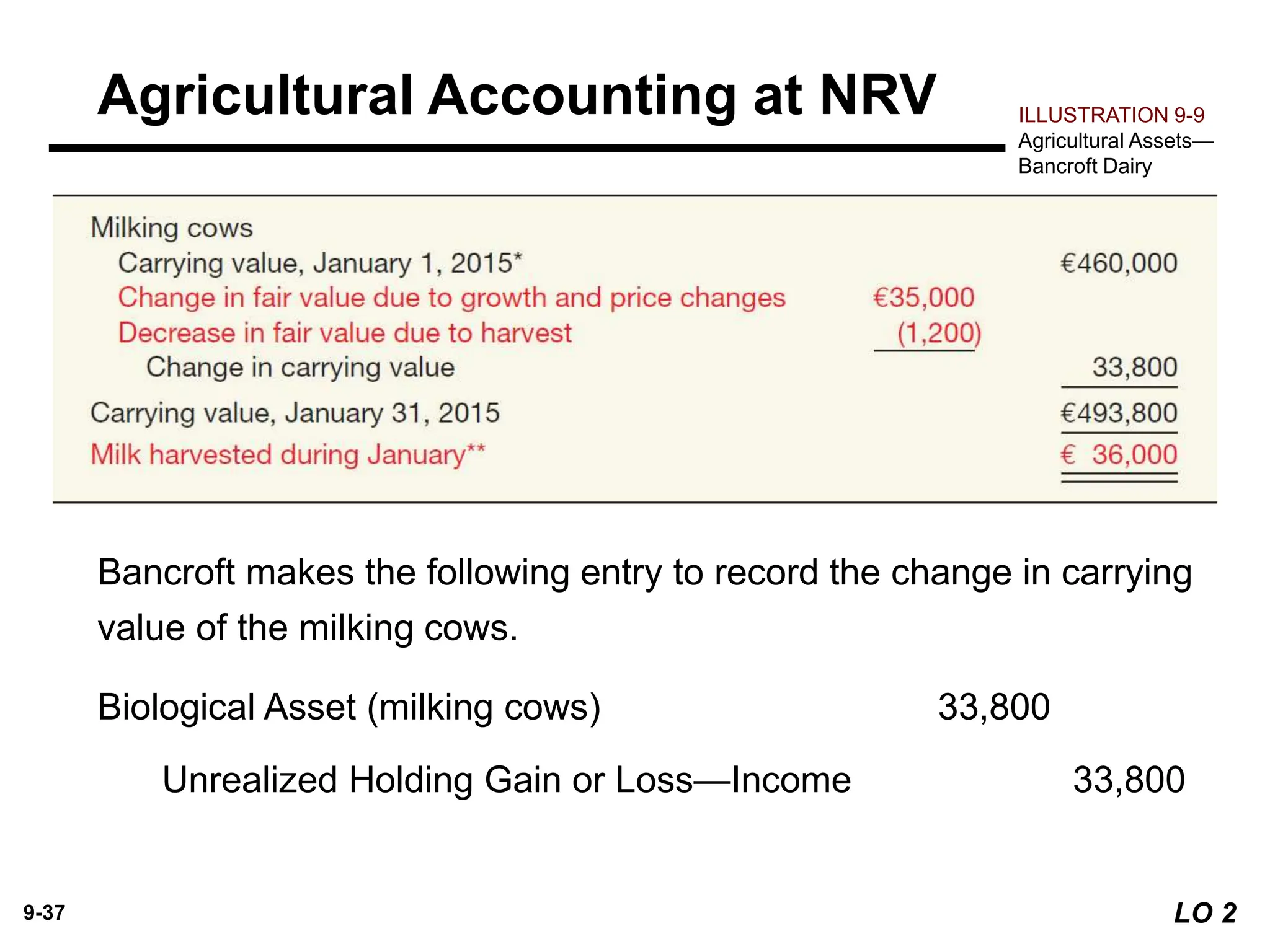
Bancroft makes thefollowing entry to record the change in carrying
value of the milking cows.
Biological Asset (milking cows) 33,800
Unrealized Holding Gain or Loss—Income 33,800
Agricultural Accounting at NRV ILLUSTRATION 9-9
Agricultural Assets—
Bancroft Dairy
LO 2
38.
9-38
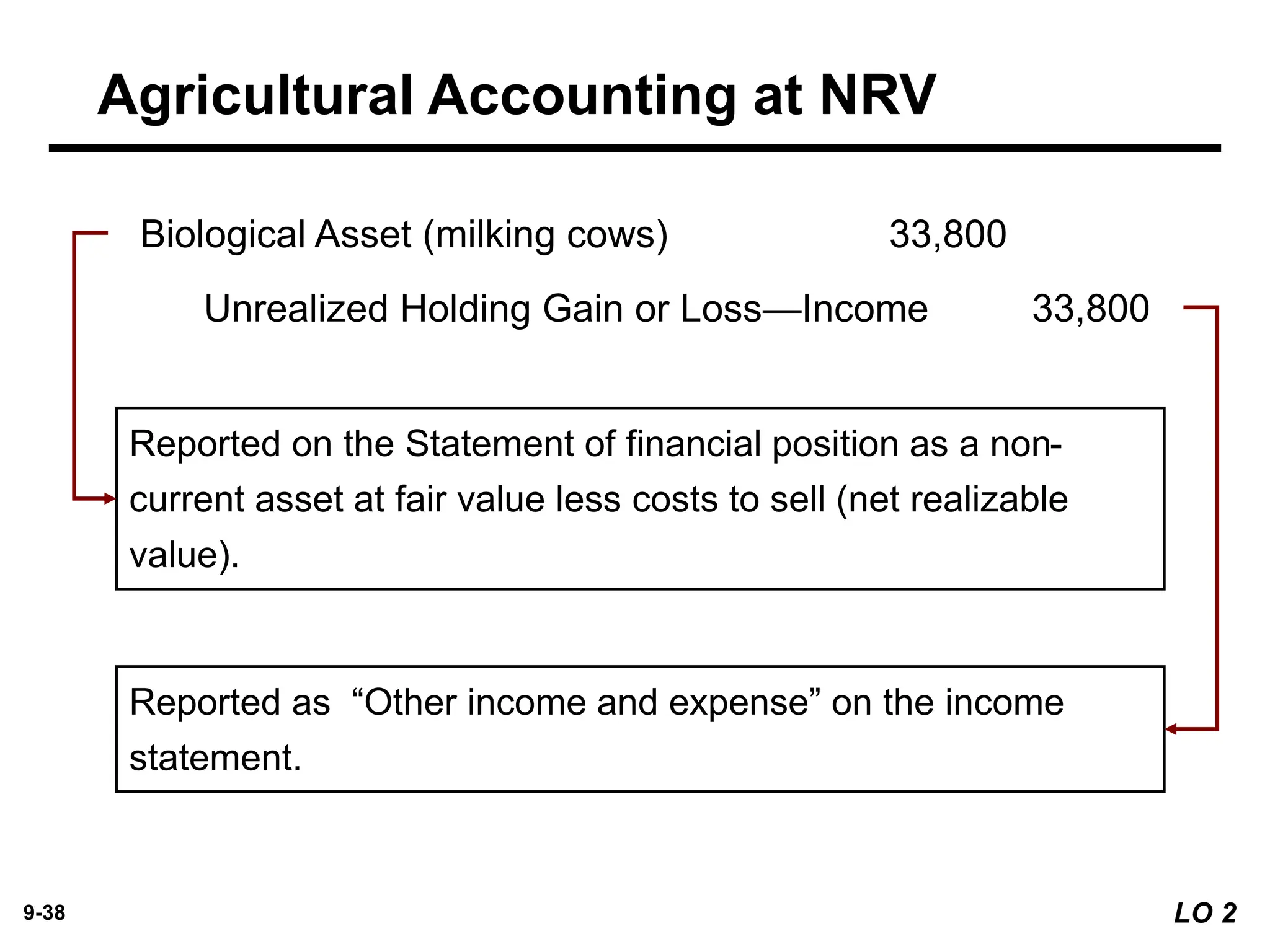
Unrealized Holding Gainor Loss—Income 33,800
Biological Asset (milking cows) 33,800
Reported on the Statement of financial position as a non-
current asset at fair value less costs to sell (net realizable
value).
Reported as “Other income and expense” on the income
statement.
Agricultural Accounting at NRV
LO 2
39.
9-39
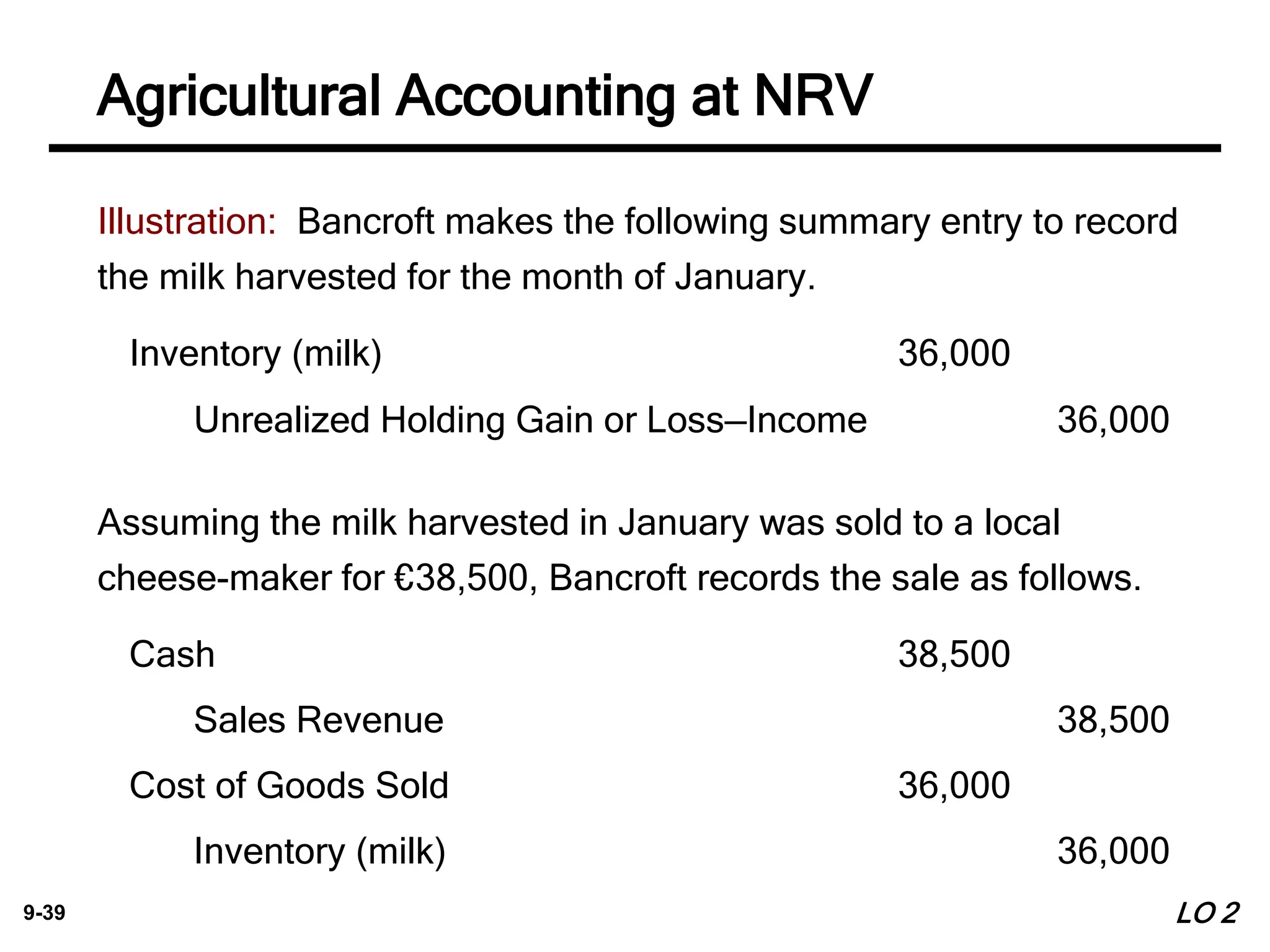
Inventory (milk) 36,000
UnrealizedHolding Gain or Loss—Income 36,000
Illustration: Bancroft makes the following summary entry to record
the milk harvested for the month of January.
Assuming the milk harvested in January was sold to a local
cheese-maker for €38,500, Bancroft records the sale as follows.
Agricultural Accounting at NRV
Cash 38,500
Sales Revenue 38,500
Cost of Goods Sold 36,000
Inventory (milk) 36,000
LO 2
40.
9-40
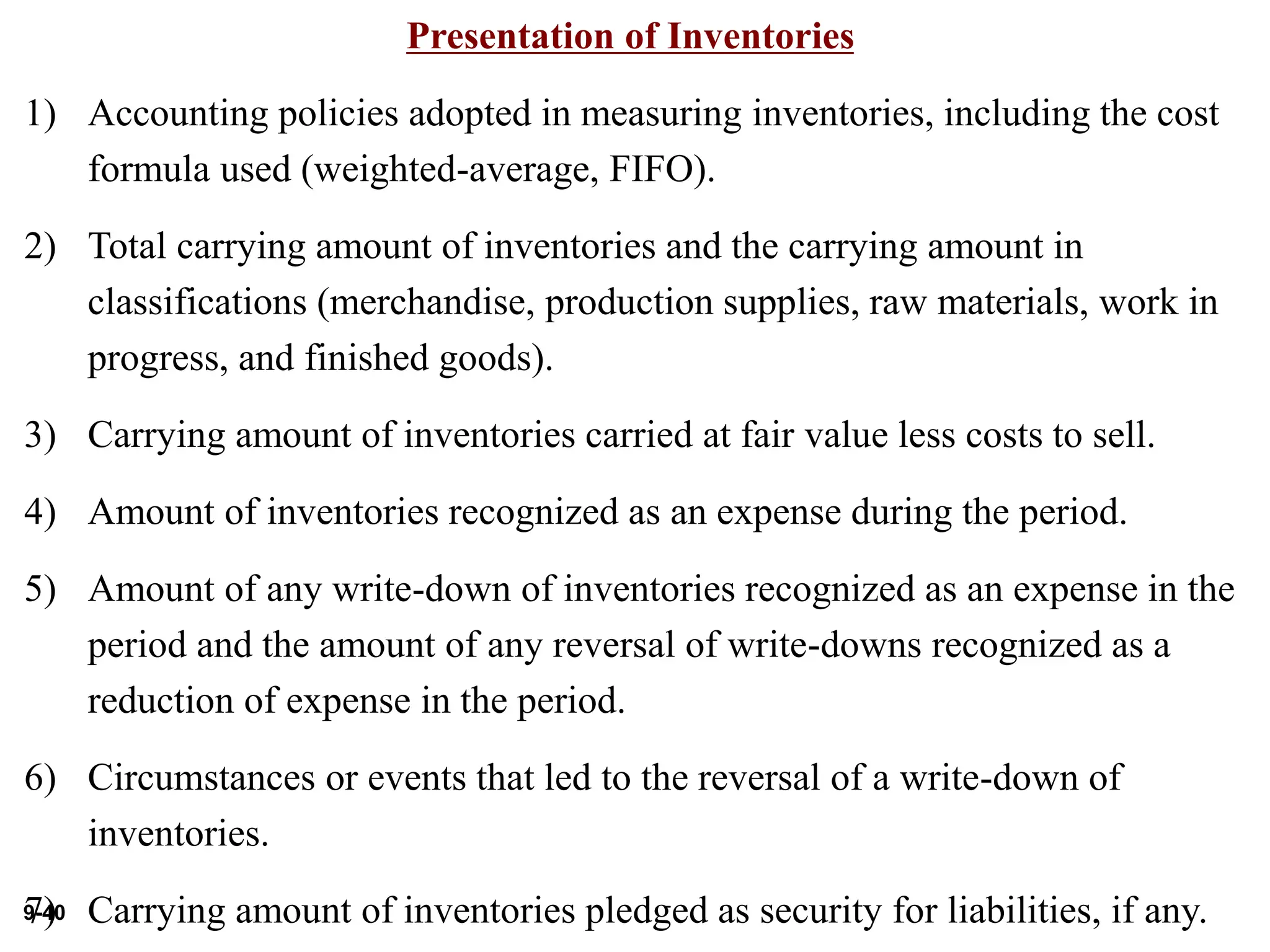
Presentation of Inventories
1)Accounting policies adopted in measuring inventories, including the cost
formula used (weighted-average, FIFO).
2) Total carrying amount of inventories and the carrying amount in
classifications (merchandise, production supplies, raw materials, work in
progress, and finished goods).
3) Carrying amount of inventories carried at fair value less costs to sell.
4) Amount of inventories recognized as an expense during the period.
5) Amount of any write-down of inventories recognized as an expense in the
period and the amount of any reversal of write-downs recognized as a
reduction of expense in the period.
6) Circumstances or events that led to the reversal of a write-down of
inventories.
7) Carrying amount of inventories pledged as security for liabilities, if any.