Financial Markets and
Institution (FIN-4201)
Course Teacher
S.M. Zahidur Rahman
Professor
Business Administration Discipline
Khulna University
Reference Book
Money and Capital Markets
9th edition +
Peter S. Rose
Irwin McGraw Hill Publishers
Chapter 1
The Role of the Financial
System in the Global
Economy
What is Financial System?
 Financial system is the collection of
markets, institutions, laws,
regulations, and techniques through
which bonds, stocks and other
securities are traded, interest rate is
determined, and financial services
are produced and delivered around
the world.
Importance of Financial
System
 Financial system is one of the most
important inventions of modern society.
Its primary task is to move scarce loan-
able funds from those who save to
those who borrow to buy goods and
services and to make investments in
new equipment and facilities so that the
global economy can grow and increase
the standard of living enjoyed by its
citizens.
 The financial system determines
both the cost of credit and how
much credit will be available to
pay for different goods and
services we purchase daily.
 What happens in this system has a
powerful impact on the health of global
economy.
 When credit becomes more costly and
less available, total spending for goods
and services falls.
 As such, unemployment rises and
economy’s growth slows down as
business cut back their production &
layoff workers.
 In contrast, when the cost of credit
declines and loan able funds
become more readily available,
total spending in economy
increases, more jobs are created,
and economic growth accelerates.
 We can conclude that, financial
system is an integral part of
economic system.
The Flows within Economic
System
 The basic function of any economy is to
allocate scarce resources- land, labor,
management skill and capital – to
produce the goods and services needed
by the society
 The high standard of living depends on
the ability of the global economy to turn
out each day an enormous volume of
food, shelter and other essentials of
modern living.
Flows within the Global Economic
System
Land and
other natural
resources
Labor and
managerial
skills
Capital
equipment
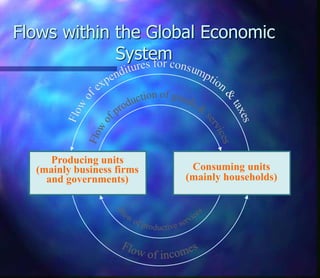
Flow of production
Flow of payments
Goods and
services sold
to the public
Flows within the Global Economic
System
Producing units
(mainly business firms
and governments)
Consuming units
(mainly households)
The Flows within Economic
System
 This is a very complex task indeed.
 The economy generates a flow of
production in return for a flow of
payments.
 Flows of payments and production
within the economic system works as a
circular flow between producing units
(mainly businesses and Govt.) and
consuming units (mainly households).
Flows within Economic System
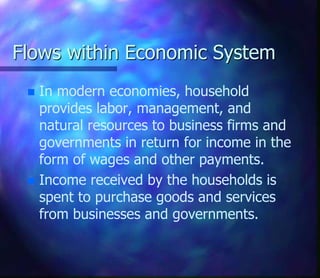
 In modern economies, household
provides labor, management, and
natural resources to business firms and
governments in return for income in the
form of wages and other payments.
 Income received by the households is
spent to purchase goods and services
from businesses and governments.
Flows within Economic System
 The result of this spending is a flow of
funds back to producing units as
income.
 Income stimulates them to produce
more goods and services in the future.
 The circular flow of production and
income is interdependent and never
ending.
The Role of Market in the
Economic System
What is Market?
–It is an institution set up by the
society to allocate resources that
are scarce relative to the demand
for them. Markets are the
channels through which buyers
and sellers meet to exchange
goods, services and resources.
–It answers the economic
problems.
Types of Markets
Factor Market
Product Market
Financial Market
Factor Market
– FM are the markets where the
consuming unit sells their labor and
other resources to those producing
units offering the highest prices. The
factor markets allocate factors of
production- land, labor and capital-
and distribute income-wages, rental
payments and so on to the owners of
productive resources.
Product Market
 In product market different
products for consumption are sold.
Consuming units use most of their
income from factor markets to
purchase goods and services in
product markets.
Financial Market
 In Financial market transaction of
different types of financial instruments
are made.
 It performs a vital function within the
economic system. The financial markets
channel savings to those individuals and
institutions needing more funds for
spending than are provided by their
current incomes.
Financial Markets
–The financial markets are the
hearts of financial system
attracting and allocating
savings and setting interest
rates and security prices.
Functions of Financial System
 Savings Function
 Wealth Function
 Liquidity Function
 Credit Function
 Payment Function
 Risk Function
 Policy Function
Savings Function
 Bonds, stocks, and other financial
claims sold in the money and capital
market provides a potentially
profitable, low risk outlet for public
savings. This savings flow through
the financial markets into investments
so that more goods and services can
be produced to increase society’s
standard of living.
Wealth Function
 The financial instruments sold in the
money and capital markets provide an
excellent way to store wealth until
funds are needed for spending.
 Unlike normal wealth like car, (which is
subject to depreciation) bonds, stocks
and other financial instruments do not
wear out overtime and usually generate
income.
Liquidity function:
Financial system provides a means of
raising funds by converting securities
and other financial assets into cash
balances. Thus the financial markets
provide liquidity for savers who hold
financial instruments but are in need
of money.
Credit Function
 The financial markets provide credit
to finance consumption and
investment spending in the
economy.
 Credit consists of a loan of funds
in return for a promise of future
payment.
 This can be consumer credit or
business credit
Payment Function
 The financial system provides a
mechanism for making
payments to purchase goods
and services.
 Debit card, credit card, ATM
card etc. are unique
mechanism for payment.
Risk function
 The financial markets offer
businesses, consumers and
Govts protection against life,
health, property and income
risks.
 These functions are performed
by sale of insurance policies like
general insurance, property
insurance etc
Policy Function
It provides a channel for
Govt. policy to achieve
society’s goals of high
employment, low inflation
and sustainable economic
growth.
 By manipulating interest rates
and the availability of credit,
Govt can affect the borrowing &
spending plans of the public,
which, in turn influence the
growth of jobs, production and
prices
Financial Services supplied
by the Money and Capital
Markets
Payment
Thrift
Insurance
Credit
Hedging
Agency
Payment services
It provides payments
accounts against which the
customer can write checks or
wire funds to pay for
purchases of goods &
services.
Thrift services
It provides attractive financial
instruments with adequate
safety and yield to encourage
people, businesses and Govt.
to save for their future
financial needs.
Insurance services:
It provides protection from
loss of income or property
in the event of death,
disability, negligence, or
other adverse
developments.
Credit services
It provides loanable funds
to supplement current
income in order to sustain
current living standard.
Hedging services
It provides protection against loss
due to unfavorable movements in
the market prices or interest
rates through such devices as
futures, options, and other
hedging instruments
Agency services
It Provides services by acting
as agent for a customer in
managing retirement funds
or other property
Types of Financial Market
 Money Market vs Capital
Market
 Open Vs Negotiated Market
 Primary Vs Secondary
Markets
 Spot Vs Futures, Forward,
and Option Markets
Money Market
 The money market is designed
for making of short-term loans.
 It is the institution through
which individuals and firms with
temporary surpluses of funds
meets the needs of the
borrowers who have temporary
funds shortages.
Money Market
 A security or loan maturing one
year or less is considered to be a
money market instrument.
 One of the principal functions of
money market is to finance the
working capital needs of
corporations and to provide
Govt. with short-term fund.
Capital Market
–The capital market is designed to
finance long term investments
(maturing more than one year) by
business, Governments and households.
–Trading of funds in the capital market
makes possible the construction of
factories, highways, schools etc.
Open Market
 In an open market, financial
instruments are bought and
sold at large without any
restrictions.
 For example, some corporate
bonds are sold in the open
market to the highest bidder
Negotiated Market
–In a negotiated market,
financial instruments like
corporate stocks, bonds etc.
are sold to one or few buyers
under private contract.
The Primary Market
–The Primary market is for the
trading of new securities issued
for the 1st time.
– Its principal function is raising
capital to support new
investment in different
projects/ventures.
–e.g. IPO.
The Secondary Market
–The secondary market deals
in securities previously
issued.
–Its chief function is to
provide liquidity to security
investors.
–Example includes trading in
CSE, DSE.
Spot Market
A Spot Market is one in
which securities or
financial services are
traded for immediate
delivery(usually within one
or two business
days).
A Spot Market
For example, you instruct your
broker to purchase 1000 share
of BATA Shoe Comp shares at
today’s price. You expect to
acquire ownership of those
shares within few hours/minutes.
A Future or Forward
Market
–These are designed to trade
contracts calling for the future
delivery of financial instruments.
–The purpose of such contract is to
reduce risk by agreeing on a price
today rather than later when price
of security may rise.
–Example: Fex Dealings in advance.
Options Markets
 It offers investors an opportunity to
reduce risk. These markets make
possible the trading of options on
selected stocks and bonds which are
agreements that give an investor the
right to either buy or sell designated
securities to the writer of the option at
a guaranteed price at any time during
the life of the contract.
Factors that tie all
Financial Markets together
Credit
Speculation
Arbitrage
Perfect and Efficient
Market.
 Credit, the Common Commodity. The
shifting of borrowers among markets
helps to weld the parts of the global
financial system together and to bring
the credit costs in the different markets
into balance with one another.
 Speculation and Arbitrage. Speculators
who watch for profitable arbitrage
opportunities help to maintain
consistent prices among the markets.
Factors Tying All Financial Markets
Together
Factors Tying All Financial Markets
Together
 Perfect and Efficient Markets. There is
some research evidence suggesting that
financial markets are closely tied to one
another due to their near perfection
and efficiency.
 In the real world however, market
imperfection and information
asymmetry exist.

Lecture 1 FIM.ppt

  • 1.
    Financial Markets and Institution(FIN-4201) Course Teacher S.M. Zahidur Rahman Professor Business Administration Discipline Khulna University
  • 2.
    Reference Book Money andCapital Markets 9th edition + Peter S. Rose Irwin McGraw Hill Publishers
  • 3.
    Chapter 1 The Roleof the Financial System in the Global Economy
  • 4.
    What is FinancialSystem?  Financial system is the collection of markets, institutions, laws, regulations, and techniques through which bonds, stocks and other securities are traded, interest rate is determined, and financial services are produced and delivered around the world.
  • 5.
    Importance of Financial System Financial system is one of the most important inventions of modern society. Its primary task is to move scarce loan- able funds from those who save to those who borrow to buy goods and services and to make investments in new equipment and facilities so that the global economy can grow and increase the standard of living enjoyed by its citizens.
  • 6.
     The financialsystem determines both the cost of credit and how much credit will be available to pay for different goods and services we purchase daily.
  • 7.
     What happensin this system has a powerful impact on the health of global economy.  When credit becomes more costly and less available, total spending for goods and services falls.  As such, unemployment rises and economy’s growth slows down as business cut back their production & layoff workers.
  • 8.
     In contrast,when the cost of credit declines and loan able funds become more readily available, total spending in economy increases, more jobs are created, and economic growth accelerates.  We can conclude that, financial system is an integral part of economic system.
  • 9.
    The Flows withinEconomic System  The basic function of any economy is to allocate scarce resources- land, labor, management skill and capital – to produce the goods and services needed by the society  The high standard of living depends on the ability of the global economy to turn out each day an enormous volume of food, shelter and other essentials of modern living.
  • 10.
    Flows within theGlobal Economic System Land and other natural resources Labor and managerial skills Capital equipment Flow of production Flow of payments Goods and services sold to the public
  • 11.
    Flows within theGlobal Economic System Producing units (mainly business firms and governments) Consuming units (mainly households)
  • 12.
    The Flows withinEconomic System  This is a very complex task indeed.  The economy generates a flow of production in return for a flow of payments.  Flows of payments and production within the economic system works as a circular flow between producing units (mainly businesses and Govt.) and consuming units (mainly households).
  • 13.
    Flows within EconomicSystem  In modern economies, household provides labor, management, and natural resources to business firms and governments in return for income in the form of wages and other payments.  Income received by the households is spent to purchase goods and services from businesses and governments.
  • 14.
    Flows within EconomicSystem  The result of this spending is a flow of funds back to producing units as income.  Income stimulates them to produce more goods and services in the future.  The circular flow of production and income is interdependent and never ending.
  • 15.
    The Role ofMarket in the Economic System
  • 16.
    What is Market? –Itis an institution set up by the society to allocate resources that are scarce relative to the demand for them. Markets are the channels through which buyers and sellers meet to exchange goods, services and resources. –It answers the economic problems.
  • 17.
    Types of Markets FactorMarket Product Market Financial Market
  • 18.
    Factor Market – FMare the markets where the consuming unit sells their labor and other resources to those producing units offering the highest prices. The factor markets allocate factors of production- land, labor and capital- and distribute income-wages, rental payments and so on to the owners of productive resources.
  • 19.
    Product Market  Inproduct market different products for consumption are sold. Consuming units use most of their income from factor markets to purchase goods and services in product markets.
  • 20.
    Financial Market  InFinancial market transaction of different types of financial instruments are made.  It performs a vital function within the economic system. The financial markets channel savings to those individuals and institutions needing more funds for spending than are provided by their current incomes.
  • 21.
    Financial Markets –The financialmarkets are the hearts of financial system attracting and allocating savings and setting interest rates and security prices.
  • 22.
    Functions of FinancialSystem  Savings Function  Wealth Function  Liquidity Function  Credit Function  Payment Function  Risk Function  Policy Function
  • 23.
    Savings Function  Bonds,stocks, and other financial claims sold in the money and capital market provides a potentially profitable, low risk outlet for public savings. This savings flow through the financial markets into investments so that more goods and services can be produced to increase society’s standard of living.
  • 24.
    Wealth Function  Thefinancial instruments sold in the money and capital markets provide an excellent way to store wealth until funds are needed for spending.  Unlike normal wealth like car, (which is subject to depreciation) bonds, stocks and other financial instruments do not wear out overtime and usually generate income.
  • 25.
    Liquidity function: Financial systemprovides a means of raising funds by converting securities and other financial assets into cash balances. Thus the financial markets provide liquidity for savers who hold financial instruments but are in need of money.
  • 26.
    Credit Function  Thefinancial markets provide credit to finance consumption and investment spending in the economy.  Credit consists of a loan of funds in return for a promise of future payment.  This can be consumer credit or business credit
  • 27.
    Payment Function  Thefinancial system provides a mechanism for making payments to purchase goods and services.  Debit card, credit card, ATM card etc. are unique mechanism for payment.
  • 28.
    Risk function  Thefinancial markets offer businesses, consumers and Govts protection against life, health, property and income risks.  These functions are performed by sale of insurance policies like general insurance, property insurance etc
  • 29.
    Policy Function It providesa channel for Govt. policy to achieve society’s goals of high employment, low inflation and sustainable economic growth.
  • 30.
     By manipulatinginterest rates and the availability of credit, Govt can affect the borrowing & spending plans of the public, which, in turn influence the growth of jobs, production and prices
  • 31.
    Financial Services supplied bythe Money and Capital Markets Payment Thrift Insurance Credit Hedging Agency
  • 32.
    Payment services It providespayments accounts against which the customer can write checks or wire funds to pay for purchases of goods & services.
  • 33.
    Thrift services It providesattractive financial instruments with adequate safety and yield to encourage people, businesses and Govt. to save for their future financial needs.
  • 34.
    Insurance services: It providesprotection from loss of income or property in the event of death, disability, negligence, or other adverse developments.
  • 35.
    Credit services It providesloanable funds to supplement current income in order to sustain current living standard.
  • 36.
    Hedging services It providesprotection against loss due to unfavorable movements in the market prices or interest rates through such devices as futures, options, and other hedging instruments
  • 37.
    Agency services It Providesservices by acting as agent for a customer in managing retirement funds or other property
  • 38.
    Types of FinancialMarket  Money Market vs Capital Market  Open Vs Negotiated Market  Primary Vs Secondary Markets  Spot Vs Futures, Forward, and Option Markets
  • 39.
    Money Market  Themoney market is designed for making of short-term loans.  It is the institution through which individuals and firms with temporary surpluses of funds meets the needs of the borrowers who have temporary funds shortages.
  • 40.
    Money Market  Asecurity or loan maturing one year or less is considered to be a money market instrument.  One of the principal functions of money market is to finance the working capital needs of corporations and to provide Govt. with short-term fund.
  • 41.
    Capital Market –The capitalmarket is designed to finance long term investments (maturing more than one year) by business, Governments and households. –Trading of funds in the capital market makes possible the construction of factories, highways, schools etc.
  • 42.
    Open Market  Inan open market, financial instruments are bought and sold at large without any restrictions.  For example, some corporate bonds are sold in the open market to the highest bidder
  • 43.
    Negotiated Market –In anegotiated market, financial instruments like corporate stocks, bonds etc. are sold to one or few buyers under private contract.
  • 44.
    The Primary Market –ThePrimary market is for the trading of new securities issued for the 1st time. – Its principal function is raising capital to support new investment in different projects/ventures. –e.g. IPO.
  • 45.
    The Secondary Market –Thesecondary market deals in securities previously issued. –Its chief function is to provide liquidity to security investors. –Example includes trading in CSE, DSE.
  • 46.
    Spot Market A SpotMarket is one in which securities or financial services are traded for immediate delivery(usually within one or two business days).
  • 47.
    A Spot Market Forexample, you instruct your broker to purchase 1000 share of BATA Shoe Comp shares at today’s price. You expect to acquire ownership of those shares within few hours/minutes.
  • 48.
    A Future orForward Market –These are designed to trade contracts calling for the future delivery of financial instruments. –The purpose of such contract is to reduce risk by agreeing on a price today rather than later when price of security may rise. –Example: Fex Dealings in advance.
  • 49.
    Options Markets  Itoffers investors an opportunity to reduce risk. These markets make possible the trading of options on selected stocks and bonds which are agreements that give an investor the right to either buy or sell designated securities to the writer of the option at a guaranteed price at any time during the life of the contract.
  • 50.
    Factors that tieall Financial Markets together Credit Speculation Arbitrage Perfect and Efficient Market.
  • 51.
     Credit, theCommon Commodity. The shifting of borrowers among markets helps to weld the parts of the global financial system together and to bring the credit costs in the different markets into balance with one another.  Speculation and Arbitrage. Speculators who watch for profitable arbitrage opportunities help to maintain consistent prices among the markets. Factors Tying All Financial Markets Together
  • 52.
    Factors Tying AllFinancial Markets Together  Perfect and Efficient Markets. There is some research evidence suggesting that financial markets are closely tied to one another due to their near perfection and efficiency.  In the real world however, market imperfection and information asymmetry exist.