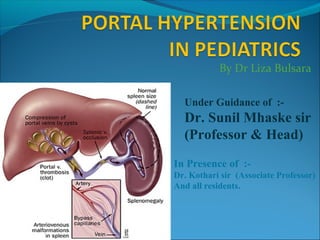
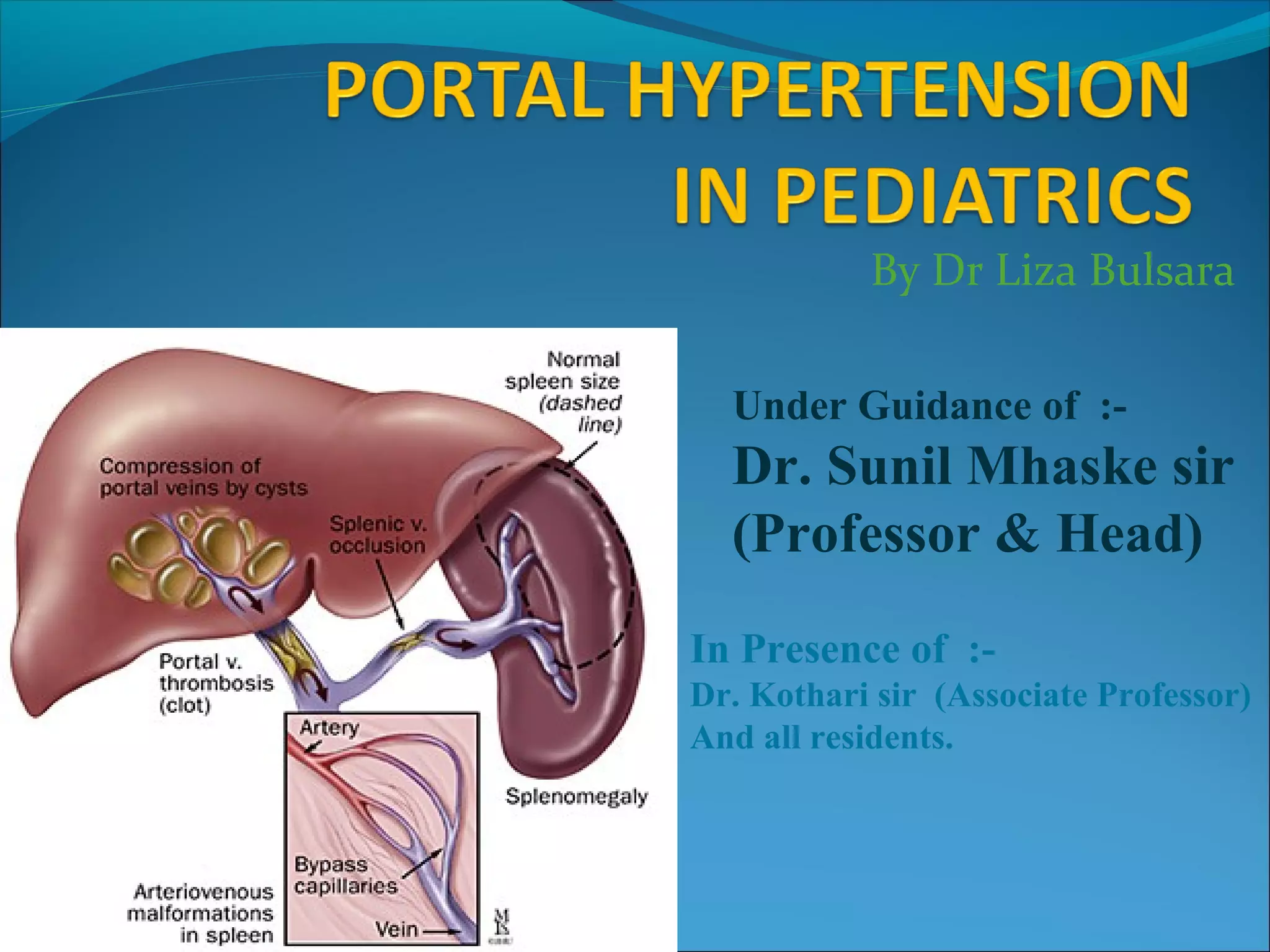
By Dr Liza Bulsara
Under Guidance of :-
Dr. Sunil Mhaske sir
(Professor & Head)
In Presence of :-
Dr. Kothari sir (Associate Professor)
And all residents.
smalathi 2
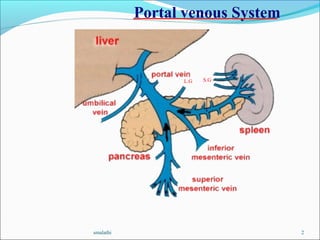
S.GL.G
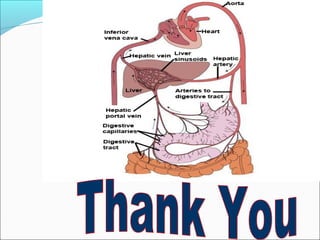
Portal venous System
Portal Hypertension
Normal range of portal venous pressure is 5 to 10 mm
of Hg or 10-15 cm saline above the pressure present in
the IVC.
Portal hypertension is defined as elevation of this
pressure gradient to values above 10 to 12 mm Hg.
smalathi 3
Portal Hypertension
Definition:PHT is a pathologic increase in portal
pressure in which the pressure gradient between
the portal vein and the IVC (Portal pressure
gradient or PPG)is increased above the upper
limit of 10 mm of Hg.
PPG > 10 mmHg(varices)
PPG > 12mmHg(variceal bleed,ascites)
PPG > 6 to 10 mmHg(subclinical PHT)
smalathi 4
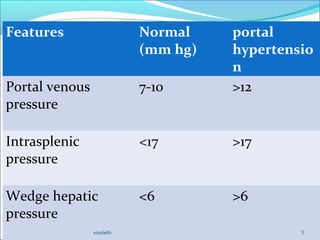
Features Normal
(mm hg)
portal
hypertensio
n
Portal venous
pressure
7-10 >12
Intrasplenic
pressure
<17 >17
Wedge hepatic
pressure
<6 >6
smalathi 5
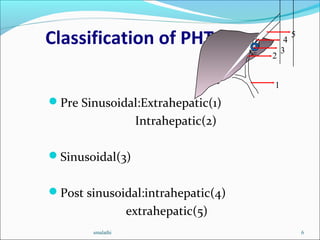
Classification of PHT
Pre Sinusoidal:Extrahepatic(1)
Intrahepatic(2)
Sinusoidal(3)
Post sinusoidal:intrahepatic(4)
extrahepatic(5)
smalathi 6
1
2
3
4
5
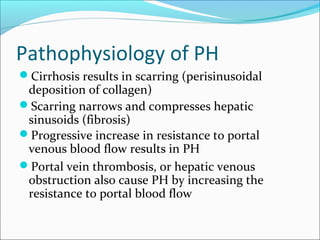
Pathophysiology of PH
Cirrhosis results in scarring (perisinusoidal
deposition of collagen)
Scarring narrows and compresses hepatic
sinusoids (fibrosis)
Progressive increase in resistance to portal
venous blood flow results in PH
Portal vein thrombosis, or hepatic venous
obstruction also cause PH by increasing the
resistance to portal blood flow
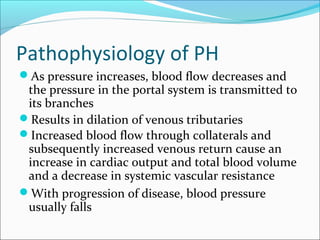
Pathophysiology of PH
As pressure increases, blood flow decreases and
the pressure in the portal system is transmitted to
its branches
Results in dilation of venous tributaries
Increased blood flow through collaterals and
subsequently increased venous return cause an
increase in cardiac output and total blood volume
and a decrease in systemic vascular resistance
With progression of disease, blood pressure
usually falls
smalathi 9
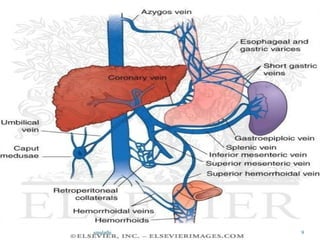
Portal Vein CollateralsCoronary vein and short gastric veins -> veins of the
lesser curve of the stomach and the esophagus, leading
to the formation of varices
Inferior mesenteric vein -> rectal branches which, when
distended, form hemorrhoids
Umbilical vein ->epigastric venous system around the
umbilicus (caput medusae)
Retroperitoneal collaterals ->gastrointestinal veins
through the bare areas of the liver
Posterior abdominal wall:veins of posterior abdominal
wall,subdiaphragmatic veins,retroperitoneal veins.
Splenorenal collaterals
Splenoperitoneal collaterals.
Etiology of PH
 Causes of PH can be divided into
1. Pre-hepatic
2. Intra-hepatic
3. Post-hepatic
Pre-hepatic PH
Caused by obstruction to blood flow at the level of
portal vein
Examples: congenital atresia, extrinsic compression,
s, portal, superior mesenteric, or splenic vein
thrombosis,cirrohsis.
Intrahepatic:
Infections:cirrohsis due to hepatitis B,C.
Metabolic disorders: wilson’s diseases.
Congenitial hepatic fibrosis
Chronic active hepatitis
Chronic myeloid luekemia
Lymphoma
Sarcoidosis
Luekemic infiltration
Toxins:arsenic,vinyl chloride,hyperviayminosis A.
smalathi 13
Post-hepatic
Caused by obstruction to blood flow at the level of
hepatic vein
Examples: Budd-Chiari syndrome, chronic heart
failure, constrictive pericarditis, vena cava webs
Budd-Chiari Syndrome
Caused by hepatic venous obstruction
At the level of the inferior vena cava, the hepatic
veins, or the central veins within the liver itself
result of congenital webs , acute or chronic
thrombosis and malignancy
Budd-Chiari Syndrome
Acute symptoms include hepatomegaly, RUQ
abdominal pain, nausea, vomiting, ascites
Chronic form present with the sequelae of
cirrhosis and portal hypertension, including
variceal bleeding, ascites, spontaneous bacterial
peritonitis, fatigue, and encephalopathy
Diagnosis is most often made by US evaluation of
the liver and its vasculature
Cross-sectional imaging using contrast-enhanced
CT or MRI
Budd-Chiari Syndrome
Gold standard for the diagnosis has been
angiography
Management has traditionally been surgical
intervention (surgical decompression with a side-
to-side portosystemic shunt)
Minimally invasive treatment using TIPS may be
first-line therapy now
Response rates to medical therapy are poor
Portal Vein Thrombosis
Most common cause in children (fewer than 10%
of adult pts.)
Normal liver function and not as susceptible to
the development of complications, such as
encephalopathy
Diagnosis by sonography, CT and MRI
Often, the initial manifestation of portal vein
thrombosis is variceal bleeding in a noncirrhotic
patient with normal liver function
Portal Vein Thrombosis -
Causes
Umbilical vein infection (the most common cause
in children)
Coagulopathies (protein C and antithrombin III
deficiency),
Hepatic malignancy, myeloproliferative disorders
Inflammatory bowel disease
pancreatitis
trauma
Most cases in adults are idiopathic
Portal Vein Thrombosis
Therapeutic options are esophageal variceal ligation
and sclerotherapy
Distal splenorenal shunt
Rex shunt in patients whose intrahepatic portal vein
is patent (most commonly children)
Splenic Vein Thrombosis
Most often caused by disorders of the pancreas
(acute and chronic pancreatitis, trauma,
pancreatic malignancy, and pseudocysts)
Related to the location of the splenic vein
Gastric varices are present in 80% of patients
Occurs in the setting of normal liver function
Readily cured with splenectomy (variceal
hemorrhage), although observation for
asymptomatic patients is acceptable.
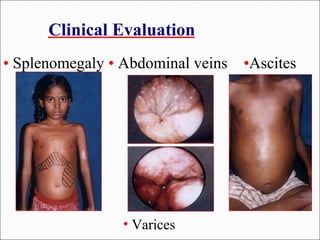
Clinical Evaluation
• Splenomegaly • Abdominal veins •Ascites
• Varices
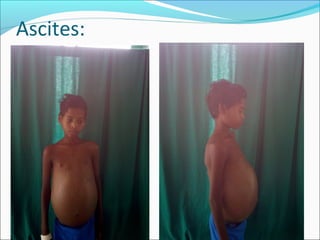
Ascites:
smalathi 23
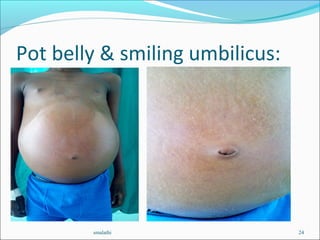
Pot belly & smiling umbilicus:
smalathi 24
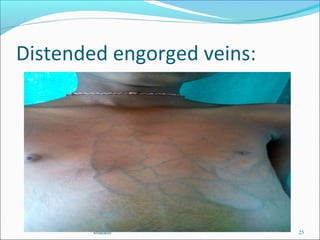
Distended engorged veins:
smalathi 25
smalathi 26
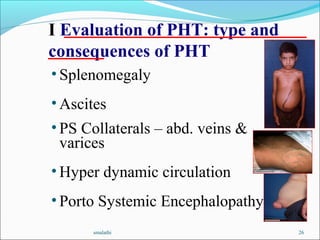
• Splenomegaly
• Ascites
• PS Collaterals – abd. veins &
varices
• Hyper dynamic circulation
• Porto Systemic Encephalopathy
I Evaluation of PHT: type and
consequences of PHT
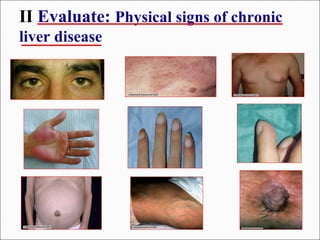
II Evaluate: Physical signs of chronic
liver disease
smalathi 28
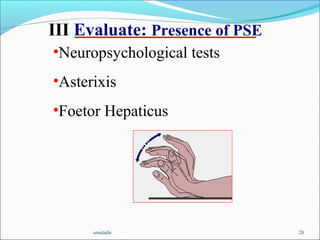
III Evaluate: Presence of PSE
•Neuropsychological tests
•Asterixis
•Foetor Hepaticus
smalathi 29
• An enlarged spleen is the single most
important diagnostic sign of PHT
•Does not correlate with height of portal
pressure, size of varices or age of pt.
•Correlates with type of PHT (*
NCPF
12cm, * *
EHPVO 6cm)
•Spleen may not be palpable soon after a
bleed
Splenomegaly
smalathi 30
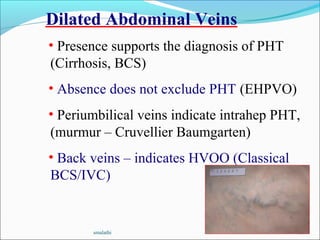
Dilated Abdominal Veins
• Presence supports the diagnosis of PHT
(Cirrhosis, BCS)
• Absence does not exclude PHT (EHPVO)
• Periumbilical veins indicate intrahep PHT,
(murmur – Cruvellier Baumgarten)
• Back veins – indicates HVOO (Classical
BCS/IVC)
smalathi 31
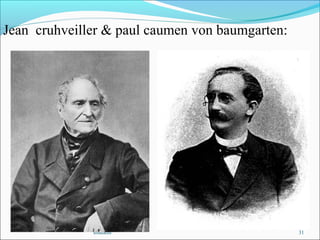
Jean cruhveiller & paul caumen von baumgarten:
smalathi 32
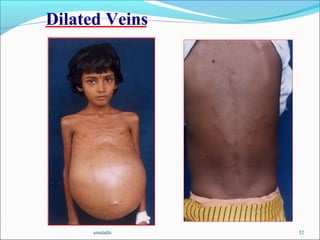
Dilated Veins
smalathi 33
Ascites
• Presence of ascites supports diag of PHT
• Present in sinusoidal/post-sinusoidal
• Sudden accumulation of ascites – HVOO
• “Frog belly” – IVC obstruction
• Ascites in EHPVO (0-36%),
NCPF (5-10%) transient
smalathi 34
• Consistency more significant than size
• Size correlates poorly with height of pp.
• Normal, soft or small liver EHPVO
• Firm, nodular ,↓ vertical span or
enlarged,L .lobe palpable- cirrhosis
• Left lobe liver enlarged - CHF
• Firm liver – NCPF (10-15% nodular)
Liver Size & Consistency
smalathi 35
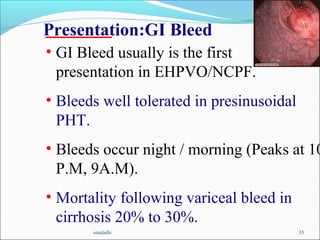
Presentation:GI Bleed
• GI Bleed usually is the first
presentation in EHPVO/NCPF.
• Bleeds well tolerated in presinusoidal
PHT.
• Bleeds occur night / morning (Peaks at 10
P.M, 9A.M).
• Mortality following variceal bleed in
cirrhosis 20% to 30%.
smalathi 36
Porto Systemic Hepatic
Encephalopathy
• Minimal Encephalopathy (>50%)
• Recurrent
• Persistent
• Acute
All 4 forms seen in cirrhosis. In NCPF /
EHPVO, this may follow GI bleed but
majority recover
smalathi 37
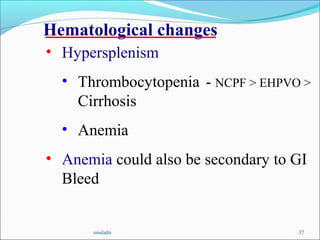
• Hypersplenism
• Thrombocytopenia - NCPF > EHPVO >
Cirrhosis
• Anemia
• Anemia could also be secondary to GI
Bleed
Hematological changes
smalathi 38
Clinical Features
• Growth Retardation – Resistance to the action
of growth hormone (EHPVO)
• Portopulmonary hypertension – non-
embolic pulmonary vasoconstriction in the
presence of PHT. (4% of cirrhosis, 9% of NCPF))
.
• Hepatorenal syndrome – renal insufficiency
in patients with severe liver failure in the absence
of any other cause of renal pathology (cirrhosis).
smalathi 39
Clinical Features
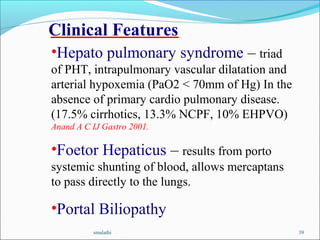
•Hepato pulmonary syndrome – triad
of PHT, intrapulmonary vascular dilatation and
arterial hypoxemia (PaO2 < 70mm of Hg) In the
absence of primary cardio pulmonary disease.
(17.5% cirrhotics, 13.3% NCPF, 10% EHPVO)
Anand A C IJ Gastro 2001.
•Foetor Hepaticus – results from porto
systemic shunting of blood, allows mercaptans
to pass directly to the lungs.
•Portal Biliopathy
smalathi 40
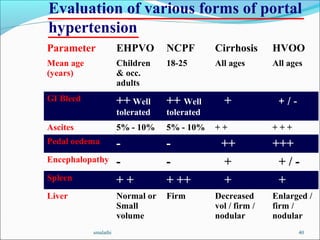
Evaluation of various forms of portal
hypertension
Parameter EHPVO NCPF Cirrhosis HVOO
Mean age
(years)
Children
& occ.
adults
18-25 All ages All ages
GI Bleed ++ Well
tolerated
++ Well
tolerated
+ + / -
Ascites 5% - 10% 5% - 10% + + + + +
Pedal oedema - - ++ +++
Encephalopathy - - + + / -
Spleen + + + ++ + +
Liver Normal or
Small
volume
Firm Decreased
vol / firm /
nodular
Enlarged /
firm /
nodular
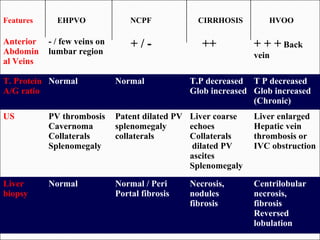
Anterior
Abdomin
al Veins
- / few veins on
lumbar region
+ / - ++ + + + Back
vein
T. Protein
A/G ratio
Normal Normal T.P decreased
Glob increased
T P decreased
Glob increased
(Chronic)
US PV thrombosis
Cavernoma
Collaterals
Splenomegaly
Patent dilated PV
splenomegaly
collaterals
Liver coarse
echoes
Collaterals
dilated PV
ascites
Splenomegaly
Liver enlarged
Hepatic vein
thrombosis or
IVC obstruction
Liver
biopsy
Normal Normal / Peri
Portal fibrosis
Necrosis,
nodules
fibrosis
Centrilobular
necrosis,
fibrosis
Reversed
lobulation
Features EHPVO NCPF CIRRHOSIS HVOO
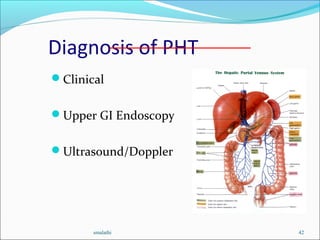
Diagnosis of PHT
Clinical
Upper GI Endoscopy
Ultrasound/Doppler
smalathi 42
Complications of PH
GI bleeding due to gastric and esophageal varices
Ascites
Hepatic encephalopathy
Varices
Most life threatening complication is bleeding from
esophageal varices
Distal 5 cm of esophagus
Usually the portal vein-hepatic vein pressure gradient
>12 mm Hg
Bleeding occurs in 25-35% of pts. With varices and
risk is highest in 1st yr.
Prevention of Varices
Primary prophylaxis: prevent 1st episode of bleeding
Secondary prophylaxis: prevent recurrent episodes of
bleeding
Include control of underlying cause of cirrhosis and
pharmacological, surgical interventions to lower
portal pressure
Prevention of Varices
Beta blockade: Beta blockade (Nadolol, Propranolol)
Nitrates:Organic nitrates
Surgery: No longer performed*
Endoscopy: Sclerotherapy (no longer used*
) and
variceal ligation
* Refers to primary prophylaxis
Treatment of Varices
 Initial Management:
1. Airway control
2. Hemodynamic monitoring
3. Placement of large bore IV lines
4. Full lab investigation (Hct, Coags, LFTs,)
5. Administration of blood products
6. ICU monitoring
Pharmacologic Treatment of
Varices
Decreases the rate of bleeding
Enhances the endoscopic ability to visualize the
site of bleeding
Vasopressin - potent splanchnic vasoconstrictor;
decreases portal venous blood flow and pressure
Somatostatin: decrease splanchnic blood flow
indirectly; fewer side effects
Octreotide: Initial drug of choice for acute
variceal bleeding
Endoscopic Therapy for Varices
Endoscopic Sclerotherapy: complications occur in 10-
30% and include fever, retrosternal chest pain,
dysphagia, perforation
Endoscopic variceal ligation: becoming the initial
intervention of choice; success rates range from 80-
100%
Balloon Tamponade
Sengstaken-Blakemore tube
Minnesota tube
Alternative therapy for pts. who fail pharmacologic or
endoscopic therapy
Complications: aspiration, perforation, necrosis
Limited to 24 hrs; works in 70-80%
TIPS
Transjugular intrahepatic portasystemic shunt
1st line treatment for bleeding esophageal
varices when earlier-mentioned methods fail
Success rates 90-100%
Significant complication is hepatic
encephalopathy
Surgical Intervention
Liver transplantation: only definitive procedure for
PH caused by cirrhosis
Shunts
Totally diverting (end-side portacaval)
Partially diverting (side-side portacaval)
Selective (distal splenorenal shunt)
Devascularization
Portal hypertension paediatrics

Portal hypertension paediatrics

  • 1.
    By Dr LizaBulsara Under Guidance of :- Dr. Sunil Mhaske sir (Professor & Head) In Presence of :- Dr. Kothari sir (Associate Professor) And all residents.
  • 2.
  • 3.
    Portal Hypertension Normal rangeof portal venous pressure is 5 to 10 mm of Hg or 10-15 cm saline above the pressure present in the IVC. Portal hypertension is defined as elevation of this pressure gradient to values above 10 to 12 mm Hg. smalathi 3
  • 4.
    Portal Hypertension Definition:PHT isa pathologic increase in portal pressure in which the pressure gradient between the portal vein and the IVC (Portal pressure gradient or PPG)is increased above the upper limit of 10 mm of Hg. PPG > 10 mmHg(varices) PPG > 12mmHg(variceal bleed,ascites) PPG > 6 to 10 mmHg(subclinical PHT) smalathi 4
  • 5.
    Features Normal (mm hg) portal hypertensio n Portalvenous pressure 7-10 >12 Intrasplenic pressure <17 >17 Wedge hepatic pressure <6 >6 smalathi 5
  • 6.
    Classification of PHT PreSinusoidal:Extrahepatic(1) Intrahepatic(2) Sinusoidal(3) Post sinusoidal:intrahepatic(4) extrahepatic(5) smalathi 6 1 2 3 4 5
  • 7.
    Pathophysiology of PH Cirrhosisresults in scarring (perisinusoidal deposition of collagen) Scarring narrows and compresses hepatic sinusoids (fibrosis) Progressive increase in resistance to portal venous blood flow results in PH Portal vein thrombosis, or hepatic venous obstruction also cause PH by increasing the resistance to portal blood flow
  • 8.
    Pathophysiology of PH Aspressure increases, blood flow decreases and the pressure in the portal system is transmitted to its branches Results in dilation of venous tributaries Increased blood flow through collaterals and subsequently increased venous return cause an increase in cardiac output and total blood volume and a decrease in systemic vascular resistance With progression of disease, blood pressure usually falls
  • 9.
  • 10.
    Portal Vein CollateralsCoronaryvein and short gastric veins -> veins of the lesser curve of the stomach and the esophagus, leading to the formation of varices Inferior mesenteric vein -> rectal branches which, when distended, form hemorrhoids Umbilical vein ->epigastric venous system around the umbilicus (caput medusae) Retroperitoneal collaterals ->gastrointestinal veins through the bare areas of the liver Posterior abdominal wall:veins of posterior abdominal wall,subdiaphragmatic veins,retroperitoneal veins. Splenorenal collaterals Splenoperitoneal collaterals.
  • 11.
    Etiology of PH Causes of PH can be divided into 1. Pre-hepatic 2. Intra-hepatic 3. Post-hepatic
  • 12.
    Pre-hepatic PH Caused byobstruction to blood flow at the level of portal vein Examples: congenital atresia, extrinsic compression, s, portal, superior mesenteric, or splenic vein thrombosis,cirrohsis.
  • 13.
    Intrahepatic: Infections:cirrohsis due tohepatitis B,C. Metabolic disorders: wilson’s diseases. Congenitial hepatic fibrosis Chronic active hepatitis Chronic myeloid luekemia Lymphoma Sarcoidosis Luekemic infiltration Toxins:arsenic,vinyl chloride,hyperviayminosis A. smalathi 13
  • 14.
    Post-hepatic Caused by obstructionto blood flow at the level of hepatic vein Examples: Budd-Chiari syndrome, chronic heart failure, constrictive pericarditis, vena cava webs
  • 15.
    Budd-Chiari Syndrome Caused byhepatic venous obstruction At the level of the inferior vena cava, the hepatic veins, or the central veins within the liver itself result of congenital webs , acute or chronic thrombosis and malignancy
  • 16.
    Budd-Chiari Syndrome Acute symptomsinclude hepatomegaly, RUQ abdominal pain, nausea, vomiting, ascites Chronic form present with the sequelae of cirrhosis and portal hypertension, including variceal bleeding, ascites, spontaneous bacterial peritonitis, fatigue, and encephalopathy Diagnosis is most often made by US evaluation of the liver and its vasculature Cross-sectional imaging using contrast-enhanced CT or MRI
  • 17.
    Budd-Chiari Syndrome Gold standardfor the diagnosis has been angiography Management has traditionally been surgical intervention (surgical decompression with a side- to-side portosystemic shunt) Minimally invasive treatment using TIPS may be first-line therapy now Response rates to medical therapy are poor
  • 18.
    Portal Vein Thrombosis Mostcommon cause in children (fewer than 10% of adult pts.) Normal liver function and not as susceptible to the development of complications, such as encephalopathy Diagnosis by sonography, CT and MRI Often, the initial manifestation of portal vein thrombosis is variceal bleeding in a noncirrhotic patient with normal liver function
  • 19.
    Portal Vein Thrombosis- Causes Umbilical vein infection (the most common cause in children) Coagulopathies (protein C and antithrombin III deficiency), Hepatic malignancy, myeloproliferative disorders Inflammatory bowel disease pancreatitis trauma Most cases in adults are idiopathic
  • 20.
    Portal Vein Thrombosis Therapeuticoptions are esophageal variceal ligation and sclerotherapy Distal splenorenal shunt Rex shunt in patients whose intrahepatic portal vein is patent (most commonly children)
  • 21.
    Splenic Vein Thrombosis Mostoften caused by disorders of the pancreas (acute and chronic pancreatitis, trauma, pancreatic malignancy, and pseudocysts) Related to the location of the splenic vein Gastric varices are present in 80% of patients Occurs in the setting of normal liver function Readily cured with splenectomy (variceal hemorrhage), although observation for asymptomatic patients is acceptable.
  • 22.
    Clinical Evaluation • Splenomegaly• Abdominal veins •Ascites • Varices
  • 23.
  • 24.
    Pot belly &smiling umbilicus: smalathi 24
  • 25.
  • 26.
    smalathi 26 • Splenomegaly •Ascites • PS Collaterals – abd. veins & varices • Hyper dynamic circulation • Porto Systemic Encephalopathy I Evaluation of PHT: type and consequences of PHT
  • 27.
    II Evaluate: Physicalsigns of chronic liver disease
  • 28.
    smalathi 28 III Evaluate:Presence of PSE •Neuropsychological tests •Asterixis •Foetor Hepaticus
  • 29.
    smalathi 29 • Anenlarged spleen is the single most important diagnostic sign of PHT •Does not correlate with height of portal pressure, size of varices or age of pt. •Correlates with type of PHT (* NCPF 12cm, * * EHPVO 6cm) •Spleen may not be palpable soon after a bleed Splenomegaly
  • 30.
    smalathi 30 Dilated AbdominalVeins • Presence supports the diagnosis of PHT (Cirrhosis, BCS) • Absence does not exclude PHT (EHPVO) • Periumbilical veins indicate intrahep PHT, (murmur – Cruvellier Baumgarten) • Back veins – indicates HVOO (Classical BCS/IVC)
  • 31.
    smalathi 31 Jean cruhveiller& paul caumen von baumgarten:
  • 32.
  • 33.
    smalathi 33 Ascites • Presenceof ascites supports diag of PHT • Present in sinusoidal/post-sinusoidal • Sudden accumulation of ascites – HVOO • “Frog belly” – IVC obstruction • Ascites in EHPVO (0-36%), NCPF (5-10%) transient
  • 34.
    smalathi 34 • Consistencymore significant than size • Size correlates poorly with height of pp. • Normal, soft or small liver EHPVO • Firm, nodular ,↓ vertical span or enlarged,L .lobe palpable- cirrhosis • Left lobe liver enlarged - CHF • Firm liver – NCPF (10-15% nodular) Liver Size & Consistency
  • 35.
    smalathi 35 Presentation:GI Bleed •GI Bleed usually is the first presentation in EHPVO/NCPF. • Bleeds well tolerated in presinusoidal PHT. • Bleeds occur night / morning (Peaks at 10 P.M, 9A.M). • Mortality following variceal bleed in cirrhosis 20% to 30%.
  • 36.
    smalathi 36 Porto SystemicHepatic Encephalopathy • Minimal Encephalopathy (>50%) • Recurrent • Persistent • Acute All 4 forms seen in cirrhosis. In NCPF / EHPVO, this may follow GI bleed but majority recover
  • 37.
    smalathi 37 • Hypersplenism •Thrombocytopenia - NCPF > EHPVO > Cirrhosis • Anemia • Anemia could also be secondary to GI Bleed Hematological changes
  • 38.
    smalathi 38 Clinical Features •Growth Retardation – Resistance to the action of growth hormone (EHPVO) • Portopulmonary hypertension – non- embolic pulmonary vasoconstriction in the presence of PHT. (4% of cirrhosis, 9% of NCPF)) . • Hepatorenal syndrome – renal insufficiency in patients with severe liver failure in the absence of any other cause of renal pathology (cirrhosis).
  • 39.
    smalathi 39 Clinical Features •Hepatopulmonary syndrome – triad of PHT, intrapulmonary vascular dilatation and arterial hypoxemia (PaO2 < 70mm of Hg) In the absence of primary cardio pulmonary disease. (17.5% cirrhotics, 13.3% NCPF, 10% EHPVO) Anand A C IJ Gastro 2001. •Foetor Hepaticus – results from porto systemic shunting of blood, allows mercaptans to pass directly to the lungs. •Portal Biliopathy
  • 40.
    smalathi 40 Evaluation ofvarious forms of portal hypertension Parameter EHPVO NCPF Cirrhosis HVOO Mean age (years) Children & occ. adults 18-25 All ages All ages GI Bleed ++ Well tolerated ++ Well tolerated + + / - Ascites 5% - 10% 5% - 10% + + + + + Pedal oedema - - ++ +++ Encephalopathy - - + + / - Spleen + + + ++ + + Liver Normal or Small volume Firm Decreased vol / firm / nodular Enlarged / firm / nodular
  • 41.
    Anterior Abdomin al Veins - /few veins on lumbar region + / - ++ + + + Back vein T. Protein A/G ratio Normal Normal T.P decreased Glob increased T P decreased Glob increased (Chronic) US PV thrombosis Cavernoma Collaterals Splenomegaly Patent dilated PV splenomegaly collaterals Liver coarse echoes Collaterals dilated PV ascites Splenomegaly Liver enlarged Hepatic vein thrombosis or IVC obstruction Liver biopsy Normal Normal / Peri Portal fibrosis Necrosis, nodules fibrosis Centrilobular necrosis, fibrosis Reversed lobulation Features EHPVO NCPF CIRRHOSIS HVOO
  • 42.
    Diagnosis of PHT Clinical UpperGI Endoscopy Ultrasound/Doppler smalathi 42
  • 43.
    Complications of PH GIbleeding due to gastric and esophageal varices Ascites Hepatic encephalopathy
  • 44.
    Varices Most life threateningcomplication is bleeding from esophageal varices Distal 5 cm of esophagus Usually the portal vein-hepatic vein pressure gradient >12 mm Hg Bleeding occurs in 25-35% of pts. With varices and risk is highest in 1st yr.
  • 45.
    Prevention of Varices Primaryprophylaxis: prevent 1st episode of bleeding Secondary prophylaxis: prevent recurrent episodes of bleeding Include control of underlying cause of cirrhosis and pharmacological, surgical interventions to lower portal pressure
  • 46.
    Prevention of Varices Betablockade: Beta blockade (Nadolol, Propranolol) Nitrates:Organic nitrates Surgery: No longer performed* Endoscopy: Sclerotherapy (no longer used* ) and variceal ligation * Refers to primary prophylaxis
  • 47.
    Treatment of Varices Initial Management: 1. Airway control 2. Hemodynamic monitoring 3. Placement of large bore IV lines 4. Full lab investigation (Hct, Coags, LFTs,) 5. Administration of blood products 6. ICU monitoring
  • 48.
    Pharmacologic Treatment of Varices Decreasesthe rate of bleeding Enhances the endoscopic ability to visualize the site of bleeding Vasopressin - potent splanchnic vasoconstrictor; decreases portal venous blood flow and pressure Somatostatin: decrease splanchnic blood flow indirectly; fewer side effects Octreotide: Initial drug of choice for acute variceal bleeding
  • 49.
    Endoscopic Therapy forVarices Endoscopic Sclerotherapy: complications occur in 10- 30% and include fever, retrosternal chest pain, dysphagia, perforation Endoscopic variceal ligation: becoming the initial intervention of choice; success rates range from 80- 100%
  • 50.
    Balloon Tamponade Sengstaken-Blakemore tube Minnesotatube Alternative therapy for pts. who fail pharmacologic or endoscopic therapy Complications: aspiration, perforation, necrosis Limited to 24 hrs; works in 70-80%
  • 51.
    TIPS Transjugular intrahepatic portasystemicshunt 1st line treatment for bleeding esophageal varices when earlier-mentioned methods fail Success rates 90-100% Significant complication is hepatic encephalopathy
  • 52.
    Surgical Intervention Liver transplantation:only definitive procedure for PH caused by cirrhosis Shunts Totally diverting (end-side portacaval) Partially diverting (side-side portacaval) Selective (distal splenorenal shunt) Devascularization