SUBMITTED TO-
Prof. Harpinder Singh
SUBMITTED BY-
Aman Kumar
GU-2015-0352-L
B.Tech CE 7th sem.
CONTENTS…
•Introduction
•Necessity of Well Foundation
•Forces acting on Well
•Shapes of Well
•Components of Well
•Sinking of Well
WELL FOUNDATION
The deep foundations which are usually provided in situations
where the loads are heavy and have to be transferred to a lower strata
are termed as Well Foundations or Caissions.
Wells or caissons have been in use for foundations of bridges and other
Important structures since the Roman and Moghul periods.
Taj Mahal at Agra built during the reign of Shah Jahan was constructed
over Well Foundation.
The word ‘Caisson’ is derived from french word ‘Caisse’ meaning a box.
Thus it refers to a box like structure, round or rectangular which is sunk
from the surface of ground or water to some required depth.
Well Foundations have been used for most of the major bridges in India.
NECESSITY OF WELL FOUNDATION
A well foundation is a type of foundation which is generally built in parts
at the surface and then sunk to its final position, where the part of the
permanent foundation. The uses of Well Foundations are described
below:
•Well Foundations are widely used in India for foundations of piers and
abutments of roads and railway bridges.
•Wells are effectively used as foundation base for heavy machinery and
equipments.
•Well Foundations can resist large lateral loads in case of bridges.
•Wells can also resist large uplifting loads as in case of transmission
towers.
FORECS ACTING ON WELL FOUNDATION
•Dead Loads (self weight of well and super structure)
•Live Loads
•Impact Loads (impact effect due to live load only)
•Wind Loads
•Water Pressure
•Longitudinal Forces (due to tractive and braking forces)
•Centrifugal Force
•Buoyant Forces
•Earth Pressure
•Temperature Stresses
•Seismic Forces
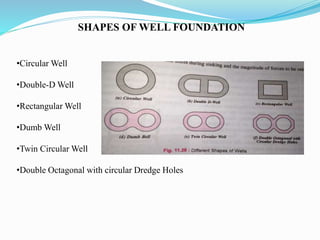
SHAPES OF WELL FOUNDATION
•Circular Well
•Double-D Well
•Rectangular Well
•Dumb Well
•Twin Circular Well
•Double Octagonal with circular Dredge Holes
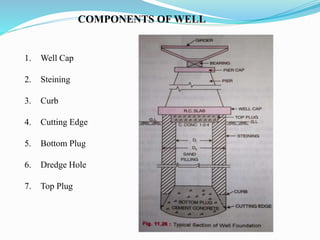
COMPONENTS OF WELL
1. Well Cap
2. Steining
3. Curb
4. Cutting Edge
5. Bottom Plug
6. Dredge Hole
7. Top Plug
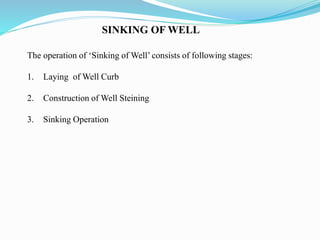
SINKING OF WELL
The operation of ‘Sinking of Well’ consists of following stages:
1. Laying of Well Curb
2. Construction of Well Steining
3. Sinking Operation
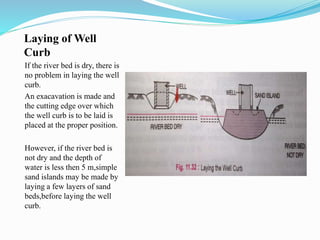
Laying of Well
Curb
If the river bed is dry, there is
no problem in laying the well
curb.
An exacavation is made and
the cutting edge over which
the well curb is to be laid is
placed at the proper position.
However, if the river bed is
not dry and the depth of
water is less then 5 m,simple
sand islands may be made by
laying a few layers of sand
beds,before laying the well
curb.
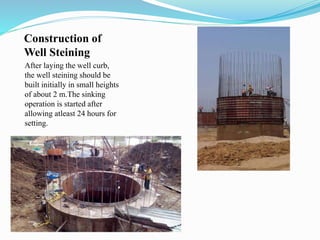
Construction of
Well Steining
After laying the well curb,
the well steining should be
built initially in small heights
of about 2 m.The sinking
operation is started after
allowing atleast 24 hours for
setting.
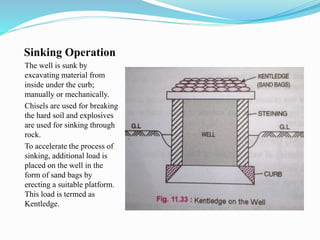
Sinking Operation
The well is sunk by
excavating material from
inside under the curb;
manually or mechanically.
Chisels are used for breaking
the hard soil and explosives
are used for sinking through
rock.
To accelerate the process of
sinking, additional load is
placed on the well in the
form of sand bags by
erecting a suitable platform.
This load is termed as
Kentledge.
Contact on Facebook- https://www.facebook.com/amn.kmr352

Well foundation by Aman Kumar

  • 1.
    SUBMITTED TO- Prof. HarpinderSingh SUBMITTED BY- Aman Kumar GU-2015-0352-L B.Tech CE 7th sem.
  • 2.
    CONTENTS… •Introduction •Necessity of WellFoundation •Forces acting on Well •Shapes of Well •Components of Well •Sinking of Well
  • 3.
    WELL FOUNDATION The deepfoundations which are usually provided in situations where the loads are heavy and have to be transferred to a lower strata are termed as Well Foundations or Caissions. Wells or caissons have been in use for foundations of bridges and other Important structures since the Roman and Moghul periods. Taj Mahal at Agra built during the reign of Shah Jahan was constructed over Well Foundation. The word ‘Caisson’ is derived from french word ‘Caisse’ meaning a box. Thus it refers to a box like structure, round or rectangular which is sunk from the surface of ground or water to some required depth. Well Foundations have been used for most of the major bridges in India.
  • 4.
    NECESSITY OF WELLFOUNDATION A well foundation is a type of foundation which is generally built in parts at the surface and then sunk to its final position, where the part of the permanent foundation. The uses of Well Foundations are described below: •Well Foundations are widely used in India for foundations of piers and abutments of roads and railway bridges. •Wells are effectively used as foundation base for heavy machinery and equipments. •Well Foundations can resist large lateral loads in case of bridges. •Wells can also resist large uplifting loads as in case of transmission towers.
  • 5.
    FORECS ACTING ONWELL FOUNDATION •Dead Loads (self weight of well and super structure) •Live Loads •Impact Loads (impact effect due to live load only) •Wind Loads •Water Pressure •Longitudinal Forces (due to tractive and braking forces) •Centrifugal Force •Buoyant Forces •Earth Pressure •Temperature Stresses •Seismic Forces
  • 6.
    SHAPES OF WELLFOUNDATION •Circular Well •Double-D Well •Rectangular Well •Dumb Well •Twin Circular Well •Double Octagonal with circular Dredge Holes
  • 7.
    COMPONENTS OF WELL 1.Well Cap 2. Steining 3. Curb 4. Cutting Edge 5. Bottom Plug 6. Dredge Hole 7. Top Plug
  • 8.
    SINKING OF WELL Theoperation of ‘Sinking of Well’ consists of following stages: 1. Laying of Well Curb 2. Construction of Well Steining 3. Sinking Operation
  • 9.
    Laying of Well Curb Ifthe river bed is dry, there is no problem in laying the well curb. An exacavation is made and the cutting edge over which the well curb is to be laid is placed at the proper position. However, if the river bed is not dry and the depth of water is less then 5 m,simple sand islands may be made by laying a few layers of sand beds,before laying the well curb.
  • 10.
    Construction of Well Steining Afterlaying the well curb, the well steining should be built initially in small heights of about 2 m.The sinking operation is started after allowing atleast 24 hours for setting.
  • 11.
    Sinking Operation The wellis sunk by excavating material from inside under the curb; manually or mechanically. Chisels are used for breaking the hard soil and explosives are used for sinking through rock. To accelerate the process of sinking, additional load is placed on the well in the form of sand bags by erecting a suitable platform. This load is termed as Kentledge.
  • 13.
    Contact on Facebook-https://www.facebook.com/amn.kmr352