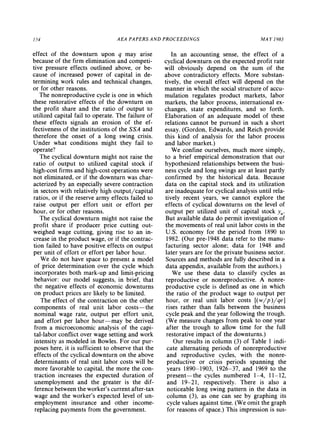
This paper proposes a theoretical model to distinguish between "reproductive cycles" and "nonreproductive cycles" and explain their relationship to long economic expansions and crises. The authors define a reproductive cycle as one where a economic downturn restores conditions for rapid economic growth, while a nonreproductive cycle requires fundamental changes to institutions. They argue long expansions are characterized by reproductive cycles that sustain profitability, while long crises feature nonreproductive cycles that lead to stagnation until a new social structure of accumulation is established. The authors present evidence that business cycles function differently depending on whether it is an expansion or crisis period of the long swing in economic activity.

![VOL. 73 NO. 2 LONG WAVES IN ECONOMIC ACTIVITY 153
regulate the accumulation process and estab-
lish the conditions for profitability.
This distinction allows us to define the
difference between long swing expansions
and crises in a particularly simple manner.
Long swing expansions are characterized by
reproductive cycles, sustaining the effective-
ness of the SSA in promoting profitability,
investment, and growth. Long swing crises
are characterized by nonreproductive cycles,
leading to prolonged periods of economic
stagnation or disaccumulation and eventu-
ally, if capitalism is to continue, to the con-
struction of a new SSA capable of rekindling
profitability, investment, and growth. The
theoretical distinction between long swing
expansions and crises thus resides in the
reproductive or nonreproductive nature of
the business cycle; slower economic growth
or reduced accumulation are therefore a
probable consequence of a long swing crisis
rather than its defining characteristic.
These definitions presuppose a specific set
of interconnections among the SSA, the ex-
pected profit rate, the cycle, and investment
activity. The expected profit rate depends on
the effectiveness of those institutions which
make up a given SSA. The level and pattern
of investment depends upon the SSA and the
expected profit rate. Cyclical downturns are
induced by a decline in the expected rate of
profit. Reproductive cyclical downturns re-
store the expected rate of profit, and thus
investment activity, while nonreproductive
cyclical downturns do not. (We provide some
econometric evidence for these propositions
in our 1983 book, and in Weisskopf's 1979
article. One effort at explaining the emer-
gence of the nonreproductive cycle in the
post-World War II period is found in Bowles
and Herbert Gintis.)
Why would a reproductive cycle become
nonreproductive?We may examine the func-
tioning of the reproductive cycle through an
analysis of the determinants of the profit
rate. Abstracting from taxes, we may repre-
sent the profit rate of the individual firm, r,
as the product of the share of profits in firm
value-added SrI the ratio of output to utilized
capital stock yu, and the ratio of utilized to
owned capital stock k*, or
(1) r-sryuk*,
where
(2) r- II/Ko; sr -I / Y; Yu Y/Ku;
k*-KJIKo;
and II is firm profits, Ko is the value of the
firm's owned capital stock, Y is firm value-
added, and KUis the portion of the owned
capital stock which is currently utilized.
The expected profit rate rewill by parallel
reasoning depend on the "full capacity profit
rate" srYu, and expected capacity utilization
k*, or
(3) re- SrYuk*e
The expression in (3) suggests that a cycli-
cal downturn may restore expected profits in
either of two principal ways, by raising the
profit share, Sr, or by raising the ratio of
output to utilized capital, yu. (Downturns do
not generally raise expected capacity utiliza-
tion.) The cyclical downturn may raise yuby
eliminating high-cost firms and by inducing
the nonuse of high-cost processes within
surviving firms. The effect of the cycle on yu
is closely associated with the effect of the
cycle on competitive pressures among busi-
ness and, by implication, with the business
failure rate.
The effect of a cyclical downturn on the
profit share involves a somewhat more com-
plicated set of connections. It may be in-
vestigated by representing the profit share as
unity minus what we call real unit labor
costs, or
(4) Sr- [(wlp)lqe] ,
where w is the nominal wage,p is the price of
output, q is output per unit of labor effort,
and e is labor effort input per hour.
A cyclical downturn may lower the prod-
uct wage (w/p), raise output per unit of
effort (q), or raise labor effort per hour (e).
The effects on w/p and e are derived from
the increased power of capital over labor
associated with an increase in the size of the
reserve army of the unemployed and the
consequent increase in the cost to the worker
of losing his or her job. (These effects are
estimated econometrically in our 1983 paper,
and in Juliet B. Schor and Bowles.) The](https://image.slidesharecdn.com/weisskopf1983cycle-101108183511-phpapp02/85/Weisskopf1983-cycle-3-320.jpg)