CTD WEEKLY WORKSHOPS:
WRITING A SUCCESSFUL
TEACHING STATEMENT
Peter Newbury
Center for Teaching Development,
University of California, San Diego
pnewbury@ucsd.edu @polarisdotca
ctd.ucsd.edu #ctducsd
resources: http://tinyurl.com/TeachingStatementsSp13
Tuesday, May 28, 2013
11:00 am Center Hall, Room 316
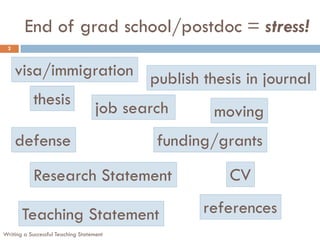
End of grad school/postdoc = stress!
2
defense
thesis
Research Statement
Teaching Statement
job search
funding/grants
CV
references
publish thesis in journal
moving
visa/immigration
Writing a Successful Teaching Statement
Job announcements
Writing a Successful Teaching Statement
3
Most job announcements require applicants to submit a
“Teaching Statement”
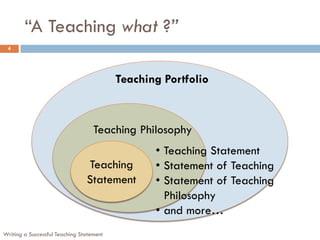
“A Teaching what ?”
4
Teaching Portfolio
Teaching
Statement
Teaching Philosophy
• Teaching Statement
• Statement of Teaching
Philosophy
• and more…
Writing a Successful Teaching Statement
Purpose of a Teaching Portfolio
Writing a Successful Teaching Statement
5
 Collect in one place all your evidence of teaching
 teaching philosophy
 teaching statement
 evaluations (like CAPE)
 examples of your work: slide deck, assignments,
exams
 Feedback from students, colleagues, bosses
 start collecting NOW
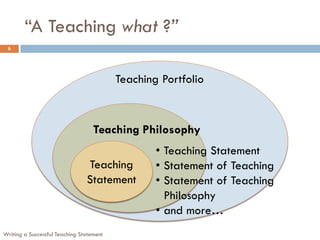
“A Teaching what ?”
6
Teaching Portfolio
Teaching
Statement
Teaching Philosophy
• Teaching Statement
• Statement of Teaching
Philosophy
• and more…
Writing a Successful Teaching Statement
Purpose of a Teaching Philosophy
Writing a Successful Teaching Statement
7
 Thesis statement for a broader teaching portfolio
 Helps tie together and synthesize evidences
 Demonstrate that you are reflective about
your teaching
 Communicate your goals and actions
 As you revise, it may shape how you teach
 Help you set goals for professional growth
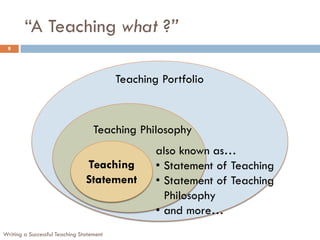
“A Teaching what ?”
8
Teaching Portfolio
Teaching
Statement
Teaching Philosophy
also known as…
• Statement of Teaching
Philosophy
• and more…
Writing a Successful Teaching Statement
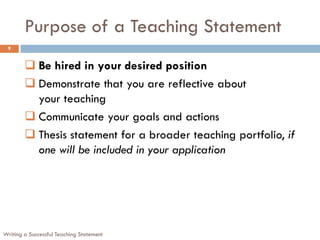
Purpose of a Teaching Statement
Writing a Successful Teaching Statement
9
 Be hired in your desired position
 Demonstrate that you are reflective about
your teaching
 Communicate your goals and actions
 Thesis statement for a broader teaching portfolio, if
one will be included in your application
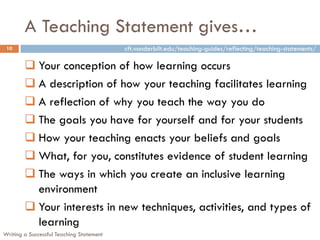
A Teaching Statement gives…
Writing a Successful Teaching Statement
10
 Your conception of how learning occurs
 A description of how your teaching facilitates learning
 A reflection of why you teach the way you do
 The goals you have for yourself and for your students
 How your teaching enacts your beliefs and goals
 What, for you, constitutes evidence of student learning
 The ways in which you create an inclusive learning
environment
 Your interests in new techniques, activities, and types of
learning
cft.vanderbilt.edu/teaching-guides/reflecting/teaching-statements/
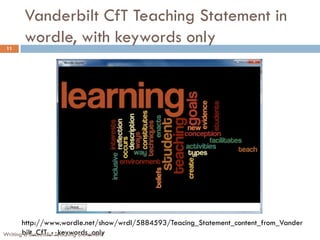
Vanderbilt CfT Teaching Statement in
wordle, with keywords only11
http://www.wordle.net/show/wrdl/5884593/Teacing_Statement_content_from_Vander
bilt_CfT_-_keywords_onlyWriting a Successful Teaching Statement
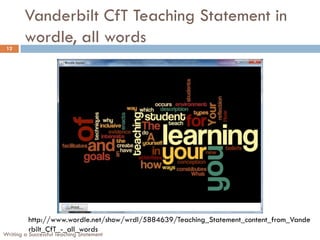
Vanderbilt CfT Teaching Statement in
wordle, all words12
http://www.wordle.net/show/wrdl/5884639/Teaching_Statement_content_from_Vande
rbilt_CfT_-_all_words
Writing a Successful Teaching Statement
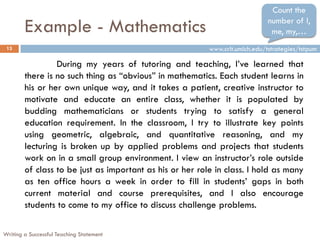
Example - Mathematics
Writing a Successful Teaching Statement
13
During my years of tutoring and teaching, I’ve learned that
there is no such thing as “obvious” in mathematics. Each student learns in
his or her own unique way, and it takes a patient, creative instructor to
motivate and educate an entire class, whether it is populated by
budding mathematicians or students trying to satisfy a general
education requirement. In the classroom, I try to illustrate key points
using geometric, algebraic, and quantitative reasoning, and my
lecturing is broken up by applied problems and projects that students
work on in a small group environment. I view an instructor’s role outside
of class to be just as important as his or her role in class. I hold as many
as ten office hours a week in order to fill in students’ gaps in both
current material and course prerequisites, and I also encourage
students to come to my office to discuss challenge problems.
Count the
number of I,
me, my,…
www.crlt.umich.edu/tstrategies/tstpum
Example – Women’s Studies
Writing a Successful Teaching Statement
14
My teaching philosophy is reflective of my overall
commitment to social justice and change through education. As a
facilitator in the learning process, I pay attention to classroom
dynamics and seek to create a supportive environment for
students, within which they feel safe taking risks and making
mistakes. Similarly, I see my own role not as infallible expert, but
as someone engaged in reciprocal learning and dialogue with
students. Within the classroom, I actively involve students in
experiential application of sociological concepts and theories.
Count the
number of I,
me, my,…
www.crlt.umich.edu/tstrategies/tstpum
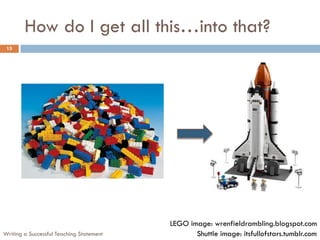
How do I get all this…into that?
15
LEGO image: wrenfieldrambling.blogspot.com
Shuttle image: itsfullofstars.tumblr.comWriting a Successful Teaching Statement
Step 1
Writing a Successful Teaching Statement
16
sit and think Step 1
sit and think
Just a thought by gintoxin78 on flickr (CC)
Discussion question
Writing a Successful Teaching Statement
17
Which of these do you feel is your primary role as an
educator?
A) Teaching students facts and principles of the subject
B) Helping students develop basic learning skills
C) Helping students develop higher-order thinking skills
D) Preparing students for jobs/careers
E) Being a role model for students
Writing a Successful Teaching Statement
Teaching Goals Inventory (Excerpt)
© 1993 Thomas A. Angelo and K. Patricia Cross.
tinyurl.com/TeachingGoalsInventory
Please rate the importance of each of the […] goals listed below to the specific course you have selected. Assess each goal's
importance to what you deliberately aim to have your students accomplish, rather than the goal's general worthiness or overall
importance to your institution's mission. There are no “right” or “wrong” answers; only personally more or less accurate ones.
Indicate whether each goal you rate is:
(1) not applicable – a goal you never try to achieve
(2) unimportant – a goal you rarely try to achieve
(3) important – a goal you sometimes try to achieve
(4) very important – a goal you often try to achieve
(5) essential – a goal you always/nearly always try to achieve
(1) (2) (3) (4) (5) Goal
     17. Improve mathematical skills
     18. Learn terms and facts of this subject
     19. Learn concepts and theories in this subject
     20. Develop skill in using materials, tools, and/or technology central to this subject
     21. Learn to understand perspectives and values of this subject
     22. Prepare for transfer or graduate study
     23. Learn techniques and methods used to gain new knowledge in this subject
     24. Learn to evaluate methods and materials in this subject
     25. Learn to appreciate important contributions to this subject
     26. Develop an appreciation of the liberal arts and sciences18
General Guidelines
Writing a Successful Teaching Statement
19
 Make your Teaching Statement brief and well
written. While Teaching Statements are probably
longer at the tenure level (i.e. 3-5 pages or more),
for hiring purposes they are typically 1-2 pages in
length.
 Use narrative, first-person approach. This allows the
Teaching Statement to be both personal and
reflective.
 Be sincere and unique. Avoid clichés, especially ones
about how much passion you have for teaching.
cft.vanderbilt.edu/teaching-guides/reflecting/teaching-statements/
General Guidelines
Writing a Successful Teaching Statement
20
 Make it specific rather than abstract. Ground your
ideas in 1-2 concrete examples, whether
experienced or anticipated. This will help the reader
to better visualize you in the classroom.
 Be discipline specific. Do not ignore your research.
Explain how you advance your field through
teaching.
 Avoid jargon and technical terms, as they can be
off-putting to some readers.
cft.vanderbilt.edu/teaching-guides/reflecting/teaching-statements/
General Guidelines
Writing a Successful Teaching Statement
21
 Try not to simply repeat what is in your CV. Teaching
Statements are not exhaustive documents and should
be used to complement other materials for the hiring
or tenure processes.
 Be humble. Mention students in an enthusiastic, not
condescending way, and illustrate your willingness to
learn from your students and colleagues.
 Revise. Teaching is an evolving, reflective process,
and Teaching Statements can be adapted and
changed as necessary.
cft.vanderbilt.edu/teaching-guides/reflecting/teaching-statements/
General Guidelines
Writing a Successful Teaching Statement
22
 Customize for the Department you’re applying to:
“I would be excited to teach introductory courses
like your MATH 10A and MATH 20B.”
“With my research background, I would be able
to teach graduate-level courses in European
history like HIST 554.”
 Remove UCSD-specific acronyms like UCSD, CAPE,
SIO, SE, MAE, CSE,…
General Guidelines
Writing a Successful Teaching Statement
23
 Formatting: do everything you can to make it easy
for the hiring committee members to read your doc:
 Put a header on each page with your name, so
that the reader can easily associate your
awesome words with your name
 full justification gives your doc a polished look
 check your PDF very carefully for .docx to .pdf
conversion problems (esp. with bullet points)
KEY Guideline:
Writing a Successful Teaching Statement
24
 You need a kick a** opening paragraph!
 What distinguishes you from everyone else applying?
 Why will the hiring committee remember your teaching
statement? Give them something to remember you by!
 Imagine the hiring committee only reads the 1st
paragraph carefully and skims the rest. Hit ‘em with
your best stuff right away – don’t save it for the
concluding paragraph.
 It’s okay to spend extra (way too much) time on the 1st
paragraph – it could get you (or cost you) the job
Five major components (Chism, 1998)
Writing a Successful Teaching Statement
25
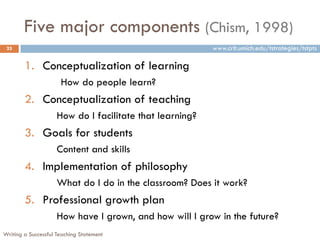
1. Conceptualization of learning
How do people learn?
2. Conceptualization of teaching
How do I facilitate that learning?
3. Goals for students
Content and skills
4. Implementation of philosophy
What do I do in the classroom? Does it work?
5. Professional growth plan
How have I grown, and how will I grow in the future?
www.crlt.umich.edu/tstrategies/tstpts
Write, rubric, revise, rubric, revise…
26
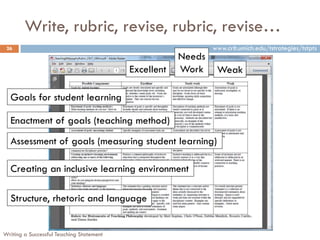
Goals for student learning
Enactment of goals (teaching method)
Assessment of goals (measuring student learning)
Creating an inclusive learning environment
Structure, rhetoric and language
Excellent
Needs
Work Weak
www.crlt.umich.edu/tstrategies/tstpts
Writing a Successful Teaching Statement
You’ve drafted it. Now what?
Writing a Successful Teaching Statement
27
1. Get someone you trust in your discipline to read it.
 Their familiarity with the subject may catch errors
specific to your field (eg, field work in geophysics)
2. Get someone you trust NOT in your discipline to
read it.
 When they ask you what something means, it forces you
to think carefully and concisely about the concept.
 People beyond the hiring-Department (eg, Faculty
Dean) may read it
Resources
28
 Center for Research on Learning and Teaching
University of Michigan
www.crlt.umich.edu/tstrategies/tstpts
Teaching statement samples: www.crlt.umich.edu/tstrategies/tstpum
 Center for Teaching
Vanderbilt University
cft.vanderbilt.edu/teaching-guides/reflecting/teaching-statements/
 McGraw Center for Teaching and Learning
Princeton University
www.princeton.edu/mcgraw/library/for-grad-students/teaching-statement
 Center for the Advancement of Teaching
Ohio State University
ucat.osu.edu/teaching_portfolio/philosophy/philosophy2.html
 Center for Teaching Development
University of California, San Diego
ctd.ucsd.edu
Writing a Successful Teaching Statement

Weekly Workshop: Teaching statements

  • 1.
    CTD WEEKLY WORKSHOPS: WRITINGA SUCCESSFUL TEACHING STATEMENT Peter Newbury Center for Teaching Development, University of California, San Diego pnewbury@ucsd.edu @polarisdotca ctd.ucsd.edu #ctducsd resources: http://tinyurl.com/TeachingStatementsSp13 Tuesday, May 28, 2013 11:00 am Center Hall, Room 316
  • 2.
    End of gradschool/postdoc = stress! 2 defense thesis Research Statement Teaching Statement job search funding/grants CV references publish thesis in journal moving visa/immigration Writing a Successful Teaching Statement
  • 3.
    Job announcements Writing aSuccessful Teaching Statement 3 Most job announcements require applicants to submit a “Teaching Statement”
  • 4.
    “A Teaching what?” 4 Teaching Portfolio Teaching Statement Teaching Philosophy • Teaching Statement • Statement of Teaching • Statement of Teaching Philosophy • and more… Writing a Successful Teaching Statement
  • 5.
    Purpose of aTeaching Portfolio Writing a Successful Teaching Statement 5  Collect in one place all your evidence of teaching  teaching philosophy  teaching statement  evaluations (like CAPE)  examples of your work: slide deck, assignments, exams  Feedback from students, colleagues, bosses  start collecting NOW
  • 6.
    “A Teaching what?” 6 Teaching Portfolio Teaching Statement Teaching Philosophy • Teaching Statement • Statement of Teaching • Statement of Teaching Philosophy • and more… Writing a Successful Teaching Statement
  • 7.
    Purpose of aTeaching Philosophy Writing a Successful Teaching Statement 7  Thesis statement for a broader teaching portfolio  Helps tie together and synthesize evidences  Demonstrate that you are reflective about your teaching  Communicate your goals and actions  As you revise, it may shape how you teach  Help you set goals for professional growth
  • 8.
    “A Teaching what?” 8 Teaching Portfolio Teaching Statement Teaching Philosophy also known as… • Statement of Teaching • Statement of Teaching Philosophy • and more… Writing a Successful Teaching Statement
  • 9.
    Purpose of aTeaching Statement Writing a Successful Teaching Statement 9  Be hired in your desired position  Demonstrate that you are reflective about your teaching  Communicate your goals and actions  Thesis statement for a broader teaching portfolio, if one will be included in your application
  • 10.
    A Teaching Statementgives… Writing a Successful Teaching Statement 10  Your conception of how learning occurs  A description of how your teaching facilitates learning  A reflection of why you teach the way you do  The goals you have for yourself and for your students  How your teaching enacts your beliefs and goals  What, for you, constitutes evidence of student learning  The ways in which you create an inclusive learning environment  Your interests in new techniques, activities, and types of learning cft.vanderbilt.edu/teaching-guides/reflecting/teaching-statements/
  • 11.
    Vanderbilt CfT TeachingStatement in wordle, with keywords only11 http://www.wordle.net/show/wrdl/5884593/Teacing_Statement_content_from_Vander bilt_CfT_-_keywords_onlyWriting a Successful Teaching Statement
  • 12.
    Vanderbilt CfT TeachingStatement in wordle, all words12 http://www.wordle.net/show/wrdl/5884639/Teaching_Statement_content_from_Vande rbilt_CfT_-_all_words Writing a Successful Teaching Statement
  • 13.
    Example - Mathematics Writinga Successful Teaching Statement 13 During my years of tutoring and teaching, I’ve learned that there is no such thing as “obvious” in mathematics. Each student learns in his or her own unique way, and it takes a patient, creative instructor to motivate and educate an entire class, whether it is populated by budding mathematicians or students trying to satisfy a general education requirement. In the classroom, I try to illustrate key points using geometric, algebraic, and quantitative reasoning, and my lecturing is broken up by applied problems and projects that students work on in a small group environment. I view an instructor’s role outside of class to be just as important as his or her role in class. I hold as many as ten office hours a week in order to fill in students’ gaps in both current material and course prerequisites, and I also encourage students to come to my office to discuss challenge problems. Count the number of I, me, my,… www.crlt.umich.edu/tstrategies/tstpum
  • 14.
    Example – Women’sStudies Writing a Successful Teaching Statement 14 My teaching philosophy is reflective of my overall commitment to social justice and change through education. As a facilitator in the learning process, I pay attention to classroom dynamics and seek to create a supportive environment for students, within which they feel safe taking risks and making mistakes. Similarly, I see my own role not as infallible expert, but as someone engaged in reciprocal learning and dialogue with students. Within the classroom, I actively involve students in experiential application of sociological concepts and theories. Count the number of I, me, my,… www.crlt.umich.edu/tstrategies/tstpum
  • 15.
    How do Iget all this…into that? 15 LEGO image: wrenfieldrambling.blogspot.com Shuttle image: itsfullofstars.tumblr.comWriting a Successful Teaching Statement
  • 16.
    Step 1 Writing aSuccessful Teaching Statement 16 sit and think Step 1 sit and think Just a thought by gintoxin78 on flickr (CC)
  • 17.
    Discussion question Writing aSuccessful Teaching Statement 17 Which of these do you feel is your primary role as an educator? A) Teaching students facts and principles of the subject B) Helping students develop basic learning skills C) Helping students develop higher-order thinking skills D) Preparing students for jobs/careers E) Being a role model for students
  • 18.
    Writing a SuccessfulTeaching Statement Teaching Goals Inventory (Excerpt) © 1993 Thomas A. Angelo and K. Patricia Cross. tinyurl.com/TeachingGoalsInventory Please rate the importance of each of the […] goals listed below to the specific course you have selected. Assess each goal's importance to what you deliberately aim to have your students accomplish, rather than the goal's general worthiness or overall importance to your institution's mission. There are no “right” or “wrong” answers; only personally more or less accurate ones. Indicate whether each goal you rate is: (1) not applicable – a goal you never try to achieve (2) unimportant – a goal you rarely try to achieve (3) important – a goal you sometimes try to achieve (4) very important – a goal you often try to achieve (5) essential – a goal you always/nearly always try to achieve (1) (2) (3) (4) (5) Goal      17. Improve mathematical skills      18. Learn terms and facts of this subject      19. Learn concepts and theories in this subject      20. Develop skill in using materials, tools, and/or technology central to this subject      21. Learn to understand perspectives and values of this subject      22. Prepare for transfer or graduate study      23. Learn techniques and methods used to gain new knowledge in this subject      24. Learn to evaluate methods and materials in this subject      25. Learn to appreciate important contributions to this subject      26. Develop an appreciation of the liberal arts and sciences18
  • 19.
    General Guidelines Writing aSuccessful Teaching Statement 19  Make your Teaching Statement brief and well written. While Teaching Statements are probably longer at the tenure level (i.e. 3-5 pages or more), for hiring purposes they are typically 1-2 pages in length.  Use narrative, first-person approach. This allows the Teaching Statement to be both personal and reflective.  Be sincere and unique. Avoid clichés, especially ones about how much passion you have for teaching. cft.vanderbilt.edu/teaching-guides/reflecting/teaching-statements/
  • 20.
    General Guidelines Writing aSuccessful Teaching Statement 20  Make it specific rather than abstract. Ground your ideas in 1-2 concrete examples, whether experienced or anticipated. This will help the reader to better visualize you in the classroom.  Be discipline specific. Do not ignore your research. Explain how you advance your field through teaching.  Avoid jargon and technical terms, as they can be off-putting to some readers. cft.vanderbilt.edu/teaching-guides/reflecting/teaching-statements/
  • 21.
    General Guidelines Writing aSuccessful Teaching Statement 21  Try not to simply repeat what is in your CV. Teaching Statements are not exhaustive documents and should be used to complement other materials for the hiring or tenure processes.  Be humble. Mention students in an enthusiastic, not condescending way, and illustrate your willingness to learn from your students and colleagues.  Revise. Teaching is an evolving, reflective process, and Teaching Statements can be adapted and changed as necessary. cft.vanderbilt.edu/teaching-guides/reflecting/teaching-statements/
  • 22.
    General Guidelines Writing aSuccessful Teaching Statement 22  Customize for the Department you’re applying to: “I would be excited to teach introductory courses like your MATH 10A and MATH 20B.” “With my research background, I would be able to teach graduate-level courses in European history like HIST 554.”  Remove UCSD-specific acronyms like UCSD, CAPE, SIO, SE, MAE, CSE,…
  • 23.
    General Guidelines Writing aSuccessful Teaching Statement 23  Formatting: do everything you can to make it easy for the hiring committee members to read your doc:  Put a header on each page with your name, so that the reader can easily associate your awesome words with your name  full justification gives your doc a polished look  check your PDF very carefully for .docx to .pdf conversion problems (esp. with bullet points)
  • 24.
    KEY Guideline: Writing aSuccessful Teaching Statement 24  You need a kick a** opening paragraph!  What distinguishes you from everyone else applying?  Why will the hiring committee remember your teaching statement? Give them something to remember you by!  Imagine the hiring committee only reads the 1st paragraph carefully and skims the rest. Hit ‘em with your best stuff right away – don’t save it for the concluding paragraph.  It’s okay to spend extra (way too much) time on the 1st paragraph – it could get you (or cost you) the job
  • 25.
    Five major components(Chism, 1998) Writing a Successful Teaching Statement 25 1. Conceptualization of learning How do people learn? 2. Conceptualization of teaching How do I facilitate that learning? 3. Goals for students Content and skills 4. Implementation of philosophy What do I do in the classroom? Does it work? 5. Professional growth plan How have I grown, and how will I grow in the future? www.crlt.umich.edu/tstrategies/tstpts
  • 26.
    Write, rubric, revise,rubric, revise… 26 Goals for student learning Enactment of goals (teaching method) Assessment of goals (measuring student learning) Creating an inclusive learning environment Structure, rhetoric and language Excellent Needs Work Weak www.crlt.umich.edu/tstrategies/tstpts Writing a Successful Teaching Statement
  • 27.
    You’ve drafted it.Now what? Writing a Successful Teaching Statement 27 1. Get someone you trust in your discipline to read it.  Their familiarity with the subject may catch errors specific to your field (eg, field work in geophysics) 2. Get someone you trust NOT in your discipline to read it.  When they ask you what something means, it forces you to think carefully and concisely about the concept.  People beyond the hiring-Department (eg, Faculty Dean) may read it
  • 28.
    Resources 28  Center forResearch on Learning and Teaching University of Michigan www.crlt.umich.edu/tstrategies/tstpts Teaching statement samples: www.crlt.umich.edu/tstrategies/tstpum  Center for Teaching Vanderbilt University cft.vanderbilt.edu/teaching-guides/reflecting/teaching-statements/  McGraw Center for Teaching and Learning Princeton University www.princeton.edu/mcgraw/library/for-grad-students/teaching-statement  Center for the Advancement of Teaching Ohio State University ucat.osu.edu/teaching_portfolio/philosophy/philosophy2.html  Center for Teaching Development University of California, San Diego ctd.ucsd.edu Writing a Successful Teaching Statement