Globalization and
             Nationalism
           Implications for USA
            education leaders?


07/16/09                          1
Globalization: the increasing
            integration of world capital,
                knowledge & trade

     Nationalism: the promotion of
   the culture, economy and national
       interests on one nation as
      opposed to subgroups, other
        nations or supranational
    organizations [UN, NAFTA, EU]
07/16/09                                    2
Fragmentation
   In “Age of Globalization” when
    nations are theoretically being
    brought closer together–nationalism
    has spawned fragmentation.
   Example: since 1945 the number of
    independent nations recognized by
    UN has risen from about 50 to over
    191

07/16/09                                  3
Fragmentation has
     spawned aggressive forms
          of nationalism
               Yugoslavia
               Middle Asia
              Central Africa
           Former Soviet Union

07/16/09                         4
Will fragmentation persist?
   Further disintegration of nation
    states appears inevitable as
    subgroups lay claim to exclusive
    ethnic, cultural, religious and
    geographical identities

   Are we witnessing the emergence of
    a new feudalism?
07/16/09                                 5
Fragmentation and global problems
   As countries / groups pursue
    political, ideological and economic
    independence with all the rights of
    nation states will this dilute ability to
    address problems which are global in
    nature such as:

      • Environmental degradation
      • Nuclear proliferation
07/16/09                                    6
Fragmentation can lead to positive
           nationalism
   National identity can strengthen
    unity among people who share
    common values and customs
   It can contribute to the richness of
    indigenous cultures through selective
    acceptance of foreign cultural
    elements without being dominated


07/16/09                                7
Globalization
   The powerful communication
    monopolies of modern civilization
    threatens to overwhelm regional and
    indigenous languages & cultures

   International languages tends to
    replace local languages


07/16/09                                  8
Promise of Globalization
   Technology has provided us with the
    potential for collaboration and
    problem solving by exchanging
    opinions on matters of shared
    interest at a level of understanding
    previously unimagined.


07/16/09                                   9
Can globalization deliver?
   Fundamental question: “why do
    people persist in seeing themselves
    in pigeonholes of their separate
    interests when we have potential to
    transcend geographic and cultural
    differences more freely than anytime
    in our history”       H. Inose, Director General of Japan’s National Center for Science
    Information Systems


07/16/09                                                                                      10
Globalization has exacerbated
                      inequities
   In many parts of the developing
    world globalization is viewed as a
    economic tool for domination by
    OECD countries. Is this accurate?
   Rich countries get richer, poor
    countries fall further behind.


07/16/09                                   11
Can education balance the
      competing pressures of
   globalization and nationalism?

           Should it try?


07/16/09                            12
Globalization and Education
   Globalization has created a deep
    division within higher education
    community.
   Is this same division reflected in
    elementary, secondary and
    vocational education?


07/16/09                                 13
Higher education at the center
 and higher education at the
  periphery: implications for
   schools and educators


07/16/09                     14
What are the disadvantages of
   higher ed. institutions in
  developing countries in a
highly sophisticated, rapidly
 changing global knowledge
          network?

 07/16/09                       15
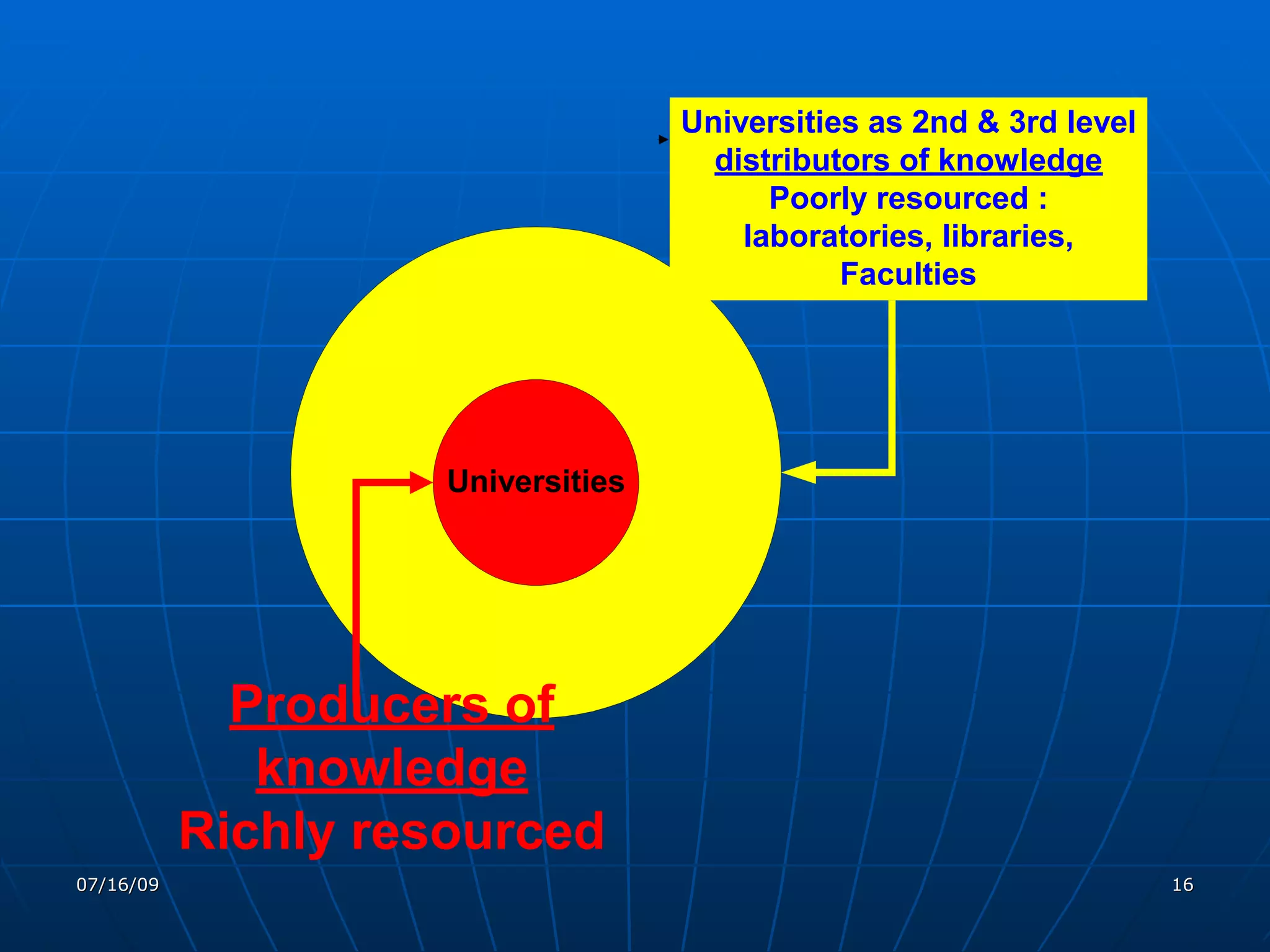
Universities as 2nd & 3rd level
                                      distributors of knowledge
                                          Poorly resourced :
                                        laboratories, libraries,
                                               Faculties


                     Universities


             Producers of
              knowledge
           Richly resourced
07/16/09                                                              16
Globalization and
      impact upon students


07/16/09                     17
Students’ cultural and
                social life
   “Globalization, migration,
    integration, travel and
    communication are bringing different
    races, cultures, and ethnicities into
    closer contact” –K. Anan


   How do we develop global citizens?

07/16/09                                18
Students’ cultural and social life
   Challenge for education, in light of
    globalization, is to promote cultural
    diversity
   Education must continue its mission
    to promote human and social capital
    but now within context of building
    global citizenship.


07/16/09                                    19
Students’ Economic Life
   Supra-national organizations e.g.,
    UN, WTO, NAFTA, World Bank,
    OECD, etc. are increasingly
    important influences
   Can our students function in a global
    economy without some basic
    understanding of these forces?
   Are we providing them with the
    necessary understanding?
07/16/09                                20
Students’ physical life
 Massive shifts in demography
  within / between nation
  states & environmental
  degradation will impact our
  students in future.
 How do we prepare them?


07/16/09                      21
Students’ ethical life

Our students will have to
  address issues of:
 survival and sustainability

 Closing gap between haves

  & have-nots
 Choices about sharing
07/16/09                            22
Students’ ethical life
Our students will need to make
  choices on moral & ethical grounds:
 Ways to bring benefits of

  globalization to everyone
 Ways to balance globalization and

  fragmentation to prevent rise of
  scurrilous nationalism or religious
  fundamentalism threatening world
  peace and stability
07/16/09                                23
Students’ academic life
Perhaps our greatest challenges:
 fostering an inquisitive,

  challenging intellectual milieu for
  our students

   Address growing utilitarian view
    of education as a commodity
    sought only for economic gain.
07/16/09                               24

Globalization & Fragmentation

  • 1.
    Globalization and Nationalism Implications for USA education leaders? 07/16/09 1
  • 2.
    Globalization: the increasing integration of world capital, knowledge & trade Nationalism: the promotion of the culture, economy and national interests on one nation as opposed to subgroups, other nations or supranational organizations [UN, NAFTA, EU] 07/16/09 2
  • 3.
    Fragmentation  In “Age of Globalization” when nations are theoretically being brought closer together–nationalism has spawned fragmentation.  Example: since 1945 the number of independent nations recognized by UN has risen from about 50 to over 191 07/16/09 3
  • 4.
    Fragmentation has spawned aggressive forms of nationalism Yugoslavia Middle Asia Central Africa Former Soviet Union 07/16/09 4
  • 5.
    Will fragmentation persist?  Further disintegration of nation states appears inevitable as subgroups lay claim to exclusive ethnic, cultural, religious and geographical identities  Are we witnessing the emergence of a new feudalism? 07/16/09 5
  • 6.
    Fragmentation and globalproblems  As countries / groups pursue political, ideological and economic independence with all the rights of nation states will this dilute ability to address problems which are global in nature such as: • Environmental degradation • Nuclear proliferation 07/16/09 6
  • 7.
    Fragmentation can leadto positive nationalism  National identity can strengthen unity among people who share common values and customs  It can contribute to the richness of indigenous cultures through selective acceptance of foreign cultural elements without being dominated 07/16/09 7
  • 8.
    Globalization  The powerful communication monopolies of modern civilization threatens to overwhelm regional and indigenous languages & cultures  International languages tends to replace local languages 07/16/09 8
  • 9.
    Promise of Globalization  Technology has provided us with the potential for collaboration and problem solving by exchanging opinions on matters of shared interest at a level of understanding previously unimagined. 07/16/09 9
  • 10.
    Can globalization deliver?  Fundamental question: “why do people persist in seeing themselves in pigeonholes of their separate interests when we have potential to transcend geographic and cultural differences more freely than anytime in our history” H. Inose, Director General of Japan’s National Center for Science Information Systems 07/16/09 10
  • 11.
    Globalization has exacerbated inequities  In many parts of the developing world globalization is viewed as a economic tool for domination by OECD countries. Is this accurate?  Rich countries get richer, poor countries fall further behind. 07/16/09 11
  • 12.
    Can education balancethe competing pressures of globalization and nationalism? Should it try? 07/16/09 12
  • 13.
    Globalization and Education  Globalization has created a deep division within higher education community.  Is this same division reflected in elementary, secondary and vocational education? 07/16/09 13
  • 14.
    Higher education atthe center and higher education at the periphery: implications for schools and educators 07/16/09 14
  • 15.
    What are thedisadvantages of higher ed. institutions in developing countries in a highly sophisticated, rapidly changing global knowledge network? 07/16/09 15
  • 16.
    Universities as 2nd& 3rd level distributors of knowledge Poorly resourced : laboratories, libraries, Faculties Universities Producers of knowledge Richly resourced 07/16/09 16
  • 17.
    Globalization and impact upon students 07/16/09 17
  • 18.
    Students’ cultural and social life  “Globalization, migration, integration, travel and communication are bringing different races, cultures, and ethnicities into closer contact” –K. Anan  How do we develop global citizens? 07/16/09 18
  • 19.
    Students’ cultural andsocial life  Challenge for education, in light of globalization, is to promote cultural diversity  Education must continue its mission to promote human and social capital but now within context of building global citizenship. 07/16/09 19
  • 20.
    Students’ Economic Life  Supra-national organizations e.g., UN, WTO, NAFTA, World Bank, OECD, etc. are increasingly important influences  Can our students function in a global economy without some basic understanding of these forces?  Are we providing them with the necessary understanding? 07/16/09 20
  • 21.
    Students’ physical life Massive shifts in demography within / between nation states & environmental degradation will impact our students in future.  How do we prepare them? 07/16/09 21
  • 22.
    Students’ ethical life Ourstudents will have to address issues of:  survival and sustainability  Closing gap between haves & have-nots  Choices about sharing 07/16/09 22
  • 23.
    Students’ ethical life Ourstudents will need to make choices on moral & ethical grounds:  Ways to bring benefits of globalization to everyone  Ways to balance globalization and fragmentation to prevent rise of scurrilous nationalism or religious fundamentalism threatening world peace and stability 07/16/09 23
  • 24.
    Students’ academic life Perhapsour greatest challenges:  fostering an inquisitive, challenging intellectual milieu for our students  Address growing utilitarian view of education as a commodity sought only for economic gain. 07/16/09 24