BY CARLY CONLON
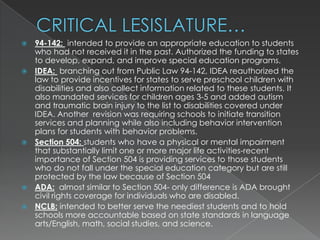
CRITICAL LESISLATURE…94-142:intended to provide an appropriate education to students who had not received it in the past. Authorized the funding to states to develop, expand, and improve special education programs.IDEA:  branching out from Public Law 94-142, IDEA reauthorized the law to provide incentives for states to serve preschool children with disabilities and also collect information related to these students. It also mandated services for children ages 3-5 and added autism and traumatic brain injury to the list to disabilities covered under IDEA. Another  revision was requiring schools to initiate transition services and planning while also including behavior intervention plans for students with behavior problems.Section 504: students who have a physical or mental impairment that substantially limit one or more major life activities-recent importance of Section 504 is providing services to those students who do not fall under the special education category but are still protected by the law because of Section 504ADA:  almost similar to Section 504- only difference is ADA brought civil rights coverage for individuals who are disabled.NCLB: intended to better serve the neediest students and to hold schools more accountable based on state standards in language arts/English, math, social studies, and science.
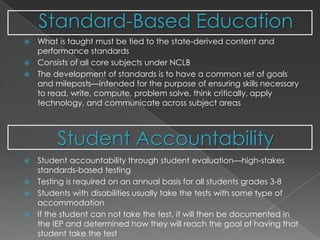
Standard-Based EducationStudent AccountabilityWhat is taught must be tied to the state-derived content and performance standardsConsists of all core subjects under NCLBThe development of standards is to have a common set of goals and mileposts—intended for the purpose of ensuring skills necessary to read, write, compute, problem solve, think critically, apply technology, and communicate across subject areasStudent accountability through student evaluation—high-stakes standards-based testingTesting is required on an annual basis for all students grades 3-8Students with disabilities usually take the tests with some type of accommodationIf the student can not take the test, it will then be documented in the IEP and determined how they will reach the goal of having that student take the test
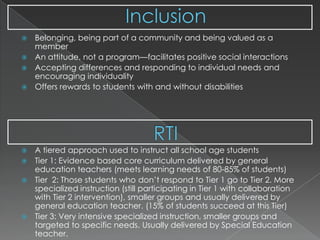
InclusionRTI Belonging, being part of a community and being valued as a memberAn attitude, not a program—facilitates positive social interactionsAccepting differences and responding to individual needs and encouraging individualityOffers rewards to students with and without disabilitiesA tiered approach used to instruct all school age studentsTier 1: Evidence based core curriculum delivered by general education teachers (meets learning needs of 80-85% of students)Tier  2: Those students who don’t respond to Tier 1 go to Tier 2. More specialized instruction (still participating in Tier 1 with collaboration with Tier 2 intervention), smaller groups and usually delivered by general education teacher. (15% of students succeed at this Tier)Tier 3: Very intensive specialized instruction, smaller groups and targeted to specific needs. Usually delivered by Special Education teacher.
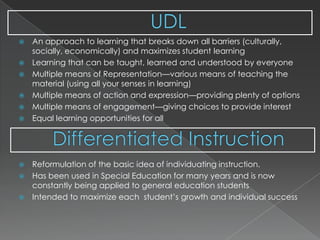
UDLDifferentiated InstructionAn approach to learning that breaks down all barriers (culturally, socially, economically) and maximizes student learningLearning that can be taught, learned and understood by everyoneMultiple means of Representation—various means of teaching the material (using all your senses in learning)Multiple means of action and expression—providing plenty of optionsMultiple means of engagement—giving choices to provide interestEqual learning opportunities for all Reformulation of the basic idea of individuating instruction.Has been used in Special Education for many years and is now constantly being applied to general education studentsIntended to maximize each  student’s growth and individual success
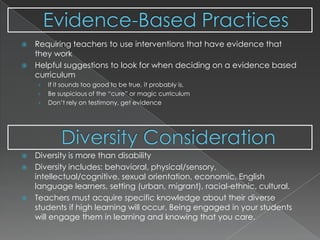
Evidence-Based Practices Diversity ConsiderationRequiring teachers to use interventions that have evidence that they workHelpful suggestions to look for when deciding on a evidence based curriculumIf it sounds too good to be true, it probably is.Be suspicious of the “cure” or magic curriculumDon’t rely on testimony, get evidenceDiversity is more than disabilityDiversity includes: behavioral, physical/sensory, intellectual/cognitive, sexual orientation, economic, English language learners, setting (urban, migrant), racial-ethnic, cultural.Teachers must acquire specific knowledge about their diverse students if high learning will occur. Being engaged in your students will engage them in learning and knowing that you care.
My view on the importance and perhaps the challenge of applying instructional strategies as we teach students with 	exceptionalities…Meeting all the needs of each individual student. Educationally, culturally, socially, mentally, physically, and emotionally.

Chapter One

  • 1.
  • 2.
    CRITICAL LESISLATURE…94-142:intended toprovide an appropriate education to students who had not received it in the past. Authorized the funding to states to develop, expand, and improve special education programs.IDEA: branching out from Public Law 94-142, IDEA reauthorized the law to provide incentives for states to serve preschool children with disabilities and also collect information related to these students. It also mandated services for children ages 3-5 and added autism and traumatic brain injury to the list to disabilities covered under IDEA. Another revision was requiring schools to initiate transition services and planning while also including behavior intervention plans for students with behavior problems.Section 504: students who have a physical or mental impairment that substantially limit one or more major life activities-recent importance of Section 504 is providing services to those students who do not fall under the special education category but are still protected by the law because of Section 504ADA: almost similar to Section 504- only difference is ADA brought civil rights coverage for individuals who are disabled.NCLB: intended to better serve the neediest students and to hold schools more accountable based on state standards in language arts/English, math, social studies, and science.
  • 3.
    Standard-Based EducationStudent AccountabilityWhatis taught must be tied to the state-derived content and performance standardsConsists of all core subjects under NCLBThe development of standards is to have a common set of goals and mileposts—intended for the purpose of ensuring skills necessary to read, write, compute, problem solve, think critically, apply technology, and communicate across subject areasStudent accountability through student evaluation—high-stakes standards-based testingTesting is required on an annual basis for all students grades 3-8Students with disabilities usually take the tests with some type of accommodationIf the student can not take the test, it will then be documented in the IEP and determined how they will reach the goal of having that student take the test
  • 4.
    InclusionRTI Belonging, beingpart of a community and being valued as a memberAn attitude, not a program—facilitates positive social interactionsAccepting differences and responding to individual needs and encouraging individualityOffers rewards to students with and without disabilitiesA tiered approach used to instruct all school age studentsTier 1: Evidence based core curriculum delivered by general education teachers (meets learning needs of 80-85% of students)Tier 2: Those students who don’t respond to Tier 1 go to Tier 2. More specialized instruction (still participating in Tier 1 with collaboration with Tier 2 intervention), smaller groups and usually delivered by general education teacher. (15% of students succeed at this Tier)Tier 3: Very intensive specialized instruction, smaller groups and targeted to specific needs. Usually delivered by Special Education teacher.
  • 5.
    UDLDifferentiated InstructionAn approachto learning that breaks down all barriers (culturally, socially, economically) and maximizes student learningLearning that can be taught, learned and understood by everyoneMultiple means of Representation—various means of teaching the material (using all your senses in learning)Multiple means of action and expression—providing plenty of optionsMultiple means of engagement—giving choices to provide interestEqual learning opportunities for all Reformulation of the basic idea of individuating instruction.Has been used in Special Education for many years and is now constantly being applied to general education studentsIntended to maximize each student’s growth and individual success
  • 6.
    Evidence-Based Practices DiversityConsiderationRequiring teachers to use interventions that have evidence that they workHelpful suggestions to look for when deciding on a evidence based curriculumIf it sounds too good to be true, it probably is.Be suspicious of the “cure” or magic curriculumDon’t rely on testimony, get evidenceDiversity is more than disabilityDiversity includes: behavioral, physical/sensory, intellectual/cognitive, sexual orientation, economic, English language learners, setting (urban, migrant), racial-ethnic, cultural.Teachers must acquire specific knowledge about their diverse students if high learning will occur. Being engaged in your students will engage them in learning and knowing that you care.
  • 7.
    My view onthe importance and perhaps the challenge of applying instructional strategies as we teach students with exceptionalities…Meeting all the needs of each individual student. Educationally, culturally, socially, mentally, physically, and emotionally.