Teaching Learners with Special Needs Chapter 1 Overview Strategies for Teaching Learners with Special Needs By: KayLee Saga Sped 413
Critical Legislation: What is… PL 94-142 IDEA Section 504 ADA NCLB
EHA Public Law 94-142 Public Law 94-142 is the Education for All Handicapped Children Act.  It is now referred to as IDEA This law was put in place to provide federal funding to states assisting them in educating students with disabilities
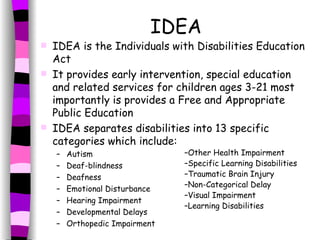
IDEA IDEA is the Individuals with Disabilities Education Act  It provides early intervention, special education and related services for children ages 3-21 most importantly is provides a Free and Appropriate Public Education IDEA separates disabilities into 13 specific categories which include: Autism Deaf-blindness Deafness Emotional Disturbance Hearing Impairment Developmental Delays Orthopedic Impairment Other Health Impairment Specific Learning Disabilities Traumatic Brain Injury Non-Categorical Delay Visual Impairment Learning Disabilities
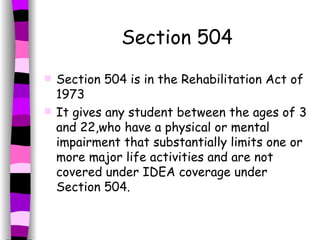
Section 504 Section 504 is in the Rehabilitation Act of 1973 It gives any student between the ages of 3 and 22,who have a physical or mental impairment that substantially limits one or more major life activities and are not covered under IDEA coverage under Section 504.
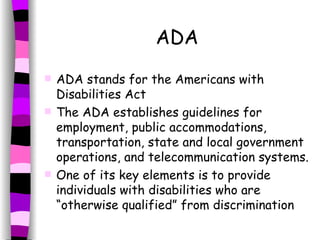
ADA ADA stands for the Americans with Disabilities Act The ADA establishes guidelines for employment, public accommodations, transportation, state and local government operations, and telecommunication systems.  One of its key elements is to provide individuals with disabilities who are “otherwise qualified” from discrimination
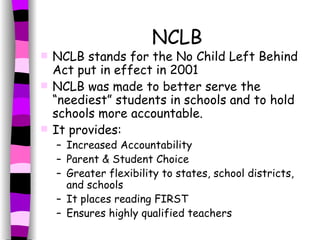
NCLB NCLB stands for the No Child Left Behind Act put in effect in 2001 NCLB was made to better serve the “neediest” students in schools and to hold schools more accountable.  It provides: Increased Accountability Parent & Student Choice Greater flexibility to states, school districts, and schools It places reading FIRST Ensures highly qualified teachers
What are some key elements in schools today? Standard-Based Education Student Accountability Inclusion RTI UDL Differentiated Instruction Evidence-Based Practices Diversity consideration   What does all of this mean??
Standard-Based Education This means that what is taught must be tied to the state-derived content and it must meet performance based standards in nearly all core subject areas.
Student Accountability Students must meet standards on the test.  NCLB requires testing every year in reading and math for grades 3-8. Most students with disabilities can and do take the same regular district or statewide tests that students who do not have disabilities take.   Inclusion This is a constant theme in Special Education It involves a commitment to providing persons with disabilities the opportunity to have a place in society and in the classroom.
RTI RTI stands for Response To Intervention This is the first step in identifying special education needs in a student and determining if they need a refferal to those needs. RTI is a 3-tier system: - The first tier involves the entire classroom it gives the teacher the opportunity to correct and rule out things that are not special needs -The second provides a more intense research based instruction that is done in small groups -The third tier is intensive intervention with specialized interventions, if found eligible after this a referral may be mad
UDL UDL stands for Universal Design for Learning. It can be used as a design for an environment to be usable by all people, to the greatest extent possible without need for adaptation or specialized design.  It is also a way to do lesson plans which attend to individual needs without drawing attention to one student.  It also uses lots of new technology and electronic resources. Differentiated Instruction   This is a teaching approach that allows students of different levels to learn in the same classroom. Using multiple approaches to teach something a seeing what works for specific students The purpose is to maximize each students growth and individual success.
Evidence-Based Practice This is a technique which requires teachers to incorporate research based interventions.  That way if they try a technique and it is unsuccessful they can try another one. Diversity Considerations Because student populations are increasingly diverse as a teacher you must remember that students to not represent the stereotypical image of a typical student.  Every student in different!
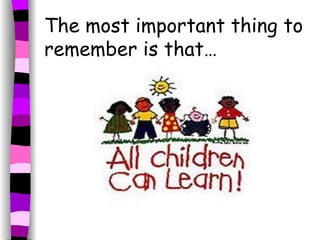
The most important thing to remember is that…

Teaching learners with special needs

  • 1.
    Teaching Learners withSpecial Needs Chapter 1 Overview Strategies for Teaching Learners with Special Needs By: KayLee Saga Sped 413
  • 2.
    Critical Legislation: Whatis… PL 94-142 IDEA Section 504 ADA NCLB
  • 3.
    EHA Public Law94-142 Public Law 94-142 is the Education for All Handicapped Children Act. It is now referred to as IDEA This law was put in place to provide federal funding to states assisting them in educating students with disabilities
  • 4.
    IDEA IDEA isthe Individuals with Disabilities Education Act It provides early intervention, special education and related services for children ages 3-21 most importantly is provides a Free and Appropriate Public Education IDEA separates disabilities into 13 specific categories which include: Autism Deaf-blindness Deafness Emotional Disturbance Hearing Impairment Developmental Delays Orthopedic Impairment Other Health Impairment Specific Learning Disabilities Traumatic Brain Injury Non-Categorical Delay Visual Impairment Learning Disabilities
  • 5.
    Section 504 Section504 is in the Rehabilitation Act of 1973 It gives any student between the ages of 3 and 22,who have a physical or mental impairment that substantially limits one or more major life activities and are not covered under IDEA coverage under Section 504.
  • 6.
    ADA ADA standsfor the Americans with Disabilities Act The ADA establishes guidelines for employment, public accommodations, transportation, state and local government operations, and telecommunication systems. One of its key elements is to provide individuals with disabilities who are “otherwise qualified” from discrimination
  • 7.
    NCLB NCLB standsfor the No Child Left Behind Act put in effect in 2001 NCLB was made to better serve the “neediest” students in schools and to hold schools more accountable. It provides: Increased Accountability Parent & Student Choice Greater flexibility to states, school districts, and schools It places reading FIRST Ensures highly qualified teachers
  • 8.
    What are somekey elements in schools today? Standard-Based Education Student Accountability Inclusion RTI UDL Differentiated Instruction Evidence-Based Practices Diversity consideration What does all of this mean??
  • 9.
    Standard-Based Education Thismeans that what is taught must be tied to the state-derived content and it must meet performance based standards in nearly all core subject areas.
  • 10.
    Student Accountability Studentsmust meet standards on the test. NCLB requires testing every year in reading and math for grades 3-8. Most students with disabilities can and do take the same regular district or statewide tests that students who do not have disabilities take. Inclusion This is a constant theme in Special Education It involves a commitment to providing persons with disabilities the opportunity to have a place in society and in the classroom.
  • 11.
    RTI RTI standsfor Response To Intervention This is the first step in identifying special education needs in a student and determining if they need a refferal to those needs. RTI is a 3-tier system: - The first tier involves the entire classroom it gives the teacher the opportunity to correct and rule out things that are not special needs -The second provides a more intense research based instruction that is done in small groups -The third tier is intensive intervention with specialized interventions, if found eligible after this a referral may be mad
  • 12.
    UDL UDL standsfor Universal Design for Learning. It can be used as a design for an environment to be usable by all people, to the greatest extent possible without need for adaptation or specialized design. It is also a way to do lesson plans which attend to individual needs without drawing attention to one student. It also uses lots of new technology and electronic resources. Differentiated Instruction This is a teaching approach that allows students of different levels to learn in the same classroom. Using multiple approaches to teach something a seeing what works for specific students The purpose is to maximize each students growth and individual success.
  • 13.
    Evidence-Based Practice Thisis a technique which requires teachers to incorporate research based interventions. That way if they try a technique and it is unsuccessful they can try another one. Diversity Considerations Because student populations are increasingly diverse as a teacher you must remember that students to not represent the stereotypical image of a typical student. Every student in different!
  • 14.
    The most importantthing to remember is that…