Special Education in an Era of Inclusion and StandardsSpecial education and instructional strategies are like a puzzle.  You have many pieces in different shapes needed to fit to form the puzzle.  The pieces represent students, teachers, specialists, legislative and federal regulations and many other key elements of special education.  All of the pieces fit together, but it takes time, patience, problem solving and team work at times to put the pieces together to form the finished product.  Often times you need to try multiple pieces until you find the right fit. The main idea is that all of the pieces do fit.Created by Anne Deilke
Legislative and Federal RegulationsAmerican with Disabilities Act (ADA)Establishes guidelines for employment, public accommodations, transportation, state and local government operations and telecommunications system for those individuals who are disabled.Broad civil rights coverage for those that are disabledProtects individuals with disabilities from discriminationNo Child Left Behind (NCLB)Increased accountabilityParent and Student choiceGreater flexibility to states, school districts and schoolsReading firstHighly qualified teachersStudent accountability through standardized testingSection 504 of Rehabilitation ActIncludes any student who has a physical or mental impairment that substantially limits one or more major life activitiesStudents that need accommodations but not categorized in IDEA
Legislative and Federal Regulations (Continued)Individuals with Disabilities Education Act of 2004 (IDEA)Revised in 1983, 1990, 1997 and 2004PL 94-142 - original law authorized funding to states to assist in development, expansion and improvement of special education programsFree Appropriate Public Education (FAPE) - school districts must provide special education and related services necessary to meet needs of students with special learning requirementsAppropriate Evaluation - must be a full and individual initial evaluation conducted before first time services
Legislative and Federal Regulations (Continued) (IDEA)Individualized Education Plan (IEP) – required written document summarizing a student’s learning program and transition planning for school to post schoolLeast Restrictive Environment (LRE) – educate children with disabilities in general education settings with peers to greatest extent possibleParent and student participation in decision making - parental consent must accompany every decision that affects a child with a disability and encouraged to participate as often as possible Procedural safeguards - protects rights of parents and children (obtain records, right to IEE, the right to request due process, etc)
Key Elements of Special EducationStandard Base Educationwhat is taught is to be correlated with state-derived content and performance standards that now exist in almost all states in the core subject areas (language arts/English, mathematics, social studies and science).Differentiated InstructionThe concept and process to approach teaching and learning for student of differing abilities in the same class while maximizing growth and success for the individual studentEmpowermentThe concept that embraces many essential aspects of what it truly means to be respected and given dignity.  The idea that quality of life is important through the use of self-determinationDiversity ConsiderationsSchool student population is diverse (race, setting, sexual orientation, cognitive, sensory, behavioral, cultural) therefore the need for the multitiered systems and approaches are important and necessary
Key Elements of Special EducationUniversal Design for Learning (UDL)Approach to teaching for diversity in the classroomLearning as unique as fingerprintsApproach to minimize barriers and maximize learningFor all studentsInclusion “supported education”the opportunity to have a place in society and a sense of belonging and acceptanceMultitieredprovides layers of intervention to meet student needs including 3 tiers of High Quality Core InstructionAccess to General Education Curriculumcontent, performance standards, standards set by district or state, acquire knowledge to gain access and accessibility to curriculum for the majority of students in school
Key Elements of Special EducationEvidence based practiceRequirement of teachers to use specific teaching tools and strategies for a particular population that has research or evidence that it is successfulStudent AccountabilityStudent evaluations acquired through standards-based testsResponse to Intervention (RTI)3 Tier approach to teaching and learningTier 1 – differentiated instruction with evidence-based curriculum  80-85% of student populationTier 2 –strategic evidence-based interventions in small groups  15% of student population supplementing core curriculum teachingTier 3 – Intensive evidence-based interventions to individual or small groups to 5% of student population
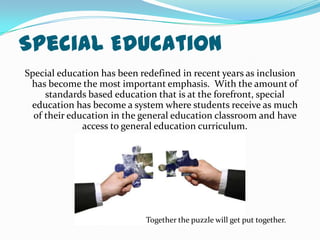
Special EducationSpecial education has been redefined in recent years as inclusion has become the most important emphasis.  With the amount of standards based education that is at the forefront, special education has become a system where students receive as much of their education in the general education classroom and have access to general education curriculum.  Together the puzzle will get put together.

Anne Deilke

  • 1.
    Special Education inan Era of Inclusion and StandardsSpecial education and instructional strategies are like a puzzle. You have many pieces in different shapes needed to fit to form the puzzle. The pieces represent students, teachers, specialists, legislative and federal regulations and many other key elements of special education. All of the pieces fit together, but it takes time, patience, problem solving and team work at times to put the pieces together to form the finished product. Often times you need to try multiple pieces until you find the right fit. The main idea is that all of the pieces do fit.Created by Anne Deilke
  • 2.
    Legislative and FederalRegulationsAmerican with Disabilities Act (ADA)Establishes guidelines for employment, public accommodations, transportation, state and local government operations and telecommunications system for those individuals who are disabled.Broad civil rights coverage for those that are disabledProtects individuals with disabilities from discriminationNo Child Left Behind (NCLB)Increased accountabilityParent and Student choiceGreater flexibility to states, school districts and schoolsReading firstHighly qualified teachersStudent accountability through standardized testingSection 504 of Rehabilitation ActIncludes any student who has a physical or mental impairment that substantially limits one or more major life activitiesStudents that need accommodations but not categorized in IDEA
  • 3.
    Legislative and FederalRegulations (Continued)Individuals with Disabilities Education Act of 2004 (IDEA)Revised in 1983, 1990, 1997 and 2004PL 94-142 - original law authorized funding to states to assist in development, expansion and improvement of special education programsFree Appropriate Public Education (FAPE) - school districts must provide special education and related services necessary to meet needs of students with special learning requirementsAppropriate Evaluation - must be a full and individual initial evaluation conducted before first time services
  • 4.
    Legislative and FederalRegulations (Continued) (IDEA)Individualized Education Plan (IEP) – required written document summarizing a student’s learning program and transition planning for school to post schoolLeast Restrictive Environment (LRE) – educate children with disabilities in general education settings with peers to greatest extent possibleParent and student participation in decision making - parental consent must accompany every decision that affects a child with a disability and encouraged to participate as often as possible Procedural safeguards - protects rights of parents and children (obtain records, right to IEE, the right to request due process, etc)
  • 5.
    Key Elements ofSpecial EducationStandard Base Educationwhat is taught is to be correlated with state-derived content and performance standards that now exist in almost all states in the core subject areas (language arts/English, mathematics, social studies and science).Differentiated InstructionThe concept and process to approach teaching and learning for student of differing abilities in the same class while maximizing growth and success for the individual studentEmpowermentThe concept that embraces many essential aspects of what it truly means to be respected and given dignity. The idea that quality of life is important through the use of self-determinationDiversity ConsiderationsSchool student population is diverse (race, setting, sexual orientation, cognitive, sensory, behavioral, cultural) therefore the need for the multitiered systems and approaches are important and necessary
  • 6.
    Key Elements ofSpecial EducationUniversal Design for Learning (UDL)Approach to teaching for diversity in the classroomLearning as unique as fingerprintsApproach to minimize barriers and maximize learningFor all studentsInclusion “supported education”the opportunity to have a place in society and a sense of belonging and acceptanceMultitieredprovides layers of intervention to meet student needs including 3 tiers of High Quality Core InstructionAccess to General Education Curriculumcontent, performance standards, standards set by district or state, acquire knowledge to gain access and accessibility to curriculum for the majority of students in school
  • 7.
    Key Elements ofSpecial EducationEvidence based practiceRequirement of teachers to use specific teaching tools and strategies for a particular population that has research or evidence that it is successfulStudent AccountabilityStudent evaluations acquired through standards-based testsResponse to Intervention (RTI)3 Tier approach to teaching and learningTier 1 – differentiated instruction with evidence-based curriculum 80-85% of student populationTier 2 –strategic evidence-based interventions in small groups 15% of student population supplementing core curriculum teachingTier 3 – Intensive evidence-based interventions to individual or small groups to 5% of student population
  • 8.
    Special EducationSpecial educationhas been redefined in recent years as inclusion has become the most important emphasis. With the amount of standards based education that is at the forefront, special education has become a system where students receive as much of their education in the general education classroom and have access to general education curriculum. Together the puzzle will get put together.