Chapter One 	Katherine OsenSPED 413
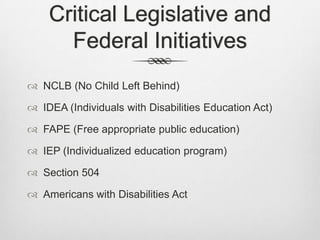
Critical Legislative and Federal InitiativesNCLB (No Child Left Behind)IDEA (Individuals with Disabilities Education Act)FAPE (Free appropriate public education)IEP (Individualized education program)Section 504Americans with Disabilities Act
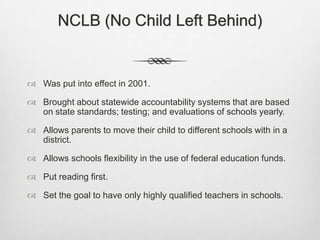
NCLB (No Child Left Behind)Was put into effect in 2001.Brought about statewide accountability systems that are based on state standards; testing; and evaluations of schools yearly.Allows parents to move their child to different schools with in a district.Allows schools flexibility in the use of federal education funds.Put reading first.Set the goal to have only highly qualified teachers in schools.
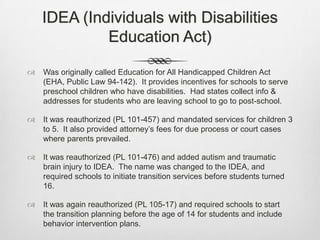
IDEA (Individuals with Disabilities Education Act)Was originally called Education for All Handicapped Children Act (EHA, Public Law 94-142).  It provides incentives for schools to serve preschool children who have disabilities.  Had states collect info & addresses for students who are leaving school to go to post-school. It was reauthorized (PL 101-457) and mandated services for children 3 to 5.  It also provided attorney’s fees for due process or court cases where parents prevailed.It was reauthorized (PL 101-476) and added autism and traumatic brain injury to IDEA.  The name was changed to the IDEA, and required schools to initiate transition services before students turned 16.It was again reauthorized (PL 105-17) and required schools to start the transition planning before the age of 14 for students and include behavior intervention plans.
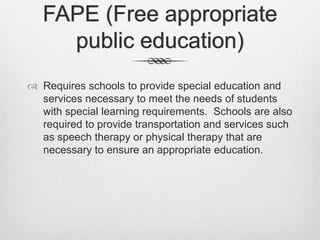
FAPE (Free appropriate public education)Requires schools to provide special education and services necessary to meet the needs of students with special learning requirements.  Schools are also required to provide transportation and services such as speech therapy or physical therapy that are necessary to ensure an appropriate education.
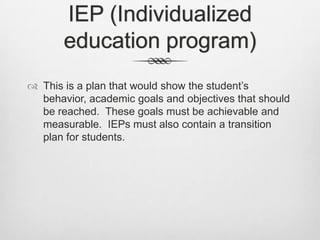
IEP (Individualized education program)This is a plan that would show the student’s behavior, academic goals and objectives that should be reached.  These goals must be achievable and measurable.  IEPs must also contain a transition plan for students.
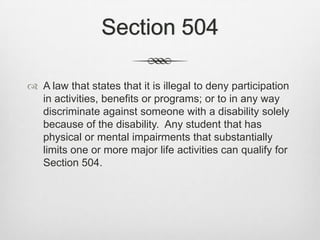
Section 504A law that states that it is illegal to deny participation in activities, benefits or programs; or to in any way discriminate against someone with a disability solely because of the disability.  Any student that has physical or mental impairments that substantially limits one or more major life activities can qualify for Section 504.
Americans with Disabilities ActMeans that no persons of any age will be discriminated against in the areas of transportation, public access, local government, or telecommunications.  It protects people with disabilities who are “otherwise qualified” from discrimination.
Key Elements of Special Education in Schools TodayStandards-Based EducationStudent AccountabilityInclusionRTIUDLDifferentiated InstructionEvidence-Based PracticesDiversity consideration
Standards-Based EducationEverything that is taught to students must be tied into the state-derived content and performance standards that now exist in almost all states in the subject areas of language arts, math, social studies, and science.  This ensures that students can read, write, compute, problem solve, think critically, apply technology, and communicate across these subjects.
Student AccountabilityThe NCLB Act requires students in grades 3-8 to standardized tests.  Most students who have disabilities can take these test.  Some students will take these test with the help of accommodations.  Some students will be exempt from taking these tests, but will still be accountable through a different type of assessment.
InclusionThis means that children with special needs are put into the regular classroom for some or all of the day with or without some resources.
RTIRTI is a process that utilizes all resources within a school in a collaborative manner to create a single, well-integrated system of instruction and interventions guided by student outcome data.  RTI is a three tier process of providing high-quality, research-based instruction and interventions at varying levels of intensity to students who struggle with learning and behavior.  The interventions are matched to student need, and progress is closely monitored at each level of intervention to make decisions about further instruction and/or interventions.
UDL (Universal Design for Learning)The general meaning of or UDL is “ the design of products and environments to be usable by all people, to the greatest extent possible, without the need for adaptation or specialized design.”The main points of UDL is:The design is general and does not attention to one certain individual.
The approach is proactive, and uses new technologies & electronics.  It also looks at students with disabilities in a new way.
The material meets the needs of all students including those with special needs. Differentiated InstructionDifferentiated instruction is a process to approach teaching and learning for students of differing abilities in the same class.  The intent of differentiating instruction success by meeting each student where he or she is and assisting in the learning process. (Hall)
Evidence-Based PracticesTeachers are to use practices of science that have proven to work.  Researchers observe, intervene, analyze, and then write abut a specific aspect of instructional intervention.  Researchers take the how, why, and what conditions of instructional strategies and generalize them for the population of students.
Diversity considerationEvery school has a diverse population of students.  Diversity is very dimensional.  Each student has different needs, and learns different ways.  Teachers must understand these diversities and have the skills to address these needs in order to teach them.

Chpt 1 power point

  • 1.
  • 2.
    Critical Legislative andFederal InitiativesNCLB (No Child Left Behind)IDEA (Individuals with Disabilities Education Act)FAPE (Free appropriate public education)IEP (Individualized education program)Section 504Americans with Disabilities Act
  • 3.
    NCLB (No ChildLeft Behind)Was put into effect in 2001.Brought about statewide accountability systems that are based on state standards; testing; and evaluations of schools yearly.Allows parents to move their child to different schools with in a district.Allows schools flexibility in the use of federal education funds.Put reading first.Set the goal to have only highly qualified teachers in schools.
  • 4.
    IDEA (Individuals withDisabilities Education Act)Was originally called Education for All Handicapped Children Act (EHA, Public Law 94-142). It provides incentives for schools to serve preschool children who have disabilities. Had states collect info & addresses for students who are leaving school to go to post-school. It was reauthorized (PL 101-457) and mandated services for children 3 to 5. It also provided attorney’s fees for due process or court cases where parents prevailed.It was reauthorized (PL 101-476) and added autism and traumatic brain injury to IDEA. The name was changed to the IDEA, and required schools to initiate transition services before students turned 16.It was again reauthorized (PL 105-17) and required schools to start the transition planning before the age of 14 for students and include behavior intervention plans.
  • 5.
    FAPE (Free appropriatepublic education)Requires schools to provide special education and services necessary to meet the needs of students with special learning requirements. Schools are also required to provide transportation and services such as speech therapy or physical therapy that are necessary to ensure an appropriate education.
  • 6.
    IEP (Individualized educationprogram)This is a plan that would show the student’s behavior, academic goals and objectives that should be reached. These goals must be achievable and measurable. IEPs must also contain a transition plan for students.
  • 7.
    Section 504A lawthat states that it is illegal to deny participation in activities, benefits or programs; or to in any way discriminate against someone with a disability solely because of the disability. Any student that has physical or mental impairments that substantially limits one or more major life activities can qualify for Section 504.
  • 8.
    Americans with DisabilitiesActMeans that no persons of any age will be discriminated against in the areas of transportation, public access, local government, or telecommunications. It protects people with disabilities who are “otherwise qualified” from discrimination.
  • 9.
    Key Elements ofSpecial Education in Schools TodayStandards-Based EducationStudent AccountabilityInclusionRTIUDLDifferentiated InstructionEvidence-Based PracticesDiversity consideration
  • 10.
    Standards-Based EducationEverything thatis taught to students must be tied into the state-derived content and performance standards that now exist in almost all states in the subject areas of language arts, math, social studies, and science. This ensures that students can read, write, compute, problem solve, think critically, apply technology, and communicate across these subjects.
  • 11.
    Student AccountabilityThe NCLBAct requires students in grades 3-8 to standardized tests. Most students who have disabilities can take these test. Some students will take these test with the help of accommodations. Some students will be exempt from taking these tests, but will still be accountable through a different type of assessment.
  • 12.
    InclusionThis means thatchildren with special needs are put into the regular classroom for some or all of the day with or without some resources.
  • 13.
    RTIRTI is aprocess that utilizes all resources within a school in a collaborative manner to create a single, well-integrated system of instruction and interventions guided by student outcome data. RTI is a three tier process of providing high-quality, research-based instruction and interventions at varying levels of intensity to students who struggle with learning and behavior. The interventions are matched to student need, and progress is closely monitored at each level of intervention to make decisions about further instruction and/or interventions.
  • 14.
    UDL (Universal Designfor Learning)The general meaning of or UDL is “ the design of products and environments to be usable by all people, to the greatest extent possible, without the need for adaptation or specialized design.”The main points of UDL is:The design is general and does not attention to one certain individual.
  • 15.
    The approach isproactive, and uses new technologies & electronics. It also looks at students with disabilities in a new way.
  • 16.
    The material meetsthe needs of all students including those with special needs. Differentiated InstructionDifferentiated instruction is a process to approach teaching and learning for students of differing abilities in the same class. The intent of differentiating instruction success by meeting each student where he or she is and assisting in the learning process. (Hall)
  • 17.
    Evidence-Based PracticesTeachers areto use practices of science that have proven to work. Researchers observe, intervene, analyze, and then write abut a specific aspect of instructional intervention. Researchers take the how, why, and what conditions of instructional strategies and generalize them for the population of students.
  • 18.
    Diversity considerationEvery schoolhas a diverse population of students. Diversity is very dimensional. Each student has different needs, and learns different ways. Teachers must understand these diversities and have the skills to address these needs in order to teach them.