Chapter 1: Special Education in an Era of Inclusion and StandardsBy: Emily Takle
Critical Legislature:Public Law 94 – 142 IDEASection 504ADANCLB
Public Law 94 - 142“Initially authorized funding to the states to assist in the development, expansion, and improvement of special education programs” (Polloway, Patton, & Serna, 2008).Provides an appropriate education to all students who, in many instances, did not receive it in the past.This law also ensures that the rights of all children with disabilities.Now referred to as Individuals with Disabilities Education Act (IDEA).
IDEAIndividuals with Disabilities Education ActThis law has been reauthorized four times:1983199019972004IDEA 2004 put a major emphasis on access to the general education curriculum for all students identified under the law.
Section 504Any student who has a physical or mental impairment that significantly limits one or more major life activities, can qualify for special services under Section 504.Provides services to students who may not be categorized under IDEA, but need certain accommodations and are entitles to protection under this law.
Americans with Disabilities ActThis law gives civil rights coverage for individuals who are disabled.  Establishes guidelines for employment, public accommodations, transportation, state and local governmental operations, and telecommunications systems.Protects individuals with disabilities from discrimination.
No Child Left Behind Act (NCLB)Increases accountability among schools.Standards  testingHigh-stakes testingEnsures that every child can read by the end of third grade.Highly qualified teachers are a must!Provides great promise for students with special needs.
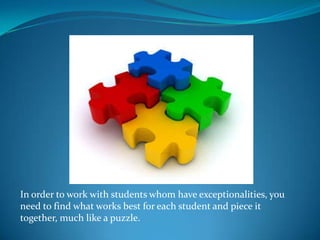
In order to work with students whom have exceptionalities, you need to find what works best for each student and piece it together, much like a puzzle.
Key Elements in Schools Today:Standard-Based EducationStudent AccountabilityInclusionResponse To InterventionUniversal Design for LearningDifferentiated InstructionEvidence-Based PracticesDiversity Consideration
Standard-Based EducationWhat is taught must be tied to the state-derived content and performance standards.Purpose of Standards:“Ensures that all students can demonstrate the knowledge and skills necessary to read, write, compute, problem solve, think critically, apply technology, and communicate across subject areas” (Polloway, Patton, & Serna, 2008).
Student AccountabilityNCLB Act and standard-based education emphasize the need for accountability through student evaluation by using high-stakes standard-based testing.Most students with disabilities also take the tests.Some types of accommodations can be made.Students with more significant needs will be exempt from taking the regular standard-based tests and are given an alternative assessment.
InclusionMost constant theme in special education.Provides people who have disabilities the opportunity to have a place in society.Implies a sense of belonging and acceptance.Has to do with how teachers respond to individual differences rather than the specific instructional arrangements.
Response To InterventionProvides early and effective assistance to children who are having difficulty learning.Multi-tiered programInterventions are designed based on the student’s individual needs.
Universal Design for Learning (UDL)It attends to individual needs in a general fashion that does not draw attention to any one individualUses curriculum and materials that concentrate on the needs of students with special needs and increases usability for everyone.Uses new technologies and electronic resources.Provides a new way of looking at students with disabilities, as well as the students with learning-related differences.
Differentiated InstructionClosely related to UDL.“Individualizing instruction” rather than “one-size-fits-all”Provides students with different “avenues” to acquire knowledge.
Evidence-Based PracticeTeachers are required to use interventions that have evidence that they work with the populations with whom they are being used.
Diversity ConsiderationDiversity is much more than just disabilityA multitiered system of interventions should be designed to address the needs of a range of learners with diverse needs.BehavioralCulturalRacial-EthnicSetting (urban, migrant)English Language LearnersEconomicSexual OrientationIntellectual/CognitivePhysical/SensoryTeachers must develop a sensitivity to the needs of a diverse group of students.
Works Cited:Polloway, Edward Al, Patton, James R., & Serna, Loretta. (2008). Strategies for teaching learners with special needs. Upper           Saddle River, NJ: Pearson Education, Inc.

Chapter 1 slideshow

  • 1.
    Chapter 1: SpecialEducation in an Era of Inclusion and StandardsBy: Emily Takle
  • 2.
    Critical Legislature:Public Law94 – 142 IDEASection 504ADANCLB
  • 3.
    Public Law 94- 142“Initially authorized funding to the states to assist in the development, expansion, and improvement of special education programs” (Polloway, Patton, & Serna, 2008).Provides an appropriate education to all students who, in many instances, did not receive it in the past.This law also ensures that the rights of all children with disabilities.Now referred to as Individuals with Disabilities Education Act (IDEA).
  • 4.
    IDEAIndividuals with DisabilitiesEducation ActThis law has been reauthorized four times:1983199019972004IDEA 2004 put a major emphasis on access to the general education curriculum for all students identified under the law.
  • 5.
    Section 504Any studentwho has a physical or mental impairment that significantly limits one or more major life activities, can qualify for special services under Section 504.Provides services to students who may not be categorized under IDEA, but need certain accommodations and are entitles to protection under this law.
  • 6.
    Americans with DisabilitiesActThis law gives civil rights coverage for individuals who are disabled. Establishes guidelines for employment, public accommodations, transportation, state and local governmental operations, and telecommunications systems.Protects individuals with disabilities from discrimination.
  • 7.
    No Child LeftBehind Act (NCLB)Increases accountability among schools.Standards testingHigh-stakes testingEnsures that every child can read by the end of third grade.Highly qualified teachers are a must!Provides great promise for students with special needs.
  • 8.
    In order towork with students whom have exceptionalities, you need to find what works best for each student and piece it together, much like a puzzle.
  • 9.
    Key Elements inSchools Today:Standard-Based EducationStudent AccountabilityInclusionResponse To InterventionUniversal Design for LearningDifferentiated InstructionEvidence-Based PracticesDiversity Consideration
  • 10.
    Standard-Based EducationWhat istaught must be tied to the state-derived content and performance standards.Purpose of Standards:“Ensures that all students can demonstrate the knowledge and skills necessary to read, write, compute, problem solve, think critically, apply technology, and communicate across subject areas” (Polloway, Patton, & Serna, 2008).
  • 11.
    Student AccountabilityNCLB Actand standard-based education emphasize the need for accountability through student evaluation by using high-stakes standard-based testing.Most students with disabilities also take the tests.Some types of accommodations can be made.Students with more significant needs will be exempt from taking the regular standard-based tests and are given an alternative assessment.
  • 12.
    InclusionMost constant themein special education.Provides people who have disabilities the opportunity to have a place in society.Implies a sense of belonging and acceptance.Has to do with how teachers respond to individual differences rather than the specific instructional arrangements.
  • 13.
    Response To InterventionProvidesearly and effective assistance to children who are having difficulty learning.Multi-tiered programInterventions are designed based on the student’s individual needs.
  • 14.
    Universal Design forLearning (UDL)It attends to individual needs in a general fashion that does not draw attention to any one individualUses curriculum and materials that concentrate on the needs of students with special needs and increases usability for everyone.Uses new technologies and electronic resources.Provides a new way of looking at students with disabilities, as well as the students with learning-related differences.
  • 15.
    Differentiated InstructionClosely relatedto UDL.“Individualizing instruction” rather than “one-size-fits-all”Provides students with different “avenues” to acquire knowledge.
  • 16.
    Evidence-Based PracticeTeachers arerequired to use interventions that have evidence that they work with the populations with whom they are being used.
  • 17.
    Diversity ConsiderationDiversity ismuch more than just disabilityA multitiered system of interventions should be designed to address the needs of a range of learners with diverse needs.BehavioralCulturalRacial-EthnicSetting (urban, migrant)English Language LearnersEconomicSexual OrientationIntellectual/CognitivePhysical/SensoryTeachers must develop a sensitivity to the needs of a diverse group of students.
  • 18.
    Works Cited:Polloway, EdwardAl, Patton, James R., & Serna, Loretta. (2008). Strategies for teaching learners with special needs. Upper Saddle River, NJ: Pearson Education, Inc.