TEKS 8C: Calculate percent composition and empirical and molecular formulas.
Causes of the Great Depression
TEKS 8C: Calculate percent composition and empirical and molecular formulas.
Objectives
• Discuss the weaknesses in the economy
of the 1920s.
• Explain how the stock market crash
contributed to the coming of the Great
Depression.
• Describe how the Great Depression spread
overseas.
TEKS 8C: Calculate percent composition and empirical and molecular formulas.
Terms and People
• Herbert Hoover – former Secretary of Commerce
and Republican candidate for President in 1928
• speculation – when investors gamble that stock
prices will rise
• Black Tuesday – October 24, 1929, the day the
stock market crashed
• business cycle – periodic expansion and
contraction of the economy
TEKS 8C: Calculate percent composition and empirical and molecular formulas.
Terms and People (continued)
• Great Depression – The collapse of the United
States and world economies beginning in 1929
• Hawley-Smoot Tariff – high protective tariff
passed in June 1930 that contributed to a
worldwide depression
TEKS 8C: Calculate percent composition and empirical and molecular formulas.
How did the prosperity of the 1920s
give way to the Great Depression?
During the 1920s, many Americans enjoyed what
seemed like an endless era of prosperity. But in
1929, the stock market crashed. Production fell,
unemployment rose, and the economy went into
a period of dramatic decline.
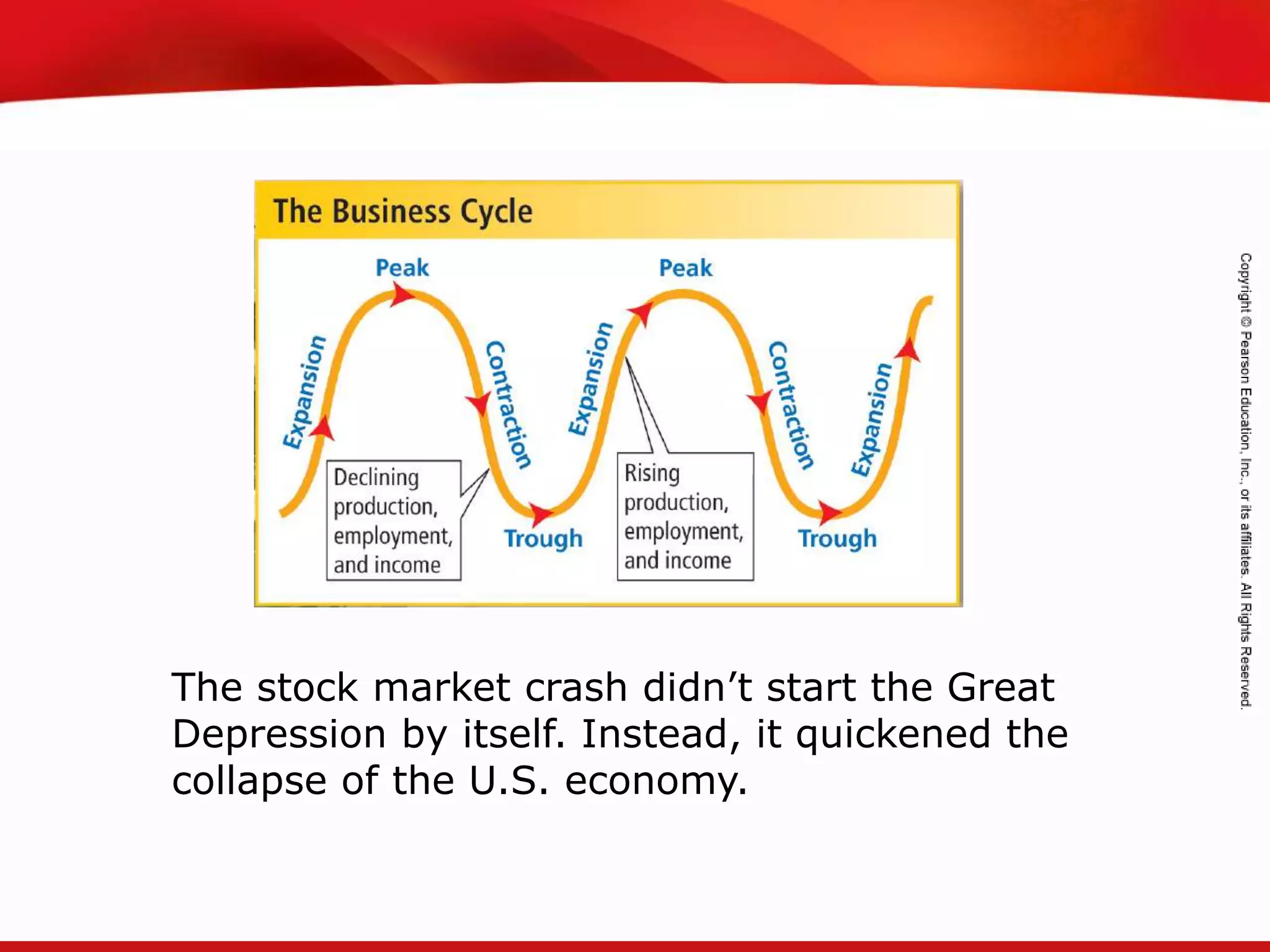
Years after the Great Depression began, periodic
contraction was seen as part of the business cycle.
TEKS 8C: Calculate percent composition and empirical and molecular formulas.
The Republicans took
credit for the strong
economy.
Their presidential
candidate was Herbert
Hoover.
He believed in voluntary
cooperation between
business and labor.
In the 1928
presidential
race, the
Republican
Party was
confident.
TEKS 8C: Calculate percent composition and empirical and molecular formulas.
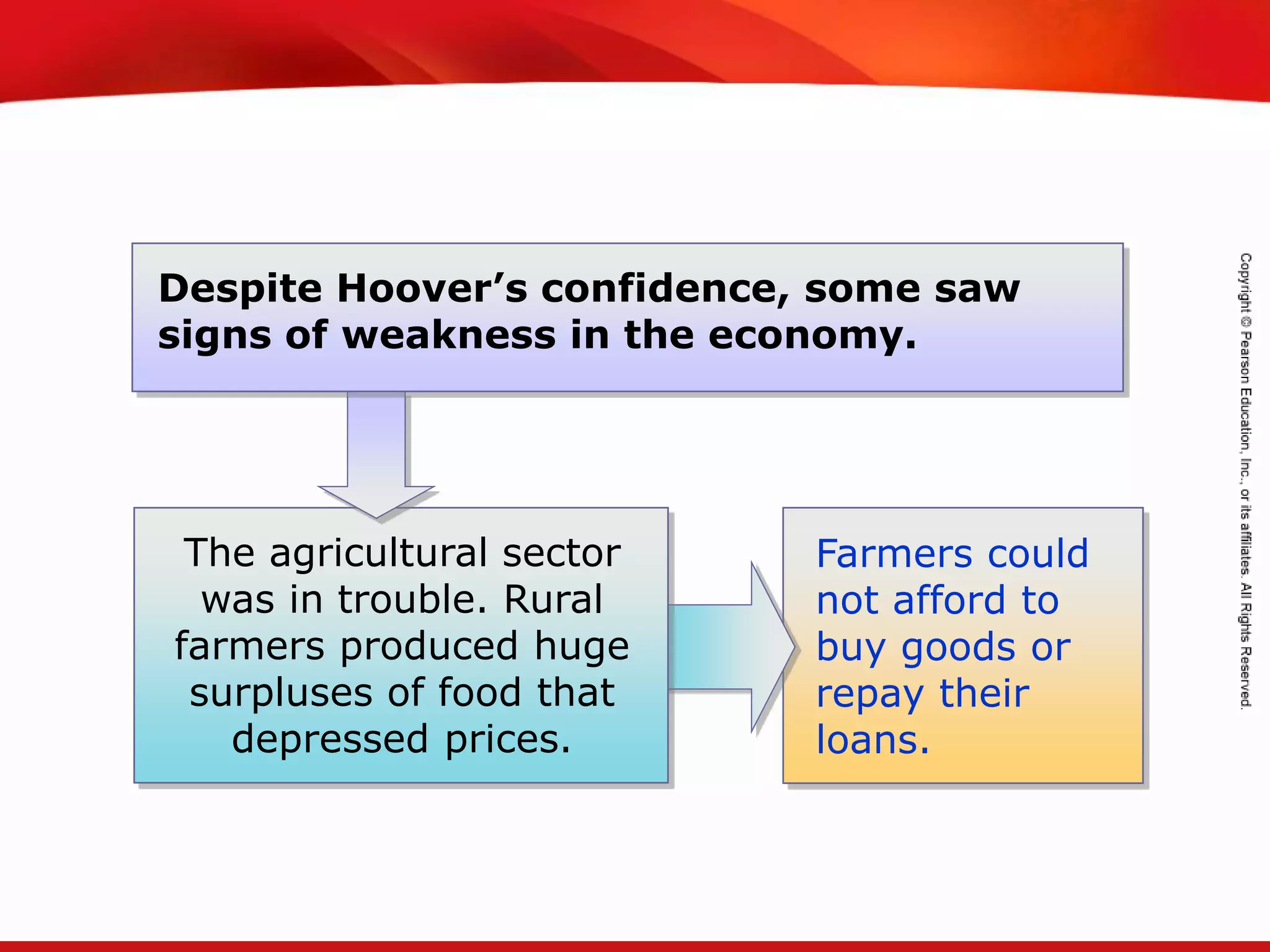
Farmers could
not afford to
buy goods or
repay their
loans.
The agricultural sector
was in trouble. Rural
farmers produced huge
surpluses of food that
depressed prices.
Despite Hoover’s confidence, some saw
signs of weakness in the economy.
TEKS 8C: Calculate percent composition and empirical and molecular formulas.
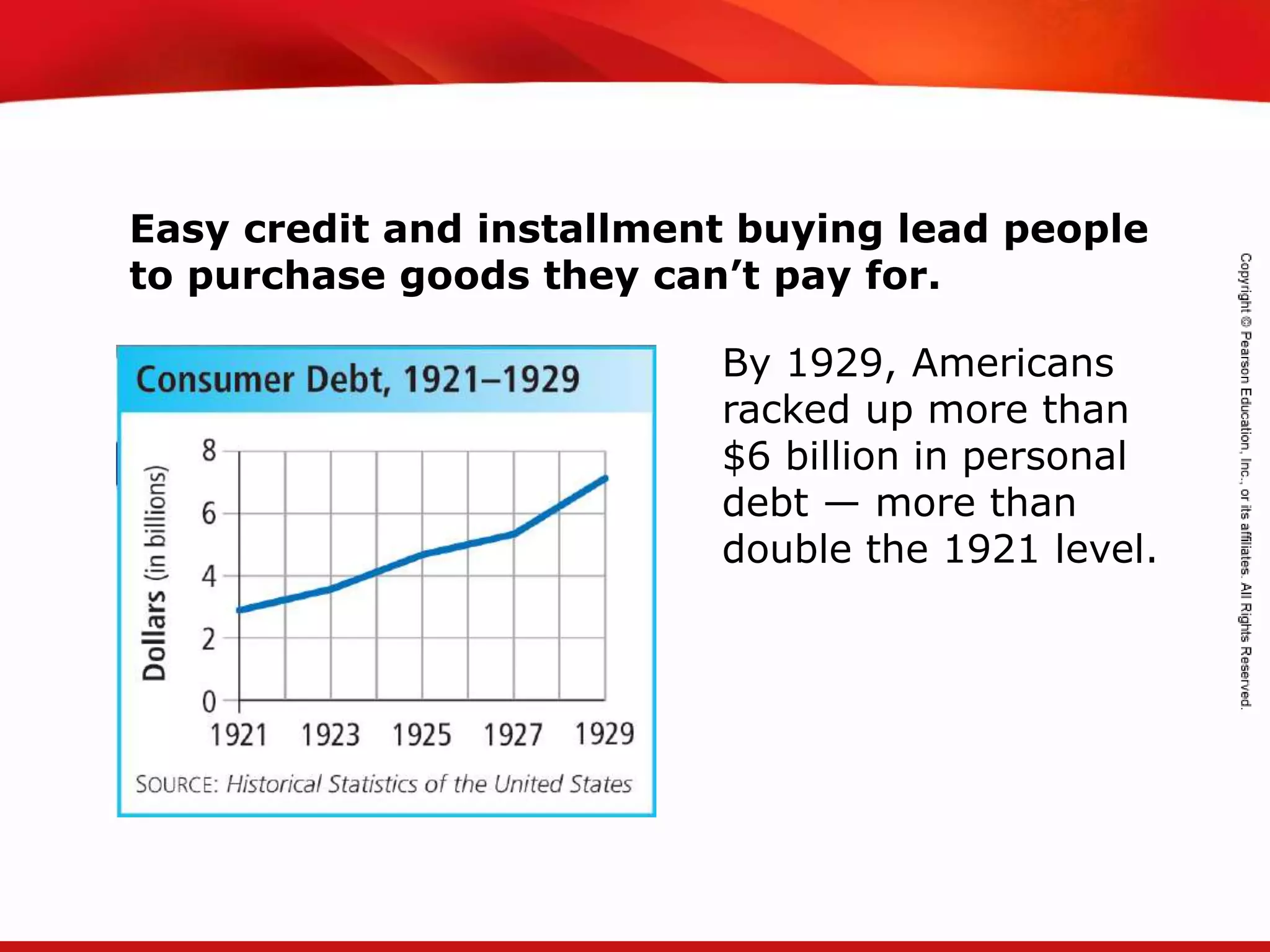
Easy credit and installment buying lead people
to purchase goods they can’t pay for.
By 1929, Americans
racked up more than
$6 billion in personal
debt — more than
double the 1921 level.
TEKS 8C: Calculate percent composition and empirical and molecular formulas.
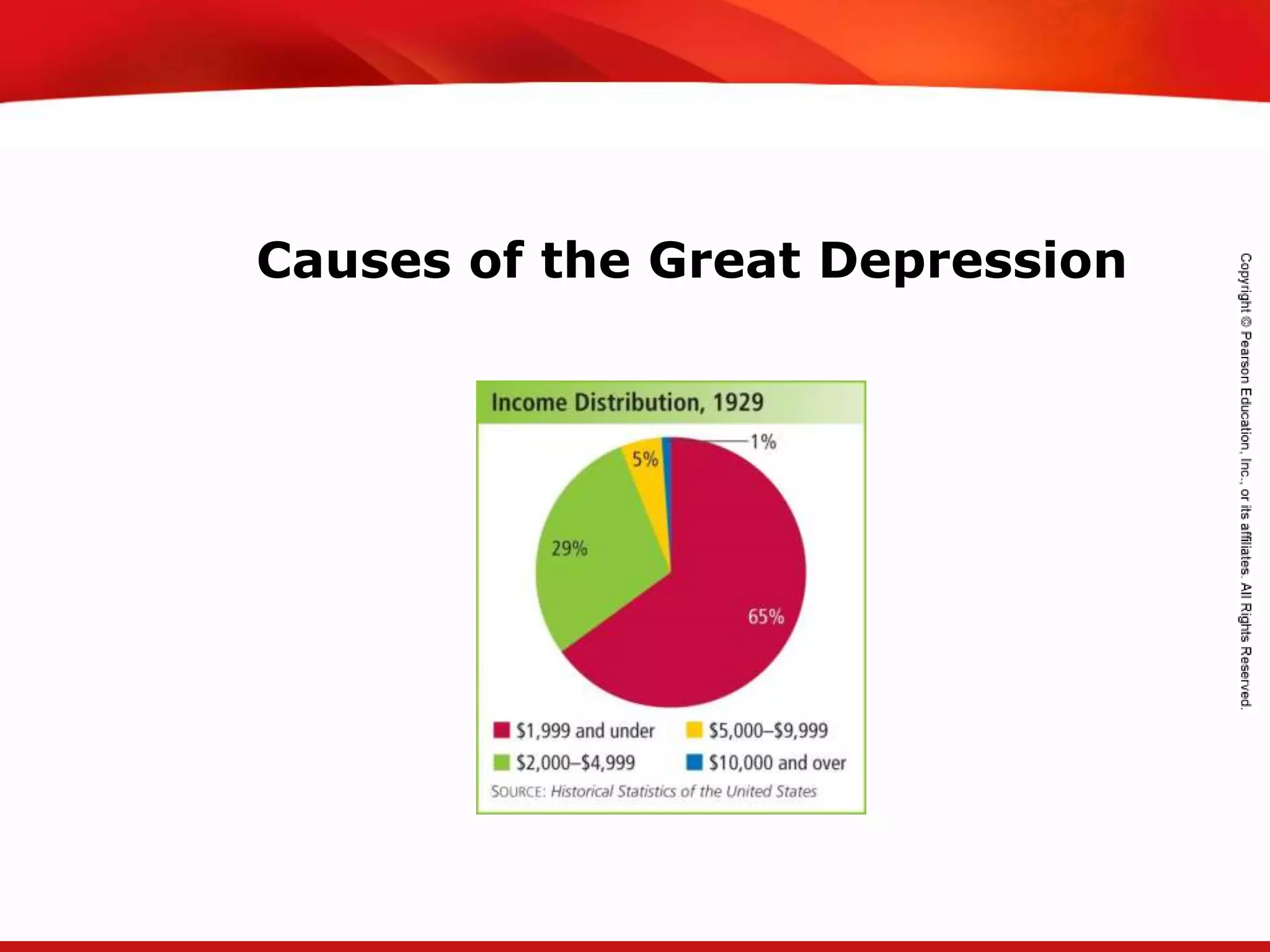
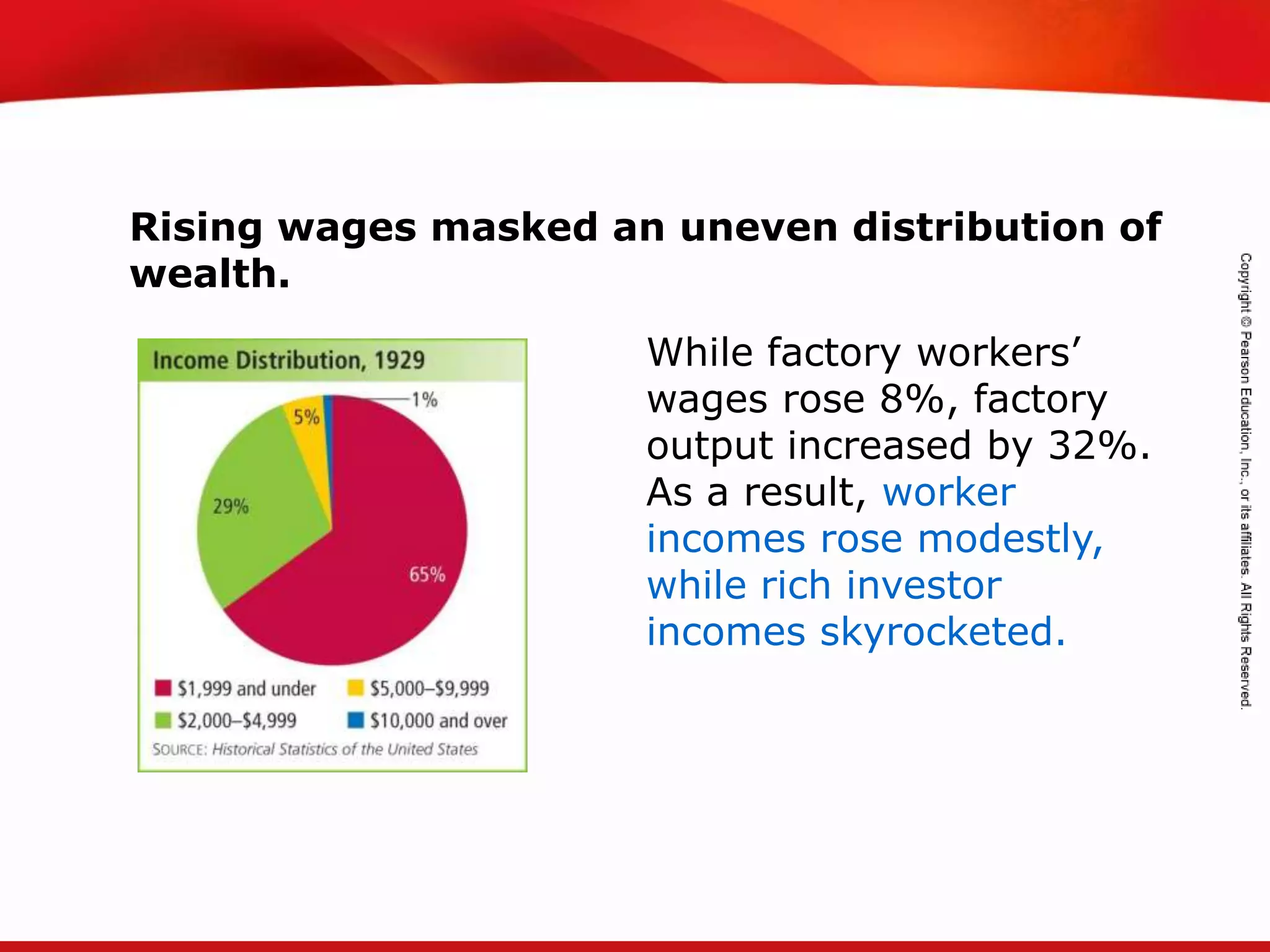
Rising wages masked an uneven distribution of
wealth.
While factory workers’
wages rose 8%, factory
output increased by 32%.
As a result, worker
incomes rose modestly,
while rich investor
incomes skyrocketed.
TEKS 8C: Calculate percent composition and empirical and molecular formulas.
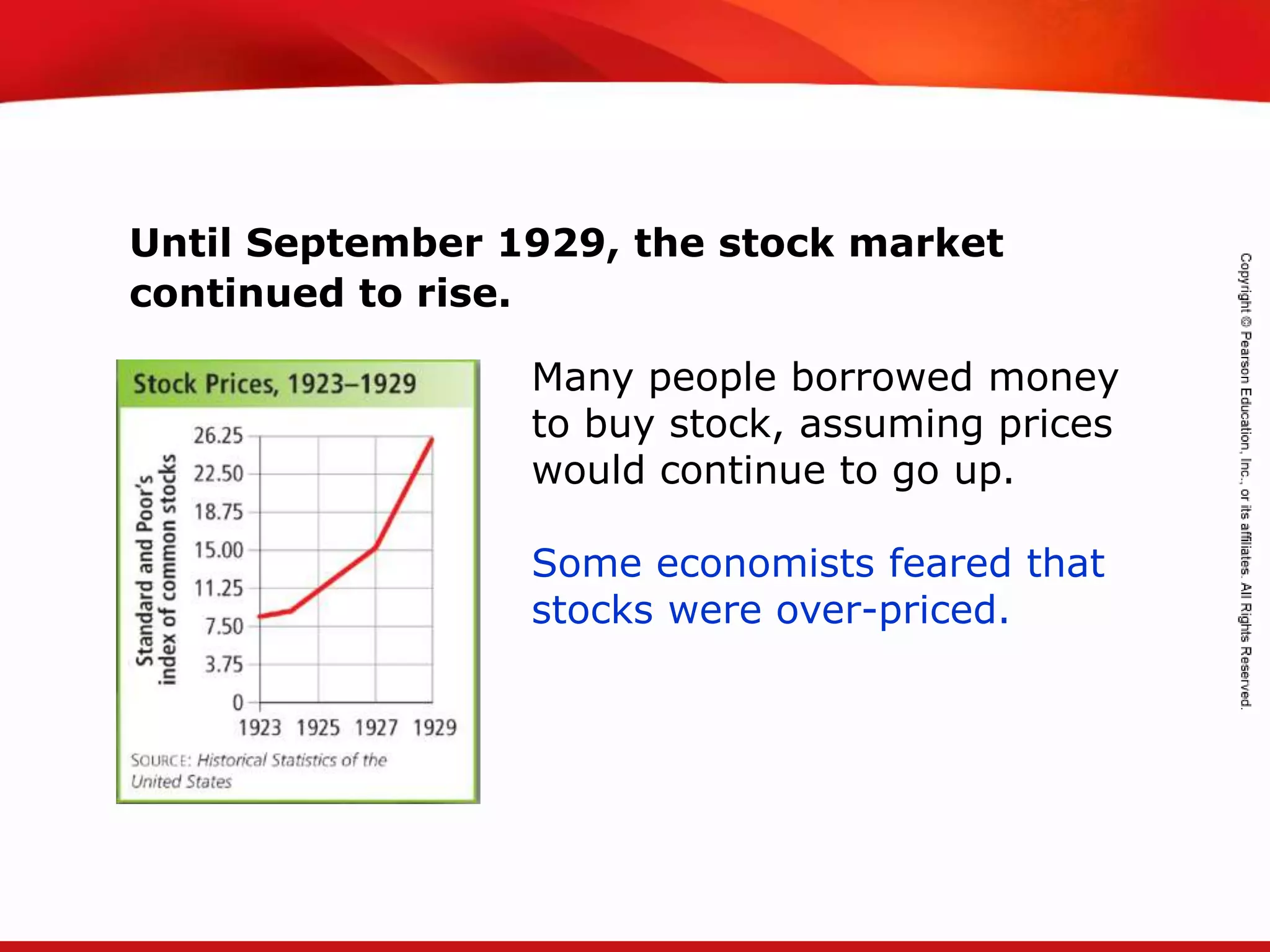
Until September 1929, the stock market
continued to rise.
Many people borrowed money
to buy stock, assuming prices
would continue to go up.
Some economists feared that
stocks were over-priced.
TEKS 8C: Calculate percent composition and empirical and molecular formulas.
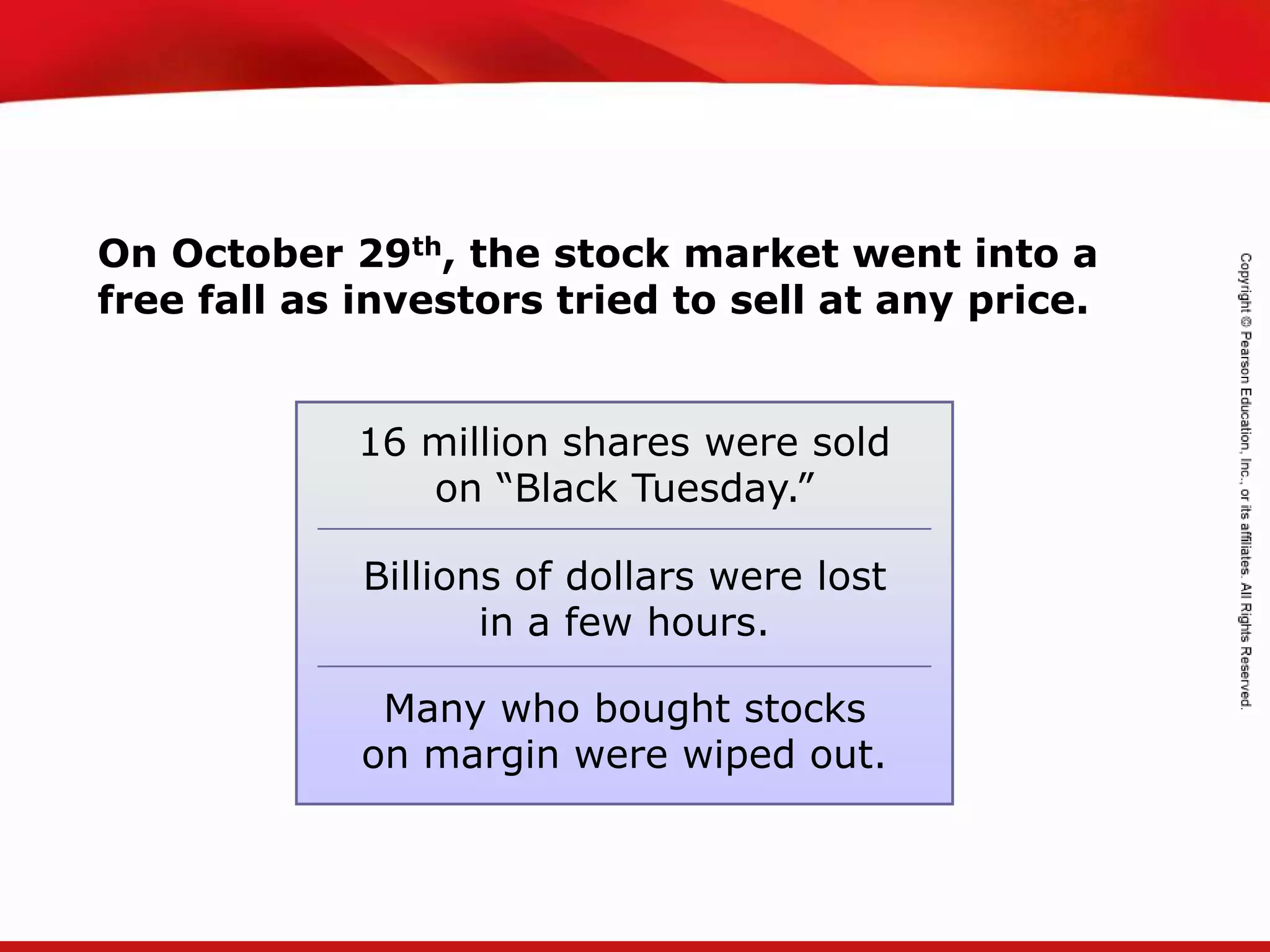
On October 29th, the stock market went into a
free fall as investors tried to sell at any price.
Many who bought stocks
on margin were wiped out.
Billions of dollars were lost
in a few hours.
16 million shares were sold
on “Black Tuesday.”
TEKS 8C: Calculate percent composition and empirical and molecular formulas.
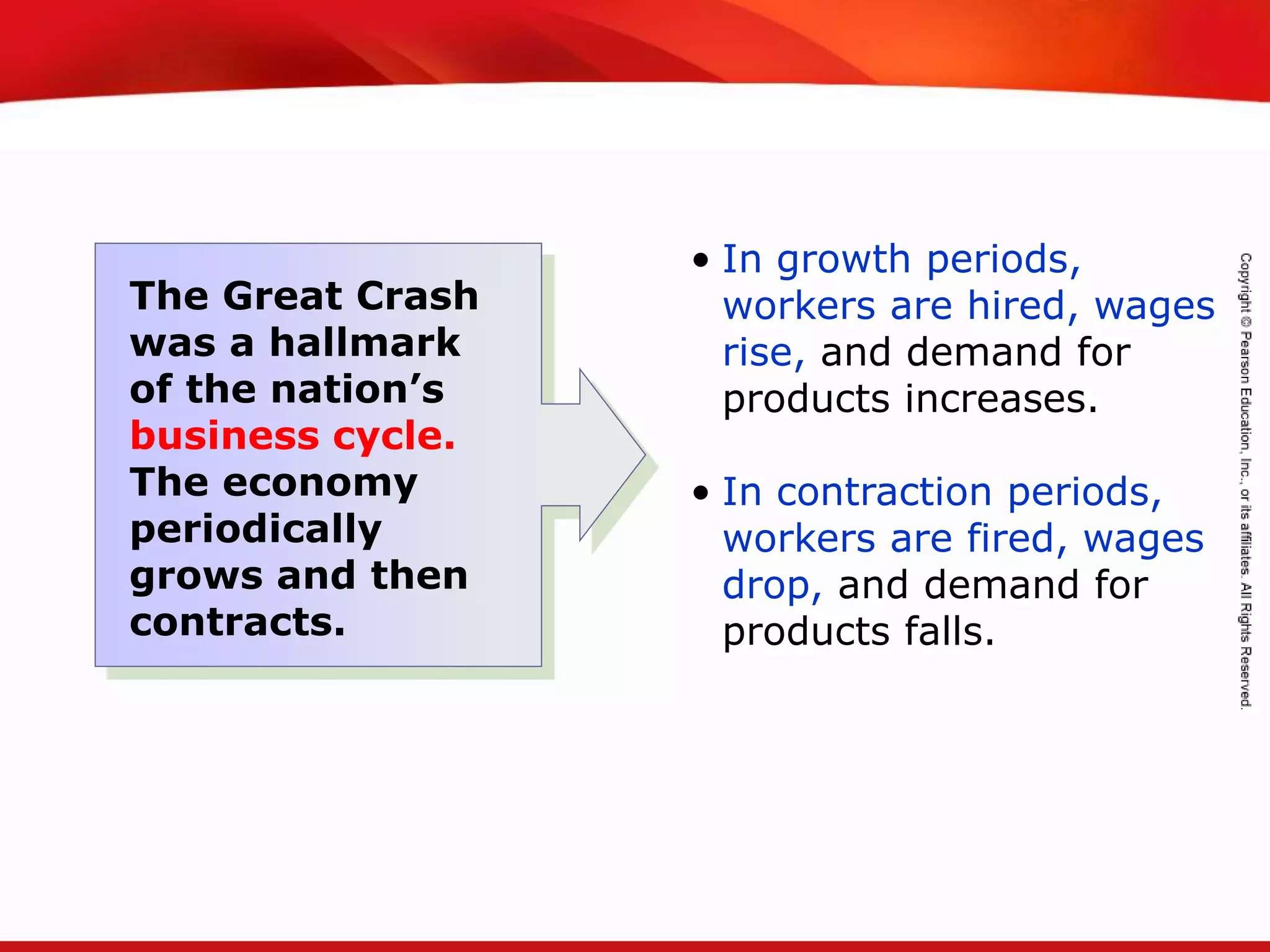
• In growth periods,
workers are hired, wages
rise, and demand for
products increases.
• In contraction periods,
workers are fired, wages
drop, and demand for
products falls.
The Great Crash
was a hallmark
of the nation’s
business cycle.
The economy
periodically
grows and then
contracts.
TEKS 8C: Calculate percent composition and empirical and molecular formulas.
The stock market crash didn’t start the Great
Depression by itself. Instead, it quickened the
collapse of the U.S. economy.
TEKS 8C: Calculate percent composition and empirical and molecular formulas.
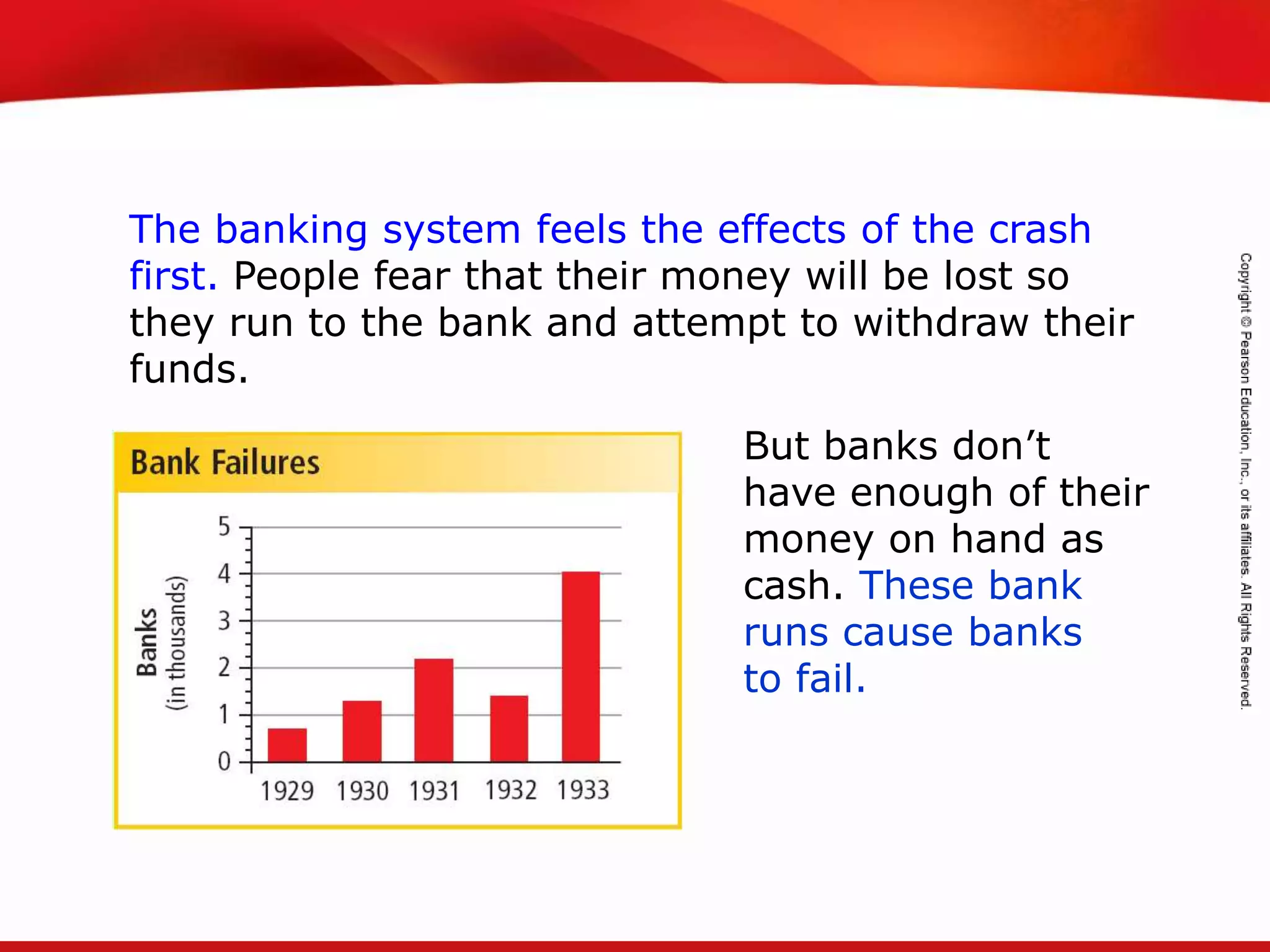
The banking system feels the effects of the crash
first. People fear that their money will be lost so
they run to the bank and attempt to withdraw their
funds.
But banks don’t
have enough of their
money on hand as
cash. These bank
runs cause banks
to fail.
TEKS 8C: Calculate percent composition and empirical and molecular formulas.
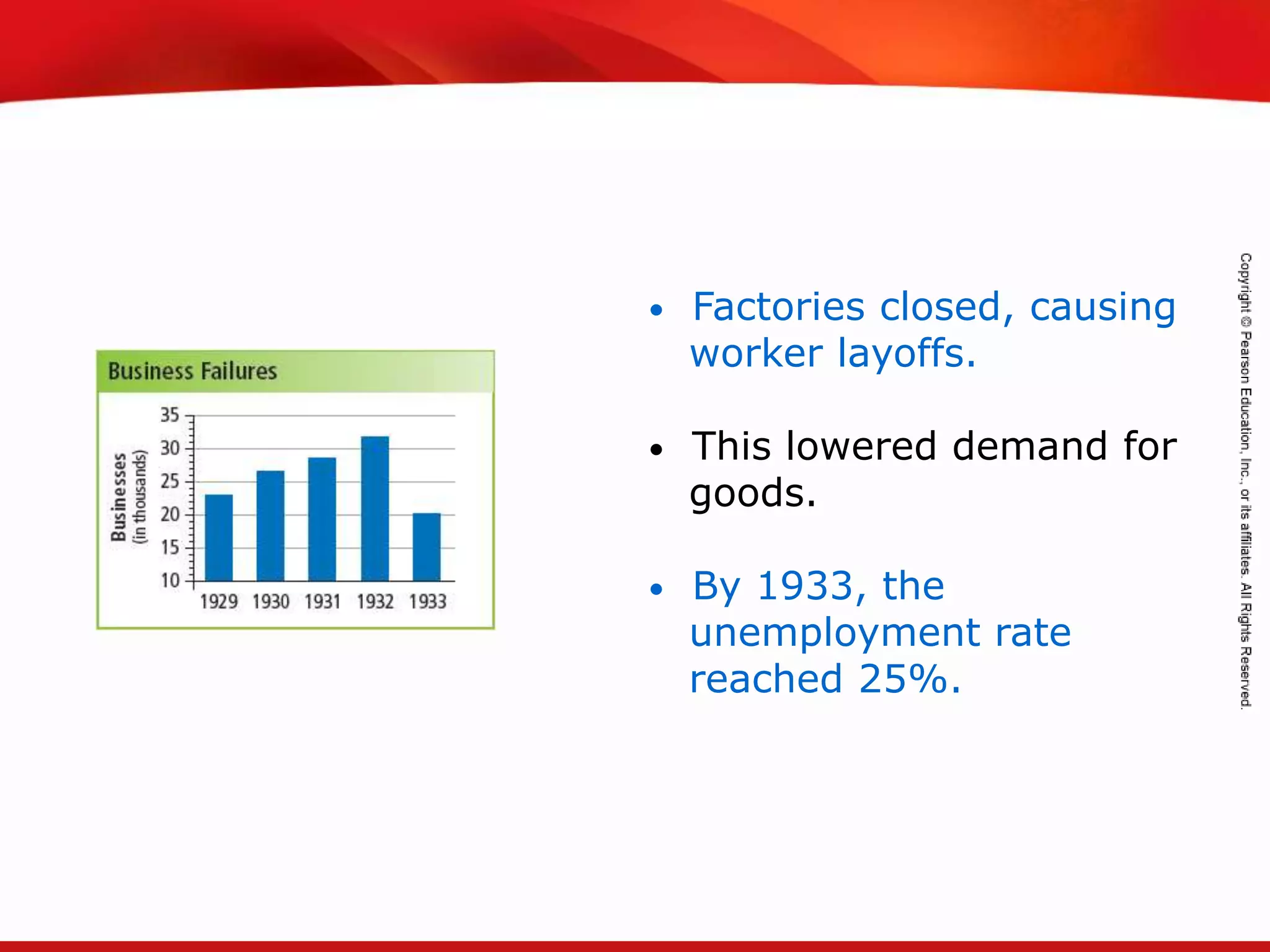
• Factories closed, causing
worker layoffs.
• This lowered demand for
goods.
• By 1933, the
unemployment rate
reached 25%.
TEKS 8C: Calculate percent composition and empirical and molecular formulas.
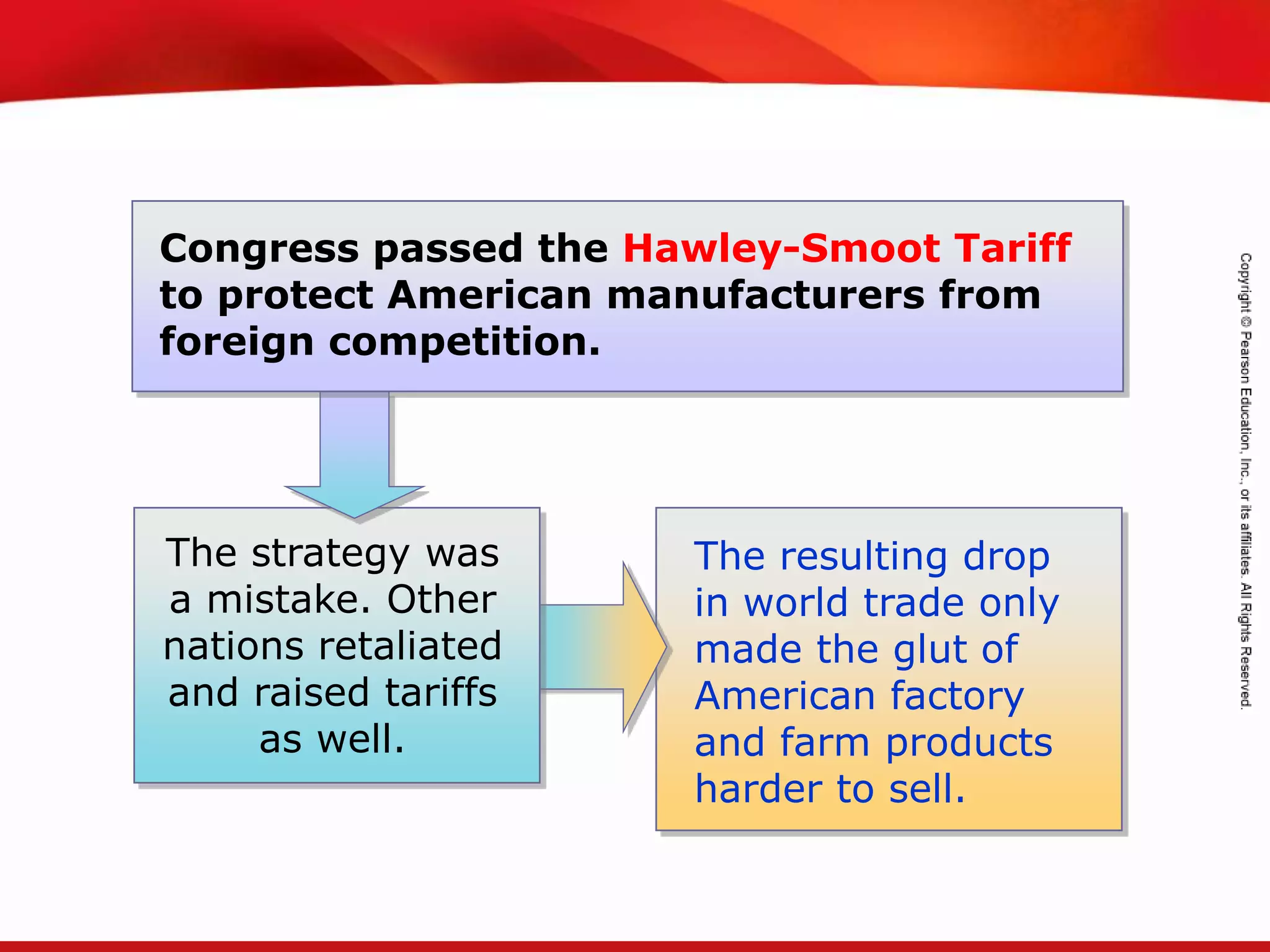
The resulting drop
in world trade only
made the glut of
American factory
and farm products
harder to sell.
The strategy was
a mistake. Other
nations retaliated
and raised tariffs
as well.
Congress passed the Hawley-Smoot Tariff
to protect American manufacturers from
foreign competition.
TEKS 8C: Calculate percent composition and empirical and molecular formulas.
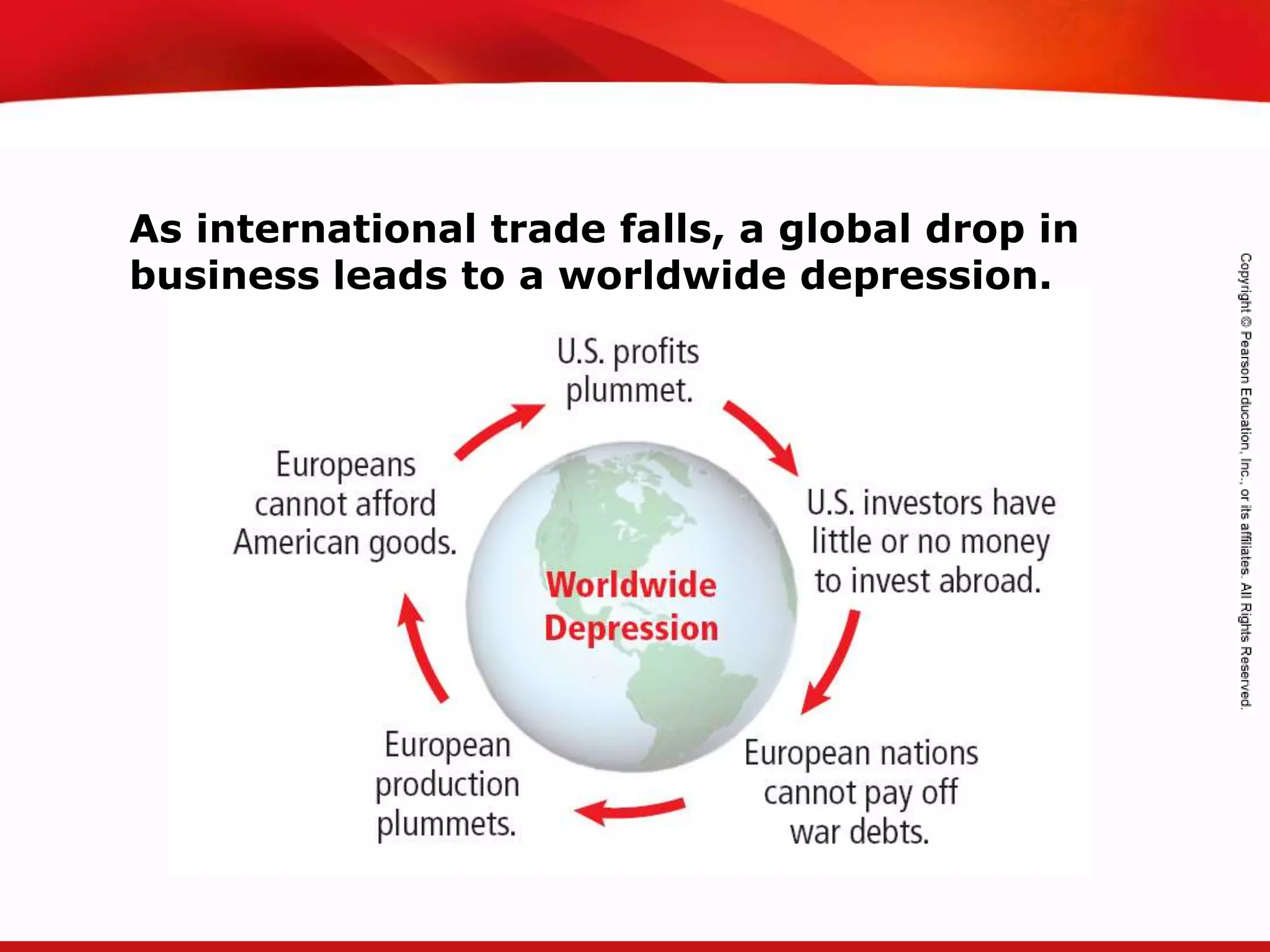
As international trade falls, a global drop in
business leads to a worldwide depression.
TEKS 8C: Calculate percent composition and empirical and molecular formulas.
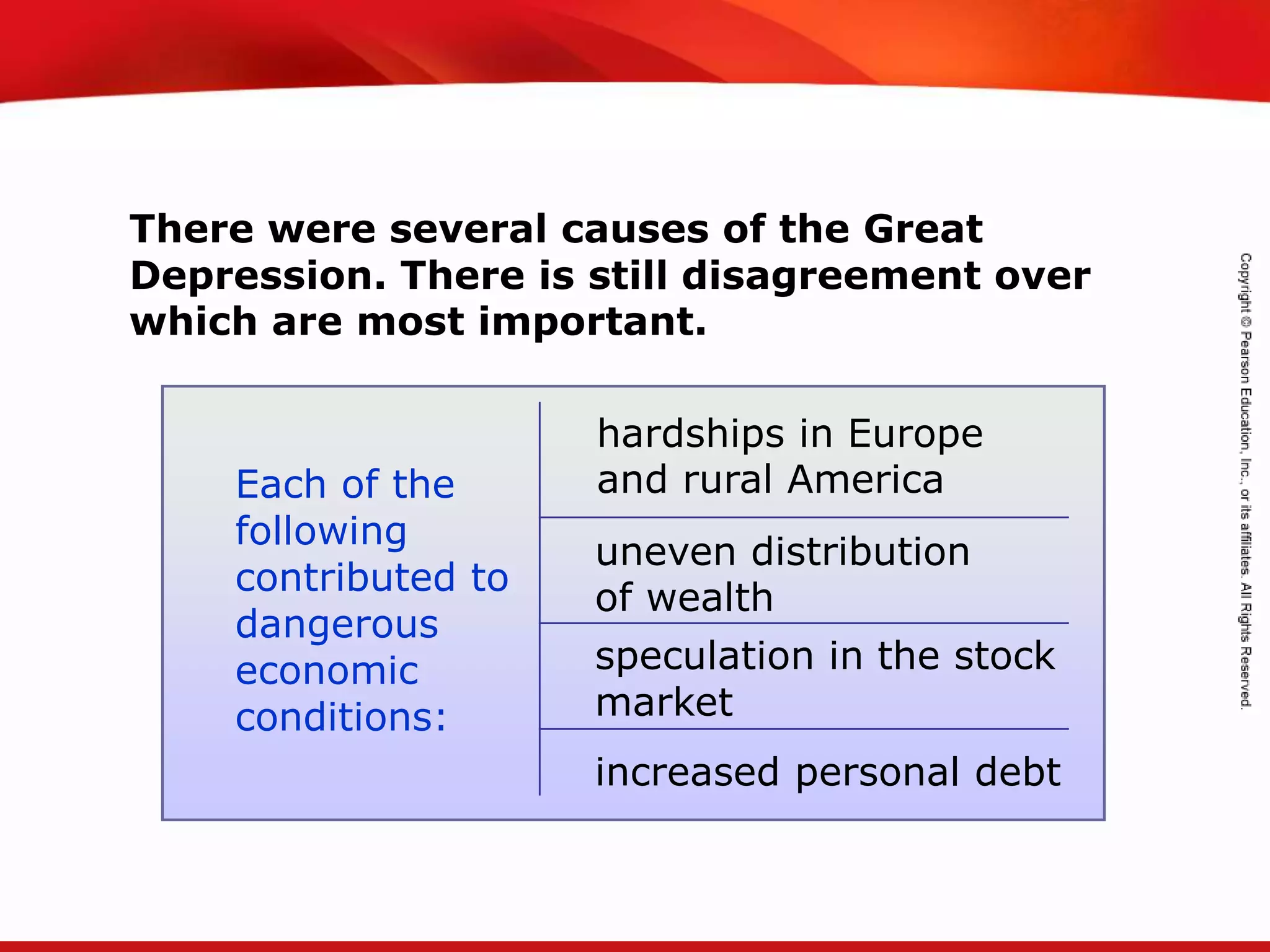
There were several causes of the Great
Depression. There is still disagreement over
which are most important.
Each of the
following
contributed to
dangerous
economic
conditions:
hardships in Europe
and rural America
uneven distribution
of wealth
speculation in the stock
market
increased personal debt
TEKS 8C: Calculate percent composition and empirical and molecular formulas.
Effects of the Depression
TEKS 8C: Calculate percent composition and empirical and molecular formulas.
• Examine the spread of unemployment in
America’s cities.
• Discuss the impact of the Great Depression
on rural America.
• Explain the human and geographical factors
that created the Dust Bowl.
Objectives
TEKS 8C: Calculate percent composition and empirical and molecular formulas.
Terms and People
• bread line – where charities or local agencies gave
food to the poor
• Hooverville – term used to describe makeshift
shantytowns set up by homeless people during the
Great Depression
• tenant farmer – rural farmers who lost their land
but stayed on to work for larger landowners
• Dust Bowl – millions of acres in the Great Plains
that were destroyed when dust storms blew away
the soil
TEKS 8C: Calculate percent composition and empirical and molecular formulas.
Terms and People (continued)
• Okies – Great Plains farmers forced off their
land by the Dust Bowl
• repatriation – policy whereby local, state,
and federal governments encouraged or
coerced Mexican immigrants—some of them
U.S. citizens—to return to Mexico
TEKS 8C: Calculate percent composition and empirical and molecular formulas.
How did the Great Depression affect the
lives of urban and rural Americans?
The stock market crash signaled the end of boom
times and the economy staggered into the Great
Depression. Desperate poverty gripped the
nation, leaving a permanent impression on those
who lived through it.
Tested by extreme hardship, this generation
forged a strong character and will to restore
prosperity.
TEKS 8C: Calculate percent composition and empirical and molecular formulas.
Between 1921–1929,
the unemployment
rate never rose above
4 percent. By 1933,
however, it was near
25 percent.
Those who managed
to keep their jobs
had their wages and
hours cut.
Few Americans
understood
the causes
of the Great
Depression, but
everyone felt the
impact.
TEKS 8C: Calculate percent composition and empirical and molecular formulas.
For many, the only food
available came from
public soup kitchens or
bread lines run by
charitable organizations.
People sold their
property to buy food.
TEKS 8C: Calculate percent composition and empirical and molecular formulas.
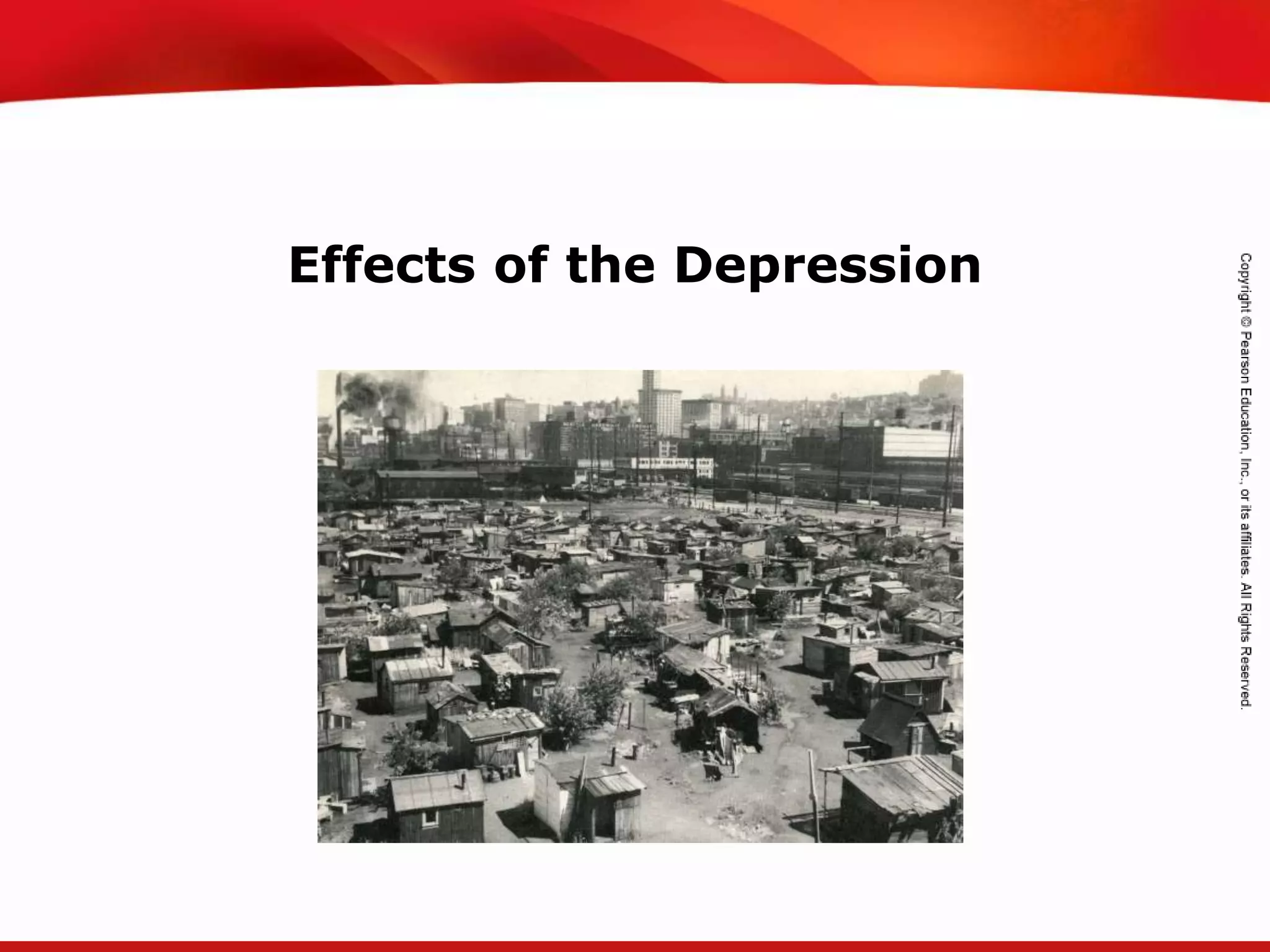
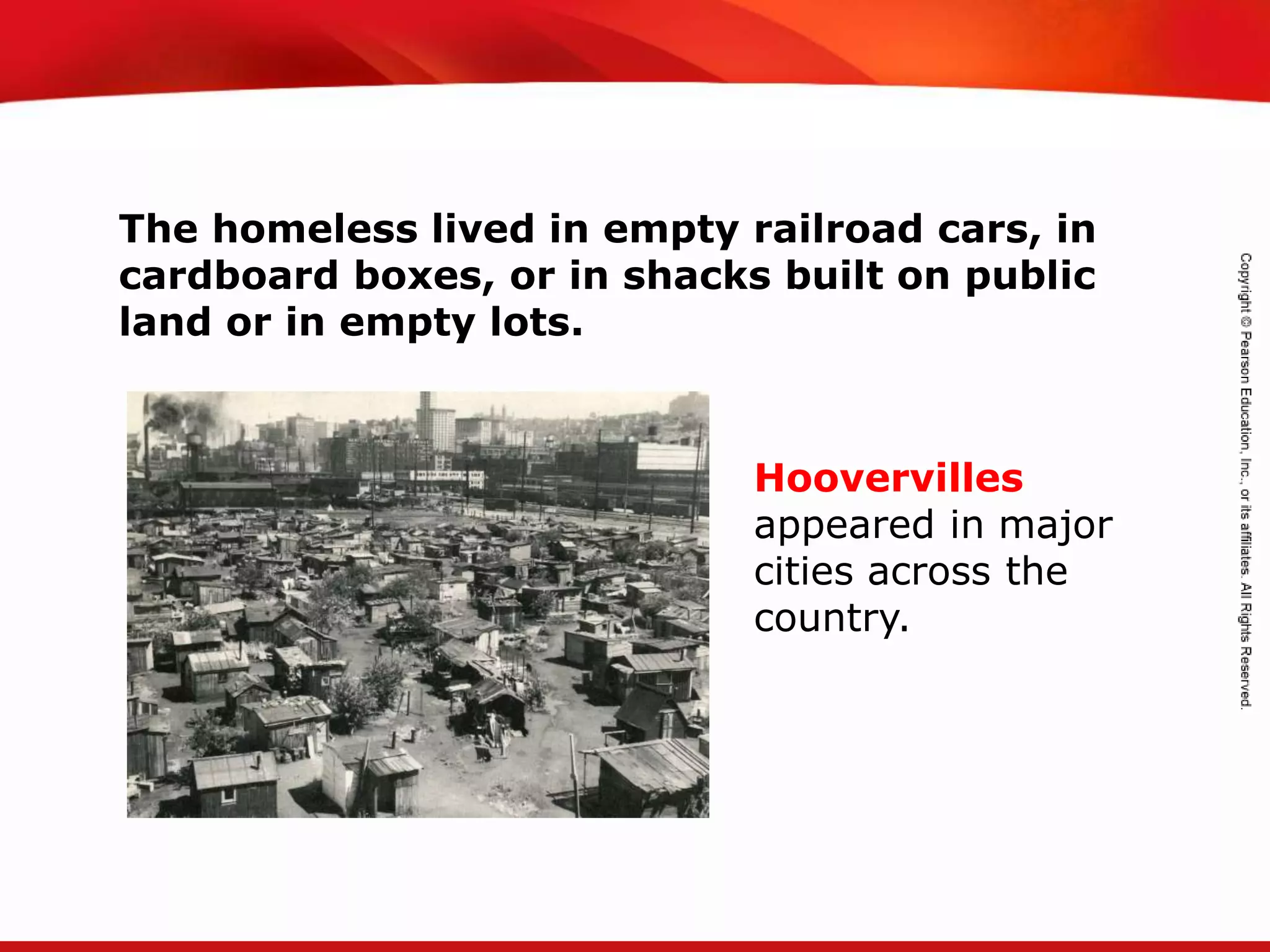
The homeless lived in empty railroad cars, in
cardboard boxes, or in shacks built on public
land or in empty lots.
Hoovervilles
appeared in major
cities across the
country.
TEKS 8C: Calculate percent composition and empirical and molecular formulas.
Bankers sold the land
and equipment at
auction. Some
farmers became
tenant farmers,
working for bigger
landowners. Others
decided to leave in
search of work
elsewhere in the
United States.
Between 1930
and 1934, nearly
a million farmers
lost their farms,
homes, and farm
equipment
because they
could not pay
their mortgages.
TEKS 8C: Calculate percent composition and empirical and molecular formulas.
The remaining
farmers on the
Great Plains
suffered a terrible
drought, which led
to the Dust Bowl.
Dust storms
destroyed
millions of acres
of farmland.
TEKS 8C: Calculate percent composition and empirical and molecular formulas.
• Farmers had dug up thick prairie grasses to
plant wheat, so there was nothing to hold the
soil in place.
• Winds traveling as fast as 100 mile-per-hour
winds blew dust clouds 8,000 feet tall in
Oklahoma, Texas, New Mexico, and Colorado.
• Wildlife and farm animals suffocated in the
choking winds.
Millions of tons of topsoil were blown
away in giant dust storms.
TEKS 8C: Calculate percent composition and empirical and molecular formulas.
In old trucks, farmers
moved west or to northern
cities. Before the pace
slowed, 800,000 Okies left
Texas, Oklahoma, Missouri,
and Arkansas alone. Rural
states lost population
during the 1930s.
Those who could afford
it bought distressed
neighbors’ farms at low
prices to build expanded
commercial farms.
Farmers who
had lost their
land, called
Okies regardless
of where they
were from, were
forced to leave.
TEKS 8C: Calculate percent composition and empirical and molecular formulas.
Family life was hurt by the Great Depression.
Some teens ran away, and families broke up.
America’s birthrate fell to its lowest level
on record.
Those who were still working felt guilty because
friends and relatives were unemployed.
Those who still had jobs lived in fear that their
next paycheck would be their last.
TEKS 8C: Calculate percent composition and empirical and molecular formulas.
Minorities suffered even more
during the depression.
• As Okies moved west to
find work, Mexicans and
Mexican Americans faced
fierce competition for jobs.
• Local governments urged
repatriation for Mexican
Americans.
• Even in good times,
African Americans were
“last hired and first fired.”
• Many were thrown off
southern farms where they
were sharecroppers.

Week four great depression

  • 1.
    TEKS 8C: Calculatepercent composition and empirical and molecular formulas. Causes of the Great Depression
  • 2.
    TEKS 8C: Calculatepercent composition and empirical and molecular formulas. Objectives • Discuss the weaknesses in the economy of the 1920s. • Explain how the stock market crash contributed to the coming of the Great Depression. • Describe how the Great Depression spread overseas.
  • 3.
    TEKS 8C: Calculatepercent composition and empirical and molecular formulas. Terms and People • Herbert Hoover – former Secretary of Commerce and Republican candidate for President in 1928 • speculation – when investors gamble that stock prices will rise • Black Tuesday – October 24, 1929, the day the stock market crashed • business cycle – periodic expansion and contraction of the economy
  • 4.
    TEKS 8C: Calculatepercent composition and empirical and molecular formulas. Terms and People (continued) • Great Depression – The collapse of the United States and world economies beginning in 1929 • Hawley-Smoot Tariff – high protective tariff passed in June 1930 that contributed to a worldwide depression
  • 5.
    TEKS 8C: Calculatepercent composition and empirical and molecular formulas. How did the prosperity of the 1920s give way to the Great Depression? During the 1920s, many Americans enjoyed what seemed like an endless era of prosperity. But in 1929, the stock market crashed. Production fell, unemployment rose, and the economy went into a period of dramatic decline. Years after the Great Depression began, periodic contraction was seen as part of the business cycle.
  • 6.
    TEKS 8C: Calculatepercent composition and empirical and molecular formulas. The Republicans took credit for the strong economy. Their presidential candidate was Herbert Hoover. He believed in voluntary cooperation between business and labor. In the 1928 presidential race, the Republican Party was confident.
  • 7.
    TEKS 8C: Calculatepercent composition and empirical and molecular formulas. Farmers could not afford to buy goods or repay their loans. The agricultural sector was in trouble. Rural farmers produced huge surpluses of food that depressed prices. Despite Hoover’s confidence, some saw signs of weakness in the economy.
  • 8.
    TEKS 8C: Calculatepercent composition and empirical and molecular formulas. Easy credit and installment buying lead people to purchase goods they can’t pay for. By 1929, Americans racked up more than $6 billion in personal debt — more than double the 1921 level.
  • 9.
    TEKS 8C: Calculatepercent composition and empirical and molecular formulas. Rising wages masked an uneven distribution of wealth. While factory workers’ wages rose 8%, factory output increased by 32%. As a result, worker incomes rose modestly, while rich investor incomes skyrocketed.
  • 10.
    TEKS 8C: Calculatepercent composition and empirical and molecular formulas. Until September 1929, the stock market continued to rise. Many people borrowed money to buy stock, assuming prices would continue to go up. Some economists feared that stocks were over-priced.
  • 11.
    TEKS 8C: Calculatepercent composition and empirical and molecular formulas. On October 29th, the stock market went into a free fall as investors tried to sell at any price. Many who bought stocks on margin were wiped out. Billions of dollars were lost in a few hours. 16 million shares were sold on “Black Tuesday.”
  • 12.
    TEKS 8C: Calculatepercent composition and empirical and molecular formulas. • In growth periods, workers are hired, wages rise, and demand for products increases. • In contraction periods, workers are fired, wages drop, and demand for products falls. The Great Crash was a hallmark of the nation’s business cycle. The economy periodically grows and then contracts.
  • 13.
    TEKS 8C: Calculatepercent composition and empirical and molecular formulas. The stock market crash didn’t start the Great Depression by itself. Instead, it quickened the collapse of the U.S. economy.
  • 14.
    TEKS 8C: Calculatepercent composition and empirical and molecular formulas. The banking system feels the effects of the crash first. People fear that their money will be lost so they run to the bank and attempt to withdraw their funds. But banks don’t have enough of their money on hand as cash. These bank runs cause banks to fail.
  • 15.
    TEKS 8C: Calculatepercent composition and empirical and molecular formulas. • Factories closed, causing worker layoffs. • This lowered demand for goods. • By 1933, the unemployment rate reached 25%.
  • 16.
    TEKS 8C: Calculatepercent composition and empirical and molecular formulas. The resulting drop in world trade only made the glut of American factory and farm products harder to sell. The strategy was a mistake. Other nations retaliated and raised tariffs as well. Congress passed the Hawley-Smoot Tariff to protect American manufacturers from foreign competition.
  • 17.
    TEKS 8C: Calculatepercent composition and empirical and molecular formulas. As international trade falls, a global drop in business leads to a worldwide depression.
  • 18.
    TEKS 8C: Calculatepercent composition and empirical and molecular formulas. There were several causes of the Great Depression. There is still disagreement over which are most important. Each of the following contributed to dangerous economic conditions: hardships in Europe and rural America uneven distribution of wealth speculation in the stock market increased personal debt
  • 19.
    TEKS 8C: Calculatepercent composition and empirical and molecular formulas. Effects of the Depression
  • 20.
    TEKS 8C: Calculatepercent composition and empirical and molecular formulas. • Examine the spread of unemployment in America’s cities. • Discuss the impact of the Great Depression on rural America. • Explain the human and geographical factors that created the Dust Bowl. Objectives
  • 21.
    TEKS 8C: Calculatepercent composition and empirical and molecular formulas. Terms and People • bread line – where charities or local agencies gave food to the poor • Hooverville – term used to describe makeshift shantytowns set up by homeless people during the Great Depression • tenant farmer – rural farmers who lost their land but stayed on to work for larger landowners • Dust Bowl – millions of acres in the Great Plains that were destroyed when dust storms blew away the soil
  • 22.
    TEKS 8C: Calculatepercent composition and empirical and molecular formulas. Terms and People (continued) • Okies – Great Plains farmers forced off their land by the Dust Bowl • repatriation – policy whereby local, state, and federal governments encouraged or coerced Mexican immigrants—some of them U.S. citizens—to return to Mexico
  • 23.
    TEKS 8C: Calculatepercent composition and empirical and molecular formulas. How did the Great Depression affect the lives of urban and rural Americans? The stock market crash signaled the end of boom times and the economy staggered into the Great Depression. Desperate poverty gripped the nation, leaving a permanent impression on those who lived through it. Tested by extreme hardship, this generation forged a strong character and will to restore prosperity.
  • 24.
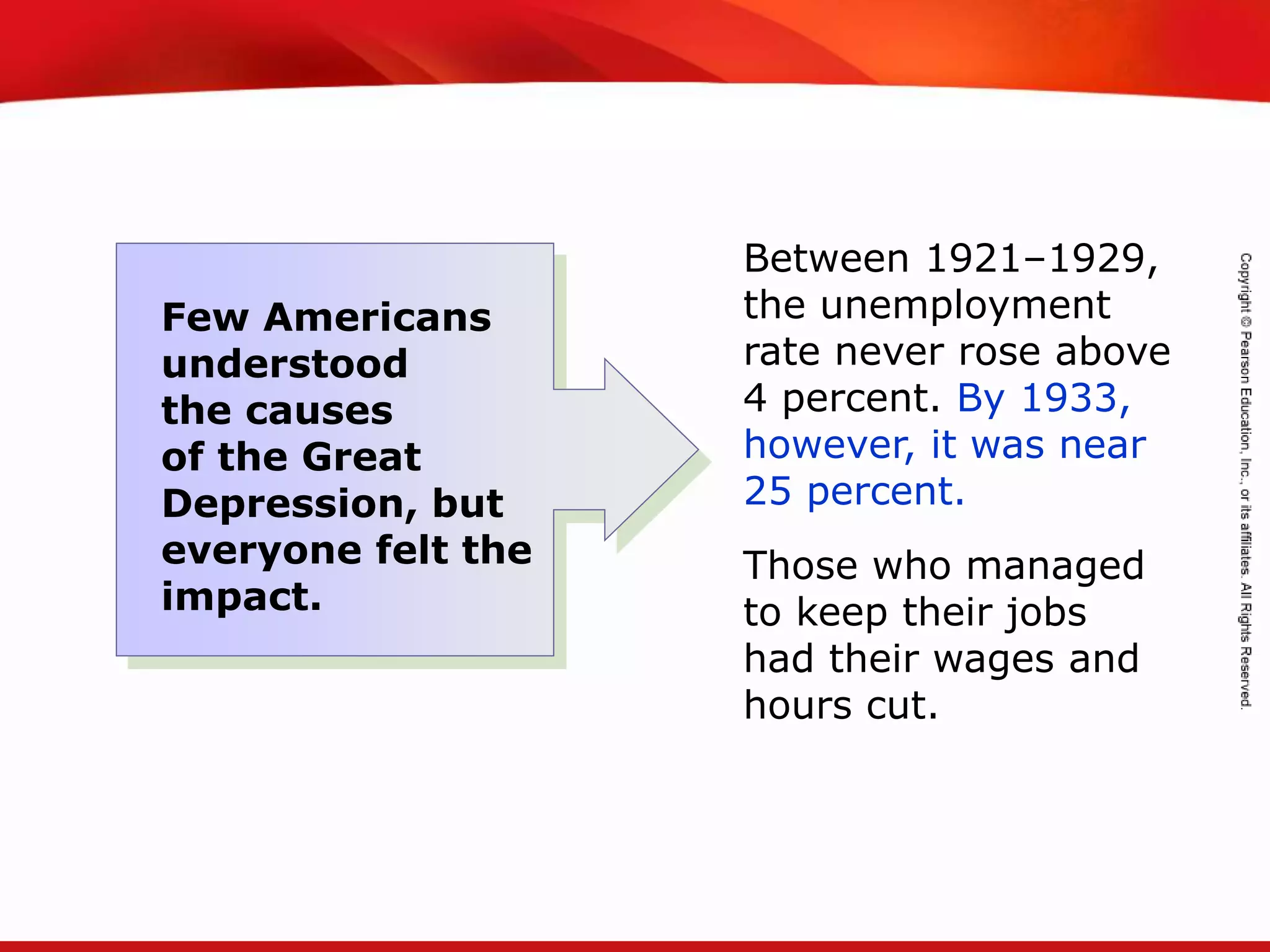
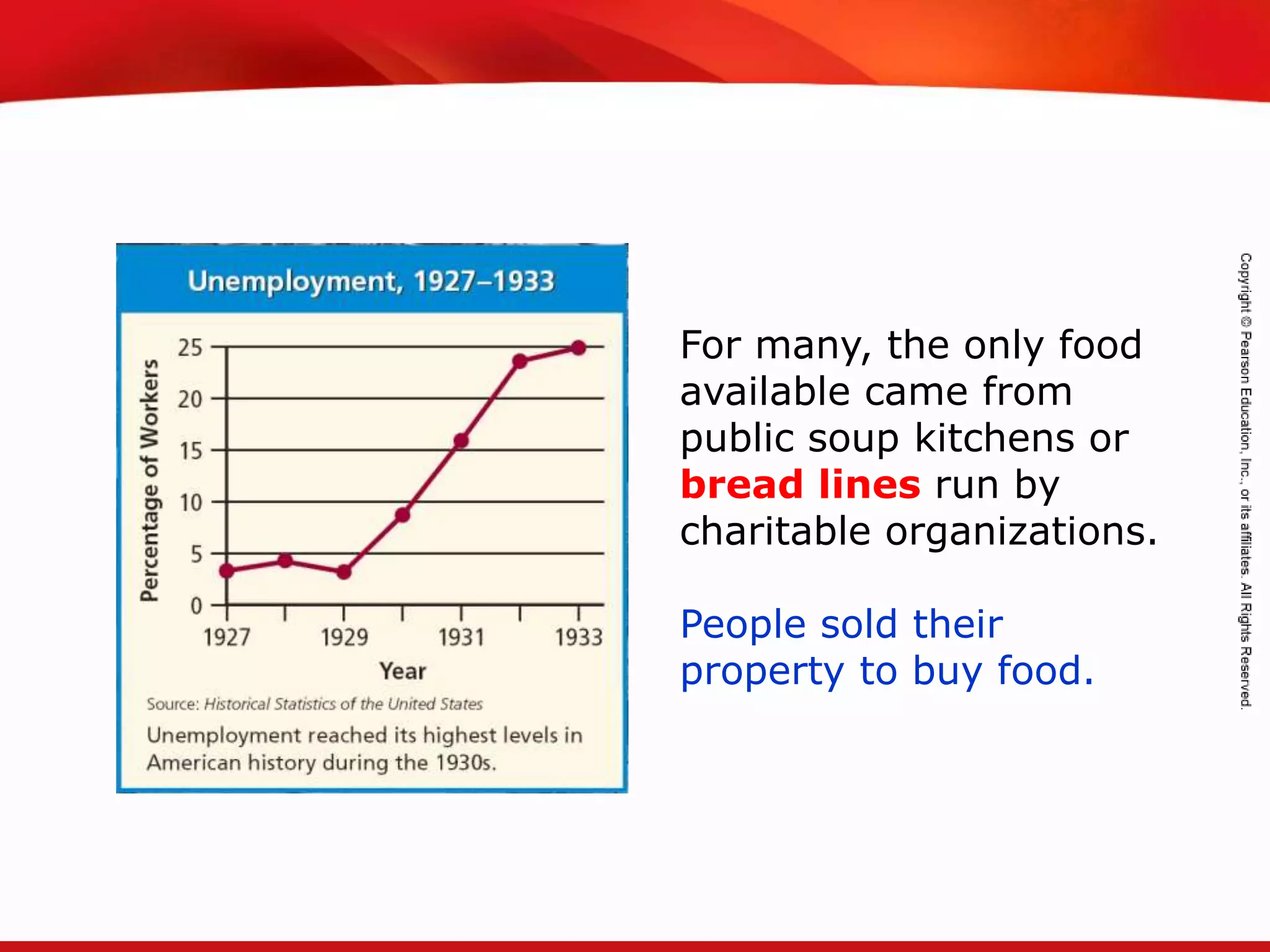
    TEKS 8C: Calculatepercent composition and empirical and molecular formulas. Between 1921–1929, the unemployment rate never rose above 4 percent. By 1933, however, it was near 25 percent. Those who managed to keep their jobs had their wages and hours cut. Few Americans understood the causes of the Great Depression, but everyone felt the impact.
  • 25.
    TEKS 8C: Calculatepercent composition and empirical and molecular formulas. For many, the only food available came from public soup kitchens or bread lines run by charitable organizations. People sold their property to buy food.
  • 26.
    TEKS 8C: Calculatepercent composition and empirical and molecular formulas. The homeless lived in empty railroad cars, in cardboard boxes, or in shacks built on public land or in empty lots. Hoovervilles appeared in major cities across the country.
  • 27.
    TEKS 8C: Calculatepercent composition and empirical and molecular formulas. Bankers sold the land and equipment at auction. Some farmers became tenant farmers, working for bigger landowners. Others decided to leave in search of work elsewhere in the United States. Between 1930 and 1934, nearly a million farmers lost their farms, homes, and farm equipment because they could not pay their mortgages.
  • 28.
    TEKS 8C: Calculatepercent composition and empirical and molecular formulas. The remaining farmers on the Great Plains suffered a terrible drought, which led to the Dust Bowl. Dust storms destroyed millions of acres of farmland.
  • 29.
    TEKS 8C: Calculatepercent composition and empirical and molecular formulas. • Farmers had dug up thick prairie grasses to plant wheat, so there was nothing to hold the soil in place. • Winds traveling as fast as 100 mile-per-hour winds blew dust clouds 8,000 feet tall in Oklahoma, Texas, New Mexico, and Colorado. • Wildlife and farm animals suffocated in the choking winds. Millions of tons of topsoil were blown away in giant dust storms.
  • 30.
    TEKS 8C: Calculatepercent composition and empirical and molecular formulas. In old trucks, farmers moved west or to northern cities. Before the pace slowed, 800,000 Okies left Texas, Oklahoma, Missouri, and Arkansas alone. Rural states lost population during the 1930s. Those who could afford it bought distressed neighbors’ farms at low prices to build expanded commercial farms. Farmers who had lost their land, called Okies regardless of where they were from, were forced to leave.
  • 31.
    TEKS 8C: Calculatepercent composition and empirical and molecular formulas. Family life was hurt by the Great Depression. Some teens ran away, and families broke up. America’s birthrate fell to its lowest level on record. Those who were still working felt guilty because friends and relatives were unemployed. Those who still had jobs lived in fear that their next paycheck would be their last.
  • 32.
    TEKS 8C: Calculatepercent composition and empirical and molecular formulas. Minorities suffered even more during the depression. • As Okies moved west to find work, Mexicans and Mexican Americans faced fierce competition for jobs. • Local governments urged repatriation for Mexican Americans. • Even in good times, African Americans were “last hired and first fired.” • Many were thrown off southern farms where they were sharecroppers.