TEKS 8C: Calculate percent composition and empirical and molecular formulas.
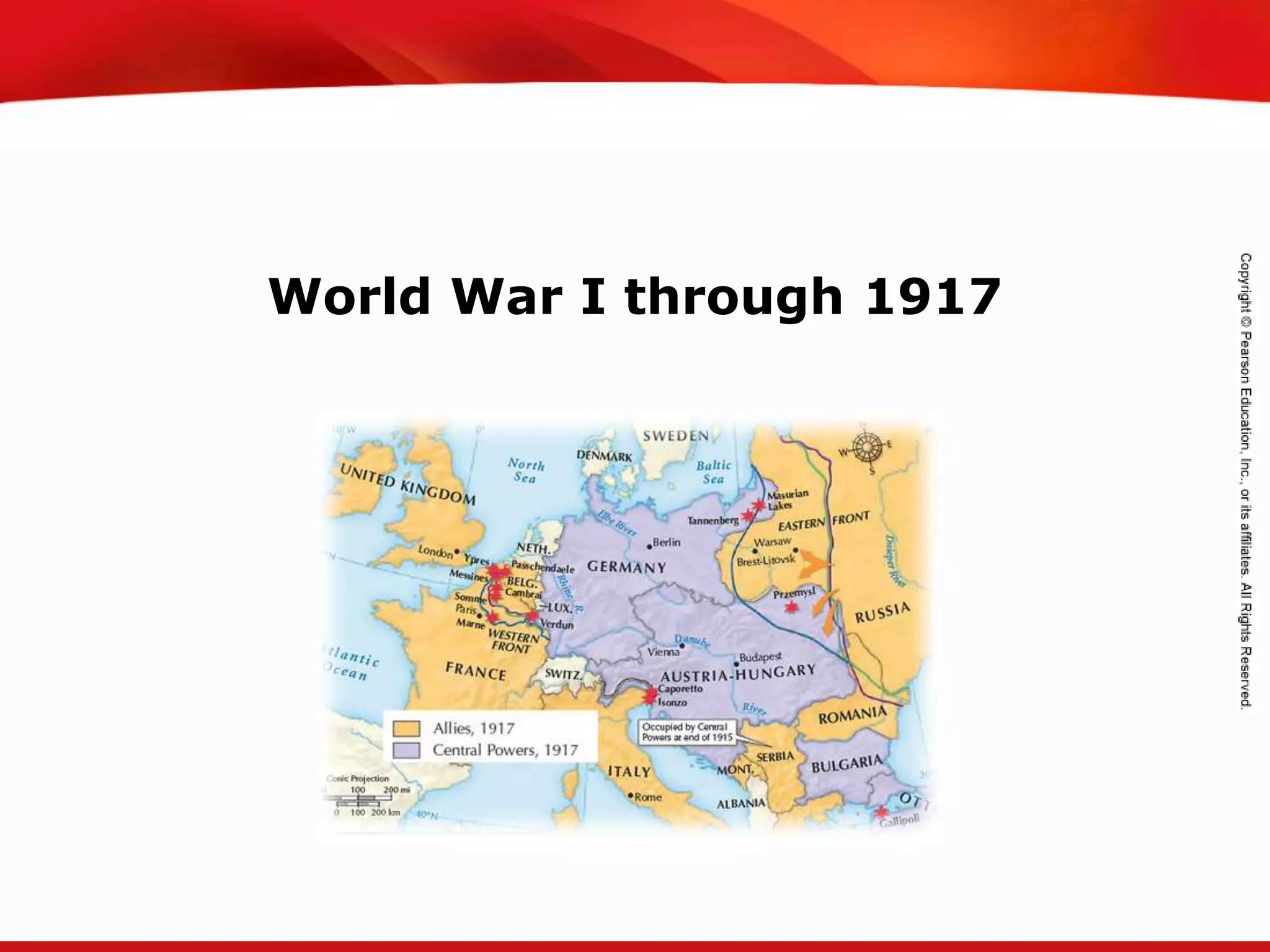
World War I through 1917
TEKS 8C: Calculate percent composition and empirical and molecular formulas.
• Identify the causes of World War I.
• Describe the course and character of the war.
• Explain why the United States entered the conflict
on the side of the Allies.
Objectives
TEKS 8C: Calculate percent composition and empirical and molecular formulas.
Terms and People
• Alsace-Lorraine – French region lost to German
states in 1871
• militarism – glorification of the military
• Francis Ferdinand – archduke of Austria-Hungary
who was assassinated in 1914
• William II – the German emperor
• Western Front − battle front between the Allies and
Central Powers in western Europe during World War I
TEKS 8C: Calculate percent composition and empirical and molecular formulas.
Terms and People (continued)
• casualty – killed, wounded, or missing soldier
• contraband – supplies captured from an enemy
during wartime
• U-boat – German submarine
• Lusitania – British passenger ship sunk by a
German U-boat during World War I
• Zimmermann note – a telegram in which the
German foreign minister Zimmerman proposed an
alliance with Mexico against the United States
TEKS 8C: Calculate percent composition and empirical and molecular formulas.
What caused World War I, and why
did the United States enter the war?
In 1914, nationalism, militarism, imperialism,
and entangling alliances combined to drag
Europe into a world war.
The United States attempted to remain
neutral but abandoned its long tradition of
staying out of European conflicts.
TEKS 8C: Calculate percent composition and empirical and molecular formulas.
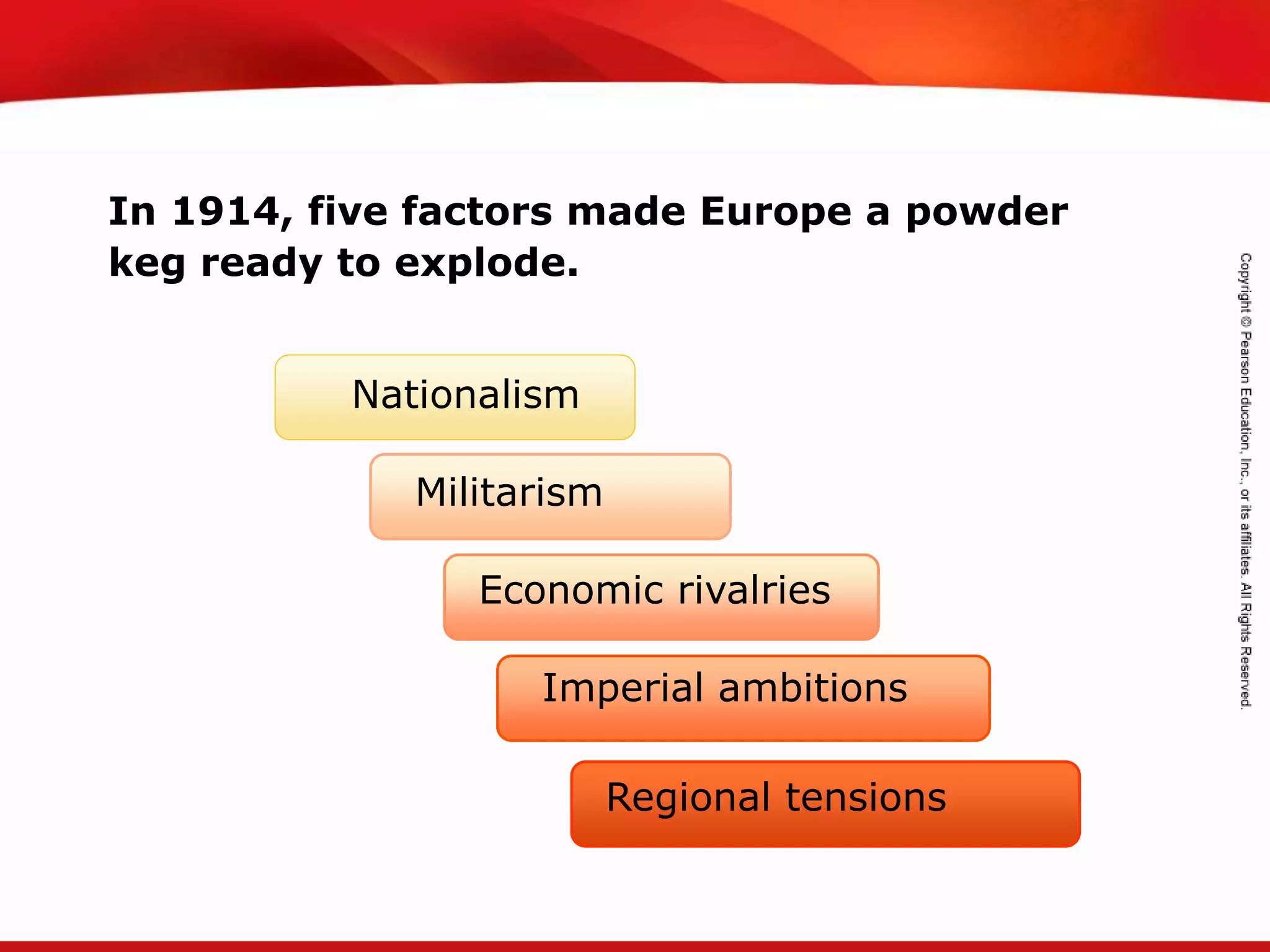
In 1914, five factors made Europe a powder
keg ready to explode.
Nationalism
Militarism
Economic rivalries
Imperial ambitions
Regional tensions
TEKS 8C: Calculate percent composition and empirical and molecular formulas.
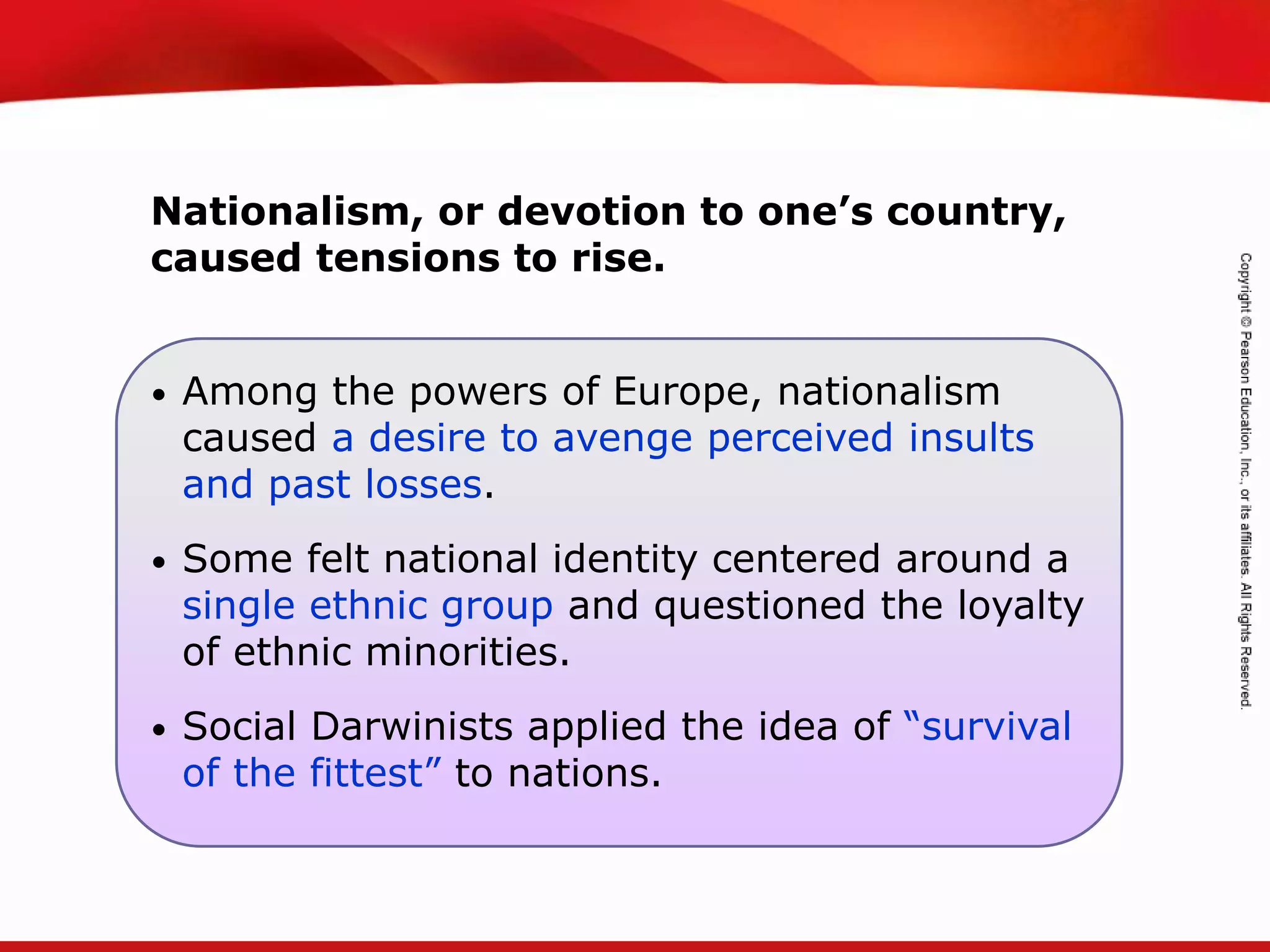
• Among the powers of Europe, nationalism
caused a desire to avenge perceived insults
and past losses.
• Some felt national identity centered around a
single ethnic group and questioned the loyalty
of ethnic minorities.
• Social Darwinists applied the idea of “survival
of the fittest” to nations.
Nationalism, or devotion to one’s country,
caused tensions to rise.
TEKS 8C: Calculate percent composition and empirical and molecular formulas.
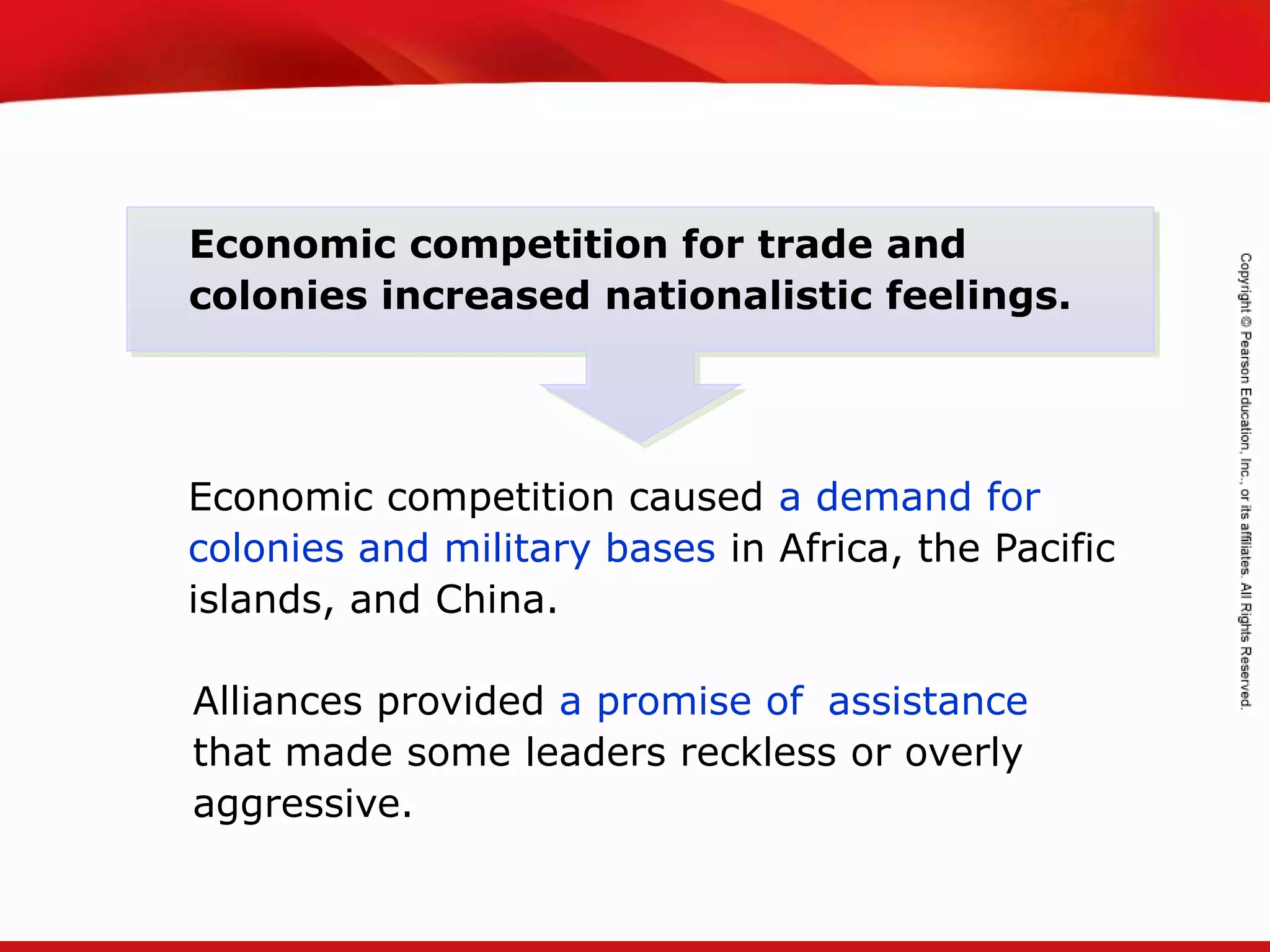
Economic competition caused a demand for
colonies and military bases in Africa, the Pacific
islands, and China.
Economic competition for trade and
colonies increased nationalistic feelings.
Alliances provided a promise of assistance
that made some leaders reckless or overly
aggressive.
TEKS 8C: Calculate percent composition and empirical and molecular formulas.
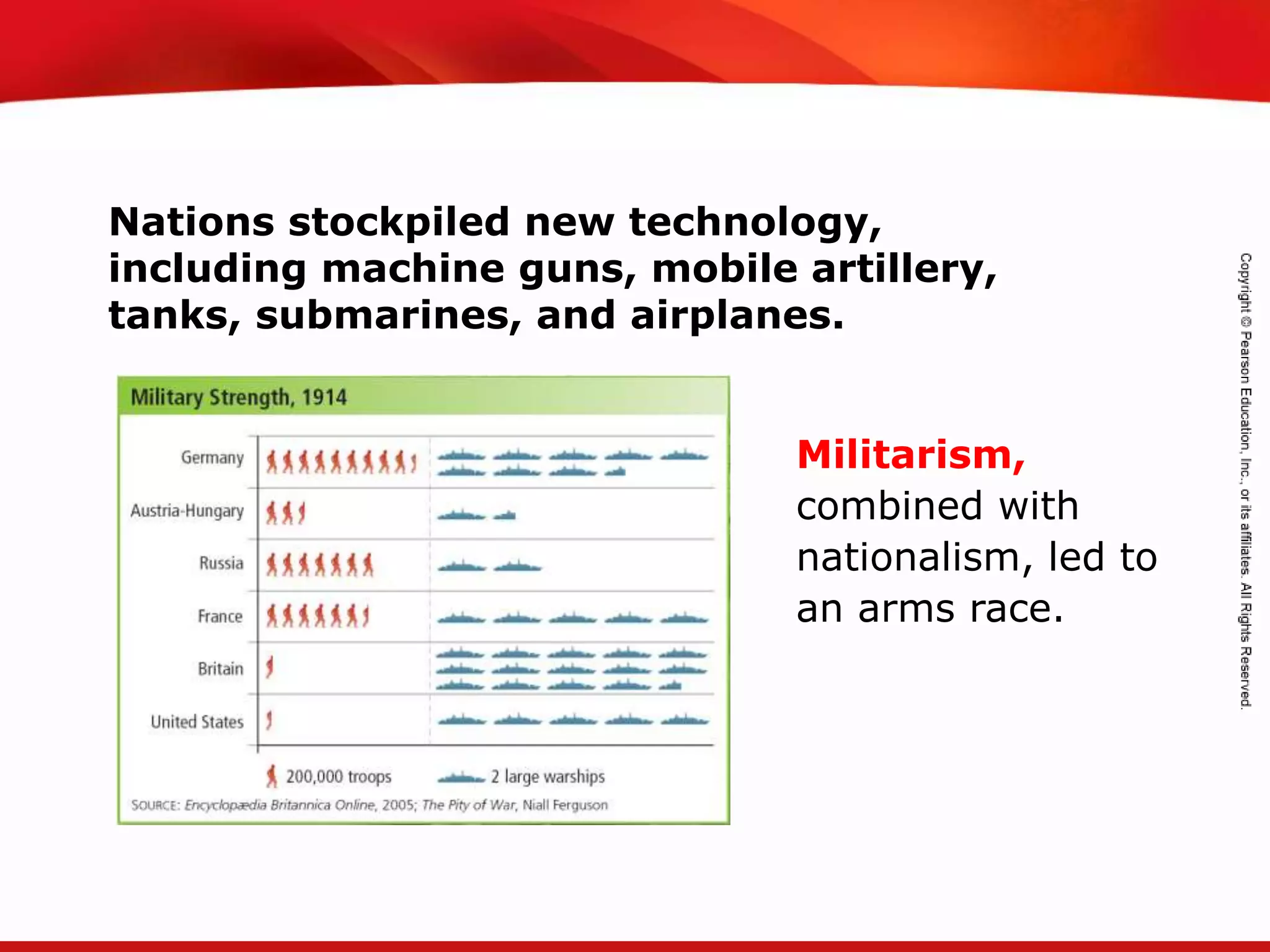
Militarism,
combined with
nationalism, led to
an arms race.
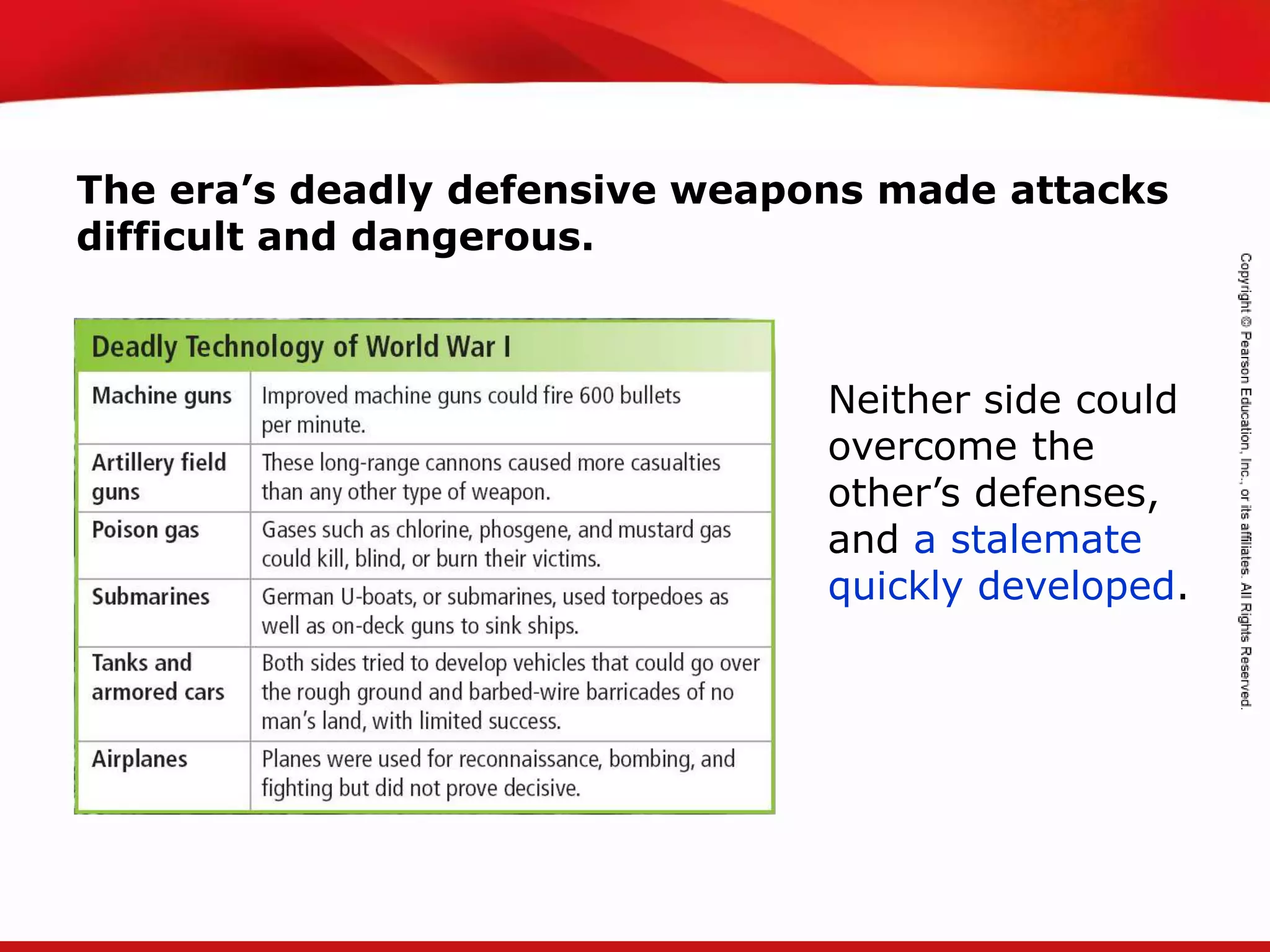
Nations stockpiled new technology,
including machine guns, mobile artillery,
tanks, submarines, and airplanes.
TEKS 8C: Calculate percent composition and empirical and molecular formulas.
The assassination
triggered a chain
of events that
drew two sets of
allies into a bloody
conflict.
On June 28, 1914,
Serb nationalists
assassinated the
heir to the throne of
Austria-Hungary,
Archduke, Francis
Ferdinand.
TEKS 8C: Calculate percent composition and empirical and molecular formulas.
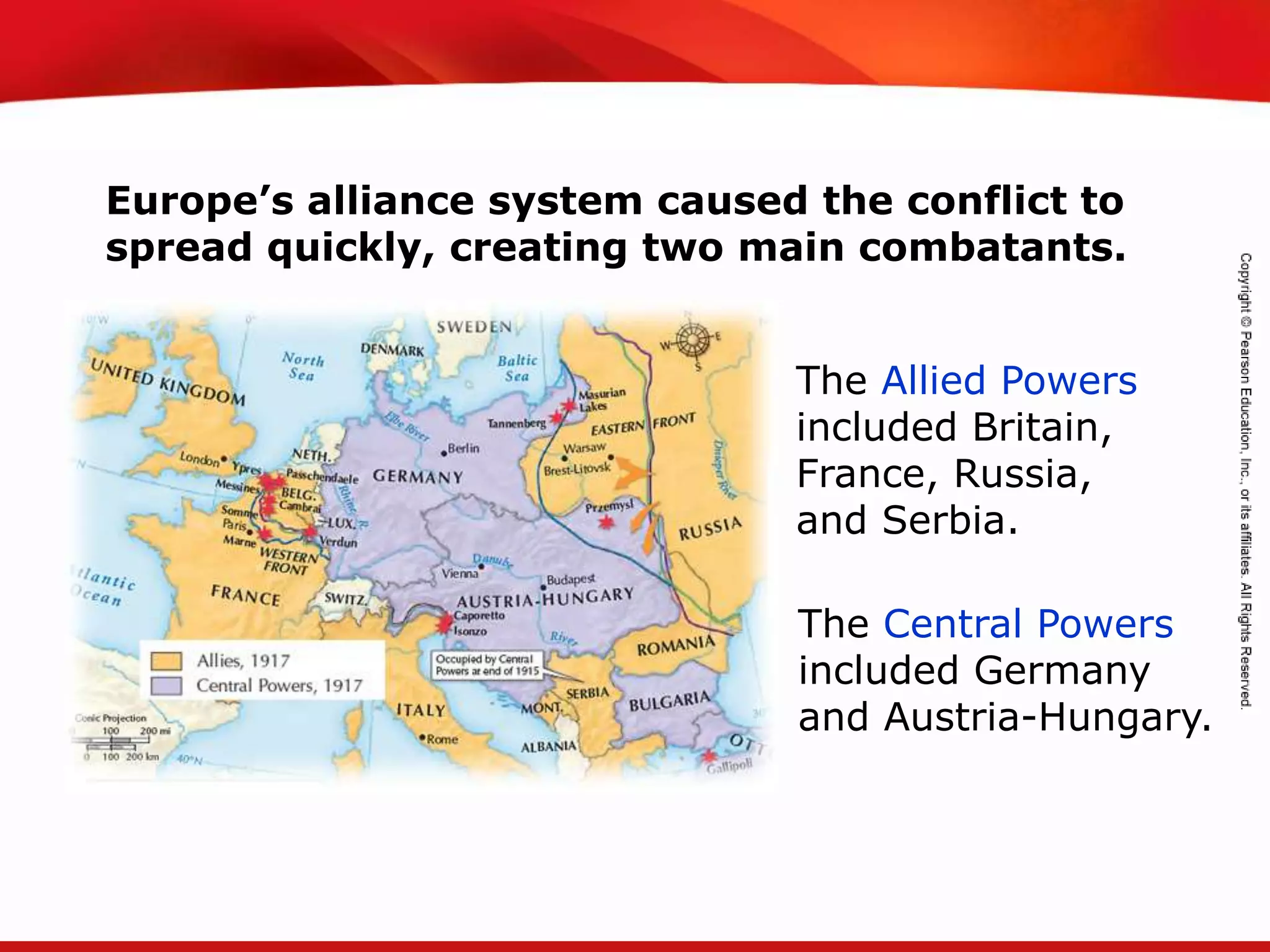
Europe’s alliance system caused the conflict to
spread quickly, creating two main combatants.
The Central Powers
included Germany
and Austria-Hungary.
The Allied Powers
included Britain,
France, Russia,
and Serbia.
TEKS 8C: Calculate percent composition and empirical and molecular formulas.
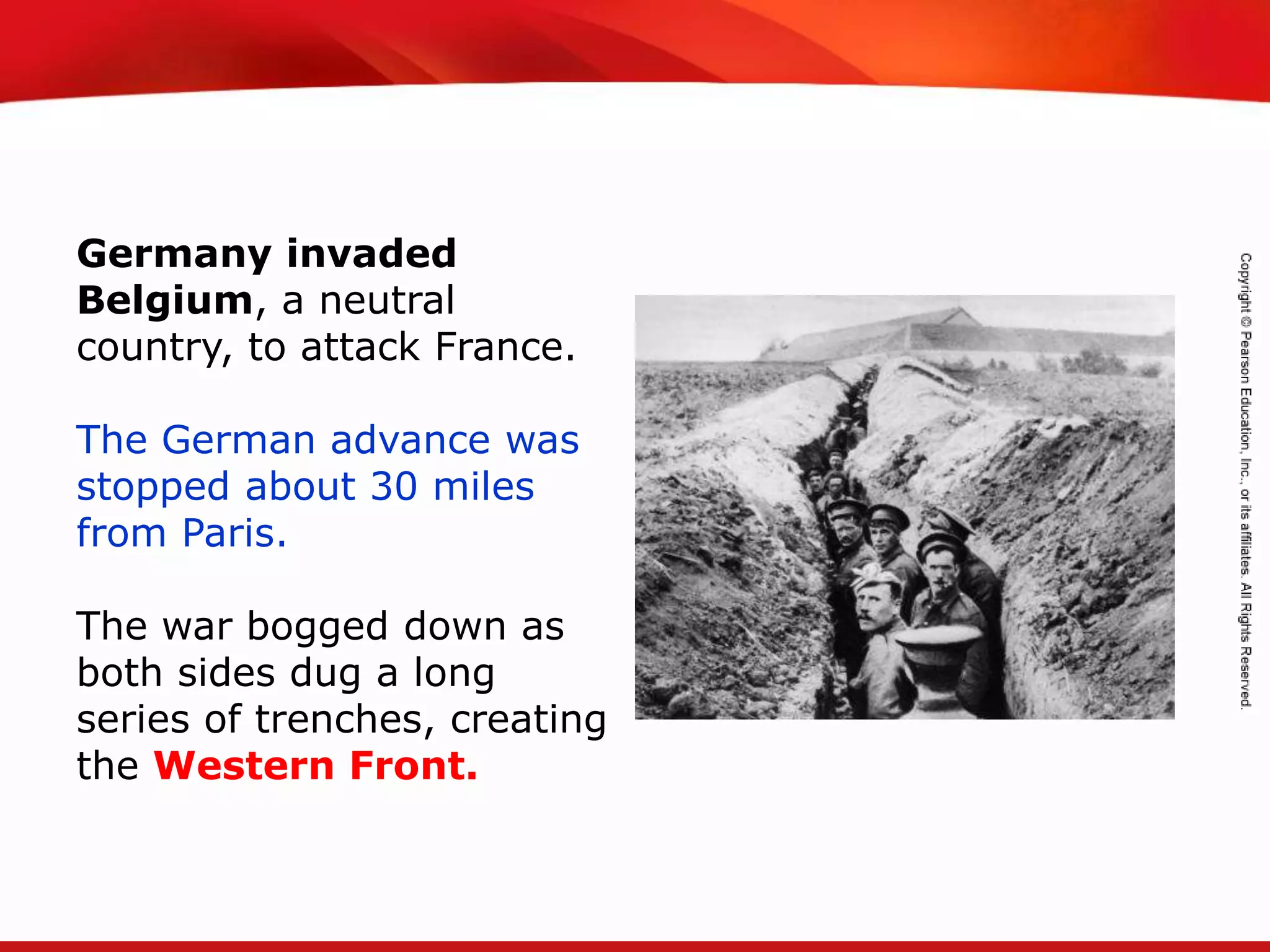
Germany invaded
Belgium, a neutral
country, to attack France.
The German advance was
stopped about 30 miles
from Paris.
The war bogged down as
both sides dug a long
series of trenches, creating
the Western Front.
TEKS 8C: Calculate percent composition and empirical and molecular formulas.
Neither side could
overcome the
other’s defenses,
and a stalemate
quickly developed.
The era’s deadly defensive weapons made attacks
difficult and dangerous.
TEKS 8C: Calculate percent composition and empirical and molecular formulas.
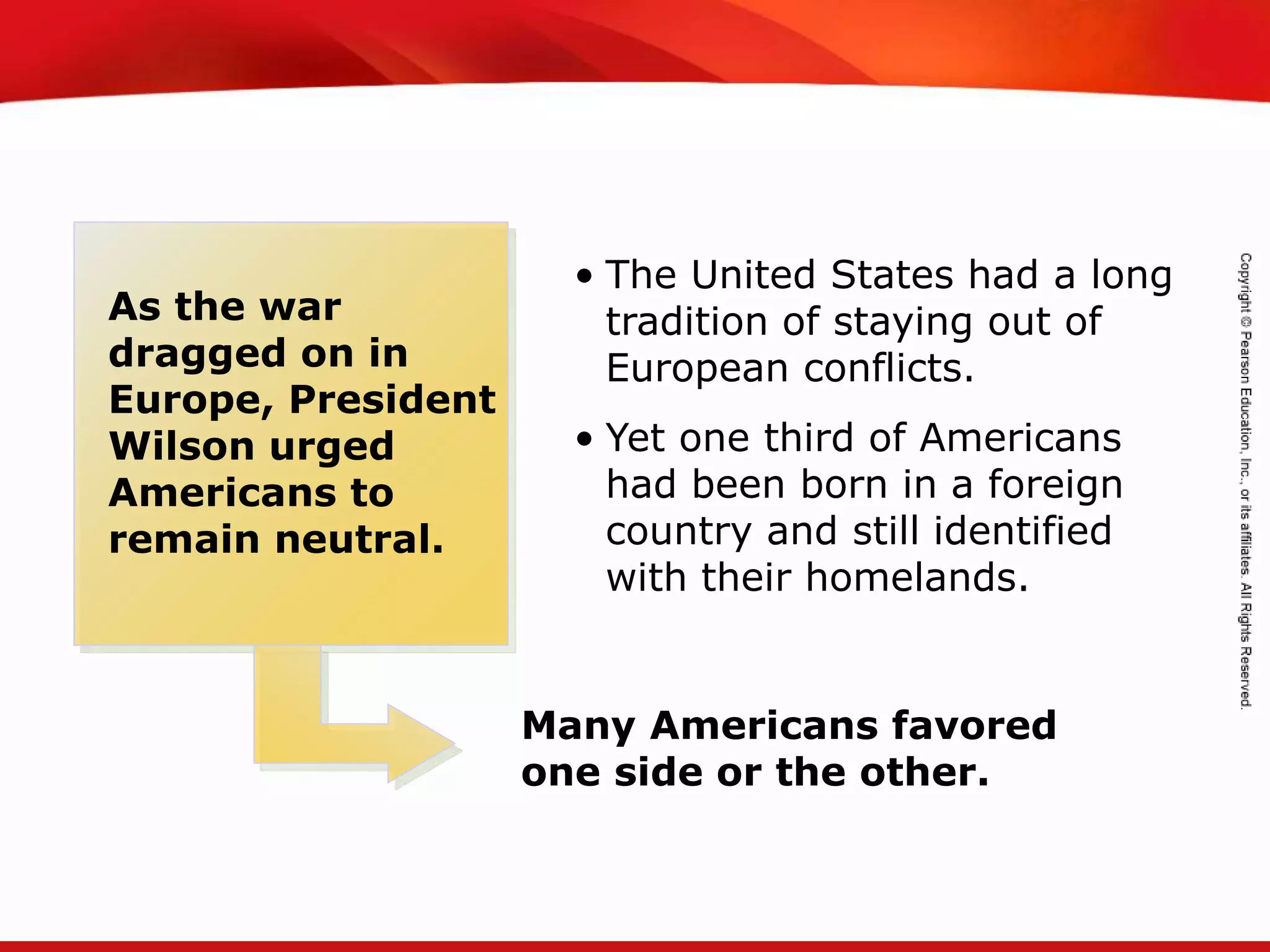
Many Americans favored
one side or the other.
As the war
dragged on in
Europe, President
Wilson urged
Americans to
remain neutral.
• The United States had a long
tradition of staying out of
European conflicts.
• Yet one third of Americans
had been born in a foreign
country and still identified
with their homelands.
TEKS 8C: Calculate percent composition and empirical and molecular formulas.
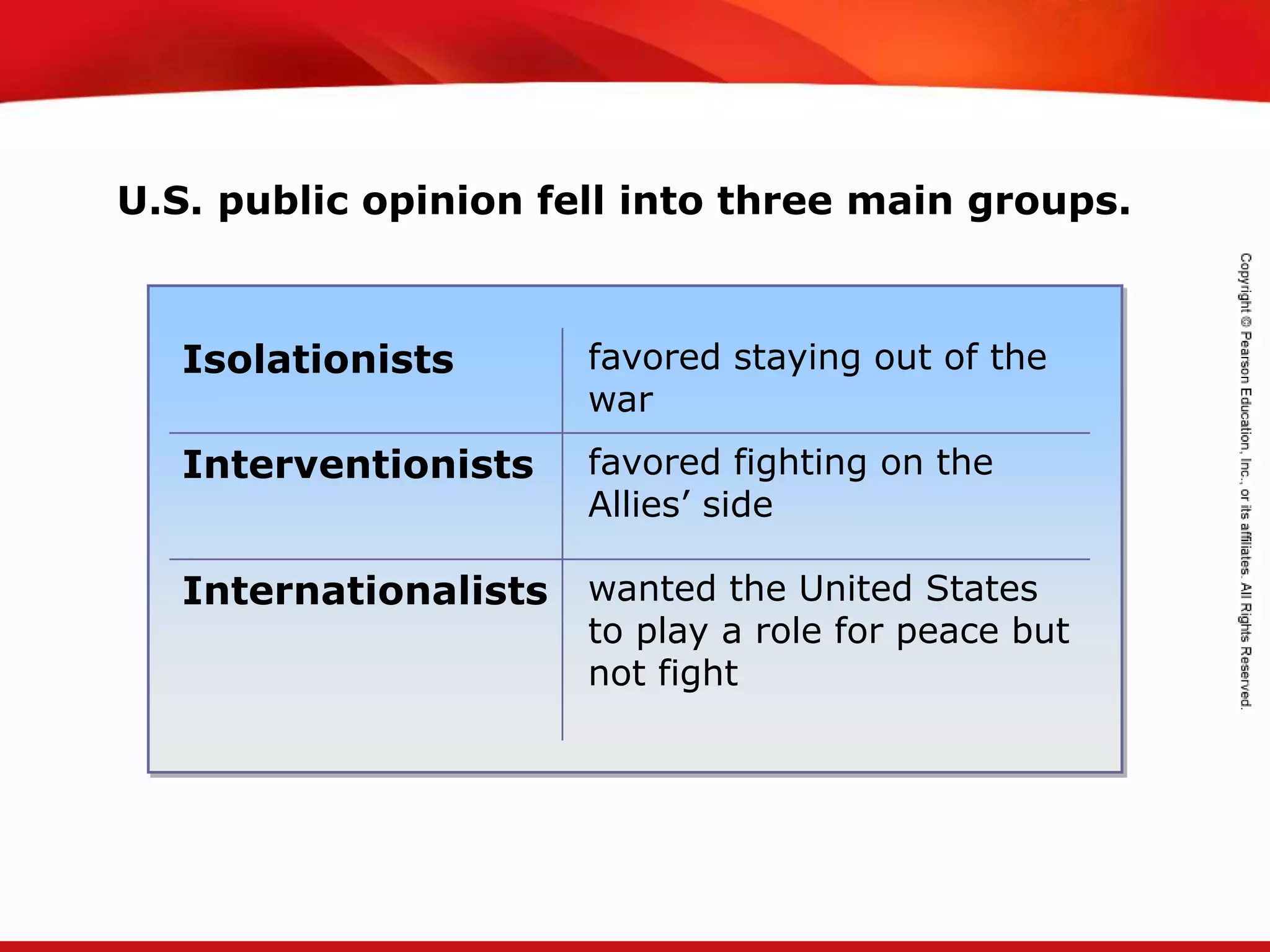
Isolationists favored staying out of the
war
Interventionists favored fighting on the
Allies’ side
Internationalists wanted the United States
to play a role for peace but
not fight
U.S. public opinion fell into three main groups.
TEKS 8C: Calculate percent composition and empirical and molecular formulas.
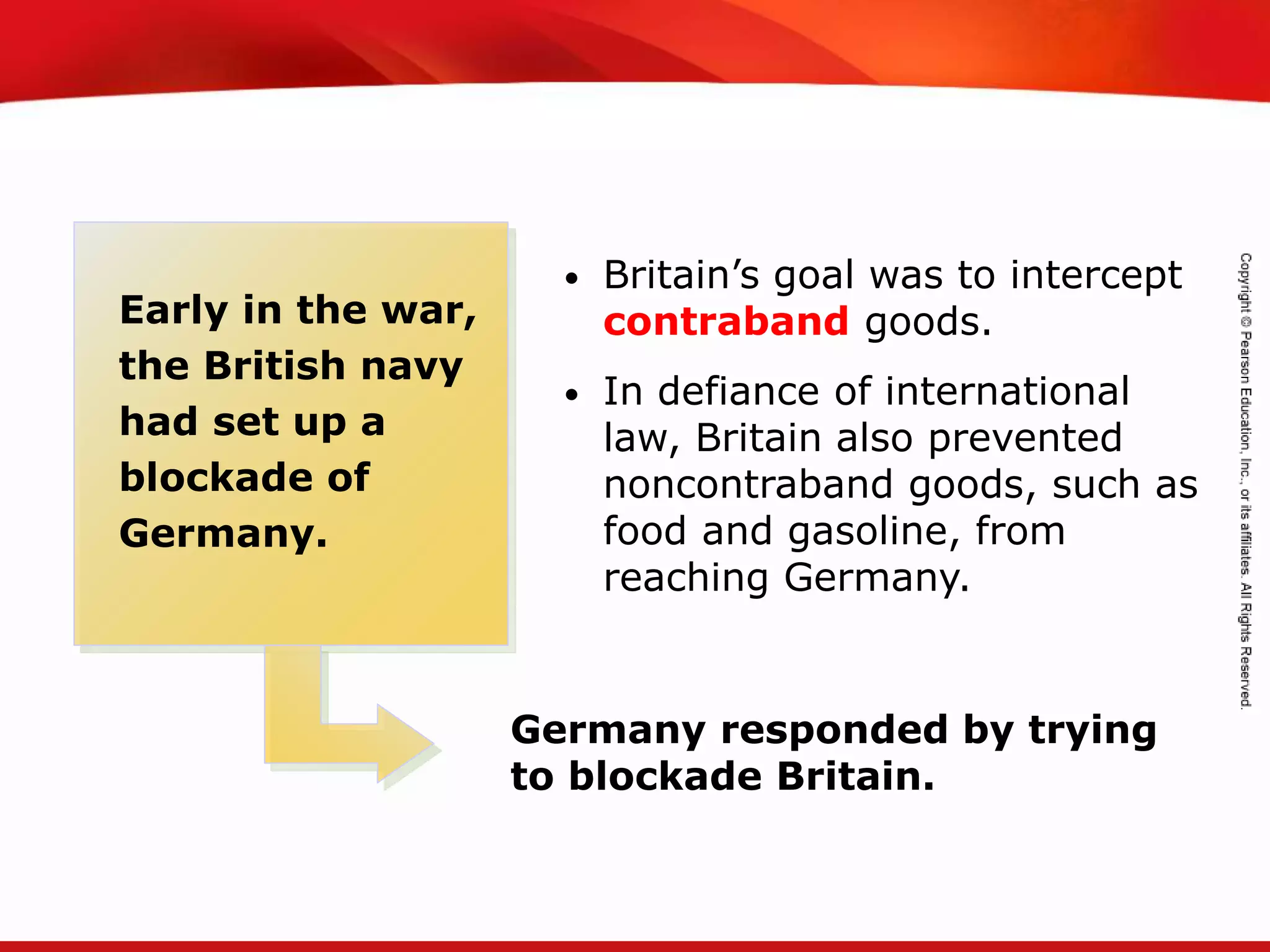
Early in the war,
the British navy
had set up a
blockade of
Germany.
• Britain’s goal was to intercept
contraband goods.
• In defiance of international
law, Britain also prevented
noncontraband goods, such as
food and gasoline, from
reaching Germany.
Germany responded by trying
to blockade Britain.
TEKS 8C: Calculate percent composition and empirical and molecular formulas.
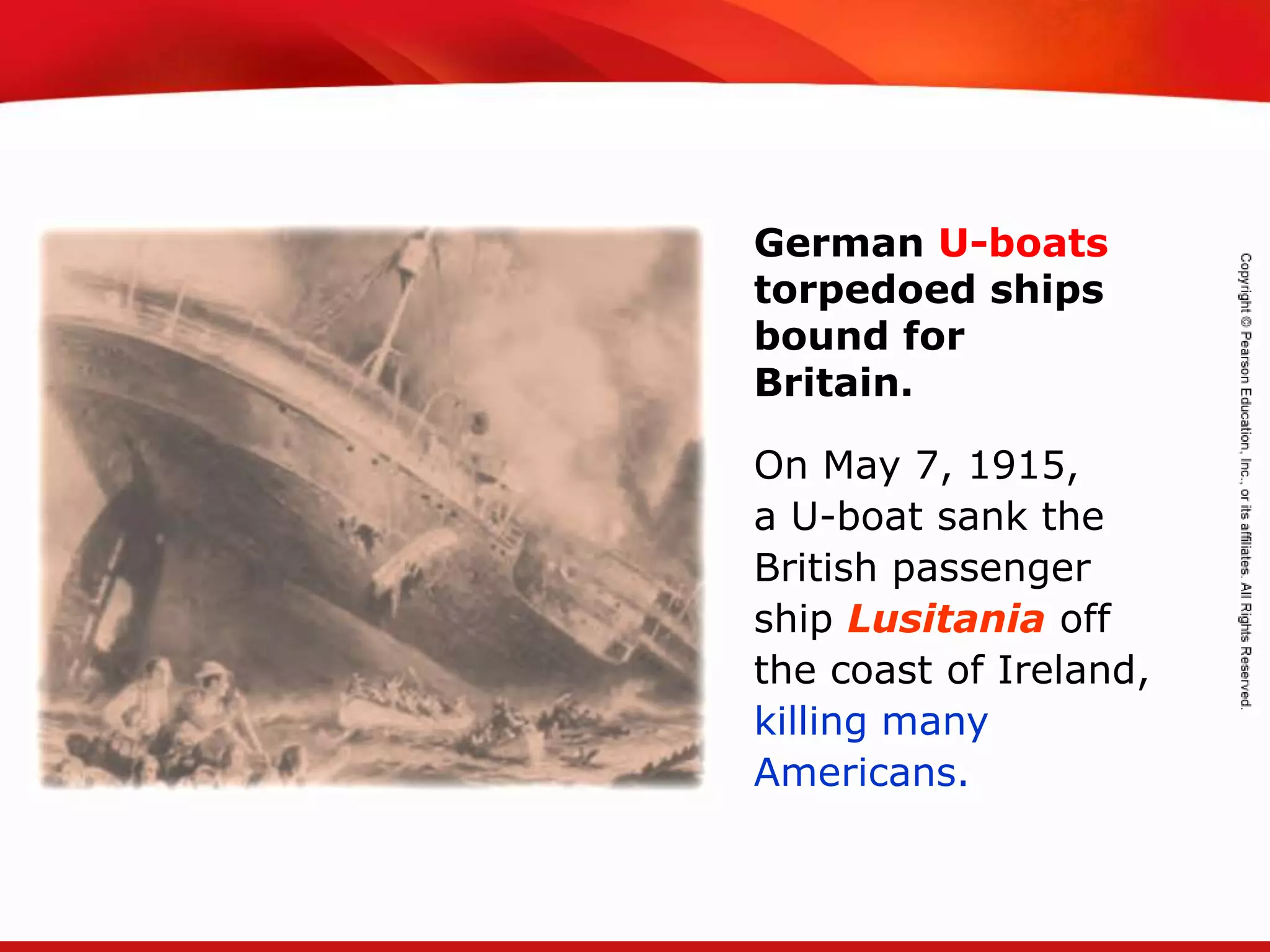
German U-boats
torpedoed ships
bound for
Britain.
On May 7, 1915,
a U-boat sank the
British passenger
ship Lusitania off
the coast of Ireland,
killing many
Americans.
TEKS 8C: Calculate percent composition and empirical and molecular formulas.
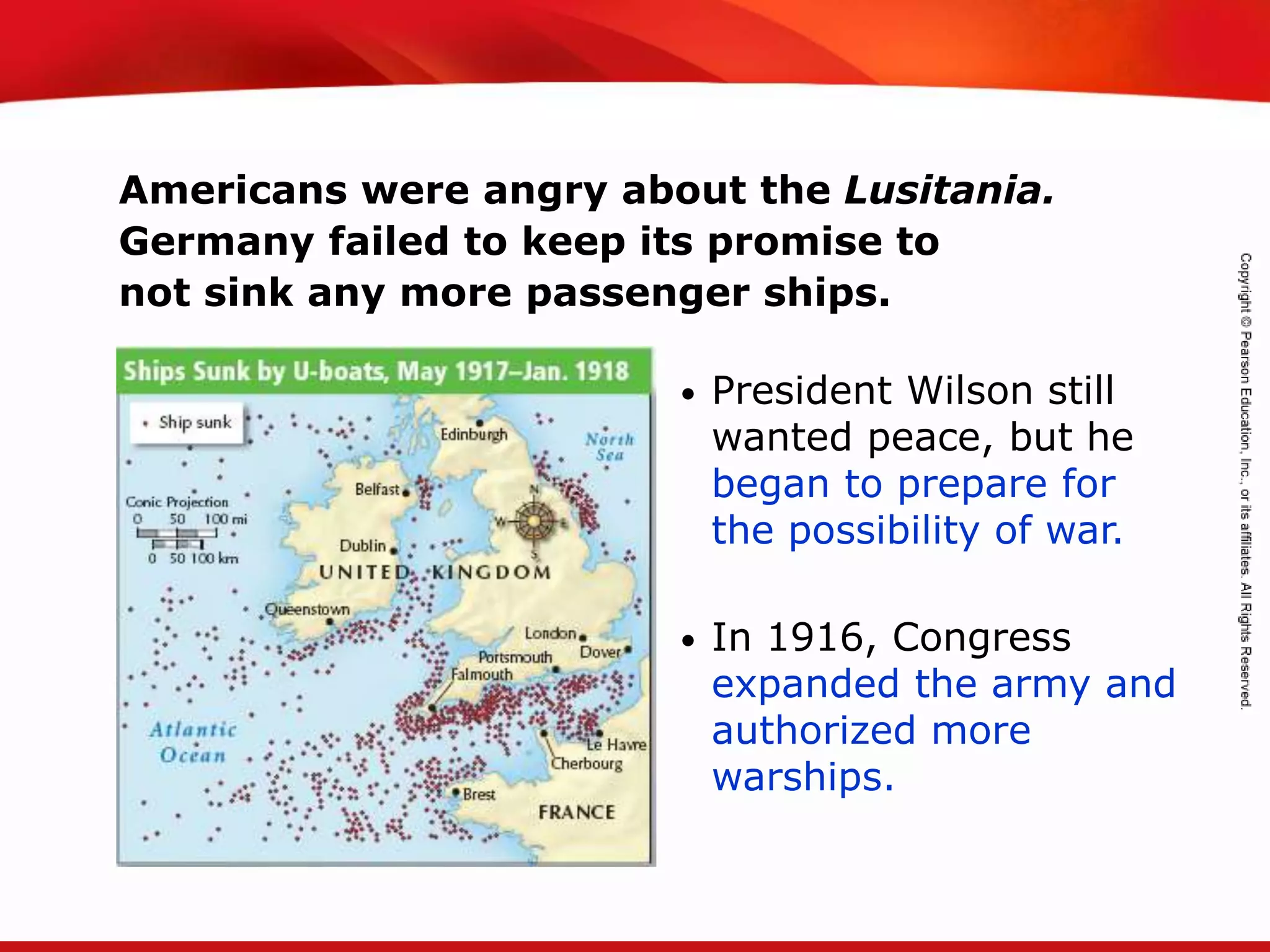
Americans were angry about the Lusitania.
Germany failed to keep its promise to
not sink any more passenger ships.
• President Wilson still
wanted peace, but he
began to prepare for
the possibility of war.
• In 1916, Congress
expanded the army and
authorized more
warships.
TEKS 8C: Calculate percent composition and empirical and molecular formulas.
• The Zimmermann note was intercepted. In
this telegram, Germany tried to forge an
alliance with Mexico against the United States.
• Germany returned to a policy of unrestricted
submarine warfare, sinking any ship headed
for Britain.
Two events in 1917 led President Wilson
to ask Congress to declare war on
the Central Powers.
TEKS 8C: Calculate percent composition and empirical and molecular formulas.
On April 2, 1917, Wilson asked Congress to
declare war against Germany, saying, “The
world must be made safe for democracy.”
Congress responded with a declaration of
war on April 6, 1917, and the United
States entered World War I.

Week three from neutrality to wwi

  • 1.
    TEKS 8C: Calculatepercent composition and empirical and molecular formulas. World War I through 1917
  • 2.
    TEKS 8C: Calculatepercent composition and empirical and molecular formulas. • Identify the causes of World War I. • Describe the course and character of the war. • Explain why the United States entered the conflict on the side of the Allies. Objectives
  • 3.
    TEKS 8C: Calculatepercent composition and empirical and molecular formulas. Terms and People • Alsace-Lorraine – French region lost to German states in 1871 • militarism – glorification of the military • Francis Ferdinand – archduke of Austria-Hungary who was assassinated in 1914 • William II – the German emperor • Western Front − battle front between the Allies and Central Powers in western Europe during World War I
  • 4.
    TEKS 8C: Calculatepercent composition and empirical and molecular formulas. Terms and People (continued) • casualty – killed, wounded, or missing soldier • contraband – supplies captured from an enemy during wartime • U-boat – German submarine • Lusitania – British passenger ship sunk by a German U-boat during World War I • Zimmermann note – a telegram in which the German foreign minister Zimmerman proposed an alliance with Mexico against the United States
  • 5.
    TEKS 8C: Calculatepercent composition and empirical and molecular formulas. What caused World War I, and why did the United States enter the war? In 1914, nationalism, militarism, imperialism, and entangling alliances combined to drag Europe into a world war. The United States attempted to remain neutral but abandoned its long tradition of staying out of European conflicts.
  • 6.
    TEKS 8C: Calculatepercent composition and empirical and molecular formulas. In 1914, five factors made Europe a powder keg ready to explode. Nationalism Militarism Economic rivalries Imperial ambitions Regional tensions
  • 7.
    TEKS 8C: Calculatepercent composition and empirical and molecular formulas. • Among the powers of Europe, nationalism caused a desire to avenge perceived insults and past losses. • Some felt national identity centered around a single ethnic group and questioned the loyalty of ethnic minorities. • Social Darwinists applied the idea of “survival of the fittest” to nations. Nationalism, or devotion to one’s country, caused tensions to rise.
  • 8.
    TEKS 8C: Calculatepercent composition and empirical and molecular formulas. Economic competition caused a demand for colonies and military bases in Africa, the Pacific islands, and China. Economic competition for trade and colonies increased nationalistic feelings. Alliances provided a promise of assistance that made some leaders reckless or overly aggressive.
  • 9.
    TEKS 8C: Calculatepercent composition and empirical and molecular formulas. Militarism, combined with nationalism, led to an arms race. Nations stockpiled new technology, including machine guns, mobile artillery, tanks, submarines, and airplanes.
  • 10.
    TEKS 8C: Calculatepercent composition and empirical and molecular formulas. The assassination triggered a chain of events that drew two sets of allies into a bloody conflict. On June 28, 1914, Serb nationalists assassinated the heir to the throne of Austria-Hungary, Archduke, Francis Ferdinand.
  • 11.
    TEKS 8C: Calculatepercent composition and empirical and molecular formulas. Europe’s alliance system caused the conflict to spread quickly, creating two main combatants. The Central Powers included Germany and Austria-Hungary. The Allied Powers included Britain, France, Russia, and Serbia.
  • 12.
    TEKS 8C: Calculatepercent composition and empirical and molecular formulas. Germany invaded Belgium, a neutral country, to attack France. The German advance was stopped about 30 miles from Paris. The war bogged down as both sides dug a long series of trenches, creating the Western Front.
  • 13.
    TEKS 8C: Calculatepercent composition and empirical and molecular formulas. Neither side could overcome the other’s defenses, and a stalemate quickly developed. The era’s deadly defensive weapons made attacks difficult and dangerous.
  • 14.
    TEKS 8C: Calculatepercent composition and empirical and molecular formulas. Many Americans favored one side or the other. As the war dragged on in Europe, President Wilson urged Americans to remain neutral. • The United States had a long tradition of staying out of European conflicts. • Yet one third of Americans had been born in a foreign country and still identified with their homelands.
  • 15.
    TEKS 8C: Calculatepercent composition and empirical and molecular formulas. Isolationists favored staying out of the war Interventionists favored fighting on the Allies’ side Internationalists wanted the United States to play a role for peace but not fight U.S. public opinion fell into three main groups.
  • 16.
    TEKS 8C: Calculatepercent composition and empirical and molecular formulas. Early in the war, the British navy had set up a blockade of Germany. • Britain’s goal was to intercept contraband goods. • In defiance of international law, Britain also prevented noncontraband goods, such as food and gasoline, from reaching Germany. Germany responded by trying to blockade Britain.
  • 17.
    TEKS 8C: Calculatepercent composition and empirical and molecular formulas. German U-boats torpedoed ships bound for Britain. On May 7, 1915, a U-boat sank the British passenger ship Lusitania off the coast of Ireland, killing many Americans.
  • 18.
    TEKS 8C: Calculatepercent composition and empirical and molecular formulas. Americans were angry about the Lusitania. Germany failed to keep its promise to not sink any more passenger ships. • President Wilson still wanted peace, but he began to prepare for the possibility of war. • In 1916, Congress expanded the army and authorized more warships.
  • 19.
    TEKS 8C: Calculatepercent composition and empirical and molecular formulas. • The Zimmermann note was intercepted. In this telegram, Germany tried to forge an alliance with Mexico against the United States. • Germany returned to a policy of unrestricted submarine warfare, sinking any ship headed for Britain. Two events in 1917 led President Wilson to ask Congress to declare war on the Central Powers.
  • 20.
    TEKS 8C: Calculatepercent composition and empirical and molecular formulas. On April 2, 1917, Wilson asked Congress to declare war against Germany, saying, “The world must be made safe for democracy.” Congress responded with a declaration of war on April 6, 1917, and the United States entered World War I.