Week 5 : Secure Software
Requirements
Requirements Phase from SSDLC
Secure SW Requirements
Requirements Phase - Secure
Software Development Life Cycle
Requirements Phase
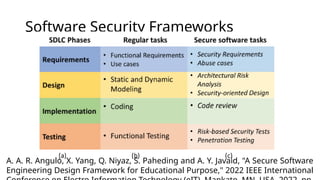
Software Security Frameworks
A. A. R. Angulo, X. Yang, Q. Niyaz, S. Paheding and A. Y. Javaid, "A Secure Software
Engineering Design Framework for Educational Purpose," 2022 IEEE International
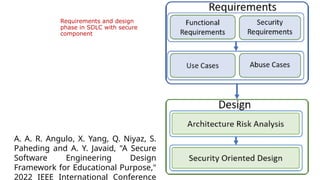
Requirements and design
phase in SDLC with secure
component
A. A. R. Angulo, X. Yang, Q. Niyaz, S.
Paheding and A. Y. Javaid, "A Secure
Software Engineering Design
Framework for Educational Purpose,"
2022 IEEE International Conference
Define Abuse case
What is Abuse Case?
• An abuse case as a specification of a type of complete
interaction between a system and one or more actors,
where the results of the interaction are harmful to the
system, one of the actors, or one of the stakeholders in
the system
• An abuse case should describe the abuse of privilege
used to complete the abuse case.
• Any abuse can be accomplished by gaining total control
of the target machine through modification of the
system software or firmware.
What is Abuse Case?
• Abuse cases are described using the same strategy as for use cases: use
case diagrams and use case descriptions.
• There are no use any special symbols for abuse cases in diagrams, that is,
an abuse case diagram is drawn with the same symbols as a use case
diagram.
• This allows to create abuse case specifications in standard notation such
as UML and to use design tools such as Rational Rose.
• Distinguish the two by keeping them separate and labelling the diagrams.
• Abuse cases are not shown on a use case diagram and use cases are not
shown on an abuse case diagram.
• Abuse cases can also range in levels of abstraction, and we use both
essential abuse cases and real abuse cases
Elements of Abuse Case
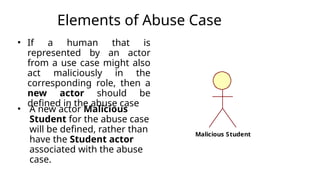
• If a human that is
represented by an actor
from a use case might also
act maliciously in the
corresponding role, then a
new actor should be
defined in the abuse case
• A new actor Malicious
Student for the abuse case
will be defined, rather than
have the Student actor
associated with the abuse
case.
Malicious Student
Elements of Abuse Case
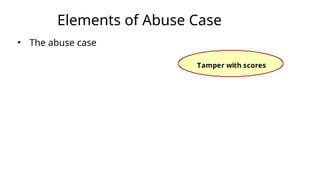
• The abuse case
Tamper with scores
Abuse case description
• The description of an abuse case can also slightly differ from the
approach taken with use case descriptions.
• An abuse case describes a family of undesirable interactions.
• The final "implementation" of an abuse case will be through the
exploitation of requirements oversights, design flaws, and
implementation flaws.
• Since we want to use the abuse case model to reduce the number of
requirements oversights and design flaws, we may choose describe
many abstract "transactions" that might take place to accomplish the
same abuse.
• Each feature or component of the target system that might be exploited
in an abuse case will be considered in the abuse case description
Steps for developing Abuse Case
1. Identify Actors
• If an actor in the use case model might attempt
harmful use of the system, then add a corresponding
malicious actor to the abuse case model.
• After the insider roles are represented, then actors
should be added for any intruders that might be a
problem.
Steps for developing Abuse Case
• 2. Identify Abuse Case
• For each actor, determine their interactions with the
system. Name each abuse case. At this point, it is helpful
to draw an abuse case diagram.
Steps for developing Abuse Case
• 3. Define Abuse Case
• As the interface to the system becomes more refined
and the specific components are identified, the abuse
case can be described. Since we use a tree structure to
describe the possible points of abuse, we defer the
definition until there is enough system structure to work
with. The definitions can be refined as the description of
the system is refined
Steps for developing Abuse Case
• 4. Check granularity
• There may be too few abuse cases or there may be too many.
• Deciding how many are needed is largely a matter of
experience and consideration of the specific target system.
• There are two ways we can wind up with too many abuse cases:
• including possible but unlikely cases, or
• modelling with too much detail.
• The latter problem results in several abuse cases that are
distinguished only by details that are inappropriate for the
purpose.
Steps for developing Abuse Case
• 5. Check completeness and minimality
• Each abuse case description should be checked to see if it describes an
interaction that results in harm to a user or stakeholder in the system.
• We should also check to see if a critical abuse case may have been
omitted.
• An abuse case in the model may lack an abuse based on the minimal
privilege needed to accomplish the harm.
• Requirements documents and the use case model should be reviewed,
along with descriptions of anticipated security features.
• Users and customers should be consulted to be sure that no critical
abuse has been overlooked
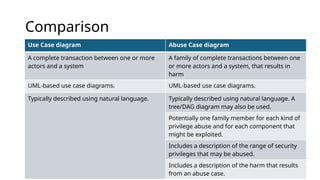
Comparison
Use Case diagram Abuse Case diagram
A complete transaction between one or more
actors and a system
A family of complete transactions between one
or more actors and a system, that results in
harm
UML-based use case diagrams. UML-based use case diagrams.
Typically described using natural language. Typically described using natural language. A
tree/DAG diagram may also be used.
Potentially one family member for each kind of
privilege abuse and for each component that
might be exploited.
Includes a description of the range of security
privileges that may be abused.
Includes a description of the harm that results
from an abuse case.
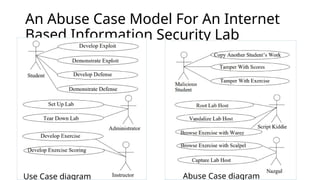
An Abuse Case Model For An Internet
Based Information Security Lab
Use Case diagram Abuse Case diagram
Actor Descriptions - Script Kiddie
• Resources
• The Script Kiddie operates alone, although he or she
may exchange some information with fellow Script
Kiddies. The Script Kiddie has hardware, software, and
Internet access that might be available to an individual
through purchase with personal funds or by theft from
an employer. Our model assumes that the Script Kiddie
is willing to spend about 24 hours trying to defeat the
security of a particular system
Actor Descriptions - Script Kiddie
• Skills
• Script Kiddies have limited technical skills. The majority of
their activities are carried out using tools and techniques
devised by other people
•Objectives
• Script Kiddies may have a variety of criminal objectives
including vandalism and theft. They also are interested in
demonstrating their technical prowess
Actor Descriptions - Nazgul
• Resources
• Nazguls operate on behalf of groups that have budgets set
aside to accomplish some form of harm. They may have
technical assistance from an organization that is tasked with
supporting them. They have hardware, software, tools, and
Internet access provided by a business, a government, or a
quasi-government. They have significant access to
documentation of the systems they intend to abuse and may be
able to test or simulate an intended exploit on a copy of the
target system. We assume that Nazguls may spend up to 90
days in preparation and execution of an attempt to breach the
security of the system.
Actor Descriptions - Nazgul
• Skills
• Nazguls have superior technical skills. They can design operating
systems, network protocols, computer hardware, and cryptographic
algorithms. They apply software engineering technology, mathematics,
computer engineering, and similar disciplines to their exploits.
• Objectives
• Nazguls are primarily interested in accomplishing the objective of the
organization that supports them. They also seek to increase their own
skills and knowledge, but not to demonstrate them to anyone.
Organizations that support Nazguls do so to carry out espionage,
warfare, terrorism or similar harmful activities
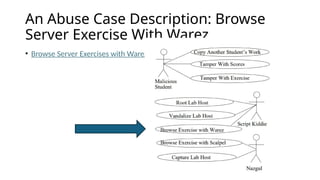
An Abuse Case Description: Browse
Server Exercise With Warez
• Browse Server Exercises with Warez
Applications Of Abuse Case Modelling
• Requirements phase
• abuse case models can be used to increase both user and customer
understanding of the security features of a proposed product.
• They can be made simple and abstract enough to be understood by users
from a wide range of application domains.
• They can be used to show customers what will be prevented and what will
not, in terms of their application domain. F
• Abuse case models are also useful for security requirements elicitation.
• Users can decide, in terms of their own application domain, which threats
apply, and which threats should be countered by product security features.
• Abuse cases may help security practitioners and users save time in arriving
at a good understanding of security requirements.
Applications Of Abuse Case Modelling
• Design Phase
• we can apply abuse cases through a refutation process.
• As we analyse and design the system, we refute each use case to the
appropriate level of assurance. This is one reason for describing the actors in
greater detail in an abuse case.
• Our refutation may depend on the skills, resources, or objectives of the
actor.
• For example, we may argue that 40-bit cryptographic keys are sufficient to
refute an abuse case involving a Script Kiddie actor, because of their
specified resource limitations, but not against a Nazgul.
• In other instances, our refutation may be based on the properties of a
design feature. The strength of the refutation can be used to characterize
the assurance we have.
Applications Of Abuse Case Modelling
• Testing Phase
• During testing, we can design our security function tests
to refute abuse cases.
• For example, we can apply the abuse case directly as a
family of test cases.
• We form a test team that has the same skills and
resources as the actors associated with the abuse case
and let them exercise our system features.
• We can also combine testing with other refutation
arguments.
Conclusion
• Abuse case are particularly useful in communicating
with users and customers during requirements analysis
and may be easier to understand when trade-offs must
be made between security and functionality
• Developing an abuse case diagram :
1. The abuse case diagram
2. Describe the actors
3. Abuse case description for each abuse case
References
• McGraw, G. (2012). Software security: Building security
in. Datenschutz und Datensicherheit-DuD, 36(9), 662-665.
• McDermott, J., & Fox, C. (1999, December). Using abuse case models
for security requirements analysis. In Proceedings 15th Annual
Computer Security Applications Conference (ACSAC'99) (pp. 55-64). IEEE.
• A. A. R. Angulo, X. Yang, Q. Niyaz, S. Paheding and A. Y. Javaid, "A
Secure Software Engineering Design Framework for Educational
Purpose," 2022 IEEE International Conference on Electro
Information Technology (eIT), Mankato, MN, USA, 2022, pp. 375-381
29

Week 6 Secure SW Requirements -Abuse case.pptx

  • 1.
    Week 5 :Secure Software Requirements Requirements Phase from SSDLC
  • 2.
    Secure SW Requirements RequirementsPhase - Secure Software Development Life Cycle
  • 3.
  • 4.
    Software Security Frameworks A.A. R. Angulo, X. Yang, Q. Niyaz, S. Paheding and A. Y. Javaid, "A Secure Software Engineering Design Framework for Educational Purpose," 2022 IEEE International
  • 5.
    Requirements and design phasein SDLC with secure component A. A. R. Angulo, X. Yang, Q. Niyaz, S. Paheding and A. Y. Javaid, "A Secure Software Engineering Design Framework for Educational Purpose," 2022 IEEE International Conference
  • 6.
  • 7.
    What is AbuseCase? • An abuse case as a specification of a type of complete interaction between a system and one or more actors, where the results of the interaction are harmful to the system, one of the actors, or one of the stakeholders in the system • An abuse case should describe the abuse of privilege used to complete the abuse case. • Any abuse can be accomplished by gaining total control of the target machine through modification of the system software or firmware.
  • 8.
    What is AbuseCase? • Abuse cases are described using the same strategy as for use cases: use case diagrams and use case descriptions. • There are no use any special symbols for abuse cases in diagrams, that is, an abuse case diagram is drawn with the same symbols as a use case diagram. • This allows to create abuse case specifications in standard notation such as UML and to use design tools such as Rational Rose. • Distinguish the two by keeping them separate and labelling the diagrams. • Abuse cases are not shown on a use case diagram and use cases are not shown on an abuse case diagram. • Abuse cases can also range in levels of abstraction, and we use both essential abuse cases and real abuse cases
  • 9.
    Elements of AbuseCase • If a human that is represented by an actor from a use case might also act maliciously in the corresponding role, then a new actor should be defined in the abuse case • A new actor Malicious Student for the abuse case will be defined, rather than have the Student actor associated with the abuse case. Malicious Student
  • 10.
    Elements of AbuseCase • The abuse case Tamper with scores
  • 11.
    Abuse case description •The description of an abuse case can also slightly differ from the approach taken with use case descriptions. • An abuse case describes a family of undesirable interactions. • The final "implementation" of an abuse case will be through the exploitation of requirements oversights, design flaws, and implementation flaws. • Since we want to use the abuse case model to reduce the number of requirements oversights and design flaws, we may choose describe many abstract "transactions" that might take place to accomplish the same abuse. • Each feature or component of the target system that might be exploited in an abuse case will be considered in the abuse case description
  • 12.
    Steps for developingAbuse Case 1. Identify Actors • If an actor in the use case model might attempt harmful use of the system, then add a corresponding malicious actor to the abuse case model. • After the insider roles are represented, then actors should be added for any intruders that might be a problem.
  • 13.
    Steps for developingAbuse Case • 2. Identify Abuse Case • For each actor, determine their interactions with the system. Name each abuse case. At this point, it is helpful to draw an abuse case diagram.
  • 14.
    Steps for developingAbuse Case • 3. Define Abuse Case • As the interface to the system becomes more refined and the specific components are identified, the abuse case can be described. Since we use a tree structure to describe the possible points of abuse, we defer the definition until there is enough system structure to work with. The definitions can be refined as the description of the system is refined
  • 15.
    Steps for developingAbuse Case • 4. Check granularity • There may be too few abuse cases or there may be too many. • Deciding how many are needed is largely a matter of experience and consideration of the specific target system. • There are two ways we can wind up with too many abuse cases: • including possible but unlikely cases, or • modelling with too much detail. • The latter problem results in several abuse cases that are distinguished only by details that are inappropriate for the purpose.
  • 16.
    Steps for developingAbuse Case • 5. Check completeness and minimality • Each abuse case description should be checked to see if it describes an interaction that results in harm to a user or stakeholder in the system. • We should also check to see if a critical abuse case may have been omitted. • An abuse case in the model may lack an abuse based on the minimal privilege needed to accomplish the harm. • Requirements documents and the use case model should be reviewed, along with descriptions of anticipated security features. • Users and customers should be consulted to be sure that no critical abuse has been overlooked
  • 17.
    Comparison Use Case diagramAbuse Case diagram A complete transaction between one or more actors and a system A family of complete transactions between one or more actors and a system, that results in harm UML-based use case diagrams. UML-based use case diagrams. Typically described using natural language. Typically described using natural language. A tree/DAG diagram may also be used. Potentially one family member for each kind of privilege abuse and for each component that might be exploited. Includes a description of the range of security privileges that may be abused. Includes a description of the harm that results from an abuse case.
  • 18.
    An Abuse CaseModel For An Internet Based Information Security Lab Use Case diagram Abuse Case diagram
  • 19.
    Actor Descriptions -Script Kiddie • Resources • The Script Kiddie operates alone, although he or she may exchange some information with fellow Script Kiddies. The Script Kiddie has hardware, software, and Internet access that might be available to an individual through purchase with personal funds or by theft from an employer. Our model assumes that the Script Kiddie is willing to spend about 24 hours trying to defeat the security of a particular system
  • 20.
    Actor Descriptions -Script Kiddie • Skills • Script Kiddies have limited technical skills. The majority of their activities are carried out using tools and techniques devised by other people •Objectives • Script Kiddies may have a variety of criminal objectives including vandalism and theft. They also are interested in demonstrating their technical prowess
  • 21.
    Actor Descriptions -Nazgul • Resources • Nazguls operate on behalf of groups that have budgets set aside to accomplish some form of harm. They may have technical assistance from an organization that is tasked with supporting them. They have hardware, software, tools, and Internet access provided by a business, a government, or a quasi-government. They have significant access to documentation of the systems they intend to abuse and may be able to test or simulate an intended exploit on a copy of the target system. We assume that Nazguls may spend up to 90 days in preparation and execution of an attempt to breach the security of the system.
  • 22.
    Actor Descriptions -Nazgul • Skills • Nazguls have superior technical skills. They can design operating systems, network protocols, computer hardware, and cryptographic algorithms. They apply software engineering technology, mathematics, computer engineering, and similar disciplines to their exploits. • Objectives • Nazguls are primarily interested in accomplishing the objective of the organization that supports them. They also seek to increase their own skills and knowledge, but not to demonstrate them to anyone. Organizations that support Nazguls do so to carry out espionage, warfare, terrorism or similar harmful activities
  • 23.
    An Abuse CaseDescription: Browse Server Exercise With Warez • Browse Server Exercises with Warez
  • 24.
    Applications Of AbuseCase Modelling • Requirements phase • abuse case models can be used to increase both user and customer understanding of the security features of a proposed product. • They can be made simple and abstract enough to be understood by users from a wide range of application domains. • They can be used to show customers what will be prevented and what will not, in terms of their application domain. F • Abuse case models are also useful for security requirements elicitation. • Users can decide, in terms of their own application domain, which threats apply, and which threats should be countered by product security features. • Abuse cases may help security practitioners and users save time in arriving at a good understanding of security requirements.
  • 25.
    Applications Of AbuseCase Modelling • Design Phase • we can apply abuse cases through a refutation process. • As we analyse and design the system, we refute each use case to the appropriate level of assurance. This is one reason for describing the actors in greater detail in an abuse case. • Our refutation may depend on the skills, resources, or objectives of the actor. • For example, we may argue that 40-bit cryptographic keys are sufficient to refute an abuse case involving a Script Kiddie actor, because of their specified resource limitations, but not against a Nazgul. • In other instances, our refutation may be based on the properties of a design feature. The strength of the refutation can be used to characterize the assurance we have.
  • 26.
    Applications Of AbuseCase Modelling • Testing Phase • During testing, we can design our security function tests to refute abuse cases. • For example, we can apply the abuse case directly as a family of test cases. • We form a test team that has the same skills and resources as the actors associated with the abuse case and let them exercise our system features. • We can also combine testing with other refutation arguments.
  • 27.
    Conclusion • Abuse caseare particularly useful in communicating with users and customers during requirements analysis and may be easier to understand when trade-offs must be made between security and functionality • Developing an abuse case diagram : 1. The abuse case diagram 2. Describe the actors 3. Abuse case description for each abuse case
  • 28.
    References • McGraw, G.(2012). Software security: Building security in. Datenschutz und Datensicherheit-DuD, 36(9), 662-665. • McDermott, J., & Fox, C. (1999, December). Using abuse case models for security requirements analysis. In Proceedings 15th Annual Computer Security Applications Conference (ACSAC'99) (pp. 55-64). IEEE. • A. A. R. Angulo, X. Yang, Q. Niyaz, S. Paheding and A. Y. Javaid, "A Secure Software Engineering Design Framework for Educational Purpose," 2022 IEEE International Conference on Electro Information Technology (eIT), Mankato, MN, USA, 2022, pp. 375-381
  • 29.