Biological, Cognitive and Learning
approaches to explaining initiation,
maintenance and relapse, and their
applications to smoking and gambling
Addictive Behaviour
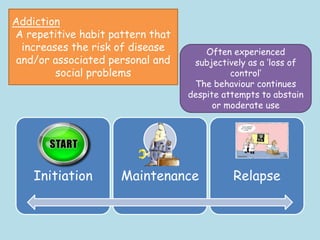
Initiation Maintenance Relapse
Addiction
A repetitive habit pattern that
increases the risk of disease
and/or associated personal and
social problems
Often experienced
subjectively as a „loss of
control‟
The behaviour continues
despite attempts to abstain
or moderate use
Cognitive Explanation
In groups identify key words that you
associate with the cognitive approach
to Psychology
How can we apply these terms to
addictive behaviour?
i) Theory of planned behaviour
ii) Cognitive processing
iii) Cognitive bias
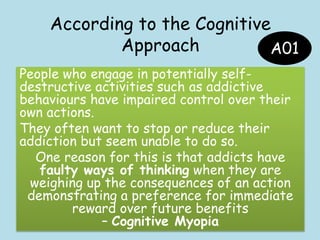
According to the Cognitive
Approach
• Addiction is due to dysfunctional beliefs
(e.g. A belief that they can‟t get through
the day without engaging in their addictive
activity)
• Maladaptive thoughts may link to mood
• Incapability of controlling the addiction
• Positive consequences outweigh negative
• Has formed the basis for lots of very
successful treatments
A01
People who engage in potentially self-
destructive activities such as addictive
behaviours have impaired control over their
own actions.
They often want to stop or reduce their
addiction but seem unable to do so.
One reason for this is that addicts have
faulty ways of thinking when they are
weighing up the consequences of an action
demonstrating a preference for immediate
reward over future benefits
– Cognitive Myopia
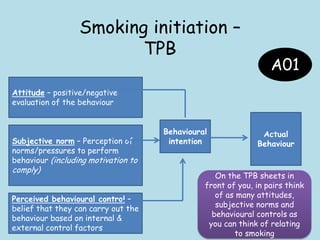
Smoking initiation –
TPB
Attitude – positive/negative
evaluation of the behaviour
Subjective norm – Perception of
norms/pressures to perform
behaviour (including motivation to
comply)
Perceived behavioural control –
belief that they can carry out the
behaviour based on internal &
external control factors
Behavioural
intention
Actual
Behaviour
On the TPB sheets in
front of you, in pairs think
of as many attitudes,
subjective norms and
behavioural controls as
you can think of relating
to smoking
A01
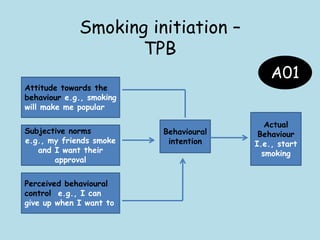
Smoking initiation –
TPB
Attitude towards the
behaviour e.g., smoking
will make me popular
Subjective norms
e.g., my friends smoke
and I want their
approval
Perceived behavioural
control e.g., I can
give up when I want to
Behavioural
intention
Actual
Behaviour
I.e., start
smoking
A01
Smoking initiation –
TPB
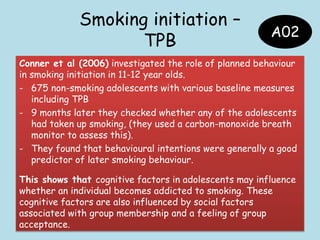
Conner et al (2006) investigated the role of planned behaviour
in smoking initiation in 11-12 year olds.
- 675 non-smoking adolescents with various baseline measures
including TPB
- 9 months later they checked whether any of the adolescents
had taken up smoking, (they used a carbon-monoxide breath
monitor to assess this).
- They found that behavioural intentions were generally a good
predictor of later smoking behaviour.
This shows that cognitive factors in adolescents may influence
whether an individual becomes addicted to smoking. These
cognitive factors are also influenced by social factors
associated with group membership and a feeling of group
acceptance.
A02
Smoking initiation –
TPB
It is estimated that over one-third of the world‟s
smokers live in China, so identifying people most likely
to start smoking is important in developing prevention
campaigns.
- Guo et al (2007) tested more than 14,000 Chinese
schoolchildren with TPB measures and found that these
measures were useful predictors of later smoking
behaviour.
• This supports the cognitive explantion of smoking
initiation as it shows a link between cognitive factors
and the start of smoking behaviour.
A02
Smoking maintenance & relapse
- Cognitive processing model
We pay little attention to routine tasks.
When a behaviour such a smoking becomes
part of our routine, we become so practiced,
that the behaviour becomes automatic e.g.,
buying cigarettes, lighting up a cigarette
(Tiffany 1990). The cognitive processing
model therefore suggests that smoking
behaviours are maintained because over a
period of time they simply become
automatic.
Think of some things that might trigger an
automatic smoking response
A01
Smoking maintenance & relapse
- Cognitive processing model
This was supported by Hester and
Garavan (2005) who suggest that as
the addictive thoughts are in working
memory; so the environmental features
associated with the addiction are also
given attention and focused on – which
in turn leads to thoughts about the
addiction. They suggest that addictive
behaviours and cravings therefore
become self-perpetuating and this
maintains the addiction.
A02
Smoking maintenance & relapse
- Cognitive processing model
Brandon (2004) suggests that as an
addiction develops, the activity is
influenced less by conscious expectations
but rather unconscious expectations
involving automatic processes – explaining
the „loss of control‟ subjectively
experienced by addictsA02
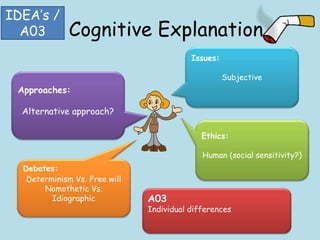
Cognitive Explanation
IDEA‟s /
A03
Approaches:
Alternative approach?
Debates:
Determinism Vs. Free will
Nomothetic Vs.
Idiographic
Issues:
Subjective
Ethics:
Human (social sensitivity?)
A03
Individual differences
According to the Cognitive
Approach
• Addiction is due to dysfunctional beliefs
(e.g. A belief that they can‟t get through
the day without engaging in their addictive
activity)
• Maladaptive thoughts may link to mood
• Incapability of controlling the addiction
• Positive consequences outweigh negative
• Has formed the basis for lots of very
successful treatments
A01
People who engage in potentially self-
destructive activities such as addictive
behaviours have impaired control over their
own actions.
They often want to stop or reduce their
addiction but seem unable to do so.
One reason for this is that addicts have
faulty ways of thinking when they are
weighing up the consequences of an action
demonstrating a preference for immediate
reward over future benefits
– Cognitive Myopia
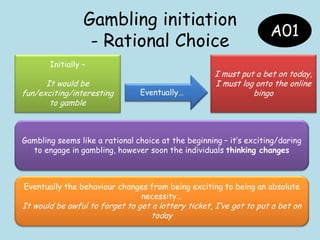
Gambling initiation
- Rational Choice
Initially –
It would be
fun/exciting/interesting
to gamble
Eventually…
I must put a bet on today,
I must log onto the online
bingo
Gambling seems like a rational choice at the beginning – it‟s exciting/daring
to engage in gambling, however soon the individuals thinking changes
Eventually the behaviour changes from being exciting to being an absolute
necessity…
It would be awful to forget to get a lottery ticket, I‟ve got to put a bet on
today
A01
Gambling initiation
- Rational Choice
Koski-Jannes (1992) found that addictions can
initially form from short-sighted means of dealing
with stressful situations, giving initially positive but
later negative consequences, leading to a self-
perpetuating cycle of addiction regulated by self-
serving thoughts.
This demonstrates that addicts are likely to seek
only the short-term consequences of a behaviour
and so it is easy to make a rational choice to engage
in the behaviour – link to gambling…
A02
Gambling initiation
- Rational Choice
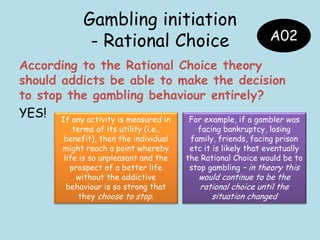
According to the Rational Choice theory
should addicts be able to make the decision
to stop the gambling behaviour entirely?
YES!
A02
If any activity is measured in
terms of its utility (i.e.,
benefit), then the individual
might reach a point whereby
life is so unpleasant and the
prospect of a better life
without the addictive
behaviour is so strong that
they choose to stop.
For example, if a gambler was
facing bankruptcy, losing
family, friends, facing prison
etc it is likely that eventually
the Rational Choice would be to
stop gambling – in theory this
would continue to be the
rational choice until the
situation changed
Gambling initiation
- Rational Choice
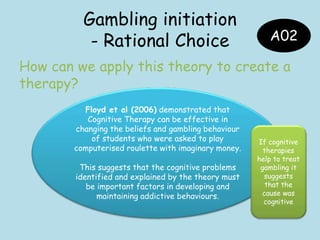
How can we apply this theory to create a
therapy?
A02
Floyd et al (2006) demonstrated that
Cognitive Therapy can be effective in
changing the beliefs and gambling behaviour
of students who were asked to play
computerised roulette with imaginary money.
This suggests that the cognitive problems
identified and explained by the theory must
be important factors in developing and
maintaining addictive behaviours.
If cognitive
therapies
help to treat
gambling it
suggests
that the
cause was
cognitive
Gambling M&R
- Cognitive Bias
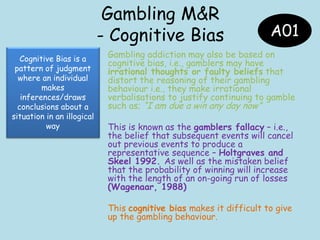
Gambling addiction may also be based on
cognitive bias, i.e., gamblers may have
irrational thoughts or faulty beliefs that
distort the reasoning of their gambling
behaviour i.e., they make irrational
verbalisations to justify continuing to gamble
such as; “I am due a win any day now”
This is known as the gamblers fallacy – i.e.,
the belief that subsequent events will cancel
out previous events to produce a
representative sequence – Holtgraves and
Skeel 1992. As well as the mistaken belief
that the probability of winning will increase
with the length of an on-going run of losses
(Wagenaar, 1988)
This cognitive bias makes it difficult to give
up the gambling behaviour.
A01
Cognitive Bias is a
pattern of judgment
where an individual
makes
inferences/draws
conclusions about a
situation in an illogical
way
Gambling M&R
- Cognitive Bias
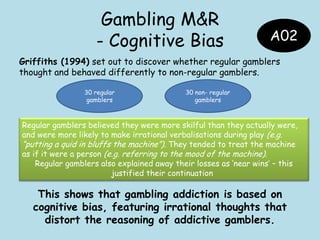
Griffiths (1994) set out to discover whether regular gamblers
thought and behaved differently to non-regular gamblers.
This shows that gambling addiction is based on
cognitive bias, featuring irrational thoughts that
distort the reasoning of addictive gamblers.
30 regular
gamblers
30 non- regular
gamblers
Regular gamblers believed they were more skilful than they actually were,
and were more likely to make irrational verbalisations during play (e.g.
“putting a quid in bluffs the machine”). They tended to treat the machine
as if it were a person (e.g. referring to the mood of the machine).
Regular gamblers also explained away their losses as „near wins‟ – this
justified their continuation
A02
Gambling M&R
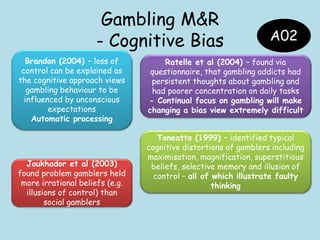
- Cognitive Bias A02
Brandon (2004) – loss of
control can be explained as
the cognitive approach views
gambling behaviour to be
influenced by unconscious
expectations
Automatic processing
Ratelle et al (2004) – found via
questionnaire, that gambling addicts had
persistent thoughts about gambling and
had poorer concentration on daily tasks
- Continual focus on gambling will make
changing a bias view extremely difficult
Toneatto (1999) – identified typical
cognitive distortions of gamblers including
maximisation, magnification, superstitious
beliefs, selective memory and illusion of
control – all of which illustrate faulty
thinking
Joukhador et al (2003)
found problem gamblers held
more irrational beliefs (e.g.
illusions of control) than
social gamblers
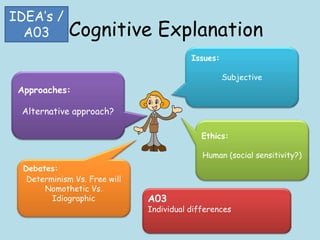
Cognitive Explanation
IDEA‟s /
A03
Approaches:
Alternative approach?
Debates:
Determinism Vs. Free will
Nomothetic Vs.
Idiographic
Issues:
Subjective
Ethics:
Human (social sensitivity?)
A03
Individual differences

Cognitive explanations 2013

  • 1.
    Biological, Cognitive andLearning approaches to explaining initiation, maintenance and relapse, and their applications to smoking and gambling Addictive Behaviour
  • 2.
    Initiation Maintenance Relapse Addiction Arepetitive habit pattern that increases the risk of disease and/or associated personal and social problems Often experienced subjectively as a „loss of control‟ The behaviour continues despite attempts to abstain or moderate use
  • 3.
    Cognitive Explanation In groupsidentify key words that you associate with the cognitive approach to Psychology How can we apply these terms to addictive behaviour? i) Theory of planned behaviour ii) Cognitive processing iii) Cognitive bias
  • 4.
    According to theCognitive Approach • Addiction is due to dysfunctional beliefs (e.g. A belief that they can‟t get through the day without engaging in their addictive activity) • Maladaptive thoughts may link to mood • Incapability of controlling the addiction • Positive consequences outweigh negative • Has formed the basis for lots of very successful treatments A01 People who engage in potentially self- destructive activities such as addictive behaviours have impaired control over their own actions. They often want to stop or reduce their addiction but seem unable to do so. One reason for this is that addicts have faulty ways of thinking when they are weighing up the consequences of an action demonstrating a preference for immediate reward over future benefits – Cognitive Myopia
  • 5.
    Smoking initiation – TPB Attitude– positive/negative evaluation of the behaviour Subjective norm – Perception of norms/pressures to perform behaviour (including motivation to comply) Perceived behavioural control – belief that they can carry out the behaviour based on internal & external control factors Behavioural intention Actual Behaviour On the TPB sheets in front of you, in pairs think of as many attitudes, subjective norms and behavioural controls as you can think of relating to smoking A01
  • 6.
    Smoking initiation – TPB Attitudetowards the behaviour e.g., smoking will make me popular Subjective norms e.g., my friends smoke and I want their approval Perceived behavioural control e.g., I can give up when I want to Behavioural intention Actual Behaviour I.e., start smoking A01
  • 7.
    Smoking initiation – TPB Conneret al (2006) investigated the role of planned behaviour in smoking initiation in 11-12 year olds. - 675 non-smoking adolescents with various baseline measures including TPB - 9 months later they checked whether any of the adolescents had taken up smoking, (they used a carbon-monoxide breath monitor to assess this). - They found that behavioural intentions were generally a good predictor of later smoking behaviour. This shows that cognitive factors in adolescents may influence whether an individual becomes addicted to smoking. These cognitive factors are also influenced by social factors associated with group membership and a feeling of group acceptance. A02
  • 8.
    Smoking initiation – TPB Itis estimated that over one-third of the world‟s smokers live in China, so identifying people most likely to start smoking is important in developing prevention campaigns. - Guo et al (2007) tested more than 14,000 Chinese schoolchildren with TPB measures and found that these measures were useful predictors of later smoking behaviour. • This supports the cognitive explantion of smoking initiation as it shows a link between cognitive factors and the start of smoking behaviour. A02
  • 9.
    Smoking maintenance &relapse - Cognitive processing model We pay little attention to routine tasks. When a behaviour such a smoking becomes part of our routine, we become so practiced, that the behaviour becomes automatic e.g., buying cigarettes, lighting up a cigarette (Tiffany 1990). The cognitive processing model therefore suggests that smoking behaviours are maintained because over a period of time they simply become automatic. Think of some things that might trigger an automatic smoking response A01
  • 10.
    Smoking maintenance &relapse - Cognitive processing model This was supported by Hester and Garavan (2005) who suggest that as the addictive thoughts are in working memory; so the environmental features associated with the addiction are also given attention and focused on – which in turn leads to thoughts about the addiction. They suggest that addictive behaviours and cravings therefore become self-perpetuating and this maintains the addiction. A02
  • 11.
    Smoking maintenance &relapse - Cognitive processing model Brandon (2004) suggests that as an addiction develops, the activity is influenced less by conscious expectations but rather unconscious expectations involving automatic processes – explaining the „loss of control‟ subjectively experienced by addictsA02
  • 12.
    Cognitive Explanation IDEA‟s / A03 Approaches: Alternativeapproach? Debates: Determinism Vs. Free will Nomothetic Vs. Idiographic Issues: Subjective Ethics: Human (social sensitivity?) A03 Individual differences
  • 13.
    According to theCognitive Approach • Addiction is due to dysfunctional beliefs (e.g. A belief that they can‟t get through the day without engaging in their addictive activity) • Maladaptive thoughts may link to mood • Incapability of controlling the addiction • Positive consequences outweigh negative • Has formed the basis for lots of very successful treatments A01 People who engage in potentially self- destructive activities such as addictive behaviours have impaired control over their own actions. They often want to stop or reduce their addiction but seem unable to do so. One reason for this is that addicts have faulty ways of thinking when they are weighing up the consequences of an action demonstrating a preference for immediate reward over future benefits – Cognitive Myopia
  • 14.
    Gambling initiation - RationalChoice Initially – It would be fun/exciting/interesting to gamble Eventually… I must put a bet on today, I must log onto the online bingo Gambling seems like a rational choice at the beginning – it‟s exciting/daring to engage in gambling, however soon the individuals thinking changes Eventually the behaviour changes from being exciting to being an absolute necessity… It would be awful to forget to get a lottery ticket, I‟ve got to put a bet on today A01
  • 15.
    Gambling initiation - RationalChoice Koski-Jannes (1992) found that addictions can initially form from short-sighted means of dealing with stressful situations, giving initially positive but later negative consequences, leading to a self- perpetuating cycle of addiction regulated by self- serving thoughts. This demonstrates that addicts are likely to seek only the short-term consequences of a behaviour and so it is easy to make a rational choice to engage in the behaviour – link to gambling… A02
  • 16.
    Gambling initiation - RationalChoice According to the Rational Choice theory should addicts be able to make the decision to stop the gambling behaviour entirely? YES! A02 If any activity is measured in terms of its utility (i.e., benefit), then the individual might reach a point whereby life is so unpleasant and the prospect of a better life without the addictive behaviour is so strong that they choose to stop. For example, if a gambler was facing bankruptcy, losing family, friends, facing prison etc it is likely that eventually the Rational Choice would be to stop gambling – in theory this would continue to be the rational choice until the situation changed
  • 17.
    Gambling initiation - RationalChoice How can we apply this theory to create a therapy? A02 Floyd et al (2006) demonstrated that Cognitive Therapy can be effective in changing the beliefs and gambling behaviour of students who were asked to play computerised roulette with imaginary money. This suggests that the cognitive problems identified and explained by the theory must be important factors in developing and maintaining addictive behaviours. If cognitive therapies help to treat gambling it suggests that the cause was cognitive
  • 18.
    Gambling M&R - CognitiveBias Gambling addiction may also be based on cognitive bias, i.e., gamblers may have irrational thoughts or faulty beliefs that distort the reasoning of their gambling behaviour i.e., they make irrational verbalisations to justify continuing to gamble such as; “I am due a win any day now” This is known as the gamblers fallacy – i.e., the belief that subsequent events will cancel out previous events to produce a representative sequence – Holtgraves and Skeel 1992. As well as the mistaken belief that the probability of winning will increase with the length of an on-going run of losses (Wagenaar, 1988) This cognitive bias makes it difficult to give up the gambling behaviour. A01 Cognitive Bias is a pattern of judgment where an individual makes inferences/draws conclusions about a situation in an illogical way
  • 19.
    Gambling M&R - CognitiveBias Griffiths (1994) set out to discover whether regular gamblers thought and behaved differently to non-regular gamblers. This shows that gambling addiction is based on cognitive bias, featuring irrational thoughts that distort the reasoning of addictive gamblers. 30 regular gamblers 30 non- regular gamblers Regular gamblers believed they were more skilful than they actually were, and were more likely to make irrational verbalisations during play (e.g. “putting a quid in bluffs the machine”). They tended to treat the machine as if it were a person (e.g. referring to the mood of the machine). Regular gamblers also explained away their losses as „near wins‟ – this justified their continuation A02
  • 20.
    Gambling M&R - CognitiveBias A02 Brandon (2004) – loss of control can be explained as the cognitive approach views gambling behaviour to be influenced by unconscious expectations Automatic processing Ratelle et al (2004) – found via questionnaire, that gambling addicts had persistent thoughts about gambling and had poorer concentration on daily tasks - Continual focus on gambling will make changing a bias view extremely difficult Toneatto (1999) – identified typical cognitive distortions of gamblers including maximisation, magnification, superstitious beliefs, selective memory and illusion of control – all of which illustrate faulty thinking Joukhador et al (2003) found problem gamblers held more irrational beliefs (e.g. illusions of control) than social gamblers
  • 21.
    Cognitive Explanation IDEA‟s / A03 Approaches: Alternativeapproach? Debates: Determinism Vs. Free will Nomothetic Vs. Idiographic Issues: Subjective Ethics: Human (social sensitivity?) A03 Individual differences