WEEK 4
NEO-LIBERALISM
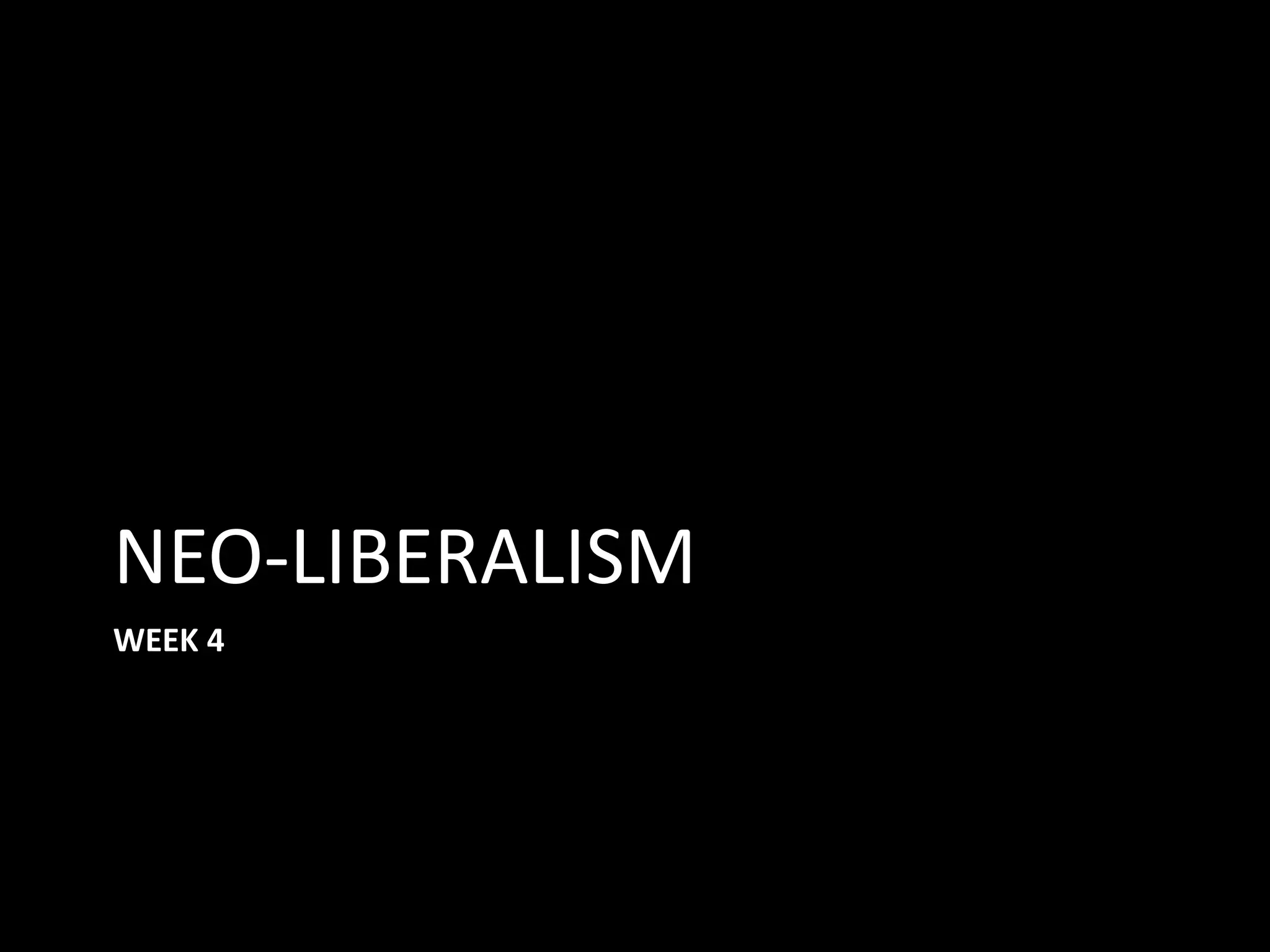
Liberalism
• Liberalism states that humans are inherently bad but can be changed for the better.
Liberalism is an inside approach to a country. It comprises of four core components
namely :
1. Juridical Equality
2. Democracy
3. Parliamentary
4. Presidential
5. Liberty
6. Free Market Economics
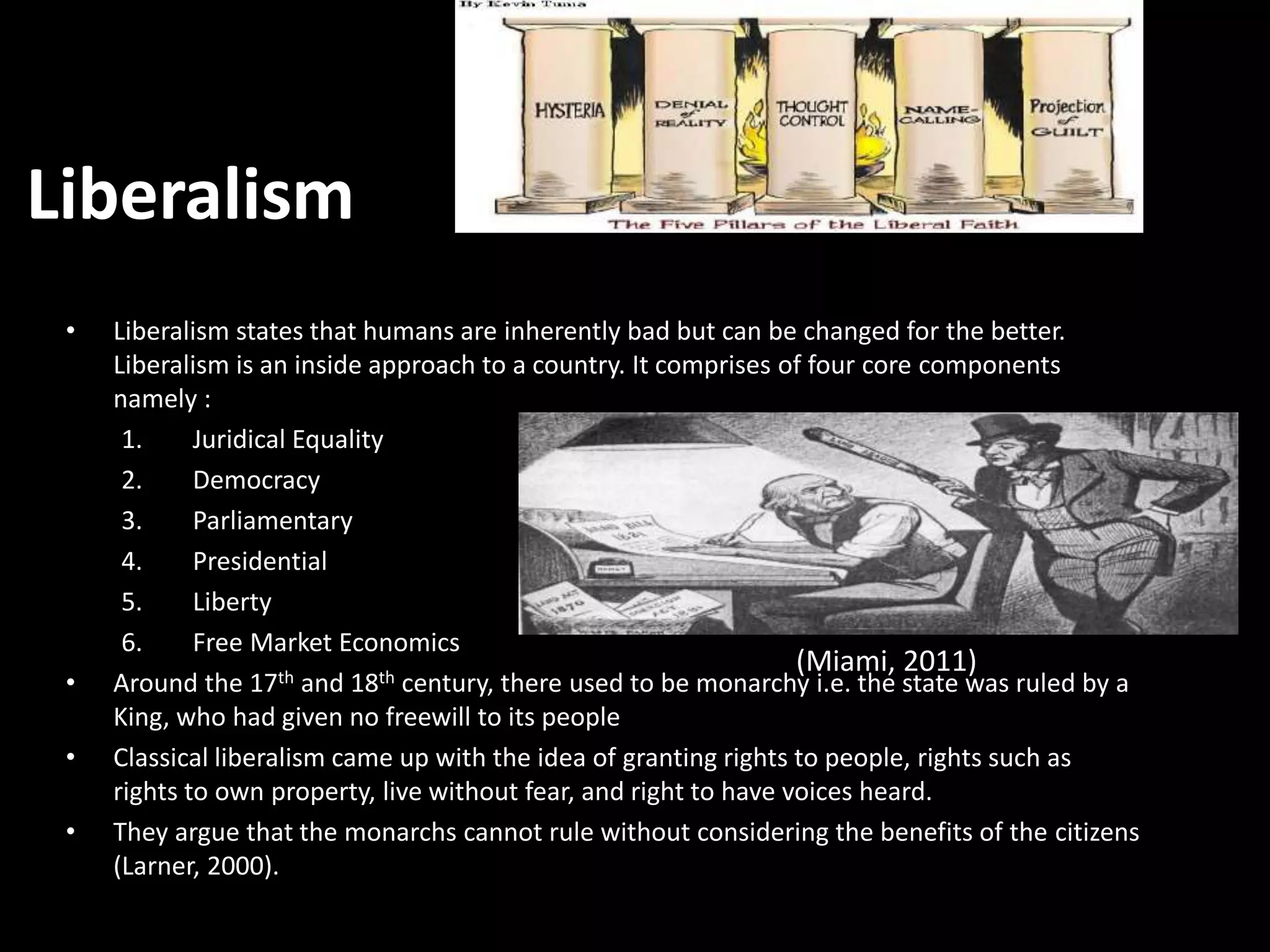
• Around the 17th and 18th century, there used to be monarchy i.e. the state was ruled by a
King, who had given no freewill to its people
• Classical liberalism came up with the idea of granting rights to people, rights such as
rights to own property, live without fear, and right to have voices heard.
• They argue that the monarchs cannot rule without considering the benefits of the citizens
(Larner, 2000).
(Miami, 2011)
Branches of Liberalism
Classical Liberalism
• It argues that one needs to re-evaluate the responsibilities of the citizens and the state.
The monarchs cannot rule without considering the benefits of the citizens. Moreover,
they argue that the divine right to rule does not exist. The school of thought of classical
liberalism was introduced by John Locke, Jeremy Benthen and John Stuart Mill. John
Stuart Mill should follow policies that will lead to the greatest good.
Globalization
• Liberalism of privilege – global trade is good.
• Radical Liberalism – global trade is not good and does not promote prosperity.
Neo-liberalism
• They speak in favor of the Globalization Theory. They argue that the state is the primary
actor in the international system. They make two arguments.
• They say that free trade is good, it promotes prosperity. One should have access to all
countries in terms of trade for this will build warm relations with everyone and hence
they would be less likely to point guns at each other. This will ensure peace within the
world. Hence, free trade would certainly be beneficial.
• It states that beyond the rim of trade, there is conflict resolution. We have to have
institutions through which states can interact and resolve their problems. And this will
make them less likely to have war with one another.
Alternate to Neo-liberalism
• An alternate to this would be privatization and pre-privatization.
• In Britain, the legislature is captivating with schools on a project of pre-
privatization. So what they have done is they have situated up an alleged
institute framework, where some state schools remain state subsidized, and
inside the state framework, however they are re-designated as academies.
(Creativeresistance.shintai-z.com, 2014)
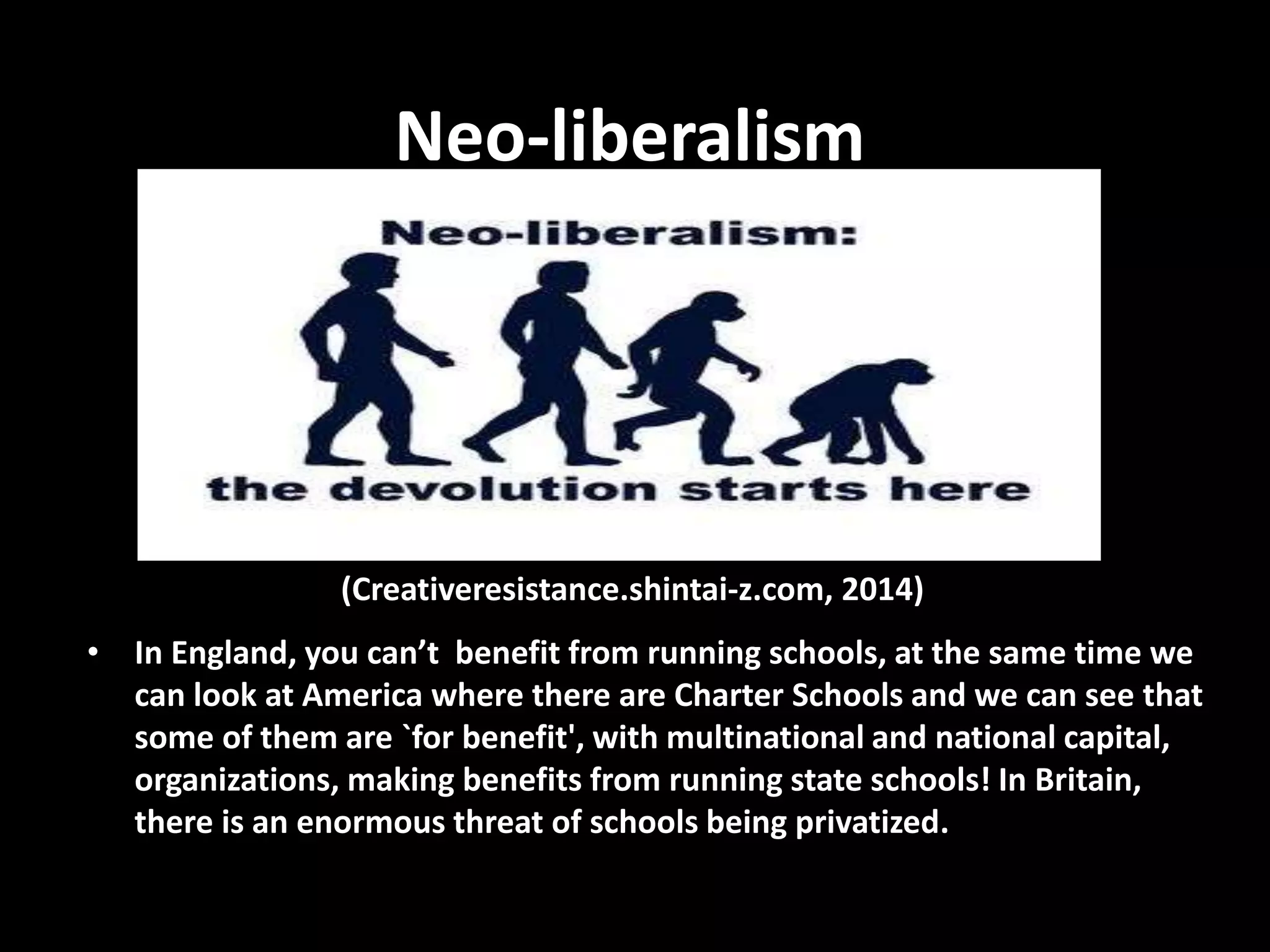
Neo-liberalism
• In England, you can’t benefit from running schools, at the same time we
can look at America where there are Charter Schools and we can see that
some of them are `for benefit', with multinational and national capital,
organizations, making benefits from running state schools! In Britain,
there is an enormous threat of schools being privatized.
(Creativeresistance.shintai-z.com, 2014)
Conclusion
• It is true that neo-liberalism does not talk about promoting equality and
peace in terms of class, gender, race, sexuality, and individuals’ ability to
participate equally in the market.
• I believe it talks mostly about the world as a whole, economically and
ignores the social aspect of it.
• Talks about world peace and prosperity, however completely neglecting
the prosperity within sectarianism.
• I don’t think Neo-liberalism should be encouraged considering how
society does not seem to be benefitting much socially. It may happen to
make the government greedy and neglect the social aspect of the
country and may start focusing on the economical and political aspects
only. It may be helpful for the developed economies to reap profits from
the developing countries through less trade barriers etc . However
concepts such as equal distribution of income and standard of living may
be ignored. The country may not have a threat of facing war with any
country but it may end up in a war with its own people if citizens of the
country are not able to satisfy their basic needs.
References
• Clarke, J. (2004). Dissolving the public realm? The logics and
limits of neo-liberalism. Journal of social policy, 33(1),
pp.27--48.
• Larner, W. (2000). Neo-liberalism: Policy, ideology,
governmentality. Studies in political economy, 63.
• Creativeresistance.shintai-z.com, (2014). What is
Neoliberalism? |. [online] Available at:
http://creativeresistance.shintai-z.com/context/the-rise-of-
neoliberalism/ [Accessed 23 May. 2014].
• Miami, U. (2011). A Classic of World Literature: LIBERALISM
IS A SIN. [online] Una Voce Miami. Available at:
http://unavocemiami.wordpress.com/2011/11/25/liberalis
m-is-a-sin/ [Accessed 23 May. 2014].

week 4

  • 1.
  • 2.
    Liberalism • Liberalism statesthat humans are inherently bad but can be changed for the better. Liberalism is an inside approach to a country. It comprises of four core components namely : 1. Juridical Equality 2. Democracy 3. Parliamentary 4. Presidential 5. Liberty 6. Free Market Economics • Around the 17th and 18th century, there used to be monarchy i.e. the state was ruled by a King, who had given no freewill to its people • Classical liberalism came up with the idea of granting rights to people, rights such as rights to own property, live without fear, and right to have voices heard. • They argue that the monarchs cannot rule without considering the benefits of the citizens (Larner, 2000). (Miami, 2011)
  • 3.
    Branches of Liberalism ClassicalLiberalism • It argues that one needs to re-evaluate the responsibilities of the citizens and the state. The monarchs cannot rule without considering the benefits of the citizens. Moreover, they argue that the divine right to rule does not exist. The school of thought of classical liberalism was introduced by John Locke, Jeremy Benthen and John Stuart Mill. John Stuart Mill should follow policies that will lead to the greatest good. Globalization • Liberalism of privilege – global trade is good. • Radical Liberalism – global trade is not good and does not promote prosperity. Neo-liberalism • They speak in favor of the Globalization Theory. They argue that the state is the primary actor in the international system. They make two arguments. • They say that free trade is good, it promotes prosperity. One should have access to all countries in terms of trade for this will build warm relations with everyone and hence they would be less likely to point guns at each other. This will ensure peace within the world. Hence, free trade would certainly be beneficial. • It states that beyond the rim of trade, there is conflict resolution. We have to have institutions through which states can interact and resolve their problems. And this will make them less likely to have war with one another.
  • 4.
    Alternate to Neo-liberalism •An alternate to this would be privatization and pre-privatization. • In Britain, the legislature is captivating with schools on a project of pre- privatization. So what they have done is they have situated up an alleged institute framework, where some state schools remain state subsidized, and inside the state framework, however they are re-designated as academies. (Creativeresistance.shintai-z.com, 2014)
  • 5.
    Neo-liberalism • In England,you can’t benefit from running schools, at the same time we can look at America where there are Charter Schools and we can see that some of them are `for benefit', with multinational and national capital, organizations, making benefits from running state schools! In Britain, there is an enormous threat of schools being privatized. (Creativeresistance.shintai-z.com, 2014)
  • 6.
    Conclusion • It istrue that neo-liberalism does not talk about promoting equality and peace in terms of class, gender, race, sexuality, and individuals’ ability to participate equally in the market. • I believe it talks mostly about the world as a whole, economically and ignores the social aspect of it. • Talks about world peace and prosperity, however completely neglecting the prosperity within sectarianism. • I don’t think Neo-liberalism should be encouraged considering how society does not seem to be benefitting much socially. It may happen to make the government greedy and neglect the social aspect of the country and may start focusing on the economical and political aspects only. It may be helpful for the developed economies to reap profits from the developing countries through less trade barriers etc . However concepts such as equal distribution of income and standard of living may be ignored. The country may not have a threat of facing war with any country but it may end up in a war with its own people if citizens of the country are not able to satisfy their basic needs.
  • 7.
    References • Clarke, J.(2004). Dissolving the public realm? The logics and limits of neo-liberalism. Journal of social policy, 33(1), pp.27--48. • Larner, W. (2000). Neo-liberalism: Policy, ideology, governmentality. Studies in political economy, 63. • Creativeresistance.shintai-z.com, (2014). What is Neoliberalism? |. [online] Available at: http://creativeresistance.shintai-z.com/context/the-rise-of- neoliberalism/ [Accessed 23 May. 2014]. • Miami, U. (2011). A Classic of World Literature: LIBERALISM IS A SIN. [online] Una Voce Miami. Available at: http://unavocemiami.wordpress.com/2011/11/25/liberalis m-is-a-sin/ [Accessed 23 May. 2014].