Chapter 2
                                    The Dynamic
                                    Environment


McGraw-Hill/Irwin   Copyright © 2012 by The McGraw-Hill Companies, Inc. All rights reserved.
Royal Dutch Shell PLC

o One of the world’s largest companies
o Each year it makes capital investments of between
  $30 billion and $40 billion
o In the 1970s pioneered the use of scenarios in
  corporate planning


                                                      2-2
Royal Dutch Shell PLC

o When an oil embargo surprised the world in 1973
  Shell was the only major oil firm prepared for the
  supply interruption
o Shell sees an emerging drama in the global energy
  system, with tensions building at the intersection of
  three powerful trends
   o Developing nations with expanding populations are
     using policies of economic growth to alleviate poverty


                                                              2-3
Royal Dutch Shell PLC

o Supplies of oil and gas cannot keep pace with rising
  demands for energy
o Environmental stresses are growing


                                                         2-4
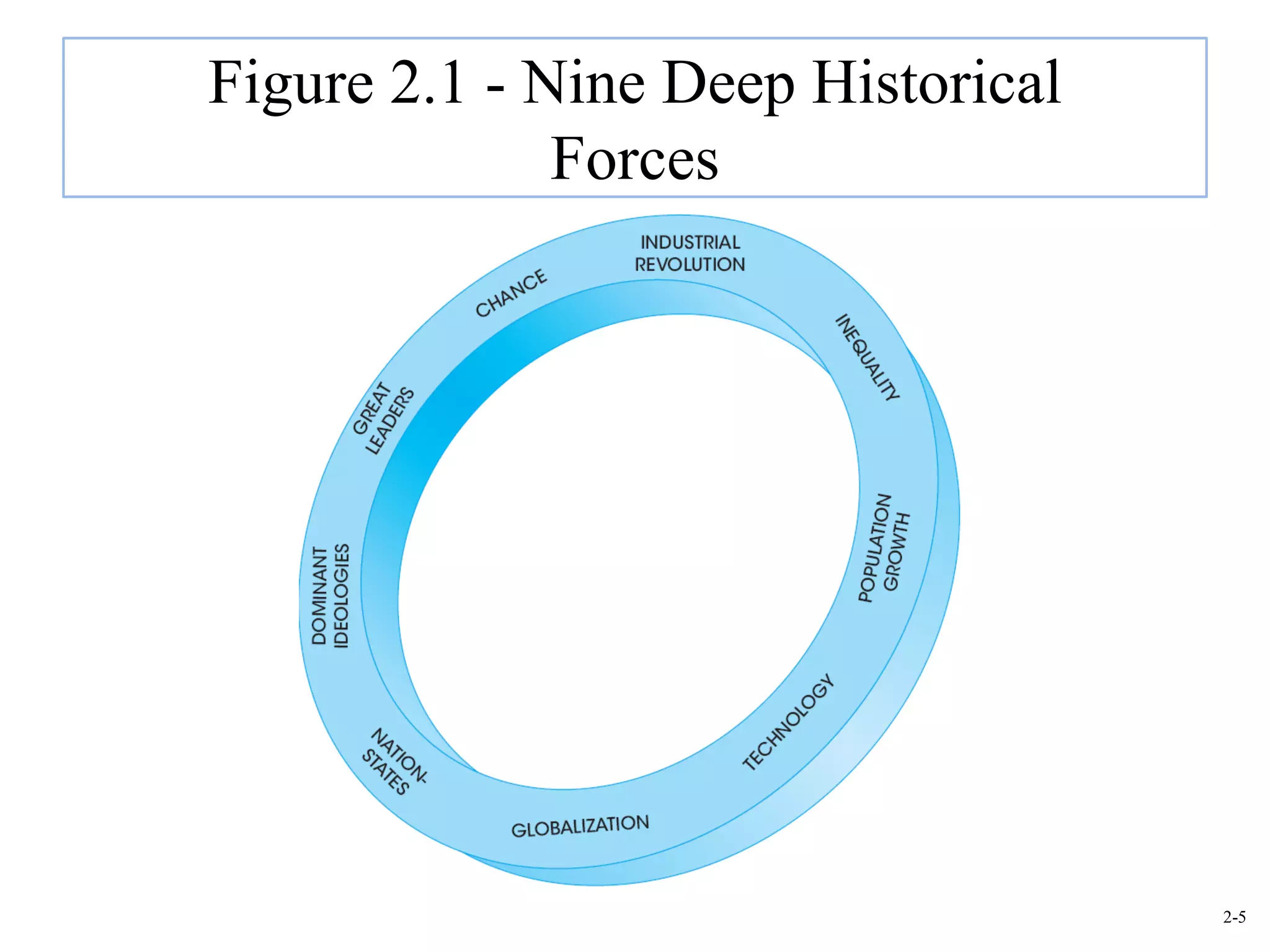
Figure 2.1 - Nine Deep Historical
              Forces


                                    2-5
The Industrial Revolution

o Historical force: An environmental force of
  unknown origin and mysterious action that provides
  the energy for events
   o The discussion divides this force, somewhat
     artificially, into nine separate but related forces
     causing distinct chains of events


                                                           2-6
The Industrial Revolution

o The Industrial Revolution: An economic
  metamorphosis in England in the late 1700s
   o It occurred when certain necessary conditions were
     present and shifted the country from a simple agrarian
     economy into a growing industrial economy


                                                              2-7
The Industrial Revolution

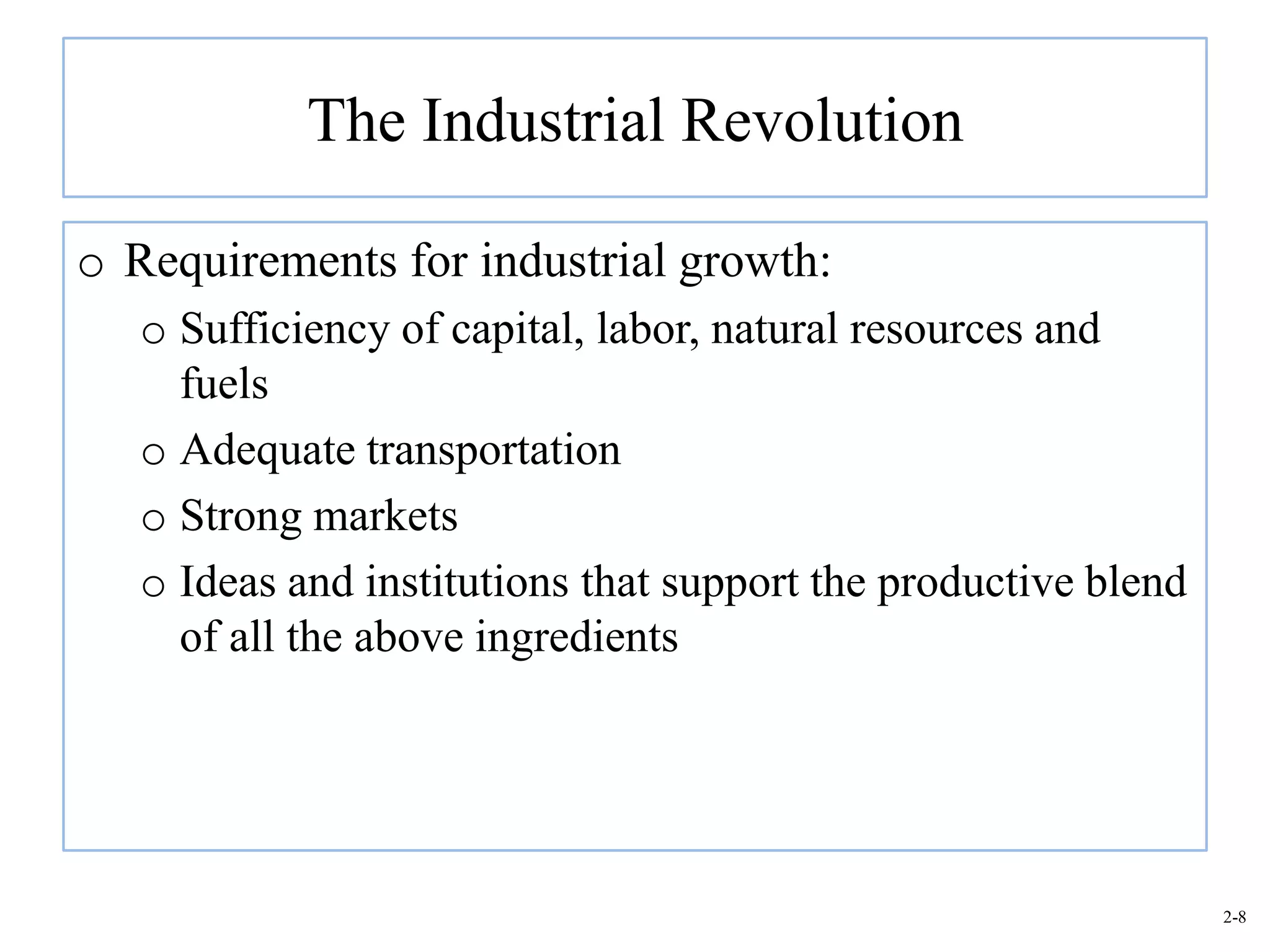
o Requirements for industrial growth:
   o Sufficiency of capital, labor, natural resources and
     fuels
   o Adequate transportation
   o Strong markets
   o Ideas and institutions that support the productive blend
     of all the above ingredients


                                                                2-8
The Industrial Revolution

o Industrial growth remakes societies in positive ways,
  but also generates strains in the social fabric
o The total amount of goods and services produced in
  the twentieth century exceeds all that produced in
  recorded human history


                                                          2-9
Inequality

o The basic political conflict in every nation, and often
  between nations, is the antagonism between rich and
  poor
o The industrial revolution accelerated the
  accumulation of wealth and widened the persistent
  problem of its uneven distribution
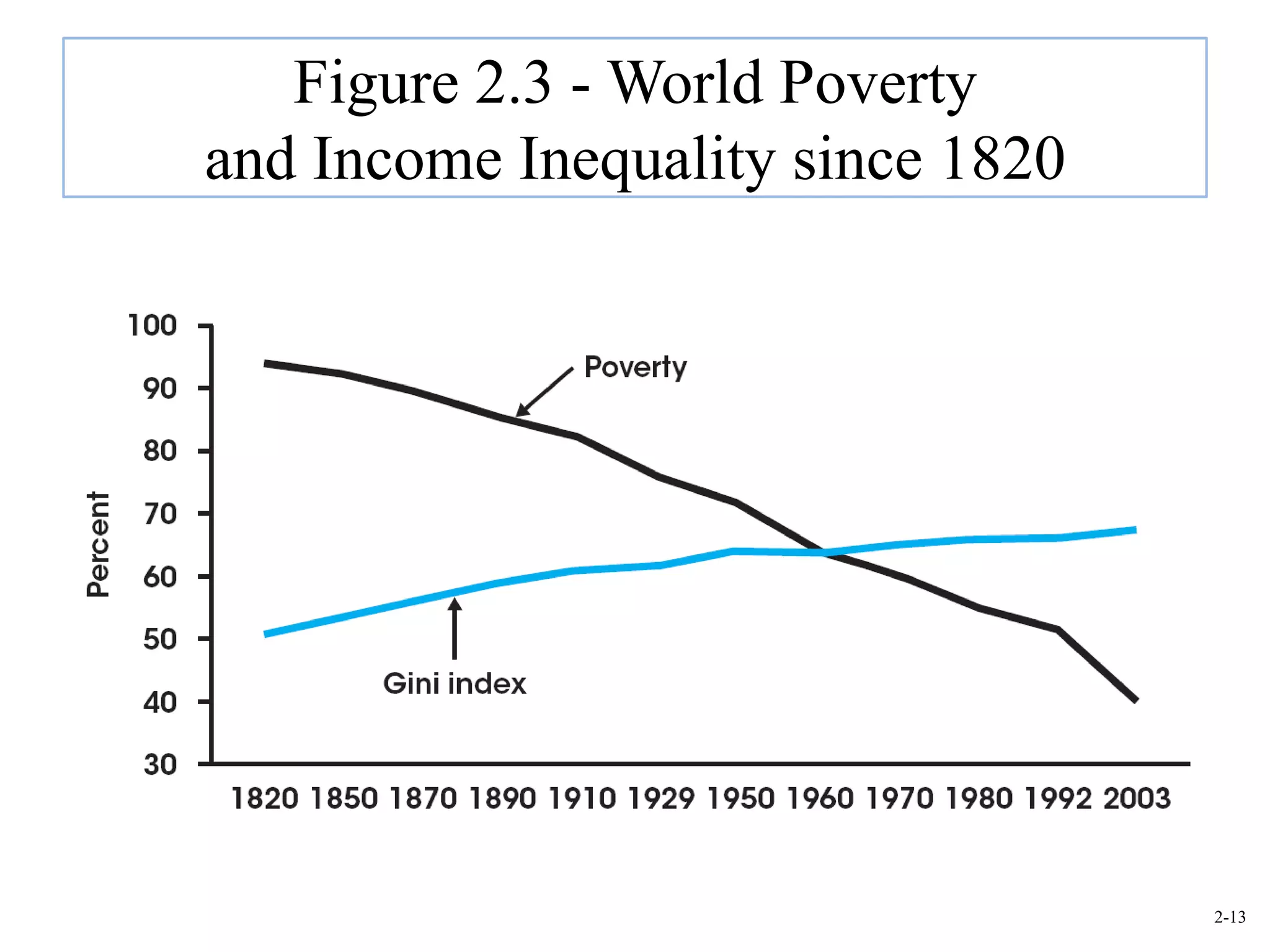
o Global income inequality is measured by the Gini
  index


                                                            2-10
Inequality

o Gini index: A statistical measure of inequality in
  which zero is perfect equality (everyone has the same
  amount of wealth and 100 is absolute inequality (a
  single person has all wealth)


                                                          2-11
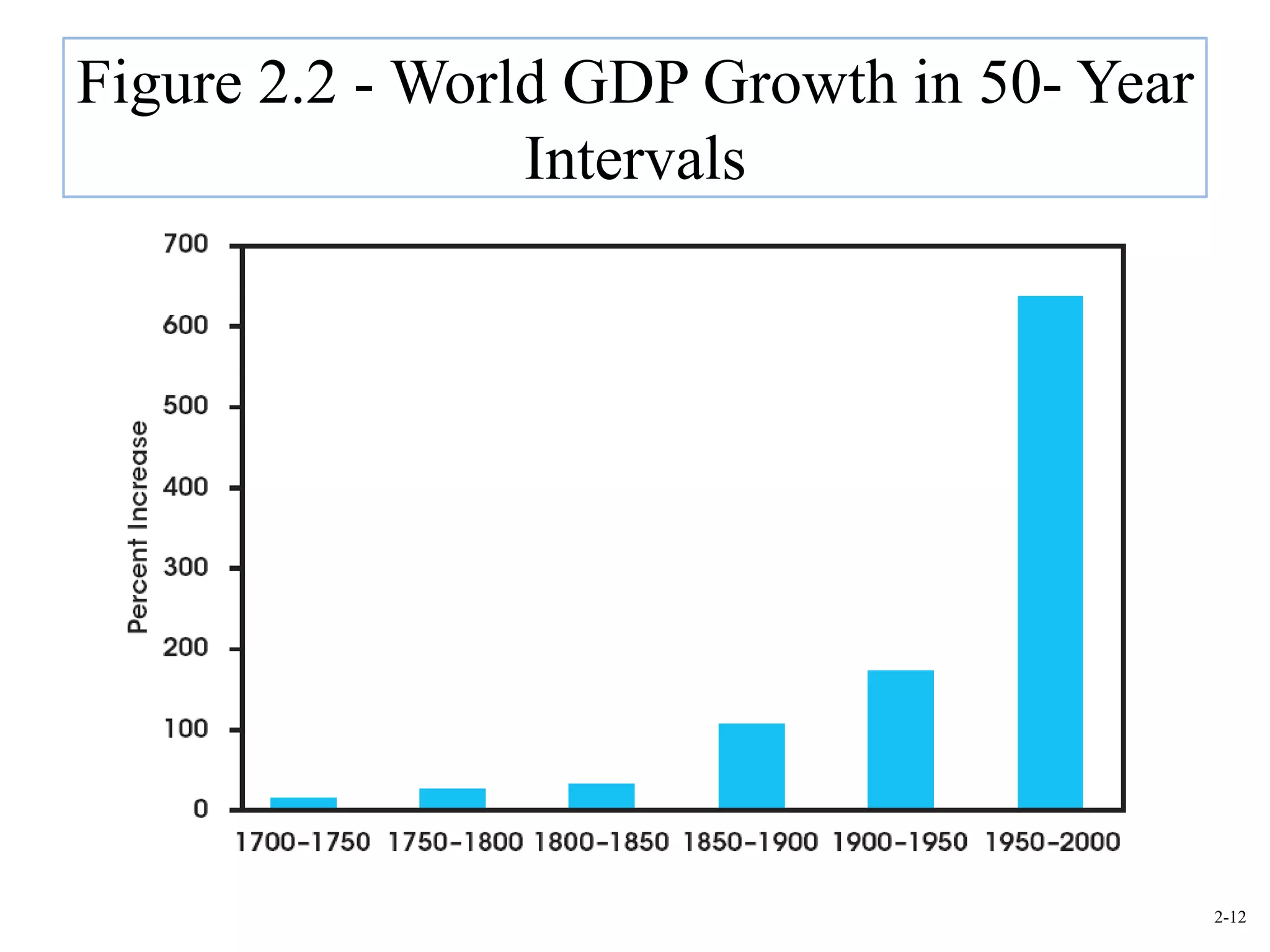
Figure 2.2 - World GDP Growth in 50- Year
                 Intervals


                                            2-12
Figure 2.3 - World Poverty
and Income Inequality since 1820


                                   2-13
Population Growth

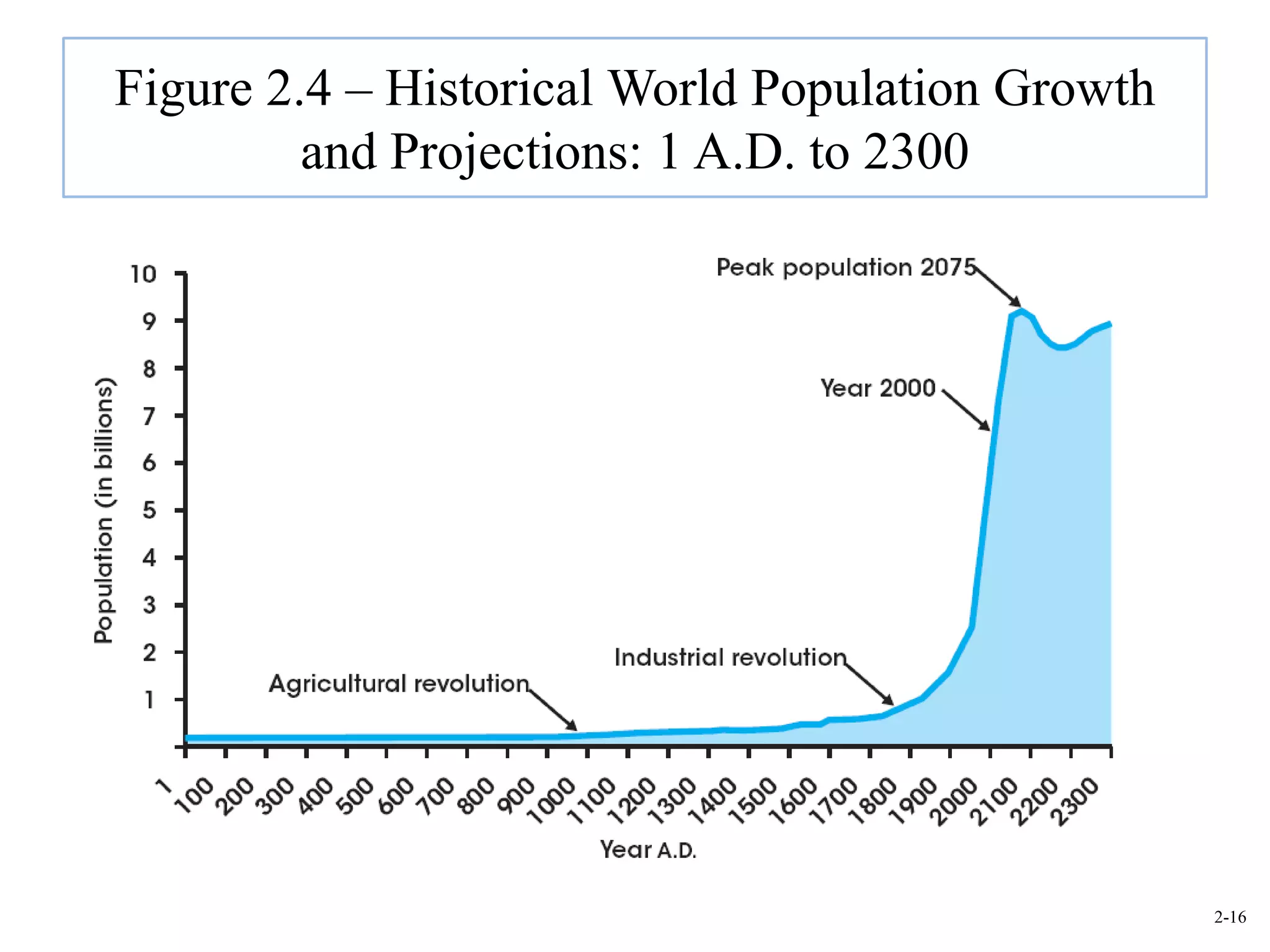
o The basic population trend throughout human history
  is upward
o Accelerated growth after 1825 due to:
   o Advances in water sanitation and medicine, reduced
     the number of deaths from infectious disease
   o Mechanized farming, expanded the food supply


                                                          2-14
Population Growth

o Rapid growth now declining due to declining fertility
o Implications of current population trends:
   o The wealth gap between high- and low-income
     countries will widen
   o Growth will continue to strain the earth’s ecosystems
   o The West is in demographic decline compared with
     other peoples


                                                             2-15
Figure 2.4 – Historical World Population Growth
         and Projections: 1 A.D. to 2300


                                                  2-16
Technology

o Throughout history new technologies and devices
  have fueled commerce and reshaped societies
   o Printing press
   o Steam engine
o New technologies:
   o Foster the productivity gains that sustain long-term
     economic progress
   o Promote human welfare
   o Can agitate societies


                                                            2-17
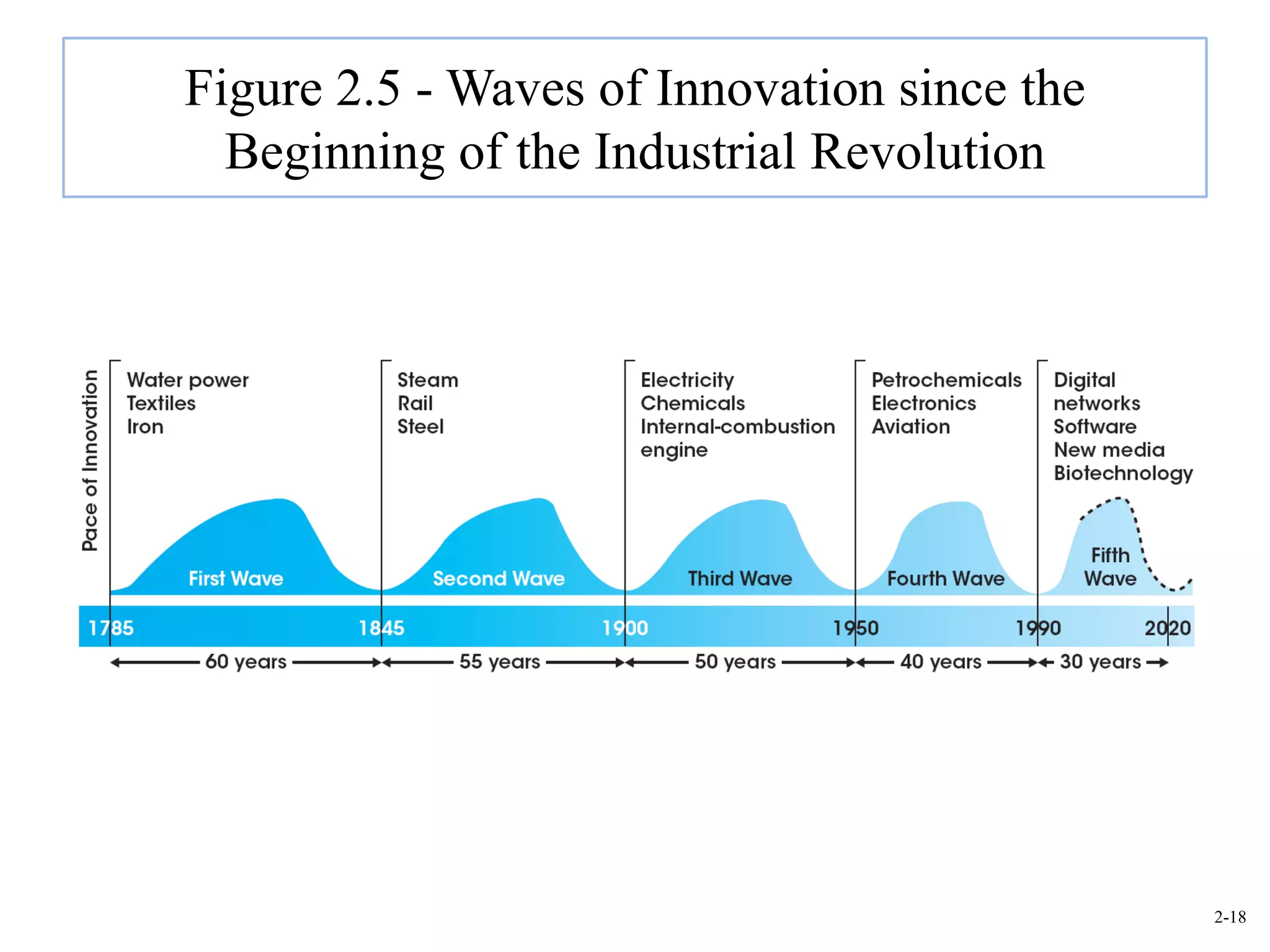
Figure 2.5 - Waves of Innovation since the
  Beginning of the Industrial Revolution


                                             2-18
Globalization

o Globalization: The creation of networks of human
  interaction that span worldwide distances
o Consequences of globalization:
   o Increased economic activity
   o Changed cultures


                                                     2-19
Globalization

o Globalization has been accelerated by new
  technologies, and sometimes slowed by national
  rivalries and wars
o Transnational corporations are the central forces of
  current economic globalization


                                                         2-20
Nation-States

o Nation-state: An international actor having a ruling
  authority, citizens, and a territory with fixed borders
o Arose out of the wreckage of the Roman Empire
o In the past, nations increased their power by seizing
  territory from other nations
o Today, nations use trade to increase their power


                                                            2-21
Nation-States

o Trade through world markets is a new source of
  power, but it also limits the ability of regimes to
  control their economies
o Other forces such as epidemics, climate change,
  terrorism and international norms also limit a nation-
  state’s autonomy


                                                           2-22
Dominant Ideologies

o Ideology: A set of reinforcing beliefs and values that
  constructs a worldview
o The industrial revolution was facilitated by several
  ideologies:
   o Capitalism
   o Constitutional democracy – protection of individuals’
     rights


                                                             2-23
Dominant Ideologies

o Progress – the idea that humanity was in upward
  motion toward material betterment
o Darwinism – constant improvement characterized the
  biological world
o Social Darwinism – evolutionary competition in
  human society weeds out the unfit and advances
  humanity


                                                       2-24
Dominant Ideologies

o Protestant ethic – hard work, saving, thrift and
  honesty lead to salvation
o Many doctrines have perished as a result of
  globalization
o The capitalism ideology accelerated in the 20th
  century due to rising literacy and innovations that
  spread information


                                                        2-25
Great Leadership

o Leaders have brought both beneficial and disastrous
  changes to societies and businesses
o Two views of historic leaders:
   o Leaders simply ride the wave of history
   o Leaders themselves change history


                                                        2-26
Chance

o Some changes in the business environment may be
  best explained as the product of unknown and
  unpredictable causes.
o Machiavelli observed that fortune determines about
  half the course of human events and human beings
  the other half.


                                                       2-27
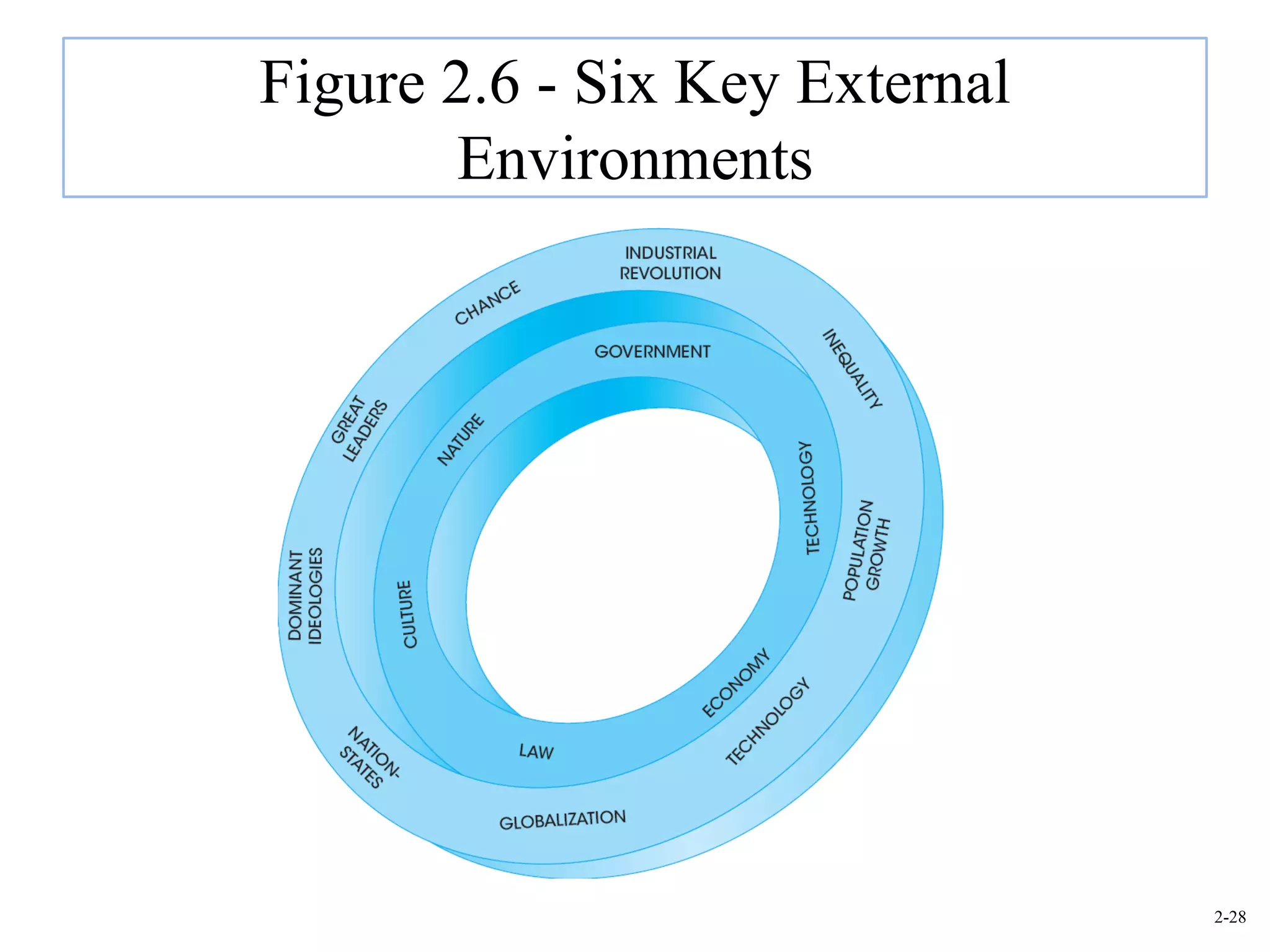
Figure 2.6 - Six Key External
       Environments


                                2-28
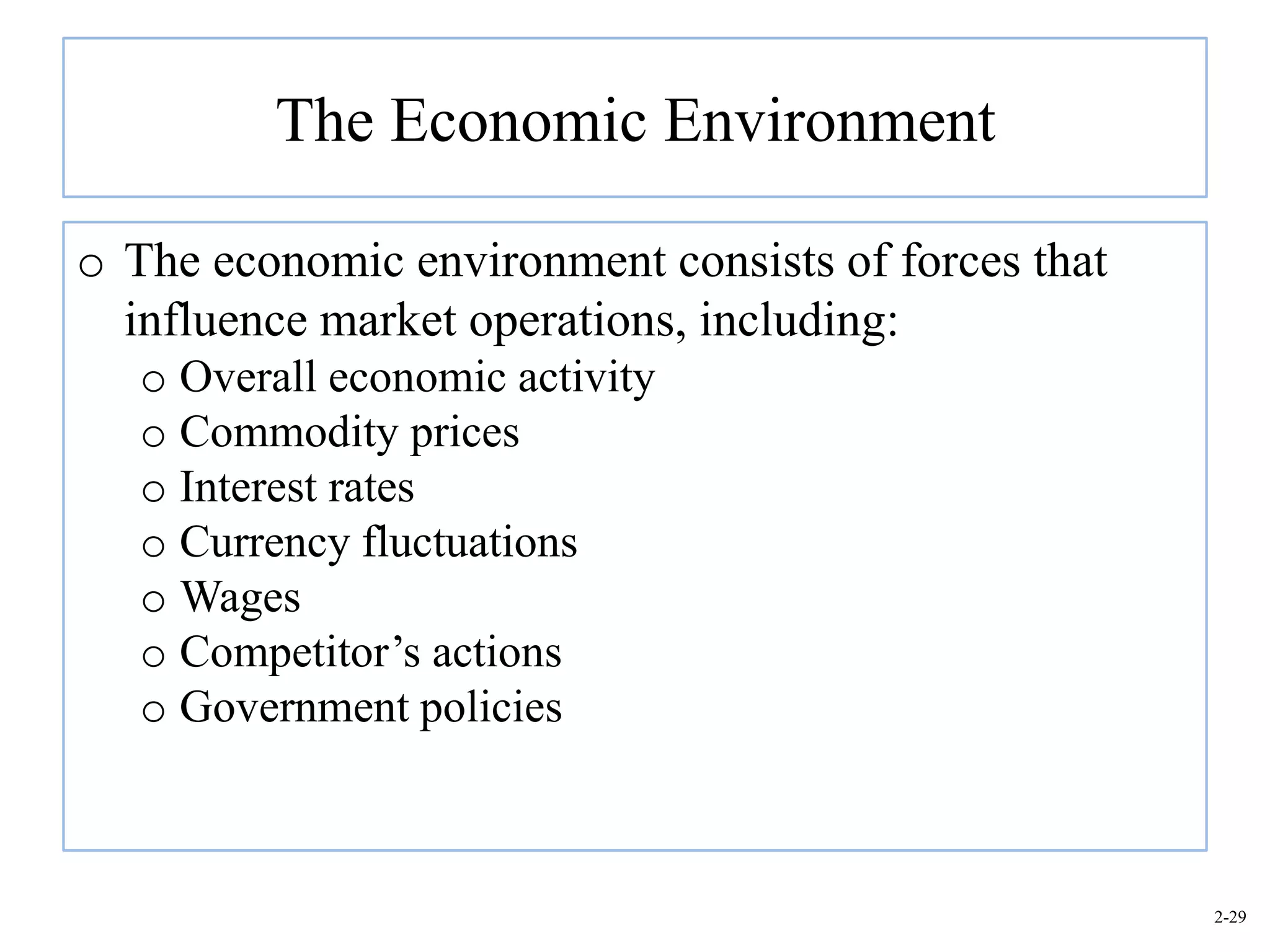
The Economic Environment

o The economic environment consists of forces that
  influence market operations, including:
   o Overall economic activity
   o Commodity prices
   o Interest rates
   o Currency fluctuations
   o Wages
   o Competitor’s actions
   o Government policies


                                                     2-29
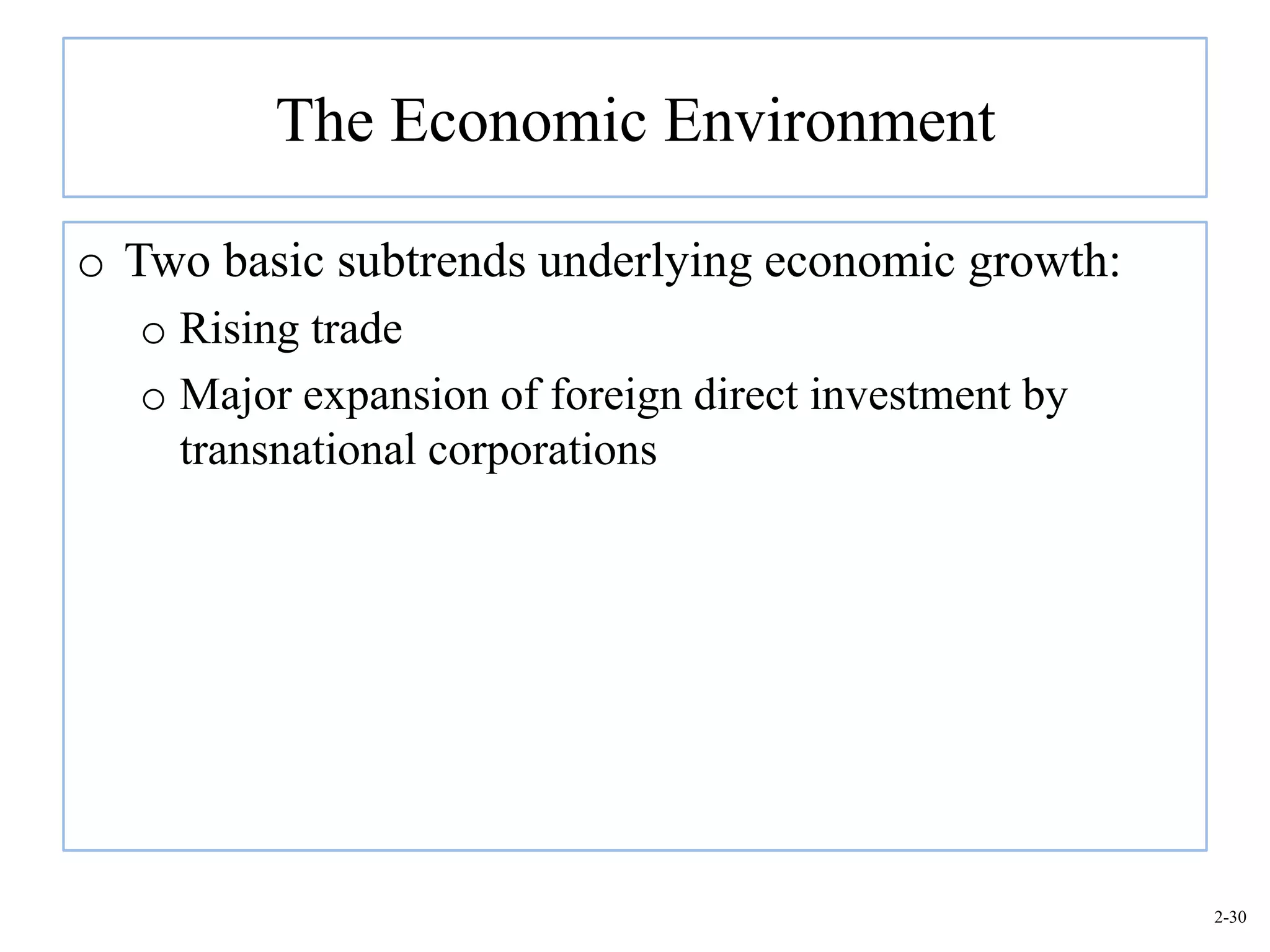
The Economic Environment

o Two basic subtrends underlying economic growth:
  o Rising trade
  o Major expansion of foreign direct investment by
    transnational corporations


                                                      2-30
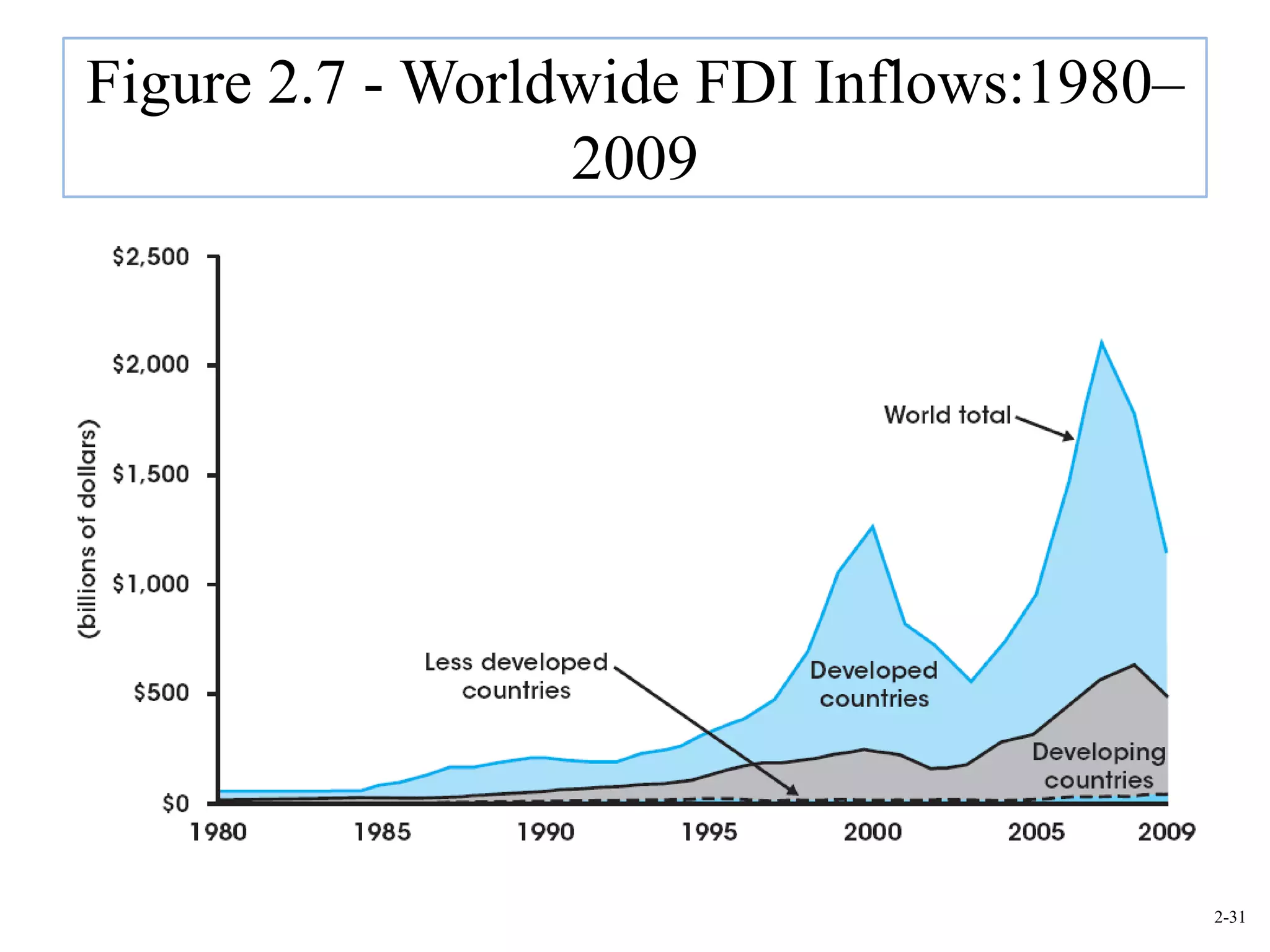
Figure 2.7 - Worldwide FDI Inflows:1980–
                  2009


                                           2-31
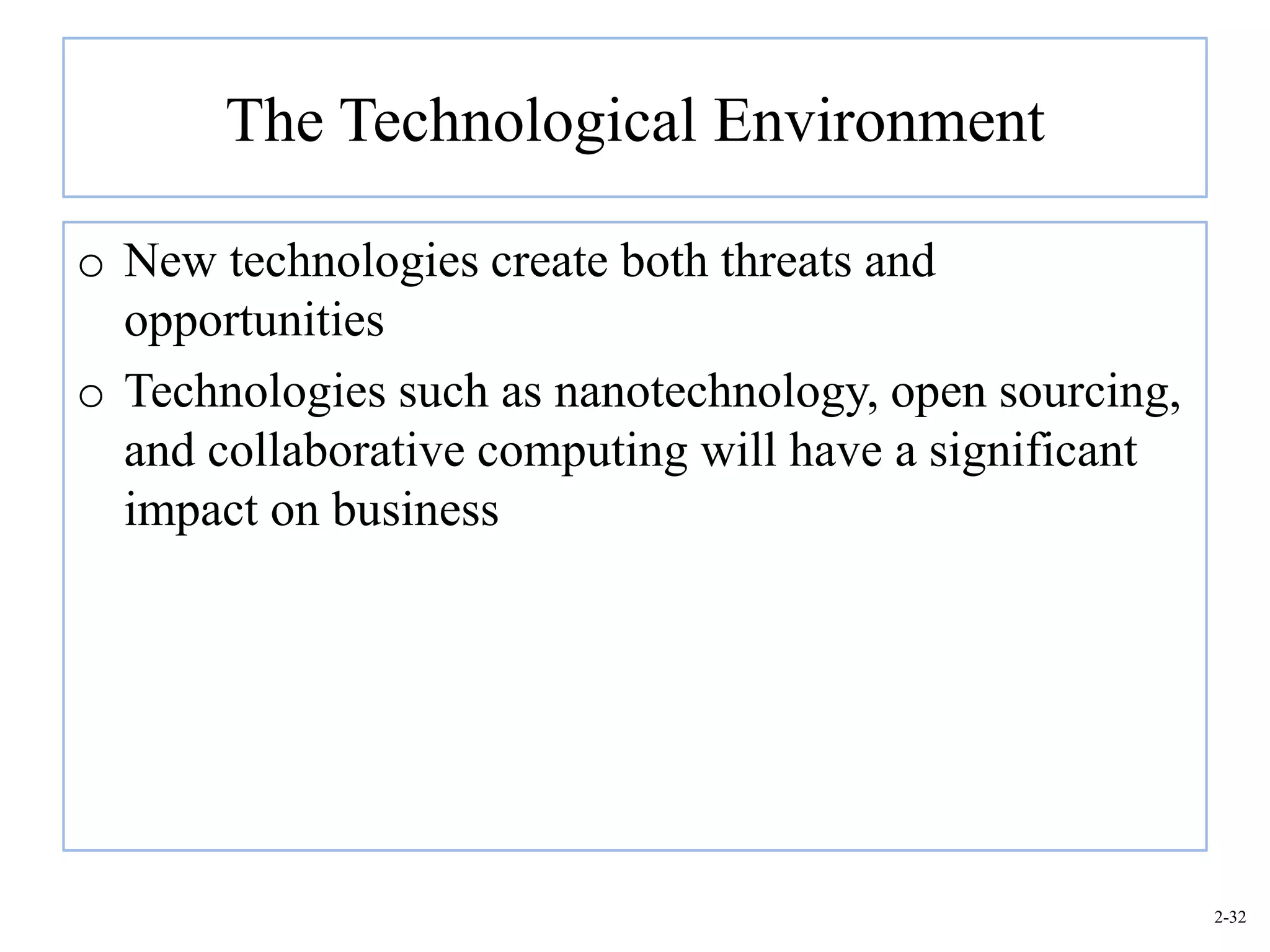
The Technological Environment

o New technologies create both threats and
  opportunities
o Technologies such as nanotechnology, open sourcing,
  and collaborative computing will have a significant
  impact on business


                                                        2-32
The Technological Environment

o New technologies have unforeseen consequences for
  society when they are put into widespread use for
  commercial gain
o Businesses must carefully weigh not only the
  strategic impact of technologies on their business
  models, but also the dangers they may impose on
  people


                                                       2-33
The Cultural Environment

o Culture: A system of shared knowledge, values,
  norms, customs, and rituals acquired by social
  learning
o The environment of a transnational corporation
  includes a variety of cultures
   o This variation causes conflicts of business customs
o There is a fundamental divide between the culture of
  Western economic development and the rest of the
  world’s cultural groupings

                                                           2-34
The Cultural Environment

o The rise of postmodern values has uniformly shifted
  the social, political, economic, and sexual norms of
  wealthy countries
o Postmodern norms are a strong influence in the
  operating environments of multinational corporations


                                                         2-35
The Government Environment

o There are currently two long-term global trends in the
  government environment of major importance to
  business:
   o Government activity has greatly expanded
      o Larger social welfare roles
      o Expanded regulation of domestic industries


                                                           2-36
The Government Environment

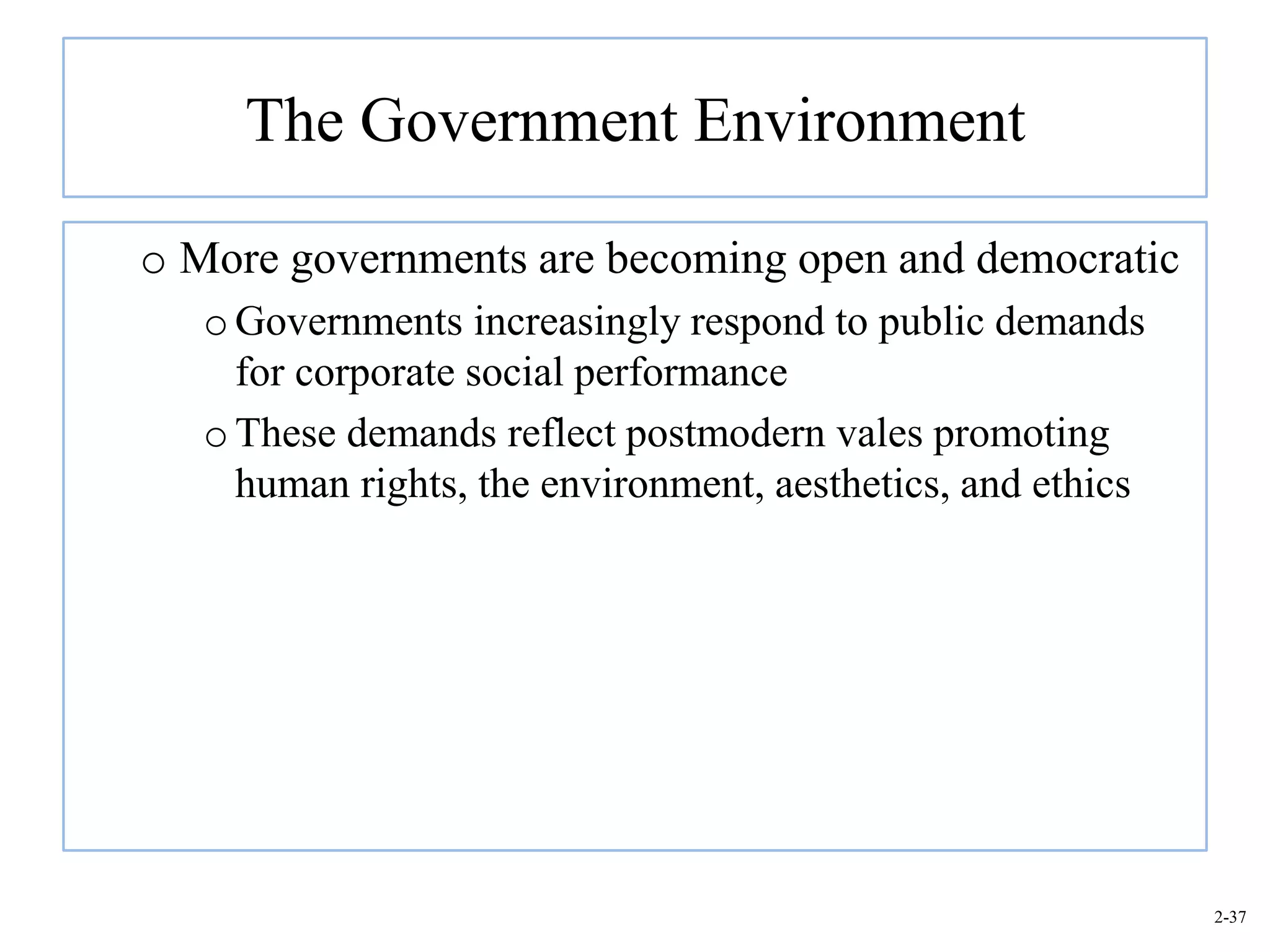
o More governments are becoming open and democratic
   o Governments increasingly respond to public demands
     for corporate social performance
   o These demands reflect postmodern vales promoting
     human rights, the environment, aesthetics, and ethics


                                                             2-37
Figure 2.8 - The Rise of Democratic
              Regimes


                                      2-38
The Legal Environment

o The legal environment consists of legislation,
  regulation, and litigation
o Five enduring trends:
   o Laws and regulations have steadily grown in number
     and complexity
   o Corporations have expanding duties to protect rights of
     stakeholders
   o Globalization has increased the complexity of the legal
     environment and expanded the application of
     voluntary codes of conduct

                                                               2-39
The Legal Environment

o Ethical behavior and corporate social responsibility
  often become codified in laws
o The law is constantly evolving


                                                         2-40
The Natural Environment

o Economic activity is a geophysical force with power
  to change the natural environment
o Economic productivity in the 20th century has:
   o Depleted mineral resources
   o Reduced forest cover
   o Killed species
   o Released molecules not found in nature
   o Unbalanced the nitrogen cycle
   o Possibly triggered climate change


                                                        2-41
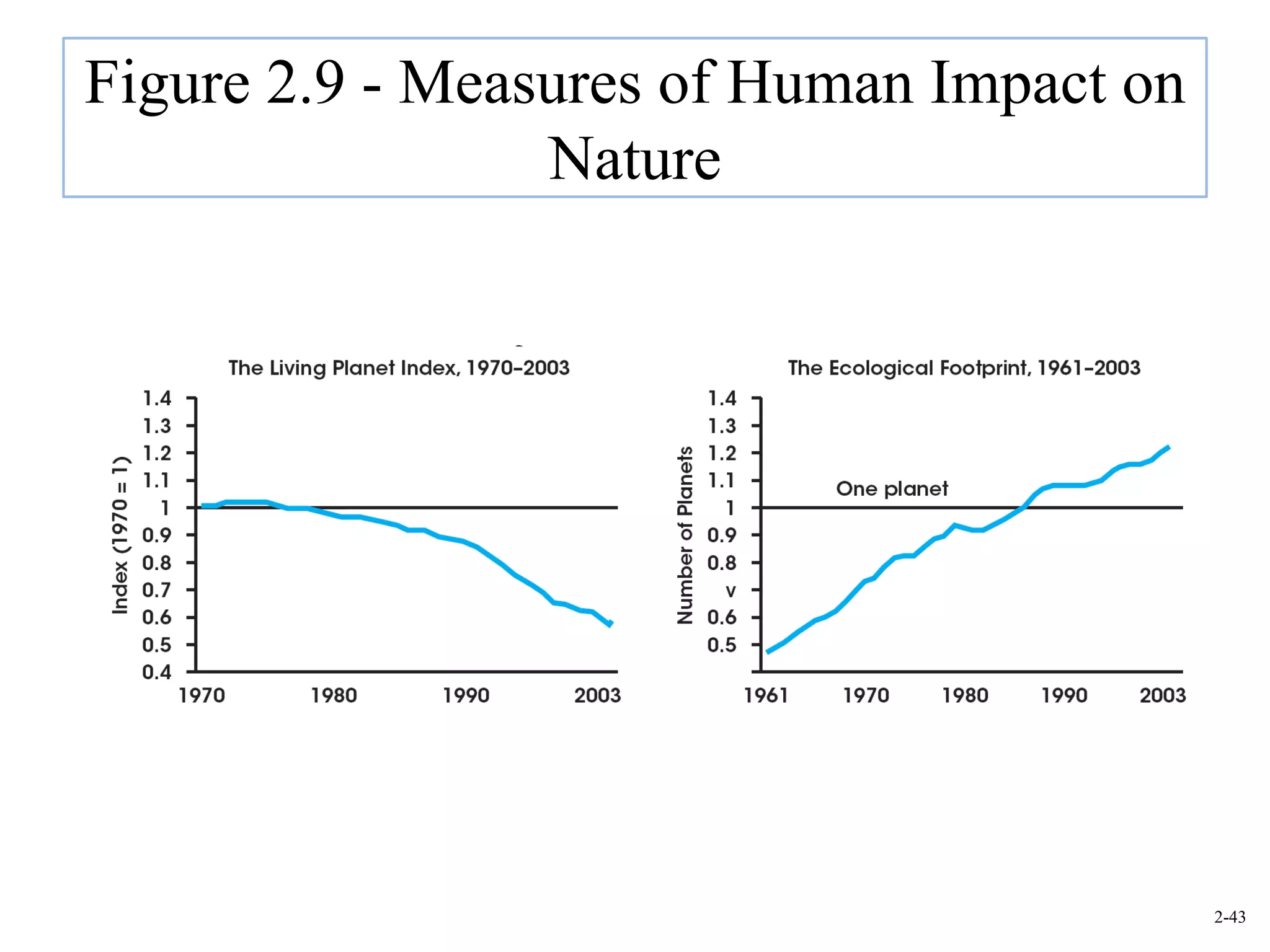
The Natural Environment

o The human ecological footprint moved beyond the
  earth’s carrying capacity in the 1980s and is now
  unsustainable
o Managers must adapt to changed thinking, toward
  preservation of nature


                                                      2-42
Figure 2.9 - Measures of Human Impact on
                 Nature


                                           2-43
The Internal Environment

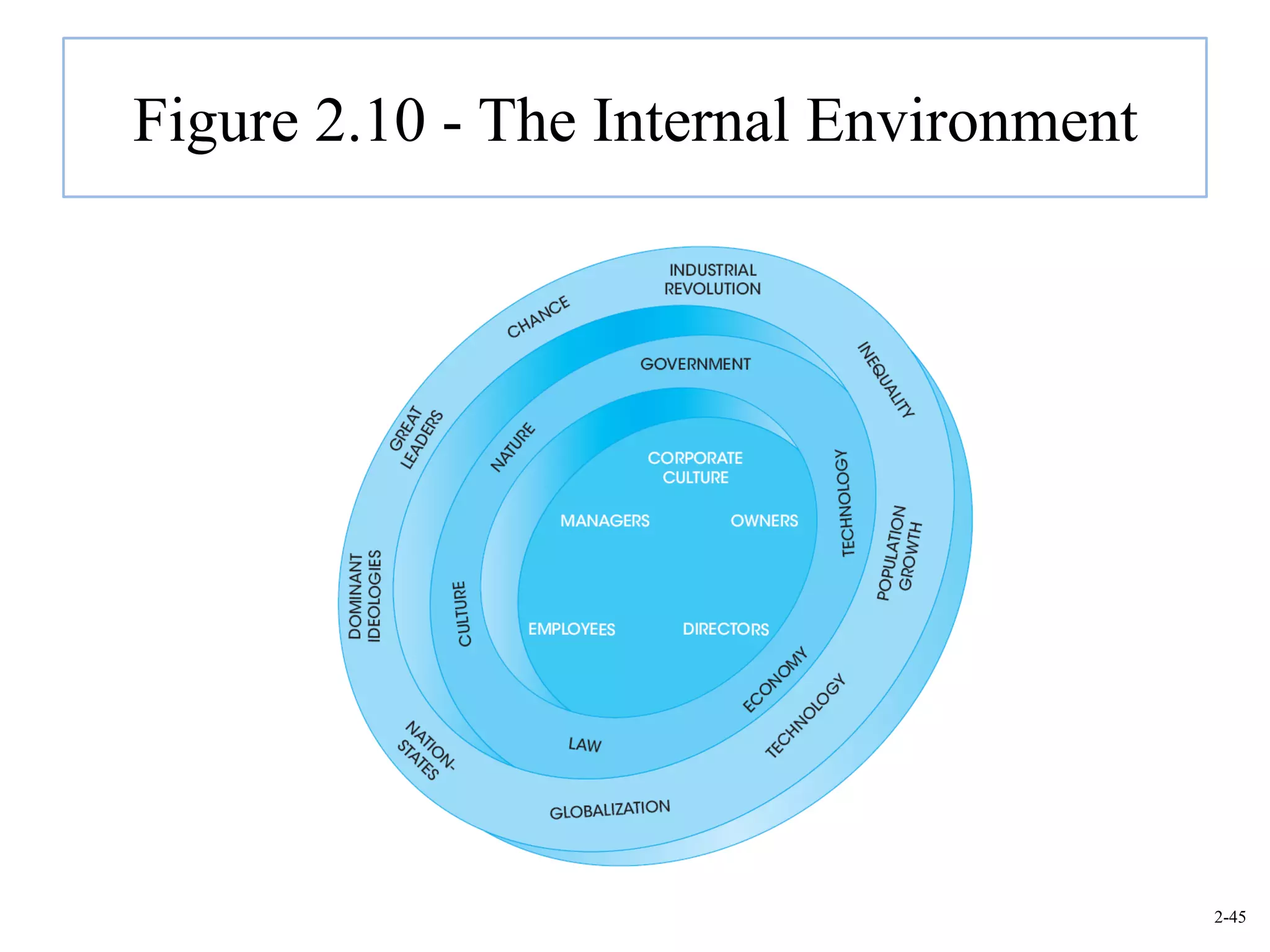
o In a corporation, the internal environment consists of
  four groups: employees, managers, the board of
  directors, and owners
o Each of these groups has different objective, beliefs,
  needs, and functions that must be coordinated
o Forces in external environments have recently
  reduced the power of these internal groups


                                                           2-44
Figure 2.10 - The Internal Environment


                                         2-45
Concluding Observations

o The environments of business have profound
  implications for managers
o The actions of business constantly influence not only
  current environments but, in addition, the deeper
  course of history
o Although strongly constrained by its environment,
  business has a powerful capacity to shape society and
  change history in ways large and small


                                                          2-46
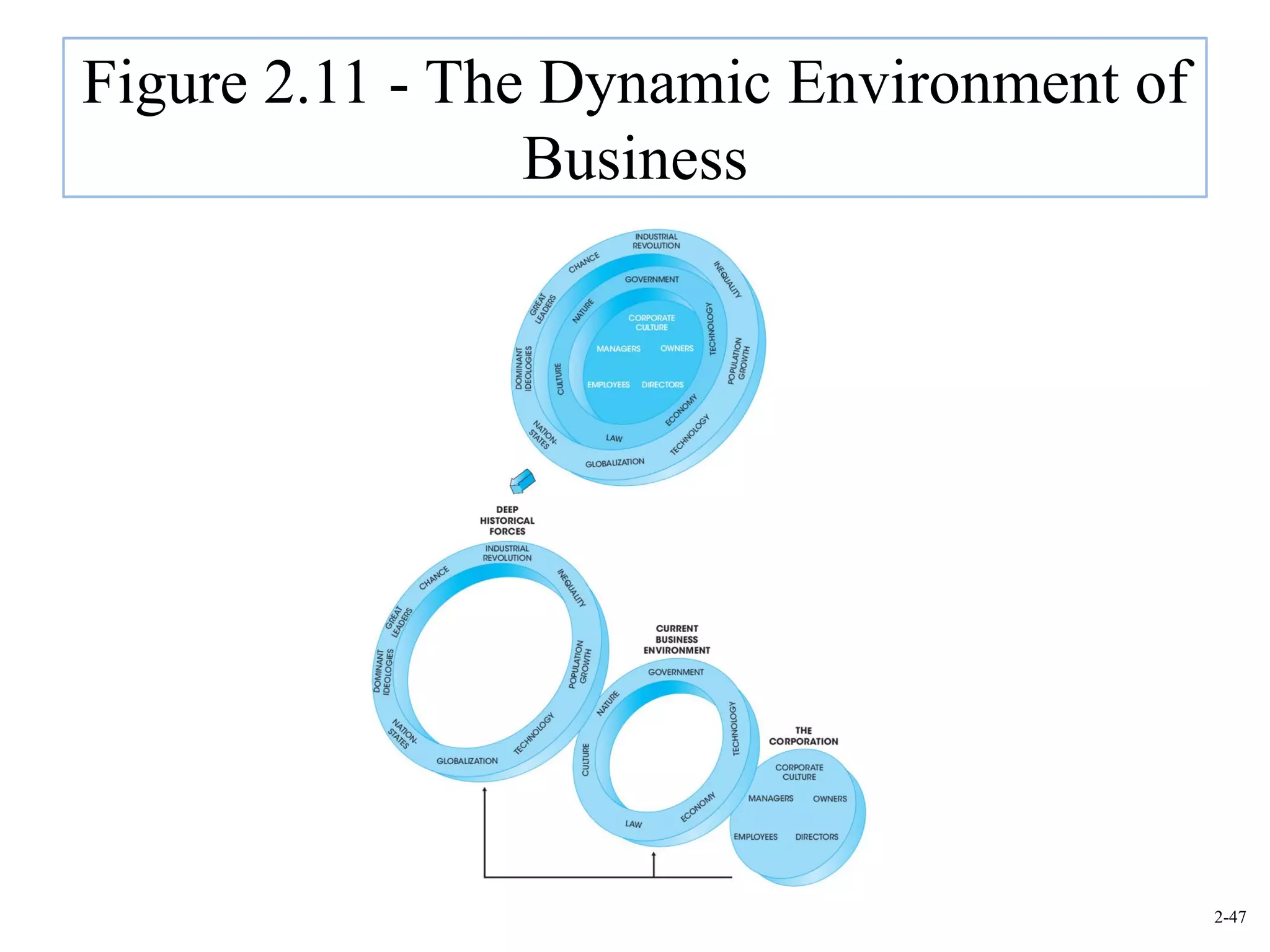
Figure 2.11 - The Dynamic Environment of
                 Business


                                           2-47

Week 2 notes

  • 1.
    Chapter 2 The Dynamic Environment McGraw-Hill/Irwin Copyright © 2012 by The McGraw-Hill Companies, Inc. All rights reserved.
  • 2.
    Royal Dutch ShellPLC o One of the world’s largest companies o Each year it makes capital investments of between $30 billion and $40 billion o In the 1970s pioneered the use of scenarios in corporate planning 2-2
  • 3.
    Royal Dutch ShellPLC o When an oil embargo surprised the world in 1973 Shell was the only major oil firm prepared for the supply interruption o Shell sees an emerging drama in the global energy system, with tensions building at the intersection of three powerful trends o Developing nations with expanding populations are using policies of economic growth to alleviate poverty 2-3
  • 4.
    Royal Dutch ShellPLC o Supplies of oil and gas cannot keep pace with rising demands for energy o Environmental stresses are growing 2-4
  • 5.
    Figure 2.1 -Nine Deep Historical Forces 2-5
  • 6.
    The Industrial Revolution oHistorical force: An environmental force of unknown origin and mysterious action that provides the energy for events o The discussion divides this force, somewhat artificially, into nine separate but related forces causing distinct chains of events 2-6
  • 7.
    The Industrial Revolution oThe Industrial Revolution: An economic metamorphosis in England in the late 1700s o It occurred when certain necessary conditions were present and shifted the country from a simple agrarian economy into a growing industrial economy 2-7
  • 8.
    The Industrial Revolution oRequirements for industrial growth: o Sufficiency of capital, labor, natural resources and fuels o Adequate transportation o Strong markets o Ideas and institutions that support the productive blend of all the above ingredients 2-8
  • 9.
    The Industrial Revolution oIndustrial growth remakes societies in positive ways, but also generates strains in the social fabric o The total amount of goods and services produced in the twentieth century exceeds all that produced in recorded human history 2-9
  • 10.
    Inequality o The basicpolitical conflict in every nation, and often between nations, is the antagonism between rich and poor o The industrial revolution accelerated the accumulation of wealth and widened the persistent problem of its uneven distribution o Global income inequality is measured by the Gini index 2-10
  • 11.
    Inequality o Gini index:A statistical measure of inequality in which zero is perfect equality (everyone has the same amount of wealth and 100 is absolute inequality (a single person has all wealth) 2-11
  • 12.
    Figure 2.2 -World GDP Growth in 50- Year Intervals 2-12
  • 13.
    Figure 2.3 -World Poverty and Income Inequality since 1820 2-13
  • 14.
    Population Growth o Thebasic population trend throughout human history is upward o Accelerated growth after 1825 due to: o Advances in water sanitation and medicine, reduced the number of deaths from infectious disease o Mechanized farming, expanded the food supply 2-14
  • 15.
    Population Growth o Rapidgrowth now declining due to declining fertility o Implications of current population trends: o The wealth gap between high- and low-income countries will widen o Growth will continue to strain the earth’s ecosystems o The West is in demographic decline compared with other peoples 2-15
  • 16.
    Figure 2.4 –Historical World Population Growth and Projections: 1 A.D. to 2300 2-16
  • 17.
    Technology o Throughout historynew technologies and devices have fueled commerce and reshaped societies o Printing press o Steam engine o New technologies: o Foster the productivity gains that sustain long-term economic progress o Promote human welfare o Can agitate societies 2-17
  • 18.
    Figure 2.5 -Waves of Innovation since the Beginning of the Industrial Revolution 2-18
  • 19.
    Globalization o Globalization: Thecreation of networks of human interaction that span worldwide distances o Consequences of globalization: o Increased economic activity o Changed cultures 2-19
  • 20.
    Globalization o Globalization hasbeen accelerated by new technologies, and sometimes slowed by national rivalries and wars o Transnational corporations are the central forces of current economic globalization 2-20
  • 21.
    Nation-States o Nation-state: Aninternational actor having a ruling authority, citizens, and a territory with fixed borders o Arose out of the wreckage of the Roman Empire o In the past, nations increased their power by seizing territory from other nations o Today, nations use trade to increase their power 2-21
  • 22.
    Nation-States o Trade throughworld markets is a new source of power, but it also limits the ability of regimes to control their economies o Other forces such as epidemics, climate change, terrorism and international norms also limit a nation- state’s autonomy 2-22
  • 23.
    Dominant Ideologies o Ideology:A set of reinforcing beliefs and values that constructs a worldview o The industrial revolution was facilitated by several ideologies: o Capitalism o Constitutional democracy – protection of individuals’ rights 2-23
  • 24.
    Dominant Ideologies o Progress– the idea that humanity was in upward motion toward material betterment o Darwinism – constant improvement characterized the biological world o Social Darwinism – evolutionary competition in human society weeds out the unfit and advances humanity 2-24
  • 25.
    Dominant Ideologies o Protestantethic – hard work, saving, thrift and honesty lead to salvation o Many doctrines have perished as a result of globalization o The capitalism ideology accelerated in the 20th century due to rising literacy and innovations that spread information 2-25
  • 26.
    Great Leadership o Leadershave brought both beneficial and disastrous changes to societies and businesses o Two views of historic leaders: o Leaders simply ride the wave of history o Leaders themselves change history 2-26
  • 27.
    Chance o Some changesin the business environment may be best explained as the product of unknown and unpredictable causes. o Machiavelli observed that fortune determines about half the course of human events and human beings the other half. 2-27
  • 28.
    Figure 2.6 -Six Key External Environments 2-28
  • 29.
    The Economic Environment oThe economic environment consists of forces that influence market operations, including: o Overall economic activity o Commodity prices o Interest rates o Currency fluctuations o Wages o Competitor’s actions o Government policies 2-29
  • 30.
    The Economic Environment oTwo basic subtrends underlying economic growth: o Rising trade o Major expansion of foreign direct investment by transnational corporations 2-30
  • 31.
    Figure 2.7 -Worldwide FDI Inflows:1980– 2009 2-31
  • 32.
    The Technological Environment oNew technologies create both threats and opportunities o Technologies such as nanotechnology, open sourcing, and collaborative computing will have a significant impact on business 2-32
  • 33.
    The Technological Environment oNew technologies have unforeseen consequences for society when they are put into widespread use for commercial gain o Businesses must carefully weigh not only the strategic impact of technologies on their business models, but also the dangers they may impose on people 2-33
  • 34.
    The Cultural Environment oCulture: A system of shared knowledge, values, norms, customs, and rituals acquired by social learning o The environment of a transnational corporation includes a variety of cultures o This variation causes conflicts of business customs o There is a fundamental divide between the culture of Western economic development and the rest of the world’s cultural groupings 2-34
  • 35.
    The Cultural Environment oThe rise of postmodern values has uniformly shifted the social, political, economic, and sexual norms of wealthy countries o Postmodern norms are a strong influence in the operating environments of multinational corporations 2-35
  • 36.
    The Government Environment oThere are currently two long-term global trends in the government environment of major importance to business: o Government activity has greatly expanded o Larger social welfare roles o Expanded regulation of domestic industries 2-36
  • 37.
    The Government Environment oMore governments are becoming open and democratic o Governments increasingly respond to public demands for corporate social performance o These demands reflect postmodern vales promoting human rights, the environment, aesthetics, and ethics 2-37
  • 38.
    Figure 2.8 -The Rise of Democratic Regimes 2-38
  • 39.
    The Legal Environment oThe legal environment consists of legislation, regulation, and litigation o Five enduring trends: o Laws and regulations have steadily grown in number and complexity o Corporations have expanding duties to protect rights of stakeholders o Globalization has increased the complexity of the legal environment and expanded the application of voluntary codes of conduct 2-39
  • 40.
    The Legal Environment oEthical behavior and corporate social responsibility often become codified in laws o The law is constantly evolving 2-40
  • 41.
    The Natural Environment oEconomic activity is a geophysical force with power to change the natural environment o Economic productivity in the 20th century has: o Depleted mineral resources o Reduced forest cover o Killed species o Released molecules not found in nature o Unbalanced the nitrogen cycle o Possibly triggered climate change 2-41
  • 42.
    The Natural Environment oThe human ecological footprint moved beyond the earth’s carrying capacity in the 1980s and is now unsustainable o Managers must adapt to changed thinking, toward preservation of nature 2-42
  • 43.
    Figure 2.9 -Measures of Human Impact on Nature 2-43
  • 44.
    The Internal Environment oIn a corporation, the internal environment consists of four groups: employees, managers, the board of directors, and owners o Each of these groups has different objective, beliefs, needs, and functions that must be coordinated o Forces in external environments have recently reduced the power of these internal groups 2-44
  • 45.
    Figure 2.10 -The Internal Environment 2-45
  • 46.
    Concluding Observations o Theenvironments of business have profound implications for managers o The actions of business constantly influence not only current environments but, in addition, the deeper course of history o Although strongly constrained by its environment, business has a powerful capacity to shape society and change history in ways large and small 2-46
  • 47.
    Figure 2.11 -The Dynamic Environment of Business 2-47