Chapter 7
                                            Business
                                             Ethics


McGraw-Hill/Irwin   Copyright © 2012 by The McGraw-Hill Companies, Inc. All rights reserved.
Bernard Ebbers

o Bernard Ebbers built WorldCom into a global
  telecommunications giant
o Ebbers used use all of his WorldCom stock as
  collateral for bank loans
o In 2000 Ebbers gave the first in a string of
  instructions to report false revenues and use
  accounting tricks to disguise rising expenses


                                                  7-2
Bernard Ebbers

o Ebbers testified that he had no knowledge of the
  fraud, but five of his subordinates testified against
  him
o Ebbers was sentenced to 25 years in prison for
  securities fraud, unprecedented for a white-collar
  crime


                                                          7-3
What are Business Ethics?

o Ethics: The study of good and evil, right and wrong,
  and just and unjust
o Business ethics: The study of good and evil, right
  and wrong, and just and unjust actions in business


                                                         7-4
What are Business Ethics?

o All managers face difficult ethical conflicts
   o Applying clear guidelines resolves the majority of
     them
o Ethical traditions that apply to business support truth
  telling, honesty, protection of life, respect for rights,
  fairness, and obedience to law


                                                              7-5
What are Business Ethics?

o Eliminating unethical behavior may be difficult, but
  knowing the rightness or wrongness of actions is easy
o Some ethical decisions are troublesome because
  although basic ethical standards apply, conflicts
  between them defy resolution
o Some ethical issues are hidden and hard to recognize


                                                          7-6
Two Theories of Business Ethics

o Theory of amorality: The belief that business should
  be conducted without reference to the full range of
  ethical standards, restraints, and ideals in society
o Theory of moral unity: Business actions are judged
  by the general ethical standards o society, not by a
  special set of more permissive standards


                                                         7-7
Figure 7.1 - Major Sources of Ethical
         Values in Business


                                        7-8
Religion

o The great religions converge in the belief that a divine
  will reveals the nature of right and wrong behavior in
  all areas of life, including business
o Christian managers often seek guidance in the Bible
o In Islam the Koran is a source of ethical inspiration


                                                             7-9
Philosophy

o Even after two millennia, there remains considerable
  dispute among ethical thinkers about the nature of
  right action
o The great Catholic theologians St. Augustine and St.
  Thomas Aquinas both believed that humanity should
  follow God’s will
   o Correct behavior in business and in all worldly activity
     was necessary to achieve salvation and life after death


                                                                7-10
Philosophy

o Immanuel Kant tried to find universal and objective
  ethical rules in logic
o Jeremy Bentham developed the idea of utilitarianism
  as a guide to ethics, validating two dominant
  ideologies: democracy and industrialism
o John Locke developed and refined doctrines of
  human rights and left an ethical legacy supporting
  belief in the inalienable rights of human beings


                                                        7-11
The Realist School of Ethics

o The realists believed that both good and evil were
  naturally present in human nature
   o Human behavior would inevitably reflect this mixture
o Niccolò Machiavelli argued that important ends
  justified expedient means
o Herbert Spencer supported a harsh ethic that justified
  vicious competition among companies because it
  furthered evolution


                                                            7-12
The Realist School of Ethics

o Friedrich Nietzsche said that “nice” ethics were
  prescriptions of the timid, designed to fetter the
  actions of great men whose irresistible power and will
  were regarded as dangerous by ordinary mortals


                                                           7-13
Cultural Experience

o Every culture transmits between generations a set of
  traditional values, rules, and standards that define
  acceptable behavior
o Civilization is a cumulative cultural experience
  consisting of three stages:
   o Hunting and gathering stage
   o Agricultural stage
   o Industrial stage


                                                         7-14
Ethical Variation in Cultures

o Ethical values differ among nations as historical
  experiences have interacted with philosophies and
  religions to create diverging cultural values and laws
o Ethical universalism: The theory that because
  human nature is everywhere the same, basic ethical
  rules are applicable in all cultures
   o There is some room for variation in the way these rules
     are followed


                                                               7-15
Ethical Variation in Cultures

o Ethical relativism: The theory that ethical values are
  created by cultural experience
   o Different cultures may create different values and there
     is no universal standard by which to judge which
     values are superior
o Because of globalization, corporations struggle with
  the question of how to apply conduct codes across
  cultures


                                                                7-16
Law

o Laws codify, or formalize, ethical expectations
o Corporations and their managers face a range of
  mechanisms set up to:
   o Deter illegal acts
   o Punish offenses
   o Rehabilitate offenders


                                                    7-17
Damages

o In civil cases courts may assess damages, or
  payments for harm done to others by a corporation
   o Compensatory damages: Payments awarded to
     redress actual, concrete losses suffered by injured
     parties
   o Punitive damages: Payments in excess of a wronged
     party’s actual losses to deter similar actions and punish
     a corporation that has exhibited reprehensible conduct


                                                                 7-18
Criminal Prosecution of Managers and
               Corporations
o Managers may be prosecuted for criminal actions
  undertaken in the course of their employment
o Corporations are criminally liable for corrupt actions
  or omissions of managers if those actions are
  intended to benefit the corporation
o Criminal prosecution of corporations and their
  executives is exceptionally difficult


                                                           7-19
Criminal Prosecution of Managers and
                 Corporations

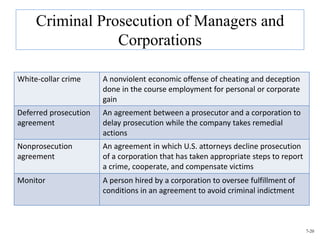
White-collar crime     A nonviolent economic offense of cheating and deception
                       done in the course employment for personal or corporate
                       gain
Deferred prosecution   An agreement between a prosecutor and a corporation to
agreement              delay prosecution while the company takes remedial
                       actions
Nonprosecution         An agreement in which U.S. attorneys decline prosecution
agreement              of a corporation that has taken appropriate steps to report
                       a crime, cooperate, and compensate victims
Monitor                A person hired by a corporation to oversee fulfillment of
                       conditions in an agreement to avoid criminal indictment


                                                                                     7-20
Sentencing and Fines

o In 1991 the U.S. Sentencing Commission released
  guidelines for sentencing both managers and
  corporations
o Managers can go to prison, be fined, put on
  probation, given community service, make restitution,
  or be banned from working in their occupations
o Corporations cannot be imprisoned, but they can be
  fined and their actions restricted


                                                          7-21
Figure 7.2 - Four Internal Forces Shaping
             Corporate Ethics


                                            7-22
Leadership

o The example of company leaders is perhaps the
  strongest influence on integrity
o A common failing is for managers to show by their
  actions that ethical duties can be compromised
o If the leader does something, an opportunistic
  employee can rationalize his or her entitlement to do
  it also


                                                          7-23
Strategies and Policies

o A critical function of managers is to create strong
  competitive strategies that enable the company to
  meet financial goals without encouraging ethical
  compromise
o Unrealistic performance goals can pressure those who
  must make them work
o Reward and compensation systems can expose
  employees to ethical compromises


                                                         7-24
Corporate Culture

o Corporate culture: A set of values, norms, rituals,
  formal rules, and physical artifacts that exists in a
  company
o Three levels of corporate culture:
   o Artifacts
   o Espoused values
   o Tacit underlying values


                                                          7-25
Individual Characteristics

o Personality traits may be more important, but are less
  studied in the literature of ethics
o The only personality trait extensively studied and
  correlated with unethical behavior is
  Machiavellianism
   o The tendency of an individual to use self-centered,
     immoral, manipulative behavior in a group


                                                           7-26
How Corporations Manage Ethics

o   Establish standards and procedures
o   Create high-level oversight
o   Screen out criminals
o   Communicate standards to all employees
o   Monitor and set up a hotline
o   Enforce standards, discipline violators
o   Assess areas of risk, modify the program


                                               7-27
How Corporations Manage Ethics

Ethics and compliance program   A system of structures, policies, procedures, and
                                controls used by corporations to promote ethical
                                behavior and ensure compliance with laws and
                                regulations

Compliance approach             An ethics and compliance program that
                                emphasizes following rules in laws, regulations,
                                and policy.

Ethics approach                 An ethics and compliance program that teaches
                                employees to make decisions based on ethical
                                values


                                                                                    7-28
Concluding Observations

o Ethics is the study of good and evil
o The most important single factor in good corporate
  ethics is the example of leaders, who shape strategies
  and cultures


                                                           7-29

Week 6 notes

  • 1.
    Chapter 7 Business Ethics McGraw-Hill/Irwin Copyright © 2012 by The McGraw-Hill Companies, Inc. All rights reserved.
  • 2.
    Bernard Ebbers o BernardEbbers built WorldCom into a global telecommunications giant o Ebbers used use all of his WorldCom stock as collateral for bank loans o In 2000 Ebbers gave the first in a string of instructions to report false revenues and use accounting tricks to disguise rising expenses 7-2
  • 3.
    Bernard Ebbers o Ebberstestified that he had no knowledge of the fraud, but five of his subordinates testified against him o Ebbers was sentenced to 25 years in prison for securities fraud, unprecedented for a white-collar crime 7-3
  • 4.
    What are BusinessEthics? o Ethics: The study of good and evil, right and wrong, and just and unjust o Business ethics: The study of good and evil, right and wrong, and just and unjust actions in business 7-4
  • 5.
    What are BusinessEthics? o All managers face difficult ethical conflicts o Applying clear guidelines resolves the majority of them o Ethical traditions that apply to business support truth telling, honesty, protection of life, respect for rights, fairness, and obedience to law 7-5
  • 6.
    What are BusinessEthics? o Eliminating unethical behavior may be difficult, but knowing the rightness or wrongness of actions is easy o Some ethical decisions are troublesome because although basic ethical standards apply, conflicts between them defy resolution o Some ethical issues are hidden and hard to recognize 7-6
  • 7.
    Two Theories ofBusiness Ethics o Theory of amorality: The belief that business should be conducted without reference to the full range of ethical standards, restraints, and ideals in society o Theory of moral unity: Business actions are judged by the general ethical standards o society, not by a special set of more permissive standards 7-7
  • 8.
    Figure 7.1 -Major Sources of Ethical Values in Business 7-8
  • 9.
    Religion o The greatreligions converge in the belief that a divine will reveals the nature of right and wrong behavior in all areas of life, including business o Christian managers often seek guidance in the Bible o In Islam the Koran is a source of ethical inspiration 7-9
  • 10.
    Philosophy o Even aftertwo millennia, there remains considerable dispute among ethical thinkers about the nature of right action o The great Catholic theologians St. Augustine and St. Thomas Aquinas both believed that humanity should follow God’s will o Correct behavior in business and in all worldly activity was necessary to achieve salvation and life after death 7-10
  • 11.
    Philosophy o Immanuel Kanttried to find universal and objective ethical rules in logic o Jeremy Bentham developed the idea of utilitarianism as a guide to ethics, validating two dominant ideologies: democracy and industrialism o John Locke developed and refined doctrines of human rights and left an ethical legacy supporting belief in the inalienable rights of human beings 7-11
  • 12.
    The Realist Schoolof Ethics o The realists believed that both good and evil were naturally present in human nature o Human behavior would inevitably reflect this mixture o Niccolò Machiavelli argued that important ends justified expedient means o Herbert Spencer supported a harsh ethic that justified vicious competition among companies because it furthered evolution 7-12
  • 13.
    The Realist Schoolof Ethics o Friedrich Nietzsche said that “nice” ethics were prescriptions of the timid, designed to fetter the actions of great men whose irresistible power and will were regarded as dangerous by ordinary mortals 7-13
  • 14.
    Cultural Experience o Everyculture transmits between generations a set of traditional values, rules, and standards that define acceptable behavior o Civilization is a cumulative cultural experience consisting of three stages: o Hunting and gathering stage o Agricultural stage o Industrial stage 7-14
  • 15.
    Ethical Variation inCultures o Ethical values differ among nations as historical experiences have interacted with philosophies and religions to create diverging cultural values and laws o Ethical universalism: The theory that because human nature is everywhere the same, basic ethical rules are applicable in all cultures o There is some room for variation in the way these rules are followed 7-15
  • 16.
    Ethical Variation inCultures o Ethical relativism: The theory that ethical values are created by cultural experience o Different cultures may create different values and there is no universal standard by which to judge which values are superior o Because of globalization, corporations struggle with the question of how to apply conduct codes across cultures 7-16
  • 17.
    Law o Laws codify,or formalize, ethical expectations o Corporations and their managers face a range of mechanisms set up to: o Deter illegal acts o Punish offenses o Rehabilitate offenders 7-17
  • 18.
    Damages o In civilcases courts may assess damages, or payments for harm done to others by a corporation o Compensatory damages: Payments awarded to redress actual, concrete losses suffered by injured parties o Punitive damages: Payments in excess of a wronged party’s actual losses to deter similar actions and punish a corporation that has exhibited reprehensible conduct 7-18
  • 19.
    Criminal Prosecution ofManagers and Corporations o Managers may be prosecuted for criminal actions undertaken in the course of their employment o Corporations are criminally liable for corrupt actions or omissions of managers if those actions are intended to benefit the corporation o Criminal prosecution of corporations and their executives is exceptionally difficult 7-19
  • 20.
    Criminal Prosecution ofManagers and Corporations White-collar crime A nonviolent economic offense of cheating and deception done in the course employment for personal or corporate gain Deferred prosecution An agreement between a prosecutor and a corporation to agreement delay prosecution while the company takes remedial actions Nonprosecution An agreement in which U.S. attorneys decline prosecution agreement of a corporation that has taken appropriate steps to report a crime, cooperate, and compensate victims Monitor A person hired by a corporation to oversee fulfillment of conditions in an agreement to avoid criminal indictment 7-20
  • 21.
    Sentencing and Fines oIn 1991 the U.S. Sentencing Commission released guidelines for sentencing both managers and corporations o Managers can go to prison, be fined, put on probation, given community service, make restitution, or be banned from working in their occupations o Corporations cannot be imprisoned, but they can be fined and their actions restricted 7-21
  • 22.
    Figure 7.2 -Four Internal Forces Shaping Corporate Ethics 7-22
  • 23.
    Leadership o The exampleof company leaders is perhaps the strongest influence on integrity o A common failing is for managers to show by their actions that ethical duties can be compromised o If the leader does something, an opportunistic employee can rationalize his or her entitlement to do it also 7-23
  • 24.
    Strategies and Policies oA critical function of managers is to create strong competitive strategies that enable the company to meet financial goals without encouraging ethical compromise o Unrealistic performance goals can pressure those who must make them work o Reward and compensation systems can expose employees to ethical compromises 7-24
  • 25.
    Corporate Culture o Corporateculture: A set of values, norms, rituals, formal rules, and physical artifacts that exists in a company o Three levels of corporate culture: o Artifacts o Espoused values o Tacit underlying values 7-25
  • 26.
    Individual Characteristics o Personalitytraits may be more important, but are less studied in the literature of ethics o The only personality trait extensively studied and correlated with unethical behavior is Machiavellianism o The tendency of an individual to use self-centered, immoral, manipulative behavior in a group 7-26
  • 27.
    How Corporations ManageEthics o Establish standards and procedures o Create high-level oversight o Screen out criminals o Communicate standards to all employees o Monitor and set up a hotline o Enforce standards, discipline violators o Assess areas of risk, modify the program 7-27
  • 28.
    How Corporations ManageEthics Ethics and compliance program A system of structures, policies, procedures, and controls used by corporations to promote ethical behavior and ensure compliance with laws and regulations Compliance approach An ethics and compliance program that emphasizes following rules in laws, regulations, and policy. Ethics approach An ethics and compliance program that teaches employees to make decisions based on ethical values 7-28
  • 29.
    Concluding Observations o Ethicsis the study of good and evil o The most important single factor in good corporate ethics is the example of leaders, who shape strategies and cultures 7-29