Bell ringer #3 8/25
● What are your plans for after you finish high
school?
● what is the opportunity cost of your decision?
-(What are you giving up?)
ECONOMIC SYSTEMS AND
DECISIONS
Chapter Two
Traditional Economies
Characteristics
● The three questions (what, how, for whom) are
answered using ritual, habit, and custom
● New ideas and new ways of doing things are
discouraged because they do not follow
tradition.
● A person’s role in the community is decided by
the elders
Examples of
Traditional Economies● The Diaguita Indians of Chile
●Farmers the same crops using the irrigation
systems their ancestors created in the 15th
century. They also herd the same animals,
Llamas.
● The Inuit of Northern Canada
●“We are told today that Inuit never had laws. Why? They say
because they are not written on paper. When I think of paper, I
think you can tear it up, and the laws are gone. The laws of the
Inuit are not on paper.”
The Potlatch economy
● Potlatch - gift giving ceremony
● economic system for some indigenous North
American coastal dwellers (inuit)
o a family or hereditary leader hosts guests in their family's
house and holds a feast for their guests
o main point to redistribute wealth from host to guest
o a display of wealth and prosperity through generosity
o "give until it hurts"
o prestige and honor is gained by whoever can give away
the most of their possessions and food.
Advantages of Traditional
Economies
● everybody knows what they are supposed to do with
their lives
● hunters hunt, farmers farm
● the way things are done has been decided
● no pressure to innovate
● who-gets-what doesn’t change
●security, life is consistent.
Disadvantages of Traditional
Economies
● discourages new ideas
● punishment for acting differently
● stagnation
● low standard of living
● no ability to change position/role
Command Economies
● The government of a command
economy makes all major
economic decisions.
● What, how, for whom
● types of leaders:
● king, dictator, Tzar
● Individual freedom is limited
● no property rights, no freedom of
speech, no voting.
Examples of Command
Economies
● Not a lot of these (pure) left:
● North Korea
● Cuba
● USSR or soviet Russia
Advantages of
Command Economies
● What is produced can change quickly
and drastically
●tractors one week, tanks the next
● Public Health care, Pensions, jobs are
available
● Government owns all businesses, so
it decides costs and whether or not
people pay.
Disadvantages of Command
Economies
● No emphasis on peoples’ wants
or needs
● “for who” not answered
● quality vs. quantity
●must meet quotas, cut corners
● lots of bureaucracy
●takes a very long time for
anything to be accomplished.
● day-to-day problems can be
tough
●inefficient distribution systems
lead to shortages
● starvation
inside north korea
Market Economies (pure)
● People make decisions in their
own interest
●What do I want? Where should I
buy it? How much am I willing to
pay for it?
● Relies on different “markets”
●where buyers and sellers meet
to exchange goods for money
●farmers market/ amazon.com, etsy
● Individuals have the freedom to
buy, sell, or save as they want.
Examples of Market
Economies
● USA
● Japan
● Great Britain
Advantages of Market
Economies
● high degree of freedom
●how to spend money, "vote with your dollar"
●whether to work or further education
●private ownership - property rights laws
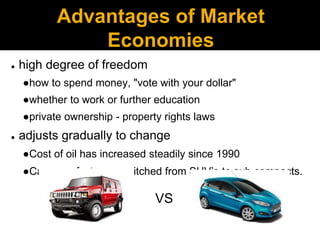
● adjusts gradually to change
●Cost of oil has increased steadily since 1990
●Car manufacturers switched from SUV’s to sub compacts.
VS
Market Economies
Advantages Cont...
● small level of government interference
● national defense, EPA, Social Security, trust-
busting, monopoly prevention
● decision making is decentralized
● people/companies make their own choices
● lots of consumer satisfaction
● you can get what you want, other people can get what
they want.
● variety
● avg. wal mart has 120,000 items
Disadvantages of Market
Economies
● A market economy does not provide for everyone’s
basic needs
●young, elderly, sick - not profitable
●The government must provide for these people (using tax money)
if family/charity can’t.
● does not provide all basic goods/services
●education, health care, roads, public buildings - public funded
●no profit, no product
● high degree of uncertainty
●Company ships offshore?
●Competition drive you out of business?
Mixed Economies
● Various combinations of all three
● Different aspects of Government, traditional, and market
economies
● minimal government intervention:
● Defense, a justice system, education
Examples of Mixed
Economies
● China
●Government owns the
factors of production
● Tradition dictates what
people do
● some private ownership
allowed
● Norway
● Government owns just
the petroleum industry
● keeps gas prices low,
finance education, maintain
roads, provide social
welfare for citizens.
Advantages of Mixed
Economies
●provides assistance for people
● young, old, sick
●traditions are still important
●voting (in some)
● affect the WHAT, HOW, and for WHOM questions.
Disadvantages of Mixed
Economies
●costs can get big
● very high tax rates
●France: 63% of income taxed
● More government services, more taxes.
●sometimes quality can suffer
● no profit, no incentive, less quality.
Social Goals of Economics
1. freedom
2. efficiency
3. full employment
4. growth
5. security
a. job security, social safety nets
6. price stability
a. control inflation and deflation
7. equity
a. fair to both sides
b. Minimum wage is designed to
provide a livable wage.
The American Free Enterprise
System
● Capitalism – private citizens own and use
the factors of production to generate
profit
● Free enterprise has –
●little government interference
●competition: having more than one business
to choose from
Characteristics of The American
Free Enterprise System
●Freedom
●to buy, to sell, to work, to quit, to hire…
●Voluntary exchange
●Private property rights
●Profit motive
●Competition
The American Free Enterprise
System
● Three participants:
● Entrepreneur
● Focused on profit
● Might do well, might fail
● The “catalyst”
● Consumer
● Have power because they buy what they want
● Government: 3 roles
● Protector
● enforce laws to protect consumers/workers
● Provider
● justice, defense, subsidies, roads, public buildings

wiggly piggle

  • 1.
    Bell ringer #38/25 ● What are your plans for after you finish high school? ● what is the opportunity cost of your decision? -(What are you giving up?)
  • 2.
  • 3.
    Traditional Economies Characteristics ● Thethree questions (what, how, for whom) are answered using ritual, habit, and custom ● New ideas and new ways of doing things are discouraged because they do not follow tradition. ● A person’s role in the community is decided by the elders
  • 4.
    Examples of Traditional Economies●The Diaguita Indians of Chile ●Farmers the same crops using the irrigation systems their ancestors created in the 15th century. They also herd the same animals, Llamas. ● The Inuit of Northern Canada ●“We are told today that Inuit never had laws. Why? They say because they are not written on paper. When I think of paper, I think you can tear it up, and the laws are gone. The laws of the Inuit are not on paper.”
  • 5.
    The Potlatch economy ●Potlatch - gift giving ceremony ● economic system for some indigenous North American coastal dwellers (inuit) o a family or hereditary leader hosts guests in their family's house and holds a feast for their guests o main point to redistribute wealth from host to guest o a display of wealth and prosperity through generosity o "give until it hurts" o prestige and honor is gained by whoever can give away the most of their possessions and food.
  • 6.
    Advantages of Traditional Economies ●everybody knows what they are supposed to do with their lives ● hunters hunt, farmers farm ● the way things are done has been decided ● no pressure to innovate ● who-gets-what doesn’t change ●security, life is consistent.
  • 7.
    Disadvantages of Traditional Economies ●discourages new ideas ● punishment for acting differently ● stagnation ● low standard of living ● no ability to change position/role
  • 8.
    Command Economies ● Thegovernment of a command economy makes all major economic decisions. ● What, how, for whom ● types of leaders: ● king, dictator, Tzar ● Individual freedom is limited ● no property rights, no freedom of speech, no voting.
  • 9.
    Examples of Command Economies ●Not a lot of these (pure) left: ● North Korea ● Cuba ● USSR or soviet Russia
  • 10.
    Advantages of Command Economies ●What is produced can change quickly and drastically ●tractors one week, tanks the next ● Public Health care, Pensions, jobs are available ● Government owns all businesses, so it decides costs and whether or not people pay.
  • 11.
    Disadvantages of Command Economies ●No emphasis on peoples’ wants or needs ● “for who” not answered ● quality vs. quantity ●must meet quotas, cut corners ● lots of bureaucracy ●takes a very long time for anything to be accomplished. ● day-to-day problems can be tough ●inefficient distribution systems lead to shortages ● starvation
  • 12.
  • 13.
    Market Economies (pure) ●People make decisions in their own interest ●What do I want? Where should I buy it? How much am I willing to pay for it? ● Relies on different “markets” ●where buyers and sellers meet to exchange goods for money ●farmers market/ amazon.com, etsy ● Individuals have the freedom to buy, sell, or save as they want.
  • 14.
    Examples of Market Economies ●USA ● Japan ● Great Britain
  • 15.
    Advantages of Market Economies ●high degree of freedom ●how to spend money, "vote with your dollar" ●whether to work or further education ●private ownership - property rights laws ● adjusts gradually to change ●Cost of oil has increased steadily since 1990 ●Car manufacturers switched from SUV’s to sub compacts. VS
  • 16.
    Market Economies Advantages Cont... ●small level of government interference ● national defense, EPA, Social Security, trust- busting, monopoly prevention ● decision making is decentralized ● people/companies make their own choices ● lots of consumer satisfaction ● you can get what you want, other people can get what they want. ● variety ● avg. wal mart has 120,000 items
  • 17.
    Disadvantages of Market Economies ●A market economy does not provide for everyone’s basic needs ●young, elderly, sick - not profitable ●The government must provide for these people (using tax money) if family/charity can’t. ● does not provide all basic goods/services ●education, health care, roads, public buildings - public funded ●no profit, no product ● high degree of uncertainty ●Company ships offshore? ●Competition drive you out of business?
  • 18.
    Mixed Economies ● Variouscombinations of all three ● Different aspects of Government, traditional, and market economies ● minimal government intervention: ● Defense, a justice system, education
  • 19.
    Examples of Mixed Economies ●China ●Government owns the factors of production ● Tradition dictates what people do ● some private ownership allowed ● Norway ● Government owns just the petroleum industry ● keeps gas prices low, finance education, maintain roads, provide social welfare for citizens.
  • 20.
    Advantages of Mixed Economies ●providesassistance for people ● young, old, sick ●traditions are still important ●voting (in some) ● affect the WHAT, HOW, and for WHOM questions.
  • 21.
    Disadvantages of Mixed Economies ●costscan get big ● very high tax rates ●France: 63% of income taxed ● More government services, more taxes. ●sometimes quality can suffer ● no profit, no incentive, less quality.
  • 22.
    Social Goals ofEconomics 1. freedom 2. efficiency 3. full employment 4. growth 5. security a. job security, social safety nets 6. price stability a. control inflation and deflation 7. equity a. fair to both sides b. Minimum wage is designed to provide a livable wage.
  • 23.
    The American FreeEnterprise System ● Capitalism – private citizens own and use the factors of production to generate profit ● Free enterprise has – ●little government interference ●competition: having more than one business to choose from
  • 24.
    Characteristics of TheAmerican Free Enterprise System ●Freedom ●to buy, to sell, to work, to quit, to hire… ●Voluntary exchange ●Private property rights ●Profit motive ●Competition
  • 25.
    The American FreeEnterprise System ● Three participants: ● Entrepreneur ● Focused on profit ● Might do well, might fail ● The “catalyst” ● Consumer ● Have power because they buy what they want ● Government: 3 roles ● Protector ● enforce laws to protect consumers/workers ● Provider ● justice, defense, subsidies, roads, public buildings