The Big Three Questions
• Every economic system in the world, past and
present, has to answer these three questions:
• What to produce? (How did economists answer this
question?)
• For whom to produce it?
• How to produce it? (Who owns the factors of
production?)
4 Different Economic Systems
• Traditional
• Command/Socialism
• Capitalism/Market
• Mixed
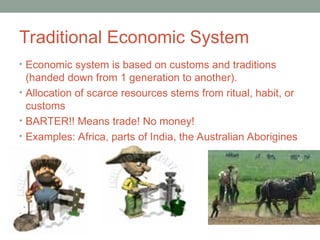
Traditional Economic System
• Economic system is based on customs and traditions
(handed down from 1 generation to another).
• Allocation of scarce resources stems from ritual, habit, or
customs
• BARTER!! Means trade! No money!
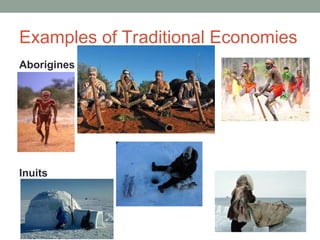
• Examples: Africa, parts of India, the Australian Aborigines
Examples of Traditional Economies
Aborigines
Inuits
Advantages Disadvantages
• Economic roles are set
• Stable, predictable,
and continuous
• Discourages new
ideas
• Lack of progress
• Lower standard of
living
Does a traditional economy answer the
big three questions?
• What will be produced?
• Whatever tradition, values, and rituals dictate
• How will it be produced?
• However tradition, values, and rituals dictate
• For whom will it be produced?
• Whomever tradition, values and rituals dictate
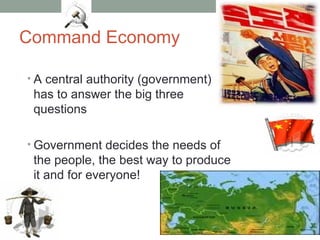
Command Economy
• A central authority (government)
has to answer the big three
questions
• Government decides the needs of
the people, the best way to produce
it and for everyone!
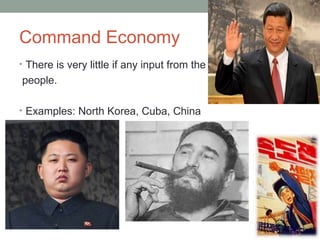
Command Economy
• There is very little if any input from the
people.
• Examples: North Korea, Cuba, China
Advantages Disadvantages
• Basic Needs taken
care of
• Education, public
health, other services
cost very little if
anything
• Very little
unemployment
• Doesn’t meet wants
• No incentives
• Requires a large
bureaucracy
• New and different
ideas are discouraged
• No room for
individuality
Does a command economy answer the
big three questions?
• What is being produced?
• Whatever the government decides
• How is it being produced?
• The government will tell someone to make it
• For whom is it being produced?
• Whomever the government decides needs it
Capitalism/Market
• System that relies on consumption choices made by
consumers
• Consumers dictate what is produced, how much is
produced, and how much things cost
Capitalism/Market
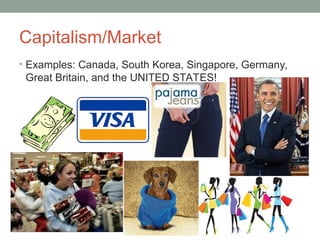
• Examples: Canada, South Korea, Singapore, Germany,
Great Britain, and the UNITED STATES!
Advantages Disadvantages
• Individual Freedom for
all
• Lack of government
interference
• Incredible variety to
choose from
• High degree of
consumer satisfaction
• Rewards only productive
people
• Workers and businesses
face uncertainty
(Competition)
• Not enough public goods
(Education, health,
defense)
• Unemployment
• Must guard against market
failure
Answer the big three…
• What will be produced?
• Whatever the consumer wants
• How will it be produced?
• Entrepreneurs will respond to demand
• For whom will it be produced?
• Whomever is willing to work for it (or afford it)
Mixed Economy
• A mix of all of the other three economies
• Some government involvement, consumer driven,
aspects of economy based on traditional values
• This is really what the US is….
• Examples: Obama Care, Bail outs yet consumer
driven. Family owned stores and corporations.
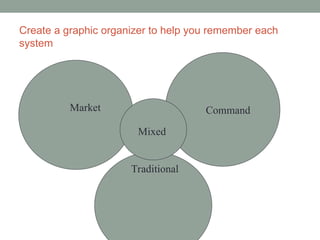
Create a graphic organizer to help you remember each
system
Market Command
Traditional
Mixed
Or maybe this…
Traditional Command Market Mixed

4 Different Economic Systems Traditional-Market-Command-Mixed.ppt

  • 1.
    The Big ThreeQuestions • Every economic system in the world, past and present, has to answer these three questions: • What to produce? (How did economists answer this question?) • For whom to produce it? • How to produce it? (Who owns the factors of production?)
  • 2.
    4 Different EconomicSystems • Traditional • Command/Socialism • Capitalism/Market • Mixed
  • 3.
    Traditional Economic System •Economic system is based on customs and traditions (handed down from 1 generation to another). • Allocation of scarce resources stems from ritual, habit, or customs • BARTER!! Means trade! No money! • Examples: Africa, parts of India, the Australian Aborigines
  • 4.
    Examples of TraditionalEconomies Aborigines Inuits
  • 5.
    Advantages Disadvantages • Economicroles are set • Stable, predictable, and continuous • Discourages new ideas • Lack of progress • Lower standard of living
  • 6.
    Does a traditionaleconomy answer the big three questions? • What will be produced? • Whatever tradition, values, and rituals dictate • How will it be produced? • However tradition, values, and rituals dictate • For whom will it be produced? • Whomever tradition, values and rituals dictate
  • 7.
    Command Economy • Acentral authority (government) has to answer the big three questions • Government decides the needs of the people, the best way to produce it and for everyone!
  • 8.
    Command Economy • Thereis very little if any input from the people. • Examples: North Korea, Cuba, China
  • 9.
    Advantages Disadvantages • BasicNeeds taken care of • Education, public health, other services cost very little if anything • Very little unemployment • Doesn’t meet wants • No incentives • Requires a large bureaucracy • New and different ideas are discouraged • No room for individuality
  • 10.
    Does a commandeconomy answer the big three questions? • What is being produced? • Whatever the government decides • How is it being produced? • The government will tell someone to make it • For whom is it being produced? • Whomever the government decides needs it
  • 11.
    Capitalism/Market • System thatrelies on consumption choices made by consumers • Consumers dictate what is produced, how much is produced, and how much things cost
  • 12.
    Capitalism/Market • Examples: Canada,South Korea, Singapore, Germany, Great Britain, and the UNITED STATES!
  • 13.
    Advantages Disadvantages • IndividualFreedom for all • Lack of government interference • Incredible variety to choose from • High degree of consumer satisfaction • Rewards only productive people • Workers and businesses face uncertainty (Competition) • Not enough public goods (Education, health, defense) • Unemployment • Must guard against market failure
  • 14.
    Answer the bigthree… • What will be produced? • Whatever the consumer wants • How will it be produced? • Entrepreneurs will respond to demand • For whom will it be produced? • Whomever is willing to work for it (or afford it)
  • 15.
    Mixed Economy • Amix of all of the other three economies • Some government involvement, consumer driven, aspects of economy based on traditional values • This is really what the US is…. • Examples: Obama Care, Bail outs yet consumer driven. Family owned stores and corporations.
  • 16.
    Create a graphicorganizer to help you remember each system Market Command Traditional Mixed
  • 17.
    Or maybe this… TraditionalCommand Market Mixed