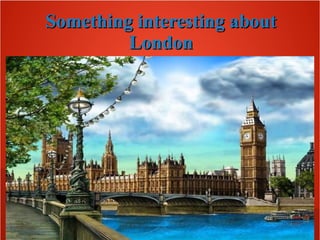
Something interesting aboutSomething interesting about
LondonLondon
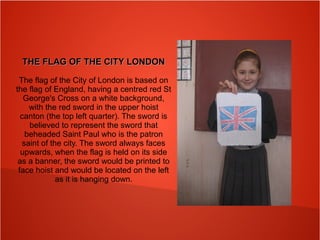
THE FLAG OF THE CITY LONDONTHE FLAG OF THE CITY LONDON
The flag of the City of London is based on
the flag of England, having a centred red St
George's Cross on a white background,
with the red sword in the upper hoist
canton (the top left quarter). The sword is
believed to represent the sword that
beheaded Saint Paul who is the patron
saint of the city. The sword always faces
upwards, when the flag is held on its side
as a banner, the sword would be printed to
face hoist and would be located on the left
as it is hanging down.
SHORT HISTORY OF LONDONSHORT HISTORY OF LONDON
London is an old city.
It grew up around the first point where
the Roman invaders found the Thames
narrow enough to build a bridge. There
has been a “London Bridge” in the
same area ever since.
They founded a Celtic settlement then
known as Londinium and later they had
turned it into a large port and important
trading centre with a long wall of stone
and brick. Inside the wall low houses
were built with bright red tiled roofs.
The Tower of London was founded by Julius
Caesar and in 1066 rebuilt by William the
Conqueror. It was used as a fortress, a royal
residence and a prison. Now it is a museum and
also the place where the Crown Jewels are kept.
Time passed. London grew and became a great
city. The coming of the railway changed London
for ever. The first underground railway was
opened in 1863 between Paddington and the
City.
Today London is the capital of Great Britain and
Northern Ireland. It is one of the most beautiful
cities in the world.
There are many places of interest in it and this
city is well worth visiting.
TOWER BRIDGETOWER BRIDGE
Tower Bridge has stood over the River
Thames in London since 1894. At the
Tower Bridge Exhibition you can enjoy
views from the high-level Walkways and
learn about the history of the Bridge and
how it was built. You can then visit the
Victorian Engine Rooms, home to the
original steam engines that used to power
the Bridge lifts.
BUCKINGHAM PALACEBUCKINGHAM PALACE
Buckingham Palace has served as the
official London residence of Britain's
sovereigns since 1837. It evolved from a
town house that was owned from the
beginning of the eighteenth century by the
Dukes of Buckingham.
Today it is The Queen's official residence.
The State Rooms at Buckingham Palace are
open to visit for 2 months during the
summer.
THE LONDON DUNGEONTHE LONDON DUNGEON
The London Dungeon was founded in
1974 by Annabel Geddes. It was initially
designed as a museum of macabre
history depicting gory scenes. Early
characters included Boudicca, Mary
Tudor and Thomas Beckett and had
scenes from the Norman Conquest. Over
the years the Dungeon has changed into
an actor-led, interactive experience with
both humorous and light horror elements.
London’s first ever indoor water ride was
installed at the venue in 1997.
SHERLOCK HOLMES MUSEUMSHERLOCK HOLMES MUSEUM
Sherlock Holmes and Doctor Watson are
detective characters created by Sir Arthur Conan
Doyle. According to the books, Sherlock Holmes
and Doctor Watson lived at 221b Baker Street,
London between 1881-1904.
The building at 221b Baker Street is open as a
museum dedicated to the life and times of
Sherlock Holmes, and the interior has been
maintained as described in the published stories.
The house is "listed" so has to be preserved due
to its "special architectural and historical
interest", while the first floor study overlooking
Baker Street is still faithfully maintained for
posterity as it was kept in Victorian Times.
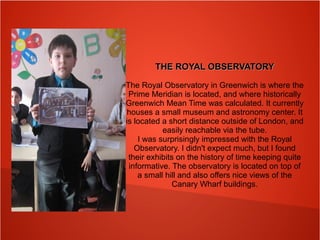
THE ROYAL OBSERVATORYTHE ROYAL OBSERVATORY
The Royal Observatory in Greenwich is where the
Prime Meridian is located, and where historically
Greenwich Mean Time was calculated. It currently
houses a small museum and astronomy center. It
is located a short distance outside of London, and
easily reachable via the tube.
I was surprisingly impressed with the Royal
Observatory. I didn't expect much, but I found
their exhibits on the history of time keeping quite
informative. The observatory is located on top of
a small hill and also offers nice views of the
Canary Wharf buildings.
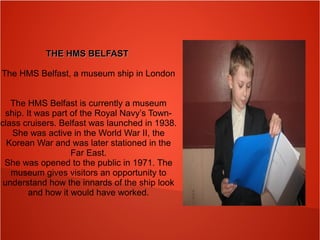
THE HMS BELFASTTHE HMS BELFAST
The HMS Belfast, a museum ship in London
The HMS Belfast is currently a museum
ship. It was part of the Royal Navy’s Town-
class cruisers. Belfast was launched in 1938.
She was active in the World War II, the
Korean War and was later stationed in the
Far East.
She was opened to the public in 1971. The
museum gives visitors an opportunity to
understand how the innards of the ship look
and how it would have worked.
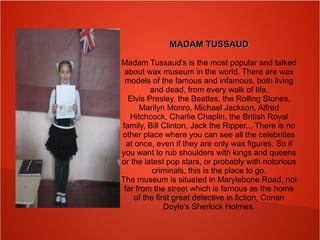
MADAM TUSSAUDMADAM TUSSAUD
Madam Tussaud's is the most popular and talked
about wax museum in the world. There are wax
models of the famous and infamous, both living
and dead, from every walk of life.
Elvis Presley, the Beatles, the Rolling Stones,
Marilyn Monro, Michael Jackson, Alfred
Hitchcock, Charlie Chaplin, the British Royal
family, Bill Clinton, Jack the Ripper... There is no
other place where you can see all the celebrities
at once, even if they are only wax figures. So if
you want to rub shoulders with kings and queens
or the latest pop stars, or probably with notorious
criminals, this is the place to go.
The museum is situated in Marylebone Road, not
far from the street which is famous as the home
of the first great detective in fiction, Conan
Doyle's Sherlock Holmes.
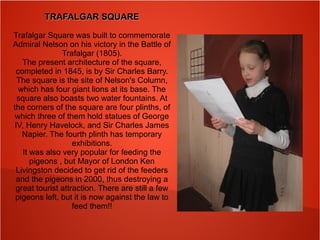
TRAFALGAR SQUARETRAFALGAR SQUARE
Trafalgar Square was built to commemorate
Admiral Nelson on his victory in the Battle of
Trafalgar (1805).
The present architecture of the square,
completed in 1845, is by Sir Charles Barry.
The square is the site of Nelson's Column,
which has four giant lions at its base. The
square also boasts two water fountains. At
the corners of the square are four plinths, of
which three of them hold statues of George
IV, Henry Havelock, and Sir Charles James
Napier. The fourth plinth has temporary
exhibitions.
It was also very popular for feeding the
pigeons , but Mayor of London Ken
Livingston decided to get rid of the feeders
and the pigeons in 2000, thus destroying a
great tourist attraction. There are still a few
pigeons left, but it is now against the law to
feed them!!
THE GLOBE THEATRETHE GLOBE THEATRE
The original Globe Theatre was built in 1599 by the
playing company to which William Shakespeare
belonged, and destroyed by fire in 1613. It was
rebuilt in 1614, closed in 1642, and demolished in
1644. A modern reconstruction of the original
Globe, named 'Shakespeare's Globe Theatre',
opened in 1997.
Founded by the pioneering American
actor/director Sam Wanamaker, Shakespeare's
Globe is a unique international resource dedicated
to the exploration of Shakespeare's work, and the
playhouse for which he wrote, through the
connected means of education and performance.
Open all year round, Shakespeare’s Globe
Exhibition is the world’s largest exhibition devoted
to Shakespeare and the London in which he lived
and worked. Housed in the vast UnderGlobe
beneath the theatre, the exhibition explores the
remarkable story of Sam Wanamaker’s struggle to
rebuild the Globe and brings Shakespeare’s world
to life using a range of interactive displays and live
demonstrations.
THE HOUSES OF PARLIAMENTTHE HOUSES OF PARLIAMENT
The site of the Houses of Parliament is the
Palace of Westminster, a royal palace and
former residence of kings. Its existing
buildings contains nearly 1,200 rooms, 100
staircases and well over 3 kilometres (2
miles) of passages.
The House of Lords and the House of
Commons conduct their sittings here .
The oldest part of the Palace still in
existence, Westminster Hall, dates from
1097. The palace originally served as a royal
residence, but no monarch has lived in it
since the 16th century. Most of the present
structure dates from the 19th century, when
the Palace was rebuilt after it was almost
entirely destroyed by a fire in 1834. The
architect responsible for rebuilding the
Palace was Sir Charles Barry and Augustus
Welby Pugin.
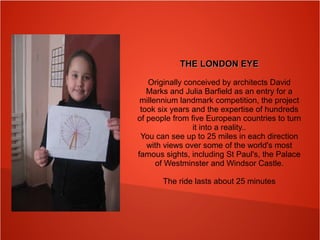
THE LONDON EYETHE LONDON EYE
Originally conceived by architects David
Marks and Julia Barfield as an entry for a
millennium landmark competition, the project
took six years and the expertise of hundreds
of people from five European countries to turn
it into a reality..
You can see up to 25 miles in each direction
with views over some of the world's most
famous sights, including St Paul's, the Palace
of Westminster and Windsor Castle.
The ride lasts about 25 minutes
CUTTY SARKCUTTY SARK
Cutty Sark is a clipper ship. Built in 1869,
she served as a merchant vessel (the last
clipper to be built for that purpose), and
then as a training ship until being put on
public display in 1954. She is preserved in
dry dock at Greenwich in London, but was
damaged in a fire on 21 May 2007 while
undergoing extensive restoration.
WE LOVE LONDON!
Thank you!

London 4 b

  • 1.
    Something interesting aboutSomethinginteresting about LondonLondon
  • 2.
    THE FLAG OFTHE CITY LONDONTHE FLAG OF THE CITY LONDON The flag of the City of London is based on the flag of England, having a centred red St George's Cross on a white background, with the red sword in the upper hoist canton (the top left quarter). The sword is believed to represent the sword that beheaded Saint Paul who is the patron saint of the city. The sword always faces upwards, when the flag is held on its side as a banner, the sword would be printed to face hoist and would be located on the left as it is hanging down.
  • 3.
    SHORT HISTORY OFLONDONSHORT HISTORY OF LONDON London is an old city. It grew up around the first point where the Roman invaders found the Thames narrow enough to build a bridge. There has been a “London Bridge” in the same area ever since. They founded a Celtic settlement then known as Londinium and later they had turned it into a large port and important trading centre with a long wall of stone and brick. Inside the wall low houses were built with bright red tiled roofs.
  • 4.
    The Tower ofLondon was founded by Julius Caesar and in 1066 rebuilt by William the Conqueror. It was used as a fortress, a royal residence and a prison. Now it is a museum and also the place where the Crown Jewels are kept. Time passed. London grew and became a great city. The coming of the railway changed London for ever. The first underground railway was opened in 1863 between Paddington and the City. Today London is the capital of Great Britain and Northern Ireland. It is one of the most beautiful cities in the world. There are many places of interest in it and this city is well worth visiting.
  • 5.
    TOWER BRIDGETOWER BRIDGE TowerBridge has stood over the River Thames in London since 1894. At the Tower Bridge Exhibition you can enjoy views from the high-level Walkways and learn about the history of the Bridge and how it was built. You can then visit the Victorian Engine Rooms, home to the original steam engines that used to power the Bridge lifts.
  • 6.
    BUCKINGHAM PALACEBUCKINGHAM PALACE BuckinghamPalace has served as the official London residence of Britain's sovereigns since 1837. It evolved from a town house that was owned from the beginning of the eighteenth century by the Dukes of Buckingham. Today it is The Queen's official residence. The State Rooms at Buckingham Palace are open to visit for 2 months during the summer.
  • 7.
    THE LONDON DUNGEONTHELONDON DUNGEON The London Dungeon was founded in 1974 by Annabel Geddes. It was initially designed as a museum of macabre history depicting gory scenes. Early characters included Boudicca, Mary Tudor and Thomas Beckett and had scenes from the Norman Conquest. Over the years the Dungeon has changed into an actor-led, interactive experience with both humorous and light horror elements. London’s first ever indoor water ride was installed at the venue in 1997.
  • 8.
    SHERLOCK HOLMES MUSEUMSHERLOCKHOLMES MUSEUM Sherlock Holmes and Doctor Watson are detective characters created by Sir Arthur Conan Doyle. According to the books, Sherlock Holmes and Doctor Watson lived at 221b Baker Street, London between 1881-1904. The building at 221b Baker Street is open as a museum dedicated to the life and times of Sherlock Holmes, and the interior has been maintained as described in the published stories. The house is "listed" so has to be preserved due to its "special architectural and historical interest", while the first floor study overlooking Baker Street is still faithfully maintained for posterity as it was kept in Victorian Times.
  • 9.
    THE ROYAL OBSERVATORYTHEROYAL OBSERVATORY The Royal Observatory in Greenwich is where the Prime Meridian is located, and where historically Greenwich Mean Time was calculated. It currently houses a small museum and astronomy center. It is located a short distance outside of London, and easily reachable via the tube. I was surprisingly impressed with the Royal Observatory. I didn't expect much, but I found their exhibits on the history of time keeping quite informative. The observatory is located on top of a small hill and also offers nice views of the Canary Wharf buildings.
  • 10.
    THE HMS BELFASTTHEHMS BELFAST The HMS Belfast, a museum ship in London The HMS Belfast is currently a museum ship. It was part of the Royal Navy’s Town- class cruisers. Belfast was launched in 1938. She was active in the World War II, the Korean War and was later stationed in the Far East. She was opened to the public in 1971. The museum gives visitors an opportunity to understand how the innards of the ship look and how it would have worked.
  • 11.
    MADAM TUSSAUDMADAM TUSSAUD MadamTussaud's is the most popular and talked about wax museum in the world. There are wax models of the famous and infamous, both living and dead, from every walk of life. Elvis Presley, the Beatles, the Rolling Stones, Marilyn Monro, Michael Jackson, Alfred Hitchcock, Charlie Chaplin, the British Royal family, Bill Clinton, Jack the Ripper... There is no other place where you can see all the celebrities at once, even if they are only wax figures. So if you want to rub shoulders with kings and queens or the latest pop stars, or probably with notorious criminals, this is the place to go. The museum is situated in Marylebone Road, not far from the street which is famous as the home of the first great detective in fiction, Conan Doyle's Sherlock Holmes.
  • 12.
    TRAFALGAR SQUARETRAFALGAR SQUARE TrafalgarSquare was built to commemorate Admiral Nelson on his victory in the Battle of Trafalgar (1805). The present architecture of the square, completed in 1845, is by Sir Charles Barry. The square is the site of Nelson's Column, which has four giant lions at its base. The square also boasts two water fountains. At the corners of the square are four plinths, of which three of them hold statues of George IV, Henry Havelock, and Sir Charles James Napier. The fourth plinth has temporary exhibitions. It was also very popular for feeding the pigeons , but Mayor of London Ken Livingston decided to get rid of the feeders and the pigeons in 2000, thus destroying a great tourist attraction. There are still a few pigeons left, but it is now against the law to feed them!!
  • 13.
    THE GLOBE THEATRETHEGLOBE THEATRE The original Globe Theatre was built in 1599 by the playing company to which William Shakespeare belonged, and destroyed by fire in 1613. It was rebuilt in 1614, closed in 1642, and demolished in 1644. A modern reconstruction of the original Globe, named 'Shakespeare's Globe Theatre', opened in 1997. Founded by the pioneering American actor/director Sam Wanamaker, Shakespeare's Globe is a unique international resource dedicated to the exploration of Shakespeare's work, and the playhouse for which he wrote, through the connected means of education and performance. Open all year round, Shakespeare’s Globe Exhibition is the world’s largest exhibition devoted to Shakespeare and the London in which he lived and worked. Housed in the vast UnderGlobe beneath the theatre, the exhibition explores the remarkable story of Sam Wanamaker’s struggle to rebuild the Globe and brings Shakespeare’s world to life using a range of interactive displays and live demonstrations.
  • 14.
    THE HOUSES OFPARLIAMENTTHE HOUSES OF PARLIAMENT The site of the Houses of Parliament is the Palace of Westminster, a royal palace and former residence of kings. Its existing buildings contains nearly 1,200 rooms, 100 staircases and well over 3 kilometres (2 miles) of passages. The House of Lords and the House of Commons conduct their sittings here . The oldest part of the Palace still in existence, Westminster Hall, dates from 1097. The palace originally served as a royal residence, but no monarch has lived in it since the 16th century. Most of the present structure dates from the 19th century, when the Palace was rebuilt after it was almost entirely destroyed by a fire in 1834. The architect responsible for rebuilding the Palace was Sir Charles Barry and Augustus Welby Pugin.
  • 15.
    THE LONDON EYETHELONDON EYE Originally conceived by architects David Marks and Julia Barfield as an entry for a millennium landmark competition, the project took six years and the expertise of hundreds of people from five European countries to turn it into a reality.. You can see up to 25 miles in each direction with views over some of the world's most famous sights, including St Paul's, the Palace of Westminster and Windsor Castle. The ride lasts about 25 minutes
  • 16.
    CUTTY SARKCUTTY SARK CuttySark is a clipper ship. Built in 1869, she served as a merchant vessel (the last clipper to be built for that purpose), and then as a training ship until being put on public display in 1954. She is preserved in dry dock at Greenwich in London, but was damaged in a fire on 21 May 2007 while undergoing extensive restoration.
  • 17.
  • 18.