© 2019 Synopsys, Inc. 1
Improving Fuzz Testing of Infotainment
Systems and Telematics Units Using
Agent Instrumentation
Rikke Kuipers and Dennis Kengo Oka
rikke.kuipers@synopsys.com
dennis.kengo.oka@synopsys.com
© 2019 Synopsys, Inc. 2
Challenges of fuzzing automotive components
Agent Instrumentation Framework—using
agents on the SUT to improve fuzz testing
Results show it is possible to detect previously
undetectable exceptions
© 2019 Synopsys, Inc. 3
Challenges of fuzzing automotive components
Agent Instrumentation Framework—using
agents on the SUT to improve fuzz testing
Results show it is possible to detect previously
undetectable exceptions
© 2019 Synopsys, Inc. 4
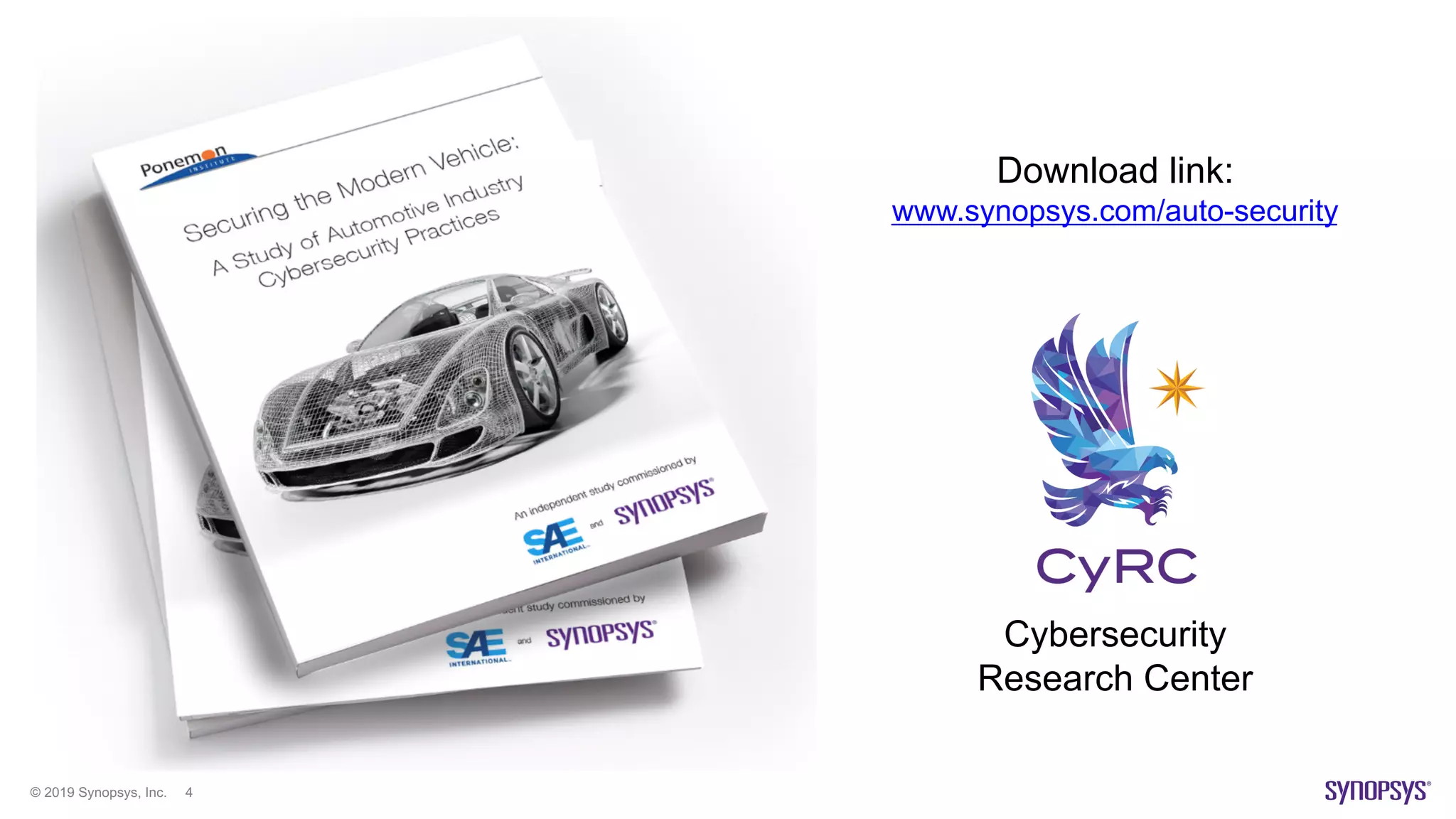
Download link:
www.synopsys.com/auto-security
Cybersecurity
Research Center
© 2019 Synopsys, Inc. 5
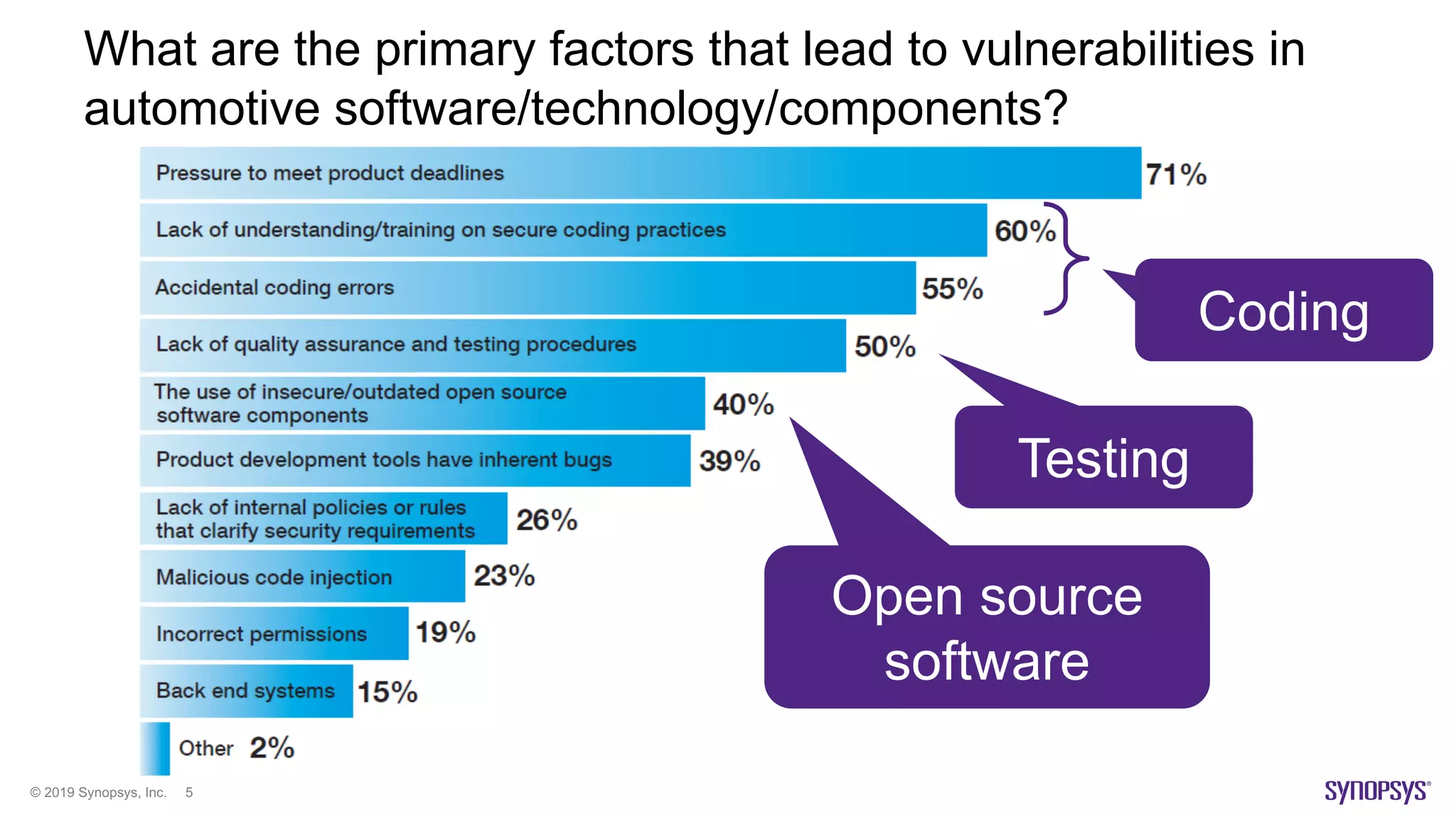
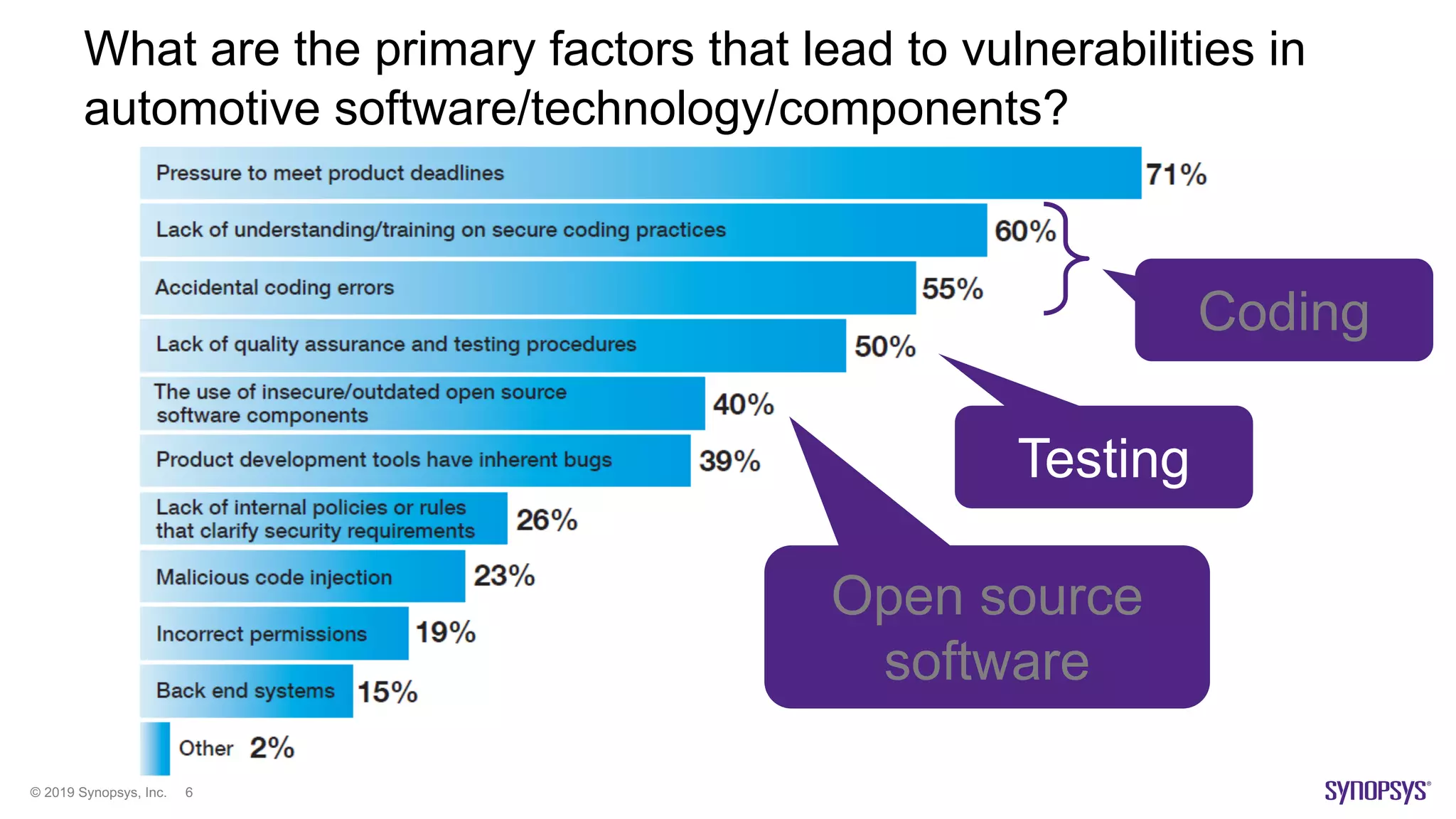
What are the primary factors that lead to vulnerabilities in
automotive software/technology/components?
Coding
Open source
software
Testing
© 2019 Synopsys, Inc. 6
What are the primary factors that lead to vulnerabilities in
automotive software/technology/components?
Coding
Open source
software
Testing
© 2019 Synopsys, Inc. 7
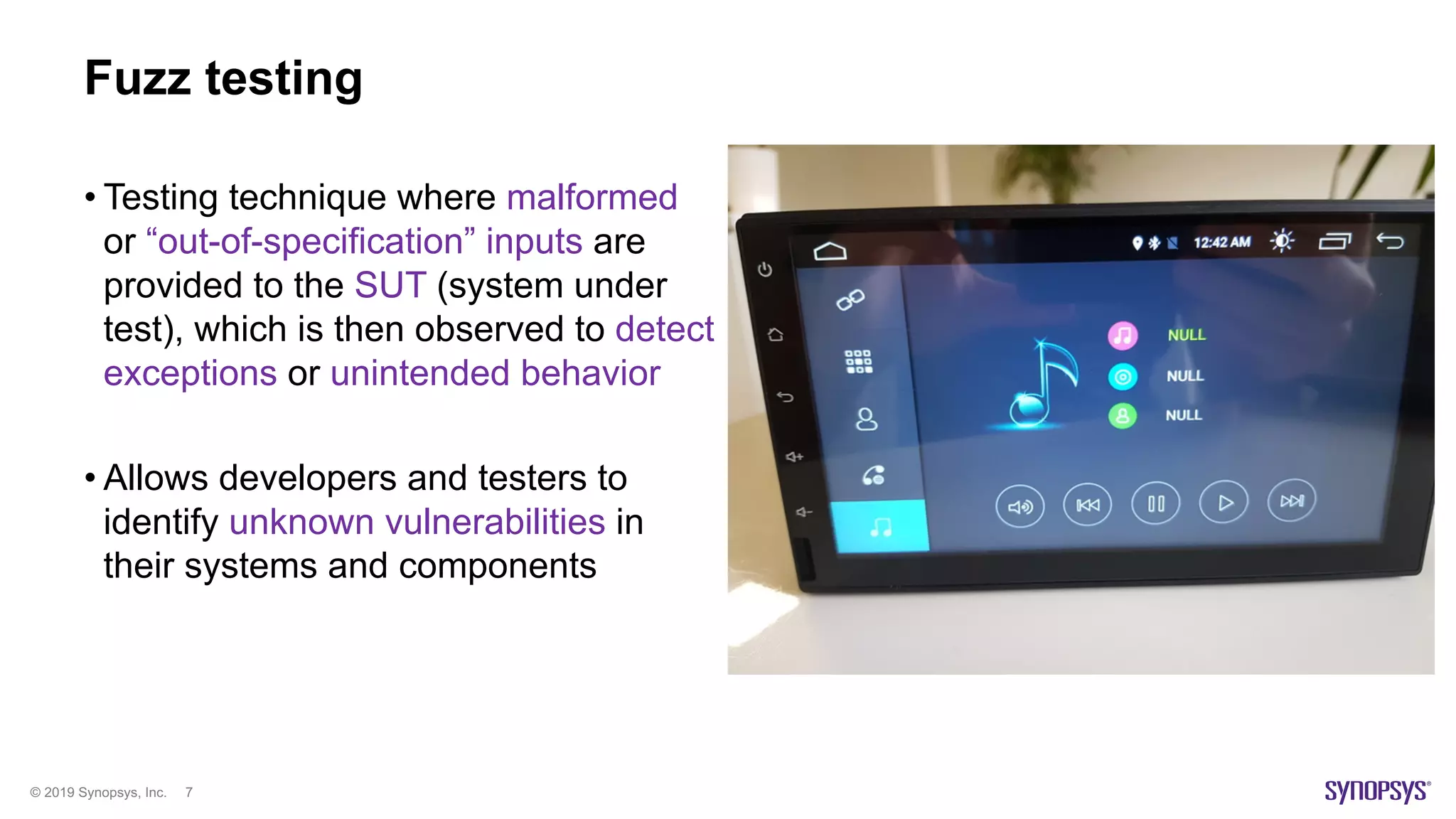
Fuzz testing
• Testing technique where malformed
or “out-of-specification” inputs are
provided to the SUT (system under
test), which is then observed to detect
exceptions or unintended behavior
• Allows developers and testers to
identify unknown vulnerabilities in
their systems and components
© 2019 Synopsys, Inc. 8
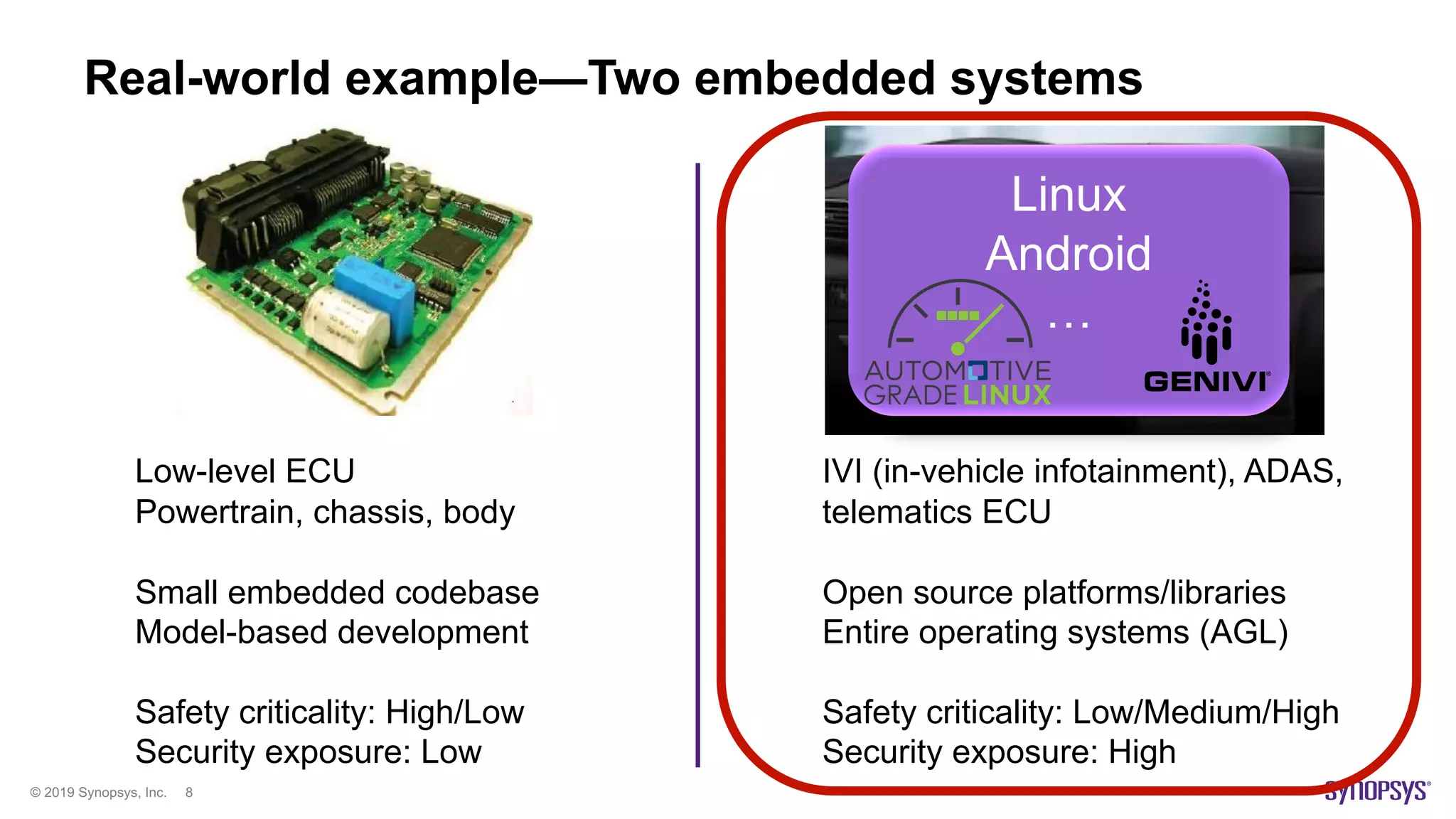
Real-world example—Two embedded systems
Low-level ECU
Powertrain, chassis, body
Small embedded codebase
Model-based development
Safety criticality: High/Low
Security exposure: Low
IVI (in-vehicle infotainment), ADAS,
telematics ECU
Open source platforms/libraries
Entire operating systems (AGL)
Safety criticality: Low/Medium/High
Security exposure: High
Linux
Android
…
© 2019 Synopsys, Inc. 9
Challenges for automotive components
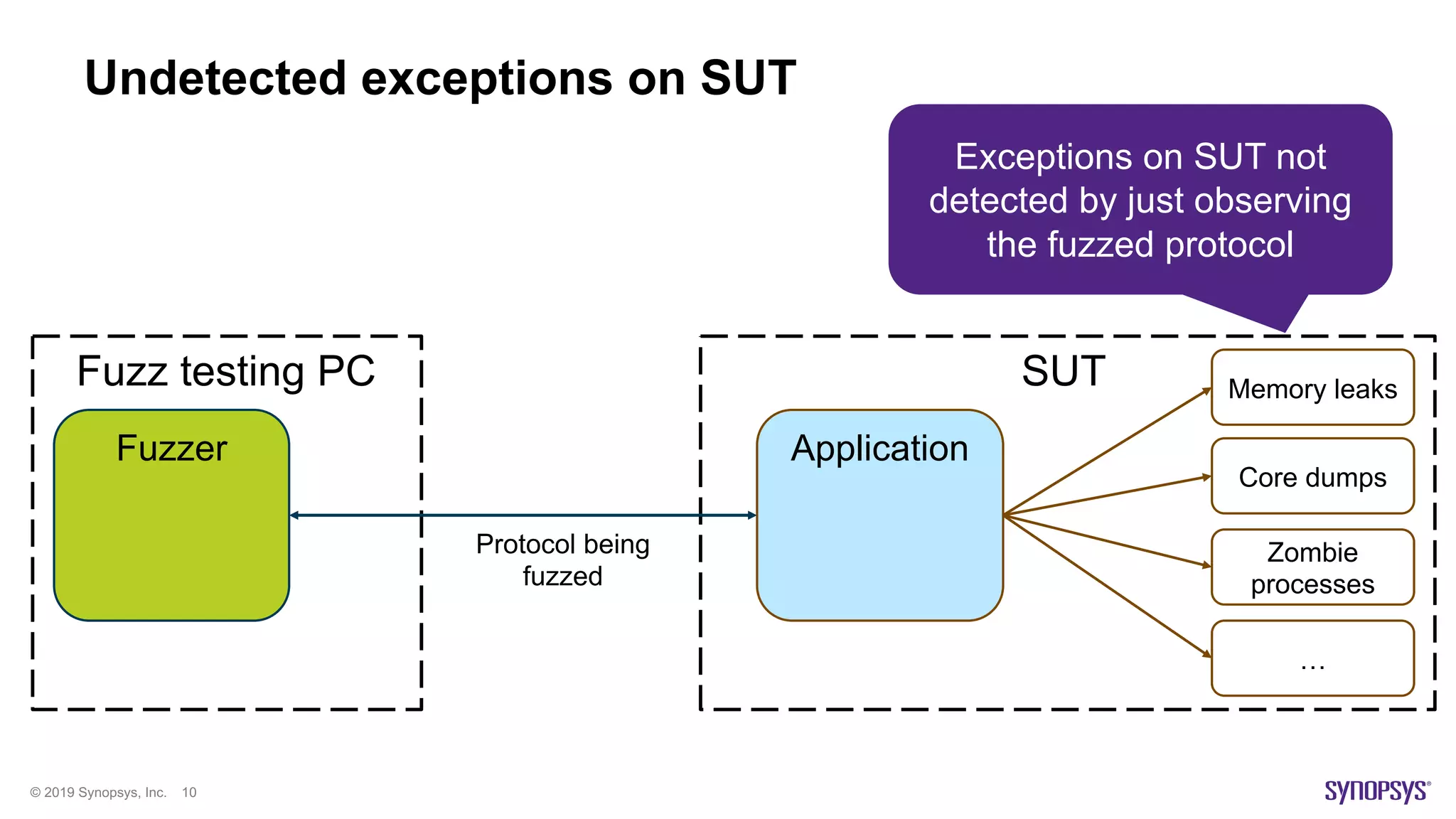
• Difficult to instrument the SUT so as to determine whether there was an
exception or if it has failed or crashed
• E.g., fuzz testing Wi-Fi or Bluetooth, instrumentation typically occurs over the
same protocol that is being fuzzed—this limited instrumentation could lead to
several potential issues going undetected
• Difficult to gather information from the SUT so as to more easily determine the
underlying root causes for the exception or failure
© 2019 Synopsys, Inc. 10
Undetected exceptions on SUT
Fuzzer
SUTFuzz testing PC
Zombie
processes
Protocol being
fuzzed
Memory leaks
Core dumps
Application
…
Exceptions on SUT not
detected by just observing
the fuzzed protocol
© 2019 Synopsys, Inc. 11
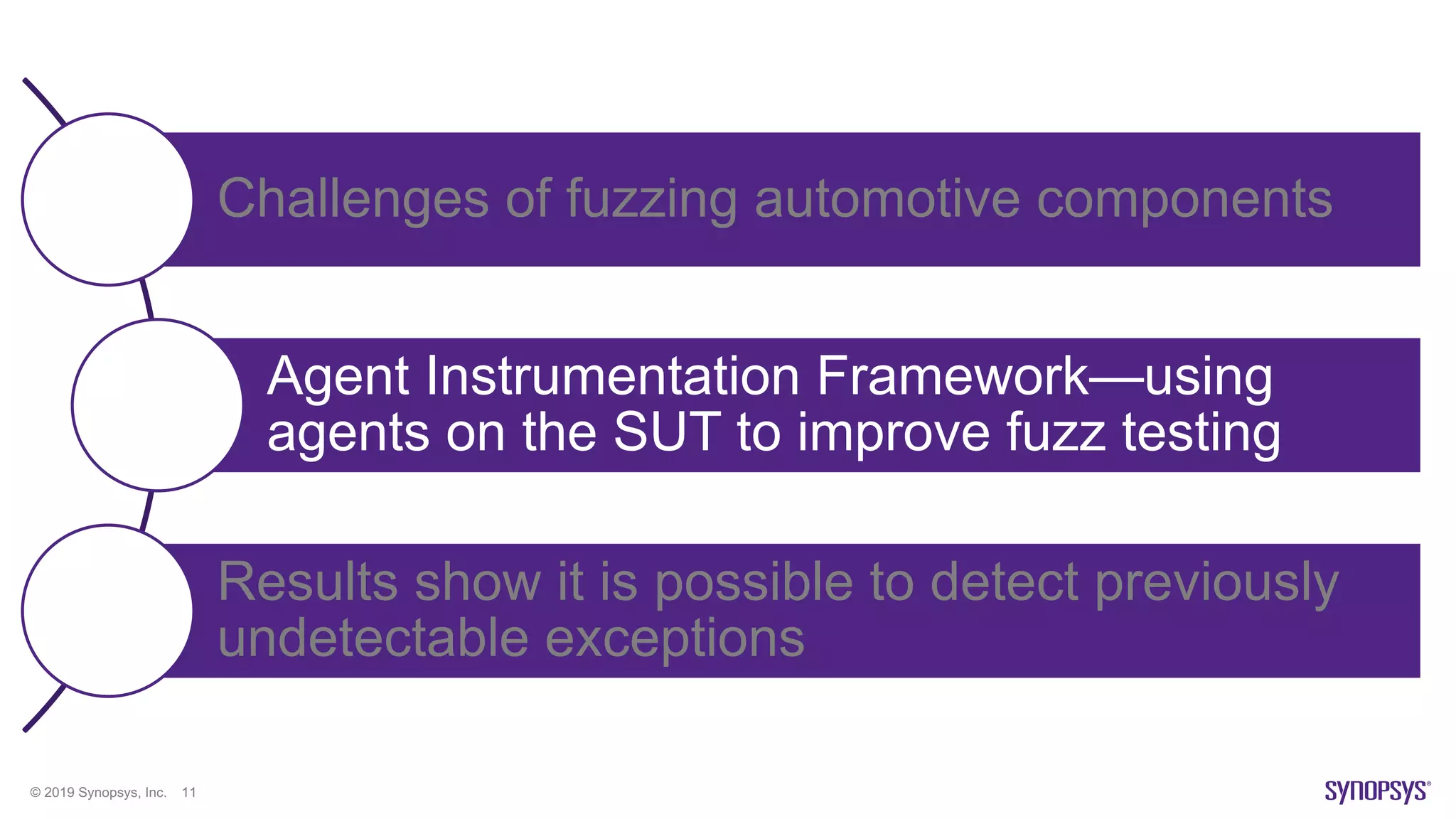
Challenges of fuzzing automotive components
Agent Instrumentation Framework—using
agents on the SUT to improve fuzz testing
Results show it is possible to detect previously
undetectable exceptions
© 2019 Synopsys, Inc. 12
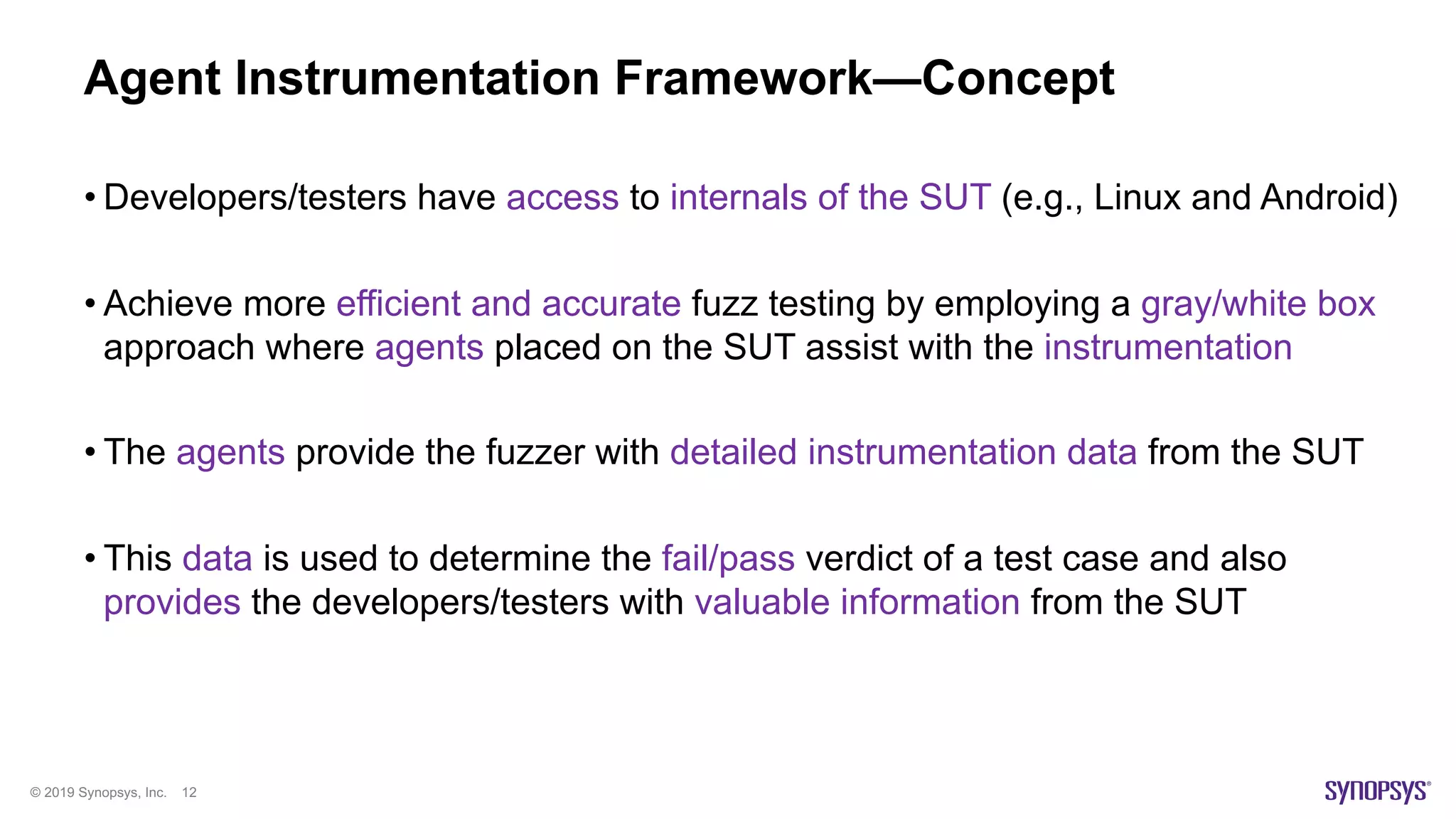
Agent Instrumentation Framework—Concept
• Developers/testers have access to internals of the SUT (e.g., Linux and Android)
• Achieve more efficient and accurate fuzz testing by employing a gray/white box
approach where agents placed on the SUT assist with the instrumentation
• The agents provide the fuzzer with detailed instrumentation data from the SUT
• This data is used to determine the fail/pass verdict of a test case and also
provides the developers/testers with valuable information from the SUT
© 2019 Synopsys, Inc. 13
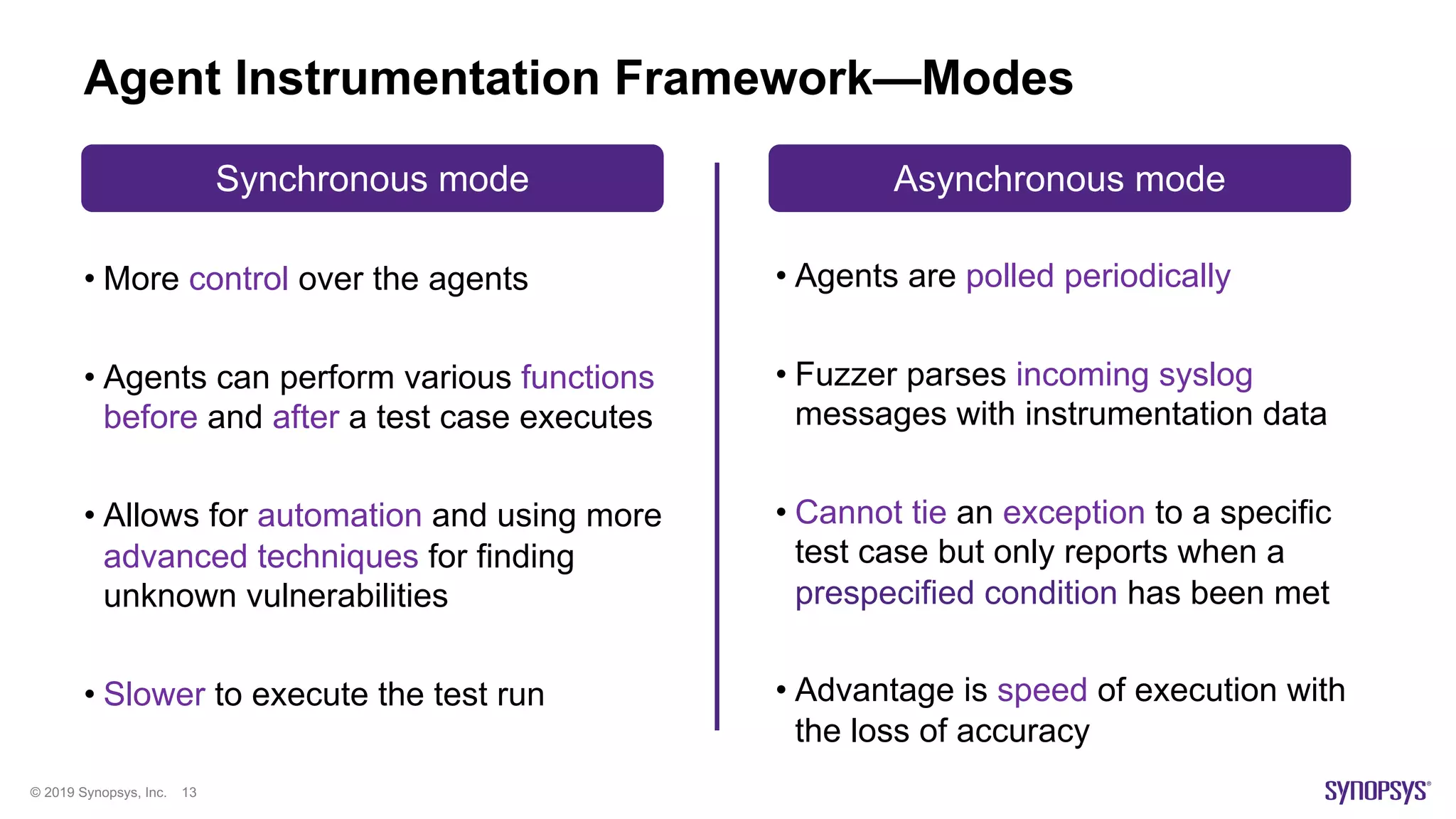
Agent Instrumentation Framework—Modes
• More control over the agents
• Agents can perform various functions
before and after a test case executes
• Allows for automation and using more
advanced techniques for finding
unknown vulnerabilities
• Slower to execute the test run
• Agents are polled periodically
• Fuzzer parses incoming syslog
messages with instrumentation data
• Cannot tie an exception to a specific
test case but only reports when a
prespecified condition has been met
• Advantage is speed of execution with
the loss of accuracy
Synchronous mode Asynchronous mode
© 2019 Synopsys, Inc. 14
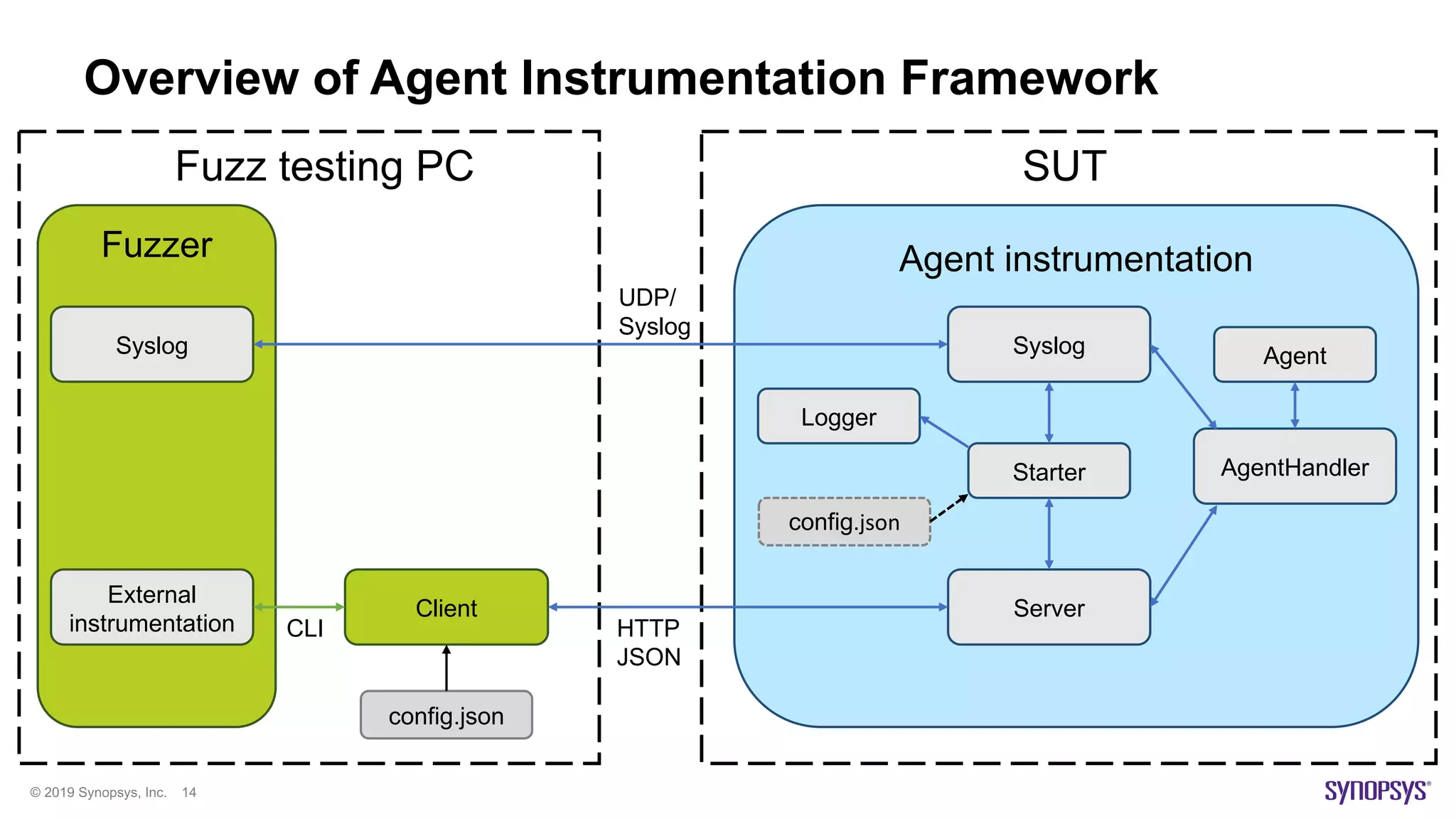
Overview of Agent Instrumentation Framework
Fuzzer Agent instrumentation
SUTFuzz testing PC
Client
External
instrumentation
Syslog
config.json
Server
Syslog
AgentHandler
config.json
Starter
Logger
Agent
CLI HTTP
JSON
UDP/
Syslog
© 2019 Synopsys, Inc. 15
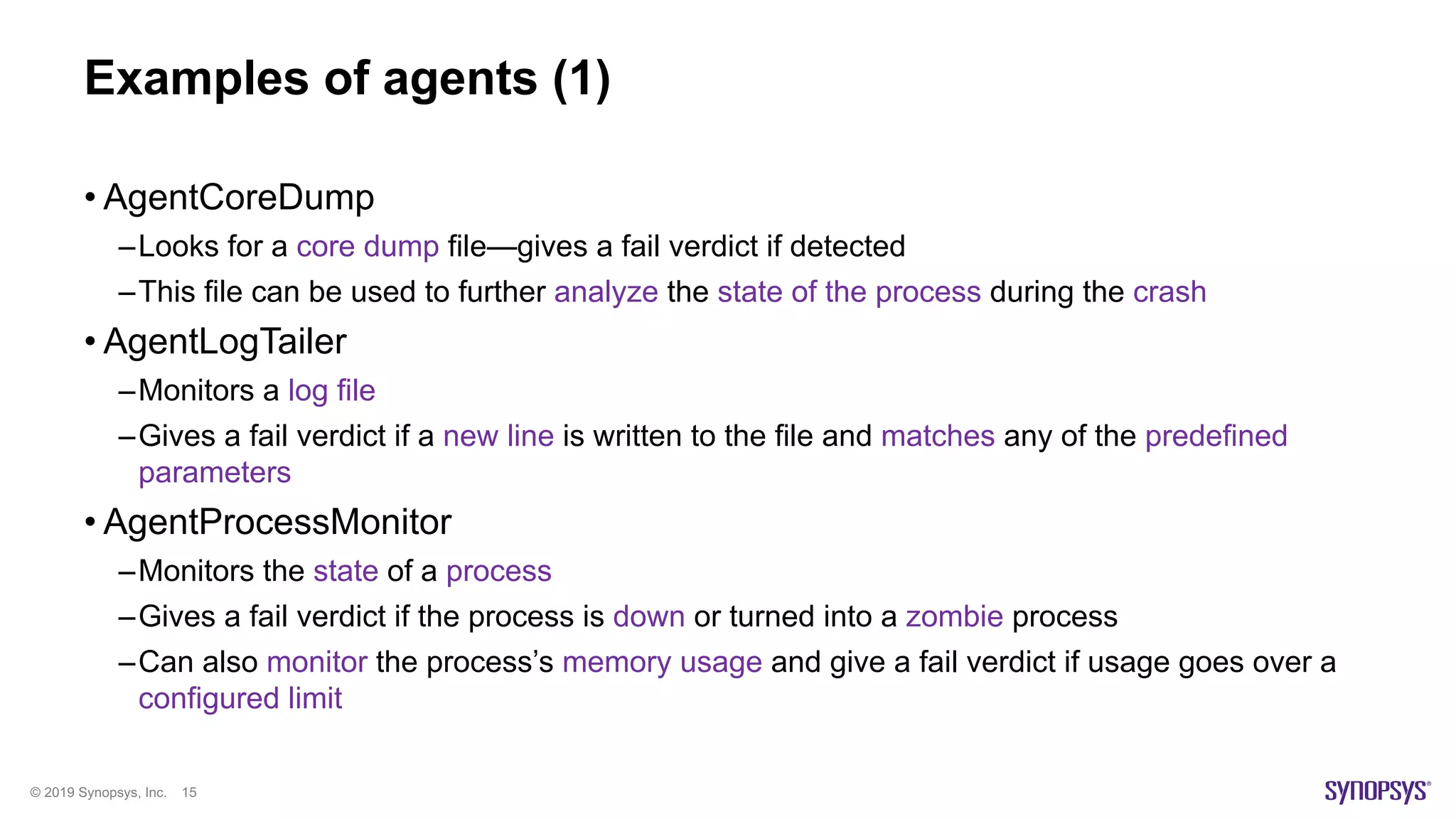
Examples of agents (1)
• AgentCoreDump
–Looks for a core dump file—gives a fail verdict if detected
–This file can be used to further analyze the state of the process during the crash
• AgentLogTailer
–Monitors a log file
–Gives a fail verdict if a new line is written to the file and matches any of the predefined
parameters
• AgentProcessMonitor
–Monitors the state of a process
–Gives a fail verdict if the process is down or turned into a zombie process
–Can also monitor the process’s memory usage and give a fail verdict if usage goes over a
configured limit
© 2019 Synopsys, Inc. 16
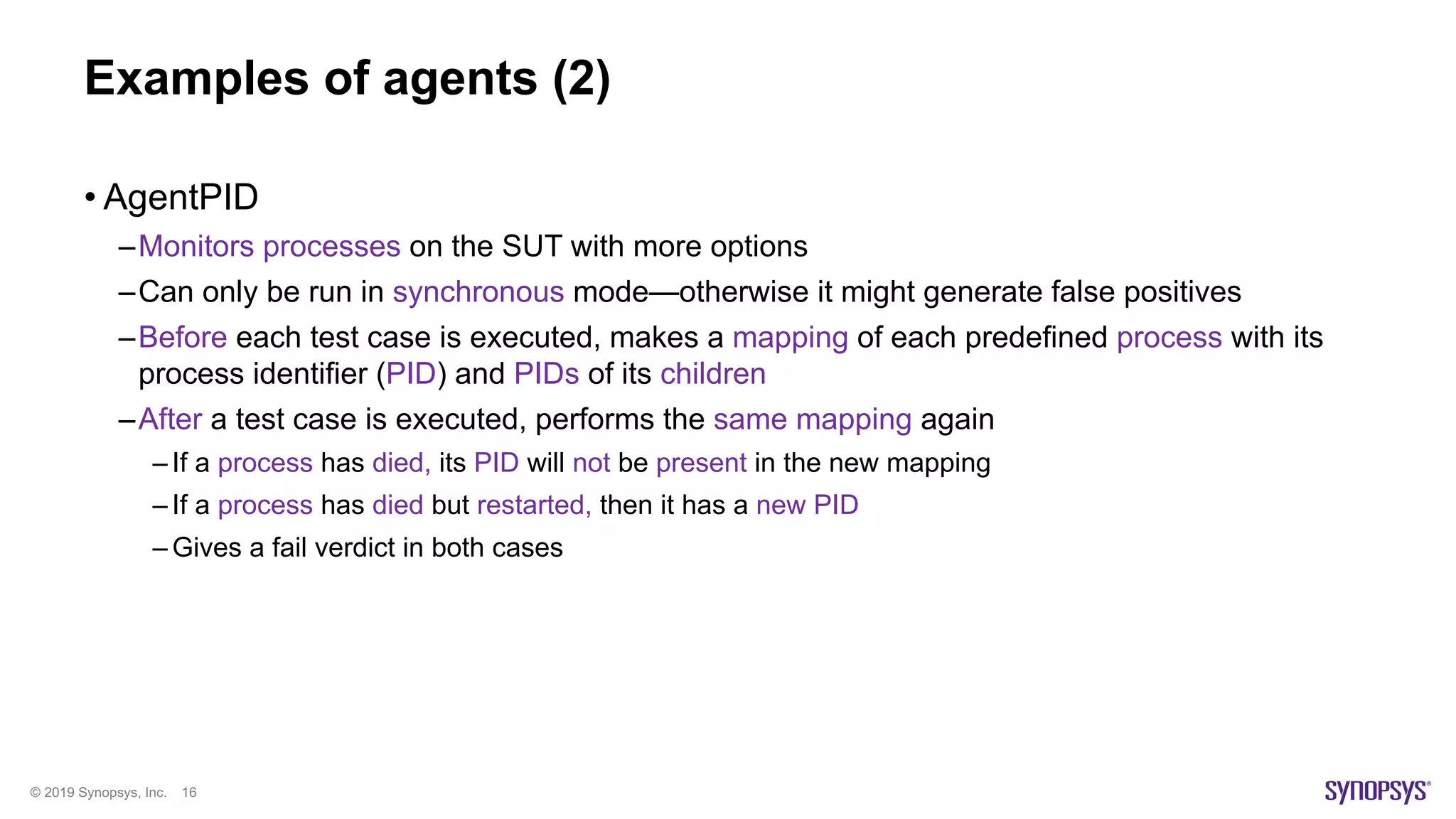
Examples of agents (2)
• AgentPID
–Monitors processes on the SUT with more options
–Can only be run in synchronous mode—otherwise it might generate false positives
–Before each test case is executed, makes a mapping of each predefined process with its
process identifier (PID) and PIDs of its children
–After a test case is executed, performs the same mapping again
– If a process has died, its PID will not be present in the new mapping
– If a process has died but restarted, then it has a new PID
– Gives a fail verdict in both cases
© 2019 Synopsys, Inc. 17
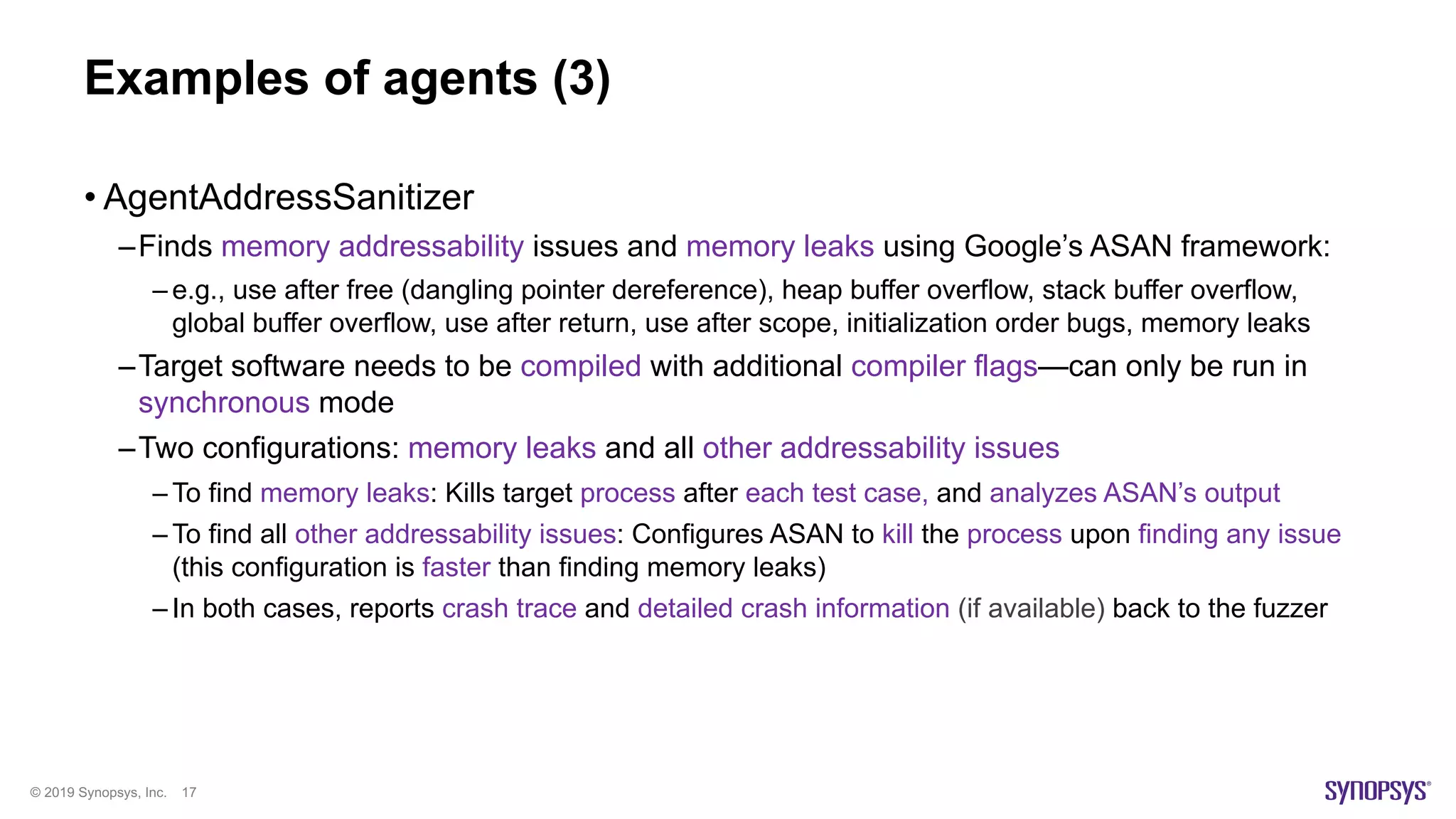
Examples of agents (3)
• AgentAddressSanitizer
–Finds memory addressability issues and memory leaks using Google’s ASAN framework:
– e.g., use after free (dangling pointer dereference), heap buffer overflow, stack buffer overflow,
global buffer overflow, use after return, use after scope, initialization order bugs, memory leaks
–Target software needs to be compiled with additional compiler flags—can only be run in
synchronous mode
–Two configurations: memory leaks and all other addressability issues
– To find memory leaks: Kills target process after each test case, and analyzes ASAN’s output
– To find all other addressability issues: Configures ASAN to kill the process upon finding any issue
(this configuration is faster than finding memory leaks)
– In both cases, reports crash trace and detailed crash information (if available) back to the fuzzer
© 2019 Synopsys, Inc. 18
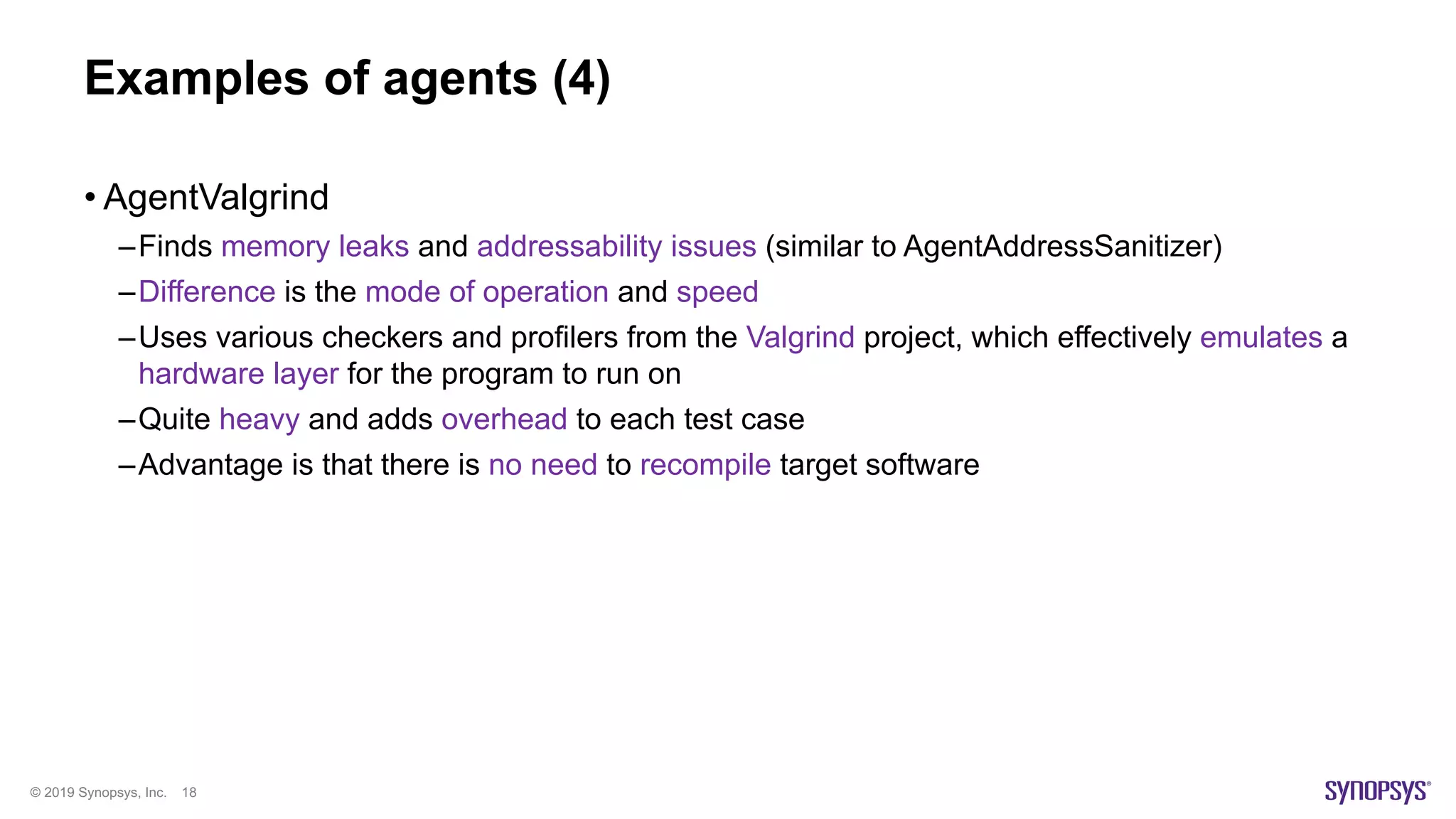
Examples of agents (4)
• AgentValgrind
–Finds memory leaks and addressability issues (similar to AgentAddressSanitizer)
–Difference is the mode of operation and speed
–Uses various checkers and profilers from the Valgrind project, which effectively emulates a
hardware layer for the program to run on
–Quite heavy and adds overhead to each test case
–Advantage is that there is no need to recompile target software
© 2019 Synopsys, Inc. 19
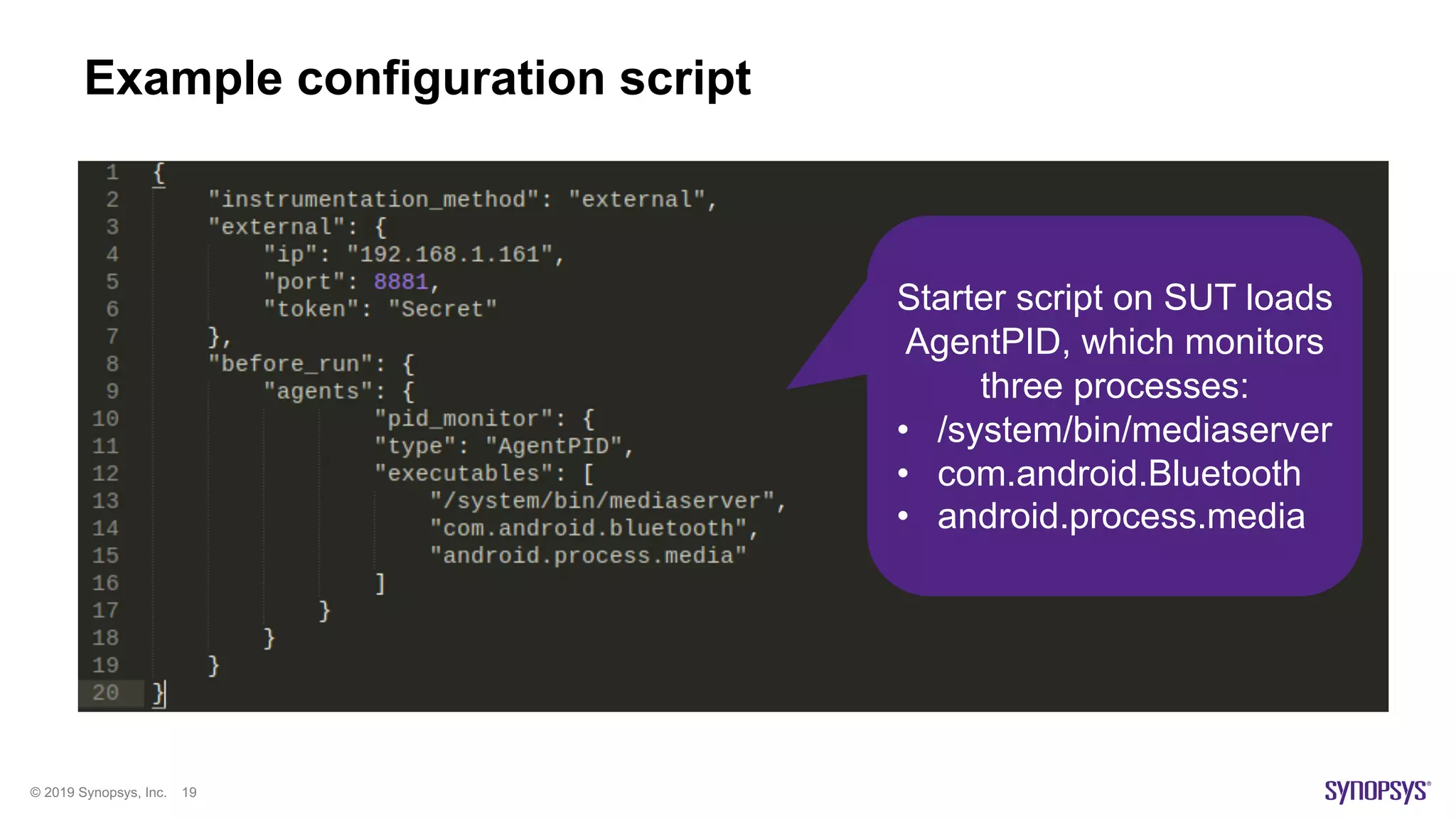
Example configuration script
Starter script on SUT loads
AgentPID, which monitors
three processes:
• /system/bin/mediaserver
• com.android.Bluetooth
• android.process.media
© 2019 Synopsys, Inc. 20
Challenges of fuzzing automotive components
Agent Instrumentation Framework—using
agents on the SUT to improve fuzz testing
Results show it is possible to detect previously
undetectable exceptions
© 2019 Synopsys, Inc. 21
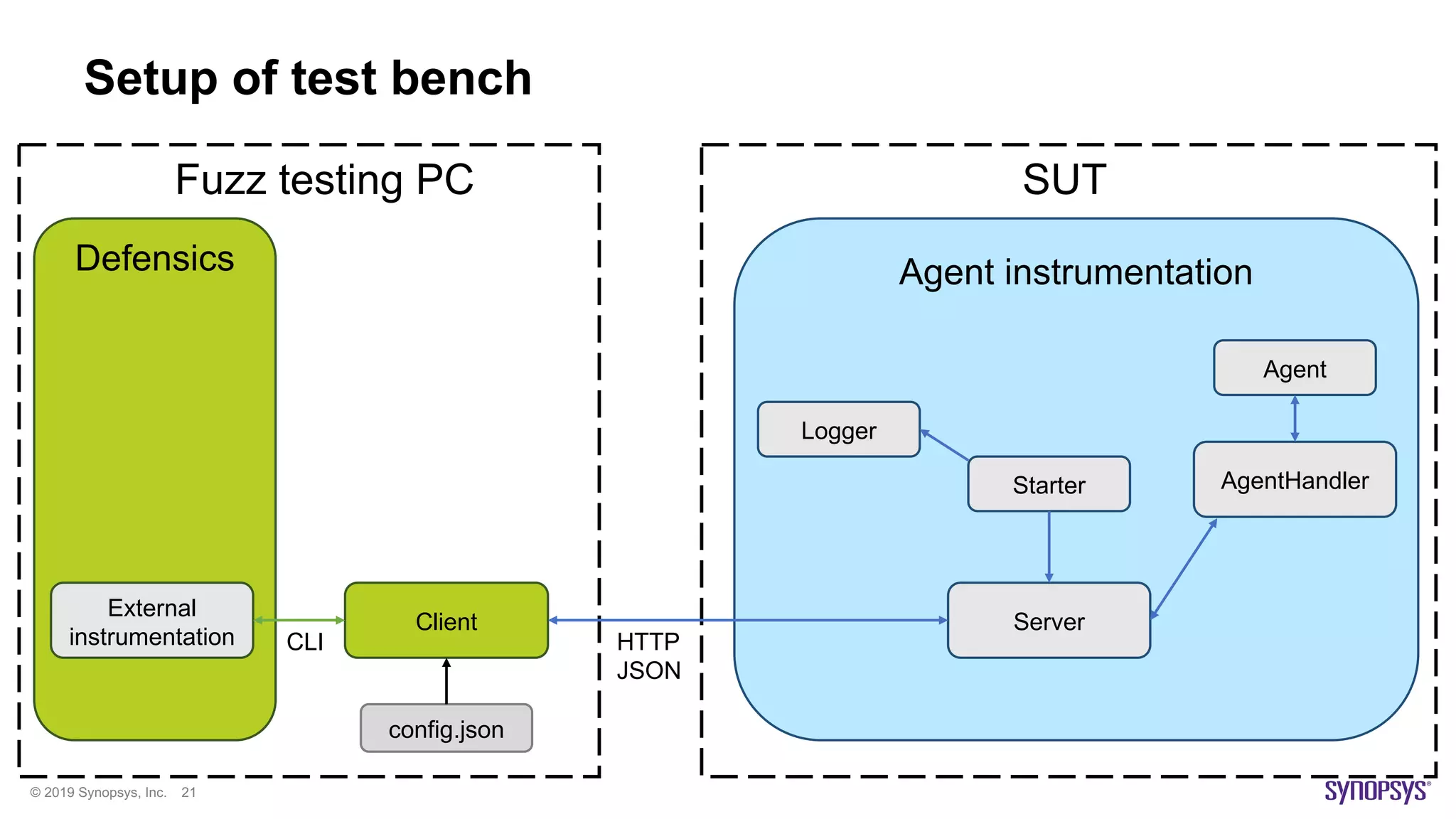
Setup of test bench
Defensics Agent instrumentation
SUTFuzz testing PC
Client
External
instrumentation
config.json
Server
AgentHandlerStarter
Logger
Agent
CLI HTTP
JSON
© 2019 Synopsys, Inc. 22
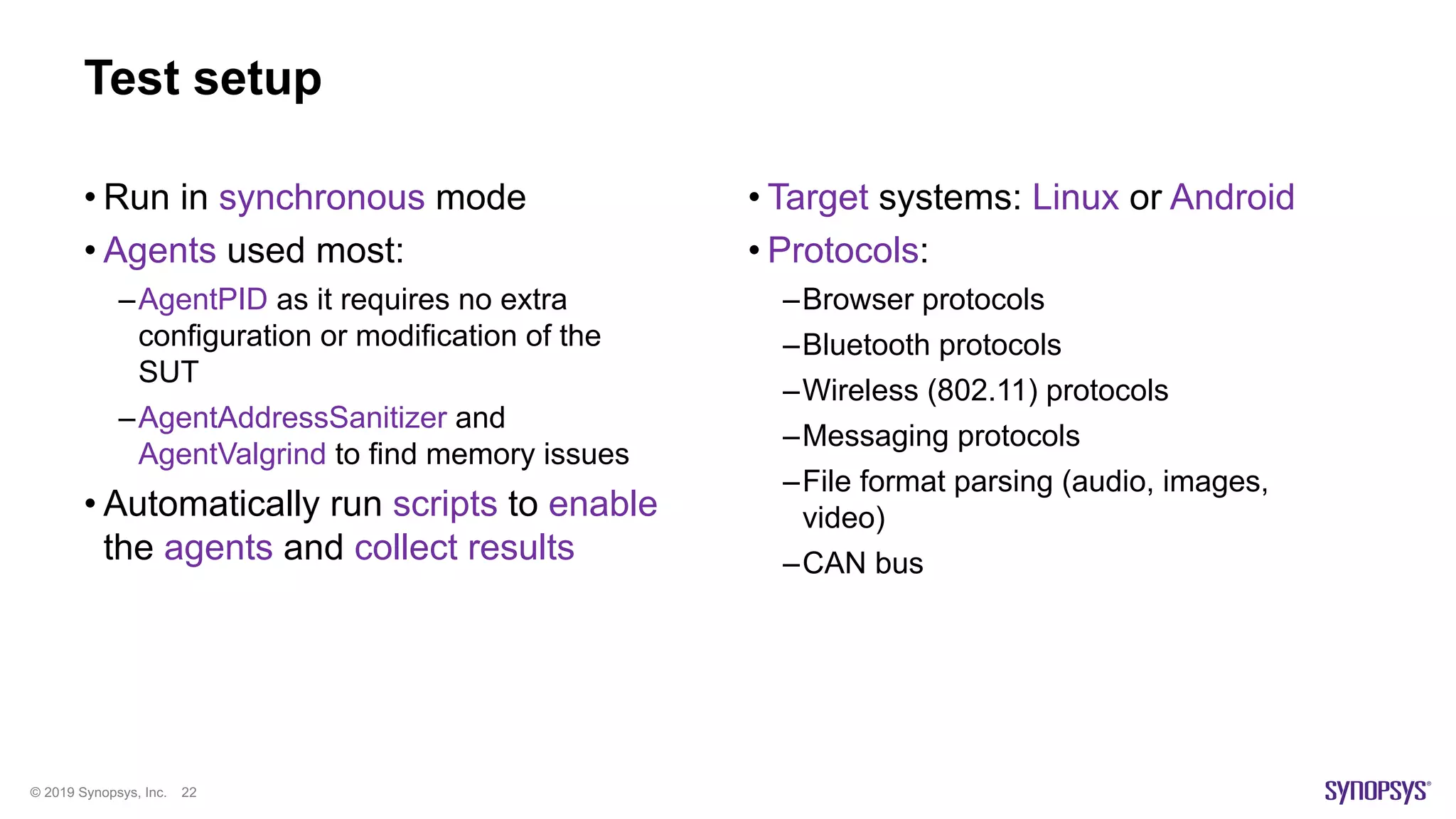
Test setup
• Run in synchronous mode
• Agents used most:
–AgentPID as it requires no extra
configuration or modification of the
SUT
–AgentAddressSanitizer and
AgentValgrind to find memory issues
• Automatically run scripts to enable
the agents and collect results
• Target systems: Linux or Android
• Protocols:
–Browser protocols
–Bluetooth protocols
–Wireless (802.11) protocols
–Messaging protocols
–File format parsing (audio, images,
video)
–CAN bus
© 2019 Synopsys, Inc. 23
Bluetooth results
• Found a critical vulnerability where a fuzzed
single frame causes the main Bluetooth
kernel module to crash
• Detected by monitoring the bluetoothd
daemon process using AgentPID
• Since the device has a daemon watchdog
that quickly restarts bluetoothd, this
vulnerability would not have been detected
by just observing the Bluetooth protocol
15:25:43.238 python client.py --config pid-
monitor.json instrumentation
15:25:43.640 Instrumentation verdict: FAIL
15:25:43.640 FAIL Agent: pid_monitor Info:
Agent pid_monitor says
15:25:43.640 ofonod : ['353']
15:25:43.640 bluetoothd : ['896'] -> [].
15:25:43.640 bluetoothgateway : [547]
15:25:43.640 mediaserver : [154]
15:25:43.640 wez-launch : ['114']
15:25:43.640 wez : ['114', '130']
15:25:43.640 ogg_streamhandler : [11]
15:25:43.640 pulseaudio : ['775']
15:25:43.640 audio_daemon : ['839']
15:25:43.640 media_engine_app : [145]
AgentPID agent
© 2019 Synopsys, Inc. 24
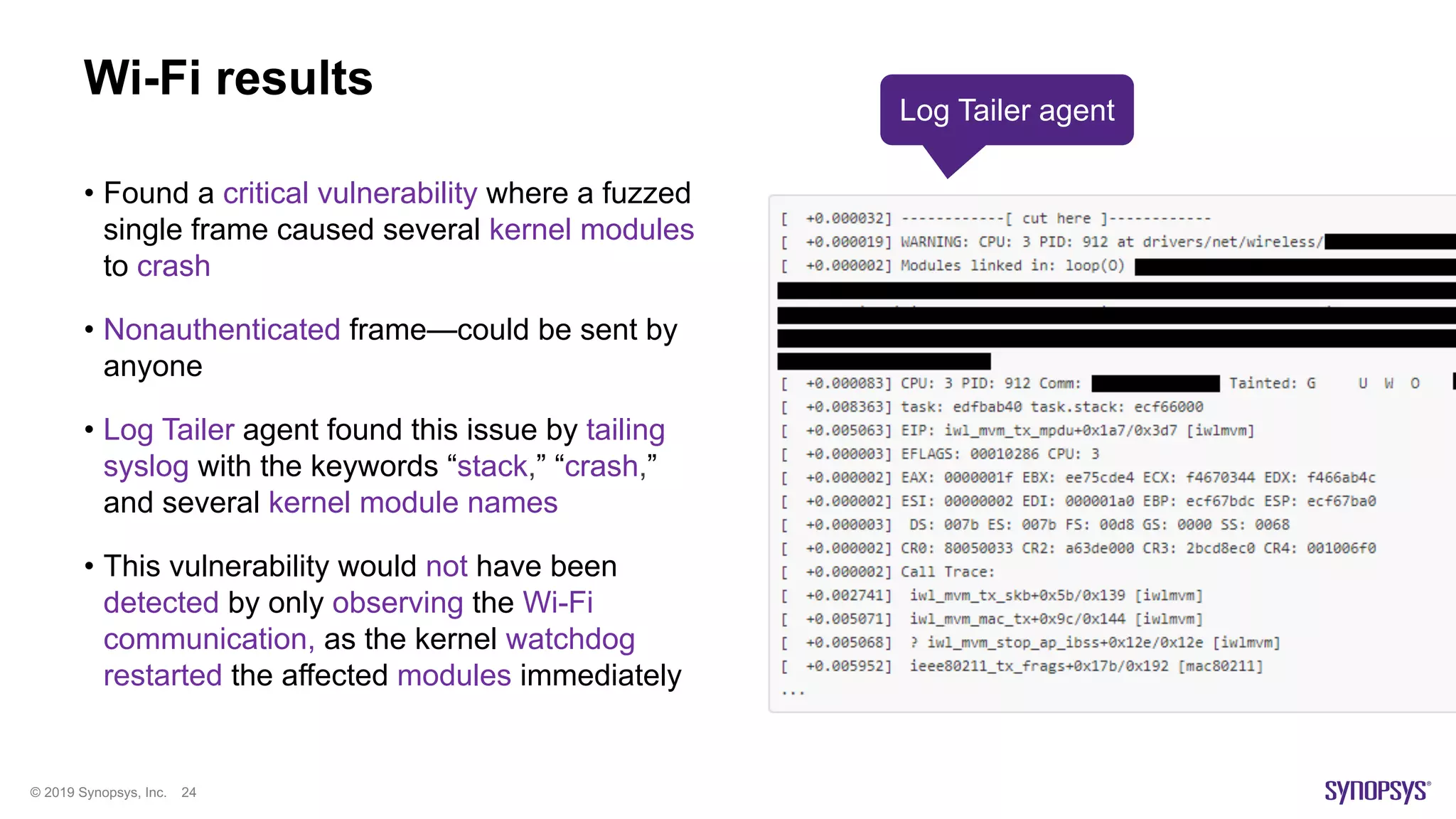
Wi-Fi results
• Found a critical vulnerability where a fuzzed
single frame caused several kernel modules
to crash
• Nonauthenticated frame—could be sent by
anyone
• Log Tailer agent found this issue by tailing
syslog with the keywords “stack,” “crash,”
and several kernel module names
• This vulnerability would not have been
detected by only observing the Wi-Fi
communication, as the kernel watchdog
restarted the affected modules immediately
Log Tailer agent
© 2019 Synopsys, Inc. 25
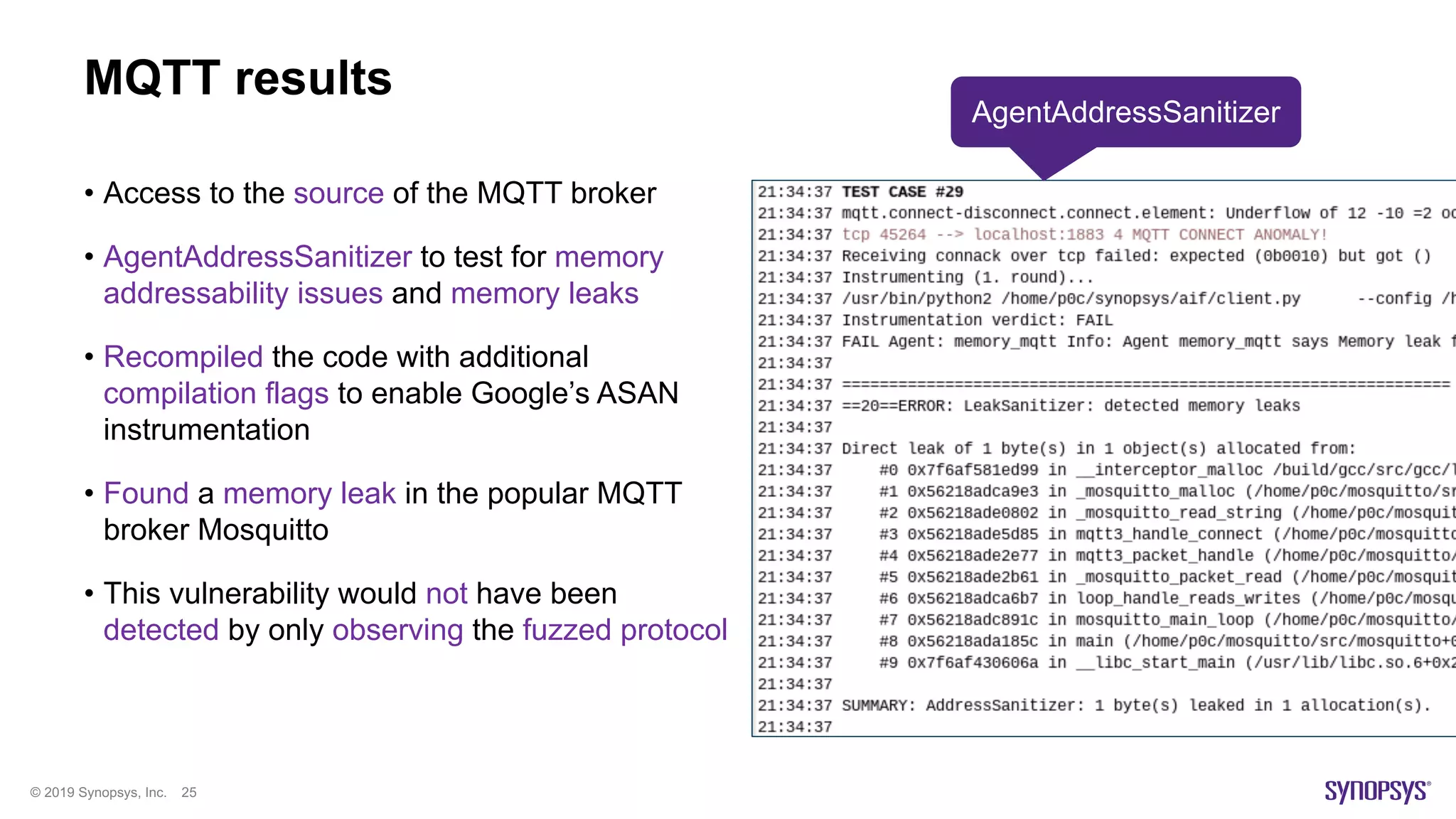
MQTT results
• Access to the source of the MQTT broker
• AgentAddressSanitizer to test for memory
addressability issues and memory leaks
• Recompiled the code with additional
compilation flags to enable Google’s ASAN
instrumentation
• Found a memory leak in the popular MQTT
broker Mosquitto
• This vulnerability would not have been
detected by only observing the fuzzed protocol
AgentAddressSanitizer
© 2019 Synopsys, Inc. 26
Challenges of fuzzing automotive components
Agent Instrumentation Framework—using
agents on the SUT to improve fuzz testing
Results show it is possible to detect previously
undetectable exceptions
Thank You
Webinar–Improving Fuzz Testing of Infotainment Systems and Telematics Units Using Agent Instrumentation

Webinar–Improving Fuzz Testing of Infotainment Systems and Telematics Units Using Agent Instrumentation

  • 1.
    © 2019 Synopsys,Inc. 1 Improving Fuzz Testing of Infotainment Systems and Telematics Units Using Agent Instrumentation Rikke Kuipers and Dennis Kengo Oka rikke.kuipers@synopsys.com dennis.kengo.oka@synopsys.com
  • 2.
    © 2019 Synopsys,Inc. 2 Challenges of fuzzing automotive components Agent Instrumentation Framework—using agents on the SUT to improve fuzz testing Results show it is possible to detect previously undetectable exceptions
  • 3.
    © 2019 Synopsys,Inc. 3 Challenges of fuzzing automotive components Agent Instrumentation Framework—using agents on the SUT to improve fuzz testing Results show it is possible to detect previously undetectable exceptions
  • 4.
    © 2019 Synopsys,Inc. 4 Download link: www.synopsys.com/auto-security Cybersecurity Research Center
  • 5.
    © 2019 Synopsys,Inc. 5 What are the primary factors that lead to vulnerabilities in automotive software/technology/components? Coding Open source software Testing
  • 6.
    © 2019 Synopsys,Inc. 6 What are the primary factors that lead to vulnerabilities in automotive software/technology/components? Coding Open source software Testing
  • 7.
    © 2019 Synopsys,Inc. 7 Fuzz testing • Testing technique where malformed or “out-of-specification” inputs are provided to the SUT (system under test), which is then observed to detect exceptions or unintended behavior • Allows developers and testers to identify unknown vulnerabilities in their systems and components
  • 8.
    © 2019 Synopsys,Inc. 8 Real-world example—Two embedded systems Low-level ECU Powertrain, chassis, body Small embedded codebase Model-based development Safety criticality: High/Low Security exposure: Low IVI (in-vehicle infotainment), ADAS, telematics ECU Open source platforms/libraries Entire operating systems (AGL) Safety criticality: Low/Medium/High Security exposure: High Linux Android …
  • 9.
    © 2019 Synopsys,Inc. 9 Challenges for automotive components • Difficult to instrument the SUT so as to determine whether there was an exception or if it has failed or crashed • E.g., fuzz testing Wi-Fi or Bluetooth, instrumentation typically occurs over the same protocol that is being fuzzed—this limited instrumentation could lead to several potential issues going undetected • Difficult to gather information from the SUT so as to more easily determine the underlying root causes for the exception or failure
  • 10.
    © 2019 Synopsys,Inc. 10 Undetected exceptions on SUT Fuzzer SUTFuzz testing PC Zombie processes Protocol being fuzzed Memory leaks Core dumps Application … Exceptions on SUT not detected by just observing the fuzzed protocol
  • 11.
    © 2019 Synopsys,Inc. 11 Challenges of fuzzing automotive components Agent Instrumentation Framework—using agents on the SUT to improve fuzz testing Results show it is possible to detect previously undetectable exceptions
  • 12.
    © 2019 Synopsys,Inc. 12 Agent Instrumentation Framework—Concept • Developers/testers have access to internals of the SUT (e.g., Linux and Android) • Achieve more efficient and accurate fuzz testing by employing a gray/white box approach where agents placed on the SUT assist with the instrumentation • The agents provide the fuzzer with detailed instrumentation data from the SUT • This data is used to determine the fail/pass verdict of a test case and also provides the developers/testers with valuable information from the SUT
  • 13.
    © 2019 Synopsys,Inc. 13 Agent Instrumentation Framework—Modes • More control over the agents • Agents can perform various functions before and after a test case executes • Allows for automation and using more advanced techniques for finding unknown vulnerabilities • Slower to execute the test run • Agents are polled periodically • Fuzzer parses incoming syslog messages with instrumentation data • Cannot tie an exception to a specific test case but only reports when a prespecified condition has been met • Advantage is speed of execution with the loss of accuracy Synchronous mode Asynchronous mode
  • 14.
    © 2019 Synopsys,Inc. 14 Overview of Agent Instrumentation Framework Fuzzer Agent instrumentation SUTFuzz testing PC Client External instrumentation Syslog config.json Server Syslog AgentHandler config.json Starter Logger Agent CLI HTTP JSON UDP/ Syslog
  • 15.
    © 2019 Synopsys,Inc. 15 Examples of agents (1) • AgentCoreDump –Looks for a core dump file—gives a fail verdict if detected –This file can be used to further analyze the state of the process during the crash • AgentLogTailer –Monitors a log file –Gives a fail verdict if a new line is written to the file and matches any of the predefined parameters • AgentProcessMonitor –Monitors the state of a process –Gives a fail verdict if the process is down or turned into a zombie process –Can also monitor the process’s memory usage and give a fail verdict if usage goes over a configured limit
  • 16.
    © 2019 Synopsys,Inc. 16 Examples of agents (2) • AgentPID –Monitors processes on the SUT with more options –Can only be run in synchronous mode—otherwise it might generate false positives –Before each test case is executed, makes a mapping of each predefined process with its process identifier (PID) and PIDs of its children –After a test case is executed, performs the same mapping again – If a process has died, its PID will not be present in the new mapping – If a process has died but restarted, then it has a new PID – Gives a fail verdict in both cases
  • 17.
    © 2019 Synopsys,Inc. 17 Examples of agents (3) • AgentAddressSanitizer –Finds memory addressability issues and memory leaks using Google’s ASAN framework: – e.g., use after free (dangling pointer dereference), heap buffer overflow, stack buffer overflow, global buffer overflow, use after return, use after scope, initialization order bugs, memory leaks –Target software needs to be compiled with additional compiler flags—can only be run in synchronous mode –Two configurations: memory leaks and all other addressability issues – To find memory leaks: Kills target process after each test case, and analyzes ASAN’s output – To find all other addressability issues: Configures ASAN to kill the process upon finding any issue (this configuration is faster than finding memory leaks) – In both cases, reports crash trace and detailed crash information (if available) back to the fuzzer
  • 18.
    © 2019 Synopsys,Inc. 18 Examples of agents (4) • AgentValgrind –Finds memory leaks and addressability issues (similar to AgentAddressSanitizer) –Difference is the mode of operation and speed –Uses various checkers and profilers from the Valgrind project, which effectively emulates a hardware layer for the program to run on –Quite heavy and adds overhead to each test case –Advantage is that there is no need to recompile target software
  • 19.
    © 2019 Synopsys,Inc. 19 Example configuration script Starter script on SUT loads AgentPID, which monitors three processes: • /system/bin/mediaserver • com.android.Bluetooth • android.process.media
  • 20.
    © 2019 Synopsys,Inc. 20 Challenges of fuzzing automotive components Agent Instrumentation Framework—using agents on the SUT to improve fuzz testing Results show it is possible to detect previously undetectable exceptions
  • 21.
    © 2019 Synopsys,Inc. 21 Setup of test bench Defensics Agent instrumentation SUTFuzz testing PC Client External instrumentation config.json Server AgentHandlerStarter Logger Agent CLI HTTP JSON
  • 22.
    © 2019 Synopsys,Inc. 22 Test setup • Run in synchronous mode • Agents used most: –AgentPID as it requires no extra configuration or modification of the SUT –AgentAddressSanitizer and AgentValgrind to find memory issues • Automatically run scripts to enable the agents and collect results • Target systems: Linux or Android • Protocols: –Browser protocols –Bluetooth protocols –Wireless (802.11) protocols –Messaging protocols –File format parsing (audio, images, video) –CAN bus
  • 23.
    © 2019 Synopsys,Inc. 23 Bluetooth results • Found a critical vulnerability where a fuzzed single frame causes the main Bluetooth kernel module to crash • Detected by monitoring the bluetoothd daemon process using AgentPID • Since the device has a daemon watchdog that quickly restarts bluetoothd, this vulnerability would not have been detected by just observing the Bluetooth protocol 15:25:43.238 python client.py --config pid- monitor.json instrumentation 15:25:43.640 Instrumentation verdict: FAIL 15:25:43.640 FAIL Agent: pid_monitor Info: Agent pid_monitor says 15:25:43.640 ofonod : ['353'] 15:25:43.640 bluetoothd : ['896'] -> []. 15:25:43.640 bluetoothgateway : [547] 15:25:43.640 mediaserver : [154] 15:25:43.640 wez-launch : ['114'] 15:25:43.640 wez : ['114', '130'] 15:25:43.640 ogg_streamhandler : [11] 15:25:43.640 pulseaudio : ['775'] 15:25:43.640 audio_daemon : ['839'] 15:25:43.640 media_engine_app : [145] AgentPID agent
  • 24.
    © 2019 Synopsys,Inc. 24 Wi-Fi results • Found a critical vulnerability where a fuzzed single frame caused several kernel modules to crash • Nonauthenticated frame—could be sent by anyone • Log Tailer agent found this issue by tailing syslog with the keywords “stack,” “crash,” and several kernel module names • This vulnerability would not have been detected by only observing the Wi-Fi communication, as the kernel watchdog restarted the affected modules immediately Log Tailer agent
  • 25.
    © 2019 Synopsys,Inc. 25 MQTT results • Access to the source of the MQTT broker • AgentAddressSanitizer to test for memory addressability issues and memory leaks • Recompiled the code with additional compilation flags to enable Google’s ASAN instrumentation • Found a memory leak in the popular MQTT broker Mosquitto • This vulnerability would not have been detected by only observing the fuzzed protocol AgentAddressSanitizer
  • 26.
    © 2019 Synopsys,Inc. 26 Challenges of fuzzing automotive components Agent Instrumentation Framework—using agents on the SUT to improve fuzz testing Results show it is possible to detect previously undetectable exceptions
  • 27.