A Hybrid Approach with
Multi-channel I-Vectors and
Convolutional Neural Networks for
Acoustic Scene Classification
Hamid Eghbal-zadeh, Bernhard Lehner, Matthias Dorfer and Gerhard Widmer
A closer look into our winning submission
at IEEE DCASE-2016 challenge1
for
Acoustic Scene Classification
1) www.cs.tut.fi/sgn/arg/dcase2016/
Introduction
 
What is Acoustic Scene Classification
(ASC)?
photo credit: www.cs.tut.fi/sgn/arg/dcase2016/
1/23
 
Challenges in ASC: Overlapping events
Park City Center
photo credit: www.cs.tut.fi/sgn/arg/dcase2016/
2/23
 
Challenges in ASC: Session Variability
Vienna! Athens!
photo credit:www.google.com
3/23
 
Challenges in ASC: Session Variability
Vienna! Athens!
υγειά μαςProst
photo credit:www.google.com
3/23
 
Challenges in ASC: Session Variability
Vienna! Athens!
photo credit:www.google.com
3/23
 
ASC is not that easy ...
photo credit: www.memegen.com
Methods for ASC
 
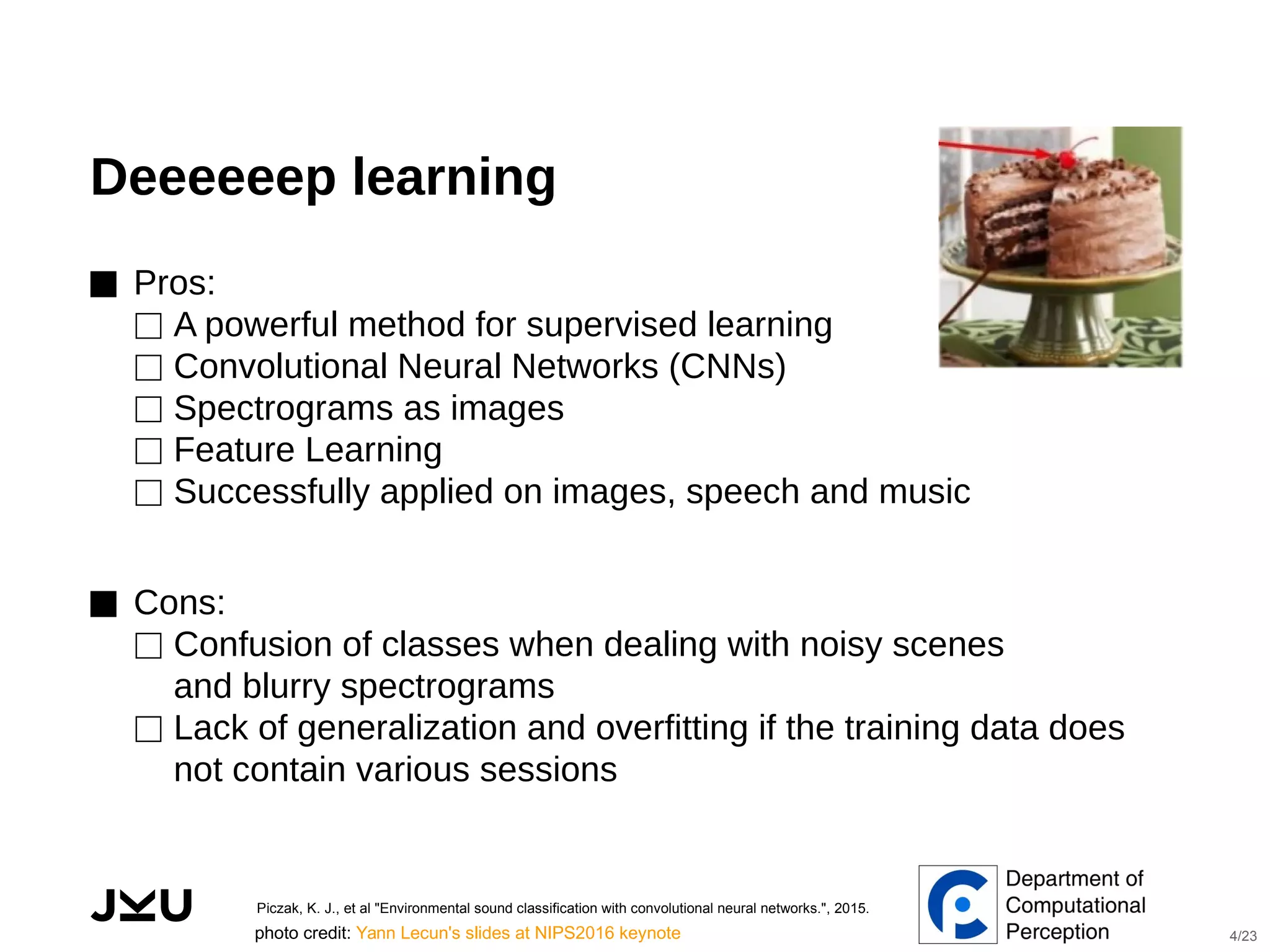
Deeeeeep learning
⬛ Pros:
⬜ A powerful method for supervised learning
⬜ Convolutional Neural Networks (CNNs)
⬜ Spectrograms as images
⬜ Feature Learning
⬜ Successfully applied on images, speech and music
⬛ Cons:
⬜ Confusion of classes when dealing with noisy scenes
and blurry spectrograms
⬜ Lack of generalization and overfitting if the training data does
not contain various sessions
Piczak, K. J., et al "Environmental sound classification with convolutional neural networks.", 2015.
photo credit: Yann Lecun's slides at NIPS2016 keynote 4/23
 
Factor Analysis
⬛ Pros:
⬜ Session Variability reduction
⬜ Use of a Universal Background Model (UBM)
⬜ Better generalization due to the unsupervised methodology
⬜ Successfully applied on sequential data such as Speech and
Music
⬛ Cons:
⬜ Relying on engineered features
⬜ Limits to use specialized features for Audio Scene Analysis
because of the independence and Gaussian assumptions in FA
[1] Dehak, Najim, et al. "Front-end factor analysis for speaker verification.",2011.
[2] Elizalde, B, et al. "An i-vector based approach for audio scene detection." (2013).
5/23
 
A Hybrid system to overcome the
complexities ...
photo credit: www.imgflip.com
 
A hybrid approach to ASC
⬛ We combine a CNN with an I-Vector based ASC system:
⬜ A CNN is trained on spectrograms
⬜ I-Vector features (based on FA) are extracted from MFCCs
⬛ Late fusion
⬜ A score fusion technique is used to combine the two methods
⬛ Model averaging for better generalization
⬜ Multiple models are trained and the decision from different
models are averaged
Brummer, N., et al. "On calibration of language recognition scores." , 2006.
6/23
CNNs for ASC
 
A hybrid approach to ASC
⬛ A VGG-style fully convolutional architecture
⬜ A well-known model for object recognition
Conv layer Pooling layer Average pooling layer
Slide...
Sumtheprobabilities
30secs
Feature Learning part Feed-Forward part
Simonyan, K., et al. "Very deep convolutional networks for large-scale image recognition.", 2014.
7/23
I-Vectors for ASC
 
I-Vector Features
GMM Train
I-Vector
model
Sparse
statistics
Adapted GMM params = GMM params – unknown matrix . hidden factor
Learned via EM
Training
MFCCs
Many components high dimension
[1] Dehak, Najim, et al. "Front-end factor analysis for speaker verification.",2011.
[2] Elizalde, B, et al. "An i-vector based approach for audio scene detection." (2013).
[3] Kenny, Patrick, et al. "Uncertainty Modeling Without Subspace Methods For Text-Dependent
Speaker Recognition.", 2016.
low dimension
I-vector
Point estimate
low dimension
EM
8/23
 
I-Vector Features
GMM
MFCCs
Sparse
statistics
I-vector
Adapted GMM params = GMM params – unknown matrix . hidden factor
Sparse
statistics
TrainingExtraction
Learned via EM
Many components
high dimension
high dimension
Train
I-Vector
model
I-vector
Point estimate
low dimension
EM
[1] Dehak, Najim, et al. "Front-end factor analysis for speaker verification.",2011.
[2] Elizalde, B, et al. "An i-vector based approach for audio scene detection." (2013).
[3] Kenny, Patrick, et al. "Uncertainty Modeling Without Subspace Methods For Text-Dependent
Speaker Recognition.", 2016.
low dimension
9/23
 
I-Vector Features
⬛ Requires a Universal Background Model (UBM):
⬜ A GMM with 256 Gaussian components
⬜ MFCCs features
⬛ MAP estimation of a hidden factor:
⬜ m: mean from the GMM
⬜ M: adapted GMM mean to MFCCs of an audio segment
⬜ Solving the following factor analysis equation:
M = m + T.y
⬜ y is the hidden factor and its MAP estimation is the I-vector
Dehak, Najim, et al. "Front-end factor analysis for speaker verification.",2011.
10/23
 
Improving I-Vector Features for ASC
GMM I-vectorleft
right
average
difference
GMM I-vector
GMM I-vector
GMM I-vector
⬛ Tuning MFCC parameters:
⬛ I-vectors from MFCCs of different channels
Elizalde, B, et al. "An i-vector based approach for audio scene detection." (2013).
11/23
 
Post-processing and Scoring I-Vector
Features
⬛ Length-Normalization
⬛ Within-class Covariance Normalization (WCCN)
⬛ Linear Discriminant Analysis (LDA)
⬛ Cosine Similarity:
⬜ Average I-vectors of each class in training set (Model I-vector)
⬜ Compute cosine similarity from each test I-vector to model I-
vector of each class
⬜ Pick the class with maximum similarity
[1] Garcia-Romero, D., et al. "Analysis of i-vector Length Normalization in Speaker Recognition.", 2011.
[2] Hatch, A. O.,et al. "Within-class covariance normalization for SVM-based speaker recognition.", 2006.
[3] Dehak, Najim, et al. "Cosine similarity scoring without score normalization techniques." 2010.
12/23
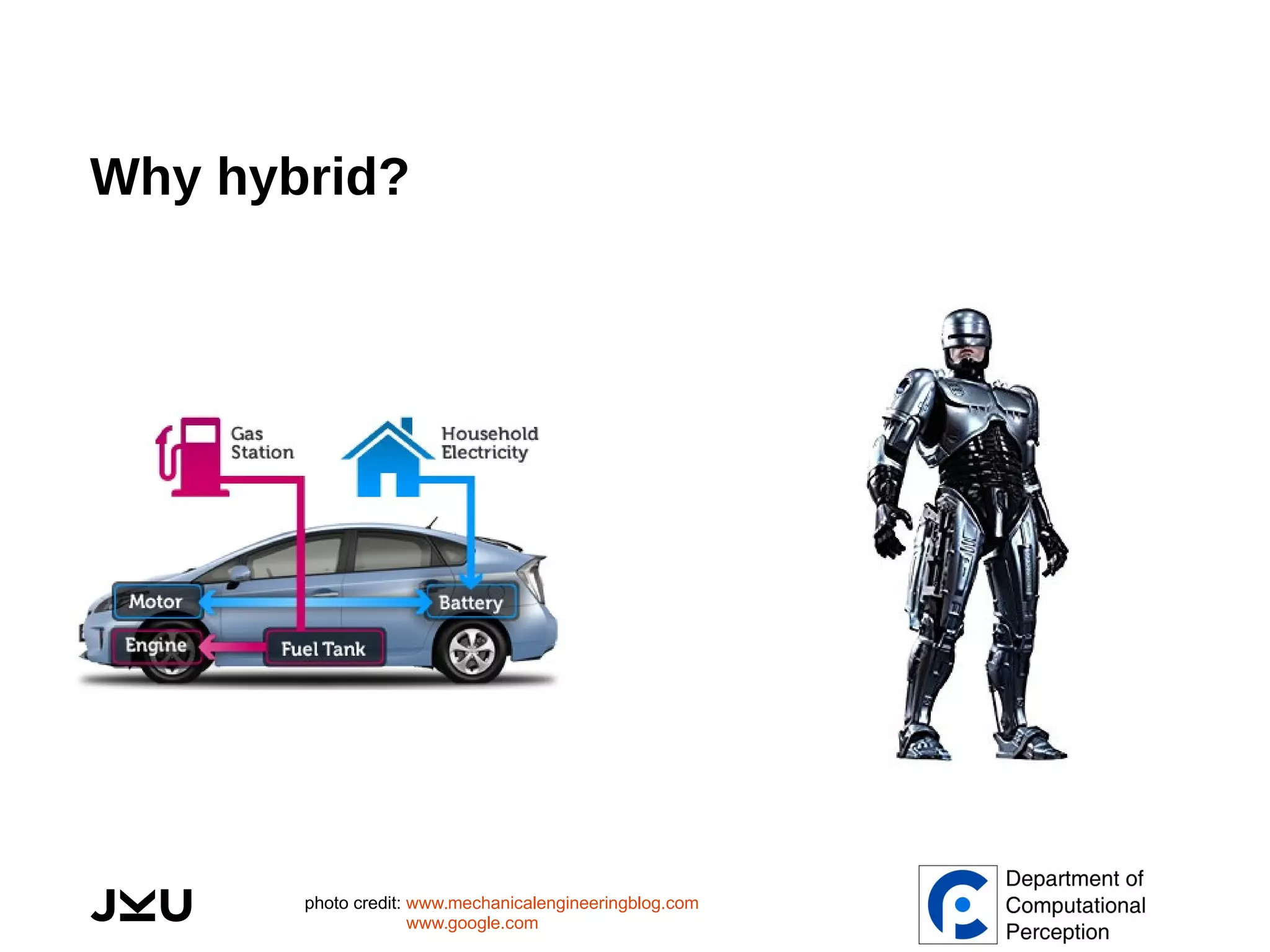
Hybrid system
 
Why hybrid?
photo credit: www.mechanicalengineeringblog.com
www.google.com
 
Linear Logistic Regression for Score
Fusion
⬛ Combining cosine scores of I-vectors with CNN probabilities
⬛ A Linear Logistic Regression (LLR) model is trained on validation
set
⬛ A coefficient is learned for each model and a bias term for each
class.
⬛ Final score is computed by applying the learned coefficients and
the bias terms on the test set scores.
13/23
 
Model averaging
⬛ 4 separate models trained from each fold
⬛ Average the final score from models in each fold
14/23
Dataset
 
TUT Acoustic Scenes 2016 dataset
⬛ 30-seconds audio segments from 15 acoustic scenes:
⬜ Bus - traveling by bus in the city (vehicle)
⬜ Cafe / Restaurant - small cafe/restaurant (indoor)
⬜ Car - driving or traveling as a passenger, in the city (vehicle)
⬜ City center (outdoor)
⬜ Forest path (outdoor)
⬜ Grocery store - medium size grocery store (indoor)
⬜ Home (indoor)
⬜ Lakeside beach (outdoor)
⬜ Library (indoor)
⬜ Metro station (indoor)
⬜ Office - multiple persons, typical work day (indoor)
⬜ Residential area (outdoor)
⬜ Train (traveling, vehicle)
⬜ Tram (traveling, vehicle)
⬜ Urban park (outdoor)
⬛ Development set:
⬜ Each acoustic scene has 78 segments totaling 39 minutes of audio.
⬜ 4 folds cross validation
⬛ Evaluation set:
⬜ 26 segments totaling 13 minutes of audio.
Mesaros, A.,et al "TUT database for acoustic scene classification and sound event detection." , 2016.
15/23
Results
 
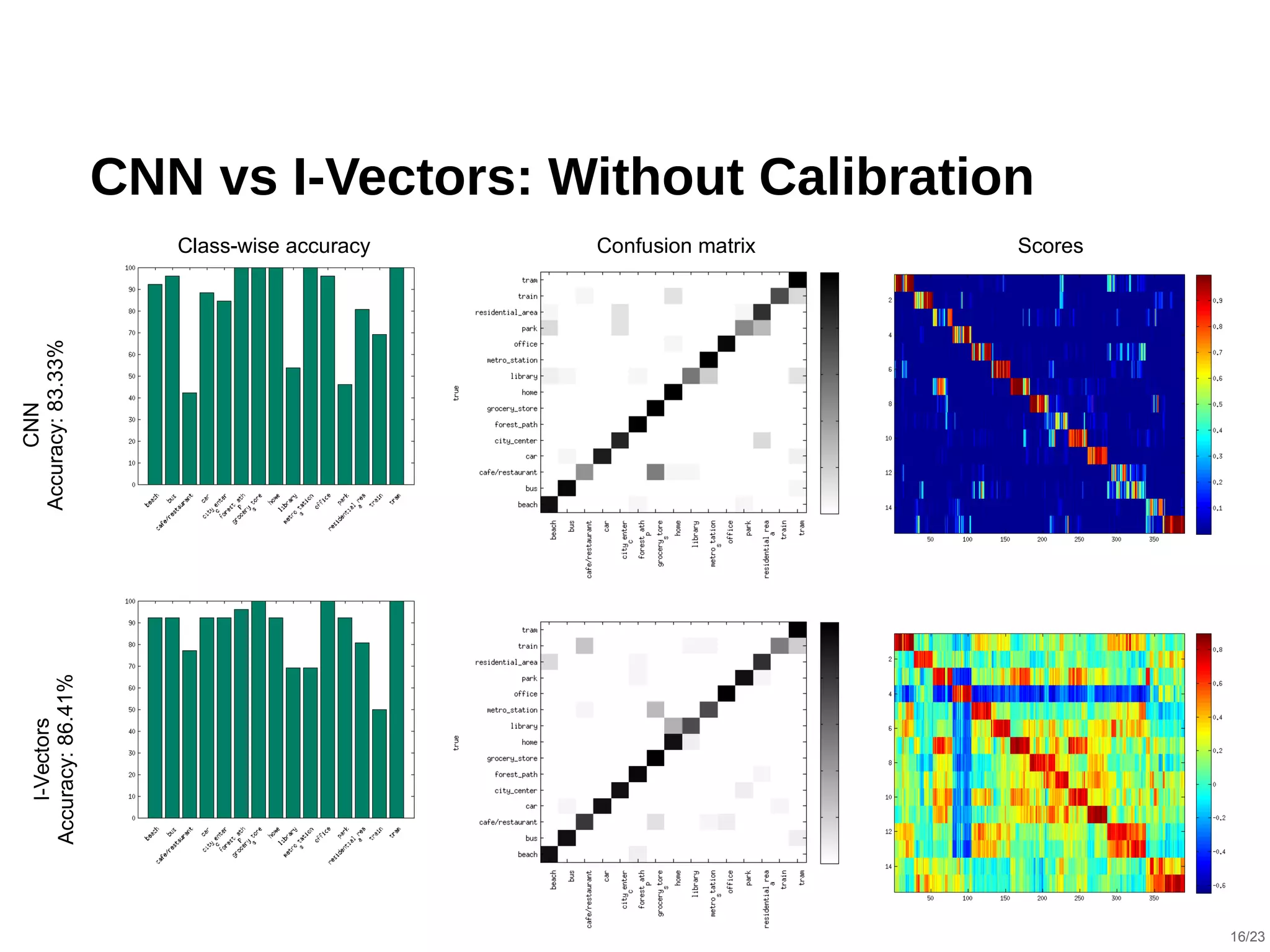
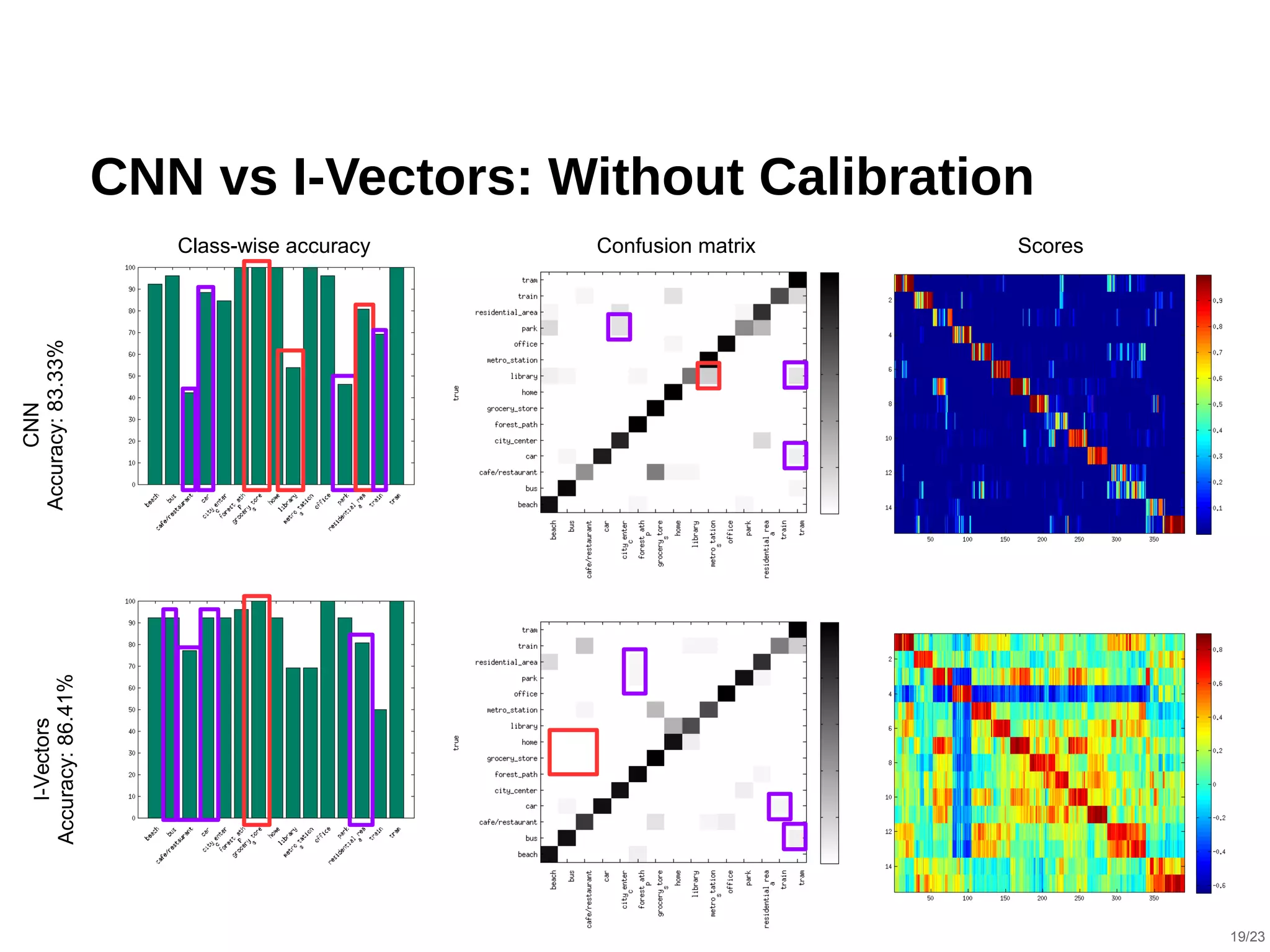
CNN vs I-Vectors: Without Calibration
CNN
Accuracy:83.33%
I-Vectors
Accuracy:86.41%
Class-wise accuracy Confusion matrix Scores
16/23
 
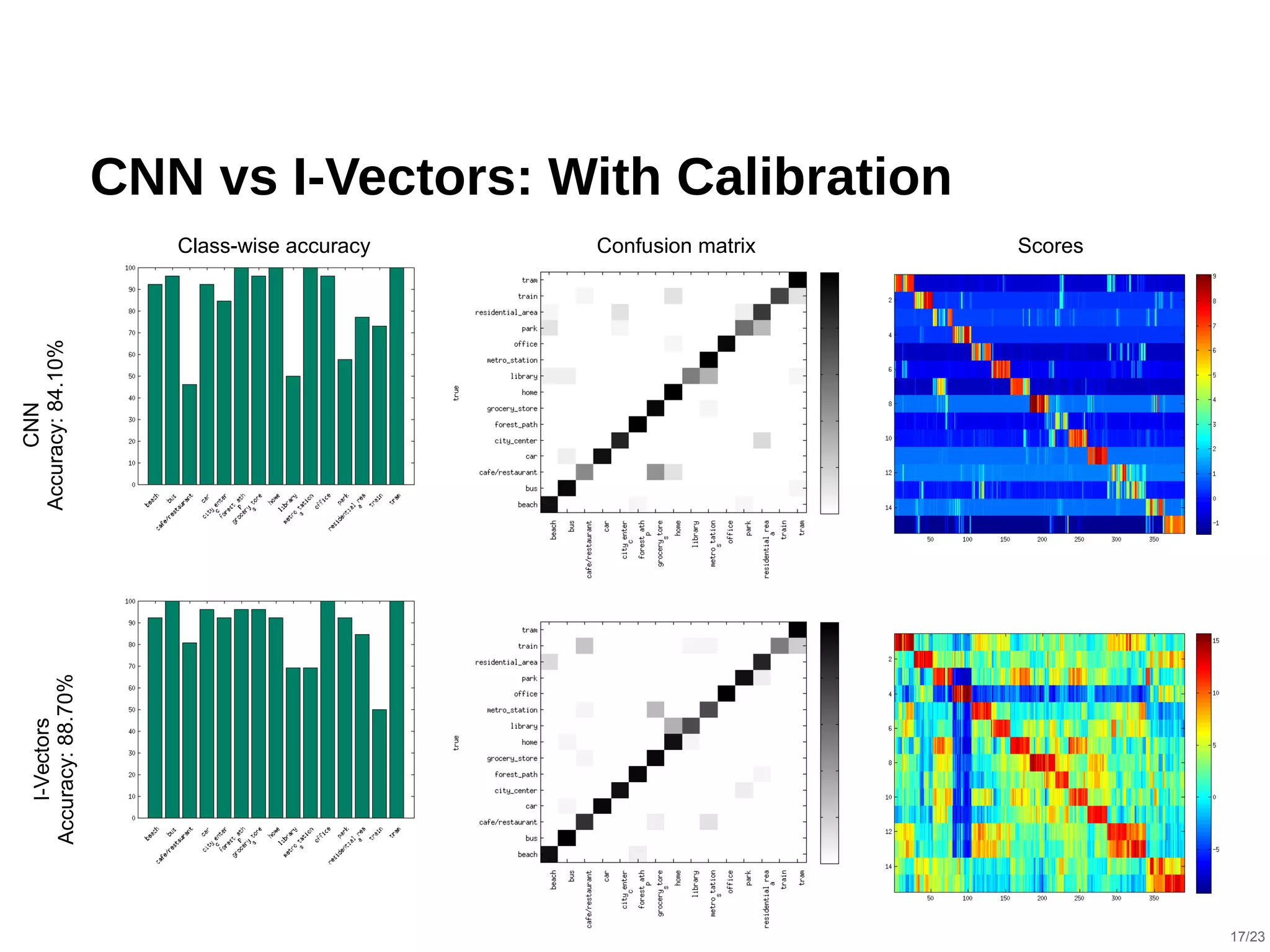
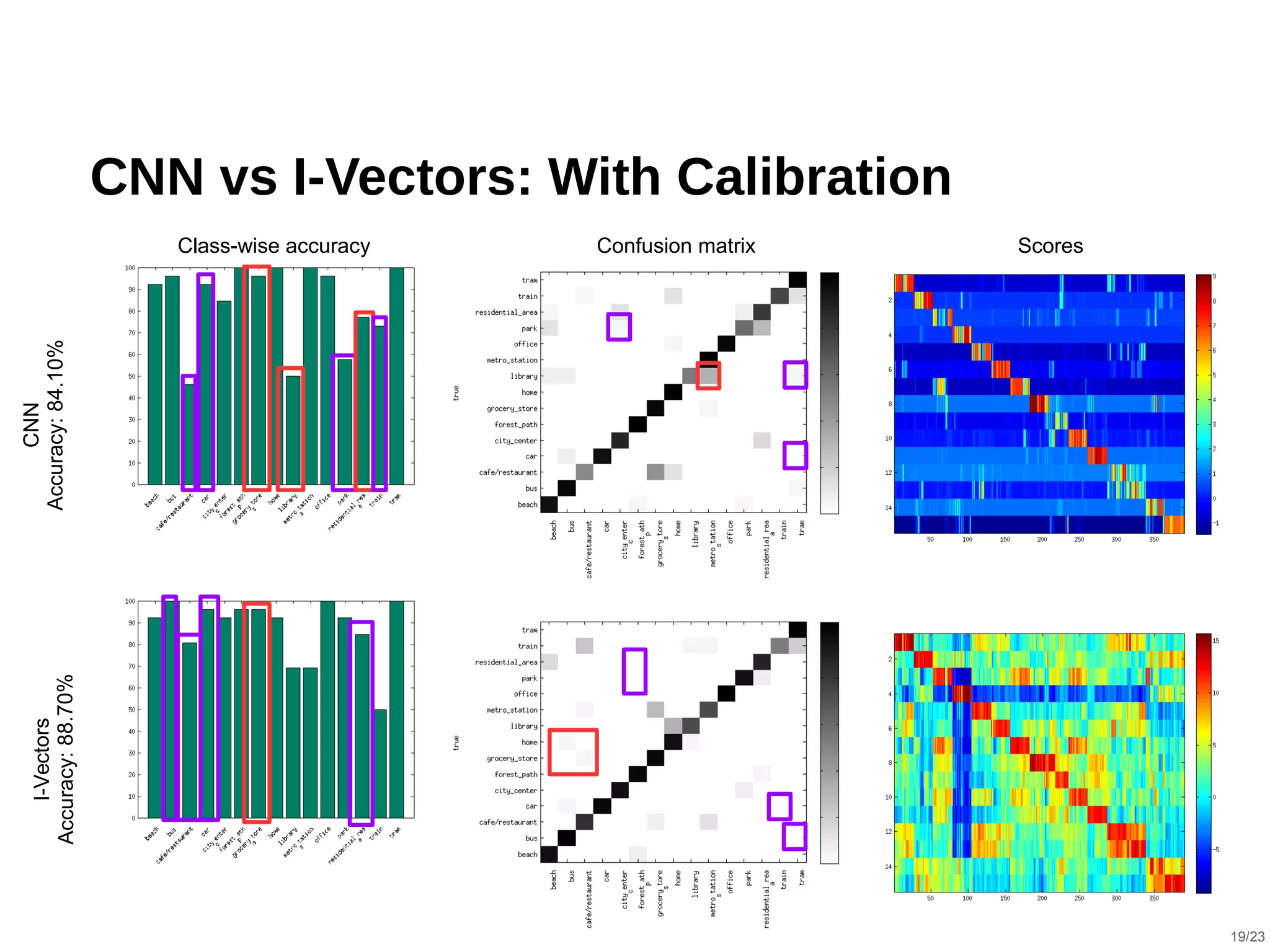
CNN vs I-Vectors: With Calibration
CNN
Accuracy:84.10%
I-Vectors
Accuracy:88.70%
Class-wise accuracy Confusion matrix Scores
17/23
 
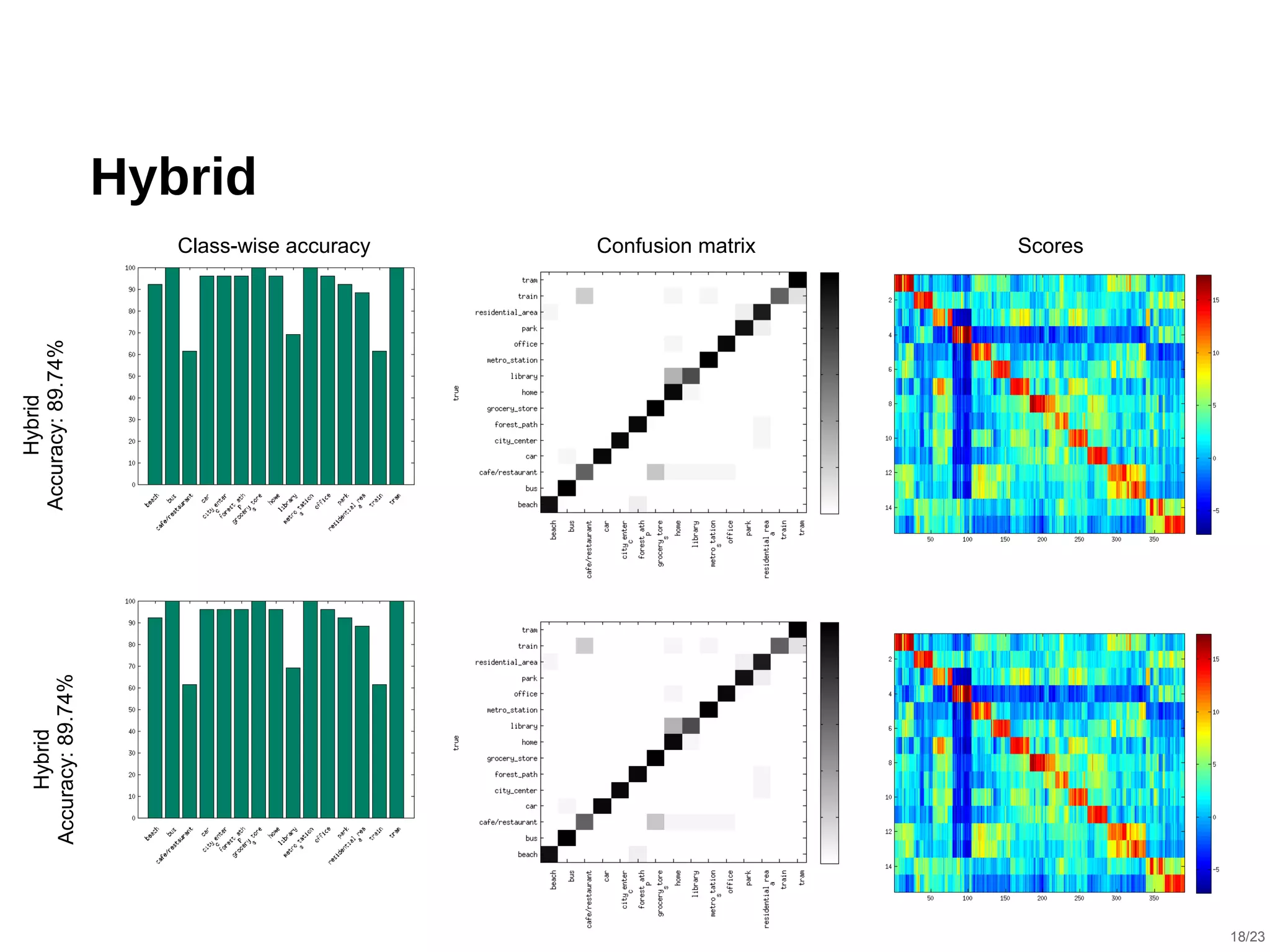
Hybrid
Hybrid
Accuracy:89.74%
Hybrid
Accuracy:89.74%
Class-wise accuracy Confusion matrix Scores
18/23
Analysis: Score Calibration
 
CNN vs I-Vectors: Without Calibration
CNN
Accuracy:83.33%
I-Vectors
Accuracy:86.41%
Class-wise accuracy Confusion matrix Scores
19/23
 
CNN vs I-Vectors: With Calibration
CNN
Accuracy:84.10%
I-Vectors
Accuracy:88.70%
Class-wise accuracy Confusion matrix Scores
19/23
Analysis: Score Fusion
 
CNN vs I-Vectors: Without Calibration
CNN
Accuracy:83.33%
I-Vectors
Accuracy:86.41%
metro train
Class-wise accuracy Confusion matrix Scores
20/23
 
Hybrid
Hybrid
Accuracy:89.7%
Hybrid
Accuracy:89.7%
Class-wise accuracy Confusion matrix Scores
20/23
 
DCASE 2016 challenge: Results
Hybrid
Calibrated
Multi-channel
I-vectors
Multi-channel
I-vectors
Oursingle
CNN
MFCC+GMM
baseline
21/23
 
DCASE 2016 challenge: Observations
22/23
 
Challenges in ASC: Session Variability
Kippis Kippis
photo credit:www.google.com
22/23
Conclusion
 
Conclusion
⬛ Performance of I-Vectors can be noticeably improved by tuning
MFCCs
⬛ Different channels contain different information from a scene that
is beneficial to the I-vector system
⬛ I-Vectors and CNNs are complementary
⬛ Score Calibration improved both I-Vectors and CNN
⬛ A late-fusion can efficiently combine the two system’s predictions
⬛ This method is easily adaptable to new conditions
23/23
 
JOHANNES KEPLER
UNIVERSITY LINZ
Altenberger Str. 69
4040 Linz, Austria
www.jku.at
Thank you!
For more information about this presentation, don’t hesitate to
contact me via:
hamid.eghbal-zadeh@jku.at
Slides available at:
https://www.slideshare.net/heghbalz
Code soon will be available at:
https://github.com/cpjku

Slides of my presentation at EUSIPCO 2017

  • 3.
    A Hybrid Approachwith Multi-channel I-Vectors and Convolutional Neural Networks for Acoustic Scene Classification Hamid Eghbal-zadeh, Bernhard Lehner, Matthias Dorfer and Gerhard Widmer
  • 4.
    A closer lookinto our winning submission at IEEE DCASE-2016 challenge1 for Acoustic Scene Classification 1) www.cs.tut.fi/sgn/arg/dcase2016/
  • 5.
  • 6.
      What is AcousticScene Classification (ASC)? photo credit: www.cs.tut.fi/sgn/arg/dcase2016/ 1/23
  • 7.
      Challenges in ASC:Overlapping events Park City Center photo credit: www.cs.tut.fi/sgn/arg/dcase2016/ 2/23
  • 8.
      Challenges in ASC:Session Variability Vienna! Athens! photo credit:www.google.com 3/23
  • 9.
      Challenges in ASC:Session Variability Vienna! Athens! υγειά μαςProst photo credit:www.google.com 3/23
  • 10.
      Challenges in ASC:Session Variability Vienna! Athens! photo credit:www.google.com 3/23
  • 11.
      ASC is notthat easy ... photo credit: www.memegen.com
  • 12.
  • 13.
      Deeeeeep learning ⬛ Pros: ⬜A powerful method for supervised learning ⬜ Convolutional Neural Networks (CNNs) ⬜ Spectrograms as images ⬜ Feature Learning ⬜ Successfully applied on images, speech and music ⬛ Cons: ⬜ Confusion of classes when dealing with noisy scenes and blurry spectrograms ⬜ Lack of generalization and overfitting if the training data does not contain various sessions Piczak, K. J., et al "Environmental sound classification with convolutional neural networks.", 2015. photo credit: Yann Lecun's slides at NIPS2016 keynote 4/23
  • 14.
      Factor Analysis ⬛ Pros: ⬜Session Variability reduction ⬜ Use of a Universal Background Model (UBM) ⬜ Better generalization due to the unsupervised methodology ⬜ Successfully applied on sequential data such as Speech and Music ⬛ Cons: ⬜ Relying on engineered features ⬜ Limits to use specialized features for Audio Scene Analysis because of the independence and Gaussian assumptions in FA [1] Dehak, Najim, et al. "Front-end factor analysis for speaker verification.",2011. [2] Elizalde, B, et al. "An i-vector based approach for audio scene detection." (2013). 5/23
  • 15.
      A Hybrid systemto overcome the complexities ... photo credit: www.imgflip.com
  • 16.
      A hybrid approachto ASC ⬛ We combine a CNN with an I-Vector based ASC system: ⬜ A CNN is trained on spectrograms ⬜ I-Vector features (based on FA) are extracted from MFCCs ⬛ Late fusion ⬜ A score fusion technique is used to combine the two methods ⬛ Model averaging for better generalization ⬜ Multiple models are trained and the decision from different models are averaged Brummer, N., et al. "On calibration of language recognition scores." , 2006. 6/23
  • 17.
  • 18.
      A hybrid approachto ASC ⬛ A VGG-style fully convolutional architecture ⬜ A well-known model for object recognition Conv layer Pooling layer Average pooling layer Slide... Sumtheprobabilities 30secs Feature Learning part Feed-Forward part Simonyan, K., et al. "Very deep convolutional networks for large-scale image recognition.", 2014. 7/23
  • 19.
  • 20.
      I-Vector Features GMM Train I-Vector model Sparse statistics AdaptedGMM params = GMM params – unknown matrix . hidden factor Learned via EM Training MFCCs Many components high dimension [1] Dehak, Najim, et al. "Front-end factor analysis for speaker verification.",2011. [2] Elizalde, B, et al. "An i-vector based approach for audio scene detection." (2013). [3] Kenny, Patrick, et al. "Uncertainty Modeling Without Subspace Methods For Text-Dependent Speaker Recognition.", 2016. low dimension I-vector Point estimate low dimension EM 8/23
  • 21.
      I-Vector Features GMM MFCCs Sparse statistics I-vector Adapted GMMparams = GMM params – unknown matrix . hidden factor Sparse statistics TrainingExtraction Learned via EM Many components high dimension high dimension Train I-Vector model I-vector Point estimate low dimension EM [1] Dehak, Najim, et al. "Front-end factor analysis for speaker verification.",2011. [2] Elizalde, B, et al. "An i-vector based approach for audio scene detection." (2013). [3] Kenny, Patrick, et al. "Uncertainty Modeling Without Subspace Methods For Text-Dependent Speaker Recognition.", 2016. low dimension 9/23
  • 22.
      I-Vector Features ⬛ Requiresa Universal Background Model (UBM): ⬜ A GMM with 256 Gaussian components ⬜ MFCCs features ⬛ MAP estimation of a hidden factor: ⬜ m: mean from the GMM ⬜ M: adapted GMM mean to MFCCs of an audio segment ⬜ Solving the following factor analysis equation: M = m + T.y ⬜ y is the hidden factor and its MAP estimation is the I-vector Dehak, Najim, et al. "Front-end factor analysis for speaker verification.",2011. 10/23
  • 23.
      Improving I-Vector Featuresfor ASC GMM I-vectorleft right average difference GMM I-vector GMM I-vector GMM I-vector ⬛ Tuning MFCC parameters: ⬛ I-vectors from MFCCs of different channels Elizalde, B, et al. "An i-vector based approach for audio scene detection." (2013). 11/23
  • 24.
      Post-processing and ScoringI-Vector Features ⬛ Length-Normalization ⬛ Within-class Covariance Normalization (WCCN) ⬛ Linear Discriminant Analysis (LDA) ⬛ Cosine Similarity: ⬜ Average I-vectors of each class in training set (Model I-vector) ⬜ Compute cosine similarity from each test I-vector to model I- vector of each class ⬜ Pick the class with maximum similarity [1] Garcia-Romero, D., et al. "Analysis of i-vector Length Normalization in Speaker Recognition.", 2011. [2] Hatch, A. O.,et al. "Within-class covariance normalization for SVM-based speaker recognition.", 2006. [3] Dehak, Najim, et al. "Cosine similarity scoring without score normalization techniques." 2010. 12/23
  • 25.
  • 26.
      Why hybrid? photo credit:www.mechanicalengineeringblog.com www.google.com
  • 27.
      Linear Logistic Regressionfor Score Fusion ⬛ Combining cosine scores of I-vectors with CNN probabilities ⬛ A Linear Logistic Regression (LLR) model is trained on validation set ⬛ A coefficient is learned for each model and a bias term for each class. ⬛ Final score is computed by applying the learned coefficients and the bias terms on the test set scores. 13/23
  • 28.
      Model averaging ⬛ 4separate models trained from each fold ⬛ Average the final score from models in each fold 14/23
  • 29.
  • 30.
      TUT Acoustic Scenes2016 dataset ⬛ 30-seconds audio segments from 15 acoustic scenes: ⬜ Bus - traveling by bus in the city (vehicle) ⬜ Cafe / Restaurant - small cafe/restaurant (indoor) ⬜ Car - driving or traveling as a passenger, in the city (vehicle) ⬜ City center (outdoor) ⬜ Forest path (outdoor) ⬜ Grocery store - medium size grocery store (indoor) ⬜ Home (indoor) ⬜ Lakeside beach (outdoor) ⬜ Library (indoor) ⬜ Metro station (indoor) ⬜ Office - multiple persons, typical work day (indoor) ⬜ Residential area (outdoor) ⬜ Train (traveling, vehicle) ⬜ Tram (traveling, vehicle) ⬜ Urban park (outdoor) ⬛ Development set: ⬜ Each acoustic scene has 78 segments totaling 39 minutes of audio. ⬜ 4 folds cross validation ⬛ Evaluation set: ⬜ 26 segments totaling 13 minutes of audio. Mesaros, A.,et al "TUT database for acoustic scene classification and sound event detection." , 2016. 15/23
  • 31.
  • 32.
      CNN vs I-Vectors:Without Calibration CNN Accuracy:83.33% I-Vectors Accuracy:86.41% Class-wise accuracy Confusion matrix Scores 16/23
  • 33.
      CNN vs I-Vectors:With Calibration CNN Accuracy:84.10% I-Vectors Accuracy:88.70% Class-wise accuracy Confusion matrix Scores 17/23
  • 34.
  • 35.
  • 36.
      CNN vs I-Vectors:Without Calibration CNN Accuracy:83.33% I-Vectors Accuracy:86.41% Class-wise accuracy Confusion matrix Scores 19/23
  • 37.
      CNN vs I-Vectors:With Calibration CNN Accuracy:84.10% I-Vectors Accuracy:88.70% Class-wise accuracy Confusion matrix Scores 19/23
  • 38.
  • 39.
      CNN vs I-Vectors:Without Calibration CNN Accuracy:83.33% I-Vectors Accuracy:86.41% metro train Class-wise accuracy Confusion matrix Scores 20/23
  • 40.
  • 41.
      DCASE 2016 challenge:Results Hybrid Calibrated Multi-channel I-vectors Multi-channel I-vectors Oursingle CNN MFCC+GMM baseline 21/23
  • 42.
      DCASE 2016 challenge:Observations 22/23
  • 43.
      Challenges in ASC:Session Variability Kippis Kippis photo credit:www.google.com 22/23
  • 44.
  • 45.
      Conclusion ⬛ Performance ofI-Vectors can be noticeably improved by tuning MFCCs ⬛ Different channels contain different information from a scene that is beneficial to the I-vector system ⬛ I-Vectors and CNNs are complementary ⬛ Score Calibration improved both I-Vectors and CNN ⬛ A late-fusion can efficiently combine the two system’s predictions ⬛ This method is easily adaptable to new conditions 23/23
  • 46.
  • 47.
    JOHANNES KEPLER UNIVERSITY LINZ Altenberger Str. 69 4040 Linz, Austria www.jku.at Thank you! For moreinformation about this presentation, don’t hesitate to contact me via: hamid.eghbal-zadeh@jku.at Slides available at: https://www.slideshare.net/heghbalz Code soon will be available at: https://github.com/cpjku