Academic Reading for your
Dissertation
• Explain the
critical reading
process
• Apply this to your
dissertation
• Evaluate
strategies for
reading critically
Rhian Wyn-Williams and
Jane Hennessy-Murdoch
Skills@ljmu.ac.uk
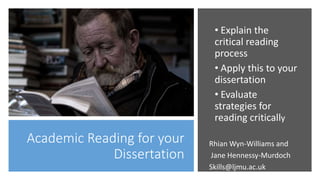
What does this image mean to you?
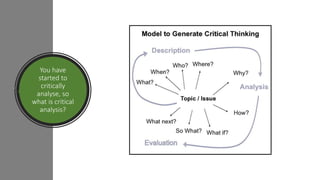
You have
started to
critically
analyse, so
what is critical
analysis?
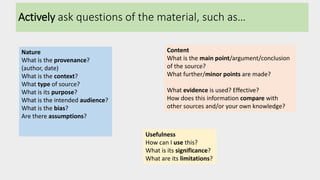
Actively ask questions of the material, such as…
Nature
What is the provenance?
(author, date)
What is the context?
What type of source?
What is its purpose?
What is the intended audience?
What is the bias?
Are there assumptions?
Content
What is the main point/argument/conclusion
of the source?
What further/minor points are made?
What evidence is used? Effective?
How does this information compare with
other sources and/or your own knowledge?
Usefulness
How can I use this?
What is its significance?
What are its limitations?
Let's pretend you are working on this dissertation
Aim:
• An investigation into
the perceptions of
teaching British
Values amongst
postgraduate
students
• We'll read through
two abstracts from
articles on teaching
British Values and
start applying some
of the critical
reading questions.
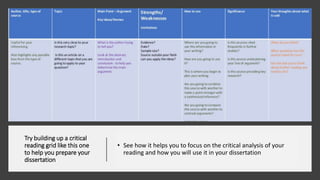
Try building up a critical
reading grid like this one
to help you prepare your
dissertation
• See how it helps you to focus on the critical analysis of your
reading and how you will use it in your dissertation
Reflection…..
If you had to
give another
student a piece
of advice
about how to
develop their
critical reading,
what would it
be?

Webinar pg critical reading for your dissertation

  • 1.
    Academic Reading foryour Dissertation • Explain the critical reading process • Apply this to your dissertation • Evaluate strategies for reading critically Rhian Wyn-Williams and Jane Hennessy-Murdoch Skills@ljmu.ac.uk
  • 2.
    What does thisimage mean to you?
  • 3.
    You have started to critically analyse,so what is critical analysis?
  • 4.
    Actively ask questionsof the material, such as… Nature What is the provenance? (author, date) What is the context? What type of source? What is its purpose? What is the intended audience? What is the bias? Are there assumptions? Content What is the main point/argument/conclusion of the source? What further/minor points are made? What evidence is used? Effective? How does this information compare with other sources and/or your own knowledge? Usefulness How can I use this? What is its significance? What are its limitations?
  • 5.
    Let's pretend youare working on this dissertation Aim: • An investigation into the perceptions of teaching British Values amongst postgraduate students
  • 6.
    • We'll readthrough two abstracts from articles on teaching British Values and start applying some of the critical reading questions.
  • 7.
    Try building upa critical reading grid like this one to help you prepare your dissertation • See how it helps you to focus on the critical analysis of your reading and how you will use it in your dissertation
  • 8.
    Reflection….. If you hadto give another student a piece of advice about how to develop their critical reading, what would it be?

Editor's Notes

  • #2 The idea in this session is to get them critical analysing before ‘revealing’ that is what they have been doing – get them to realise that they can do it and this is how.
  • #3 Acknowledging some students’ experiences of B colonialism (probably from own heritage and culture – past but also eg N.Irish, even Welsh – where is the flag?) – move into a ‘you’ve been critically analysing!) Bvalues are: Democracy. The rule of law. Individual liberty. Mutual respect. Tolerance of those of different faiths and beliefs.
  • #4 To confirm/develop their initial responses – ask them for examples from the discussion of how they did each
  • #5 Talk about each of these – ask them for egs from subjects. Apply these to what they have read so far as we go along
  • #7 I’d put them into fours and give them about 10 mins max on this and then a bit of q and a feedback using critical questioning to push them as far as poss, esp on poss limitations/bias/methods etc. – you know what to do!! Grandmother and eggs here
  • #9 Go round and get all of their responses to these questions as a plenary.