STRATEGIES FOR CRITICAL READING
Reading and Writing Skills 11
OBJECTIVES
Specifically, you will learn the
following in this module:
1. Identify the different strategies
for critical reading; and
2. Use appropriate strategies for
critical reading.
PRETEST
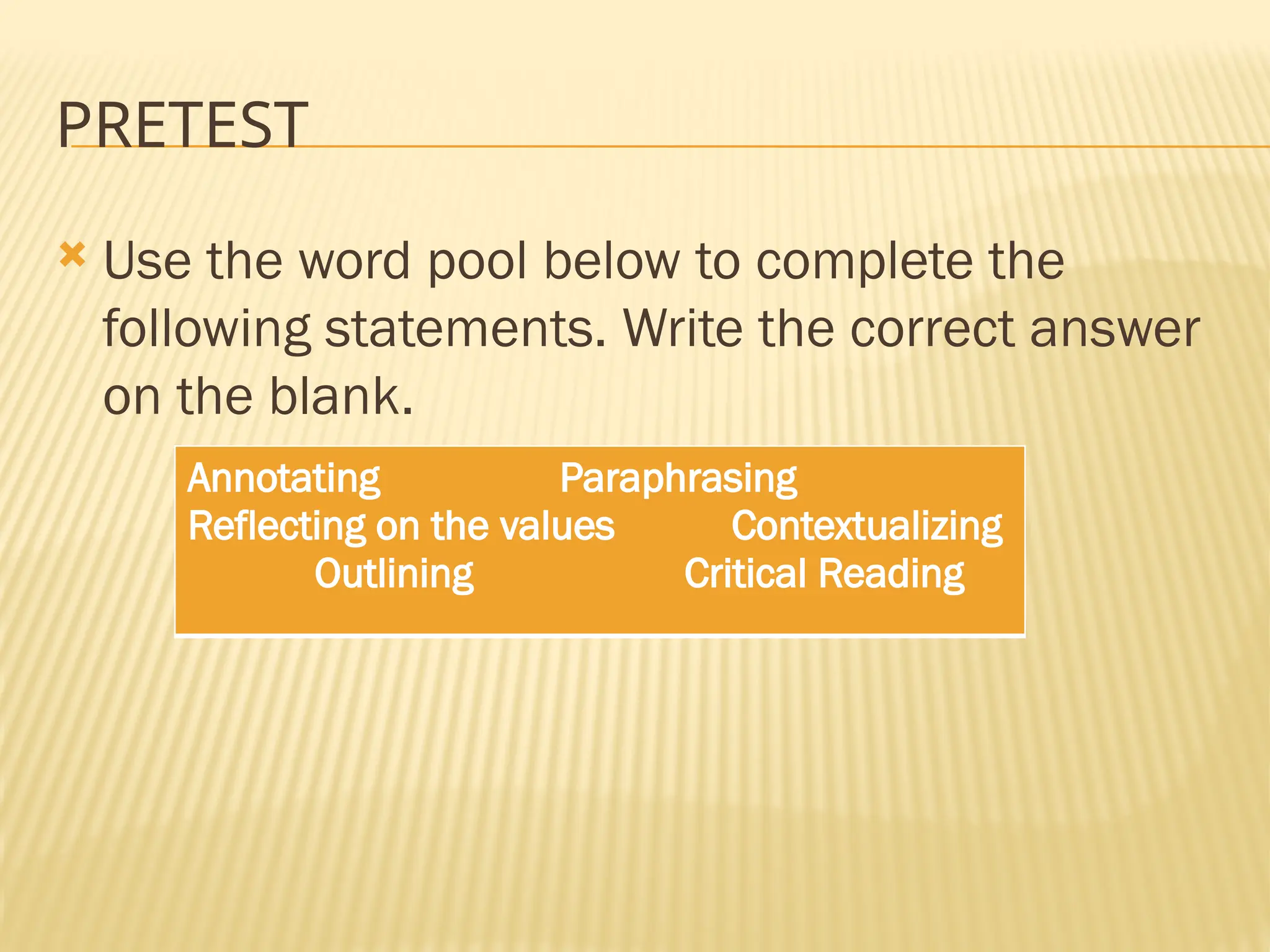
 Use the word pool below to complete the
following statements. Write the correct answer
on the blank.
Annotating Paraphrasing
Reflecting on the values Contextualizing
Outlining Critical Reading
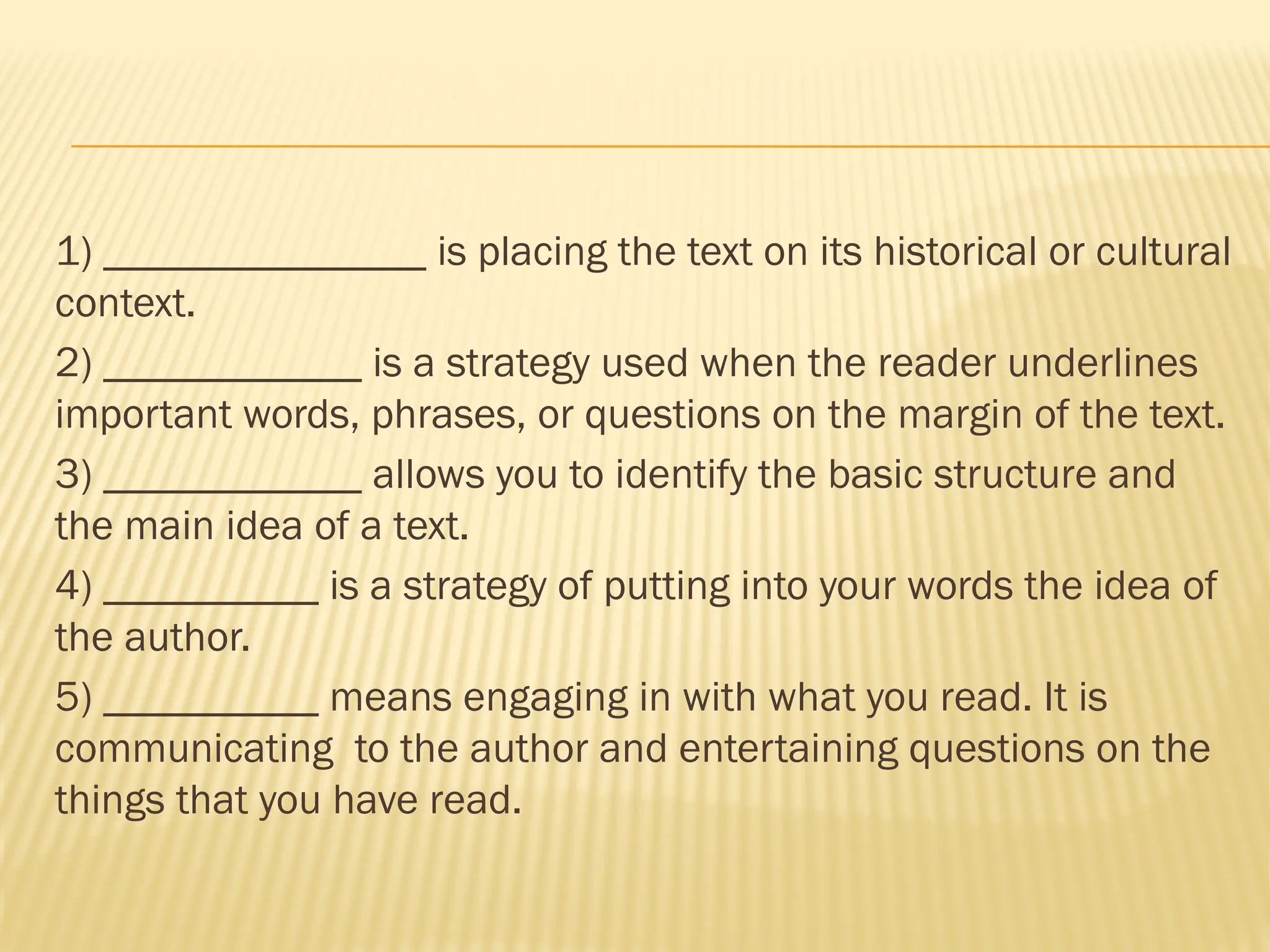
1) _______________ is placing the text on its historical or cultural
context.
2) ____________ is a strategy used when the reader underlines
important words, phrases, or questions on the margin of the text.
3) ____________ allows you to identify the basic structure and
the main idea of a text.
4) __________ is a strategy of putting into your words the idea of
the author.
5) __________ means engaging in with what you read. It is
communicating to the author and entertaining questions on the
things that you have read.
LESSON
 Reading effectively requires approaching texts with a
critical eye: evaluating what you read for not just
what it says, but how and why it says it. Effective
reading is central to both effective research (when
you evaluate sources) and effective writing (when
you understand how what you read is written, you
can work to incorporate those techniques into your
own writing). Being an effective reader also means
being able to evaluate your own practices, working to
develop your critical reading skills.
 Reading critically does not, necessarily, mean
being critical of what you read. Though at the
sound of the word, it usually connotes critic or
negative reactions. Both reading and thinking
critically do not mean being ‘critical’ about
some idea, argument, or piece of writing -
claiming that it is somehow faulty or flawed. It
is going beyond what is given.
Critical reading means engaging in
what you read by asking yourself
questions such as, ‘what is the author
trying to say?’ or ‘what is the main
argument being presented?’ This way
we are communicating with the
writer’s idea(s) whether we are
affirming or not.
Critical reading involves presenting a
reasoned argument that evaluates
and analyses what you have read.
Being critical, therefore - in an
academic sense - means advancing
your understanding, not dismissing,
and therefore closing off learning.
To read critically is exercising your
judgement about what you are
reading – that is, not taking anything
you read at face value. It is always
trying to know what is beyond it. It is
considering all options and thinking
relatively what will be the
consequences that it offers.
 When reading academic material, you will be faced with
the author’s interpretation and opinion. Different authors
will, naturally, have different slants. You should always
examine what you are reading critically and look for
limitations, omissions, inconsistencies, oversights, and
arguments against what you are reading. Opening oneself
to different readings and interpretations, you are
extending your evaluation on the veracity of the ideas
presented or given by the author. Considering the multiple
sides of issues before choosing own side is a quality of
critical thinkers.
As a student, you will be expected to
understand different viewpoints and
make your own judgements based on
what you have read. We can have a
better understanding of the meaning
of the text and its context as we
expose ourselves to different reading
materials.
Critical reading goes further than just
being satisfied with what a text says,
it also involves reflecting on what the
text describes, and analyzing what the
text means, in the context of your
studies. But how can we attain critical
reading? This module will give you
different strategies to attain it.
STRATEGIES IN CRITICAL READING
 1. Annotating
One of the first strategies to begin with is
annotating a text. When you annotate, you
underline important parts of the text, such as
the thesis statement, topic sentences of body
paragraphs and explanatory material. It may
include encircling important words and even
writing comments or questions as you read the
text.
2. CONTEXTUALIZING
 When you contextualize a text, you place it within its
original historical or cultural context. As a reader you
should try to identify this context and consider how this
context differs from your own. To do this, you need to
consider the following:
 a. Language or ideas that appear foreign or out of date.
 b. Your knowledge of the time and place in which the
work was written.
 c. The effect these differences have on your
understanding and judgment of the reading.
3. REFLECTING ON CHALLENGES TO YOUR BELIEFS AND
VALUES
 Sometimes our beliefs about an issue are
difficult to express because they are so
ingrained. We can discover these beliefs if we
will explore on the challenges that the text post
on us. Is the value presented challenge your
own value or beliefs? Does it contradict on your
beliefs? Do you feel disturbed after reading
such text?
4. PARAPHRASING
 When you paraphrase a text, you put it into your
own words. This can clarify a difficult or
ambiguous passage. Unlike a summary, a
paraphrase contains all the original
information. The purpose of a paraphrase is to
simplify without changing any information. You
are not changing what is said, but how it is
said.
5. OUTLINING
This can be used as a preliminary to
summarizing. Outlining allows you to
identify the basic structure of a text
and the main ideas of the text. In an
outline you are listing the main ideas
and supporting evidence of a text.
Use your own words when outlining a
text.
6. SUMMARIZING
Summarizing creates a new
text by synthesizing the
material of the original.
After outlining the text, the
information is put together
again in your own words.
7. EXPLORING THE FIGURATIVE
LANGUAGE
Similes, metaphors, and
symbols are all examples of
figurative language. This type of
language helps writers
illustrate their points and get
the type of reaction they want
from the reader.
8. EVALUATING THE LOGIC OF AN ARGUMENT
The two parts of an argument are
claim and support. The claim is what
the writer wants the reader to accept.
That is, the claim is the idea, opinion,
or point of view of the writer. The
support is the reasons and evidence
that becomes the basis for that claim.
LET US TRY THIS
 Apply the “exercise your judgment” definition of
critical reading in the given situation.
 There is a trolley coming down the tracks and
ahead, there are five people tied to the tracks who
are unable to move. The trolley will continue coming
and will kill five people. There is nothing you can do
to rescue the five, except that there is a lever. If you
pull the lever, the train will be directed to another
track, which has only one person tied to it.
 You have two choices:
1. Do nothing and the five people will die
2. Pull the lever and save the five people but let one person die.
In this situation, most likely you will choose number two option:
pull the lever and save the five people but let one person die. This
is the least that one can do, to sacrifice one for other five to
survive. Here we need critical thinking. What is beyond the text? Is
it merely sacrificing lives? Is it to think clearly and attentively? Is it
to choose wisely on the given options? Or you have no choice at
all for your next move is already given in the text?
Today, we are always facing different challenges right on our very
noses. We tend to close our eyes and choose the lesser evil as
philosophers would say and teach.
ACTIVITY 1
 Identify the reading strategy being described in each
statement. Encircle the letter of the answer.
1) This reading strategy places the text within its
original historical or
cultural context.
A. Annotating
B. Contextualizing
C. Outlining
D. Summarizing
 2) This strategy entails identification of the basic structure of a text
and the main ideas of the text.
A. Contextualizing
B. Evaluating
C. Outlining
D. Summarizing
 3) The following are some strategies in critical reading EXCEPT one.
A. Annotating
B. Evaluating
C. Exploring
D. Summarizing
4) This strategy differs from summarization because it contains all the
original information though putting it into your own words.
A. Annotating
B. Evaluating
C. Exploring
D. Paraphrasing
5) This strategy in critical reading may include underlining, encircling, or
writing comments as you read.
A. Annotating
B. Evaluating
C. Exploring
D. Summarizing
ACTIVITY 2
 Apply critical reading in analyzing the caption below.
Through writing your own 5-8 sentence paragraph,
express your analysis using contextualizing reading
strategy.
 Justin: ‘What I love about Chikki the most is that she
always finds a way to make me laugh or smile.’ Chikki:
‘I love that Justin supports me and allows me to grow
to my full potential in every aspect of my life. He
inspires me to be the best person I can be.’(-Caption
on the “Born for you” news article written by Joanne
Rae M. Ramirez published on The Philippine Star on
August 25, 2020 at 12:00noon.)
RUBRICS:
Content (the essential elements are
developed): 10 pts.
Originality (personal insights are
shared): 5 pts.
Organization (unity of thoughts and
details): 5 pts.
TOTAL SCORE 20 pts.
ACTIVITY 3
 Write true if the statement is correct and false if otherwise.
1. Presenting a reasoned argument that evaluates and analyses the
text read is involved in critical reading.
2. Reading one source is enough to be a critical reader.
3. Critical reading means engaging in with what you read. It is
communicating to the author and entertaining questions on the
things that you have read.
4. Annotating is a reading strategy that entails putting into your
words the idea of the author.
5. Reflecting on challenges to your beliefs and values is a reading
strategy that concerns on weighing the impact of the values
presented to the reader.
QUIZ
 Match the items in column A with the items in
column B. Write the letter of the correct answer
on the space provided before each number.
A.
_____ 1. It is a strategy of putting in your own
words the idea of the author.
_____ 2. It is putting personal words, underline
and circle on important words or phrases.
_____ 3. It is identifying the context of the text
and circle on important words or phrases.
_____ 4. It is an identification of the basic
structure and the main idea of a text.
_____ 5. It means engaging in with what you
read. It is communicating to the author.
B
A. Outlining
B. Critical Reading
C. Contextualizing
D. Annotating
E. Paraphrasing

Reading and Writing skills 11 - strategies for critical reading

  • 1.
    STRATEGIES FOR CRITICALREADING Reading and Writing Skills 11
  • 2.
    OBJECTIVES Specifically, you willlearn the following in this module: 1. Identify the different strategies for critical reading; and 2. Use appropriate strategies for critical reading.
  • 3.
    PRETEST  Use theword pool below to complete the following statements. Write the correct answer on the blank. Annotating Paraphrasing Reflecting on the values Contextualizing Outlining Critical Reading
  • 4.
    1) _______________ isplacing the text on its historical or cultural context. 2) ____________ is a strategy used when the reader underlines important words, phrases, or questions on the margin of the text. 3) ____________ allows you to identify the basic structure and the main idea of a text. 4) __________ is a strategy of putting into your words the idea of the author. 5) __________ means engaging in with what you read. It is communicating to the author and entertaining questions on the things that you have read.
  • 5.
    LESSON  Reading effectivelyrequires approaching texts with a critical eye: evaluating what you read for not just what it says, but how and why it says it. Effective reading is central to both effective research (when you evaluate sources) and effective writing (when you understand how what you read is written, you can work to incorporate those techniques into your own writing). Being an effective reader also means being able to evaluate your own practices, working to develop your critical reading skills.
  • 6.
     Reading criticallydoes not, necessarily, mean being critical of what you read. Though at the sound of the word, it usually connotes critic or negative reactions. Both reading and thinking critically do not mean being ‘critical’ about some idea, argument, or piece of writing - claiming that it is somehow faulty or flawed. It is going beyond what is given.
  • 7.
    Critical reading meansengaging in what you read by asking yourself questions such as, ‘what is the author trying to say?’ or ‘what is the main argument being presented?’ This way we are communicating with the writer’s idea(s) whether we are affirming or not.
  • 8.
    Critical reading involvespresenting a reasoned argument that evaluates and analyses what you have read. Being critical, therefore - in an academic sense - means advancing your understanding, not dismissing, and therefore closing off learning.
  • 9.
    To read criticallyis exercising your judgement about what you are reading – that is, not taking anything you read at face value. It is always trying to know what is beyond it. It is considering all options and thinking relatively what will be the consequences that it offers.
  • 10.
     When readingacademic material, you will be faced with the author’s interpretation and opinion. Different authors will, naturally, have different slants. You should always examine what you are reading critically and look for limitations, omissions, inconsistencies, oversights, and arguments against what you are reading. Opening oneself to different readings and interpretations, you are extending your evaluation on the veracity of the ideas presented or given by the author. Considering the multiple sides of issues before choosing own side is a quality of critical thinkers.
  • 11.
    As a student,you will be expected to understand different viewpoints and make your own judgements based on what you have read. We can have a better understanding of the meaning of the text and its context as we expose ourselves to different reading materials.
  • 12.
    Critical reading goesfurther than just being satisfied with what a text says, it also involves reflecting on what the text describes, and analyzing what the text means, in the context of your studies. But how can we attain critical reading? This module will give you different strategies to attain it.
  • 13.
    STRATEGIES IN CRITICALREADING  1. Annotating One of the first strategies to begin with is annotating a text. When you annotate, you underline important parts of the text, such as the thesis statement, topic sentences of body paragraphs and explanatory material. It may include encircling important words and even writing comments or questions as you read the text.
  • 14.
    2. CONTEXTUALIZING  Whenyou contextualize a text, you place it within its original historical or cultural context. As a reader you should try to identify this context and consider how this context differs from your own. To do this, you need to consider the following:  a. Language or ideas that appear foreign or out of date.  b. Your knowledge of the time and place in which the work was written.  c. The effect these differences have on your understanding and judgment of the reading.
  • 15.
    3. REFLECTING ONCHALLENGES TO YOUR BELIEFS AND VALUES  Sometimes our beliefs about an issue are difficult to express because they are so ingrained. We can discover these beliefs if we will explore on the challenges that the text post on us. Is the value presented challenge your own value or beliefs? Does it contradict on your beliefs? Do you feel disturbed after reading such text?
  • 16.
    4. PARAPHRASING  Whenyou paraphrase a text, you put it into your own words. This can clarify a difficult or ambiguous passage. Unlike a summary, a paraphrase contains all the original information. The purpose of a paraphrase is to simplify without changing any information. You are not changing what is said, but how it is said.
  • 17.
    5. OUTLINING This canbe used as a preliminary to summarizing. Outlining allows you to identify the basic structure of a text and the main ideas of the text. In an outline you are listing the main ideas and supporting evidence of a text. Use your own words when outlining a text.
  • 18.
    6. SUMMARIZING Summarizing createsa new text by synthesizing the material of the original. After outlining the text, the information is put together again in your own words.
  • 19.
    7. EXPLORING THEFIGURATIVE LANGUAGE Similes, metaphors, and symbols are all examples of figurative language. This type of language helps writers illustrate their points and get the type of reaction they want from the reader.
  • 20.
    8. EVALUATING THELOGIC OF AN ARGUMENT The two parts of an argument are claim and support. The claim is what the writer wants the reader to accept. That is, the claim is the idea, opinion, or point of view of the writer. The support is the reasons and evidence that becomes the basis for that claim.
  • 21.
    LET US TRYTHIS  Apply the “exercise your judgment” definition of critical reading in the given situation.  There is a trolley coming down the tracks and ahead, there are five people tied to the tracks who are unable to move. The trolley will continue coming and will kill five people. There is nothing you can do to rescue the five, except that there is a lever. If you pull the lever, the train will be directed to another track, which has only one person tied to it.
  • 22.
     You havetwo choices: 1. Do nothing and the five people will die 2. Pull the lever and save the five people but let one person die. In this situation, most likely you will choose number two option: pull the lever and save the five people but let one person die. This is the least that one can do, to sacrifice one for other five to survive. Here we need critical thinking. What is beyond the text? Is it merely sacrificing lives? Is it to think clearly and attentively? Is it to choose wisely on the given options? Or you have no choice at all for your next move is already given in the text? Today, we are always facing different challenges right on our very noses. We tend to close our eyes and choose the lesser evil as philosophers would say and teach.
  • 23.
    ACTIVITY 1  Identifythe reading strategy being described in each statement. Encircle the letter of the answer. 1) This reading strategy places the text within its original historical or cultural context. A. Annotating B. Contextualizing C. Outlining D. Summarizing
  • 24.
     2) Thisstrategy entails identification of the basic structure of a text and the main ideas of the text. A. Contextualizing B. Evaluating C. Outlining D. Summarizing  3) The following are some strategies in critical reading EXCEPT one. A. Annotating B. Evaluating C. Exploring D. Summarizing
  • 25.
    4) This strategydiffers from summarization because it contains all the original information though putting it into your own words. A. Annotating B. Evaluating C. Exploring D. Paraphrasing 5) This strategy in critical reading may include underlining, encircling, or writing comments as you read. A. Annotating B. Evaluating C. Exploring D. Summarizing
  • 26.
    ACTIVITY 2  Applycritical reading in analyzing the caption below. Through writing your own 5-8 sentence paragraph, express your analysis using contextualizing reading strategy.  Justin: ‘What I love about Chikki the most is that she always finds a way to make me laugh or smile.’ Chikki: ‘I love that Justin supports me and allows me to grow to my full potential in every aspect of my life. He inspires me to be the best person I can be.’(-Caption on the “Born for you” news article written by Joanne Rae M. Ramirez published on The Philippine Star on August 25, 2020 at 12:00noon.)
  • 27.
    RUBRICS: Content (the essentialelements are developed): 10 pts. Originality (personal insights are shared): 5 pts. Organization (unity of thoughts and details): 5 pts. TOTAL SCORE 20 pts.
  • 28.
    ACTIVITY 3  Writetrue if the statement is correct and false if otherwise. 1. Presenting a reasoned argument that evaluates and analyses the text read is involved in critical reading. 2. Reading one source is enough to be a critical reader. 3. Critical reading means engaging in with what you read. It is communicating to the author and entertaining questions on the things that you have read. 4. Annotating is a reading strategy that entails putting into your words the idea of the author. 5. Reflecting on challenges to your beliefs and values is a reading strategy that concerns on weighing the impact of the values presented to the reader.
  • 29.
    QUIZ  Match theitems in column A with the items in column B. Write the letter of the correct answer on the space provided before each number. A. _____ 1. It is a strategy of putting in your own words the idea of the author. _____ 2. It is putting personal words, underline and circle on important words or phrases.
  • 30.
    _____ 3. Itis identifying the context of the text and circle on important words or phrases. _____ 4. It is an identification of the basic structure and the main idea of a text. _____ 5. It means engaging in with what you read. It is communicating to the author.
  • 31.
    B A. Outlining B. CriticalReading C. Contextualizing D. Annotating E. Paraphrasing