Center for Medicare and Medicaaid Innovvaation Centter Updatte 
eDr. Patrick Conway, M.D., MSc CMS Chief Medical Officer and Deputy Administrator for Innovation and QualityDirector, Center for Medicare and Medicaid innovationDirector, Center for Clinical Standards and QualityNovember 10, 2014
Discussion 
• Our Goals and Early Results 
• Center for Medicare and Medicaid Innovation 
• Model Updates 
• Looking Forward 
2
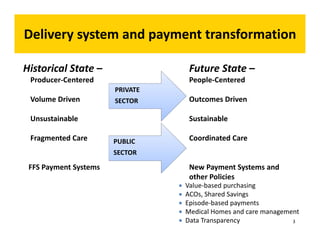
 Value‐based purchasing 
 ACOs, Shared Savings 
 Episode‐based payments 
 Medical Homes and care management 
 Data Transparency 
Future State – 
People‐Centered 
Outcomes Driven 
Sustainable 
Coordinated Care 
New Payment Systems and 
other Policies 
PUBLIC 
SECTOR 
PRIVATE 
SECTOR 
Historical State – 
Producer‐Centered 
Volume Driven 
Unsustainable 
Fragmented Care 
FFS Payment Systems 
Delivery system and payment transformation 
3
Rajkumar R, Conway PH, TavennerM. The CMS—Engaging Multiple Payers in Risk‐Sharing Models. JAMA. Doi:10.1001/jama.2014.3703 
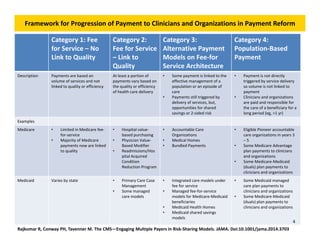
Category 1: Fee 
for Service – No 
Link to Quality 
Category 2: 
Feefor Service 
– Link to 
Quality 
Category 3: 
Alternative Payment 
Models on Fee‐for 
Service Architecture 
Category 4: 
Population‐Based 
Payment 
Description Payments are based on 
volume of services and not 
linked to quality or efficiency 
At least a portion of 
payments vary based on 
the quality or efficiency 
of health care delivery 
• Some payment is linked to the 
effective management of a 
population or an episode of 
care 
• Payments still triggered by 
delivery of services, but, 
opportunities for shared 
savings or 2‐sided risk 
• Payment is not directly 
triggered by service delivery 
so volume is not linked to 
payment 
• Clinicians and organizations 
are paid and responsible for 
the care of a beneficiary for a 
long period (eg, >1 yr) 
Examples 
Medicare • Limited in Medicare fee‐for‐ 
service 
• Majority of Medicare 
payments now are linked 
to quality 
• Hospital value‐based 
purchasing 
• Physician Value‐ 
Based Modifier 
• Readmissions/Hos 
pital Acquired 
Condition 
Reduction Program 
• Accountable Care 
Organizations 
• Medical Homes 
• Bundled Payments 
• Eligible Pioneer accountable 
care organizations in years 3 
– 5 
• Some Medicare Advantage 
plan payments to clinicians 
and organizations 
• Some Medicare‐Medicaid 
(duals) plan payments to 
clinicians and organizations 
Medicaid Varies by state • Primary Care Case 
Management 
• Some managed 
care models 
• Integrated care models under 
fee for service 
• Managed fee‐for‐service 
models for Medicare‐Medicaid 
beneficiaries 
• Medicaid Health Homes 
• Medicaid shared savings 
models 
• Some Medicaid managed 
care plan payments to 
clinicians and organizations 
• Some Medicare‐Medicaid 
(duals) plan payments to 
clinicians and organizations 
Framework for Progression of Payment to Clinicians and Fr Organizations in Payment Reform 
amework 4
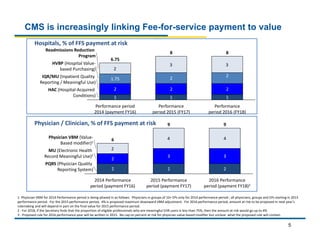
5 
1‐ Physician VBM for 2014 Performance period is being phased in as follows: Physicians in groups of 10+ EPs only for 2014 performance period ; all physicians, groups and EPs starting in 2015 
performance period. For the 2015 performance period, 4% is proposed maximum downward VBM adjustment. For 2016 performance period, amount at risk to be proposed in next year’s 
rulemaking and will depend in part on the final value for 2015 performance period. 
2 ‐ For 2018, if the Secretary finds that the proportion of eligible professionals who are meaningful EHR users is less than 75%, then the amount at risk would go up to 4% 
3 ‐ Proposed rule for 2016 performance year will be written in 2015. No cap on percent at risk for physician value‐based modifier but unclear what the proposed rule will contain. 
2 
4 4 
3 
2 
9 
2016 Performance 
period (payment FY18)3 
3 
2 
9 
2015 Performance 
period (payment FY17) 
Physician VBM (Value‐ 
Based modifier)1 
2 
MU (Electronic Health 
Record Meaningful Use)2 
2 
PQRS (Physician Quality 
Reporting System) 
6 
2014 Performance 
period (payment FY16) 
Physician / Clinician, % of FFS payment at risk 
2 
3 3 
2 
2 
1 
8 
Performance 
period 2016 (FY18) 
2 
2 
1 
8 
Performance 
period 2015 (FY17) 
Readmissions Reduction 
Program 
1.75 
HVBP (Hospital Value‐based 
Purchasing) 
2 
IQR/MU (Inpatient Quality 
Reporting / Meaningful Use) 
1 
HAC (Hospital‐Acquired 
Conditions) 
6.75 
Performance period 
2014 (payment FY16) 
Hospitals, % of FFS payment at risk 
CMS is increasingly linking Fee-for-service payment to value
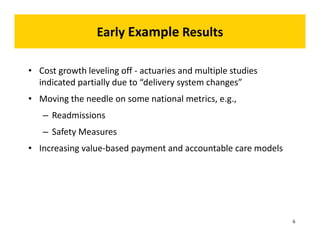
Early Example Results 
• Cost growth leveling off ‐ actuaries and multiple studies 
indicated partially due to “delivery system changes” 
• Moving the needle on some national metrics, e.g., 
– Readmissions 
– Safety Measures 
• Increasing value‐based payment and accountable care models 
6
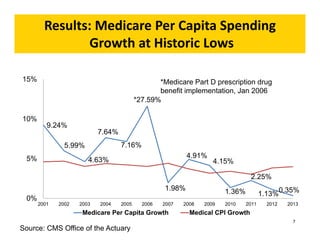
Source: CMS Office of the Actuary 
*Medicare Part D prescription drug 
benefit implementation, Jan 2006 
9.24% 
5.99% 
4.63% 
7.64% 
7.16% 
*27.59% 
1.98% 
4.91% 
4.15% 
1.36% 
2.25% 
1.13%0.35% 
0% 
5% 
10% 
15% 
2001 2002200320042005 2006200720082009 2010201120122013 
Medicare Per Capita Growth Medical CPI Growth 
Results: Medicare Per Capita Spending 
Growth at Historic Lows 
7
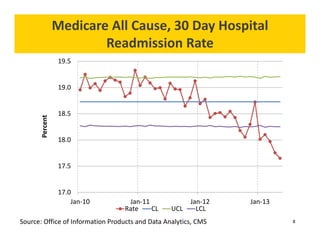
Source: Office of Information Products and Data Analytics, CMS 
17.0 
17.5 
18.0 
18.5 
19.0 
19.5 
Jan‐10 Jan‐11 Jan‐12 Jan‐13 
Percent 
Rate CL UCL LCL 
Medicare All Cause, 30 Day Hospital 
Readmission Rate 
8
Hospital 
Acquired 
Condition 
Ventilator- 
Associated 
Pneumonia 
(VAP) 
Early 
Elective 
Delivery 
(EED) 
Obstetric 
Trauma 
Rate 
(OB) 
Venous 
thromboembolic 
complications 
(VTE) 
Falls 
and 
Trauma 
Pressure 
Ulcers 
Percent 
Decrease 
55.3% 52.3%12.3%12.0%11.2%11.2% 
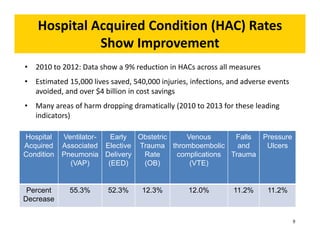
• 2010 to 2012: Data show a 9% reduction in HACs across all measures 
• Estimated 15,000 lives saved, 540,000 injuries, infections, and adverse events 
avoided, and over $4 billion in cost savings 
• Many areas of harm dropping dramatically (2010 to 2013 for these leading 
indicators) 
Hospital Acquired Condition (HAC) Rates 
Show Improvement 
9
Discussion 
• Our Goals and Early Results 
• Center for Medicare and Medicaid Innovation 
• Model Updates 
• Looking Forward 
10
The purpose of the [Center] is to test innovative 
payment and service delivery models to reduce program 
expenditures…while preserving or enhancing the quality 
of care furnished to individuals under such titles. 
- The Affordable CareAct 
Identify, Test, Evaluate, Scale 
The CMS Innovation Center 
11
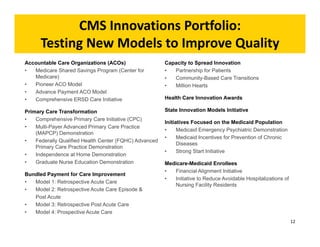
Accountable Care Organizations (ACOs) 
• Medicare Shared Savings Program (Center for 
Medicare) 
• Pioneer ACO Model 
• Advance Payment ACO Model 
• Comprehensive ERSD Care Initiative 
Primary Care Transformation 
• Comprehensive Primary Care Initiative (CPC) 
• Multi-Payer Advanced Primary Care Practice 
(MAPCP) Demonstration 
• Federally Qualified Health Center (FQHC) Advanced 
Primary Care Practice Demonstration 
• Independence at Home Demonstration 
• Graduate Nurse Education Demonstration 
Bundled Payment for Care Improvement 
• Model 1: Retrospective AcuteCare 
• Model 2: Retrospective Acute Care Episode & 
Post Acute 
• Model3: Retrospective Post Acute Care 
• Model4: Prospective Acute Care 
Capacity to Spread Innovation 
• Partnership for Patients 
• Community-Based Care Transitions 
• Million Hearts 
Health Care Innovation Awards 
State Innovation Models Initiative 
Initiatives Focusedon the Medicaid Population 
• Medicaid Emergency Psychiatric Demonstration 
• Medicaid Incentives for Prevention of Chronic 
Diseases 
• Strong Start Initiative 
Medicare-Medicaid Enrollees 
• Financial Alignment Initiative 
• Initiative to Reduce Avoidable Hospitalizations of 
Nursing Facility Residents 
CMS Innovations Portfolio: 
Testing New Models to Improve Quality 
12
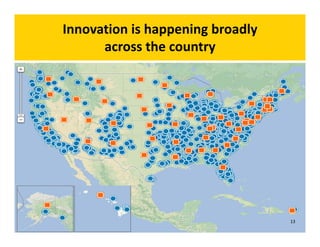
Innovation is happening broadly 
across the country 
13
Discussion 
• Our Goals and Early Results 
• Center for Medicare and Medicaid Innovation 
• Model Updates 
• Looking Forward 
14
Accountable Care Organization Goals 
ountable • Improve the safety and quality of patient care while lowering 
costs 
• Promote shared accountability across providers 
• Increase coordination of care 
• Invest in infrastructure and redesigned care services 
• Achieve better health and better care at lower costs 
• Medicaid and private payers increasingly launching both 
Accountable Care Organizations and “alternative” contracts 
15
Accountable Care Organizations (ACOs) 
• An ACO promotes coordinated care and population 
management 
• Over 350 ACOs serving over 5 million Medicare beneficiaries 
• Over $380 million of savings combined year 1 of Medicare 
Shared Savings Plan (MSSP) and Pioneer ACOs 
• Pioneer model with early promising results 
– Generated shared savings and low cost growth (0.3%) 
– Outperformed published benchmarks on 15 of 15 clinical 
quality measures and 4 of 4 patient experience measures 
16
1 Pham H, Cohen M, Conway PH. The Pioneer Accountable Care organization Model: 
Improving quality and lowering costs. JAMA 2014 Sept 17. 
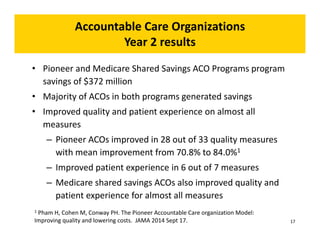
• Pioneer and Medicare Shared Savings ACO Programs program 
savings of $372 million 
• Majority of ACOs in both programs generated savings 
• Improved quality and patient experience on almost all 
measures 
– Pioneer ACOs improved in 28 out of 33 quality measures 
with mean improvement from 70.8% to 84.0%1 
– Improved patient experience in 6 out of 7 measures 
– Medicare shared savings ACOs also improved quality and 
patient experience for almost all measures 
Accountable Care Organizations 
Year 2 results 
17
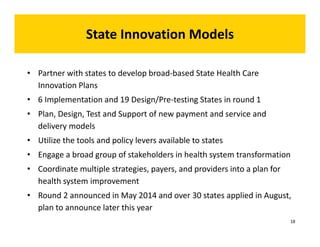
State Innovation Models 
ate • Partner with states to develop broad‐based State Health Care 
Innovation Plans 
• 6 Implementation and 19 Design/Pre‐testing States in round 1 
• Plan, Design, Test and Support of new payment and service and 
delivery models 
• Utilize the tools and policy levers available to states 
• Engage a broad group of stakeholders in health system transformation 
• Coordinate multiple strategies, payers, and providers into a plan for 
health system improvement 
• Round 2 announced in May 2014 and over 30 states applied in August, 
plan to announce later this year 
18
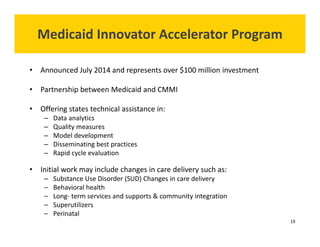
Medicaid Innovator Accelerator Program 
• Announced July 2014 and represents over $100 million investment 
• Partnership between Medicaid and CMMI 
• Offering states technical assistance in: 
– Data analytics 
– Quality measures 
– Model development 
– Disseminating best practices 
– Rapid cycle evaluation 
• Initial work may include changes in care delivery such as: 
– Substance Use Disorder (SUD) Changes in care delivery 
– Behavioral health 
– Long‐ term services and supports & community integration 
– Superutilizers 
– Perinatal 
19
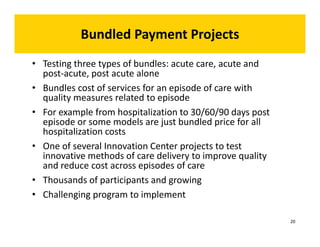
Bundled Payment Projects 
• Testing three types of bundles: acute care, acute and 
post‐acute, post acute alone 
• Bundles cost of services for an episode of care with 
quality measures related to episode 
• For example from hospitalization to 30/60/90 days post 
episode or some models are just bundled price for all 
hospitalization costs 
• One of several Innovation Center projects to test 
innovative methods of care delivery to improve quality 
and reduce cost across episodes of care 
• Thousands of participants and growing 
• Challenging program to implement 
20
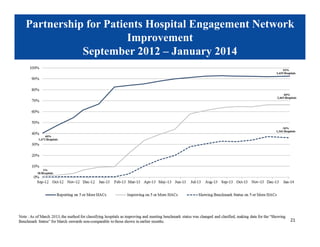
Partnership for Patients Hospital Engagement Network 
Improvement 
September 2012 –January 2014 
21
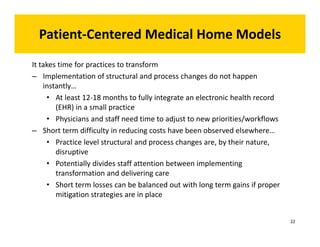
Patient‐Centered Medical Home Models 
atient‐It takes time for practices to transform 
– Implementation of structural and process changes do not happen 
instantly… 
• At least 12‐18 months to fully integrate an electronic health record 
(EHR) in a small practice 
• Physicians and staff need time to adjust to new priorities/workflows 
– Short term difficulty in reducing costs have been observed elsewhere… 
• Practice level structural and process changes are, by their nature, 
disruptive 
• Potentially divides staff attention between implementing 
transformation and delivering care 
• Short term losses can be balanced out with long term gains if proper 
mitigation strategies are in place 
22
Innovation Center 
Patient‐Centered Medical Home Models 
• Multi‐payer Advanced Primary Care Practice (MAPCP) 
Demonstration 
• Federally Qualified Health Center (FQHC) Advanced 
Primary Care Practice Demonstration 
• Comprehensive Primary Care (CPC) Initiative 
23
• CMS convened Medicaid and commercial payers in discrete 
geographic areas to support primary care practice transformation 
through: enhanced, non-visit-based payments; data feedback; and 
technical assistance 
• Aligned set of quality measures 
• 7 regions (AR, OR, NJ, CO, OK, OH/KY, NY) encompassing 31 
payers, 500 practices, and 2.6 million patients 
• CMS-defined, standardized intervention, includes 5 functions: 
– Risk-stratified care management 
– Access and continuity 
– Planned care for chronic conditions 
– Coordination of care across the medical neighborhood 
– Patient and caregiver engagement 
Comprehensive Primary Care (CPC) Overview 
24
CPC Key Findings from Year 1 
y • CPC practices added 1,100 care managers, who are staff providing 
intensive care management to patients at highest risk 
• 97% of eligible providers have attested to at least stage one Meaningful 
Use of Health IT 
• Deployed patient shared decision‐making tools to address prostate cancer 
screening, diabetes medications, management of acute low back pain, and 
others 
• Early results indicate that expenditures are trending downward 
25
Overarching Patient‐Centered Medical Home 
(PCMH) Early Results 
• With some exceptions, too early in model tests to see changes 
in key outcomes 
– Primary care practice transformation takes time to implement 
– Benefits of better primary care and care coordination take time to 
improve health and reduce downstream events 
– Seeing some promising results, suggesting cost savings, though they 
are preliminary and not consistent 
• Seeing steady improvements in PCMH capabilities 
• Spreading learnings across CMMI models and into core 
payment programs 
26
• Medical practices provide chronically ill beneficiaries with home‐based 
primary care. 
• Practices must serve at least 200 targeted beneficiaries living with 
multiple chronic diseases to be eligible. 
• Incentive payments for practices successful in: 
o meeting quality standards; and 
o reducing total expenditures. 
• 14 independent practices and 1 consortia participating in IAH. 
• Early results promising 
GOAL: Testing the effectiveness of providing chronically ill beneficiaries with 
home‐based primary care. 
Independence at Home 
October 2014
Discussion 
• Our Goals and Early Results 
• Center for Medicare and Medicaid Innovation 
• Model Updates 
• Looking Forward 
28
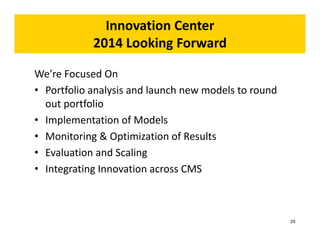
Innovation Center 
2014 Looking Forward 
We’re Focused On 
• Portfolio analysis and launch new models to round 
out portfolio 
• Implementation of Models 
• Monitoring & Optimization of Results 
• Evaluation and Scaling 
• Integrating Innovation across CMS 
29
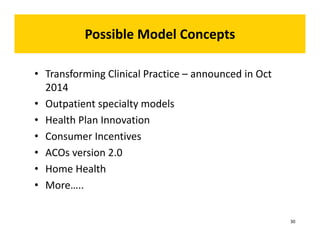
Possible Model Concepts 
ossible • Transforming Clinical Practice – announced in Oct 
2014 
• Outpatient specialty models 
• Health Plan Innovation 
• Consumer Incentives 
• ACOs version 2.0 
• Home Health 
• More….. 
30
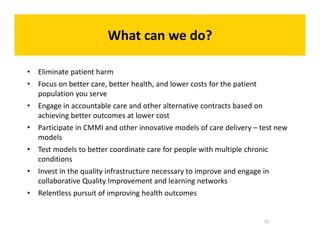
What can we do? 
t • Eliminate patient harm 
• Focus on better care, better health, and lower costs for the patient 
population you serve 
• Engage in accountable care and other alternative contracts based on 
achieving better outcomes at lower cost 
• Participate in CMMI and other innovative models of care delivery – test new 
models 
• Test models to better coordinate care for people with multiple chronic 
conditions 
• Invest in the quality infrastructure necessary to improve and engage in 
collaborative Quality Improvement and learning networks 
• Relentless pursuit of improving health outcomes 
31
Dr. Patrick Conway, M.D., M.Sc. 
CMS Deputy Administrator for Innovation and Quality and 
CMS Chief Medical Officer 
410-786-6841 
patrick.conway@cms.hhs.gov 
Contact Information 
32

Webinar: CMS Innovation Center Update

  • 1.
    Center for Medicareand Medicaaid Innovvaation Centter Updatte eDr. Patrick Conway, M.D., MSc CMS Chief Medical Officer and Deputy Administrator for Innovation and QualityDirector, Center for Medicare and Medicaid innovationDirector, Center for Clinical Standards and QualityNovember 10, 2014
  • 2.
    Discussion • OurGoals and Early Results • Center for Medicare and Medicaid Innovation • Model Updates • Looking Forward 2
  • 3.
     Value‐based purchasing  ACOs, Shared Savings  Episode‐based payments  Medical Homes and care management  Data Transparency Future State – People‐Centered Outcomes Driven Sustainable Coordinated Care New Payment Systems and other Policies PUBLIC SECTOR PRIVATE SECTOR Historical State – Producer‐Centered Volume Driven Unsustainable Fragmented Care FFS Payment Systems Delivery system and payment transformation 3
  • 4.
    Rajkumar R, ConwayPH, TavennerM. The CMS—Engaging Multiple Payers in Risk‐Sharing Models. JAMA. Doi:10.1001/jama.2014.3703 Category 1: Fee for Service – No Link to Quality Category 2: Feefor Service – Link to Quality Category 3: Alternative Payment Models on Fee‐for Service Architecture Category 4: Population‐Based Payment Description Payments are based on volume of services and not linked to quality or efficiency At least a portion of payments vary based on the quality or efficiency of health care delivery • Some payment is linked to the effective management of a population or an episode of care • Payments still triggered by delivery of services, but, opportunities for shared savings or 2‐sided risk • Payment is not directly triggered by service delivery so volume is not linked to payment • Clinicians and organizations are paid and responsible for the care of a beneficiary for a long period (eg, >1 yr) Examples Medicare • Limited in Medicare fee‐for‐ service • Majority of Medicare payments now are linked to quality • Hospital value‐based purchasing • Physician Value‐ Based Modifier • Readmissions/Hos pital Acquired Condition Reduction Program • Accountable Care Organizations • Medical Homes • Bundled Payments • Eligible Pioneer accountable care organizations in years 3 – 5 • Some Medicare Advantage plan payments to clinicians and organizations • Some Medicare‐Medicaid (duals) plan payments to clinicians and organizations Medicaid Varies by state • Primary Care Case Management • Some managed care models • Integrated care models under fee for service • Managed fee‐for‐service models for Medicare‐Medicaid beneficiaries • Medicaid Health Homes • Medicaid shared savings models • Some Medicaid managed care plan payments to clinicians and organizations • Some Medicare‐Medicaid (duals) plan payments to clinicians and organizations Framework for Progression of Payment to Clinicians and Fr Organizations in Payment Reform amework 4
  • 5.
    5 1‐ PhysicianVBM for 2014 Performance period is being phased in as follows: Physicians in groups of 10+ EPs only for 2014 performance period ; all physicians, groups and EPs starting in 2015 performance period. For the 2015 performance period, 4% is proposed maximum downward VBM adjustment. For 2016 performance period, amount at risk to be proposed in next year’s rulemaking and will depend in part on the final value for 2015 performance period. 2 ‐ For 2018, if the Secretary finds that the proportion of eligible professionals who are meaningful EHR users is less than 75%, then the amount at risk would go up to 4% 3 ‐ Proposed rule for 2016 performance year will be written in 2015. No cap on percent at risk for physician value‐based modifier but unclear what the proposed rule will contain. 2 4 4 3 2 9 2016 Performance period (payment FY18)3 3 2 9 2015 Performance period (payment FY17) Physician VBM (Value‐ Based modifier)1 2 MU (Electronic Health Record Meaningful Use)2 2 PQRS (Physician Quality Reporting System) 6 2014 Performance period (payment FY16) Physician / Clinician, % of FFS payment at risk 2 3 3 2 2 1 8 Performance period 2016 (FY18) 2 2 1 8 Performance period 2015 (FY17) Readmissions Reduction Program 1.75 HVBP (Hospital Value‐based Purchasing) 2 IQR/MU (Inpatient Quality Reporting / Meaningful Use) 1 HAC (Hospital‐Acquired Conditions) 6.75 Performance period 2014 (payment FY16) Hospitals, % of FFS payment at risk CMS is increasingly linking Fee-for-service payment to value
  • 6.
    Early Example Results • Cost growth leveling off ‐ actuaries and multiple studies indicated partially due to “delivery system changes” • Moving the needle on some national metrics, e.g., – Readmissions – Safety Measures • Increasing value‐based payment and accountable care models 6
  • 7.
    Source: CMS Officeof the Actuary *Medicare Part D prescription drug benefit implementation, Jan 2006 9.24% 5.99% 4.63% 7.64% 7.16% *27.59% 1.98% 4.91% 4.15% 1.36% 2.25% 1.13%0.35% 0% 5% 10% 15% 2001 2002200320042005 2006200720082009 2010201120122013 Medicare Per Capita Growth Medical CPI Growth Results: Medicare Per Capita Spending Growth at Historic Lows 7
  • 8.
    Source: Office ofInformation Products and Data Analytics, CMS 17.0 17.5 18.0 18.5 19.0 19.5 Jan‐10 Jan‐11 Jan‐12 Jan‐13 Percent Rate CL UCL LCL Medicare All Cause, 30 Day Hospital Readmission Rate 8
  • 9.
    Hospital Acquired Condition Ventilator- Associated Pneumonia (VAP) Early Elective Delivery (EED) Obstetric Trauma Rate (OB) Venous thromboembolic complications (VTE) Falls and Trauma Pressure Ulcers Percent Decrease 55.3% 52.3%12.3%12.0%11.2%11.2% • 2010 to 2012: Data show a 9% reduction in HACs across all measures • Estimated 15,000 lives saved, 540,000 injuries, infections, and adverse events avoided, and over $4 billion in cost savings • Many areas of harm dropping dramatically (2010 to 2013 for these leading indicators) Hospital Acquired Condition (HAC) Rates Show Improvement 9
  • 10.
    Discussion • OurGoals and Early Results • Center for Medicare and Medicaid Innovation • Model Updates • Looking Forward 10
  • 11.
    The purpose ofthe [Center] is to test innovative payment and service delivery models to reduce program expenditures…while preserving or enhancing the quality of care furnished to individuals under such titles. - The Affordable CareAct Identify, Test, Evaluate, Scale The CMS Innovation Center 11
  • 12.
    Accountable Care Organizations(ACOs) • Medicare Shared Savings Program (Center for Medicare) • Pioneer ACO Model • Advance Payment ACO Model • Comprehensive ERSD Care Initiative Primary Care Transformation • Comprehensive Primary Care Initiative (CPC) • Multi-Payer Advanced Primary Care Practice (MAPCP) Demonstration • Federally Qualified Health Center (FQHC) Advanced Primary Care Practice Demonstration • Independence at Home Demonstration • Graduate Nurse Education Demonstration Bundled Payment for Care Improvement • Model 1: Retrospective AcuteCare • Model 2: Retrospective Acute Care Episode & Post Acute • Model3: Retrospective Post Acute Care • Model4: Prospective Acute Care Capacity to Spread Innovation • Partnership for Patients • Community-Based Care Transitions • Million Hearts Health Care Innovation Awards State Innovation Models Initiative Initiatives Focusedon the Medicaid Population • Medicaid Emergency Psychiatric Demonstration • Medicaid Incentives for Prevention of Chronic Diseases • Strong Start Initiative Medicare-Medicaid Enrollees • Financial Alignment Initiative • Initiative to Reduce Avoidable Hospitalizations of Nursing Facility Residents CMS Innovations Portfolio: Testing New Models to Improve Quality 12
  • 13.
    Innovation is happeningbroadly across the country 13
  • 14.
    Discussion • OurGoals and Early Results • Center for Medicare and Medicaid Innovation • Model Updates • Looking Forward 14
  • 15.
    Accountable Care OrganizationGoals ountable • Improve the safety and quality of patient care while lowering costs • Promote shared accountability across providers • Increase coordination of care • Invest in infrastructure and redesigned care services • Achieve better health and better care at lower costs • Medicaid and private payers increasingly launching both Accountable Care Organizations and “alternative” contracts 15
  • 16.
    Accountable Care Organizations(ACOs) • An ACO promotes coordinated care and population management • Over 350 ACOs serving over 5 million Medicare beneficiaries • Over $380 million of savings combined year 1 of Medicare Shared Savings Plan (MSSP) and Pioneer ACOs • Pioneer model with early promising results – Generated shared savings and low cost growth (0.3%) – Outperformed published benchmarks on 15 of 15 clinical quality measures and 4 of 4 patient experience measures 16
  • 17.
    1 Pham H,Cohen M, Conway PH. The Pioneer Accountable Care organization Model: Improving quality and lowering costs. JAMA 2014 Sept 17. • Pioneer and Medicare Shared Savings ACO Programs program savings of $372 million • Majority of ACOs in both programs generated savings • Improved quality and patient experience on almost all measures – Pioneer ACOs improved in 28 out of 33 quality measures with mean improvement from 70.8% to 84.0%1 – Improved patient experience in 6 out of 7 measures – Medicare shared savings ACOs also improved quality and patient experience for almost all measures Accountable Care Organizations Year 2 results 17
  • 18.
    State Innovation Models ate • Partner with states to develop broad‐based State Health Care Innovation Plans • 6 Implementation and 19 Design/Pre‐testing States in round 1 • Plan, Design, Test and Support of new payment and service and delivery models • Utilize the tools and policy levers available to states • Engage a broad group of stakeholders in health system transformation • Coordinate multiple strategies, payers, and providers into a plan for health system improvement • Round 2 announced in May 2014 and over 30 states applied in August, plan to announce later this year 18
  • 19.
    Medicaid Innovator AcceleratorProgram • Announced July 2014 and represents over $100 million investment • Partnership between Medicaid and CMMI • Offering states technical assistance in: – Data analytics – Quality measures – Model development – Disseminating best practices – Rapid cycle evaluation • Initial work may include changes in care delivery such as: – Substance Use Disorder (SUD) Changes in care delivery – Behavioral health – Long‐ term services and supports & community integration – Superutilizers – Perinatal 19
  • 20.
    Bundled Payment Projects • Testing three types of bundles: acute care, acute and post‐acute, post acute alone • Bundles cost of services for an episode of care with quality measures related to episode • For example from hospitalization to 30/60/90 days post episode or some models are just bundled price for all hospitalization costs • One of several Innovation Center projects to test innovative methods of care delivery to improve quality and reduce cost across episodes of care • Thousands of participants and growing • Challenging program to implement 20
  • 21.
    Partnership for PatientsHospital Engagement Network Improvement September 2012 –January 2014 21
  • 22.
    Patient‐Centered Medical HomeModels atient‐It takes time for practices to transform – Implementation of structural and process changes do not happen instantly… • At least 12‐18 months to fully integrate an electronic health record (EHR) in a small practice • Physicians and staff need time to adjust to new priorities/workflows – Short term difficulty in reducing costs have been observed elsewhere… • Practice level structural and process changes are, by their nature, disruptive • Potentially divides staff attention between implementing transformation and delivering care • Short term losses can be balanced out with long term gains if proper mitigation strategies are in place 22
  • 23.
    Innovation Center Patient‐CenteredMedical Home Models • Multi‐payer Advanced Primary Care Practice (MAPCP) Demonstration • Federally Qualified Health Center (FQHC) Advanced Primary Care Practice Demonstration • Comprehensive Primary Care (CPC) Initiative 23
  • 24.
    • CMS convenedMedicaid and commercial payers in discrete geographic areas to support primary care practice transformation through: enhanced, non-visit-based payments; data feedback; and technical assistance • Aligned set of quality measures • 7 regions (AR, OR, NJ, CO, OK, OH/KY, NY) encompassing 31 payers, 500 practices, and 2.6 million patients • CMS-defined, standardized intervention, includes 5 functions: – Risk-stratified care management – Access and continuity – Planned care for chronic conditions – Coordination of care across the medical neighborhood – Patient and caregiver engagement Comprehensive Primary Care (CPC) Overview 24
  • 25.
    CPC Key Findingsfrom Year 1 y • CPC practices added 1,100 care managers, who are staff providing intensive care management to patients at highest risk • 97% of eligible providers have attested to at least stage one Meaningful Use of Health IT • Deployed patient shared decision‐making tools to address prostate cancer screening, diabetes medications, management of acute low back pain, and others • Early results indicate that expenditures are trending downward 25
  • 26.
    Overarching Patient‐Centered MedicalHome (PCMH) Early Results • With some exceptions, too early in model tests to see changes in key outcomes – Primary care practice transformation takes time to implement – Benefits of better primary care and care coordination take time to improve health and reduce downstream events – Seeing some promising results, suggesting cost savings, though they are preliminary and not consistent • Seeing steady improvements in PCMH capabilities • Spreading learnings across CMMI models and into core payment programs 26
  • 27.
    • Medical practicesprovide chronically ill beneficiaries with home‐based primary care. • Practices must serve at least 200 targeted beneficiaries living with multiple chronic diseases to be eligible. • Incentive payments for practices successful in: o meeting quality standards; and o reducing total expenditures. • 14 independent practices and 1 consortia participating in IAH. • Early results promising GOAL: Testing the effectiveness of providing chronically ill beneficiaries with home‐based primary care. Independence at Home October 2014
  • 28.
    Discussion • OurGoals and Early Results • Center for Medicare and Medicaid Innovation • Model Updates • Looking Forward 28
  • 29.
    Innovation Center 2014Looking Forward We’re Focused On • Portfolio analysis and launch new models to round out portfolio • Implementation of Models • Monitoring & Optimization of Results • Evaluation and Scaling • Integrating Innovation across CMS 29
  • 30.
    Possible Model Concepts ossible • Transforming Clinical Practice – announced in Oct 2014 • Outpatient specialty models • Health Plan Innovation • Consumer Incentives • ACOs version 2.0 • Home Health • More….. 30
  • 31.
    What can wedo? t • Eliminate patient harm • Focus on better care, better health, and lower costs for the patient population you serve • Engage in accountable care and other alternative contracts based on achieving better outcomes at lower cost • Participate in CMMI and other innovative models of care delivery – test new models • Test models to better coordinate care for people with multiple chronic conditions • Invest in the quality infrastructure necessary to improve and engage in collaborative Quality Improvement and learning networks • Relentless pursuit of improving health outcomes 31
  • 32.
    Dr. Patrick Conway,M.D., M.Sc. CMS Deputy Administrator for Innovation and Quality and CMS Chief Medical Officer 410-786-6841 patrick.conway@cms.hhs.gov Contact Information 32