ACO Realizing Equity, Access, and
Community Health (REACH) Model
Financial Methodology Updates Webinar
CMS/CMMI
March 28, 2022
Agenda
Agenda for
Today
ACO REACH Financial Overview
Benchmarking
Capitation Payment Mechanisms
Financial Methodology Features
Discount & Quality Withhold
Health Equity Benchmark Adjustment
Residual Stop-Loss Reinsurance
PY2024 Risk Score Growth Cap
This webinar is primarily intended to introduce
the new financial features in ACO REACH, with
some background on key finance concepts. CMS
will publish methodology papers outlining all
aspects of the ACO REACH Model financial
methodology this summer. In the meantime, CMS
has published detailed methodology papers and
webinars covering benchmarking, capitation, risk
adjustment, and other topics for the Global &
Professional Direct Contracting Model, that can
serve as a reference for all financial features that
remain unchanged in the ACO REACH Model:
https://innovation.cms.gov/innovation-
models/gpdc-model
Additional information on these and other financial methodology features will be
provided in detailed specification papers to be released in Summer 2022
2
Benchmarking Overview
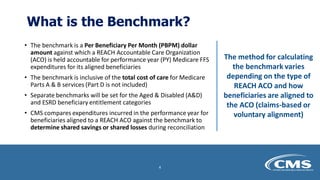
What is the Benchmark?
• The benchmark is a Per Beneficiary Per Month (PBPM) dollar
amount against which a REACH Accountable Care Organization
(ACO) is held accountable for performance year (PY) Medicare FFS
expenditures for its aligned beneficiaries
• The benchmark is inclusive of the total cost of care for Medicare
Parts A & B services (Part D is not included)
• Separate benchmarks will be set for the Aged & Disabled (A&D)
and ESRD beneficiary entitlement categories
• CMS compares expenditures incurred in the performance year for
beneficiaries aligned to a REACH ACO against the benchmark to
determine shared savings or shared losses during reconciliation
The method for calculating
the benchmark varies
depending on the type of
REACH ACO and how
beneficiaries are aligned to
the ACO (claims-based or
voluntary alignment)
4
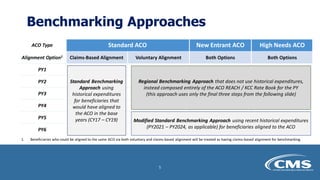
Benchmarking Approaches
ACO Type Standard ACO New Entrant ACO High Needs ACO
Alignment Option1 Claims-Based Alignment Voluntary Alignment Both Options Both Options
PY1
PY2
PY3
PY4
PY5
PY6
Standard Benchmarking
Approach using
historical expenditures
for beneficiaries that
would have aligned to
the ACO in the base
years (CY17 – CY19)
Regional Benchmarking Approach that does not use historical expenditures,
instead composed entirely of the ACO REACH / KCC Rate Book for the PY
(this approach uses only the final three steps from the following slide)
Modified Standard Benchmarking Approach using recent historical expenditures
(PY2021 – PY2024, as applicable) for beneficiaries aligned to the ACO
1. Beneficiaries who could be aligned to the same ACO via both voluntary and claims-based alignment will be treated as having claims-based alignment for benchmarking
5
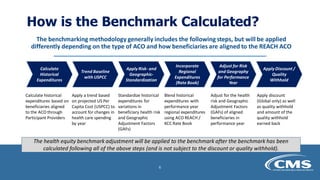
How is the Benchmark Calculated?
The benchmarking methodology generally includes the following steps, but will be applied
differently depending on the type of ACO and how beneficiaries are aligned to the REACH ACO
Calculate
Historical
Expenditures
Trend Baseline
with USPCC
Apply Risk- and
Geographic-
Standardization
Incorporate
Regional
Expenditures
(Rate Book)
Adjust for Risk
and Geography
for Performance
Year
Apply Discount /
Quality
Withhold
Calculate historical
expenditures based on
beneficiaries aligned
to the ACO through
Participant Providers
Apply a trend based
on projected US Per
Capita Cost (USPCC) to
account for changes in
health care spending
by year
Standardize historical
expenditures for
variations in
beneficiary health risk
and Geographic
Adjustment Factors
(GAFs)
Blend historical
expenditures with
performance year
regional expenditures
using ACO REACH /
KCC Rate Book
Adjust for the health
risk and Geographic
Adjustment Factors
(GAFs) of aligned
beneficiaries in
performance year
Apply discount
(Global only) as well
as quality withhold
and amount of the
quality withhold
earned back
The health equity benchmark adjustment will be applied to the benchmark after the benchmark has been
calculated following all of the above steps (and is not subject to the discount or quality withhold).
6
Payment Mechanism Policies
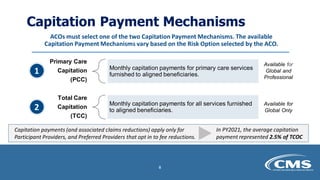
Capitation Payment Mechanisms
ACOs must select one of the two Capitation Payment Mechanisms. The available
Capitation Payment Mechanisms vary based on the Risk Option selected by the ACO.
1
Primary Care
Capitation
(PCC)
Monthly capitation payments for primary care services
furnished to aligned beneficiaries.
Available for
Global and
Professional
2
Total Care
Capitation
(TCC)
Monthly capitation payments for all services furnished
to aligned beneficiaries.
Available for
Global Only
Capitation payments (and associated claims reductions) apply only for
Participant Providers, and Preferred Providers that opt in to fee reductions.
In PY2021, the average capitation
payment represented 2.5% of TCOC
8
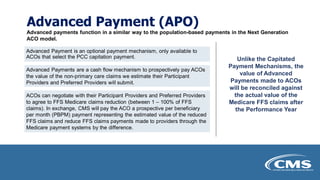
Advanced Payment (APO)
Advanced payments function in a similar way to the population-based payments in the Next Generation
ACO model.
Advanced Payment is an optional payment mechanism, only available to
ACOs that select the PCC capitation payment.
Advanced Payments are a cash flow mechanism to prospectively pay ACOs
the value of the non-primary care claims we estimate their Participant
Providers and Preferred Providers will submit.
ACOs can negotiate with their Participant Providers and Preferred Providers
to agree to FFS Medicare claims reduction (between 1 – 100% of FFS
claims). In exchange, CMS will pay the ACO a prospective per beneficiary
per month (PBPM) payment representing the estimated value of the reduced
FFS claims and reduce FFS claims payments made to providers through the
Medicare payment systems by the difference.
Unlike the Capitated
Payment Mechanisms, the
value of Advanced
Payments made to ACOs
will be reconciled against
the actual value of the
Medicare FFS claims after
the Performance Year
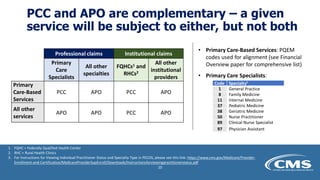
PCC and APO are complementary – a given
service will be subject to either, but not both
Professional claims Institutional claims
N/A
Primary
Care
Specialists
All other
specialties
FQHCs1 and
RHCs2
All other
institutional
providers
Primary
Care-Based
Services
PCC APO PCC APO
All other
services
APO APO PCC APO
• Primary Care-Based Services: PQEM
codes used for alignment (see Financial
Overview paper for comprehensive list)
• Primary Care Specialists:
Code Specialty1
1 General Practice
8 Family Medicine
11 Internal Medicine
37 Pediatric Medicine
38 Geriatric Medicine
50 Nurse Practitioner
89 Clinical Nurse Specialist
97 Physician Assistant
1. FQHC = Federally Qualified Health Center
2. RHC = Rural Health Clinics
3. For Instructions for Viewing Individual Practitioner Status and Specialty Type in PECOS, please see this link: https://www.cms.gov/Medicare/Provider-
Enrollment-and-Certification/MedicareProviderSupEnroll/Downloads/Instructionsforviewingpractitionerstatus.pdf
10
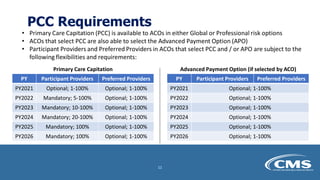
PCC Requirements
• Primary Care Capitation (PCC) is available to ACOs in either Global or Professional risk options
• ACOs that select PCC are also able to select the Advanced Payment Option (APO)
• Participant Providers and Preferred Providers in ACOs that select PCC and / or APO are subject to the
following flexibilities and requirements:
Primary Care Capitation
PY Participant Providers Preferred Providers
PY2021 Optional; 1-100% Optional; 1-100%
PY2022 Mandatory; 5-100% Optional; 1-100%
PY2023 Mandatory; 10-100% Optional; 1-100%
PY2024 Mandatory; 20-100% Optional; 1-100%
PY2025 Mandatory; 100% Optional; 1-100%
PY2026 Mandatory; 100% Optional; 1-100%
Advanced Payment Option (if selected by ACO)
PY Participant Providers Preferred Providers
PY2021 Optional; 1-100%
PY2022 Optional; 1-100%
PY2023 Optional; 1-100%
PY2024 Optional; 1-100%
PY2025 Optional; 1-100%
PY2026 Optional; 1-100%
11
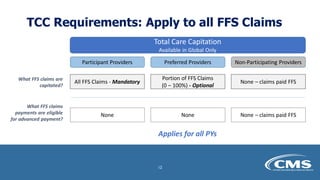
TCC Requirements: Apply to all FFS Claims
Total Care Capitation
Available in Global Only
Participant Providers Preferred Providers
What FFS claims are
capitated?
All FFS Claims - Mandatory
Portion of FFS Claims
(0 – 100%) - Optional
What FFS claims
payments are eligible
for advanced payment?
None
None
Non-Participating Providers
None – claims paid FFS
Applies for all PYs
12
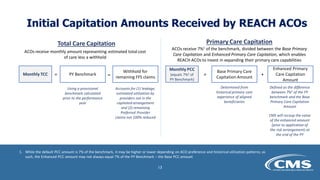
Initial Capitation Amounts Received by REACH ACOs
Total Care Capitation
Using a provisional
benchmark calculated
prior to the performance
year
Accounts for (1) leakage,
estimated utilization by
providers not in the
capitated arrangement
and (2) remaining
Preferred Provider
claims not 100% reduced
-
=
ACOs receive monthly amount representing estimated total cost
of care less a withhold
PY Benchmark
Withhold for
remaining FFS claims
Monthly TCC
Primary Care Capitation
ACOs receive 7%1 of the benchmark, divided between the Base Primary
Care Capitation and Enhanced Primary Care Capitation, which enables
REACH ACOs to invest in expanding their primary care capabilities
Monthly PCC
(equals 7%1 of
PY Benchmark)
Base Primary Care
Capitation Amount
Enhanced Primary
Care Capitation
Amount
Determined from
historical primary care
experience of aligned
beneficiaries
Defined as the difference
between 7%1 of the PY
benchmark and the Base
Primary Care Capitation
Amount
CMS will recoup the value
of the enhanced amount
(prior to application of
the risk arrangement) at
the end of the PY
= +
1. While the default PCC amount is 7% of the benchmark, it may be higher or lower depending on ACO preference and historical utilization patterns; as
such, the Enhanced PCC amount may not always equal 7% of the PY Benchmark – the Base PCC amount
13
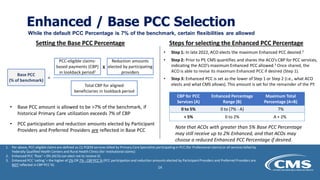
Enhanced / Base PCC Selection
While the default PCC Percentage is 7% of the benchmark, certain flexibilities are allowed
Setting the Base PCC Percentage
x
=
PCC-eligible claims-
based payments (CBP)
in lookback period1
Reduction amounts
elected by participating
providers
Base PCC
(% of benchmark)
Total CBP for aligned
beneficiaries in lookback period
• Base PCC amount is allowed to be >7% of the benchmark, if
historical Primary Care utilization exceeds 7% of CBP
• PCC participation and reduction amounts elected by Participant
Providers and Preferred Providers are reflected in Base PCC
Steps for selecting the Enhanced PCC Percentage
• Step 1: In late 2022, ACO elects the maximum Enhanced PCC desired.2
• Step 2: Prior to PY, CMS quantifies and shares the ACO’s CBP for PCC services,
indicating the ACO’s maximum Enhanced PCC allowed.3 Once shared, the
ACO is able to revise its maximum Enhanced PCC if desired (Step 1).
• Step 3: Enhanced PCC is set as the lower of Step 1 or Step 2 (i.e., what ACO
elects and what CMS allows). This amount is set for the remainder of the PY.
CBP for PCC
Services (A)
Enhanced Percentage
Range (B)
Maximum Total
Percentage (A+B)
0 to 5% 0 to (7% - A) 7%
> 5% 0 to 2% A + 2%
Note that ACOs with greater than 5% Base PCC Percentage
may still receive up to 2% Enhanced, and that ACOs may
choose a reduced Enhanced PCC Percentage if desired.
1. Per above, PCC-eligibleclaims are defined as (1) PQEM services billed by Primary CareSpecialists participating in PCC (for Professional claims) or all services billed by
Federally Qualified Health Centers and Rural Health Clinics (for Institutional claims)
2. Enhanced PCC ‘floor’ = 0% (ACOs can elect not to receive it)
3. Enhanced PCC ‘ceiling’ = the higher of 2% OR 7% - CBP PCC % (PCC participation and reduction amounts elected by ParticipantProviders and Preferred Providers are
NOT reflected in CBP PCC %)
14
Discount & Quality Withhold
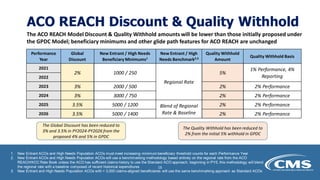
ACO REACH Discount & Quality Withhold
The ACO REACH Model Discount & Quality Withhold amounts will be lower than those initially proposed under
the GPDC Model; beneficiary minimums and other glide path features for ACO REACH are unchanged
Performance
Year
Global
Discount
New Entrant / High Needs
Beneficiary Minimums1
New Entrant / High
Needs Benchmark2,3
Quality Withhold
Amount
Quality Withhold Basis
2021
2% 1000 / 250
Regional Rate
5%
1% Performance, 4%
Reporting
2022
2023 3% 2000 / 500 2% 2% Performance
2024 3% 3000 / 750 2% 2% Performance
2025 3.5% 5000 / 1200 Blend of Regional
Rate & Baseline
2% 2% Performance
2026 3.5% 5000 / 1400 2% 2% Performance
The Global Discount has been reduced to
3% and 3.5% in PY2024-PY2026 from the
proposed 4% and 5% in GPDC
The Quality Withhold has been reduced to
2% from the initial 5% withhold in GPDC
1. New Entrant ACOs and High Needs Population ACOs must meet increasing minimum beneficiary threshold counts for each Performance Year
2. New Entrant ACOs and High Needs Population ACOs will use a benchmarking methodology based entirely on the regional rate from the ACO
REACH/KCC Rate Book unless the ACO has sufficient claims history to use the Standard ACO approach; beginning in PY5, this methodology will blend
the regional rate with a baseline composed of recent historical expenditures
3. New Entrant and High Needs Population ACOs with > 3,000 claims-aligned beneficiaries will use the same benchmarking approach as Standard ACOs
16
Health Equity Benchmark
Adjustment
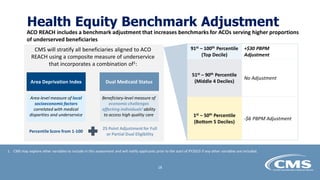
Health Equity Benchmark Adjustment
ACO REACH includes a benchmark adjustment that increases benchmarks for ACOs serving higher proportions
of underserved beneficiaries
CMS will stratify all beneficiaries aligned to ACO
REACH using a composite measure of underservice
that incorporates a combination of1:
Area-level measure of local
socioeconomic factors
correlated with medical
disparities and underservice
Area Deprivation Index Dual Medicaid Status
Beneficiary-level measure of
economic challenges
affecting individuals’ ability
to access high quality care
Percentile Score from 1-100
25 Point Adjustment for Full
or Partial Dual Eligibility
91st – 100th Percentile
(Top Decile)
+$30 PBPM
Adjustment
51st – 90th Percentile
(Middle 4 Deciles)
No Adjustment
1st – 50th Percentile
(Bottom 5 Deciles)
-$6 PBPM Adjustment
1. CMS may explore other variables to include in this assessment and will notify applicants prior to the start of PY2023 if any other variables are included.
18
Residual Stop-Loss Reinsurance
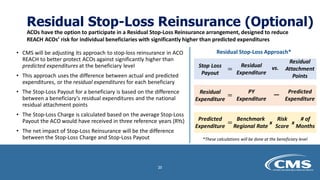
Residual Stop-Loss Reinsurance (Optional)
ACOs have the option to participate in a Residual Stop-Loss Reinsurance arrangement, designed to reduce
REACH ACOs’ risk for individual beneficiaries with significantly higher than predicted expenditures
• CMS will be adjusting its approach to stop-loss reinsurance in ACO
REACH to better protect ACOs against significantly higher than
predicted expenditures at the beneficiary level
• This approach uses the difference between actual and predicted
expenditures, or the residual expenditures for each beneficiary
• The Stop-Loss Payout for a beneficiary is based on the difference
between a beneficiary’s residual expenditures and the national
residual attachment points
• The Stop-Loss Charge is calculated based on the average Stop-Loss
Payout the ACO would have received in three reference years (RYs)
• The net impact of Stop-Loss Reinsurance will be the difference
between the Stop-Loss Charge and Stop-Loss Payout
Residual Stop-Loss Approach*
Stop Loss
Payout
Residual
Attachment
Points
=
Residual
Expenditure
vs.
Residual
Expenditure
Predicted
Expenditure
=
PY
Expenditure
―
Predicted
Expenditure
Risk
Score
=
Benchmark
Regional Rate
x
# of
Months
x
*These calculations will be done at the beneficiary level
20
Risk Adjustment & PY2024 Risk Score
Growth Constraints
Risk Adjustment
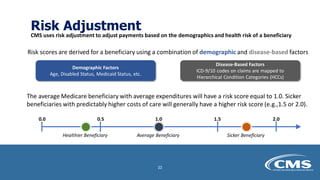
CMS uses risk adjustment to adjust payments based on the demographics and health risk of a beneficiary
Risk scores are derived for a beneficiary using a combination of demographic and disease-based factors
Demographic Factors
Age, Disabled Status, Medicaid Status, etc.
Disease-Based Factors
ICD-9/10 codes on claims are mapped to
Hierarchical Condition Categories (HCCs)
The average Medicare beneficiary with average expenditures will have a risk score equal to 1.0. Sicker
beneficiaries with predictably higher costs of care will generally have a higher risk score (e.g.,1.5 or 2.0).
Average Beneficiary
1.0
0.5 1.5
0.0 2.0
Sicker Beneficiary
Healthier Beneficiary
22
Risk Adjustment Models
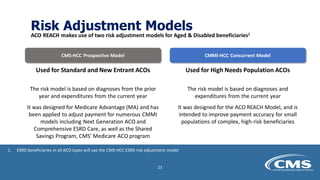
ACO REACH makes use of two risk adjustment models for Aged & Disabled beneficiaries1
CMS-HCC Prospective Model CMMI-HCC Concurrent Model
Used for Standard and New Entrant ACOs
The risk model is based on diagnoses from the prior
year and expenditures from the current year
It was designed for Medicare Advantage (MA) and has
been applied to adjust payment for numerous CMMI
models including Next Generation ACO and
Comprehensive ESRD Care, as well as the Shared
Savings Program, CMS’ Medicare ACO program
Used for High Needs Population ACOs
The risk model is based on diagnoses and
expenditures from the current year
It was designed for the ACO REACH Model, and is
intended to improve payment accuracy for small
populations of complex, high-risk beneficiaries
1. ESRD beneficiaries in all ACO types will use the CMS-HCC ESRD risk adjustment model
23
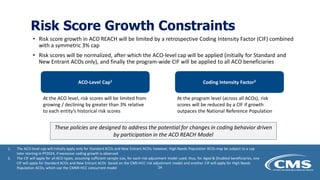
Risk Score Growth Constraints
• Risk score growth in ACO REACH will be limited by a retrospective Coding Intensity Factor (CIF) combined
with a symmetric 3% cap
• Risk scores will be normalized, after which the ACO-level cap will be applied (initially for Standard and
New Entrant ACOs only), and finally the program-wide CIF will be applied to all ACO beneficiaries
ACO-Level Cap1 Coding Intensity Factor2
At the ACO level, risk scores will be limited from
growing / declining by greater than 3% relative
to each entity’s historical risk scores
At the program level (across all ACOs), risk
scores will be reduced by a CIF if growth
outpaces the National Reference Population
These policies are designed to address the potential for changes in coding behavior driven
by participation in the ACO REACH Model
1. The ACO-level cap will initially apply only for Standard ACOs and New Entrant ACOs; however, High Needs Population ACOs may be subject to a cap
later starting in PY2024, if excessive coding growth is observed
2. The CIF will apply for all ACO types, assuming sufficient sample size, for each risk adjustment model used; thus, for Aged & Disabled beneficiaries, one
CIF will apply for Standard ACOs and New Entrant ACOs based on the CMS-HCC risk adjustment model and another CIF will apply for High Needs
Population ACOs, which use the CMMI-HCC concurrent model 24
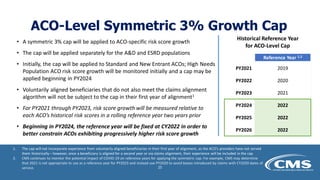
ACO-Level Symmetric 3% Growth Cap
• A symmetric 3% cap will be applied to ACO-specific risk score growth
• The cap will be applied separately for the A&D and ESRD populations
• Initially, the cap will be applied to Standard and New Entrant ACOs; High Needs
Population ACO risk score growth will be monitored initially and a cap may be
applied beginning in PY2024
• Voluntarily aligned beneficiaries that do not also meet the claims alignment
algorithm will not be subject to the cap in their first year of alignment1
• For PY2021 through PY2023, risk score growth will be measured relative to
each ACO’s historical risk scores in a rolling reference year two years prior
• Beginning in PY2024, the reference year will be fixed at CY2022 in order to
better constrain ACOs exhibiting progressively higher risk score growth
Historical Reference Year
for ACO-Level Cap
Reference Year 1,2
PY2021 2019
PY2022 2020
PY2023 2021
PY2024 2022
PY2025 2022
PY2026 2022
1. The cap will not incorporate experience from voluntarily aligned beneficiaries in their first year of alignment, as the ACO’s providers have not served
them historically – however, once a beneficiary is aligned for a second year or via claims alignment, their experience will be included in the cap
2. CMS continues to monitor the potential impact of COVID-19 on reference years for applying the symmetric cap. For example, CMS may determine
that 2021 is not appropriate to use as a reference year for PY2023 and instead use PY2020 to avoid biases introduced by claims with CY2020 dates of
service. 25
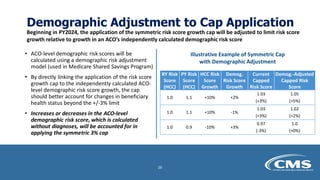
Demographic Adjustment to Cap Application
Beginning in PY2024, the application of the symmetric risk score growth cap will be adjusted to limit risk score
growth relative to growth in an ACO’s independently calculated demographic risk score
• ACO-level demographic risk scores will be
calculated using a demographic risk adjustment
model (used in Medicare Shared Savings Program)
• By directly linking the application of the risk score
growth cap to the independently calculated ACO-
level demographic risk score growth, the cap
should better account for changes in beneficiary
health status beyond the +/-3% limit
• Increases or decreases in the ACO-level
demographic risk score, which is calculated
without diagnoses, will be accounted for in
applying the symmetric 3% cap
Illustrative Example of Symmetric Cap
with Demographic Adjustment
RY Risk
Score
(HCC)
PY Risk
Score
(HCC)
HCC Risk
Score
Growth
Demog.
Risk Score
Growth
Current
Capped
Risk Score
Demog.-Adjusted
Capped Risk
Score
1.0 1.1 +10% +2%
1.03
(+3%)
1.05
(+5%)
1.0 1.1 +10% -1%
1.03
(+3%)
1.02
(+2%)
1.0 0.9 -10% +3%
0.97
(-3%)
1.0
(+0%)
26
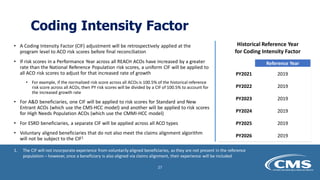
Coding Intensity Factor
• A Coding Intensity Factor (CIF) adjustment will be retrospectively applied at the
program level to ACO risk scores before final reconciliation
• If risk scores in a Performance Year across all REACH ACOs have increased by a greater
rate than the National Reference Population risk scores, a uniform CIF will be applied to
all ACO risk scores to adjust for that increased rate of growth
• For example, if the normalized risk score across all ACOs is 100.5% of the historical reference
risk score across all ACOs, then PY risk scores will be divided by a CIF of 100.5% to account for
the increased growth rate
• For A&D beneficiaries, one CIF will be applied to risk scores for Standard and New
Entrant ACOs (which use the CMS-HCC model) and another will be applied to risk scores
for High Needs Population ACOs (which use the CMMI-HCC model)
• For ESRD beneficiaries, a separate CIF will be applied across all ACO types
• Voluntary aligned beneficiaries that do not also meet the claims alignment algorithm
will not be subject to the CIF1
Historical Reference Year
for Coding Intensity Factor
Reference Year
PY2021 2019
PY2022 2019
PY2023 2019
PY2024 2019
PY2025 2019
PY2026 2019
1. The CIF will not incorporate experience from voluntarily aligned beneficiaries, as they are not present in the reference
population – however, once a beneficiary is also aligned via claims alignment, their experience will be included
27
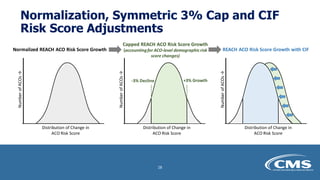
Normalization, Symmetric 3% Cap and CIF
Risk Score Adjustments
Normalized REACH ACO Risk Score Growth
Capped REACH ACO Risk Score Growth
(accountingfor ACO-level demographicrisk
score changes)
REACH ACO Risk Score Growth with CIF
Distribution of Change in
ACO Risk Score
Number
of
ACOs
→
Distribution of Change in
ACO Risk Score
Number
of
ACOs
→
+3% Growth
-3% Decline
Distribution of Change in
ACO Risk Score
Number
of
ACOs
→
28
Upcoming Webinars and Questions
29
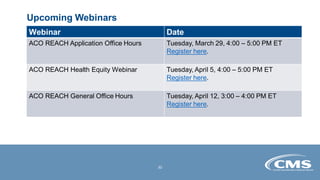
Upcoming Webinars
Webinar Date
ACO REACH Application Office Hours Tuesday, March 29, 4:00 – 5:00 PM ET
Register here.
ACO REACH Health Equity Webinar Tuesday, April 5, 4:00 – 5:00 PM ET
Register here.
ACO REACH General Office Hours Tuesday, April 12, 3:00 – 4:00 PM ET
Register here.
30
Contact Information and References
ACO REACH Webpage:
https://innovation.cms.gov/innovation-models/aco-reach
ACO REACH Request for Applications:
https://innovation.cms.gov/media/document/aco-reach-rfa
ACO REACH/GPDC Comparison Table:
https://innovation.cms.gov/media/document/gpdc-aco-reach-comparison
ACO REACH Summary Graphic:
https://innovation.cms.gov/media/document/aco-reach-graphic
Email: ACOREACH@cms.hhs.gov
31
Questions
32

ACO_REACH_FinanceWebinar_03-28-22.pdf

  • 1.
    ACO Realizing Equity,Access, and Community Health (REACH) Model Financial Methodology Updates Webinar CMS/CMMI March 28, 2022
  • 2.
    Agenda Agenda for Today ACO REACHFinancial Overview Benchmarking Capitation Payment Mechanisms Financial Methodology Features Discount & Quality Withhold Health Equity Benchmark Adjustment Residual Stop-Loss Reinsurance PY2024 Risk Score Growth Cap This webinar is primarily intended to introduce the new financial features in ACO REACH, with some background on key finance concepts. CMS will publish methodology papers outlining all aspects of the ACO REACH Model financial methodology this summer. In the meantime, CMS has published detailed methodology papers and webinars covering benchmarking, capitation, risk adjustment, and other topics for the Global & Professional Direct Contracting Model, that can serve as a reference for all financial features that remain unchanged in the ACO REACH Model: https://innovation.cms.gov/innovation- models/gpdc-model Additional information on these and other financial methodology features will be provided in detailed specification papers to be released in Summer 2022 2
  • 3.
  • 4.
    What is theBenchmark? • The benchmark is a Per Beneficiary Per Month (PBPM) dollar amount against which a REACH Accountable Care Organization (ACO) is held accountable for performance year (PY) Medicare FFS expenditures for its aligned beneficiaries • The benchmark is inclusive of the total cost of care for Medicare Parts A & B services (Part D is not included) • Separate benchmarks will be set for the Aged & Disabled (A&D) and ESRD beneficiary entitlement categories • CMS compares expenditures incurred in the performance year for beneficiaries aligned to a REACH ACO against the benchmark to determine shared savings or shared losses during reconciliation The method for calculating the benchmark varies depending on the type of REACH ACO and how beneficiaries are aligned to the ACO (claims-based or voluntary alignment) 4
  • 5.
    Benchmarking Approaches ACO TypeStandard ACO New Entrant ACO High Needs ACO Alignment Option1 Claims-Based Alignment Voluntary Alignment Both Options Both Options PY1 PY2 PY3 PY4 PY5 PY6 Standard Benchmarking Approach using historical expenditures for beneficiaries that would have aligned to the ACO in the base years (CY17 – CY19) Regional Benchmarking Approach that does not use historical expenditures, instead composed entirely of the ACO REACH / KCC Rate Book for the PY (this approach uses only the final three steps from the following slide) Modified Standard Benchmarking Approach using recent historical expenditures (PY2021 – PY2024, as applicable) for beneficiaries aligned to the ACO 1. Beneficiaries who could be aligned to the same ACO via both voluntary and claims-based alignment will be treated as having claims-based alignment for benchmarking 5
  • 6.
    How is theBenchmark Calculated? The benchmarking methodology generally includes the following steps, but will be applied differently depending on the type of ACO and how beneficiaries are aligned to the REACH ACO Calculate Historical Expenditures Trend Baseline with USPCC Apply Risk- and Geographic- Standardization Incorporate Regional Expenditures (Rate Book) Adjust for Risk and Geography for Performance Year Apply Discount / Quality Withhold Calculate historical expenditures based on beneficiaries aligned to the ACO through Participant Providers Apply a trend based on projected US Per Capita Cost (USPCC) to account for changes in health care spending by year Standardize historical expenditures for variations in beneficiary health risk and Geographic Adjustment Factors (GAFs) Blend historical expenditures with performance year regional expenditures using ACO REACH / KCC Rate Book Adjust for the health risk and Geographic Adjustment Factors (GAFs) of aligned beneficiaries in performance year Apply discount (Global only) as well as quality withhold and amount of the quality withhold earned back The health equity benchmark adjustment will be applied to the benchmark after the benchmark has been calculated following all of the above steps (and is not subject to the discount or quality withhold). 6
  • 7.
  • 8.
    Capitation Payment Mechanisms ACOsmust select one of the two Capitation Payment Mechanisms. The available Capitation Payment Mechanisms vary based on the Risk Option selected by the ACO. 1 Primary Care Capitation (PCC) Monthly capitation payments for primary care services furnished to aligned beneficiaries. Available for Global and Professional 2 Total Care Capitation (TCC) Monthly capitation payments for all services furnished to aligned beneficiaries. Available for Global Only Capitation payments (and associated claims reductions) apply only for Participant Providers, and Preferred Providers that opt in to fee reductions. In PY2021, the average capitation payment represented 2.5% of TCOC 8
  • 9.
    Advanced Payment (APO) Advancedpayments function in a similar way to the population-based payments in the Next Generation ACO model. Advanced Payment is an optional payment mechanism, only available to ACOs that select the PCC capitation payment. Advanced Payments are a cash flow mechanism to prospectively pay ACOs the value of the non-primary care claims we estimate their Participant Providers and Preferred Providers will submit. ACOs can negotiate with their Participant Providers and Preferred Providers to agree to FFS Medicare claims reduction (between 1 – 100% of FFS claims). In exchange, CMS will pay the ACO a prospective per beneficiary per month (PBPM) payment representing the estimated value of the reduced FFS claims and reduce FFS claims payments made to providers through the Medicare payment systems by the difference. Unlike the Capitated Payment Mechanisms, the value of Advanced Payments made to ACOs will be reconciled against the actual value of the Medicare FFS claims after the Performance Year
  • 10.
    PCC and APOare complementary – a given service will be subject to either, but not both Professional claims Institutional claims N/A Primary Care Specialists All other specialties FQHCs1 and RHCs2 All other institutional providers Primary Care-Based Services PCC APO PCC APO All other services APO APO PCC APO • Primary Care-Based Services: PQEM codes used for alignment (see Financial Overview paper for comprehensive list) • Primary Care Specialists: Code Specialty1 1 General Practice 8 Family Medicine 11 Internal Medicine 37 Pediatric Medicine 38 Geriatric Medicine 50 Nurse Practitioner 89 Clinical Nurse Specialist 97 Physician Assistant 1. FQHC = Federally Qualified Health Center 2. RHC = Rural Health Clinics 3. For Instructions for Viewing Individual Practitioner Status and Specialty Type in PECOS, please see this link: https://www.cms.gov/Medicare/Provider- Enrollment-and-Certification/MedicareProviderSupEnroll/Downloads/Instructionsforviewingpractitionerstatus.pdf 10
  • 11.
    PCC Requirements • PrimaryCare Capitation (PCC) is available to ACOs in either Global or Professional risk options • ACOs that select PCC are also able to select the Advanced Payment Option (APO) • Participant Providers and Preferred Providers in ACOs that select PCC and / or APO are subject to the following flexibilities and requirements: Primary Care Capitation PY Participant Providers Preferred Providers PY2021 Optional; 1-100% Optional; 1-100% PY2022 Mandatory; 5-100% Optional; 1-100% PY2023 Mandatory; 10-100% Optional; 1-100% PY2024 Mandatory; 20-100% Optional; 1-100% PY2025 Mandatory; 100% Optional; 1-100% PY2026 Mandatory; 100% Optional; 1-100% Advanced Payment Option (if selected by ACO) PY Participant Providers Preferred Providers PY2021 Optional; 1-100% PY2022 Optional; 1-100% PY2023 Optional; 1-100% PY2024 Optional; 1-100% PY2025 Optional; 1-100% PY2026 Optional; 1-100% 11
  • 12.
    TCC Requirements: Applyto all FFS Claims Total Care Capitation Available in Global Only Participant Providers Preferred Providers What FFS claims are capitated? All FFS Claims - Mandatory Portion of FFS Claims (0 – 100%) - Optional What FFS claims payments are eligible for advanced payment? None None Non-Participating Providers None – claims paid FFS None – claims paid FFS Applies for all PYs 12
  • 13.
    Initial Capitation AmountsReceived by REACH ACOs Total Care Capitation Using a provisional benchmark calculated prior to the performance year Accounts for (1) leakage, estimated utilization by providers not in the capitated arrangement and (2) remaining Preferred Provider claims not 100% reduced - = ACOs receive monthly amount representing estimated total cost of care less a withhold PY Benchmark Withhold for remaining FFS claims Monthly TCC Primary Care Capitation ACOs receive 7%1 of the benchmark, divided between the Base Primary Care Capitation and Enhanced Primary Care Capitation, which enables REACH ACOs to invest in expanding their primary care capabilities Monthly PCC (equals 7%1 of PY Benchmark) Base Primary Care Capitation Amount Enhanced Primary Care Capitation Amount Determined from historical primary care experience of aligned beneficiaries Defined as the difference between 7%1 of the PY benchmark and the Base Primary Care Capitation Amount CMS will recoup the value of the enhanced amount (prior to application of the risk arrangement) at the end of the PY = + 1. While the default PCC amount is 7% of the benchmark, it may be higher or lower depending on ACO preference and historical utilization patterns; as such, the Enhanced PCC amount may not always equal 7% of the PY Benchmark – the Base PCC amount 13
  • 14.
    Enhanced / BasePCC Selection While the default PCC Percentage is 7% of the benchmark, certain flexibilities are allowed Setting the Base PCC Percentage x = PCC-eligible claims- based payments (CBP) in lookback period1 Reduction amounts elected by participating providers Base PCC (% of benchmark) Total CBP for aligned beneficiaries in lookback period • Base PCC amount is allowed to be >7% of the benchmark, if historical Primary Care utilization exceeds 7% of CBP • PCC participation and reduction amounts elected by Participant Providers and Preferred Providers are reflected in Base PCC Steps for selecting the Enhanced PCC Percentage • Step 1: In late 2022, ACO elects the maximum Enhanced PCC desired.2 • Step 2: Prior to PY, CMS quantifies and shares the ACO’s CBP for PCC services, indicating the ACO’s maximum Enhanced PCC allowed.3 Once shared, the ACO is able to revise its maximum Enhanced PCC if desired (Step 1). • Step 3: Enhanced PCC is set as the lower of Step 1 or Step 2 (i.e., what ACO elects and what CMS allows). This amount is set for the remainder of the PY. CBP for PCC Services (A) Enhanced Percentage Range (B) Maximum Total Percentage (A+B) 0 to 5% 0 to (7% - A) 7% > 5% 0 to 2% A + 2% Note that ACOs with greater than 5% Base PCC Percentage may still receive up to 2% Enhanced, and that ACOs may choose a reduced Enhanced PCC Percentage if desired. 1. Per above, PCC-eligibleclaims are defined as (1) PQEM services billed by Primary CareSpecialists participating in PCC (for Professional claims) or all services billed by Federally Qualified Health Centers and Rural Health Clinics (for Institutional claims) 2. Enhanced PCC ‘floor’ = 0% (ACOs can elect not to receive it) 3. Enhanced PCC ‘ceiling’ = the higher of 2% OR 7% - CBP PCC % (PCC participation and reduction amounts elected by ParticipantProviders and Preferred Providers are NOT reflected in CBP PCC %) 14
  • 15.
  • 16.
    ACO REACH Discount& Quality Withhold The ACO REACH Model Discount & Quality Withhold amounts will be lower than those initially proposed under the GPDC Model; beneficiary minimums and other glide path features for ACO REACH are unchanged Performance Year Global Discount New Entrant / High Needs Beneficiary Minimums1 New Entrant / High Needs Benchmark2,3 Quality Withhold Amount Quality Withhold Basis 2021 2% 1000 / 250 Regional Rate 5% 1% Performance, 4% Reporting 2022 2023 3% 2000 / 500 2% 2% Performance 2024 3% 3000 / 750 2% 2% Performance 2025 3.5% 5000 / 1200 Blend of Regional Rate & Baseline 2% 2% Performance 2026 3.5% 5000 / 1400 2% 2% Performance The Global Discount has been reduced to 3% and 3.5% in PY2024-PY2026 from the proposed 4% and 5% in GPDC The Quality Withhold has been reduced to 2% from the initial 5% withhold in GPDC 1. New Entrant ACOs and High Needs Population ACOs must meet increasing minimum beneficiary threshold counts for each Performance Year 2. New Entrant ACOs and High Needs Population ACOs will use a benchmarking methodology based entirely on the regional rate from the ACO REACH/KCC Rate Book unless the ACO has sufficient claims history to use the Standard ACO approach; beginning in PY5, this methodology will blend the regional rate with a baseline composed of recent historical expenditures 3. New Entrant and High Needs Population ACOs with > 3,000 claims-aligned beneficiaries will use the same benchmarking approach as Standard ACOs 16
  • 17.
  • 18.
    Health Equity BenchmarkAdjustment ACO REACH includes a benchmark adjustment that increases benchmarks for ACOs serving higher proportions of underserved beneficiaries CMS will stratify all beneficiaries aligned to ACO REACH using a composite measure of underservice that incorporates a combination of1: Area-level measure of local socioeconomic factors correlated with medical disparities and underservice Area Deprivation Index Dual Medicaid Status Beneficiary-level measure of economic challenges affecting individuals’ ability to access high quality care Percentile Score from 1-100 25 Point Adjustment for Full or Partial Dual Eligibility 91st – 100th Percentile (Top Decile) +$30 PBPM Adjustment 51st – 90th Percentile (Middle 4 Deciles) No Adjustment 1st – 50th Percentile (Bottom 5 Deciles) -$6 PBPM Adjustment 1. CMS may explore other variables to include in this assessment and will notify applicants prior to the start of PY2023 if any other variables are included. 18
  • 19.
  • 20.
    Residual Stop-Loss Reinsurance(Optional) ACOs have the option to participate in a Residual Stop-Loss Reinsurance arrangement, designed to reduce REACH ACOs’ risk for individual beneficiaries with significantly higher than predicted expenditures • CMS will be adjusting its approach to stop-loss reinsurance in ACO REACH to better protect ACOs against significantly higher than predicted expenditures at the beneficiary level • This approach uses the difference between actual and predicted expenditures, or the residual expenditures for each beneficiary • The Stop-Loss Payout for a beneficiary is based on the difference between a beneficiary’s residual expenditures and the national residual attachment points • The Stop-Loss Charge is calculated based on the average Stop-Loss Payout the ACO would have received in three reference years (RYs) • The net impact of Stop-Loss Reinsurance will be the difference between the Stop-Loss Charge and Stop-Loss Payout Residual Stop-Loss Approach* Stop Loss Payout Residual Attachment Points = Residual Expenditure vs. Residual Expenditure Predicted Expenditure = PY Expenditure ― Predicted Expenditure Risk Score = Benchmark Regional Rate x # of Months x *These calculations will be done at the beneficiary level 20
  • 21.
    Risk Adjustment &PY2024 Risk Score Growth Constraints
  • 22.
    Risk Adjustment CMS usesrisk adjustment to adjust payments based on the demographics and health risk of a beneficiary Risk scores are derived for a beneficiary using a combination of demographic and disease-based factors Demographic Factors Age, Disabled Status, Medicaid Status, etc. Disease-Based Factors ICD-9/10 codes on claims are mapped to Hierarchical Condition Categories (HCCs) The average Medicare beneficiary with average expenditures will have a risk score equal to 1.0. Sicker beneficiaries with predictably higher costs of care will generally have a higher risk score (e.g.,1.5 or 2.0). Average Beneficiary 1.0 0.5 1.5 0.0 2.0 Sicker Beneficiary Healthier Beneficiary 22
  • 23.
    Risk Adjustment Models ACOREACH makes use of two risk adjustment models for Aged & Disabled beneficiaries1 CMS-HCC Prospective Model CMMI-HCC Concurrent Model Used for Standard and New Entrant ACOs The risk model is based on diagnoses from the prior year and expenditures from the current year It was designed for Medicare Advantage (MA) and has been applied to adjust payment for numerous CMMI models including Next Generation ACO and Comprehensive ESRD Care, as well as the Shared Savings Program, CMS’ Medicare ACO program Used for High Needs Population ACOs The risk model is based on diagnoses and expenditures from the current year It was designed for the ACO REACH Model, and is intended to improve payment accuracy for small populations of complex, high-risk beneficiaries 1. ESRD beneficiaries in all ACO types will use the CMS-HCC ESRD risk adjustment model 23
  • 24.
    Risk Score GrowthConstraints • Risk score growth in ACO REACH will be limited by a retrospective Coding Intensity Factor (CIF) combined with a symmetric 3% cap • Risk scores will be normalized, after which the ACO-level cap will be applied (initially for Standard and New Entrant ACOs only), and finally the program-wide CIF will be applied to all ACO beneficiaries ACO-Level Cap1 Coding Intensity Factor2 At the ACO level, risk scores will be limited from growing / declining by greater than 3% relative to each entity’s historical risk scores At the program level (across all ACOs), risk scores will be reduced by a CIF if growth outpaces the National Reference Population These policies are designed to address the potential for changes in coding behavior driven by participation in the ACO REACH Model 1. The ACO-level cap will initially apply only for Standard ACOs and New Entrant ACOs; however, High Needs Population ACOs may be subject to a cap later starting in PY2024, if excessive coding growth is observed 2. The CIF will apply for all ACO types, assuming sufficient sample size, for each risk adjustment model used; thus, for Aged & Disabled beneficiaries, one CIF will apply for Standard ACOs and New Entrant ACOs based on the CMS-HCC risk adjustment model and another CIF will apply for High Needs Population ACOs, which use the CMMI-HCC concurrent model 24
  • 25.
    ACO-Level Symmetric 3%Growth Cap • A symmetric 3% cap will be applied to ACO-specific risk score growth • The cap will be applied separately for the A&D and ESRD populations • Initially, the cap will be applied to Standard and New Entrant ACOs; High Needs Population ACO risk score growth will be monitored initially and a cap may be applied beginning in PY2024 • Voluntarily aligned beneficiaries that do not also meet the claims alignment algorithm will not be subject to the cap in their first year of alignment1 • For PY2021 through PY2023, risk score growth will be measured relative to each ACO’s historical risk scores in a rolling reference year two years prior • Beginning in PY2024, the reference year will be fixed at CY2022 in order to better constrain ACOs exhibiting progressively higher risk score growth Historical Reference Year for ACO-Level Cap Reference Year 1,2 PY2021 2019 PY2022 2020 PY2023 2021 PY2024 2022 PY2025 2022 PY2026 2022 1. The cap will not incorporate experience from voluntarily aligned beneficiaries in their first year of alignment, as the ACO’s providers have not served them historically – however, once a beneficiary is aligned for a second year or via claims alignment, their experience will be included in the cap 2. CMS continues to monitor the potential impact of COVID-19 on reference years for applying the symmetric cap. For example, CMS may determine that 2021 is not appropriate to use as a reference year for PY2023 and instead use PY2020 to avoid biases introduced by claims with CY2020 dates of service. 25
  • 26.
    Demographic Adjustment toCap Application Beginning in PY2024, the application of the symmetric risk score growth cap will be adjusted to limit risk score growth relative to growth in an ACO’s independently calculated demographic risk score • ACO-level demographic risk scores will be calculated using a demographic risk adjustment model (used in Medicare Shared Savings Program) • By directly linking the application of the risk score growth cap to the independently calculated ACO- level demographic risk score growth, the cap should better account for changes in beneficiary health status beyond the +/-3% limit • Increases or decreases in the ACO-level demographic risk score, which is calculated without diagnoses, will be accounted for in applying the symmetric 3% cap Illustrative Example of Symmetric Cap with Demographic Adjustment RY Risk Score (HCC) PY Risk Score (HCC) HCC Risk Score Growth Demog. Risk Score Growth Current Capped Risk Score Demog.-Adjusted Capped Risk Score 1.0 1.1 +10% +2% 1.03 (+3%) 1.05 (+5%) 1.0 1.1 +10% -1% 1.03 (+3%) 1.02 (+2%) 1.0 0.9 -10% +3% 0.97 (-3%) 1.0 (+0%) 26
  • 27.
    Coding Intensity Factor •A Coding Intensity Factor (CIF) adjustment will be retrospectively applied at the program level to ACO risk scores before final reconciliation • If risk scores in a Performance Year across all REACH ACOs have increased by a greater rate than the National Reference Population risk scores, a uniform CIF will be applied to all ACO risk scores to adjust for that increased rate of growth • For example, if the normalized risk score across all ACOs is 100.5% of the historical reference risk score across all ACOs, then PY risk scores will be divided by a CIF of 100.5% to account for the increased growth rate • For A&D beneficiaries, one CIF will be applied to risk scores for Standard and New Entrant ACOs (which use the CMS-HCC model) and another will be applied to risk scores for High Needs Population ACOs (which use the CMMI-HCC model) • For ESRD beneficiaries, a separate CIF will be applied across all ACO types • Voluntary aligned beneficiaries that do not also meet the claims alignment algorithm will not be subject to the CIF1 Historical Reference Year for Coding Intensity Factor Reference Year PY2021 2019 PY2022 2019 PY2023 2019 PY2024 2019 PY2025 2019 PY2026 2019 1. The CIF will not incorporate experience from voluntarily aligned beneficiaries, as they are not present in the reference population – however, once a beneficiary is also aligned via claims alignment, their experience will be included 27
  • 28.
    Normalization, Symmetric 3%Cap and CIF Risk Score Adjustments Normalized REACH ACO Risk Score Growth Capped REACH ACO Risk Score Growth (accountingfor ACO-level demographicrisk score changes) REACH ACO Risk Score Growth with CIF Distribution of Change in ACO Risk Score Number of ACOs → Distribution of Change in ACO Risk Score Number of ACOs → +3% Growth -3% Decline Distribution of Change in ACO Risk Score Number of ACOs → 28
  • 29.
  • 30.
    Upcoming Webinars Webinar Date ACOREACH Application Office Hours Tuesday, March 29, 4:00 – 5:00 PM ET Register here. ACO REACH Health Equity Webinar Tuesday, April 5, 4:00 – 5:00 PM ET Register here. ACO REACH General Office Hours Tuesday, April 12, 3:00 – 4:00 PM ET Register here. 30
  • 31.
    Contact Information andReferences ACO REACH Webpage: https://innovation.cms.gov/innovation-models/aco-reach ACO REACH Request for Applications: https://innovation.cms.gov/media/document/aco-reach-rfa ACO REACH/GPDC Comparison Table: https://innovation.cms.gov/media/document/gpdc-aco-reach-comparison ACO REACH Summary Graphic: https://innovation.cms.gov/media/document/aco-reach-graphic Email: ACOREACH@cms.hhs.gov 31
  • 32.