web 2.0
quick history lesson: #1
quick history *  lesson: #2 A survey was conducted with teens regarding what they thought has become passe in their lifetimes: "I used to use Instant Messenger,but now I mostly use Facebook to communicate with people. I use e-mail for, like, reaching my coaches or uncles -- older people. Otherwise it's either my cellphone or Facebook." -- Emily Siegel, 16, Alexandria "Dictionaries and encyclopedias. They've been replaced with Google, Wikipedia and online dictionaries. It's been years since I looked at the dictionary or encyclopedia on my family's bookshelf." -- Vidya Srinivasan, 13, Chevy Chase "In elementary school we had chalkboards in every single room, but now teachers all use boards that are connected to the computer." --Emma Fensterheim, 13, Bethesda "We had an old Saturn, and you had to crank something to open the window. I only remember that in one car. It was fun to play with, but I never got the window open." -- Ariana Steel, 13, Washington
rationale “ They have never known a world without  eBay , Amazon, or Google,” he added. “They assume that when you create a piece of software it will be Internet-connected and it will have an innate sense of who your friends are.” In three weeks of February, the Barack Obama entry in Wikipedia had almost 2 million views and was the seventh most visited (and, really, second most visited in terms of content) article on the site.*  J ohn McCain’s had 1.1 million. Hillary Clinton, who apparently more people “know” about, had about 422,000. In those same three weeks, the Wikipedia home page got over 140 million views.  The point? People are turning to Wikipedia in large numbers to learn about the topics that are of interest and importance to them. Many of them, no doubt, are kids. Go figure. Design tools that are intended for a generation of Web users who are familiar with the Internet but are not skilled programmers (consider: the phenomenon of 13-year-olds who are “tricking out” their  MySpace  pages with “digital bling.”) They didn’t realize it, but by cutting and pasting snippets of code together, they were programming. Publish-then-filter world. Teach students how to interact with digital data in new ways!
overview Main Points of Discussion: What are the current trends of Web 2.0? What are we doing to incorporate the principles of Web 2.0 in our curriculum, and why bother?  How are we teaching information literacy? What are we doing to help build towards Web 3.0?
background 1989 = Web 1.0  “ Web as an information source.” (Bernes-Lee, Switzerland) 2004 = Web 2.0 Terminology resulted from O'Reilly Media Web conference.  “ Although the term suggests a new version of the World Wide Web, it does not refer to an update to any technical specifications, but to changes in the ways software developers and end-users use webs.”  2008 = Semantic Web (Web 3.0?)
web2.0 = definition Refers to the second generation of web-based communities and hosted services focused on: “ facilitating creativity, collaboration, and sharing between users/people [i.e., social-networking sites, wikis, and folksonomies]...Finally, people are people, not ‘users’ - a banned word.”
web2.0 = definition cont. Web 2.0 write read read write (blogging) Web 1.0 write read (self-description) Web 3.0 write read read write (active-services) WEB WEB request request
characteristics AJAX Valid XHTML Folksonomies CSS XML APIs RSS and Atom feeds Mashups Weblogs Wiki/ forum software WYSIWYG Standards based web (w3c)
categories http://www.darcynorman.net/2007/10/15/k12-online-more-than-cool-tools/ Embed Connect Socialize Collaborate Share Remix Filter Liberate Disrupt Youtube Slideshare flickr blip APIs ( picnik ) grease monkey safari widgets googal yzer   delicious photo bucket facebook linkin typophile google docs wiki vmukti skype thinka ture openWeb CC googlecoop free/open ware oer formats (mp3, mp4) derivatives vs. original housingmaps.com programmableweb .com gatekeepers network concentrator social rating systems (Digg,  Pligg ) online socialware opensource freeware moodle j oomla iSafe w3c lit eracy trust +growth
Embed Connect Socialize Collaborate Share Remix Filter Liberate Disrupt
class examples most obvious: wikipedia blogger f lickr f acebook del.ic io.us uses: dynamic collaborative information dynamic collaborative commentary dynamic collaborative imagery dynamic collaborative networking dynamic collaborative bookmarking
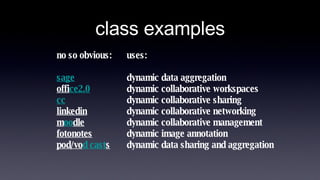
class examples no so obvious: sage offi ce2.0 cc linkedin m oo dle fotonotes pod/vo d cast s uses: dynamic data aggregation  dynamic collaborative workspaces dynamic collaborative sharing dynamic collaborative networking dynamic collaborative management dynamic image annotation dynamic data sharing and aggregation
summary Main Points of Discussion: What are the current trends of Web 2.0? What are we doing to incorporate the principles of Web 2.0 in our curriculum, and why bother?  How are we teaching information literacy? What are we doing to help build towards Web 3.0?
examples Text http://www.go2web20.net /

Web2

  • 1.
  • 2.
  • 3.
    quick history * lesson: #2 A survey was conducted with teens regarding what they thought has become passe in their lifetimes: "I used to use Instant Messenger,but now I mostly use Facebook to communicate with people. I use e-mail for, like, reaching my coaches or uncles -- older people. Otherwise it's either my cellphone or Facebook." -- Emily Siegel, 16, Alexandria "Dictionaries and encyclopedias. They've been replaced with Google, Wikipedia and online dictionaries. It's been years since I looked at the dictionary or encyclopedia on my family's bookshelf." -- Vidya Srinivasan, 13, Chevy Chase "In elementary school we had chalkboards in every single room, but now teachers all use boards that are connected to the computer." --Emma Fensterheim, 13, Bethesda "We had an old Saturn, and you had to crank something to open the window. I only remember that in one car. It was fun to play with, but I never got the window open." -- Ariana Steel, 13, Washington
  • 4.
    rationale “ Theyhave never known a world without eBay , Amazon, or Google,” he added. “They assume that when you create a piece of software it will be Internet-connected and it will have an innate sense of who your friends are.” In three weeks of February, the Barack Obama entry in Wikipedia had almost 2 million views and was the seventh most visited (and, really, second most visited in terms of content) article on the site.* J ohn McCain’s had 1.1 million. Hillary Clinton, who apparently more people “know” about, had about 422,000. In those same three weeks, the Wikipedia home page got over 140 million views. The point? People are turning to Wikipedia in large numbers to learn about the topics that are of interest and importance to them. Many of them, no doubt, are kids. Go figure. Design tools that are intended for a generation of Web users who are familiar with the Internet but are not skilled programmers (consider: the phenomenon of 13-year-olds who are “tricking out” their MySpace pages with “digital bling.”) They didn’t realize it, but by cutting and pasting snippets of code together, they were programming. Publish-then-filter world. Teach students how to interact with digital data in new ways!
  • 5.
    overview Main Pointsof Discussion: What are the current trends of Web 2.0? What are we doing to incorporate the principles of Web 2.0 in our curriculum, and why bother? How are we teaching information literacy? What are we doing to help build towards Web 3.0?
  • 6.
    background 1989 =Web 1.0 “ Web as an information source.” (Bernes-Lee, Switzerland) 2004 = Web 2.0 Terminology resulted from O'Reilly Media Web conference. “ Although the term suggests a new version of the World Wide Web, it does not refer to an update to any technical specifications, but to changes in the ways software developers and end-users use webs.” 2008 = Semantic Web (Web 3.0?)
  • 7.
    web2.0 = definitionRefers to the second generation of web-based communities and hosted services focused on: “ facilitating creativity, collaboration, and sharing between users/people [i.e., social-networking sites, wikis, and folksonomies]...Finally, people are people, not ‘users’ - a banned word.”
  • 8.
    web2.0 = definitioncont. Web 2.0 write read read write (blogging) Web 1.0 write read (self-description) Web 3.0 write read read write (active-services) WEB WEB request request
  • 9.
    characteristics AJAX ValidXHTML Folksonomies CSS XML APIs RSS and Atom feeds Mashups Weblogs Wiki/ forum software WYSIWYG Standards based web (w3c)
  • 10.
    categories http://www.darcynorman.net/2007/10/15/k12-online-more-than-cool-tools/ EmbedConnect Socialize Collaborate Share Remix Filter Liberate Disrupt Youtube Slideshare flickr blip APIs ( picnik ) grease monkey safari widgets googal yzer delicious photo bucket facebook linkin typophile google docs wiki vmukti skype thinka ture openWeb CC googlecoop free/open ware oer formats (mp3, mp4) derivatives vs. original housingmaps.com programmableweb .com gatekeepers network concentrator social rating systems (Digg, Pligg ) online socialware opensource freeware moodle j oomla iSafe w3c lit eracy trust +growth
  • 11.
    Embed Connect SocializeCollaborate Share Remix Filter Liberate Disrupt
  • 12.
    Embed Connect SocializeCollaborate Share Remix Filter Liberate Disrupt
  • 13.
    Embed Connect SocializeCollaborate Share Remix Filter Liberate Disrupt
  • 14.
    Embed Connect SocializeCollaborate Share Remix Filter Liberate Disrupt
  • 15.
    Embed Connect SocializeCollaborate Share Remix Filter Liberate Disrupt
  • 16.
    Embed Connect SocializeCollaborate Share Remix Filter Liberate Disrupt
  • 17.
    Embed Connect SocializeCollaborate Share Remix Filter Liberate Disrupt
  • 18.
    Embed Connect SocializeCollaborate Share Remix Filter Liberate Disrupt
  • 19.
    Embed Connect SocializeCollaborate Share Remix Filter Liberate Disrupt
  • 20.
    class examples mostobvious: wikipedia blogger f lickr f acebook del.ic io.us uses: dynamic collaborative information dynamic collaborative commentary dynamic collaborative imagery dynamic collaborative networking dynamic collaborative bookmarking
  • 21.
    class examples noso obvious: sage offi ce2.0 cc linkedin m oo dle fotonotes pod/vo d cast s uses: dynamic data aggregation dynamic collaborative workspaces dynamic collaborative sharing dynamic collaborative networking dynamic collaborative management dynamic image annotation dynamic data sharing and aggregation
  • 22.
    summary Main Pointsof Discussion: What are the current trends of Web 2.0? What are we doing to incorporate the principles of Web 2.0 in our curriculum, and why bother? How are we teaching information literacy? What are we doing to help build towards Web 3.0?
  • 23.