


WEB WRITING FOR TRANSLATORS How to improve your online writing and translation skills by Andrea Spila
Objectives Understanding why online writing is different Improving your web content translation skills Improving your web content writing skills Improving your online communication skills
Agenda Readers and Engines (Why online reading is different) Writing for Readers (How to improve usability) Writing for Engines (How to improve findability) Writing for the Web Workshop
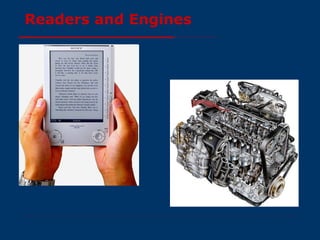
Readers and Engines
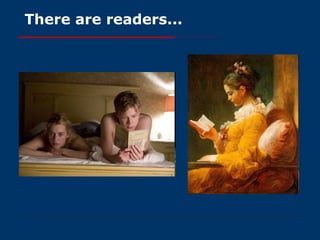
There are readers...
... and readers
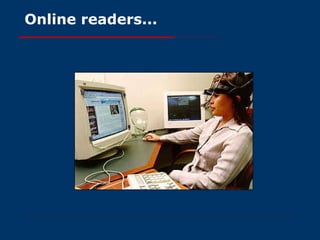
Online readers...
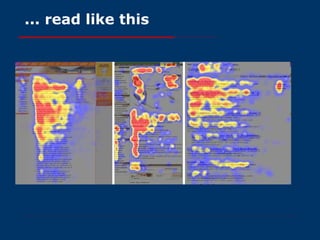
... read like this
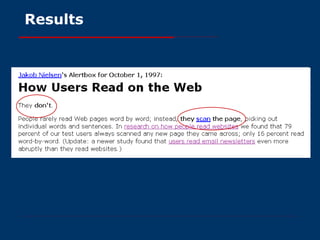
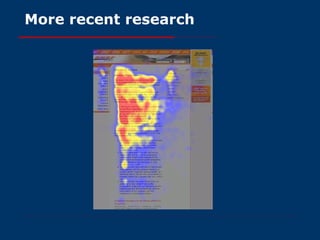
Tracking and scanning End of 1990s Stanford-Poynter research study:   use of  eyetracking  methodology Jakob Nielsen’s usability research   studies
Results
More recent research
Microcontent & Nanocontent
Microcontent (1998) Page Title Headings and subheadings within Body text E-mail subjects   (Jakob Nielsen)
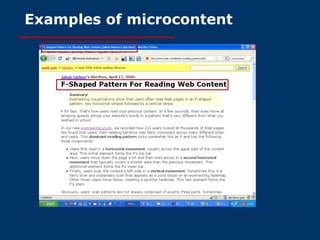
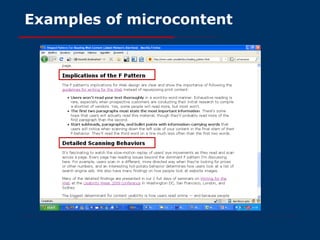
Examples of microcontent
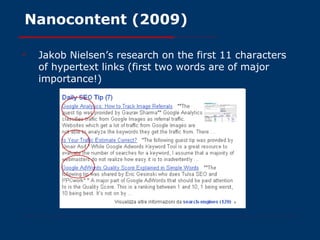
Nanocontent (2009) Jakob Nielsen’s research on the first 11 characters of hypertext links (first two words are of major importance!)
Search engines read too...
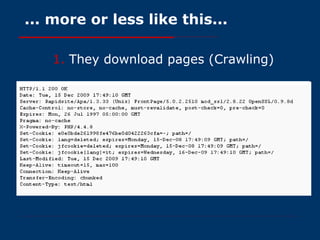
... more or less like this... They download pages (Crawling)
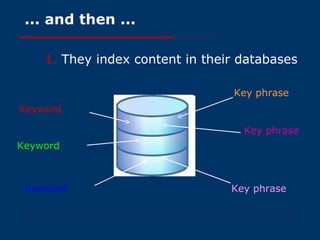
... and then ... They index content in their databases Keyword Keyword Key phrase Keyword Key phrase Key phrase
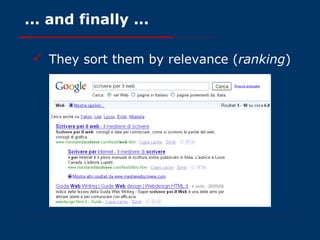
... and finally ... They sort them by relevance ( ranking )
Keywords: three principles Prominence In general, a keyword that appears closer to the top of the page or text area will be more relevant to some search engines.
Keywords: three principles Proximity The closer the keywords in a key phrase, the higher the weight given to such phrase.
Keywords: three principles Density Key phrase density refers to the frequency of such key phrase within the page content.
A brief summary... Web pages are “read” by  human beings  ad  machines  (search engines) Human beings don’t actually read but rather  “scan”  page content, focusing on a few specific areas Search engines are looking for  key words/phrases  and they also focus on a few specific areas
Agenda Readers and Engines (Why online reading is different) Writing for Readers (How to improve usability) Writing for Engines (How to improve findability) Writing for the Web Workshop
Writing for readers
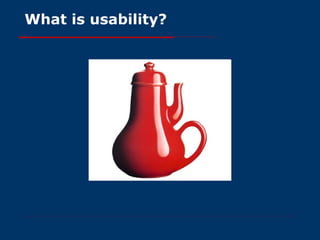
What is usability?
Why is it important? “ On the Web, usability is a necessary condition for survival. If a website is difficult to use, people  leave .” Jakob Nielsen
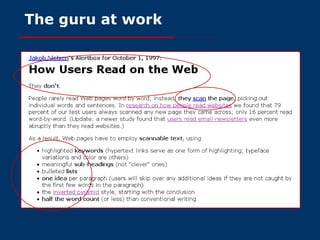
The guru at work
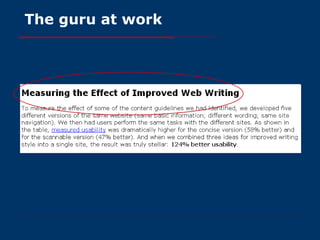
The guru at work
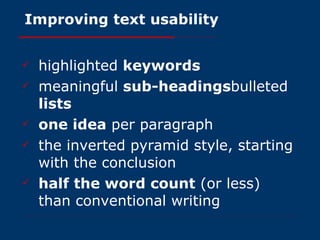
Improving text usability highlighted  keywords meaningful  sub-headings bulleted  lists   one idea  per paragraph the inverted pyramid style, starting with the conclusion  half the word count  (or less) than conventional writing
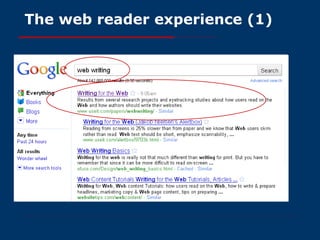
The web reader experience (1)
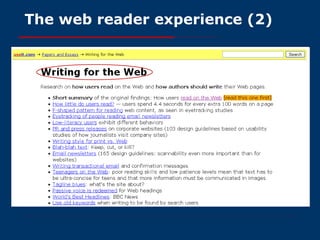
The web reader experience (2)
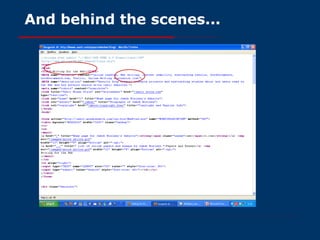
And behind the scenes...
Keywords in the right place In the page TITLE In the page description (DESCRIPTION metatag) At the start of the content visible by the user In subheadings introducing paragraphs In hypertextual link descriptions In bullet points (ordered and unordered)
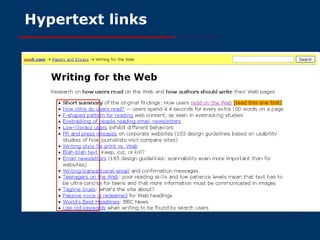
Hypertext links
A brief summary... Always keep in mind  how people read on the web Usability =  Survival To  improve usability  we can work on: Formatting Structure Conciseness Position of keywords
Agenda Readers and Engines (Why online reading is different) Writing for Readers (How to improve usability) Writing for Engines (How to improve findability) Writing for the Web Workshop
Writing for Engines
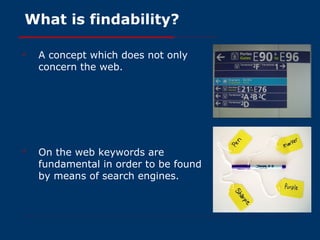
What is findability? A concept which does not only concern the web. On the web keywords are fundamental in order to be found by means of search engines.
Search engine statistics 90%   of people find content on the web through search engines* 84%   of people does not go beyond the second page of Google results** 65%   of people does not click on sponsored links* Forecasts say that by 2020  40%   of all purchases will be made online*** *  David Viney,  Get to the top on Google **  OneUp.com *** uSwitch.com
Keywords: the basic ingredient There are various tools and resources which can help us identify keywords for our web content (both when writing and translating): Google Analytics and other statistical tools Competitors Software tools for keyword search Brainstorming
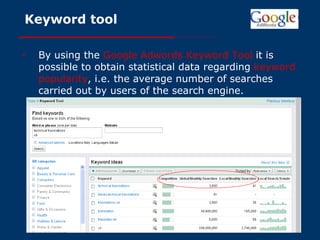
Keyword tool By using the   Google Adwords Keyword Tool  it is possible to obtain statistical data regarding   keyword popularity , i.e. the average number of searches carried out by users of the search engine.
Keywords: practical suggestions Use keywords used by your prospects Avoid preconceived ideas on keywords Focus on facts, not on personal opinions Prefer “old words” to marketing terms or new coinages
Keywords: use   Should be inserted in each text area: domain name URL metatags title etc.
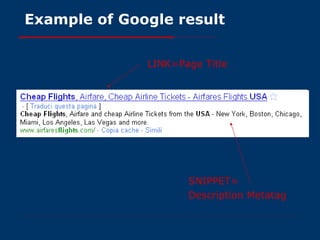
Example of Google result LINK=Page Title SNIPPET= Description Metatag
A key element for both positioning purposes (SEO) and marketing purposes (SEM), as well as for usability purposes Title
Metatag Description There are at least two reasons to give attention to the   Description metatag: : In SERPs the Description metatag content sometimes appears  in the  snippet   below the link (= TITLE) Description metatag content is used to describe pages in directories Even though for indexing purposes it does not hold the same value of the Title
Content in the BODY area Optimum length of a page: 450-600 words Bold   is used to highlight main keywords and key phrases Avoid   underlined text ! Subdivide the text in paragraphs and position main key phrases at the start of the paragraph
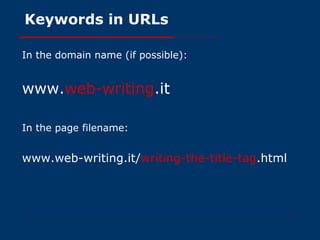
Keywords in URLs In the domain name (if possible): www. web-writing .it In the page filename: www.web-writing.it/ writing-the-title-tag .html
A brief summary... Always start from  key words/phrases  when writing web content Choose keywords used by readers Position keywords in the various  page areas  (Title, metatags, body, etc.)
Agenda Readers and Engines (Why online reading is different) Writing for Readers (How to improve usability) Writing for Engines (How to improve findability) Writing for the Web Workshop
Writing for the web
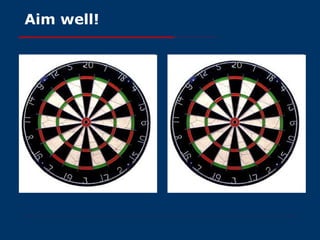
Aim well!
Two bull’s eyes! How?
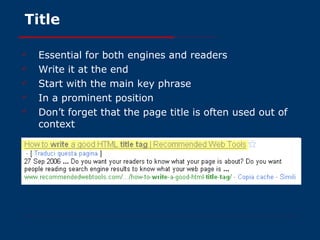
Title Essential for both engines and readers Write it at the end  Start with the main key phrase In a prominent position Don’t forget that the page title is often used out of context
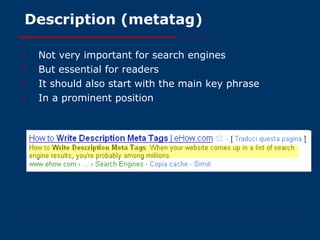
Description (metatag) Not very important for search engines But essential for readers It should also start with the main key phrase In a prominent position
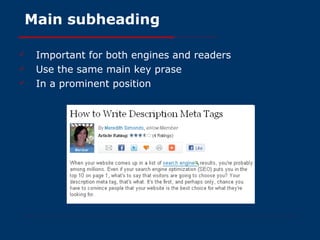
Main subheading Important for both engines and readers Use the same main key prase In a prominent position
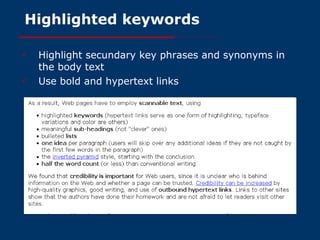
Highlighted keywords Highlight secundary key phrases and synonyms in the body text Use bold and hypertext links
Write for readers (AND engines) Three main rules: Write for your readers Write on a specific subject Write in a concise manner ... and search engines  will be happy too!
Workshop
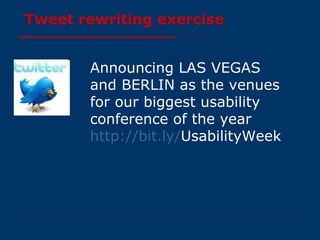
Tweet rewriting exercise Announcing LAS VEGAS and BERLIN as the venues for our biggest usability conference of the year  http:// bit.ly / UsabilityWeek
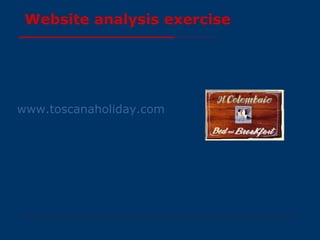
Website analysis exercise www.toscanaholiday.com
Thank you for your attention! Links can be found here: http://delicious.com/andrea.spila/proz-webinar I can be found here: [email_address]

Web writing for translators

  • 1.
    WEB WRITING FORTRANSLATORS How to improve your online writing and translation skills by Andrea Spila
  • 2.
    Objectives Understanding whyonline writing is different Improving your web content translation skills Improving your web content writing skills Improving your online communication skills
  • 3.
    Agenda Readers andEngines (Why online reading is different) Writing for Readers (How to improve usability) Writing for Engines (How to improve findability) Writing for the Web Workshop
  • 4.
  • 5.
  • 6.
  • 7.
  • 8.
  • 9.
    Tracking and scanningEnd of 1990s Stanford-Poynter research study: use of eyetracking methodology Jakob Nielsen’s usability research studies
  • 10.
  • 11.
  • 12.
  • 13.
    Microcontent (1998) PageTitle Headings and subheadings within Body text E-mail subjects (Jakob Nielsen)
  • 14.
  • 15.
  • 16.
    Nanocontent (2009) JakobNielsen’s research on the first 11 characters of hypertext links (first two words are of major importance!)
  • 17.
  • 18.
    ... more orless like this... They download pages (Crawling)
  • 19.
    ... and then... They index content in their databases Keyword Keyword Key phrase Keyword Key phrase Key phrase
  • 20.
    ... and finally... They sort them by relevance ( ranking )
  • 21.
    Keywords: three principlesProminence In general, a keyword that appears closer to the top of the page or text area will be more relevant to some search engines.
  • 22.
    Keywords: three principlesProximity The closer the keywords in a key phrase, the higher the weight given to such phrase.
  • 23.
    Keywords: three principlesDensity Key phrase density refers to the frequency of such key phrase within the page content.
  • 24.
    A brief summary...Web pages are “read” by human beings ad machines (search engines) Human beings don’t actually read but rather “scan” page content, focusing on a few specific areas Search engines are looking for key words/phrases and they also focus on a few specific areas
  • 25.
    Agenda Readers andEngines (Why online reading is different) Writing for Readers (How to improve usability) Writing for Engines (How to improve findability) Writing for the Web Workshop
  • 26.
  • 27.
  • 28.
    Why is itimportant? “ On the Web, usability is a necessary condition for survival. If a website is difficult to use, people leave .” Jakob Nielsen
  • 29.
  • 30.
  • 31.
    Improving text usabilityhighlighted keywords meaningful sub-headings bulleted lists one idea per paragraph the inverted pyramid style, starting with the conclusion half the word count (or less) than conventional writing
  • 32.
    The web readerexperience (1)
  • 33.
    The web readerexperience (2)
  • 34.
    And behind thescenes...
  • 35.
    Keywords in theright place In the page TITLE In the page description (DESCRIPTION metatag) At the start of the content visible by the user In subheadings introducing paragraphs In hypertextual link descriptions In bullet points (ordered and unordered)
  • 36.
  • 37.
    A brief summary...Always keep in mind how people read on the web Usability = Survival To improve usability we can work on: Formatting Structure Conciseness Position of keywords
  • 38.
    Agenda Readers andEngines (Why online reading is different) Writing for Readers (How to improve usability) Writing for Engines (How to improve findability) Writing for the Web Workshop
  • 39.
  • 40.
    What is findability?A concept which does not only concern the web. On the web keywords are fundamental in order to be found by means of search engines.
  • 41.
    Search engine statistics90% of people find content on the web through search engines* 84% of people does not go beyond the second page of Google results** 65% of people does not click on sponsored links* Forecasts say that by 2020 40% of all purchases will be made online*** * David Viney, Get to the top on Google ** OneUp.com *** uSwitch.com
  • 42.
    Keywords: the basicingredient There are various tools and resources which can help us identify keywords for our web content (both when writing and translating): Google Analytics and other statistical tools Competitors Software tools for keyword search Brainstorming
  • 43.
    Keyword tool Byusing the Google Adwords Keyword Tool it is possible to obtain statistical data regarding keyword popularity , i.e. the average number of searches carried out by users of the search engine.
  • 44.
    Keywords: practical suggestionsUse keywords used by your prospects Avoid preconceived ideas on keywords Focus on facts, not on personal opinions Prefer “old words” to marketing terms or new coinages
  • 45.
    Keywords: use Should be inserted in each text area: domain name URL metatags title etc.
  • 46.
    Example of Googleresult LINK=Page Title SNIPPET= Description Metatag
  • 47.
    A key elementfor both positioning purposes (SEO) and marketing purposes (SEM), as well as for usability purposes Title
  • 48.
    Metatag Description Thereare at least two reasons to give attention to the Description metatag: : In SERPs the Description metatag content sometimes appears in the snippet below the link (= TITLE) Description metatag content is used to describe pages in directories Even though for indexing purposes it does not hold the same value of the Title
  • 49.
    Content in theBODY area Optimum length of a page: 450-600 words Bold is used to highlight main keywords and key phrases Avoid underlined text ! Subdivide the text in paragraphs and position main key phrases at the start of the paragraph
  • 50.
    Keywords in URLsIn the domain name (if possible): www. web-writing .it In the page filename: www.web-writing.it/ writing-the-title-tag .html
  • 51.
    A brief summary...Always start from key words/phrases when writing web content Choose keywords used by readers Position keywords in the various page areas (Title, metatags, body, etc.)
  • 52.
    Agenda Readers andEngines (Why online reading is different) Writing for Readers (How to improve usability) Writing for Engines (How to improve findability) Writing for the Web Workshop
  • 53.
  • 54.
  • 55.
  • 56.
    Title Essential forboth engines and readers Write it at the end Start with the main key phrase In a prominent position Don’t forget that the page title is often used out of context
  • 57.
    Description (metatag) Notvery important for search engines But essential for readers It should also start with the main key phrase In a prominent position
  • 58.
    Main subheading Importantfor both engines and readers Use the same main key prase In a prominent position
  • 59.
    Highlighted keywords Highlightsecundary key phrases and synonyms in the body text Use bold and hypertext links
  • 60.
    Write for readers(AND engines) Three main rules: Write for your readers Write on a specific subject Write in a concise manner ... and search engines will be happy too!
  • 61.
  • 62.
    Tweet rewriting exerciseAnnouncing LAS VEGAS and BERLIN as the venues for our biggest usability conference of the year http:// bit.ly / UsabilityWeek
  • 63.
    Website analysis exercisewww.toscanaholiday.com
  • 64.
    Thank you foryour attention! Links can be found here: http://delicious.com/andrea.spila/proz-webinar I can be found here: [email_address]