BioPython modules for handling
RNA sequences containing modified
          nucleosides.
        Tomasz Puton, Kristian Rother,
      Magdalena Rother, Janusz M. Bujnicki


        Laboratory of Structural Bioinformatics
      Adam Mickiewicz University, Poznań, Poland
        http://bioinformatics.amu.edu.pl/Lab/

   International Institute of Molecular and Cell Biology
       Warsaw, Poland http://iimcb.genesilico.pl/
BioPython – a set of freely available tools for
 biological computation written in Python.


            http://biopython.org/
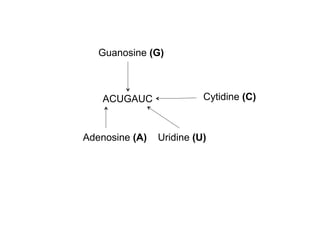
ACUGAUC
Guanosine (G)


    ACUGAUC               Cytidine (C)


Adenosine (A)   Uridine (U)
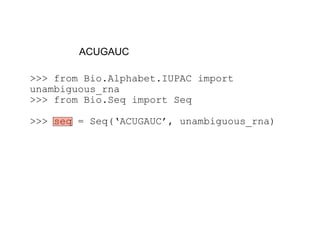
ACUGAUC

>>> from Bio.Alphabet.IUPAC import
unambiguous_rna
>>> from Bio.Seq import Seq

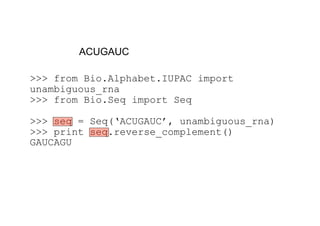
>>> seq = Seq(‘ACUGAUC’, unambiguous_rna)
ACUGAUC

>>> from Bio.Alphabet.IUPAC import
unambiguous_rna
>>> from Bio.Seq import Seq

>>> seq = Seq(‘ACUGAUC’, unambiguous_rna)
>>> print seq.reverse_complement()
GAUCAGU
Problem:

    The linked image cannot be displayed. The file may have been
    moved, renamed, or deleted. Verify that the link points to the
    correct file and location.


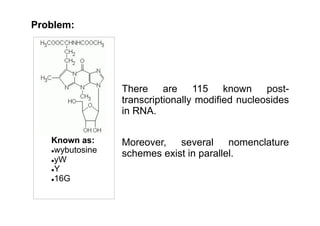
                                                                     There are 115 known post-
                                                                     transcriptionally modified nucleosides
                                                                     in RNA.

   Known as:                                                         Moreover, several nomenclature
    wybutosine
                                                                     schemes exist in parallel.
    yW

    Y

    16G
Solution:

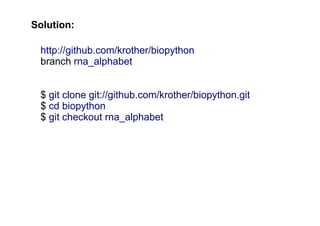
 http://github.com/krother/biopython
 branch rna_alphabet


 $ git clone git://github.com/krother/biopython.git
 $ cd biopython
 $ git checkout rna_alphabet
Solution:

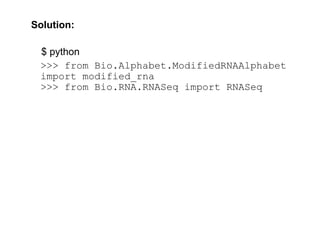
 $ python
 >>> from Bio.Alphabet.ModifiedRNAAlphabet
 import modified_rna
 >>> from Bio.RNA.RNASeq import RNASeq
Solution:

 $ python
 >>> from Bio.Alphabet.ModifiedRNAAlphabet
 import modified_rna
 >>> from Bio.RNA.RNASeq import RNASeq

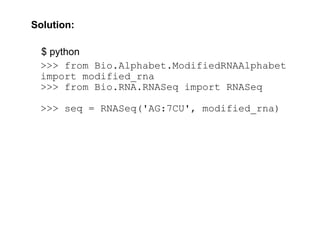
 >>> seq = RNASeq('AG:7CU', modified_rna)
Solution:

 $ python
 >>> from Bio.Alphabet.ModifiedRNAAlphabet
 import modified_rna
 >>> from Bio.RNA.RNASeq import RNASeq

 >>> seq = RNASeq('AG:7CU', modified_rna)

 >>> print seq[2].full_name
 2-O-methyloadenosine
Solution:

 $ python
 >>> from Bio.Alphabet.ModifiedRNAAlphabet
 import modified_rna
 >>> from Bio.RNA.RNASeq import RNASeq

 >>> seq = RNASeq('AG:7CU', modified_rna)

 >>> print seq[2].full_name
 2-O-methyloadenosine

 >>> print seq[3].long_abbrev
 m7G
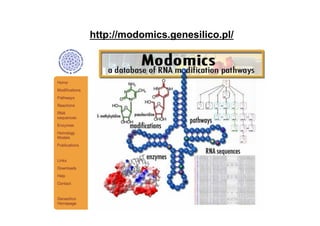
http://modomics.genesilico.pl/
Example applications (part 1):


ModeRNA: A tool for comparative modeling of
RNA 3D structure.

http://iimcb.genesilico.pl/moderna/

Our software models modified RNA 3D structures!

Open source project!
Example applications (part 2):


CompaRNA: A server for continuous benchmarking of
automated methods for RNA structure prediction

POSTER NUMBER: W17
SUNDAY, JULY 11: 12:40 p.m. – 2.30 p.m.

http://comparna.amu.edu.pl/

Uses open source software e.g.
  BioPython, PyCogent & ModeRNA
Thank you for attention!


   Tomasz Puton       Kristian Rother
t.puton@amu.edu.pl   krother@rubor.de

 Magdalena Rother     Janusz M. Bujnicki
lenam@amu.edu.pl     iamb@genesilico.pl

Puton bosc2010 bio_python-modules-rna

  • 1.
    BioPython modules forhandling RNA sequences containing modified nucleosides. Tomasz Puton, Kristian Rother, Magdalena Rother, Janusz M. Bujnicki Laboratory of Structural Bioinformatics Adam Mickiewicz University, Poznań, Poland http://bioinformatics.amu.edu.pl/Lab/ International Institute of Molecular and Cell Biology Warsaw, Poland http://iimcb.genesilico.pl/
  • 2.
    BioPython – aset of freely available tools for biological computation written in Python. http://biopython.org/
  • 3.
  • 4.
    Guanosine (G) ACUGAUC Cytidine (C) Adenosine (A) Uridine (U)
  • 5.
    ACUGAUC >>> from Bio.Alphabet.IUPACimport unambiguous_rna >>> from Bio.Seq import Seq >>> seq = Seq(‘ACUGAUC’, unambiguous_rna)
  • 6.
    ACUGAUC >>> from Bio.Alphabet.IUPACimport unambiguous_rna >>> from Bio.Seq import Seq >>> seq = Seq(‘ACUGAUC’, unambiguous_rna) >>> print seq.reverse_complement() GAUCAGU
  • 7.
    Problem: The linked image cannot be displayed. The file may have been moved, renamed, or deleted. Verify that the link points to the correct file and location. There are 115 known post- transcriptionally modified nucleosides in RNA. Known as: Moreover, several nomenclature  wybutosine schemes exist in parallel.  yW  Y  16G
  • 8.
    Solution: http://github.com/krother/biopython branchrna_alphabet $ git clone git://github.com/krother/biopython.git $ cd biopython $ git checkout rna_alphabet
  • 9.
    Solution: $ python >>> from Bio.Alphabet.ModifiedRNAAlphabet import modified_rna >>> from Bio.RNA.RNASeq import RNASeq
  • 10.
    Solution: $ python >>> from Bio.Alphabet.ModifiedRNAAlphabet import modified_rna >>> from Bio.RNA.RNASeq import RNASeq >>> seq = RNASeq('AG:7CU', modified_rna)
  • 11.
    Solution: $ python >>> from Bio.Alphabet.ModifiedRNAAlphabet import modified_rna >>> from Bio.RNA.RNASeq import RNASeq >>> seq = RNASeq('AG:7CU', modified_rna) >>> print seq[2].full_name 2-O-methyloadenosine
  • 12.
    Solution: $ python >>> from Bio.Alphabet.ModifiedRNAAlphabet import modified_rna >>> from Bio.RNA.RNASeq import RNASeq >>> seq = RNASeq('AG:7CU', modified_rna) >>> print seq[2].full_name 2-O-methyloadenosine >>> print seq[3].long_abbrev m7G
  • 13.
  • 14.
    Example applications (part1): ModeRNA: A tool for comparative modeling of RNA 3D structure. http://iimcb.genesilico.pl/moderna/ Our software models modified RNA 3D structures! Open source project!
  • 15.
    Example applications (part2): CompaRNA: A server for continuous benchmarking of automated methods for RNA structure prediction POSTER NUMBER: W17 SUNDAY, JULY 11: 12:40 p.m. – 2.30 p.m. http://comparna.amu.edu.pl/ Uses open source software e.g. BioPython, PyCogent & ModeRNA
  • 16.
    Thank you forattention! Tomasz Puton Kristian Rother t.puton@amu.edu.pl krother@rubor.de Magdalena Rother Janusz M. Bujnicki lenam@amu.edu.pl iamb@genesilico.pl