Web 2.0 pedagogy and e-portfolios
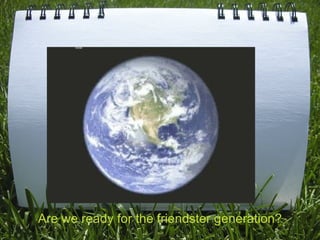
Are we ready for the friendster generation?
And what  about gifted students? They have learning needs that go  beyond what is traditionally offered in the regular classroom.  The nature of their abilities requires differentiated  learning experiences and opportunities for them to maximize their potential.
Gifted Learners need opportunities to ...  pursue topics of study in greater depth or breadth  engage in authentic and complex academic tasks  that require doing real world work  advance through activities at a faster pace  interact with other gifted peers to form social and  intellectual connections   and develop a sense of self and the possibilities that the  world has to offer.
21st Century learning is Constructivist Offers diverse  resources  to a student   Engages students in experiences that challenge their prior  conceptions of their existing knowledge  Allows student responses to drive lessons   Encourages questioning by asking open-ended questions   Uses terminology such as "classify", "analyze", and "create" 
21st Century learning is Constructivist Encourages and accepts student autonomy and initiative   Uses primary sources along with interactive materials   Insists on clear expression in communication from students   Is connected and collaborative
Using ICT to meet needs of gifted learners   Siegle (2004, 2007) has suggested that technology  of the 21st century can provide educators with new and exciting possibilities for engaging gifted and talented students.  As we enter the 21st century, tools of collaboration  have changed dramatically. Over the last five years, there has been a significant  change in the Internet. Friendster has been overtaken by Multiply in popularity among younger Filipinos
What is Web 2.0? The term ‘Web 2.0’ was officially coined in 2004 by  Dale Dougherty, a vice-president of O’Reilly Media Inc.  Many believe the Web has entered a second phase,  where new services and software - collectively known as Web 2.0 - are transforming the web from a read only medium to one where anyone can publish and share content and easily collaborate with others. Friendster, Multiply and Facebook  are examples of Web 2.0
How is Web 2.0 changing education?   Teachers are discovering that Web 2.0 can be used  to empower students and create exciting new learning opportunities.  Web 2.0 provides opportunities for differentiation  of content, process, product and learning environment.
Web 2.0 technologies Web 2.0 technologies are collaborative and  conversational.  Examples:  Wiki   Social networking   Blogs   Video and photo sharing   Discussion Forums   Podcasting
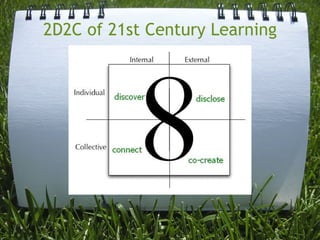
2D2C of 21st Century Learning
Maraming Salamat po! Note: This presentation was produced using Web 2.0 tools.

Web 2.0 Pedagogy and Giftedness

  • 1.
    Web 2.0 pedagogyand e-portfolios
  • 2.
    Are we readyfor the friendster generation?
  • 3.
    And what  aboutgifted students? They have learning needs that go  beyond what is traditionally offered in the regular classroom. The nature of their abilities requires differentiated  learning experiences and opportunities for them to maximize their potential.
  • 4.
    Gifted Learners needopportunities to ... pursue topics of study in greater depth or breadth engage in authentic and complex academic tasks  that require doing real world work advance through activities at a faster pace interact with other gifted peers to form social and  intellectual connections  and develop a sense of self and the possibilities that the  world has to offer.
  • 5.
    21st Century learningis Constructivist Offers diverse  resources  to a student  Engages students in experiences that challenge their prior  conceptions of their existing knowledge Allows student responses to drive lessons  Encourages questioning by asking open-ended questions  Uses terminology such as "classify", "analyze", and "create" 
  • 6.
    21st Century learningis Constructivist Encourages and accepts student autonomy and initiative  Uses primary sources along with interactive materials  Insists on clear expression in communication from students  Is connected and collaborative
  • 7.
    Using ICT tomeet needs of gifted learners   Siegle (2004, 2007) has suggested that technology  of the 21st century can provide educators with new and exciting possibilities for engaging gifted and talented students. As we enter the 21st century, tools of collaboration  have changed dramatically. Over the last five years, there has been a significant  change in the Internet. Friendster has been overtaken by Multiply in popularity among younger Filipinos
  • 8.
    What is Web2.0? The term ‘Web 2.0’ was officially coined in 2004 by  Dale Dougherty, a vice-president of O’Reilly Media Inc. Many believe the Web has entered a second phase,  where new services and software - collectively known as Web 2.0 - are transforming the web from a read only medium to one where anyone can publish and share content and easily collaborate with others. Friendster, Multiply and Facebook  are examples of Web 2.0
  • 9.
    How is Web2.0 changing education?   Teachers are discovering that Web 2.0 can be used  to empower students and create exciting new learning opportunities. Web 2.0 provides opportunities for differentiation  of content, process, product and learning environment.
  • 10.
    Web 2.0 technologiesWeb 2.0 technologies are collaborative and  conversational. Examples: Wiki  Social networking  Blogs  Video and photo sharing  Discussion Forums  Podcasting
  • 11.
    2D2C of 21stCentury Learning
  • 12.
    Maraming Salamat po!Note: This presentation was produced using Web 2.0 tools.

Editor's Notes

  • #12 Part of the philosophy here is helping the learner build e-portfolios. For the gifted and talented