PAPER WEAVING
By
Bernard E. Richardson
Master Teacher|Art Educator|2022
©Bernard E. Richardson| 2022
PAPER WEAVING
By
Bernard E. Richardson
Master Teacher|Art Educator|2022
©Bernard E. Richardson| 2022
WEAVING…
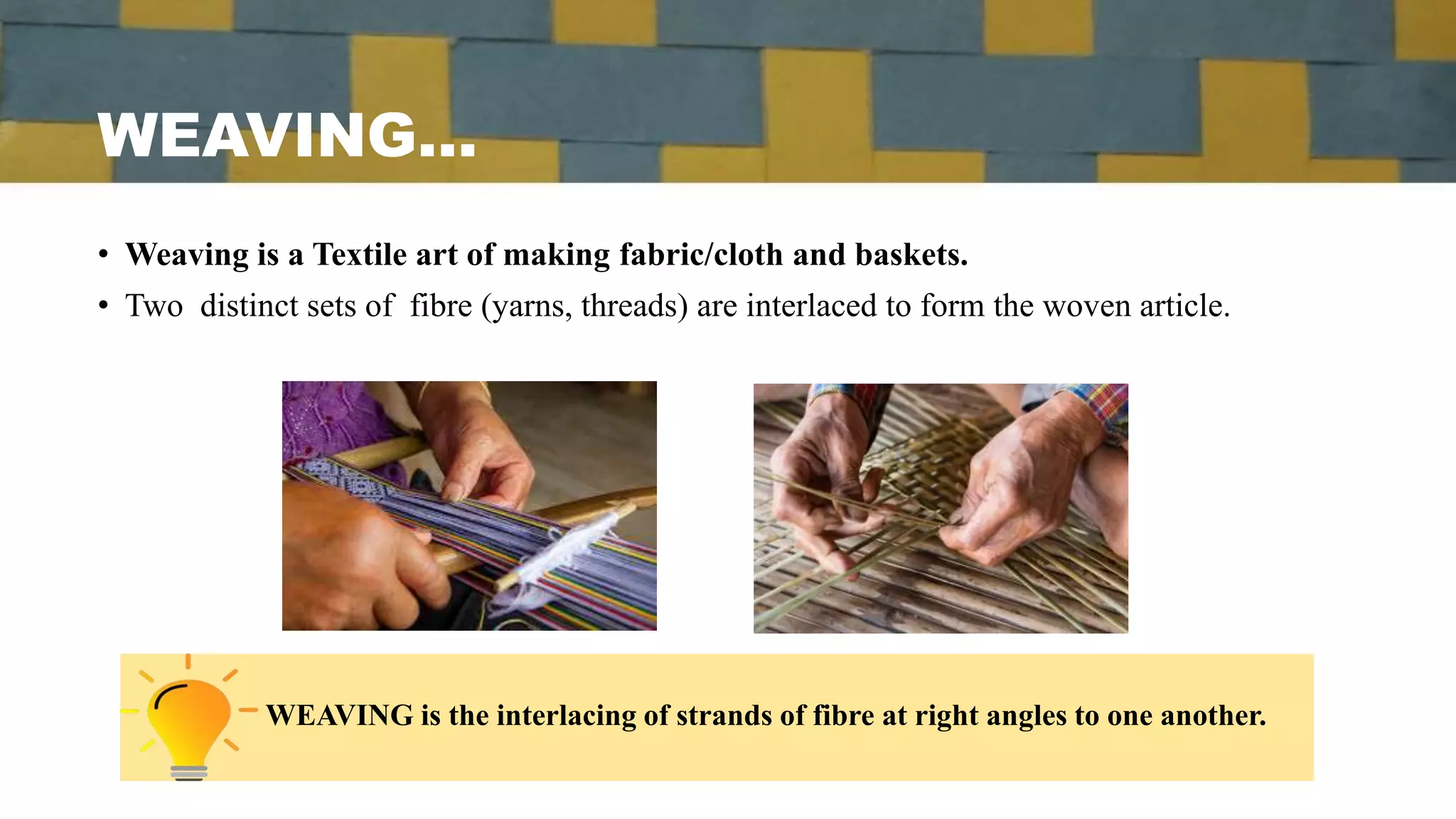
• Weaving is a Textile art of making fabric/cloth and baskets.
• Two distinct sets of fibre (yarns, threads) are interlaced to form the woven article.
WEAVING is the interlacing of strands of fibre at right angles to one another.
WEAVING TERMS…
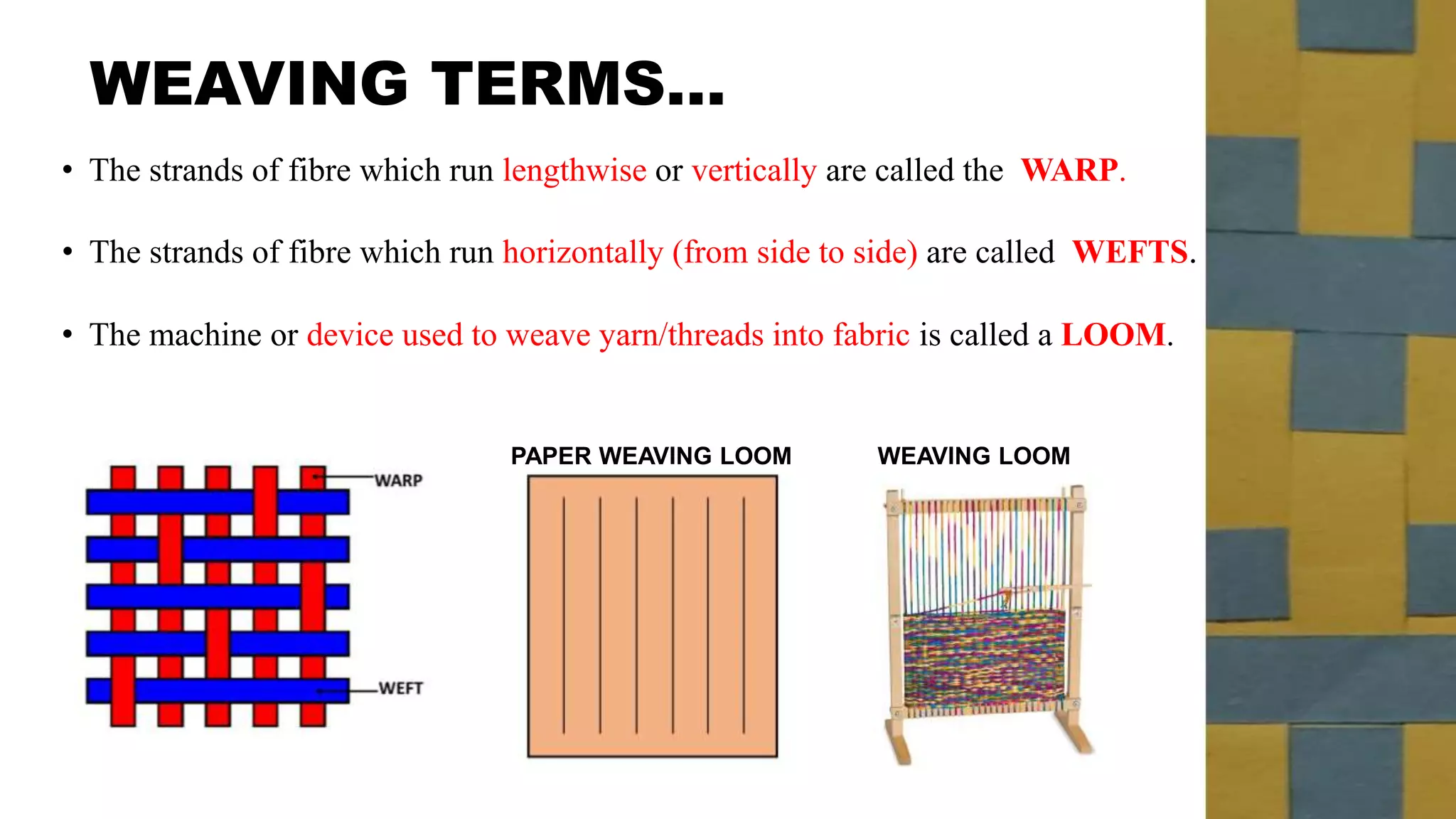
• The strands of fibre which run lengthwise or vertically are called the WARP.
• The strands of fibre which run horizontally (from side to side) are called WEFTS.
PAPER WEAVING LOOM
• The machine or device used to weave yarn/threads into fabric is called a LOOM.
WEAVING LOOM
• Weaving is one of the most ancient form of human creativity.
• It has been used since prehistoric times for making materials to help keep our
bodies warm, for shelter and to make vessels for gathering and storing food.
• Today, fabrics and baskets would not have been possible without weaving.
WEAVING… Brief History
THE PATTERN…
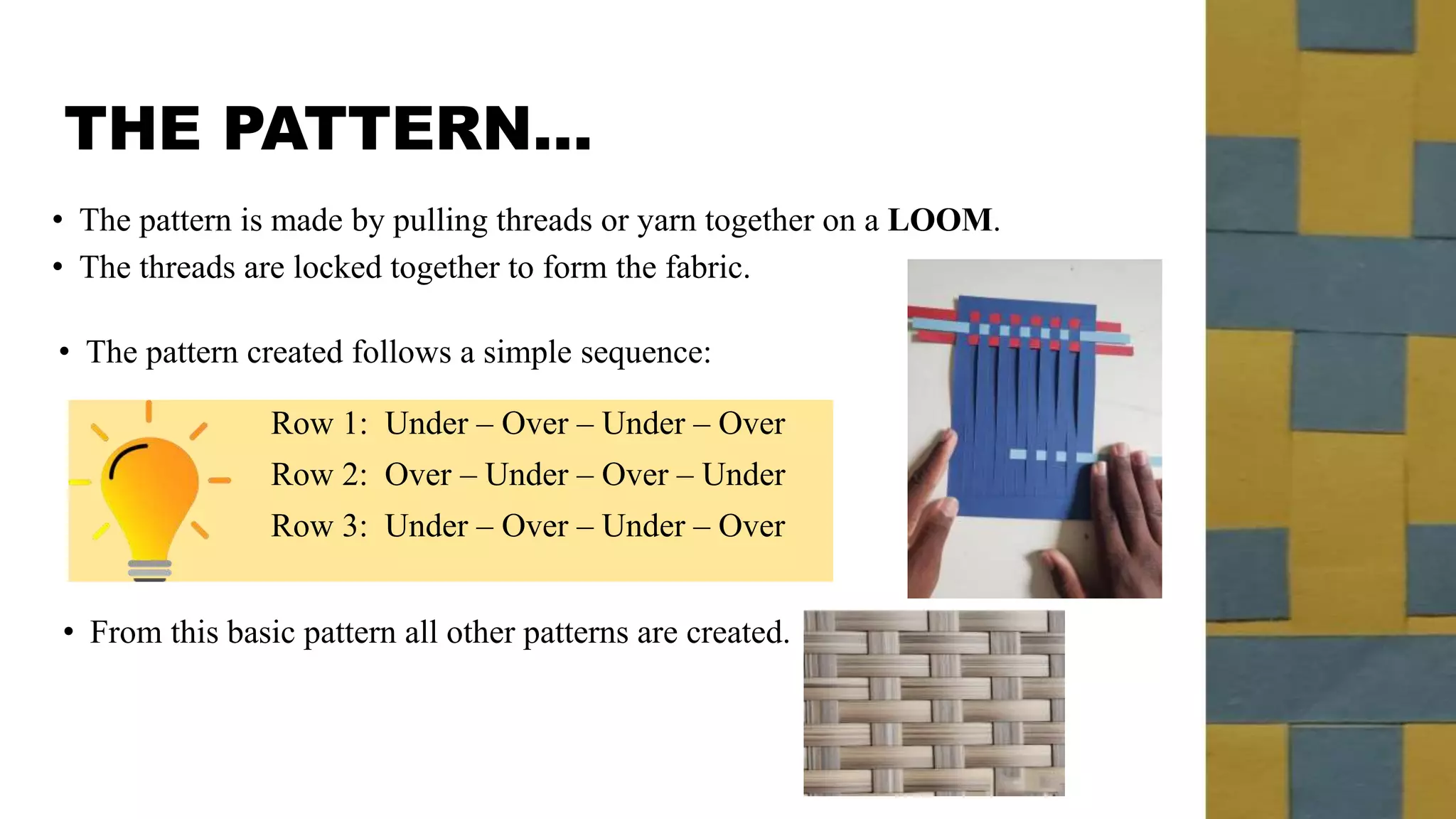
• The pattern is made by pulling threads or yarn together on a LOOM.
• The threads are locked together to form the fabric.
• The pattern created follows a simple sequence:
• From this basic pattern all other patterns are created.
Row 1: Under – Over – Under – Over
Row 2: Over – Under – Over – Under
Row 3: Under – Over – Under – Over
PAPER WEAVING
• The weaving can be created using different colours and patterns to create
decorative and functional Art items such as tablemats, book marks, baskets,
greeting cards etc.
Greeting cards and Book marks
Tablemats
Baskets
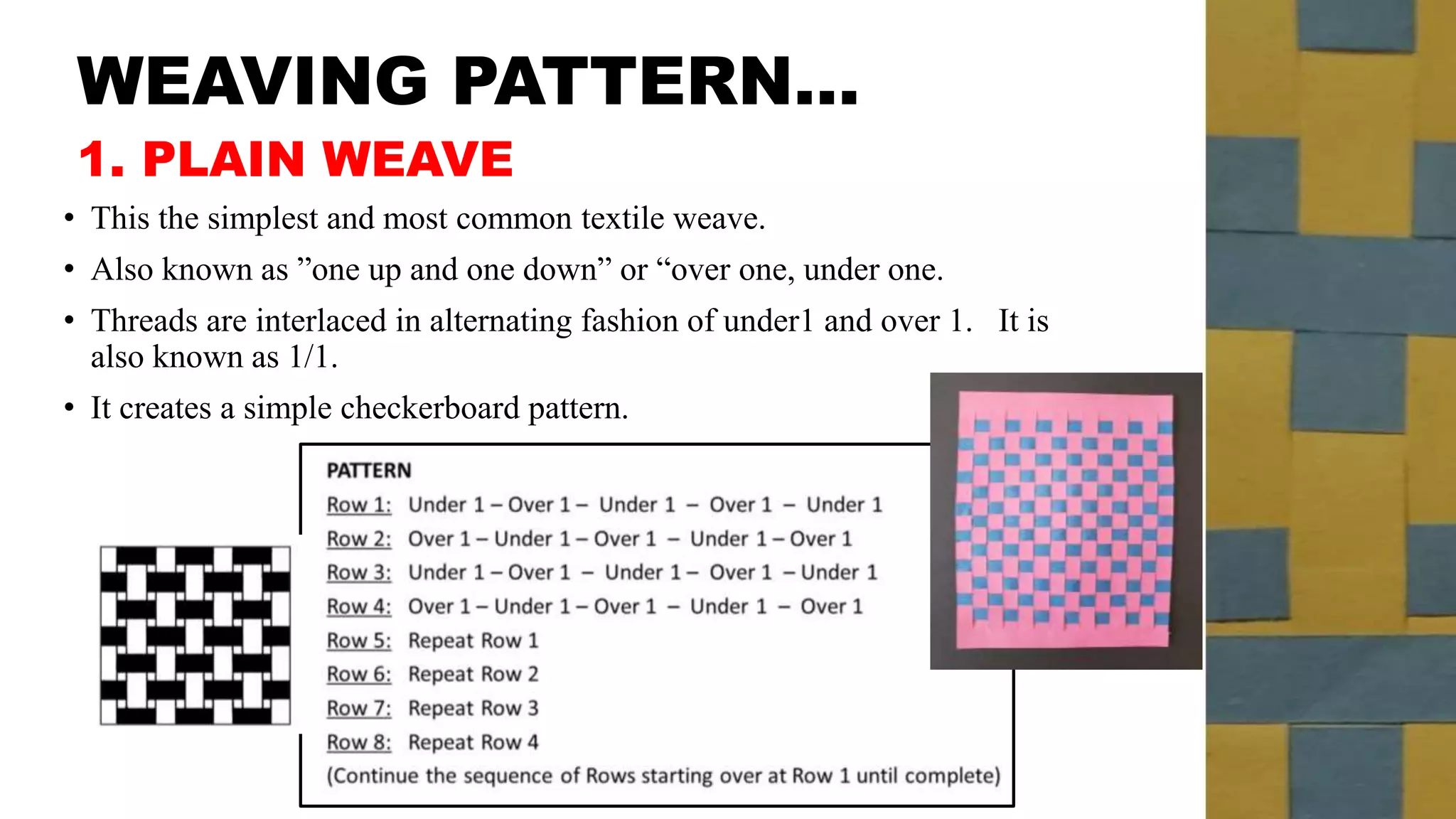
1. PLAIN WEAVE
• This the simplest and most common textile weave.
• Also known as ”one up and one down” or “over one, under one.
• Threads are interlaced in alternating fashion of under1 and over 1. It is
also known as 1/1.
• It creates a simple checkerboard pattern.
WEAVING PATTERN…
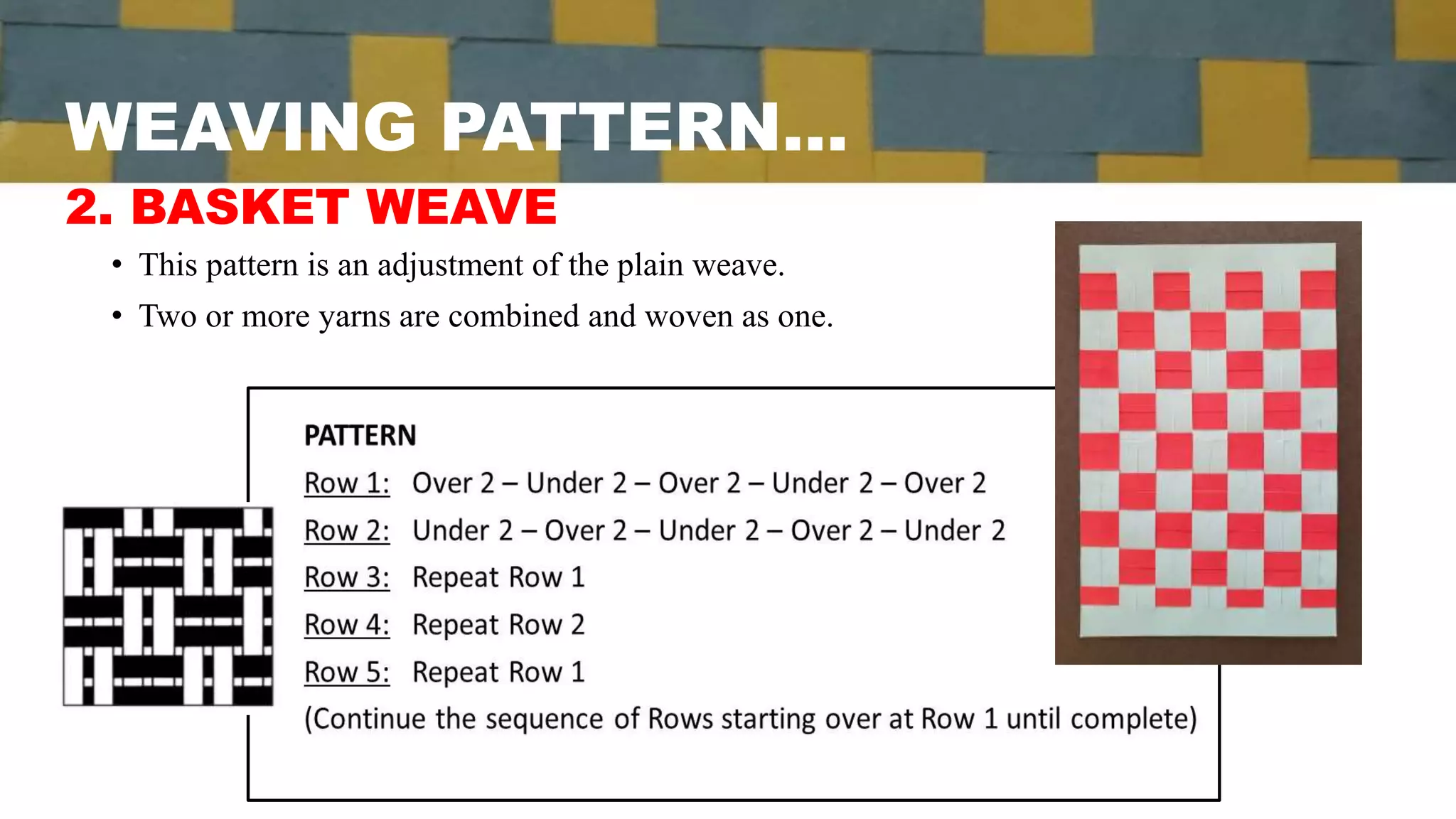
2. BASKET WEAVE
• This pattern is an adjustment of the plain weave.
• Two or more yarns are combined and woven as one.
WEAVING PATTERN…
• Twill weave is one of the most widely used weaving
technique to create fabric today.
• It has a pattern of diagonal lines.
3. TWILL WEAVE
WEAVING PATTERN…
• Zig zag twill weave pattern is produced by reversing the direction of the twill weave.
4. ZIG ZAG TWILL WEAVE
WEAVING PATTERN…
• Satin weaves are very flat and creates a smooth finish because
of its pattern.
5. SATIN WEAVE
WEAVING PATTERN…
• Is a way of taking strips of paper and placing them either “over” or “under” the base piece
of the paper.
PAPER WEAVING…
• The strips can be referred to as the
wefts.
• The base can be referred to as the Loom
which is made up of a number of warps
created by cutting slits in the paper.
The Paper Weaving process….
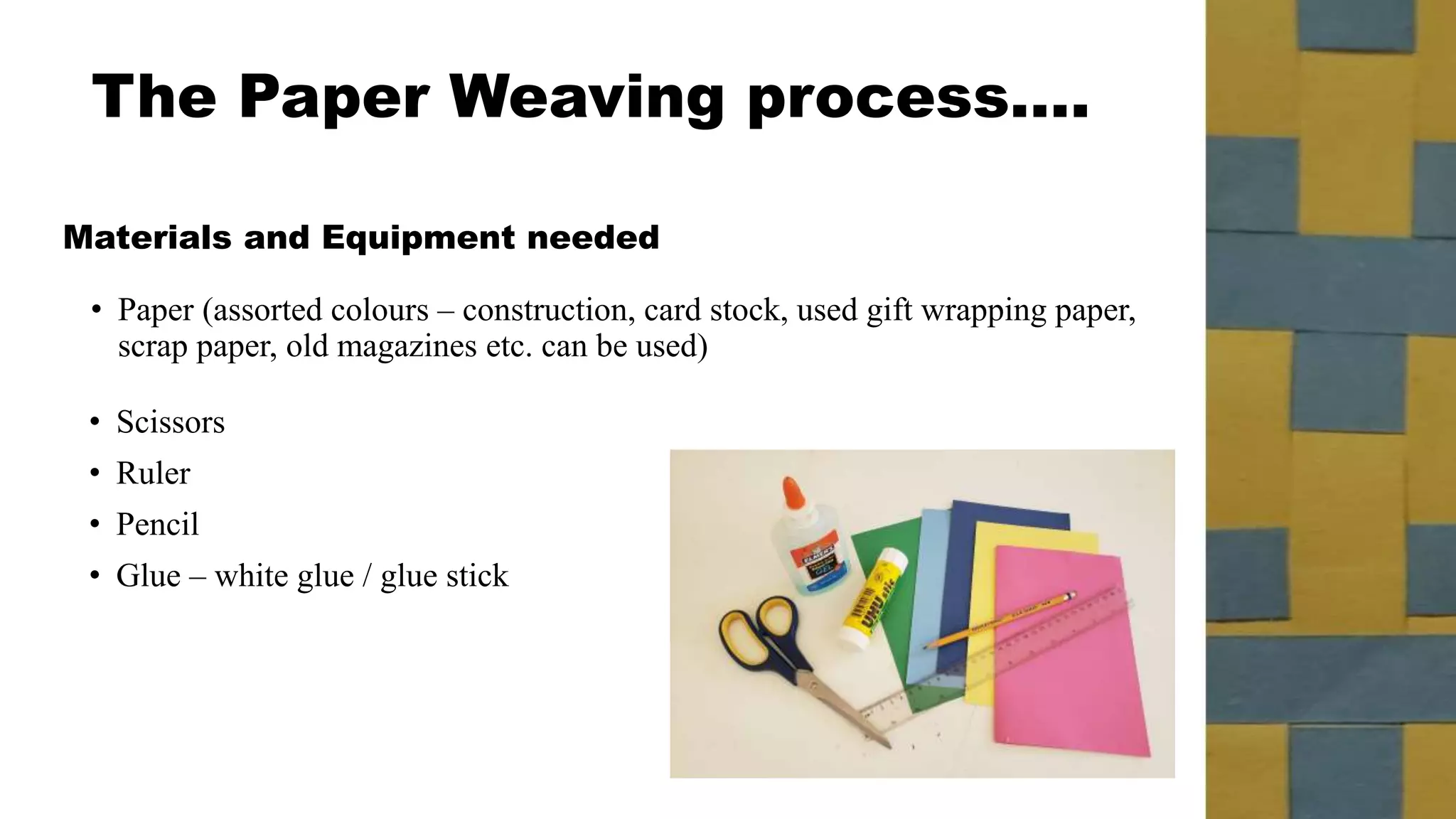
Materials and Equipment needed
• Scissors
• Ruler
• Pencil
• Glue – white glue / glue stick
• Paper (assorted colours – construction, card stock, used gift wrapping paper,
scrap paper, old magazines etc. can be used)
The Paper Weaving process…. (cont’d)
STEP 2
• Fold the paper in half
STEP 1
• Cut your paper into the shape and size
desired for making your paper weave.
STEP 3
• Draw a horizontal straight line about ½ to 1
inch along the open-ended side of the fold
with the ruler and pencil.
• Use the pencil and ruler to measure and
mark off evenly spaced dimensions to
create the loom.
STEP 4
• Use the pencil and ruler to draw in the
vertical lines to create the loom starting
from the horizontal line drawn.
The Paper Weaving process…. (cont’d)
STEP 5
• Using the scissors, cut slits along the marked lines
starting from the folded edge and stop at the
horizontal line made at the open edge.
STEP 6
• Carefully unfold the paper.
• THIS IS YOUR LOOM.
The Paper Weaving process…. (cont’d)
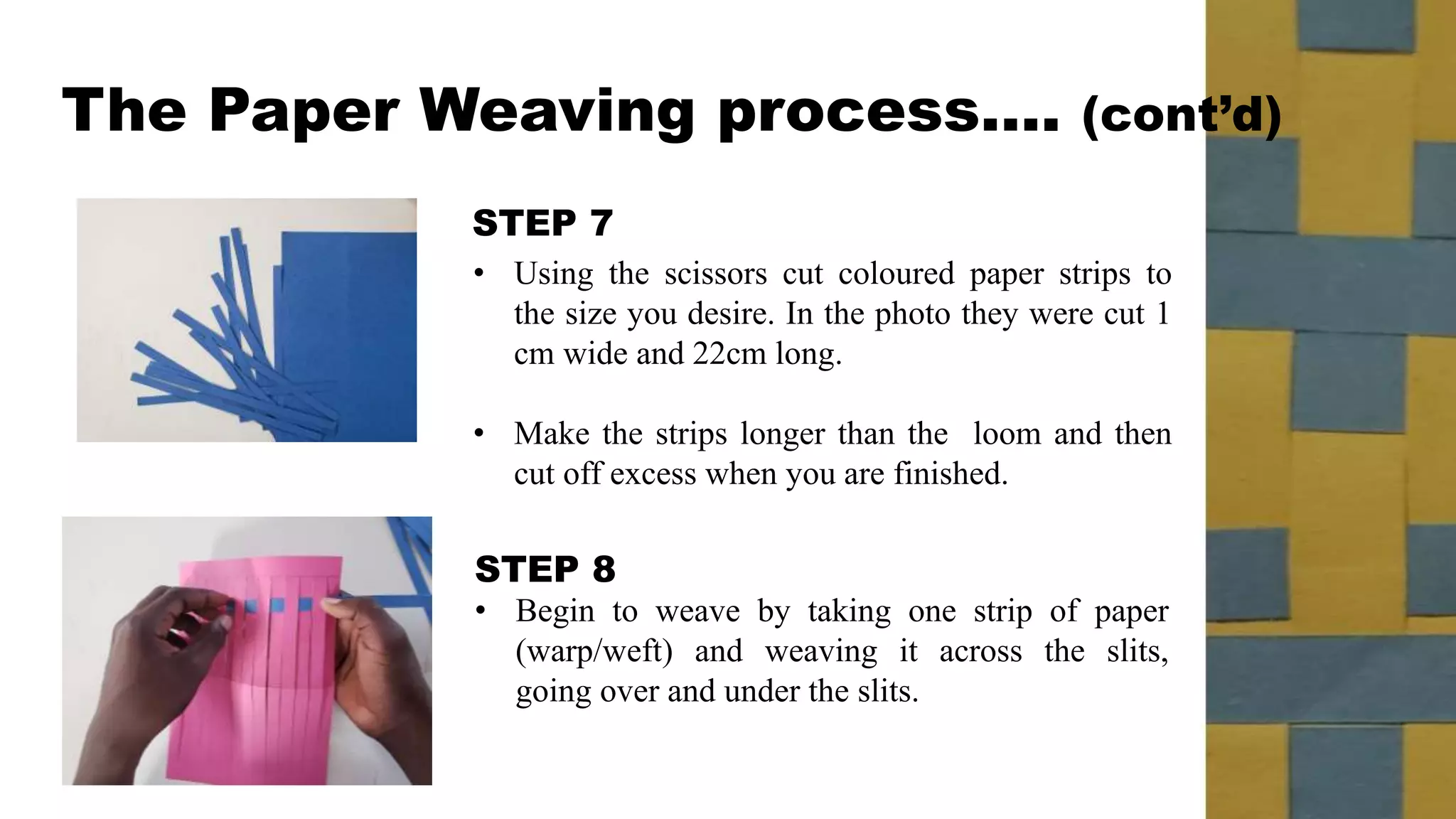
STEP 7
STEP 8
• Begin to weave by taking one strip of paper
(warp/weft) and weaving it across the slits,
going over and under the slits.
• Using the scissors cut coloured paper strips to
the size you desire. In the photo they were cut 1
cm wide and 22cm long.
• Make the strips longer than the loom and then
cut off excess when you are finished.
The Paper Weaving process…. (cont’d)
STEP 10
STEP 9
• Move the woven strip (weft) to the top and start with the next
one.
• Weave the second strip in an opposite pattern to the first. If
your first strip started under and over. Then the second strip
would go over and under.
• Continue weaving the rest strips using an alternate
pattern of over one under one until your loom is full.
The Paper Weaving process…. (cont’d)
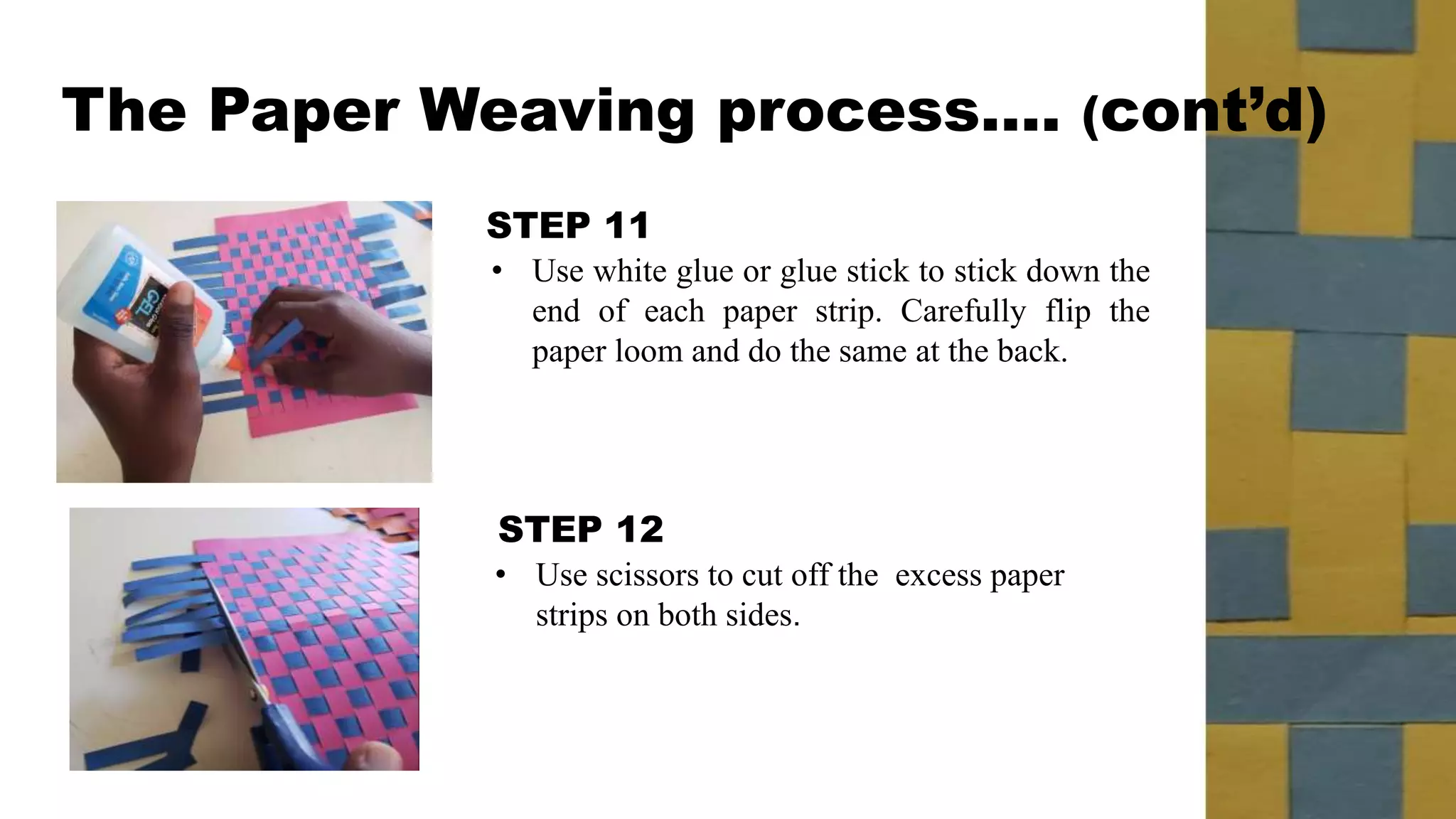
STEP 11
• Use white glue or glue stick to stick down the
end of each paper strip. Carefully flip the
paper loom and do the same at the back.
STEP 12
• Use scissors to cut off the excess paper
strips on both sides.
The Paper Weaving process…. (cont’d)
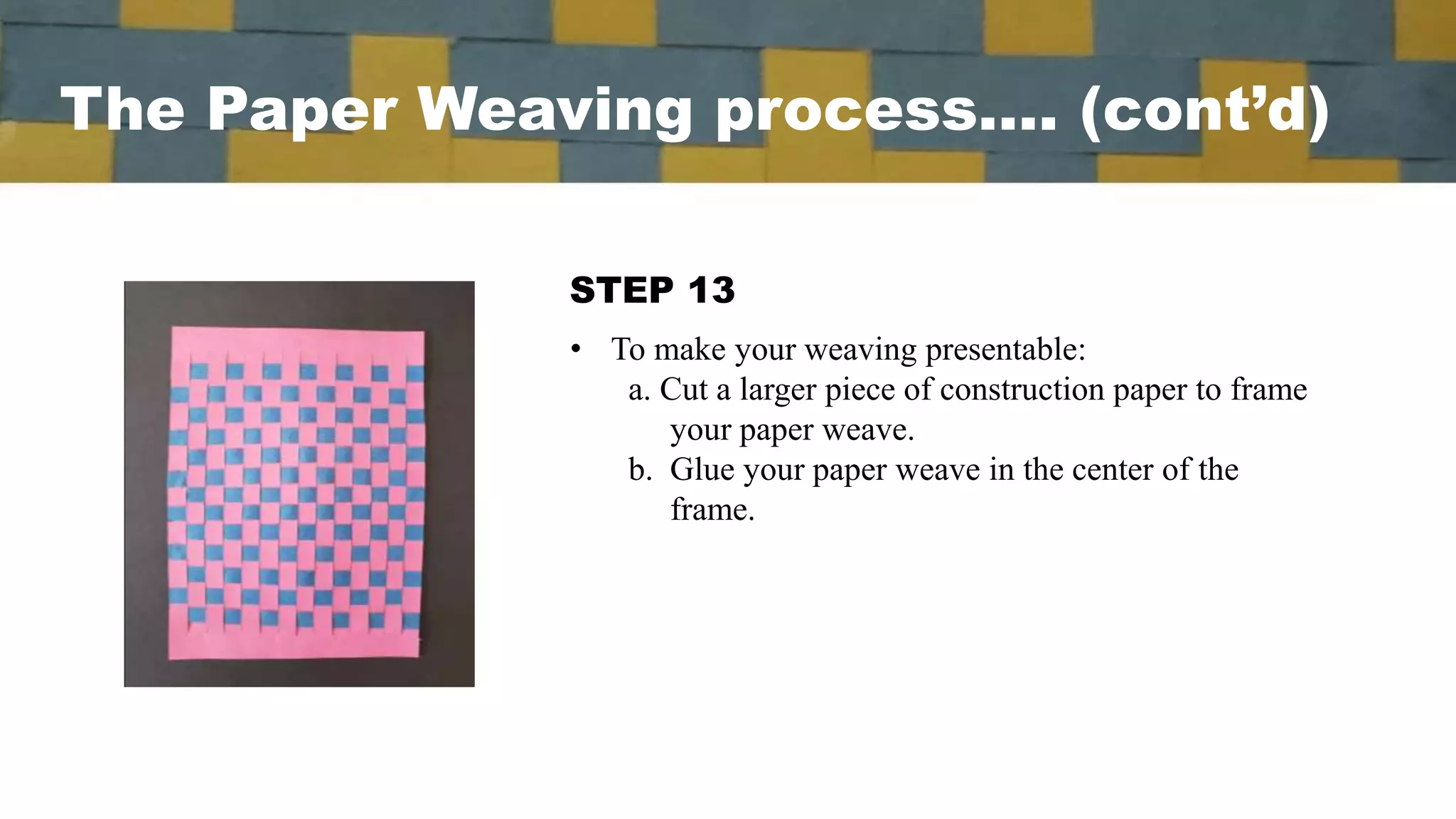
STEP 13
• To make your weaving presentable:
a. Cut a larger piece of construction paper to frame
your paper weave.
b. Glue your paper weave in the center of the
frame.
The Paper Weaving process…. (cont’d)
RESOURCES
• Sieupersad, Alan. (2009). Longman Visual Arts for Secondary Schools. Essex: Pearson Education Limited.
Books
Web Resources
• Polymer Properties Database. (2015-2022). Encyclopedia of Fiber & Textile Technology. [Online] Available:
https://polymerdatabase.com/Fibers/Fiberpedia%20W.html (January 8, 2022).
• First Palette.Com. (2008-2020). Paper weaving. [Online] Available: https://www.firstpalette.com/craft/paper-
weaving.html (January 9, 2022).
Image Courtesy
• https://www.gardeningknowhow.com/garden-how-to/projects/using-plants-for-woven-baskets.htm
• https://www.intechopen.com/chapters/16631
• https://www.cedarwoodschool.org/huckleberry/paper-basket
• https://www.walmart.com/ip/Melissa-Doug-Wooden-Multi-Craft-Weaving-Loom/50386920
• https://study.com/cimages/videopreview/jqdwqp0df2.jpg
• https://image.made-in-china.com/202f0j00ObyzLDPnyqoN/Factory-Best-Selling-Rattan-Garden-Furniture-
Set-Wicker-Furniture-Ratten-Garden.webp
• https://www.ohsweetbabies.com/images/entertainment-weaving-paper-basket-1.jpg
• https://cdn.shopify.com/s/files/1/1192/7874/files/History_of_weaving_2048x2048.jpg?v=1532478710
RESOURCES
The End

Weaving with paper

  • 1.
    PAPER WEAVING By Bernard E.Richardson Master Teacher|Art Educator|2022 ©Bernard E. Richardson| 2022
  • 2.
    PAPER WEAVING By Bernard E.Richardson Master Teacher|Art Educator|2022 ©Bernard E. Richardson| 2022
  • 3.
    WEAVING… • Weaving isa Textile art of making fabric/cloth and baskets. • Two distinct sets of fibre (yarns, threads) are interlaced to form the woven article. WEAVING is the interlacing of strands of fibre at right angles to one another.
  • 4.
    WEAVING TERMS… • Thestrands of fibre which run lengthwise or vertically are called the WARP. • The strands of fibre which run horizontally (from side to side) are called WEFTS. PAPER WEAVING LOOM • The machine or device used to weave yarn/threads into fabric is called a LOOM. WEAVING LOOM
  • 5.
    • Weaving isone of the most ancient form of human creativity. • It has been used since prehistoric times for making materials to help keep our bodies warm, for shelter and to make vessels for gathering and storing food. • Today, fabrics and baskets would not have been possible without weaving. WEAVING… Brief History
  • 6.
    THE PATTERN… • Thepattern is made by pulling threads or yarn together on a LOOM. • The threads are locked together to form the fabric. • The pattern created follows a simple sequence: • From this basic pattern all other patterns are created. Row 1: Under – Over – Under – Over Row 2: Over – Under – Over – Under Row 3: Under – Over – Under – Over
  • 7.
    PAPER WEAVING • Theweaving can be created using different colours and patterns to create decorative and functional Art items such as tablemats, book marks, baskets, greeting cards etc. Greeting cards and Book marks Tablemats Baskets
  • 8.
    1. PLAIN WEAVE •This the simplest and most common textile weave. • Also known as ”one up and one down” or “over one, under one. • Threads are interlaced in alternating fashion of under1 and over 1. It is also known as 1/1. • It creates a simple checkerboard pattern. WEAVING PATTERN…
  • 9.
    2. BASKET WEAVE •This pattern is an adjustment of the plain weave. • Two or more yarns are combined and woven as one. WEAVING PATTERN…
  • 10.
    • Twill weaveis one of the most widely used weaving technique to create fabric today. • It has a pattern of diagonal lines. 3. TWILL WEAVE WEAVING PATTERN…
  • 11.
    • Zig zagtwill weave pattern is produced by reversing the direction of the twill weave. 4. ZIG ZAG TWILL WEAVE WEAVING PATTERN…
  • 12.
    • Satin weavesare very flat and creates a smooth finish because of its pattern. 5. SATIN WEAVE WEAVING PATTERN…
  • 13.
    • Is away of taking strips of paper and placing them either “over” or “under” the base piece of the paper. PAPER WEAVING… • The strips can be referred to as the wefts. • The base can be referred to as the Loom which is made up of a number of warps created by cutting slits in the paper.
  • 14.
    The Paper Weavingprocess…. Materials and Equipment needed • Scissors • Ruler • Pencil • Glue – white glue / glue stick • Paper (assorted colours – construction, card stock, used gift wrapping paper, scrap paper, old magazines etc. can be used)
  • 15.
    The Paper Weavingprocess…. (cont’d) STEP 2 • Fold the paper in half STEP 1 • Cut your paper into the shape and size desired for making your paper weave.
  • 16.
    STEP 3 • Drawa horizontal straight line about ½ to 1 inch along the open-ended side of the fold with the ruler and pencil. • Use the pencil and ruler to measure and mark off evenly spaced dimensions to create the loom. STEP 4 • Use the pencil and ruler to draw in the vertical lines to create the loom starting from the horizontal line drawn. The Paper Weaving process…. (cont’d)
  • 17.
    STEP 5 • Usingthe scissors, cut slits along the marked lines starting from the folded edge and stop at the horizontal line made at the open edge. STEP 6 • Carefully unfold the paper. • THIS IS YOUR LOOM. The Paper Weaving process…. (cont’d)
  • 18.
    STEP 7 STEP 8 •Begin to weave by taking one strip of paper (warp/weft) and weaving it across the slits, going over and under the slits. • Using the scissors cut coloured paper strips to the size you desire. In the photo they were cut 1 cm wide and 22cm long. • Make the strips longer than the loom and then cut off excess when you are finished. The Paper Weaving process…. (cont’d)
  • 19.
    STEP 10 STEP 9 •Move the woven strip (weft) to the top and start with the next one. • Weave the second strip in an opposite pattern to the first. If your first strip started under and over. Then the second strip would go over and under. • Continue weaving the rest strips using an alternate pattern of over one under one until your loom is full. The Paper Weaving process…. (cont’d)
  • 20.
    STEP 11 • Usewhite glue or glue stick to stick down the end of each paper strip. Carefully flip the paper loom and do the same at the back. STEP 12 • Use scissors to cut off the excess paper strips on both sides. The Paper Weaving process…. (cont’d)
  • 21.
    STEP 13 • Tomake your weaving presentable: a. Cut a larger piece of construction paper to frame your paper weave. b. Glue your paper weave in the center of the frame. The Paper Weaving process…. (cont’d)
  • 22.
    RESOURCES • Sieupersad, Alan.(2009). Longman Visual Arts for Secondary Schools. Essex: Pearson Education Limited. Books Web Resources • Polymer Properties Database. (2015-2022). Encyclopedia of Fiber & Textile Technology. [Online] Available: https://polymerdatabase.com/Fibers/Fiberpedia%20W.html (January 8, 2022). • First Palette.Com. (2008-2020). Paper weaving. [Online] Available: https://www.firstpalette.com/craft/paper- weaving.html (January 9, 2022).
  • 23.
    Image Courtesy • https://www.gardeningknowhow.com/garden-how-to/projects/using-plants-for-woven-baskets.htm •https://www.intechopen.com/chapters/16631 • https://www.cedarwoodschool.org/huckleberry/paper-basket • https://www.walmart.com/ip/Melissa-Doug-Wooden-Multi-Craft-Weaving-Loom/50386920 • https://study.com/cimages/videopreview/jqdwqp0df2.jpg • https://image.made-in-china.com/202f0j00ObyzLDPnyqoN/Factory-Best-Selling-Rattan-Garden-Furniture- Set-Wicker-Furniture-Ratten-Garden.webp • https://www.ohsweetbabies.com/images/entertainment-weaving-paper-basket-1.jpg • https://cdn.shopify.com/s/files/1/1192/7874/files/History_of_weaving_2048x2048.jpg?v=1532478710 RESOURCES
  • 24.