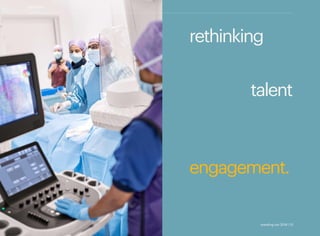
rethinking
talent
engagement.
contents
standing out 2019 | 13
contents
Flexible and permanent
talent may have very
different expectations.
This is why Philips
has developed a
dedicated assignment
value proposition for
freelancers as part of its
global talent attraction
strategy.
In businesses that rely on multiple sets of
specialist talent, the right person may be
an employee, a contractor or a contingent
worker, and could come from anywhere in
the world. That’s why Philips, the leading
health technology company, is rethinking
the way it engages with different types of
talent. “One size just can’t fit all. So, we’ve
developed an assignment value proposi-
tion for freelancers that’s in line with our
employer value proposition, yet quite dis-
tinct and specific,” says Martina De Marinis,
Global Campaign Manager, Recruitment
Marketing and Employer Branding. “As we
tap into the gig economy, the HR focus is
shifting from managing people to leading
work – we need to find the most effective
way to engage with the right people and
get the work done,” says Maarten Hansson,
Head of Workforce Strategy. How does
this agile talent acquisition and manage-
ment strategy work in practice? How are
these evolving demands shaping Philips’
employer branding strategy?
standing out 2019 | 14
that's the essence of
our employer brand:
the authentic stories
of our own people.
contents
Standing Out: Philips has evolved from
a consumer electronics business to the
leading health technology company.
What impact has this had on talent
demands?
Martina De Marinis: The change has been
massive. As a business providing digital
healthcare solutions we have an increas-
ing demand for technical specialists in
areas such as software development,
data science and systems architecture.
We need people with the understanding
and engagement skills to work with
customers, hospitals, clinicians and
patients to develop the right solutions,
many of which are customized. And as
we now operate within a highly regulated
healthcare sector, we need people who
understand the compliance demands,
and can meet the quality standards 100%.
From an employer branding perspective,
one of the big challenges is attracting
high-end technical talent who might
not have considered working for Philips
before, especially if they still see it as a
consumer business. That‘s why in 2016
we launched our ‘Code to Care’ global
campaign, targeted at software engineers
worldwide, which shows how software
specialists can put their skills to work
in improving people’s lives and make a
positive impact in areas such as helping
doctors to diagnose cancer early.
The chance to push back the frontiers
of health technology and work at the
forefront of digital innovation is hugely
rewarding professionally. We come
across inspiring stories of employees who
worked on the solution that helped their
own relatives or people around them.
Our people are very much the advocates
and ambassadors for Philips’ mission to
improve the lives of three billion people
annually by 2030. We encourage them
to share their personal experience. The
stories they come back with are touching,
and show how much their work means
to them. And that’s the essence of our
employer brand really: the authentic
stories of our own people.
A further challenge is the need to
compete with tech start-ups, which on
the surface, especially for young talent,
appear more exciting. Our message
is that we can offer the best of both
worlds – the vibrancy and entrepreneurial
environment of a start-up, but also the
opportunity to apply solutions on a large
scale. There are many cutting-edge pro­
jects in which interns or new graduates
are playing a prominent role: their ideas
and energies are highly valued.
standing out 2019 | 15
contents
Standing Out: What part do contract
and contingent workers play in meeting
these evolving talent demands?
Maarten Hansson: The challenge we
face isn’t a shortage of talent, but rather
the right people may not be where we
need them. That’s why the ability to
engage with multiple sources of talent,
like freelancers, and making full use of
opportunities for virtual working from
anywhere in the world, are so important.
We also recognize that many people now
prefer to work flexibly, and therefore this
is a fast-growing part of our available
talent pool. This is certainly the case
for the newest generations coming into
the workforce. Many expect greater
autonomy over how, where and when
they work. They also want to engage
with different companies on multiple
challenges. And it isn’t just a younger
flexible workforce we’re targeting. We
also know that there are a lot of people in
their fifties and sixties who want to work
on selected assignments.
Together with the transformation into
a health technology company, this was
the trigger to broaden our existing
recruitment channels for employees and
procurement channels for outsourced
work. There are a lot of engagement
points between these two, so HR and
procurement work closely as part of a
holistic ‘total talent’ approach.
Our job is to advise on how and where
the work is done, in-house, freelance
and/or outsourced. We want to connect
people with the business and vice-versa
in the most seamless and mutually
beneficial way. Whether people prefer to
be at home or in an office environment,
we aim to make this possible.
To help meet these evolving demands,
we’ve developed an assignment value
proposition – a version of our employee
value proposition targeted at the distinct
expectations of freelancers. We want
to make it possible for them to work in
the way that best suits them to deliver
on our goals in a way that enriches their
career.
we want to connect
people with the business
and vice-versa in the most
seamless and mutually
beneficial way.
standing out 2019 | 16
contents
Standing Out: What marks out your
assignment value proposition from your
employee value proposition for perma-
nent staff, and how is this reflected in
your employer brand?
Martina De Marinis: The overall employer
value proposition of improving people’s
lives through meaningful innovation
applies to all talent. However, we realized
that the ‘candidate personas’ we’ve been
targeting in our marketing efforts for
permanent employees don’t necessarily
resonate 100% with freelancers. They’re
far less interested in factors such as
career paths, for example.
So, we’ve been conducting surveys and
hosting focus groups to find out what
motivates freelancers, how we can
shape our talent acquisition to reflect
this, and also checked the sentiment of
freelancers that work or have worked for
Philips. What’s clear is that freelancers
are constantly building up their skills
and their marketability as highly skilled
specialists. So, every new assignment
needs to bring something valuable for
their learning and development. A key
part of this is being able to work with
leading experts within Philips, and some
of the iconic organizations we serve.
The employer brand messaging for
freelancers and underlying assignment
value proposition are built around
the opportunity to work flexibly and
creatively on challenging projects that
allow freelancers to develop their skills
and make an impact. A key part of this
is showing that working with us isn’t just
another assignment, but a project that
can inspire and help them to progress
their freelance career. Examples of the
messages include “don’t just accept a
new project, accept a challenge” and
“surprise yourself with an assignment at
Philips".
what’s clear is that freelancers are
constantly building up their skills
and their marketability as highly
skilled specialists.
standing out 2019 | 17
contents
Standing Out: How is your employer
brand reflected in the candidate
experience?
Maarten Hansson: We’re conscious that
even if a candidate isn’t selected this time
around, they may fit in the future. That’s
why we want to bring them into our talent
community, which includes both people
registered on our freelance platform, and
prospective candidates for permanent
positions.
The candidate experience is evolving as we
look to make it more engaging, transparent
and personalized.
Standing Out: How are you looking to
strengthen diversity?
Martina De Marinis: Diversity and inclusion
is an absolute priority in Philips’ people
strategy. We want to build an inclusive
and diverse workforce, which reflects the
­
socie­
ties we operate in, our customers
and the markets that we serve. We believe
a more diverse and inclusive workplace
makes good business sense – it makes us
more competitive and more innovative,
and is a key driver for making Philips a
great place to work for people who share
our passion.
We are taking steps to foster a more
inclusive workplace, including a new global
gender diversity goal to grow the percent-
age of our women in senior leadership to
25% by 2020. And following our CEO, Frans
van Houten’s pledge to the Catalyst CEO
Champions for Change movement, we’re
determined to exceed this threshold in the
future.
Standing Out: How do you deal with
feedback on social media and job rating
sites such as Glassdoor?
Martina De Marinis: Coming from
­
traditional product consumer marketing,
I recognize how invaluable this kind of
feedback can be to improve your pro­
ducts and services, to respond to unmet
needs, and gather new insights. It works
exactly the same way in talent acquisition.
We take reviews very seriously and we
value all feedback. We check and take
account of all reviews and comments on
social media. And this goes for people
across our organization, including our
leadership team, that regularly log in to
engage digitally with their network.
maarten hansson
head of workforce
strategy, philips
Maarten Hansson started at
Philips in 2015 as the Global
category lead for Contingent
Labor within Procurement,
before moving to his current
post. Before that he worked
at Dutch telecom giant KPN
and also managed their IT
offshore program from India.
standing out 2019 | 18
contents
knowledge base
what we can learn from
employer branding at philips
•	 Philips wants to work with talent on
the terms (contract type) that fit both
parties.
•	 People with specialist skills are highly
sought after. The chance for them to
improve people’s lives is the big differ-
entiator and draw, both personally and
professionally.
•	 Freelancers and permanent employees
have different expectations about what
they want from a company. The value
proposition and employer brand need
to reflect this.
•	 Diversity and inclusion aren’t just
about equality within recruitment and
promotion, as important as this is.
The way companies go to market, and
the products and services they offer
should also be inclusive.
•	 Job rating platforms are for talent
acquisition what customer satisfaction
and brand promoter scores are for
product marketing. They offer invalu-
able information to help strengthen
talent recruitment and retention, but
only if they’re acted on.
martina de marinis
global campaign manager,
recruitment marketing and
employer branding, philips
Martina De Marinis began her career in
consumer marketing and branding, in
the consumer lifestyle division of Philips,
before moving to employer branding
in 2016, where she’s driving global
­
campaigns and programs to attract
the most critical talent segments.
standing out 2019 | 19

Philips

  • 1.
  • 2.
    contents Flexible and permanent talentmay have very different expectations. This is why Philips has developed a dedicated assignment value proposition for freelancers as part of its global talent attraction strategy. In businesses that rely on multiple sets of specialist talent, the right person may be an employee, a contractor or a contingent worker, and could come from anywhere in the world. That’s why Philips, the leading health technology company, is rethinking the way it engages with different types of talent. “One size just can’t fit all. So, we’ve developed an assignment value proposi- tion for freelancers that’s in line with our employer value proposition, yet quite dis- tinct and specific,” says Martina De Marinis, Global Campaign Manager, Recruitment Marketing and Employer Branding. “As we tap into the gig economy, the HR focus is shifting from managing people to leading work – we need to find the most effective way to engage with the right people and get the work done,” says Maarten Hansson, Head of Workforce Strategy. How does this agile talent acquisition and manage- ment strategy work in practice? How are these evolving demands shaping Philips’ employer branding strategy? standing out 2019 | 14
  • 3.
    that's the essenceof our employer brand: the authentic stories of our own people. contents Standing Out: Philips has evolved from a consumer electronics business to the leading health technology company. What impact has this had on talent demands? Martina De Marinis: The change has been massive. As a business providing digital healthcare solutions we have an increas- ing demand for technical specialists in areas such as software development, data science and systems architecture. We need people with the understanding and engagement skills to work with customers, hospitals, clinicians and patients to develop the right solutions, many of which are customized. And as we now operate within a highly regulated healthcare sector, we need people who understand the compliance demands, and can meet the quality standards 100%. From an employer branding perspective, one of the big challenges is attracting high-end technical talent who might not have considered working for Philips before, especially if they still see it as a consumer business. That‘s why in 2016 we launched our ‘Code to Care’ global campaign, targeted at software engineers worldwide, which shows how software specialists can put their skills to work in improving people’s lives and make a positive impact in areas such as helping doctors to diagnose cancer early. The chance to push back the frontiers of health technology and work at the forefront of digital innovation is hugely rewarding professionally. We come across inspiring stories of employees who worked on the solution that helped their own relatives or people around them. Our people are very much the advocates and ambassadors for Philips’ mission to improve the lives of three billion people annually by 2030. We encourage them to share their personal experience. The stories they come back with are touching, and show how much their work means to them. And that’s the essence of our employer brand really: the authentic stories of our own people. A further challenge is the need to compete with tech start-ups, which on the surface, especially for young talent, appear more exciting. Our message is that we can offer the best of both worlds – the vibrancy and entrepreneurial environment of a start-up, but also the opportunity to apply solutions on a large scale. There are many cutting-edge pro­ jects in which interns or new graduates are playing a prominent role: their ideas and energies are highly valued. standing out 2019 | 15
  • 4.
    contents Standing Out: Whatpart do contract and contingent workers play in meeting these evolving talent demands? Maarten Hansson: The challenge we face isn’t a shortage of talent, but rather the right people may not be where we need them. That’s why the ability to engage with multiple sources of talent, like freelancers, and making full use of opportunities for virtual working from anywhere in the world, are so important. We also recognize that many people now prefer to work flexibly, and therefore this is a fast-growing part of our available talent pool. This is certainly the case for the newest generations coming into the workforce. Many expect greater autonomy over how, where and when they work. They also want to engage with different companies on multiple challenges. And it isn’t just a younger flexible workforce we’re targeting. We also know that there are a lot of people in their fifties and sixties who want to work on selected assignments. Together with the transformation into a health technology company, this was the trigger to broaden our existing recruitment channels for employees and procurement channels for outsourced work. There are a lot of engagement points between these two, so HR and procurement work closely as part of a holistic ‘total talent’ approach. Our job is to advise on how and where the work is done, in-house, freelance and/or outsourced. We want to connect people with the business and vice-versa in the most seamless and mutually beneficial way. Whether people prefer to be at home or in an office environment, we aim to make this possible. To help meet these evolving demands, we’ve developed an assignment value proposition – a version of our employee value proposition targeted at the distinct expectations of freelancers. We want to make it possible for them to work in the way that best suits them to deliver on our goals in a way that enriches their career. we want to connect people with the business and vice-versa in the most seamless and mutually beneficial way. standing out 2019 | 16
  • 5.
    contents Standing Out: Whatmarks out your assignment value proposition from your employee value proposition for perma- nent staff, and how is this reflected in your employer brand? Martina De Marinis: The overall employer value proposition of improving people’s lives through meaningful innovation applies to all talent. However, we realized that the ‘candidate personas’ we’ve been targeting in our marketing efforts for permanent employees don’t necessarily resonate 100% with freelancers. They’re far less interested in factors such as career paths, for example. So, we’ve been conducting surveys and hosting focus groups to find out what motivates freelancers, how we can shape our talent acquisition to reflect this, and also checked the sentiment of freelancers that work or have worked for Philips. What’s clear is that freelancers are constantly building up their skills and their marketability as highly skilled specialists. So, every new assignment needs to bring something valuable for their learning and development. A key part of this is being able to work with leading experts within Philips, and some of the iconic organizations we serve. The employer brand messaging for freelancers and underlying assignment value proposition are built around the opportunity to work flexibly and creatively on challenging projects that allow freelancers to develop their skills and make an impact. A key part of this is showing that working with us isn’t just another assignment, but a project that can inspire and help them to progress their freelance career. Examples of the messages include “don’t just accept a new project, accept a challenge” and “surprise yourself with an assignment at Philips". what’s clear is that freelancers are constantly building up their skills and their marketability as highly skilled specialists. standing out 2019 | 17
  • 6.
    contents Standing Out: Howis your employer brand reflected in the candidate experience? Maarten Hansson: We’re conscious that even if a candidate isn’t selected this time around, they may fit in the future. That’s why we want to bring them into our talent community, which includes both people registered on our freelance platform, and prospective candidates for permanent positions. The candidate experience is evolving as we look to make it more engaging, transparent and personalized. Standing Out: How are you looking to strengthen diversity? Martina De Marinis: Diversity and inclusion is an absolute priority in Philips’ people strategy. We want to build an inclusive and diverse workforce, which reflects the ­ socie­ ties we operate in, our customers and the markets that we serve. We believe a more diverse and inclusive workplace makes good business sense – it makes us more competitive and more innovative, and is a key driver for making Philips a great place to work for people who share our passion. We are taking steps to foster a more inclusive workplace, including a new global gender diversity goal to grow the percent- age of our women in senior leadership to 25% by 2020. And following our CEO, Frans van Houten’s pledge to the Catalyst CEO Champions for Change movement, we’re determined to exceed this threshold in the future. Standing Out: How do you deal with feedback on social media and job rating sites such as Glassdoor? Martina De Marinis: Coming from ­ traditional product consumer marketing, I recognize how invaluable this kind of feedback can be to improve your pro­ ducts and services, to respond to unmet needs, and gather new insights. It works exactly the same way in talent acquisition. We take reviews very seriously and we value all feedback. We check and take account of all reviews and comments on social media. And this goes for people across our organization, including our leadership team, that regularly log in to engage digitally with their network. maarten hansson head of workforce strategy, philips Maarten Hansson started at Philips in 2015 as the Global category lead for Contingent Labor within Procurement, before moving to his current post. Before that he worked at Dutch telecom giant KPN and also managed their IT offshore program from India. standing out 2019 | 18
  • 7.
    contents knowledge base what wecan learn from employer branding at philips • Philips wants to work with talent on the terms (contract type) that fit both parties. • People with specialist skills are highly sought after. The chance for them to improve people’s lives is the big differ- entiator and draw, both personally and professionally. • Freelancers and permanent employees have different expectations about what they want from a company. The value proposition and employer brand need to reflect this. • Diversity and inclusion aren’t just about equality within recruitment and promotion, as important as this is. The way companies go to market, and the products and services they offer should also be inclusive. • Job rating platforms are for talent acquisition what customer satisfaction and brand promoter scores are for product marketing. They offer invalu- able information to help strengthen talent recruitment and retention, but only if they’re acted on. martina de marinis global campaign manager, recruitment marketing and employer branding, philips Martina De Marinis began her career in consumer marketing and branding, in the consumer lifestyle division of Philips, before moving to employer branding in 2016, where she’s driving global ­ campaigns and programs to attract the most critical talent segments. standing out 2019 | 19