Philippine Normal University
The National Center for Teacher Education
Visayas Campus
LESSON PLAN
IN
SCIENCE III
Submitted by:
Ariel O. Omangayon
Student Intern
Submitted to:
Mr. Denmark A. Yonson
Critic Teacher
A.Y. 2015-2016
I. Objectives: At the end of the lesson, 75% of the Grade 3 pupils will be able to:
a. identify the different waterforms
II. Subject Matter: Waterforms
Reference:Science for Active Learning 3, Rosalyn R. Manio © 2014, pages 310-314
Concept: Earth has different waterforms that form its hydrosphere; Theseincludes:
 Groundwater, it may be found in a deep or shallow part of the ground.
 Spring, a water that comes from underground and returns to surface.
 Lake and Pond, a body of water surrounded by land.
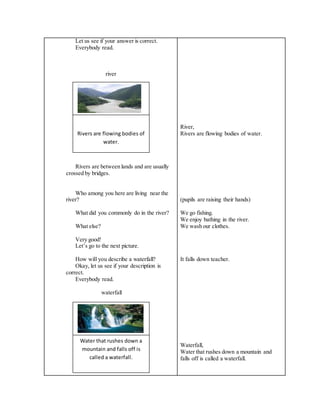
 River,a flowing body of water.
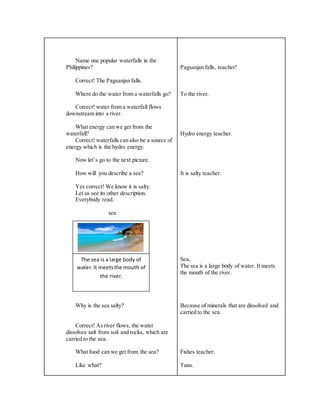
 Waterfall, water that rushes down a mountain and falls off.
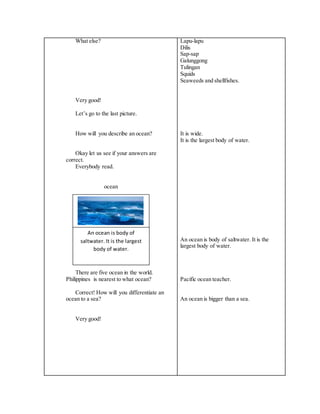
 Sea,is a large body of water. It meets the mouth of a river.
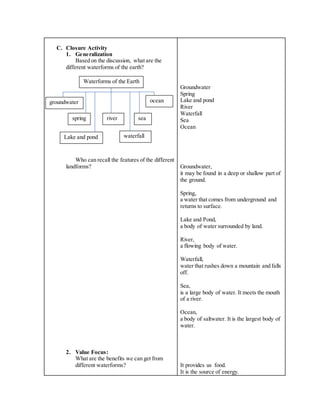
 Ocean,a body of saltwater. It is the largest body of water.
Value Focus:
 Take care of the different waterforms because they are sources of food and energy.
III. Materials:Pictures,puzzle, song, cut-out materials, stick and cartolina.
IV. Procedure:
Teacher’s activity Students’ activity
A. Preparatory Activities
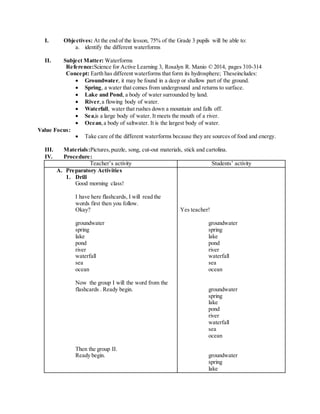
1. Drill
Good morning class!
I have here flashcards, I will read the
words first then you follow.
Okay?
groundwater
spring
lake
pond
river
waterfall
sea
ocean
Now the group I will the word from the
flashcards . Ready begin.
Then the group II.
Ready begin.
Yes teacher!
groundwater
spring
lake
pond
river
waterfall
sea
ocean
groundwater
spring
lake
pond
river
waterfall
sea
ocean
groundwater
spring
lake
Thank you class!
2. Motivation
Who loves fish?
Who loves fishing?
Okay let’s go fishing!
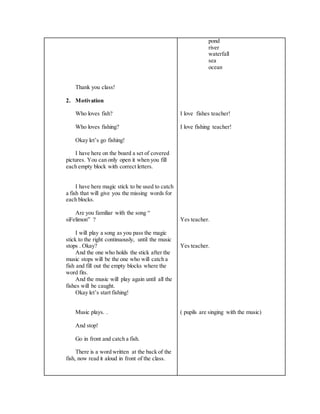
I have here on the board a set of covered
pictures. You can only open it when you fill
each empty block with correct letters.
I have here magic stick to be used to catch
a fish that will give you the missing words for
each blocks.
Are you familiar with the song “
siFelimon” ?
I will play a song as you pass the magic
stick to the right continuously, until the music
stops . Okay?
And the one who holds the stick after the
music stops will be the one who will catch a
fish and fill out the empty blocks where the
word fits.
And the music will play again until all the
fishes will be caught.
Okay let’s start fishing!
Music plays. .
And stop!
Go in front and catch a fish.
There is a word written at the back of the
fish, now read it aloud in front of the class.
pond
river
waterfall
sea
ocean
I love fishes teacher!
I love fishing teacher!
Yes teacher.
Yes teacher.
( pupils are singing with the music)
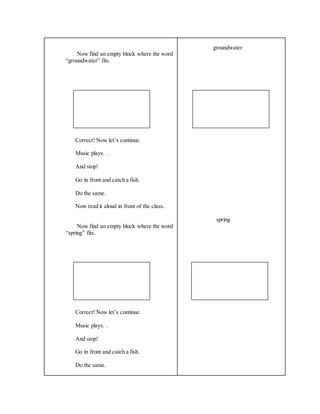
Now find an empty block where the word
“groundwater” fits.
Correct! Now let’s continue.
Music plays. .
And stop!
Go in front and catch a fish.
Do the same.
Now read it aloud in front of the class.
Now find an empty block where the word
“spring” fits.
Correct! Now let’s continue.
Music plays. .
And stop!
Go in front and catch a fish.
Do the same.
groundwater
spring
Now read it aloud in front of the class.
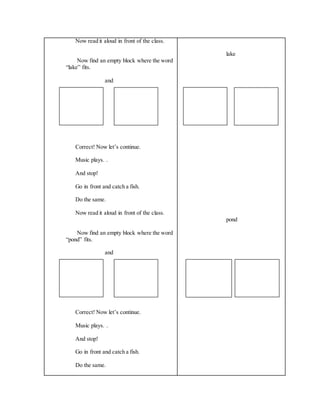
Now find an empty block where the word
“lake” fits.
and
Correct! Now let’s continue.
Music plays. .
And stop!
Go in front and catch a fish.
Do the same.
Now read it aloud in front of the class.
Now find an empty block where the word
“pond” fits.
and
Correct! Now let’s continue.
Music plays. .
And stop!
Go in front and catch a fish.
Do the same.
lake
pond
Now read it aloud in front of the class.
Now find an empty block where the word
“river” fits.
Correct! Now let’s continue.
Music plays. .
And stop!
Go in front and catch a fish.
Do the same.
Now read it aloud in front of the class.
Now find an empty block where the word
“waterfall” fits.
Correct! Now let’s continue.
Music plays. .
And stop!
Go in front and catch a fish.
Do the same.
river
waterfall
Now read it aloud in front of the class.
Now find an empty block where the word
“sea” fits.
Correct! Now let’s continue.
Music plays. .
And stop!
Go in front and catch a fish.
Do the same.
Now read it aloud in front of the class.
Now find an empty block where the word
“ocean” fits.
Very good Grade III.
Everybody read the words form from the
blocks.
sea
ocean
groundwater
spring
lake and pond
river
waterfall
sea
ocean
Very good! Now let us see what is behind
these covered papers.
B. Developmental Activities
1. Presentation ofthe activity
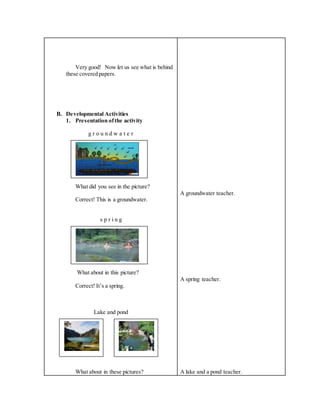
g r o u n d w a t e r
What did you see in the picture?
Correct! This is a groundwater.
s p r i n g
What about in this picture?
Correct! It’s a spring.
Lake and pond
What about in these pictures?
A groundwater teacher.
A spring teacher.
A lake and a pond teacher.
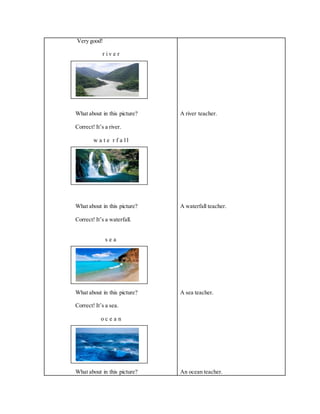
Very good!
r i v e r
What about in this picture?
Correct! It’s a river.
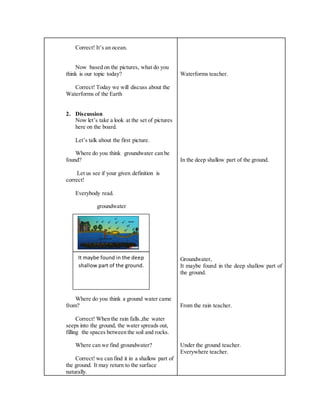
w a t e r f a l l
What about in this picture?
Correct! It’s a waterfall.
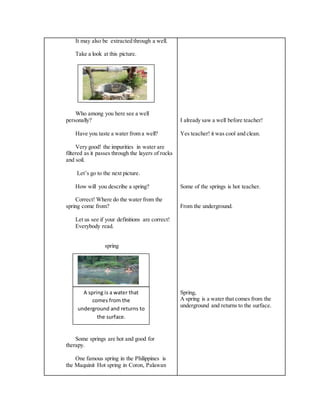
s e a
What about in this picture?
Correct! It’s a sea.
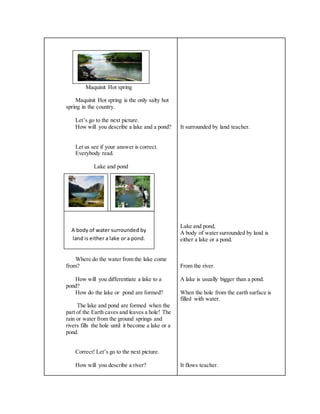
o c e a n
What about in this picture?
A river teacher.
A waterfall teacher.
A sea teacher.
An ocean teacher.
Correct! It’s an ocean.
Now based on the pictures, what do you
think is our topic today?
Correct! Today we will discuss about the
Waterforms of the Earth
2. Discussion
Now let’s take a look at the set of pictures
here on the board.
Let’s talk about the first picture.
Where do you think groundwater can be
found?
Let us see if your given definition is
correct!
Everybody read.
groundwater
Where do you think a ground water came
from?
Correct! When the rain falls.,the water
seeps into the ground, the water spreads out,
filling the spaces between the soil and rocks.
Where can we find groundwater?
Correct! we can find it in a shallow part of
the ground. It may return to the surface
naturally.
Waterforms teacher.
In the deep shallow part of the ground.
Groundwater,
It maybe found in the deep shallow part of
the ground.
From the rain teacher.
Under the ground teacher.
Everywhere teacher.
It maybe found in the deep
shallow part of the ground.
It may also be extracted through a well.
Take a look at this picture.
Who among you here see a well
personally?
Have you taste a water from a well?
Very good! the impurities in water are
filtered as it passes through the layers of rocks
and soil.
Let’s go to the next picture.
How will you describe a spring?
Correct! Where do the water from the
spring come from?
Let us see if your definitions are correct!
Everybody read.
spring
Some springs are hot and good for
therapy.
One famous spring in the Philippines is
the Maquinit Hot spring in Coron, Palawan
I already saw a well before teacher!
Yes teacher! it was cool and clean.
Some of the springs is hot teacher.
From the underground.
Spring,
A spring is a water that comes from the
underground and returns to the surface.
A spring is a water that
comes from the
underground and returns to
the surface.
Maquinit Hot spring
Maquinit Hot spring is the only salty hot
spring in the country.
Let’s go to the next picture.
How will you describe a lake and a pond?
Let us see if your answer is correct.
Everybody read.
Lake and pond
Where do the water from the lake come
from?
How will you differentiate a lake to a
pond?
How do the lake or pond are formed?
The lake and pond are formed when the
part of the Earth caves and leaves a hole! The
rain or water from the ground springs and
rivers fills the hole until it become a lake or a
pond.
Correct! Let’s go to the next picture.
How will you describe a river?
It surrounded by land teacher.
Lake and pond,
A body of water surrounded by land is
either a lake or a pond.
From the river.
A lake is usually bigger than a pond.
When the hole from the earth surface is
filled with water.
It flows teacher.
A body of water surrounded by
land is either a lake or a pond.
Let us see if your answer is correct.
Everybody read.
river
Rivers are between lands and are usually
crossed by bridges.
Who among you here are living near the
river?
What did you commonly do in the river?
What else?
Very good!
Let’s go to the next picture.
How will you describe a waterfall?
Okay, let us see if your description is
correct.
Everybody read.
waterfall
River,
Rivers are flowing bodies of water.
(pupils are raising their hands)
We go fishing.
We enjoy bathing in the river.
We wash our clothes.
It falls down teacher.
Waterfall,
Water that rushes down a mountain and
falls off is called a waterfall.
Rivers are flowing bodies of
water.
Water that rushes down a
mountain and falls off is
called a waterfall.
Name one popular waterfalls in the
Philippines?
Correct! The Pagsanjan falls.
Where do the water from a waterfalls go?
Correct! water from a waterfall flows
downstream into a river.
What energy can we get from the
waterfall?
Correct! waterfalls can also be a source of
energy which is the hydro energy.
Now let’s go to the next picture.
How will you describe a sea?
Yes correct! We know it is salty.
Let us see its other description.
Everybody read.
sea
Why is the sea salty?
Correct! As river flows, the water
dissolves salt from soil and rocks, which are
carried to the sea.
What food can we get from the sea?
Like what?
Pagsanjan falls, teacher!
To the river.
Hydro energy teacher.
It is salty teacher.
Sea,
The sea is a large body of water. It meets
the mouth of the river.
Because of minerals that are dissolved and
carried to the sea.
Fishes teacher.
Tuna.
The sea is a large body of
water.It meetsthe mouth of
the river.
What else?
Very good!
Let’s go to the last picture.
How will you describe an ocean?
Okay let us see if your answers are
correct.
Everybody read.
ocean
There are five ocean in the world.
Philippines is nearest to what ocean?
Correct! How will you differentiate an
ocean to a sea?
Very good!
Lapu-lapu
Dilis
Sap-sap
Galunggong
Tulingan
Squids
Seaweeds and shellfishes.
It is wide.
It is the largest body of water.
An ocean is body of saltwater. It is the
largest body of water.
Pacific ocean teacher.
An ocean is bigger than a sea.
An ocean is body of
saltwater. It is the largest
body of water.
C. Closure Activity
1. Generalization
Based on the discussion, what are the
different waterforms of the earth?
Who can recall the features of the different
landforms?
2. Value Focus:
What are the benefits we can get from
different waterforms?
Groundwater
Spring
Lake and pond
River
Waterfall
Sea
Ocean
Groundwater,
it may be found in a deep or shallow part of
the ground.
Spring,
a water that comes from underground and
returns to surface.
Lake and Pond,
a body of water surrounded by land.
River,
a flowing body of water.
Waterfall,
water that rushes down a mountain and falls
off.
Sea,
is a large body of water. It meets the mouth
of a river.
Ocean,
a body of saltwater. It is the largest body of
water.
It provides us food.
It is the source of energy.
Waterforms of the Earth
ocean
sea
waterfall
river
Lake and pond
spring
groundwater
Very good. It is the source of our food and
energy.
So what do we have to do to maintain
these waterforms?
Very good! We have to take care of these
waterforms because it provides our need
for food and energy. It is also a habitat for
water animals.
In what way we can take care of these
waterforms?
What else?
Some more?
Correct!
3. Application
Okay now we will have a group activity.
I will divide you into four groups.
You have to choose your group leader and
group reporter, first.
Then I will give the envelope to your
group leader with your task inside.
You will only have 5 minutes to complete
your task.
Group leaders, please read the direction.
Direction: Assemble the pieces of puzzle
to form two pictures, then identify what kind
of waterforms your group puzzled. Paste your
work on the board.
Before we start what are the guidelines
during the group activity?
What else?
And?
Okay you can start with your group now.
Are you done?
Present your work to the class.
We have to take care of them teacher.
Do not throw garbage in the water.
Do not use dynamites in fishing
Conserve water.
Direction: Assemble the pieces of puzzle to
form two pictures, then identify what kind
of waterforms your group puzzled. Paste
your work on the board.
Cooperate with the group!
Do not roam around?
Be quite during the activity.
Yes!
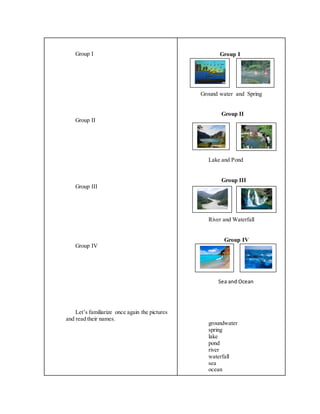
Group I
Group II
Group III
Group IV
Let’s familiarize once again the pictures
and read their names.
Group I
Ground water and Spring
Group II
Lake and Pond
Group III
River and Waterfall
Group IV
Sea and Ocean
groundwater
spring
lake
pond
river
waterfall
sea
ocean
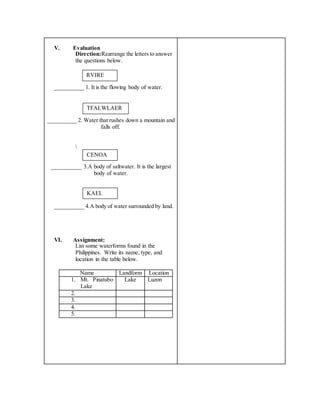
V. Evaluation
Direction:Rearrange the letters to answer
the questions below.
__________ 1. It is the flowing body of water.
__________ 2. Water that rushes down a mountain and
falls off.

__________ 3.A body of saltwater. It is the largest
body of water.
__________ 4.A body of water surrounded by land.
VI. Assignment:
List some waterforms found in the
Philippines. Write its name, type, and
location in the table below.
Name Landform Location
1. Mt. Pinatubo
Lake
Lake Luzon
2.
3.
4.
5.
RVIRE
TFALWLAER
CENOA
KAEL

WaterForms of the Earth

  • 1.
    Philippine Normal University TheNational Center for Teacher Education Visayas Campus LESSON PLAN IN SCIENCE III Submitted by: Ariel O. Omangayon Student Intern Submitted to: Mr. Denmark A. Yonson Critic Teacher A.Y. 2015-2016
  • 2.
    I. Objectives: Atthe end of the lesson, 75% of the Grade 3 pupils will be able to: a. identify the different waterforms II. Subject Matter: Waterforms Reference:Science for Active Learning 3, Rosalyn R. Manio © 2014, pages 310-314 Concept: Earth has different waterforms that form its hydrosphere; Theseincludes:  Groundwater, it may be found in a deep or shallow part of the ground.  Spring, a water that comes from underground and returns to surface.  Lake and Pond, a body of water surrounded by land.  River,a flowing body of water.  Waterfall, water that rushes down a mountain and falls off.  Sea,is a large body of water. It meets the mouth of a river.  Ocean,a body of saltwater. It is the largest body of water. Value Focus:  Take care of the different waterforms because they are sources of food and energy. III. Materials:Pictures,puzzle, song, cut-out materials, stick and cartolina. IV. Procedure: Teacher’s activity Students’ activity A. Preparatory Activities 1. Drill Good morning class! I have here flashcards, I will read the words first then you follow. Okay? groundwater spring lake pond river waterfall sea ocean Now the group I will the word from the flashcards . Ready begin. Then the group II. Ready begin. Yes teacher! groundwater spring lake pond river waterfall sea ocean groundwater spring lake pond river waterfall sea ocean groundwater spring lake
  • 3.
    Thank you class! 2.Motivation Who loves fish? Who loves fishing? Okay let’s go fishing! I have here on the board a set of covered pictures. You can only open it when you fill each empty block with correct letters. I have here magic stick to be used to catch a fish that will give you the missing words for each blocks. Are you familiar with the song “ siFelimon” ? I will play a song as you pass the magic stick to the right continuously, until the music stops . Okay? And the one who holds the stick after the music stops will be the one who will catch a fish and fill out the empty blocks where the word fits. And the music will play again until all the fishes will be caught. Okay let’s start fishing! Music plays. . And stop! Go in front and catch a fish. There is a word written at the back of the fish, now read it aloud in front of the class. pond river waterfall sea ocean I love fishes teacher! I love fishing teacher! Yes teacher. Yes teacher. ( pupils are singing with the music)
  • 4.
    Now find anempty block where the word “groundwater” fits. Correct! Now let’s continue. Music plays. . And stop! Go in front and catch a fish. Do the same. Now read it aloud in front of the class. Now find an empty block where the word “spring” fits. Correct! Now let’s continue. Music plays. . And stop! Go in front and catch a fish. Do the same. groundwater spring
  • 5.
    Now read italoud in front of the class. Now find an empty block where the word “lake” fits. and Correct! Now let’s continue. Music plays. . And stop! Go in front and catch a fish. Do the same. Now read it aloud in front of the class. Now find an empty block where the word “pond” fits. and Correct! Now let’s continue. Music plays. . And stop! Go in front and catch a fish. Do the same. lake pond
  • 6.
    Now read italoud in front of the class. Now find an empty block where the word “river” fits. Correct! Now let’s continue. Music plays. . And stop! Go in front and catch a fish. Do the same. Now read it aloud in front of the class. Now find an empty block where the word “waterfall” fits. Correct! Now let’s continue. Music plays. . And stop! Go in front and catch a fish. Do the same. river waterfall
  • 7.
    Now read italoud in front of the class. Now find an empty block where the word “sea” fits. Correct! Now let’s continue. Music plays. . And stop! Go in front and catch a fish. Do the same. Now read it aloud in front of the class. Now find an empty block where the word “ocean” fits. Very good Grade III. Everybody read the words form from the blocks. sea ocean groundwater spring lake and pond river waterfall sea ocean
  • 8.
    Very good! Nowlet us see what is behind these covered papers. B. Developmental Activities 1. Presentation ofthe activity g r o u n d w a t e r What did you see in the picture? Correct! This is a groundwater. s p r i n g What about in this picture? Correct! It’s a spring. Lake and pond What about in these pictures? A groundwater teacher. A spring teacher. A lake and a pond teacher.
  • 9.
    Very good! r iv e r What about in this picture? Correct! It’s a river. w a t e r f a l l What about in this picture? Correct! It’s a waterfall. s e a What about in this picture? Correct! It’s a sea. o c e a n What about in this picture? A river teacher. A waterfall teacher. A sea teacher. An ocean teacher.
  • 10.
    Correct! It’s anocean. Now based on the pictures, what do you think is our topic today? Correct! Today we will discuss about the Waterforms of the Earth 2. Discussion Now let’s take a look at the set of pictures here on the board. Let’s talk about the first picture. Where do you think groundwater can be found? Let us see if your given definition is correct! Everybody read. groundwater Where do you think a ground water came from? Correct! When the rain falls.,the water seeps into the ground, the water spreads out, filling the spaces between the soil and rocks. Where can we find groundwater? Correct! we can find it in a shallow part of the ground. It may return to the surface naturally. Waterforms teacher. In the deep shallow part of the ground. Groundwater, It maybe found in the deep shallow part of the ground. From the rain teacher. Under the ground teacher. Everywhere teacher. It maybe found in the deep shallow part of the ground.
  • 11.
    It may alsobe extracted through a well. Take a look at this picture. Who among you here see a well personally? Have you taste a water from a well? Very good! the impurities in water are filtered as it passes through the layers of rocks and soil. Let’s go to the next picture. How will you describe a spring? Correct! Where do the water from the spring come from? Let us see if your definitions are correct! Everybody read. spring Some springs are hot and good for therapy. One famous spring in the Philippines is the Maquinit Hot spring in Coron, Palawan I already saw a well before teacher! Yes teacher! it was cool and clean. Some of the springs is hot teacher. From the underground. Spring, A spring is a water that comes from the underground and returns to the surface. A spring is a water that comes from the underground and returns to the surface.
  • 12.
    Maquinit Hot spring MaquinitHot spring is the only salty hot spring in the country. Let’s go to the next picture. How will you describe a lake and a pond? Let us see if your answer is correct. Everybody read. Lake and pond Where do the water from the lake come from? How will you differentiate a lake to a pond? How do the lake or pond are formed? The lake and pond are formed when the part of the Earth caves and leaves a hole! The rain or water from the ground springs and rivers fills the hole until it become a lake or a pond. Correct! Let’s go to the next picture. How will you describe a river? It surrounded by land teacher. Lake and pond, A body of water surrounded by land is either a lake or a pond. From the river. A lake is usually bigger than a pond. When the hole from the earth surface is filled with water. It flows teacher. A body of water surrounded by land is either a lake or a pond.
  • 13.
    Let us seeif your answer is correct. Everybody read. river Rivers are between lands and are usually crossed by bridges. Who among you here are living near the river? What did you commonly do in the river? What else? Very good! Let’s go to the next picture. How will you describe a waterfall? Okay, let us see if your description is correct. Everybody read. waterfall River, Rivers are flowing bodies of water. (pupils are raising their hands) We go fishing. We enjoy bathing in the river. We wash our clothes. It falls down teacher. Waterfall, Water that rushes down a mountain and falls off is called a waterfall. Rivers are flowing bodies of water. Water that rushes down a mountain and falls off is called a waterfall.
  • 14.
    Name one popularwaterfalls in the Philippines? Correct! The Pagsanjan falls. Where do the water from a waterfalls go? Correct! water from a waterfall flows downstream into a river. What energy can we get from the waterfall? Correct! waterfalls can also be a source of energy which is the hydro energy. Now let’s go to the next picture. How will you describe a sea? Yes correct! We know it is salty. Let us see its other description. Everybody read. sea Why is the sea salty? Correct! As river flows, the water dissolves salt from soil and rocks, which are carried to the sea. What food can we get from the sea? Like what? Pagsanjan falls, teacher! To the river. Hydro energy teacher. It is salty teacher. Sea, The sea is a large body of water. It meets the mouth of the river. Because of minerals that are dissolved and carried to the sea. Fishes teacher. Tuna. The sea is a large body of water.It meetsthe mouth of the river.
  • 15.
    What else? Very good! Let’sgo to the last picture. How will you describe an ocean? Okay let us see if your answers are correct. Everybody read. ocean There are five ocean in the world. Philippines is nearest to what ocean? Correct! How will you differentiate an ocean to a sea? Very good! Lapu-lapu Dilis Sap-sap Galunggong Tulingan Squids Seaweeds and shellfishes. It is wide. It is the largest body of water. An ocean is body of saltwater. It is the largest body of water. Pacific ocean teacher. An ocean is bigger than a sea. An ocean is body of saltwater. It is the largest body of water.
  • 16.
    C. Closure Activity 1.Generalization Based on the discussion, what are the different waterforms of the earth? Who can recall the features of the different landforms? 2. Value Focus: What are the benefits we can get from different waterforms? Groundwater Spring Lake and pond River Waterfall Sea Ocean Groundwater, it may be found in a deep or shallow part of the ground. Spring, a water that comes from underground and returns to surface. Lake and Pond, a body of water surrounded by land. River, a flowing body of water. Waterfall, water that rushes down a mountain and falls off. Sea, is a large body of water. It meets the mouth of a river. Ocean, a body of saltwater. It is the largest body of water. It provides us food. It is the source of energy. Waterforms of the Earth ocean sea waterfall river Lake and pond spring groundwater
  • 17.
    Very good. Itis the source of our food and energy. So what do we have to do to maintain these waterforms? Very good! We have to take care of these waterforms because it provides our need for food and energy. It is also a habitat for water animals. In what way we can take care of these waterforms? What else? Some more? Correct! 3. Application Okay now we will have a group activity. I will divide you into four groups. You have to choose your group leader and group reporter, first. Then I will give the envelope to your group leader with your task inside. You will only have 5 minutes to complete your task. Group leaders, please read the direction. Direction: Assemble the pieces of puzzle to form two pictures, then identify what kind of waterforms your group puzzled. Paste your work on the board. Before we start what are the guidelines during the group activity? What else? And? Okay you can start with your group now. Are you done? Present your work to the class. We have to take care of them teacher. Do not throw garbage in the water. Do not use dynamites in fishing Conserve water. Direction: Assemble the pieces of puzzle to form two pictures, then identify what kind of waterforms your group puzzled. Paste your work on the board. Cooperate with the group! Do not roam around? Be quite during the activity. Yes!
  • 18.
    Group I Group II GroupIII Group IV Let’s familiarize once again the pictures and read their names. Group I Ground water and Spring Group II Lake and Pond Group III River and Waterfall Group IV Sea and Ocean groundwater spring lake pond river waterfall sea ocean
  • 19.
    V. Evaluation Direction:Rearrange theletters to answer the questions below. __________ 1. It is the flowing body of water. __________ 2. Water that rushes down a mountain and falls off. __________ 3.A body of saltwater. It is the largest body of water. __________ 4.A body of water surrounded by land. VI. Assignment: List some waterforms found in the Philippines. Write its name, type, and location in the table below. Name Landform Location 1. Mt. Pinatubo Lake Lake Luzon 2. 3. 4. 5. RVIRE TFALWLAER CENOA KAEL