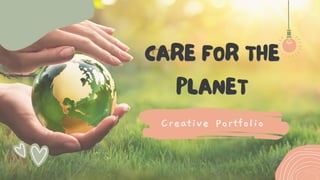
CARE FOR THE
CARE FOR THE
PLANET
PLANET
Creative Portfolio
" The earth does not
belong to us; we
belong to earth"
-Red Indian Chief
Seattle
LEARNING OUTCOMES:
LEARNING OUTCOMES:
DEMONSTRATE AN AFFECTIONATE ATTITUDE TOWARDSTHE
EARTH AND NATURE.
DESCRIBE HOW WE CONTRIBUTE TO THE ENVIRONMENTAL
CRISES.
VALUE REUSING, REPAIRING, AND RECYCLING NATURAL
RESOURCES, AND
APPRECIATE PEACE WITH NATURE
AT THE END OF THIS LESSON, THE STUDENTS MUST BE ABLE
TO :
1.
2.
3.
4.
ABSTRACTION
• We are very sensitive to Nature.
• In coming into touch with Nature, we develop
what is called, the planet consciousness.
• Subjects like science, geography, and social
studies area in both primary and secondary
amply provide knowledge about the planet.
• Peace education helps internalization of such
knowledge, through bringing in the effective
learning dimension.
• Mankind had been living on earth at least
for the last 6 million years.
• The striking facts about the ancient
civilizations was that they were never posed
threats to the earth.
• Within the short existence of the modern
civilization for the last 27 decades, (say
from 1830 upto the present) the earth has
been threathened with damage, pollution, and
destruction as never before.
EDUCATING TO CARE FOR THE
PLANET
PLANET
Children can be crusaders to save the earth.
To quote only a few problems affecting the
earth:
• Global Warming
• Epidemics/Pandemics
• Ever increasing poverty
• Population Growth
• Soil erosion
•Extinction of species
• Security of drinking
water
• Chemical poisoning of
fertile soil
• Toxic wastes
OVER FISHING AIR POLLUTION
People accept the need to stop all the destruction.
The damaging is continuing as ever year-by-year.
Educationally, raising awareness in children should
be reinforced through providing an opportunity to get
into action.
We should not forget the fact that children are
capable of changing the world in their own ways.
HOW TO CARE FOR OUR PLANET
Reduce, reuse, and recycle. Cut
down on what you throw away.
Follow the three "R's" to conserve
natural resources and landfill space.
Volunteer for cleanups in your
community. You can get involved in
protecting your watershed, too.
Educate. When you further your own education, you
can help others understand the importance and value
of our natural resources.
Conserve water. The less water you use, the less
runoff and wastewater that eventually end up in the
Shop wisely. Buy less plastic and bring a reusable
shopping bag.
Use long-lasting light bulbs. Energy efficient light
bulbs reduce greenhouse gas emissions. Also flip the
light switch off when you leave the room!
Plant a tree. Trees provide food
and oxygen. They help save
energy, clean the air, and help
combat climate change.
Don't send chemicals into our
waterways. Choose non-toxic
chemicals in the home and office.
Bike more. Drive less.
THANK YOU !!
THANK YOU !!

Care for the planet.pdf

  • 1.
    CARE FOR THE CAREFOR THE PLANET PLANET Creative Portfolio
  • 2.
    " The earthdoes not belong to us; we belong to earth" -Red Indian Chief Seattle
  • 3.
    LEARNING OUTCOMES: LEARNING OUTCOMES: DEMONSTRATEAN AFFECTIONATE ATTITUDE TOWARDSTHE EARTH AND NATURE. DESCRIBE HOW WE CONTRIBUTE TO THE ENVIRONMENTAL CRISES. VALUE REUSING, REPAIRING, AND RECYCLING NATURAL RESOURCES, AND APPRECIATE PEACE WITH NATURE AT THE END OF THIS LESSON, THE STUDENTS MUST BE ABLE TO : 1. 2. 3. 4.
  • 4.
    ABSTRACTION • We arevery sensitive to Nature. • In coming into touch with Nature, we develop what is called, the planet consciousness. • Subjects like science, geography, and social studies area in both primary and secondary amply provide knowledge about the planet. • Peace education helps internalization of such knowledge, through bringing in the effective learning dimension.
  • 5.
    • Mankind hadbeen living on earth at least for the last 6 million years. • The striking facts about the ancient civilizations was that they were never posed threats to the earth. • Within the short existence of the modern civilization for the last 27 decades, (say from 1830 upto the present) the earth has been threathened with damage, pollution, and destruction as never before.
  • 6.
    EDUCATING TO CAREFOR THE EDUCATING TO CARE FOR THE PLANET PLANET Children can be crusaders to save the earth. To quote only a few problems affecting the earth: • Global Warming • Epidemics/Pandemics • Ever increasing poverty • Population Growth • Soil erosion •Extinction of species • Security of drinking water • Chemical poisoning of fertile soil • Toxic wastes
  • 7.
    OVER FISHING AIRPOLLUTION OVER FISHING AIR POLLUTION People accept the need to stop all the destruction. The damaging is continuing as ever year-by-year. Educationally, raising awareness in children should be reinforced through providing an opportunity to get into action. We should not forget the fact that children are capable of changing the world in their own ways.
  • 8.
    HOW TO CAREFOR OUR PLANET HOW TO CARE FOR OUR PLANET Reduce, reuse, and recycle. Cut down on what you throw away. Follow the three "R's" to conserve natural resources and landfill space. Volunteer for cleanups in your community. You can get involved in protecting your watershed, too.
  • 9.
    Educate. When youfurther your own education, you can help others understand the importance and value of our natural resources. Conserve water. The less water you use, the less runoff and wastewater that eventually end up in the Shop wisely. Buy less plastic and bring a reusable shopping bag. Use long-lasting light bulbs. Energy efficient light bulbs reduce greenhouse gas emissions. Also flip the light switch off when you leave the room!
  • 10.
    Plant a tree.Trees provide food and oxygen. They help save energy, clean the air, and help combat climate change. Don't send chemicals into our waterways. Choose non-toxic chemicals in the home and office. Bike more. Drive less.
  • 11.