TREATMENT OF HOSPITAL WASTEWATER 
Name- Tabish.I.Malik 
Enroll- 190/11 
Roll no.- 52 
Sec- A
 Wastewater composition refers to the actual amounts of physical, 
chemical and biological constituents present in wastewater. 
 Hospital wastewater may contain various potential hazardous materials 
including, microbiological pathogens, radioactive isotopes, disinfectants, 
drugs, chemical compounds and pharmaceuticals. 
 The major aim of wastewater treatment is to remove as much of the 
suspended solids as possible before the remaining water, called effluent, 
is discharged back to the environment. 
 The selection of suitable treatment technology and proper treatment of 
hospital wastewater is essential.
 As solid material decays, it uses up oxygen, which is needed by the 
plants and animals living in the water. 
 Fisheries -Clean water is critical to plants and animals that live in water. 
 Wildlife Habitats-Our rivers and ocean waters teem with life that 
depends on shoreline, beaches and marshes. 
 Recreation and Quality of Life-Water is a great playground for us all. 
The scenic and recreational values of our waters are reasons many people 
choose to live where they do. Visitors are drawn to water activities such 
as swimming, fishing, boating. 
 Health Concerns
If wastewater is not properly treated, then the environment and human 
health can be negatively impacted 
 decaying organic matter and debris can use up the dissolved oxygen in a lake so fish and 
other aquatic biota cannot survive 
 excessive nutrients, such as phosphorus and nitrogen (including ammonia), can cause over-fertilization 
of receiving waters, which can be toxic to aquatic organisms, promote 
excessive plant growth, reduce available oxygen, alter habitat and lead to a decline in 
certain species 
 chlorine compounds and inorganic chloramines can be toxic to aquatic invertebrates, algae 
and fish 
 bacteria, viruses and disease-causing pathogens can pollute beaches and contaminate 
shellfish populations, leading to restrictions on human recreation, drinking water 
consumption and shellfish consumption 
 other substances such as some pharmaceutical and personal care products, primarily 
entering the environment in wastewater effluents, may also pose threats to human health, 
aquatic life and wildlife.
 Sher-e-Kashmir Institute of Medical Sciences, located at Soura, Srinagar 
(J&K) is a reputed post graduate institute for training, research and 
patient care. 
 The construction of SKIMS commenced in the year 1976 & the institute 
was partially commissioned on 5th December 1982.
This waste water from the main supply sewer is directly fed to the sewage treatment plant 
(SPT). The feeding is done in two phases. The various components and the various 
operations that are carried out are described as follows:- 
MAIN SEWER – 
 A sewer is an underground conduit or drain through which sewage is carried 
 For carrying the waste water in SKIMS Hospital, cement concrete main sewer has been 
provided. 
 The main sewer carries wastewater from laboratories, toilets, kitchens, bathrooms, 
wastewater from other domestic and medical activities. 
Main sewer in SKIMS
 The water from the main sewer is then divided and distributed in two phases. 
Phase 1 consists of a primary sedimentation cum storage tank, an aeration tank and 
a clarifier/secondary sedimentation tank. The phase 2 consists of a screening 
chamber, a grit chamber, an aeration tank and a clarifier/secondary sedimentation 
tank. The description of these two phases has been provided as follows. 
PHASE 1 
 PRIMARY SEDIMENTATION TANK CUM STORAGE TANK 
 They are usually rectangular or circular 
 Most sedimentation tanks are constructed with gently sloped bottoms 
 The present sedimentation tank as is a rectangular type reinforced concrete primary 
sedimentation tank 
 The tank is 13 m long , 2 m wide and 2.6 m deep 
 The detention period corresponding to the tank is 2.5 hours 
 The sludge moves to hoppers by gravity, where it is removed 
Primary sedimentary tank cum storage tank
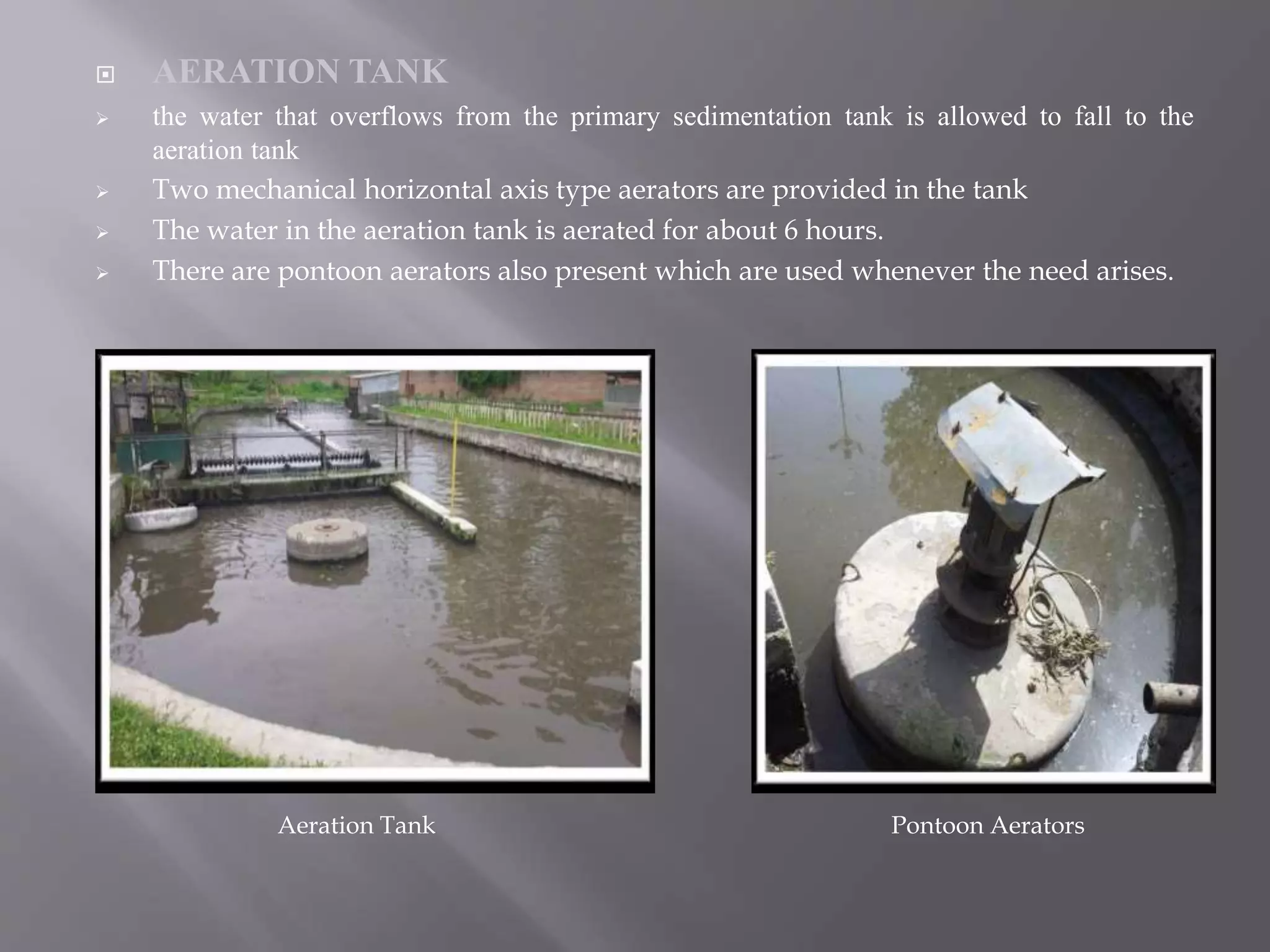
 AERATION TANK 
 the water that overflows from the primary sedimentation tank is allowed to fall to the 
aeration tank 
 Two mechanical horizontal axis type aerators are provided in the tank 
 The water in the aeration tank is aerated for about 6 hours. 
 There are pontoon aerators also present which are used whenever the need arises. 
Aeration Tank Pontoon Aerators
 SECONDARY SEDIMENTATION TANK/CLARIFIER 
 Activated sludge process is undergone in this tank as the efficient 
separation of the biological waste is necessary 
 The secondary clarifier is a rectangular cement concrete structure with a 
length of 2.8 m breadth 2.4 m and depth 3 m 
 The Phase 1 of the treatment plant has a capacity of processing 12 lac liters 
of wastewater per day 
Secondary Sedimentation Tank/Clarifier
The part of wastewater that does not go into the phase 1 is treated in phase 2 
 SCREENING CHAMBER 
 The main sewer feeds all the waste water to a rectangular conduit called 
screening chamber. Screening is the first treatment station, both for surface and 
wastewater. Its purpose to: 
 Protect the structure downstream against large objects which could create 
obstructions in some of the facility's units, 
 Easily separate and remove large matter carried along by the raw water, which 
might negatively affect the efficiency of later treatment procedures or make their 
implementation more difficult. 
Screening Chamber
 GRIT CHAMBER 
 Sewage consists of a considerable amount of grit which consists of sand, gravel, 
silt, ash, cinders, clinkers, egg shells etc. 
 Grit removal is necessary to protect the moving mechanical equipment and pump 
elements from abrasion and accompanying abnormal wear and tear, to reduce the 
formation of heavy deposits in pipes, channels and conduits, and to reduce the 
frequency of the cleaning of sludge digesters. 
Grit Chamber
 AERATION TANK 
 After the grit chamber, the waste water is allowed to pass into an 
aeration tank 
 The principle of working of this aeration tank is similar to that of 
phase 1 
Aeration Tank
 SECONDARY CLARIFIER TANK 
 The secondary clarifier tank in phase 2 is similar in working and construction to 
that of phase 1. Only the capacity is different 
 The phase 2 of the treatment plant has a capacity of treating about 6 lac liters of 
wastewater per day 
 The treated wastewater from the two phases is then separately taken to the sludge 
beds and from sludge beds to the soak wells 
 SLUDGE BEDS 
 The sludge in both the phases is applied on the sludge drying beds. 
 The purpose of the sludge drying beds is to dewater the sludge 
 There are 7 no. of beds provided at the present site and each bed has the 
dimensions of 4.5mx6m.
 These beds consist of a 30 cm thick layer of sand and gravel on specially 
prepared open beds. The sludge is applied on this layer and is allowed to dry. 
 All the drainage from the beds/drains is collected in a pipe and returned to the 
secondary clarifier tank of the phase 2 and again processed as discussed above, 
and the cycle continues 
 Pick-up trucks are used for hauling the sludge cakes. 
Sludge Beds
 SOAK WELLS 
 The effluents from the secondary clarifier tanks in phases 1 and 2 are allowed to 
enter the soak wells 
 There are 8 no. of soak wells present at the present site. 
 Only a little amount of effluent is absorbed in the soak pits and a major portion 
remains unabsorbed. 
 The unabsorbed wastewater effluent is collected and discharged directly into the 
adjacent Anchar Lake 
Soak Well
SHORTCOMINGS IN THE PRESENT WASTEWATER 
TREATMENT FACILITY 
•So all the units are lacking the potential required for the treatment of the 
wastewater from the SKIMS complex. 
•Sludge from the primary sedimentation tank of Phase I is disposed off in 
open. This may result to be hazardous for the occupants. 
•The screens of the screening chamber are not cleaned at regular intervals and 
they were found to be clogged. 
•Grit from the grit chamber is not taken out regularly 
•Sand is not replaced in the sludge beds regularly. 
•The soak wells are not cleaned at regular intervals. This has resulted in their 
clogging. So the effluent remains unsoaked and almost all the effluent is 
disposed off in the nearby Anchar Lake. 
•Since the effluent from the treatment facility has to be finally discharged into 
the neighboring Anchar Lake, it must be free from all virus and other infectious 
elements. The present treatment plant is lacking such a facility.
THANK YOU

waste water treatment in hospitals

  • 1.
    TREATMENT OF HOSPITALWASTEWATER Name- Tabish.I.Malik Enroll- 190/11 Roll no.- 52 Sec- A
  • 2.
     Wastewater compositionrefers to the actual amounts of physical, chemical and biological constituents present in wastewater.  Hospital wastewater may contain various potential hazardous materials including, microbiological pathogens, radioactive isotopes, disinfectants, drugs, chemical compounds and pharmaceuticals.  The major aim of wastewater treatment is to remove as much of the suspended solids as possible before the remaining water, called effluent, is discharged back to the environment.  The selection of suitable treatment technology and proper treatment of hospital wastewater is essential.
  • 3.
     As solidmaterial decays, it uses up oxygen, which is needed by the plants and animals living in the water.  Fisheries -Clean water is critical to plants and animals that live in water.  Wildlife Habitats-Our rivers and ocean waters teem with life that depends on shoreline, beaches and marshes.  Recreation and Quality of Life-Water is a great playground for us all. The scenic and recreational values of our waters are reasons many people choose to live where they do. Visitors are drawn to water activities such as swimming, fishing, boating.  Health Concerns
  • 4.
    If wastewater isnot properly treated, then the environment and human health can be negatively impacted  decaying organic matter and debris can use up the dissolved oxygen in a lake so fish and other aquatic biota cannot survive  excessive nutrients, such as phosphorus and nitrogen (including ammonia), can cause over-fertilization of receiving waters, which can be toxic to aquatic organisms, promote excessive plant growth, reduce available oxygen, alter habitat and lead to a decline in certain species  chlorine compounds and inorganic chloramines can be toxic to aquatic invertebrates, algae and fish  bacteria, viruses and disease-causing pathogens can pollute beaches and contaminate shellfish populations, leading to restrictions on human recreation, drinking water consumption and shellfish consumption  other substances such as some pharmaceutical and personal care products, primarily entering the environment in wastewater effluents, may also pose threats to human health, aquatic life and wildlife.
  • 5.
     Sher-e-Kashmir Instituteof Medical Sciences, located at Soura, Srinagar (J&K) is a reputed post graduate institute for training, research and patient care.  The construction of SKIMS commenced in the year 1976 & the institute was partially commissioned on 5th December 1982.
  • 6.
    This waste waterfrom the main supply sewer is directly fed to the sewage treatment plant (SPT). The feeding is done in two phases. The various components and the various operations that are carried out are described as follows:- MAIN SEWER –  A sewer is an underground conduit or drain through which sewage is carried  For carrying the waste water in SKIMS Hospital, cement concrete main sewer has been provided.  The main sewer carries wastewater from laboratories, toilets, kitchens, bathrooms, wastewater from other domestic and medical activities. Main sewer in SKIMS
  • 7.
     The waterfrom the main sewer is then divided and distributed in two phases. Phase 1 consists of a primary sedimentation cum storage tank, an aeration tank and a clarifier/secondary sedimentation tank. The phase 2 consists of a screening chamber, a grit chamber, an aeration tank and a clarifier/secondary sedimentation tank. The description of these two phases has been provided as follows. PHASE 1  PRIMARY SEDIMENTATION TANK CUM STORAGE TANK  They are usually rectangular or circular  Most sedimentation tanks are constructed with gently sloped bottoms  The present sedimentation tank as is a rectangular type reinforced concrete primary sedimentation tank  The tank is 13 m long , 2 m wide and 2.6 m deep  The detention period corresponding to the tank is 2.5 hours  The sludge moves to hoppers by gravity, where it is removed Primary sedimentary tank cum storage tank
  • 8.
     AERATION TANK  the water that overflows from the primary sedimentation tank is allowed to fall to the aeration tank  Two mechanical horizontal axis type aerators are provided in the tank  The water in the aeration tank is aerated for about 6 hours.  There are pontoon aerators also present which are used whenever the need arises. Aeration Tank Pontoon Aerators
  • 9.
     SECONDARY SEDIMENTATIONTANK/CLARIFIER  Activated sludge process is undergone in this tank as the efficient separation of the biological waste is necessary  The secondary clarifier is a rectangular cement concrete structure with a length of 2.8 m breadth 2.4 m and depth 3 m  The Phase 1 of the treatment plant has a capacity of processing 12 lac liters of wastewater per day Secondary Sedimentation Tank/Clarifier
  • 10.
    The part ofwastewater that does not go into the phase 1 is treated in phase 2  SCREENING CHAMBER  The main sewer feeds all the waste water to a rectangular conduit called screening chamber. Screening is the first treatment station, both for surface and wastewater. Its purpose to:  Protect the structure downstream against large objects which could create obstructions in some of the facility's units,  Easily separate and remove large matter carried along by the raw water, which might negatively affect the efficiency of later treatment procedures or make their implementation more difficult. Screening Chamber
  • 11.
     GRIT CHAMBER  Sewage consists of a considerable amount of grit which consists of sand, gravel, silt, ash, cinders, clinkers, egg shells etc.  Grit removal is necessary to protect the moving mechanical equipment and pump elements from abrasion and accompanying abnormal wear and tear, to reduce the formation of heavy deposits in pipes, channels and conduits, and to reduce the frequency of the cleaning of sludge digesters. Grit Chamber
  • 12.
     AERATION TANK  After the grit chamber, the waste water is allowed to pass into an aeration tank  The principle of working of this aeration tank is similar to that of phase 1 Aeration Tank
  • 13.
     SECONDARY CLARIFIERTANK  The secondary clarifier tank in phase 2 is similar in working and construction to that of phase 1. Only the capacity is different  The phase 2 of the treatment plant has a capacity of treating about 6 lac liters of wastewater per day  The treated wastewater from the two phases is then separately taken to the sludge beds and from sludge beds to the soak wells  SLUDGE BEDS  The sludge in both the phases is applied on the sludge drying beds.  The purpose of the sludge drying beds is to dewater the sludge  There are 7 no. of beds provided at the present site and each bed has the dimensions of 4.5mx6m.
  • 14.
     These bedsconsist of a 30 cm thick layer of sand and gravel on specially prepared open beds. The sludge is applied on this layer and is allowed to dry.  All the drainage from the beds/drains is collected in a pipe and returned to the secondary clarifier tank of the phase 2 and again processed as discussed above, and the cycle continues  Pick-up trucks are used for hauling the sludge cakes. Sludge Beds
  • 15.
     SOAK WELLS  The effluents from the secondary clarifier tanks in phases 1 and 2 are allowed to enter the soak wells  There are 8 no. of soak wells present at the present site.  Only a little amount of effluent is absorbed in the soak pits and a major portion remains unabsorbed.  The unabsorbed wastewater effluent is collected and discharged directly into the adjacent Anchar Lake Soak Well
  • 16.
    SHORTCOMINGS IN THEPRESENT WASTEWATER TREATMENT FACILITY •So all the units are lacking the potential required for the treatment of the wastewater from the SKIMS complex. •Sludge from the primary sedimentation tank of Phase I is disposed off in open. This may result to be hazardous for the occupants. •The screens of the screening chamber are not cleaned at regular intervals and they were found to be clogged. •Grit from the grit chamber is not taken out regularly •Sand is not replaced in the sludge beds regularly. •The soak wells are not cleaned at regular intervals. This has resulted in their clogging. So the effluent remains unsoaked and almost all the effluent is disposed off in the nearby Anchar Lake. •Since the effluent from the treatment facility has to be finally discharged into the neighboring Anchar Lake, it must be free from all virus and other infectious elements. The present treatment plant is lacking such a facility.
  • 17.