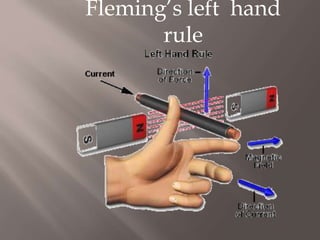
Fleming’s left hand
rule
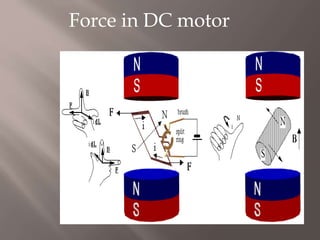
Fleming’s left hand
ruleUsed to determine the direction of force acting
on a current carrying conductor placed in a
magnetic field .
The middle finger , the fore finger and thumb of
the left hand are kept at right angles to one
another .
The middle finger represent the direction
of current
The fore finger represent the direction of
magnetic field
The thumb will indicate the direction of
force acting on the conductor .
This rule is used in motors.
 Conventional DC generators are being replaced by the
solid state rectifiers where ac supply is available.
 The same is not true for dc motors because of
 Constant mechanical power output or constant torque
 Rapid acceleration or deceleration
 Responsiveness to feedback signals
 1W to 10,000 hp
 Applications – in electric vehicles to extend their range
and reduce vehicle weight, in steel and aluminum
rolling mills, traction motors, electric trains, overhead
cranes, control devices, etc.
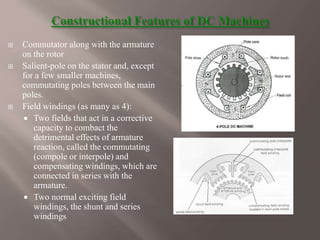
 Commutator along with the armature
on the rotor
 Salient-pole on the stator and, except
for a few smaller machines,
commutating poles between the main
poles.
 Field windings (as many as 4):
 Two fields that act in a corrective
capacity to combact the
detrimental effects of armature
reaction, called the commutating
(compole or interpole) and
compensating windings, which are
connected in series with the
armature.
 Two normal exciting field
windings, the shunt and series
windings
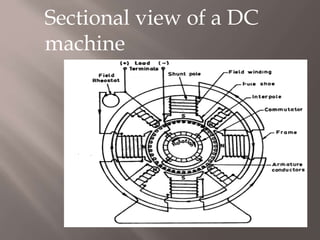
Sectional view of a DC
machine
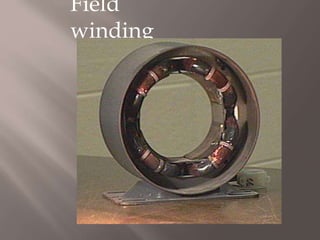
Field
winding
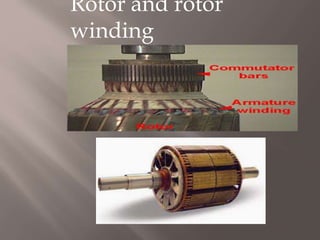
Rotor and rotor
winding
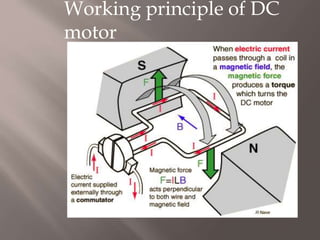
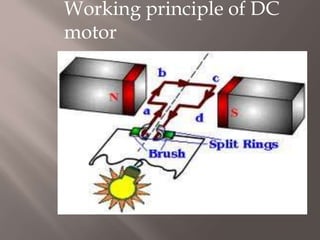
Working principle of DC
motor
Working principle of DC
motor
Force in DC motor
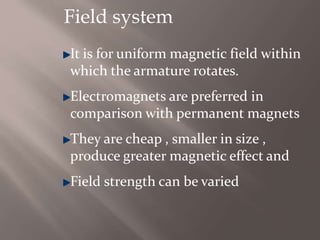
Field system
It is for uniform magnetic field within
which the armature rotates.
Electromagnets are preferred in
comparison with permanent magnets
They are cheap , smaller in size ,
produce greater magnetic effect and
Field strength can be varied
Field system consists of the
following parts
Yoke
Pole cores
Pole shoes
Field coils
Armature core
The armature core is cylindrical
High permeability silicon steel
stampings
Impregnated
Lamination is to reduce the eddy
current loss
Commutator
Connect with external circuit
Converts ac into unidirectional current
Cylindrical in shape
Made of wedge shaped copper segments
Segments are insulated from each other
Each commutator segment is connected to
armature conductors by means of a cu strip called
riser.
No of segments equal to no of coils
Carbon brush
Carbon brushes are used in DC machines
because they are soft materials
It does not generate spikes when they contact
commutator
To deliver the current thro armature
Carbon is used for brushes because it has
negative temperature coefficient of resistance
Self lubricating , takes its shape , improving
area of contact
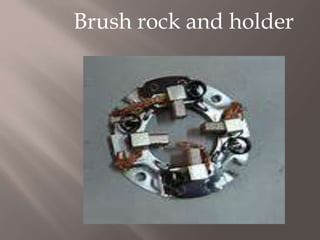
Brush rock and holder
Series wound Motor or series motor
Shunt wound Motor or shunt motor
Compound wound motor
dcmotor 19
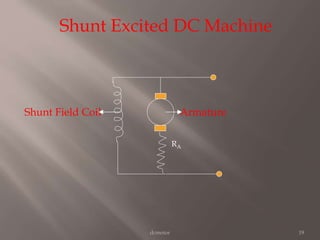
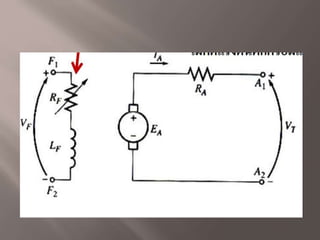
Shunt Field Coil Armature
RA
Shunt Excited DC Machine
dcmotor 20
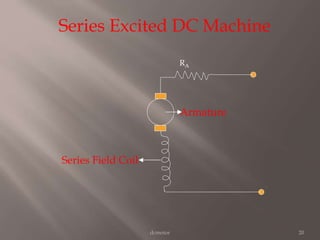
Series Field Coil
Armature
RA
Series Excited DC Machine
dcmotor 21
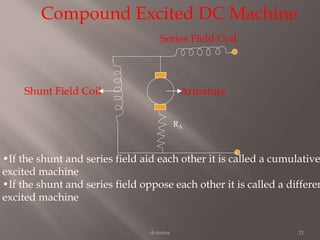
Shunt Field Coil Armature
RA
Compound Excited DC Machine
Series Field Coil
•If the shunt and series field aid each other it is called a cumulative
excited machine
•If the shunt and series field oppose each other it is called a differen
excited machine
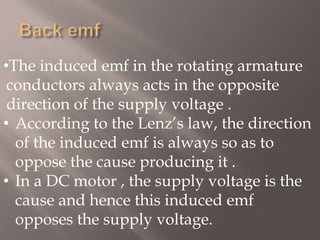
•The induced emf in the rotating armature
conductors always acts in the opposite
direction of the supply voltage .
• According to the Lenz’s law, the direction
of the induced emf is always so as to
oppose the cause producing it .
• In a DC motor , the supply voltage is the
cause and hence this induced emf
opposes the supply voltage.
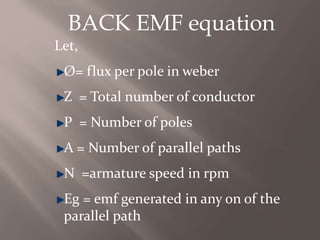
BACK EMF equation
Let,
Ø= flux per pole in weber
Z = Total number of conductor
P = Number of poles
A = Number of parallel paths
N =armature speed in rpm
Eg = emf generated in any on of the
parallel path
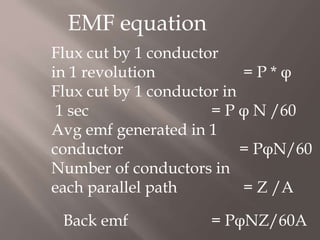
EMF equation
Flux cut by 1 conductor
in 1 revolution = P * φ
Flux cut by 1 conductor in
1 sec = P φ N /60
Avg emf generated in 1
conductor = PφN/60
Number of conductors in
each parallel path = Z /A
Back emf = PφNZ/60A
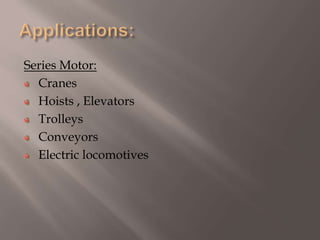
Series Motor:
Cranes
Hoists , Elevators
Trolleys
Conveyors
Electric locomotives
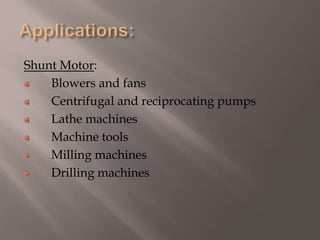
Shunt Motor:
Blowers and fans
Centrifugal and reciprocating pumps
Lathe machines
Machine tools
Milling machines
Drilling machines
Cumulative compound Motor:
Rolling mills
Punches
Shears
Heavy planers
Elevators

ROTATING MACHINES via magnetic field

  • 2.
  • 3.
    Fleming’s left hand ruleUsedto determine the direction of force acting on a current carrying conductor placed in a magnetic field . The middle finger , the fore finger and thumb of the left hand are kept at right angles to one another . The middle finger represent the direction of current The fore finger represent the direction of magnetic field The thumb will indicate the direction of force acting on the conductor . This rule is used in motors.
  • 4.
     Conventional DCgenerators are being replaced by the solid state rectifiers where ac supply is available.  The same is not true for dc motors because of  Constant mechanical power output or constant torque  Rapid acceleration or deceleration  Responsiveness to feedback signals  1W to 10,000 hp  Applications – in electric vehicles to extend their range and reduce vehicle weight, in steel and aluminum rolling mills, traction motors, electric trains, overhead cranes, control devices, etc.
  • 5.
     Commutator alongwith the armature on the rotor  Salient-pole on the stator and, except for a few smaller machines, commutating poles between the main poles.  Field windings (as many as 4):  Two fields that act in a corrective capacity to combact the detrimental effects of armature reaction, called the commutating (compole or interpole) and compensating windings, which are connected in series with the armature.  Two normal exciting field windings, the shunt and series windings
  • 6.
    Sectional view ofa DC machine
  • 7.
  • 8.
  • 9.
  • 10.
  • 11.
  • 12.
    Field system It isfor uniform magnetic field within which the armature rotates. Electromagnets are preferred in comparison with permanent magnets They are cheap , smaller in size , produce greater magnetic effect and Field strength can be varied
  • 13.
    Field system consistsof the following parts Yoke Pole cores Pole shoes Field coils
  • 14.
    Armature core The armaturecore is cylindrical High permeability silicon steel stampings Impregnated Lamination is to reduce the eddy current loss
  • 15.
    Commutator Connect with externalcircuit Converts ac into unidirectional current Cylindrical in shape Made of wedge shaped copper segments Segments are insulated from each other Each commutator segment is connected to armature conductors by means of a cu strip called riser. No of segments equal to no of coils
  • 16.
    Carbon brush Carbon brushesare used in DC machines because they are soft materials It does not generate spikes when they contact commutator To deliver the current thro armature Carbon is used for brushes because it has negative temperature coefficient of resistance Self lubricating , takes its shape , improving area of contact
  • 17.
  • 18.
    Series wound Motoror series motor Shunt wound Motor or shunt motor Compound wound motor
  • 19.
    dcmotor 19 Shunt FieldCoil Armature RA Shunt Excited DC Machine
  • 20.
    dcmotor 20 Series FieldCoil Armature RA Series Excited DC Machine
  • 21.
    dcmotor 21 Shunt FieldCoil Armature RA Compound Excited DC Machine Series Field Coil •If the shunt and series field aid each other it is called a cumulative excited machine •If the shunt and series field oppose each other it is called a differen excited machine
  • 24.
    •The induced emfin the rotating armature conductors always acts in the opposite direction of the supply voltage . • According to the Lenz’s law, the direction of the induced emf is always so as to oppose the cause producing it . • In a DC motor , the supply voltage is the cause and hence this induced emf opposes the supply voltage.
  • 25.
    BACK EMF equation Let, Ø=flux per pole in weber Z = Total number of conductor P = Number of poles A = Number of parallel paths N =armature speed in rpm Eg = emf generated in any on of the parallel path
  • 26.
    EMF equation Flux cutby 1 conductor in 1 revolution = P * φ Flux cut by 1 conductor in 1 sec = P φ N /60 Avg emf generated in 1 conductor = PφN/60 Number of conductors in each parallel path = Z /A Back emf = PφNZ/60A
  • 29.
    Series Motor: Cranes Hoists ,Elevators Trolleys Conveyors Electric locomotives
  • 30.
    Shunt Motor: Blowers andfans Centrifugal and reciprocating pumps Lathe machines Machine tools Milling machines Drilling machines
  • 31.
    Cumulative compound Motor: Rollingmills Punches Shears Heavy planers Elevators