WASTE DIVERSION PROGRAM
PHASE 1
@ 15 Sperling Drive
THE PROGRAM
 New four-streamed waste diversion strategy in the 15 Sperling office
starting January 6th, 2014.
 12 stations will be set up throughout the office where staff can sort
their waste.
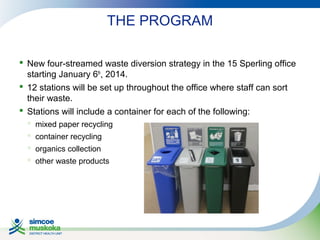
 Stations will include a container for each of the following:
 mixed paper recycling
 container recycling
 organics collection
 other waste products
THE PROGRAM
 On January 6th, you will notice that individual recycling and garbage
bins will be removed from all desks at 15 Sperling Drive.
 But don’t worry, the 12 recycling stations will be set up throughout the
office and ready to go for you!
 This will help not only better divert our waste; you can also use going
to the recycling stations as a well deserved stretch break throughout
the day!
 The individual recycling and garbage bins will be donated to The
Restore.
THE PROGRAM
Evidence Shows that:
Increasing the capacity of recycling stations and having consistent
signage, as well as decreasing access to desk-side garbage bins,
helps to ensure better sorting of waste, which leads to better diversion
rates.
Making staff responsible for putting their waste into recycling stations,
rather than having desk-side pick up by custodians, helps staff to better
acknowledge the amount of waste they are producing. This helps not
only in waste diversion, but also waste reduction.
In a pilot program run at the Simcoe County Administration Centre,
staff were able to achieve a 91.03% waste diversion rate when
centralized recycling stations were implemented, and desk-side bins
removed.
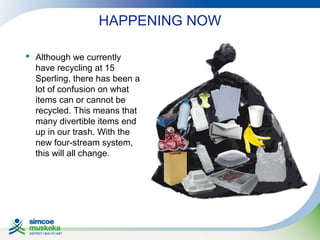
HAPPENING NOW
 Although we currently
have recycling at 15
Sperling, there has been a
lot of confusion on what
items can or cannot be
recycled. This means that
many divertible items end
up in our trash. With the
new four-stream system,
this will all change.
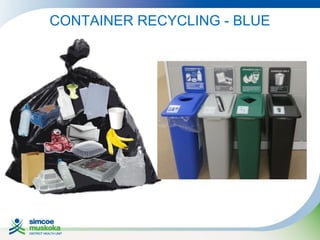
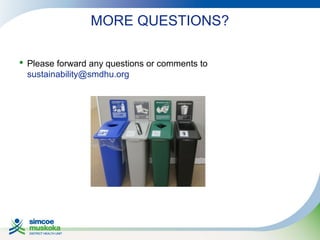
CONTAINER RECYCLING - BLUE
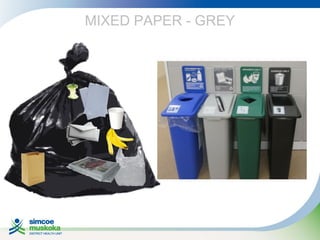
MIXED PAPER - GREY
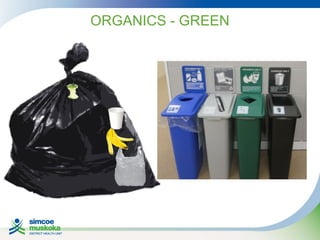
ORGANICS - GREEN
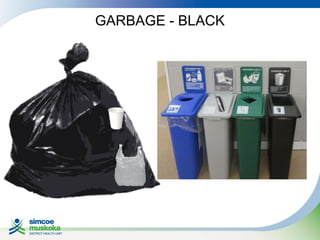
GARBAGE - BLACK
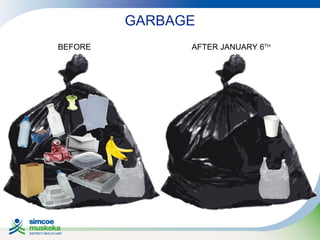
GARBAGE
BEFORE

AFTER JANUARY 6TH
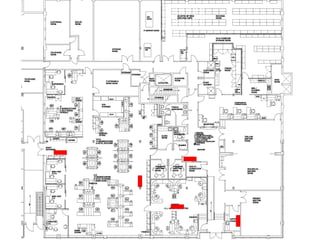
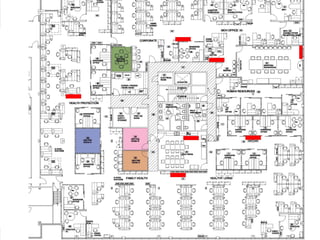
WHERE ARE THE STATIONS LOCATED?
 Barrie Upper Floor – 7 stations
 Barrie Lower Floor – 5 stations
 12 four-stream stations total
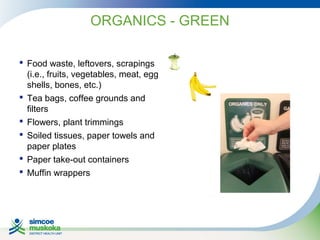
ORGANICS - GREEN
 Food waste, leftovers, scrapings
(i.e., fruits, vegetables, meat, egg
shells, bones, etc.)
 Tea bags, coffee grounds and
filters
 Flowers, plant trimmings
 Soiled tissues, paper towels and
paper plates
 Paper take-out containers
 Muffin wrappers
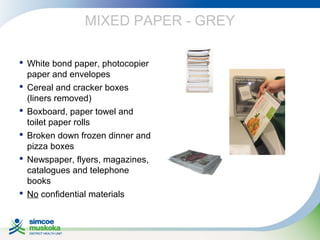
MIXED PAPER - GREY
 White bond paper, photocopier
paper and envelopes
 Cereal and cracker boxes
(liners removed)
 Boxboard, paper towel and
toilet paper rolls
 Broken down frozen dinner and
pizza boxes
 Newspaper, flyers, magazines,
catalogues and telephone
books
 No confidential materials
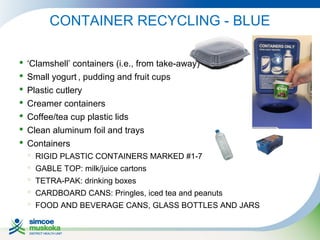
CONTAINER RECYCLING - BLUE








‘Clamshell’ containers (i.e., from take-away)
Small yogurt , pudding and fruit cups
Plastic cutlery
Creamer containers
Coffee/tea cup plastic lids
Clean aluminum foil and trays
Containers
 RIGID PLASTIC CONTAINERS MARKED #1-7
 GABLE TOP: milk/juice cartons
 TETRA-PAK: drinking boxes
 CARDBOARD CANS: Pringles, iced tea and peanuts
 FOOD AND BEVERAGE CANS, GLASS BOTTLES AND JARS
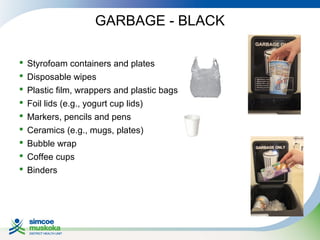
GARBAGE - BLACK










Styrofoam containers and plates
Disposable wipes
Plastic film, wrappers and plastic bags
Foil lids (e.g., yogurt cup lids)
Markers, pencils and pens
Ceramics (e.g., mugs, plates)
Bubble wrap
Coffee cups
Binders
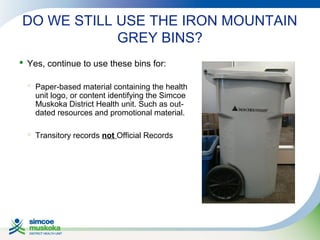
DO WE STILL USE THE IRON MOUNTAIN
GREY BINS?
 Yes, continue to use these bins for:
 Paper-based material containing the health
unit logo, or content identifying the Simcoe
Muskoka District Health unit. Such as outdated resources and promotional material.

 Transitory records not Official Records
WHY NOT COFFEE CUPS?
 Paper coffee cups have a plastic (usually polyethylene) liner; this is
what stops the liquid from seeping through the paper.
 The ability to compost this lining depends on the capacity of the
organics processing facility – this is why in some places, you can put
coffee cups in the organics (e.g., County of Simcoe), where in other
places you cannot (e.g., York Region).
 Currently the capacity of the facility that processes the organics
taking from 15 Sperling cannot process this liner. However, they have
let us know they are going to look into the potential for composting
the cups in the future.
WHAT ABOUT OTHER FAST FOOD
CUPS?
 Most fast food cups for cold beverages contain a wax layer, to stop
the seepage of liquid out of the cups.
 Because of this liner, fast food cups cannot be recycled or put into
the organics program, and must be placed into the garbage, as well
as the straws.
 However, their lids are plastic and therefore can be discarded in the
co-mingle containers.
WHAT ABOUT K-CUPS?
 As is (with foil and coffee grounds) the cups are not accepted into
recycling.
However
 if the foil is removed (tossed into garbage bin)
 coffee grounds are emptied (into organics bin)
 and the plastic k-cup is rinsed out it, the k-cup can then can be tossed into
the blue co-mingle recycling bin.

 This process will need to be done on an individual basis – if you
want your k-cup to be recycled, make sure to divert it yourself!
BINS IN THE WASHROOMS?
 Organic and garbage bins will be in washrooms
 The organic bin can take:
 soiled paper products, such as paper towels and tissue
WHAT ABOUT LARGE
CARDBOARD/BOXES?
 Large cardboard recycling process remains the same:
 Break down cardboard/boxes
 Put beside your desk or in custodian’s area
 Cleaning staff will pick it up and place at the large bin outside
WHY IS IT IMPORTANT NOT TO
“CONTAMINATE” A BIN?
 Bin contamination = placing materials into the wrong diversion bin (i.e.,
placing paper products into the mixed containers recycling bin)
 Separating our recycling helps to decrease the time and energy of
processing at the recycling facility, making it easier for the materials to
get back into the products stream
 When bins get contaminated, it makes it difficult for the recycling facility
to separate and process the materials – If there are too many items in a
bin that should not be there, the waste company places the entire bin in
the garbage rather than diverting it
 But we know that mistakes can happen. We are allowed up to 10%
contamination of our bins, and they will still be accepted. This is why it is
so essential to follow the signs and place the materials in the right bin.
WHERE DOES OUR WASTE END UP?
 Recycling will be separated and processed, and will then be used for:
 Creating recycled cardboard and container board packaging (paper)
 Creating water bottles, and molds in the automotive and agricultural
industries (plastics)

 The manufacture of new steel coils, bars, and rods in steel mills (Metals)

 Organic material will be used for:
 Compost/Fertilizer
 Renewable energy production through anaerobic digestion (want to learn
more about this? Visit http://seacliffenergy.com/)
WASTE REDUCTION
 Although our 4 stream waste diversion program is going to reduce
our impact on the landfill.

Let’s not forget – waste
reduction is best!
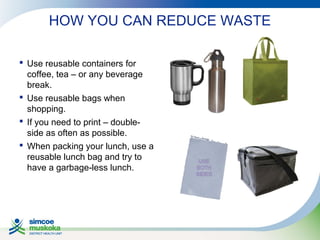
HOW YOU CAN REDUCE WASTE
 Use reusable containers for
coffee, tea – or any beverage
break.
 Use reusable bags when
shopping.
 If you need to print – doubleside as often as possible.
 When packing your lunch, use a
reusable lunch bag and try to
have a garbage-less lunch.
MORE QUESTIONS?
 Please forward any questions or comments to
sustainability@smdhu.org

Waste diversion power point final

  • 1.
    WASTE DIVERSION PROGRAM PHASE1 @ 15 Sperling Drive
  • 2.
    THE PROGRAM  Newfour-streamed waste diversion strategy in the 15 Sperling office starting January 6th, 2014.  12 stations will be set up throughout the office where staff can sort their waste.  Stations will include a container for each of the following:  mixed paper recycling  container recycling  organics collection  other waste products
  • 3.
    THE PROGRAM  OnJanuary 6th, you will notice that individual recycling and garbage bins will be removed from all desks at 15 Sperling Drive.  But don’t worry, the 12 recycling stations will be set up throughout the office and ready to go for you!  This will help not only better divert our waste; you can also use going to the recycling stations as a well deserved stretch break throughout the day!  The individual recycling and garbage bins will be donated to The Restore.
  • 4.
    THE PROGRAM Evidence Showsthat: Increasing the capacity of recycling stations and having consistent signage, as well as decreasing access to desk-side garbage bins, helps to ensure better sorting of waste, which leads to better diversion rates. Making staff responsible for putting their waste into recycling stations, rather than having desk-side pick up by custodians, helps staff to better acknowledge the amount of waste they are producing. This helps not only in waste diversion, but also waste reduction. In a pilot program run at the Simcoe County Administration Centre, staff were able to achieve a 91.03% waste diversion rate when centralized recycling stations were implemented, and desk-side bins removed.
  • 5.
    HAPPENING NOW  Althoughwe currently have recycling at 15 Sperling, there has been a lot of confusion on what items can or cannot be recycled. This means that many divertible items end up in our trash. With the new four-stream system, this will all change.
  • 6.
  • 7.
  • 8.
  • 9.
  • 10.
  • 11.
    WHERE ARE THESTATIONS LOCATED?  Barrie Upper Floor – 7 stations  Barrie Lower Floor – 5 stations  12 four-stream stations total
  • 14.
    ORGANICS - GREEN Food waste, leftovers, scrapings (i.e., fruits, vegetables, meat, egg shells, bones, etc.)  Tea bags, coffee grounds and filters  Flowers, plant trimmings  Soiled tissues, paper towels and paper plates  Paper take-out containers  Muffin wrappers
  • 15.
    MIXED PAPER -GREY  White bond paper, photocopier paper and envelopes  Cereal and cracker boxes (liners removed)  Boxboard, paper towel and toilet paper rolls  Broken down frozen dinner and pizza boxes  Newspaper, flyers, magazines, catalogues and telephone books  No confidential materials
  • 16.
    CONTAINER RECYCLING -BLUE        ‘Clamshell’ containers (i.e., from take-away) Small yogurt , pudding and fruit cups Plastic cutlery Creamer containers Coffee/tea cup plastic lids Clean aluminum foil and trays Containers  RIGID PLASTIC CONTAINERS MARKED #1-7  GABLE TOP: milk/juice cartons  TETRA-PAK: drinking boxes  CARDBOARD CANS: Pringles, iced tea and peanuts  FOOD AND BEVERAGE CANS, GLASS BOTTLES AND JARS
  • 17.
    GARBAGE - BLACK          Styrofoamcontainers and plates Disposable wipes Plastic film, wrappers and plastic bags Foil lids (e.g., yogurt cup lids) Markers, pencils and pens Ceramics (e.g., mugs, plates) Bubble wrap Coffee cups Binders
  • 18.
    DO WE STILLUSE THE IRON MOUNTAIN GREY BINS?  Yes, continue to use these bins for:  Paper-based material containing the health unit logo, or content identifying the Simcoe Muskoka District Health unit. Such as outdated resources and promotional material.  Transitory records not Official Records
  • 19.
    WHY NOT COFFEECUPS?  Paper coffee cups have a plastic (usually polyethylene) liner; this is what stops the liquid from seeping through the paper.  The ability to compost this lining depends on the capacity of the organics processing facility – this is why in some places, you can put coffee cups in the organics (e.g., County of Simcoe), where in other places you cannot (e.g., York Region).  Currently the capacity of the facility that processes the organics taking from 15 Sperling cannot process this liner. However, they have let us know they are going to look into the potential for composting the cups in the future.
  • 20.
    WHAT ABOUT OTHERFAST FOOD CUPS?  Most fast food cups for cold beverages contain a wax layer, to stop the seepage of liquid out of the cups.  Because of this liner, fast food cups cannot be recycled or put into the organics program, and must be placed into the garbage, as well as the straws.  However, their lids are plastic and therefore can be discarded in the co-mingle containers.
  • 21.
    WHAT ABOUT K-CUPS? As is (with foil and coffee grounds) the cups are not accepted into recycling. However  if the foil is removed (tossed into garbage bin)  coffee grounds are emptied (into organics bin)  and the plastic k-cup is rinsed out it, the k-cup can then can be tossed into the blue co-mingle recycling bin.  This process will need to be done on an individual basis – if you want your k-cup to be recycled, make sure to divert it yourself!
  • 22.
    BINS IN THEWASHROOMS?  Organic and garbage bins will be in washrooms  The organic bin can take:  soiled paper products, such as paper towels and tissue
  • 23.
    WHAT ABOUT LARGE CARDBOARD/BOXES? Large cardboard recycling process remains the same:  Break down cardboard/boxes  Put beside your desk or in custodian’s area  Cleaning staff will pick it up and place at the large bin outside
  • 24.
    WHY IS ITIMPORTANT NOT TO “CONTAMINATE” A BIN?  Bin contamination = placing materials into the wrong diversion bin (i.e., placing paper products into the mixed containers recycling bin)  Separating our recycling helps to decrease the time and energy of processing at the recycling facility, making it easier for the materials to get back into the products stream  When bins get contaminated, it makes it difficult for the recycling facility to separate and process the materials – If there are too many items in a bin that should not be there, the waste company places the entire bin in the garbage rather than diverting it  But we know that mistakes can happen. We are allowed up to 10% contamination of our bins, and they will still be accepted. This is why it is so essential to follow the signs and place the materials in the right bin.
  • 25.
    WHERE DOES OURWASTE END UP?  Recycling will be separated and processed, and will then be used for:  Creating recycled cardboard and container board packaging (paper)  Creating water bottles, and molds in the automotive and agricultural industries (plastics)  The manufacture of new steel coils, bars, and rods in steel mills (Metals)  Organic material will be used for:  Compost/Fertilizer  Renewable energy production through anaerobic digestion (want to learn more about this? Visit http://seacliffenergy.com/)
  • 26.
    WASTE REDUCTION  Althoughour 4 stream waste diversion program is going to reduce our impact on the landfill. Let’s not forget – waste reduction is best!
  • 27.
    HOW YOU CANREDUCE WASTE  Use reusable containers for coffee, tea – or any beverage break.  Use reusable bags when shopping.  If you need to print – doubleside as often as possible.  When packing your lunch, use a reusable lunch bag and try to have a garbage-less lunch.
  • 28.
    MORE QUESTIONS?  Pleaseforward any questions or comments to sustainability@smdhu.org

Editor's Notes

  • #4 Reasoning behind this altering of current diversion practices is three-fold.
  • #5 Reasoning behind this altering of current diversion practices is three-fold.