

Evaluator Workshop   Fall Visits 2010 Tuesday, May 25, 2010 Please join the audio portion of this training:   866-740-1260, Access Code: 7489001   ReadyTalk Help Desk: 800.843.9166  International Help: 303.209.1600
Announcements This presentation and the accompanying materials are available for download from:  http://www.wascsenior.org/evaltrainingFall2010 For assistance with Voice and Web connections please contact: ReadyTalk Help Desk,  800.843.9166   International Help:  303.209.1600 Please mute your microphone if you are not speaking. If you have questions, please enter them into the Chat window.
WASC Evaluator Workshop Fall Visits 2010
Workshop Outcomes Know how to prepare for and conduct an effective visit  Be prepared to produce a useful, high-quality team report Be ready to make sound judgments about institutions under the Standards Be familiar with resources that support your work on a team
Agenda Context  for the Visit/Accreditation Preparing  for the Visit Conducting  the Visit Developing  Team Recommendations Writing  the Team Report
Context for Accreditation  and Visits The continuing evolution of the WASC process and Standards The accountability movement Moving from assessment for improvement to assessment for accountability New areas of emphasis The Handbook revision process
Recent Changes in the Institutional Review Process  and Standards   Changes to Institutional Review Process re: Student Success, Program Review and EE Sustainability Changes to CFRs Clarifying the scope of the CPR visit to review the “infrastructure” for assessment of student learning Program Review and Program-Level Student Learning in a systematic way Tool:  Table A   and B  (RB pg. 41and 46)
Covering the Impact of the Financial Recession on Institutions Questions to ask the institution: How has the financial recession affected your institution? How has your institution responded? What plans are in place in case the current state of affairs becomes permanent?
Q&A Please feel free to type in your questions using the chat window or just chime in.
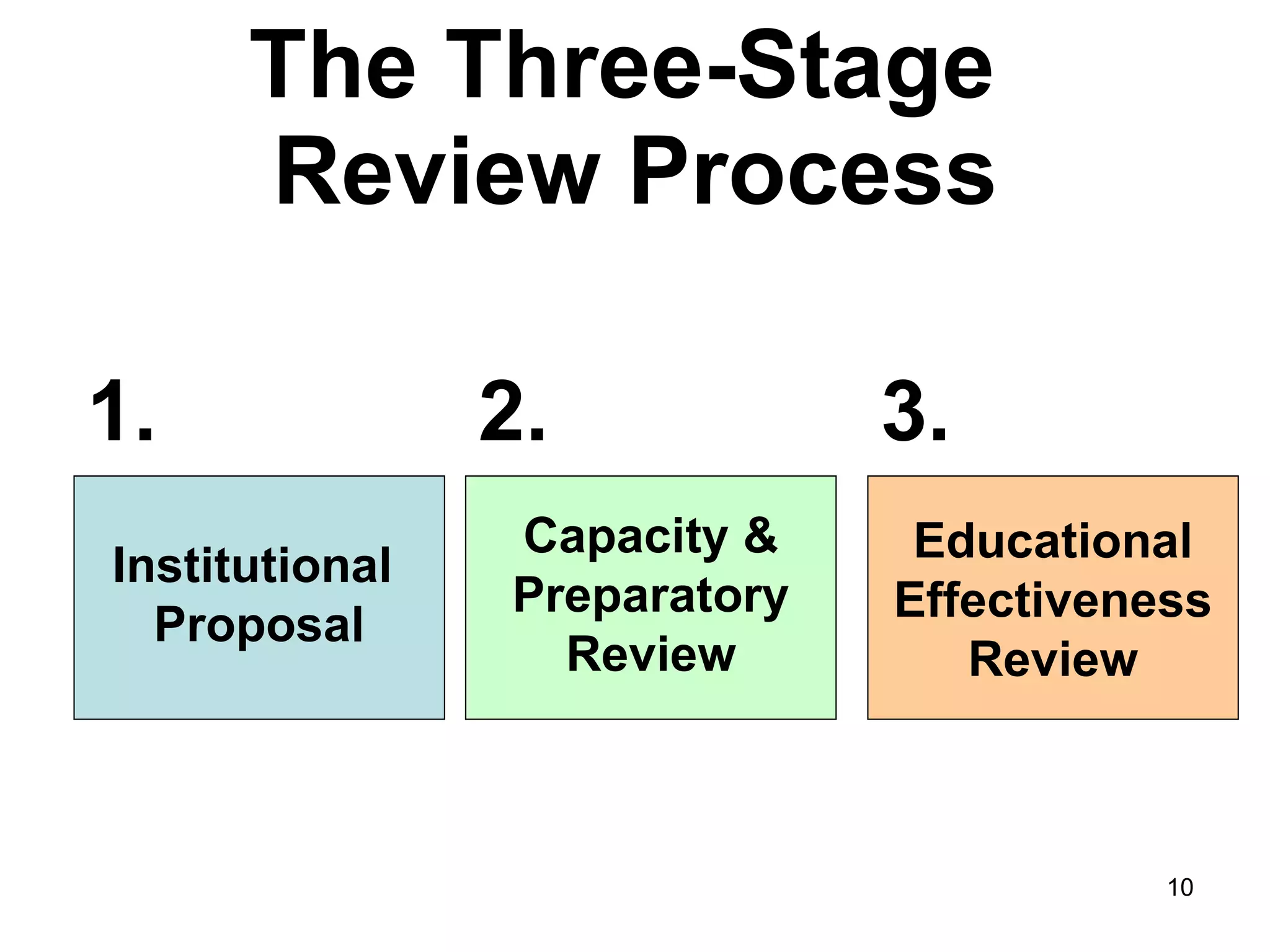
The Three-Stage  Review Process Institutional  Proposal Capacity & Preparatory Review Educational Effectiveness Review 1. 2. 3.
The Three-Stage Review Process Institutional Proposal Capacity and Preparatory Review Educational Effectiveness Review
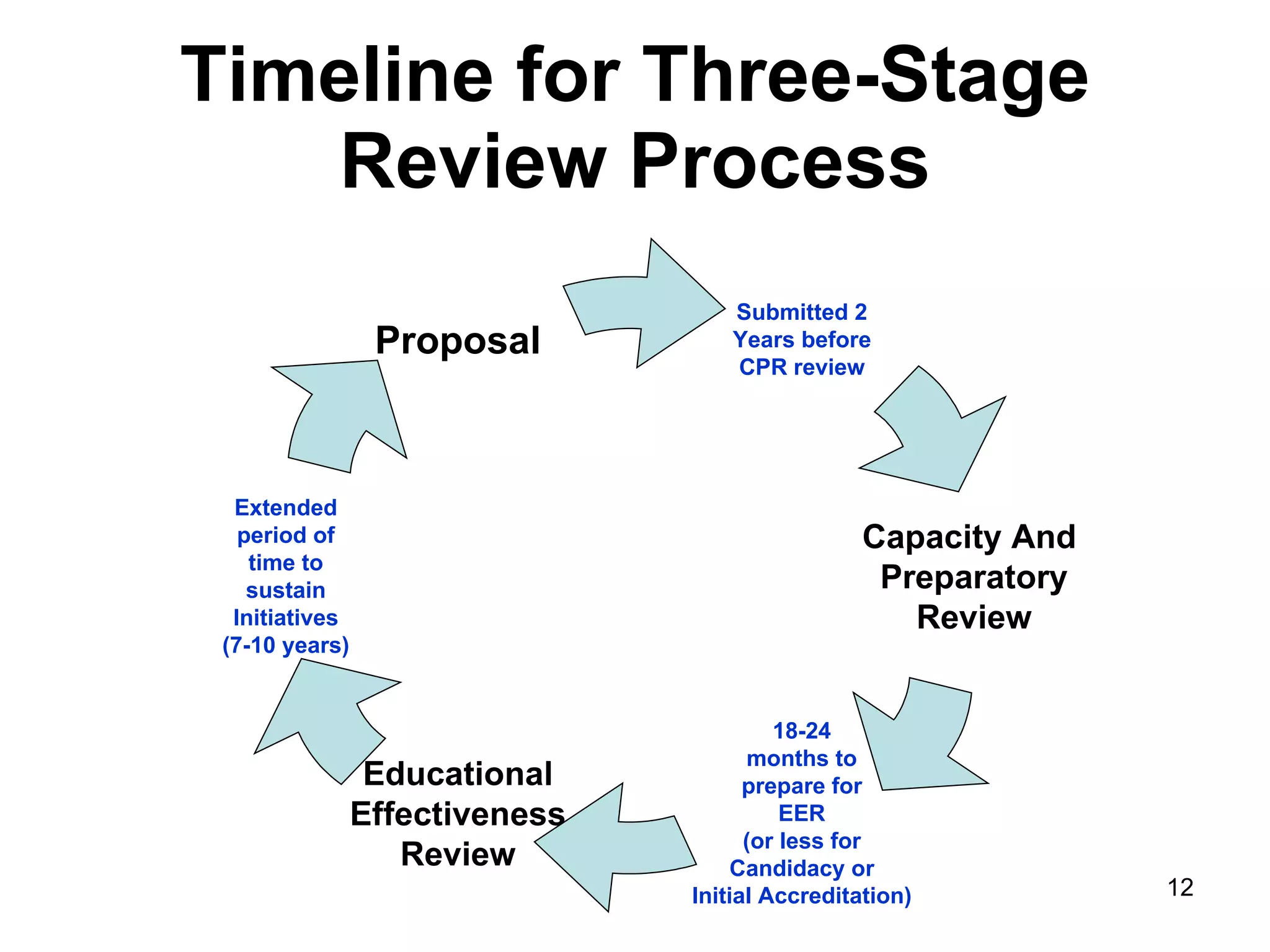
Timeline for Three-Stage Review Process Submitted 2 Years before CPR review Capacity And  Preparatory Review 18-24 months to prepare for EER (or less for Candidacy or Initial Accreditation) Educational Effectiveness Review Extended period of time to sustain Initiatives (7-10 years) Proposal
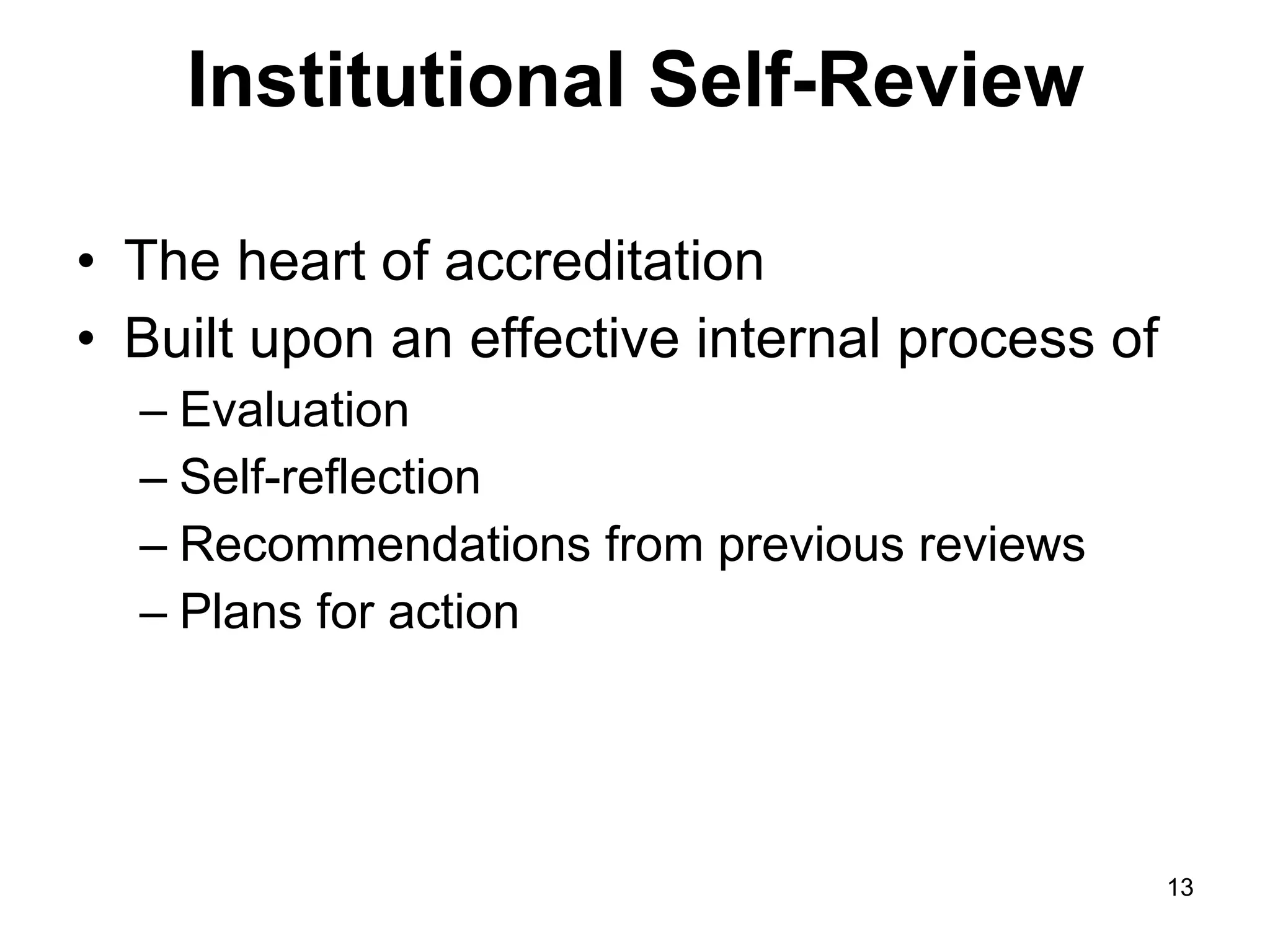
Institutional Self-Review The heart of accreditation Built upon an effective internal process of Evaluation Self-reflection Recommendations from previous reviews Plans for action
Stage 1:   The Institutional Proposal
The Institutional Proposal Guides  the entire accreditation review process Connects  institution’s context and priorities with the Standards of Accreditation Provides primary  basis  for both institution self-review and team evaluation Allows  alignment  of accreditation activities to institutional strategic plan and key areas chosen for improvement
The Letter of Intent Submitted by institutions seeking Candidacy or Initial Accreditation, the LOI serves the same purpose as the proposal Includes suggestions from Eligibility approval letter Submitted to assigned WASC liaison, one year in advance of CPR Review Instructions are in “How to Become Accredited” on WASC website
Stage 2:  The Capacity and  Preparatory Review
Purpose of the CPR Review and verify the information in the institutional presentation (report and data) Evaluate key institutional resources, structures, processes in light of Standards Evaluate institution’s infrastructure to support and assess student learning Assess institution’s preparedness to undertake the Educational Effectiveness Review
Stage 3:  The Educational Effectiveness Review
Purpose of the EER Invite sustained engagement by the institution on the extent to which it fulfills its educational objectives Enable the Commission to make a judgment about extent to which institution fills its Core Commitment to Educational Effectiveness
The Two Core Commitments
Core Commitment 1 “ The institution functions with clear  purposes , high levels of institutional  integrity ,  fiscal stability , and organizational  structures  to fulfill its purposes.”
Core Commitment 2 “The institution evidences clear and appropriate  educational objectives  and  design  at the institutional and program level. The institution employs processes of  review , including the collection and use of  data , that ensure delivery of  program and learner accomplishments  at a level of performance appropriate for the degree or certificate awarded.”
The Four Standards Tool:  Standards of Accreditation, RB p. 23  Standards at a Glance, RB p. 37
Standard 1: Defining Institutional Purposes and Ensuring Educational Objectives Institutional Purposes Integrity
Standard 2: Achieving Educational Objectives Through Core Functions Teaching and Learning Scholarship and Creative Activity Support for Student Learning
Standard 3: Developing and Applying Resources and Organizational Structures to Ensure Sustainability Faculty and Staff Fiscal, Physical, Information Resources Organizational Structures & Decision Making Processes
S tandard  4: Creating an Organization Committed to Learning and Improvement Strategic Thinking and Planning Commitment to Learning and   Improvement
Expectations for Two Reviews Tool:  Expectations for Two Reviews  (RB pg. 20) Educational Effectiveness Demonstrating student learning Demonstrating institutional learning Demonstrating evidence-based decision-making Capacity and Preparatory Preparatory = readiness for the Educational Effectiveness Review Capacity = purposes, integrity, stability, resources, structures, policies, processes
Q&A Please feel free to type in your questions using the chat window or just chime in.
Preparing for the Visit (Visit Guide, Part II, pp. 29-52)
Roles and Responsibilities of Team Members and Staff Role of Team Chair  (RB pg. 193) Role of Team Assistant Chair  (RB pg. 195) Role of assigned WASC staff liaison  (VG pg. 7) Team assignments Tool: Section 9 (Tips, Roles and Advice, RB p 189)
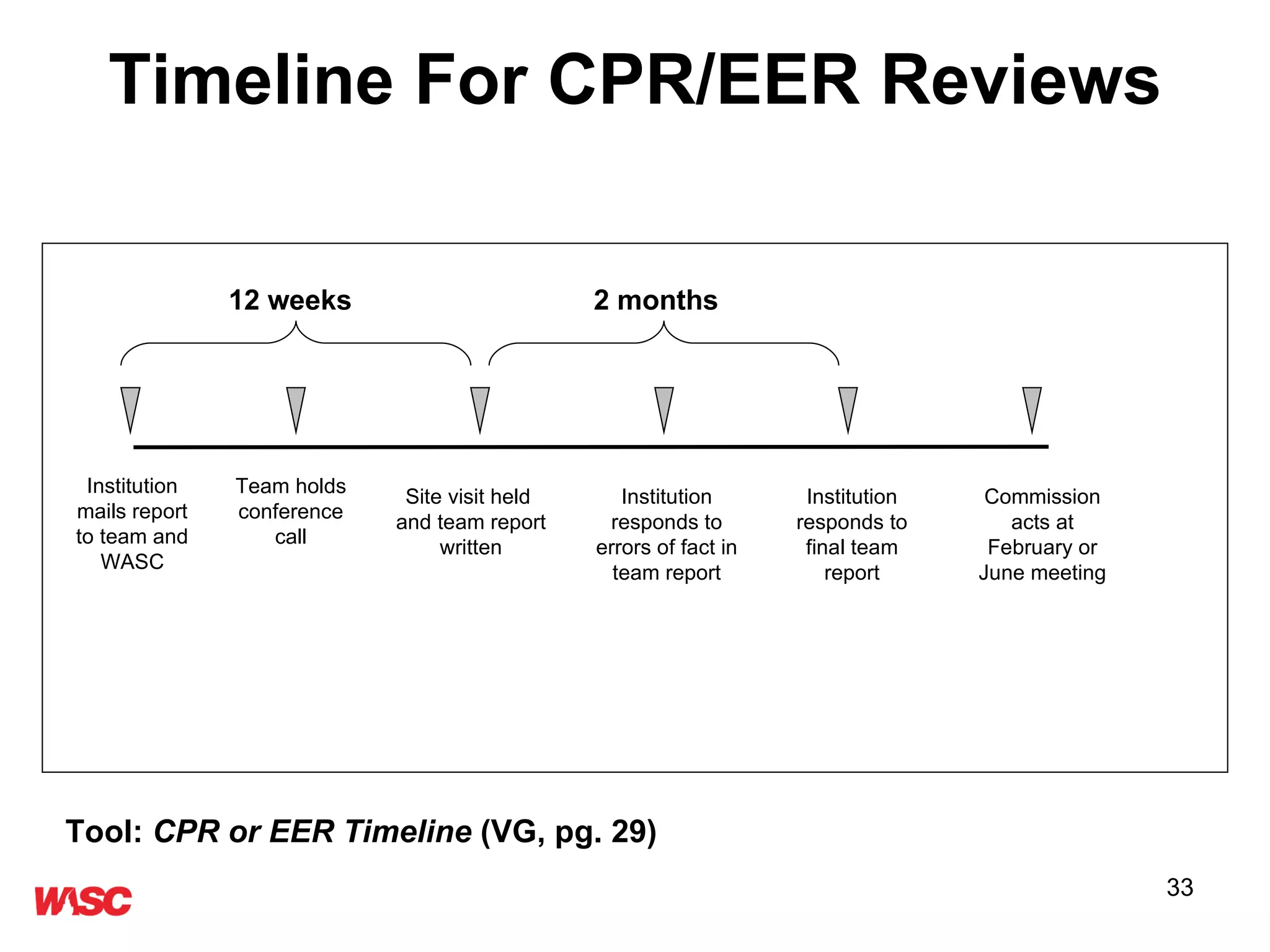
Timeline For CPR/EER Reviews 12 weeks   2 months Institution mails report to team and WASC Team holds conference call Site visit held  and team report written Institution responds to errors of fact in team report Institution responds to final team report Commission acts at February or June meeting Tool:  CPR or EER Timeline  (VG, pg. 29)
Pre-visit Preparation Read all the documents from WASC Standards, CFRs, policies, visit guide, rubrics Background documents re: institution and purpose of the visit, including Proposal and/or last action letter/team report Read the institutional report Review the data portfolio and exhibits What to look for and highlight?
Reviewing the Exhibits Enrollment data Headcounts and FTE Graduation data Faculty data Key financial indicators Inventory of Educational Effectiveness Indicators Inventory of Concurrent Accreditation and Key Performance Indicators Tool:  How to Review WASC Data Exhibits   (RB pg. 61)
Reading the Report Has the institution done what it said it would do in its Proposal? Has it collected and analyzed data effectively? Are its conclusions supported by evidence? Are there serious problems or potential areas of noncompliance? Does the report contain recommendations for further institutional action?
Worksheet for Team Pre-Visit Conference Call Organizes team’s responses to institutional materials  Helps team make preliminary evaluation under the Standards Provides basis for team to work toward consensus Should be submitted in advance of call Tool:   CPR Conference Call Worksheet   (VG pg. 42) EER  Conference Call  Worksheet (VG pg. 47) SV  Conference Call  Worksheet (SVG pg. 70)
Evaluates quality of institutional report and alignment with Proposal and previous action letter(s)  Identifies areas of good practice, improvement, and further inquiry  Identifies issues, strategies, evidence needed Identifies persons and entities to be interviewed  Makes or refines team assignments Plans visit logistics  Team Pre-Visit Conference Call
Off-Campus Sites and  Distance Education Programs (special requirement for some visits) Prior to Visit: Sites/online programs will be identified and assignments made Review substantive change action letters to determine if issues have been identified Develop plan for the review of the programs and/or sites  During Visit Interview faculty, administrators and students Evaluate facilities OR online infrastructure Observe classes (can be done ahead for online) Document visit and findings in the appendix  Discuss important findings with team for inclusion in report, as appropriate Tools:   Protocols   (RB pg. 157, RB pg. 162)   Forms   (RB pg. 55, RB pg. 58)
Compliance Audit   (special requirement for some visits) Required for: Institutions seeking Candidacy and Initial Accreditation Some institutions under sanction Additional report submitted by institution in advance of the visit—with links to documents Prepare as appendix to report Tool:  Compliance Audit Checklist   (RB, pg. 51)
Determining Strategy for CPR Visit What evidence is provided to show capacity and readiness for EE? What are the strengths and weaknesses of the evidence? What other evidence do you want to review to evaluate capacity and preparation for EE? Do any issues arise with regard to the Standards? Meetings: format/methodologies
Determining Strategy for EER Visit What evidence is provided to show EE? Why was it chosen? What are the strengths and weaknesses of the evidence? What other evidence do you want to see to evaluate effectiveness? Do any issues arise with regard to the Standards? Meetings: format/methodologies
Drafting in Advance of the Visit Assistant Chairs draft outline of team report and Section I Team members draft outline or text for which they are responsible, using institution’s report and data portfolio, with space for additional evidence, analysis and conclusions  Tool:  Team Reports   (VG pg. 54)
Q&A Please feel free to type in your questions using the chat window or just chime in.
Conducting the Visit
Launching the Visit:  Team Executive Session Discuss preliminary findings Identify major issues for exploration Refine lines of inquiry for each meeting Confirm team assignments Discuss use of tools and rubrics Review preliminary outline/draft team report Discuss options for confidential team recommendation Review schedule
Visit Schedule Executive sessions and debriefings with team only Meetings and interviews with key individuals and groups Open meetings with students, faculty and staff Document review  Time for drafting report sections Final exit meeting Tool:  Visit Schedule  (VG pg. 40, SVG pg. 68)
Confidential Email Account Set up by WASC as extension of open meetings Checked by Assistant Chair during visit Important emails shared with team and investigated Comments included in team report only if the institution has a chance to address them Tool:  Sample Notification re: Confidential Email Account  (RB, pg. 151)
Approaches Used on Visits   Document review Interviews and meetings Mini-questionnaires Techniques for small and large meetings  Fishbowl exercises Audits Plan visit methodologies in advance  as part of schedule.
Tips for Good Interviews Decide on a protocol for interview Prepare questions and lines of inquiry in advance  Ask questions that elicit information, stimulate discussion, or require judgment Avoid interrogation, leading questions, or loaded language Avoid consultation, giving solutions, or talking about your institution Let them do the talking
Addressing Student Success All CPR and EER reports should address this topic Teams should designate someone to study and write about student success Discussion should include summary of data, identification of issues, and plans for improvement
Evaluating Program Review and Student Learning  on EER Visits Tool:  Suggested Approaches for Evaluating Program Review  (RB, pg. 156) EER Toolkit
Rubrics: Assessment of Student Learning   Academic Program Learning Outcomes Use of Portfolios in Assessing Program Outcomes Use of Capstones in Assessing Program Outcomes Integration of Student Learning Assessment into Program Review General Education Assessment Process Tool:  Assessment Related Rubrics (VG, pp. 77-88) Program Learning Outcome Rubric
Educational Effectiveness Framework Use with team to evaluate institution’s “place”  Use language of rubric to describe the institution in the report Ask the institution to evaluate itself and discuss Confer with team toward end of visit to mark a copy of the EEF  Submit the marked EEF confidentially to WASC Tool:  Educational Effectiveness Framework  (RB, pp. 160-161)
The Exit Meeting Team chair communicates commendations and key recommendations that will be included in report Chair may ask team members to participate The meeting is not a dialog, discussion or debate
Q&A Please feel free to type in your questions using the chat window or just chime in.
Developing Team Recommendations
Two Kinds of Recommendations Team recommendations  at the end of team report, delivered at the exit meeting Confidential Team Recommendation  to the Commission for action Tools:  Commission Decisions on Institutions   (Visit Guide pg. 89; SV Guide pg. Append. F) Commission and Team Decision Matrix  (RB pg. 177)
Team Report Recommendations Should be: Overarching and important Supported by evidence  Linked clearly to Standards and CFRs Supported by text in the report Distinguish recommendations from suggestions and observations embedded in the report Tool:  Educational Effectiveness Framework     (RB pg. 160)
Producing Effective  Team Reports
Report Preparation Logistics Follow report template Start writing before the visit  Complete your sections on site and give to Assistant Chair for editing together Tool:  Team Report Templates  (VG, pg. 55; SV Guide, Appen. K) CPR Team Report
Using Evidence in Team Reports Use qualitative and quantitative evidence  Select evidence carefully and purposefully Connect evidence to an assertion or question  Analyze information; do not just set forth data Let evidence suggest improvements Use evidence that speaks to the institution’s themes and the team's questions
Team Use of the Standards  and CFRs Team judgments must be linked to specific Standards and CFRs CFRs must be cited in reports  Standards and CFRs form the basis for Commission decisions Standards and CFRs provide a context for continuous quality improvement
What is an effective team report? Reflects a thorough assessment of the institution’s capacity, preparation, and/or effectiveness Is evidence based Cites the Standards and CFRs Provides the basis for a sound and supportable Commission decision Identifies important areas for institution to address
Tips for Writing Team Reports Consider multiple audiences: institution, Commission, and next team Know your areas of responsibility, including length and depth of your section Start writing before you arrive on campus Address priorities and goals set by the institution Address Commission’s concerns (last action letter) Make commendations, but don’t overdo it Use praise that doesn’t send wrong or mixed signal
More Tips on Team Reports…. Be sure to check facts  Support findings and recommendations with evidence --and tie them to CFRs Ensure evidence is sound and valid Distinguish recommendations from suggestions or observations Use formal language and tone (e.g., not “we/they”) Don’t mention personnel by name Don’t prescribe solutions
Q&A Please feel free to type in your questions using the chat window or just chime in.
After the Visit
What happens next? Assistant Chair prepares draft for Chair, team and staff review; changes as needed Chair sends to institution for corrections  of fact Chair finalizes draft and submits to WASC Chair sends Confidential Team Recommendation and completed EEF  to WASC WASC sends report to institution
Then… Staff prepares draft action letter, which is reviewed by team Chair Commission Panel reads report and  documentation including institution’s written response, meets with institutional representatives at Commission meeting Panel makes recommendation to Commission, and Commission acts Staff finalizes draft action letter on behalf of Commission
Also after the visit…. Team members send reimbursement forms to WASC within 30 days Hotel arranged and paid directly by institution Travel / food reimbursed  Rental car must be approved in advance by WASC staff Spouse or assistant costs not covered See policy for more details Team members should not have any contact with the institution  About the visit OR Consult with the institution for one year
The Team’s Impact  Peer review is the foundation of accreditation.  The team report forms the basis for the Commission action and its letter. The team report and action letter inform the work of the institution for years to come. Why were you chosen for a team?
Resources for Teams Appendices of Visit Guide  Team Materials and Institutional Report mailed 10-12 weeks in advance of visit WASC Website:  www.wascsenior.org WASC Email Advisory (sent prior to visit) WASC Staff
Q&A Please feel free to type in your questions using the chat window or just chime in.
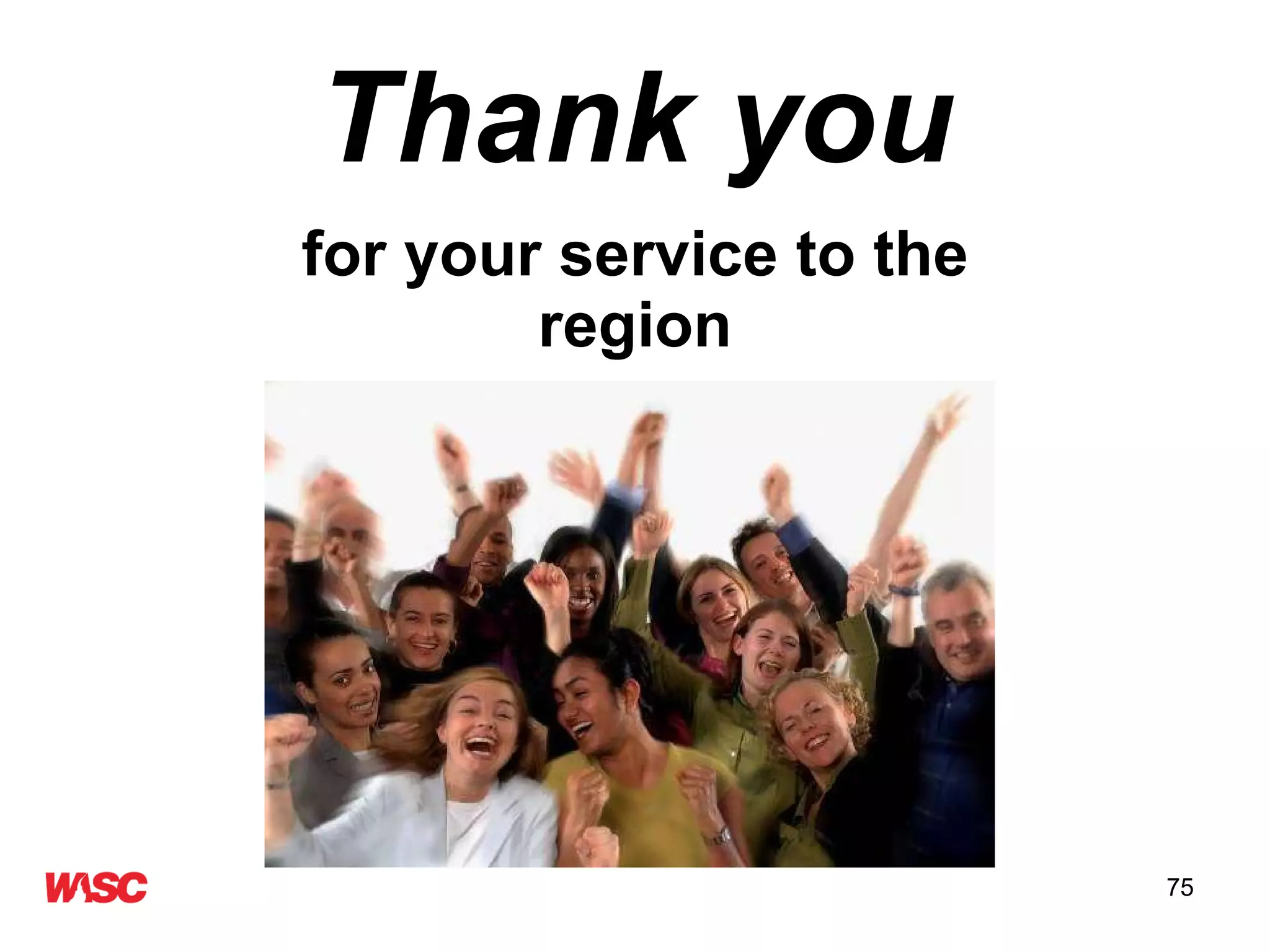
Thank you for your service to the region
Announcements The materials presented during this webinar and a recording of this session will be posted at:  http://www.wascsenior.org/evaltrainingFall2010

WASC Evaluator Training Fall 2010

  • 1.
    Evaluator Workshop Fall Visits 2010 Tuesday, May 25, 2010 Please join the audio portion of this training: 866-740-1260, Access Code: 7489001 ReadyTalk Help Desk: 800.843.9166 International Help: 303.209.1600
  • 2.
    Announcements This presentationand the accompanying materials are available for download from: http://www.wascsenior.org/evaltrainingFall2010 For assistance with Voice and Web connections please contact: ReadyTalk Help Desk, 800.843.9166 International Help: 303.209.1600 Please mute your microphone if you are not speaking. If you have questions, please enter them into the Chat window.
  • 3.
    WASC Evaluator WorkshopFall Visits 2010
  • 4.
    Workshop Outcomes Knowhow to prepare for and conduct an effective visit Be prepared to produce a useful, high-quality team report Be ready to make sound judgments about institutions under the Standards Be familiar with resources that support your work on a team
  • 5.
    Agenda Context for the Visit/Accreditation Preparing for the Visit Conducting the Visit Developing Team Recommendations Writing the Team Report
  • 6.
    Context for Accreditation and Visits The continuing evolution of the WASC process and Standards The accountability movement Moving from assessment for improvement to assessment for accountability New areas of emphasis The Handbook revision process
  • 7.
    Recent Changes inthe Institutional Review Process and Standards Changes to Institutional Review Process re: Student Success, Program Review and EE Sustainability Changes to CFRs Clarifying the scope of the CPR visit to review the “infrastructure” for assessment of student learning Program Review and Program-Level Student Learning in a systematic way Tool: Table A and B (RB pg. 41and 46)
  • 8.
    Covering the Impactof the Financial Recession on Institutions Questions to ask the institution: How has the financial recession affected your institution? How has your institution responded? What plans are in place in case the current state of affairs becomes permanent?
  • 9.
    Q&A Please feelfree to type in your questions using the chat window or just chime in.
  • 10.
    The Three-Stage Review Process Institutional Proposal Capacity & Preparatory Review Educational Effectiveness Review 1. 2. 3.
  • 11.
    The Three-Stage ReviewProcess Institutional Proposal Capacity and Preparatory Review Educational Effectiveness Review
  • 12.
    Timeline for Three-StageReview Process Submitted 2 Years before CPR review Capacity And Preparatory Review 18-24 months to prepare for EER (or less for Candidacy or Initial Accreditation) Educational Effectiveness Review Extended period of time to sustain Initiatives (7-10 years) Proposal
  • 13.
    Institutional Self-Review Theheart of accreditation Built upon an effective internal process of Evaluation Self-reflection Recommendations from previous reviews Plans for action
  • 14.
    Stage 1: The Institutional Proposal
  • 15.
    The Institutional ProposalGuides the entire accreditation review process Connects institution’s context and priorities with the Standards of Accreditation Provides primary basis for both institution self-review and team evaluation Allows alignment of accreditation activities to institutional strategic plan and key areas chosen for improvement
  • 16.
    The Letter ofIntent Submitted by institutions seeking Candidacy or Initial Accreditation, the LOI serves the same purpose as the proposal Includes suggestions from Eligibility approval letter Submitted to assigned WASC liaison, one year in advance of CPR Review Instructions are in “How to Become Accredited” on WASC website
  • 17.
    Stage 2: The Capacity and Preparatory Review
  • 18.
    Purpose of theCPR Review and verify the information in the institutional presentation (report and data) Evaluate key institutional resources, structures, processes in light of Standards Evaluate institution’s infrastructure to support and assess student learning Assess institution’s preparedness to undertake the Educational Effectiveness Review
  • 19.
    Stage 3: The Educational Effectiveness Review
  • 20.
    Purpose of theEER Invite sustained engagement by the institution on the extent to which it fulfills its educational objectives Enable the Commission to make a judgment about extent to which institution fills its Core Commitment to Educational Effectiveness
  • 21.
    The Two CoreCommitments
  • 22.
    Core Commitment 1“ The institution functions with clear purposes , high levels of institutional integrity , fiscal stability , and organizational structures to fulfill its purposes.”
  • 23.
    Core Commitment 2“The institution evidences clear and appropriate educational objectives and design at the institutional and program level. The institution employs processes of review , including the collection and use of data , that ensure delivery of program and learner accomplishments at a level of performance appropriate for the degree or certificate awarded.”
  • 24.
    The Four StandardsTool: Standards of Accreditation, RB p. 23 Standards at a Glance, RB p. 37
  • 25.
    Standard 1: DefiningInstitutional Purposes and Ensuring Educational Objectives Institutional Purposes Integrity
  • 26.
    Standard 2: AchievingEducational Objectives Through Core Functions Teaching and Learning Scholarship and Creative Activity Support for Student Learning
  • 27.
    Standard 3: Developingand Applying Resources and Organizational Structures to Ensure Sustainability Faculty and Staff Fiscal, Physical, Information Resources Organizational Structures & Decision Making Processes
  • 28.
    S tandard 4: Creating an Organization Committed to Learning and Improvement Strategic Thinking and Planning Commitment to Learning and Improvement
  • 29.
    Expectations for TwoReviews Tool: Expectations for Two Reviews (RB pg. 20) Educational Effectiveness Demonstrating student learning Demonstrating institutional learning Demonstrating evidence-based decision-making Capacity and Preparatory Preparatory = readiness for the Educational Effectiveness Review Capacity = purposes, integrity, stability, resources, structures, policies, processes
  • 30.
    Q&A Please feelfree to type in your questions using the chat window or just chime in.
  • 31.
    Preparing for theVisit (Visit Guide, Part II, pp. 29-52)
  • 32.
    Roles and Responsibilitiesof Team Members and Staff Role of Team Chair (RB pg. 193) Role of Team Assistant Chair (RB pg. 195) Role of assigned WASC staff liaison (VG pg. 7) Team assignments Tool: Section 9 (Tips, Roles and Advice, RB p 189)
  • 33.
    Timeline For CPR/EERReviews 12 weeks 2 months Institution mails report to team and WASC Team holds conference call Site visit held and team report written Institution responds to errors of fact in team report Institution responds to final team report Commission acts at February or June meeting Tool: CPR or EER Timeline (VG, pg. 29)
  • 34.
    Pre-visit Preparation Readall the documents from WASC Standards, CFRs, policies, visit guide, rubrics Background documents re: institution and purpose of the visit, including Proposal and/or last action letter/team report Read the institutional report Review the data portfolio and exhibits What to look for and highlight?
  • 35.
    Reviewing the ExhibitsEnrollment data Headcounts and FTE Graduation data Faculty data Key financial indicators Inventory of Educational Effectiveness Indicators Inventory of Concurrent Accreditation and Key Performance Indicators Tool: How to Review WASC Data Exhibits (RB pg. 61)
  • 36.
    Reading the ReportHas the institution done what it said it would do in its Proposal? Has it collected and analyzed data effectively? Are its conclusions supported by evidence? Are there serious problems or potential areas of noncompliance? Does the report contain recommendations for further institutional action?
  • 37.
    Worksheet for TeamPre-Visit Conference Call Organizes team’s responses to institutional materials Helps team make preliminary evaluation under the Standards Provides basis for team to work toward consensus Should be submitted in advance of call Tool: CPR Conference Call Worksheet (VG pg. 42) EER Conference Call Worksheet (VG pg. 47) SV Conference Call Worksheet (SVG pg. 70)
  • 38.
    Evaluates quality ofinstitutional report and alignment with Proposal and previous action letter(s) Identifies areas of good practice, improvement, and further inquiry Identifies issues, strategies, evidence needed Identifies persons and entities to be interviewed Makes or refines team assignments Plans visit logistics Team Pre-Visit Conference Call
  • 39.
    Off-Campus Sites and Distance Education Programs (special requirement for some visits) Prior to Visit: Sites/online programs will be identified and assignments made Review substantive change action letters to determine if issues have been identified Develop plan for the review of the programs and/or sites During Visit Interview faculty, administrators and students Evaluate facilities OR online infrastructure Observe classes (can be done ahead for online) Document visit and findings in the appendix Discuss important findings with team for inclusion in report, as appropriate Tools: Protocols (RB pg. 157, RB pg. 162) Forms (RB pg. 55, RB pg. 58)
  • 40.
    Compliance Audit (special requirement for some visits) Required for: Institutions seeking Candidacy and Initial Accreditation Some institutions under sanction Additional report submitted by institution in advance of the visit—with links to documents Prepare as appendix to report Tool: Compliance Audit Checklist (RB, pg. 51)
  • 41.
    Determining Strategy forCPR Visit What evidence is provided to show capacity and readiness for EE? What are the strengths and weaknesses of the evidence? What other evidence do you want to review to evaluate capacity and preparation for EE? Do any issues arise with regard to the Standards? Meetings: format/methodologies
  • 42.
    Determining Strategy forEER Visit What evidence is provided to show EE? Why was it chosen? What are the strengths and weaknesses of the evidence? What other evidence do you want to see to evaluate effectiveness? Do any issues arise with regard to the Standards? Meetings: format/methodologies
  • 43.
    Drafting in Advanceof the Visit Assistant Chairs draft outline of team report and Section I Team members draft outline or text for which they are responsible, using institution’s report and data portfolio, with space for additional evidence, analysis and conclusions Tool: Team Reports (VG pg. 54)
  • 44.
    Q&A Please feelfree to type in your questions using the chat window or just chime in.
  • 45.
  • 46.
    Launching the Visit: Team Executive Session Discuss preliminary findings Identify major issues for exploration Refine lines of inquiry for each meeting Confirm team assignments Discuss use of tools and rubrics Review preliminary outline/draft team report Discuss options for confidential team recommendation Review schedule
  • 47.
    Visit Schedule Executivesessions and debriefings with team only Meetings and interviews with key individuals and groups Open meetings with students, faculty and staff Document review Time for drafting report sections Final exit meeting Tool: Visit Schedule (VG pg. 40, SVG pg. 68)
  • 48.
    Confidential Email AccountSet up by WASC as extension of open meetings Checked by Assistant Chair during visit Important emails shared with team and investigated Comments included in team report only if the institution has a chance to address them Tool: Sample Notification re: Confidential Email Account (RB, pg. 151)
  • 49.
    Approaches Used onVisits Document review Interviews and meetings Mini-questionnaires Techniques for small and large meetings Fishbowl exercises Audits Plan visit methodologies in advance as part of schedule.
  • 50.
    Tips for GoodInterviews Decide on a protocol for interview Prepare questions and lines of inquiry in advance Ask questions that elicit information, stimulate discussion, or require judgment Avoid interrogation, leading questions, or loaded language Avoid consultation, giving solutions, or talking about your institution Let them do the talking
  • 51.
    Addressing Student SuccessAll CPR and EER reports should address this topic Teams should designate someone to study and write about student success Discussion should include summary of data, identification of issues, and plans for improvement
  • 52.
    Evaluating Program Reviewand Student Learning on EER Visits Tool: Suggested Approaches for Evaluating Program Review (RB, pg. 156) EER Toolkit
  • 53.
    Rubrics: Assessment ofStudent Learning Academic Program Learning Outcomes Use of Portfolios in Assessing Program Outcomes Use of Capstones in Assessing Program Outcomes Integration of Student Learning Assessment into Program Review General Education Assessment Process Tool: Assessment Related Rubrics (VG, pp. 77-88) Program Learning Outcome Rubric
  • 54.
    Educational Effectiveness FrameworkUse with team to evaluate institution’s “place” Use language of rubric to describe the institution in the report Ask the institution to evaluate itself and discuss Confer with team toward end of visit to mark a copy of the EEF Submit the marked EEF confidentially to WASC Tool: Educational Effectiveness Framework (RB, pp. 160-161)
  • 55.
    The Exit MeetingTeam chair communicates commendations and key recommendations that will be included in report Chair may ask team members to participate The meeting is not a dialog, discussion or debate
  • 56.
    Q&A Please feelfree to type in your questions using the chat window or just chime in.
  • 57.
  • 58.
    Two Kinds ofRecommendations Team recommendations at the end of team report, delivered at the exit meeting Confidential Team Recommendation to the Commission for action Tools: Commission Decisions on Institutions (Visit Guide pg. 89; SV Guide pg. Append. F) Commission and Team Decision Matrix (RB pg. 177)
  • 59.
    Team Report RecommendationsShould be: Overarching and important Supported by evidence Linked clearly to Standards and CFRs Supported by text in the report Distinguish recommendations from suggestions and observations embedded in the report Tool: Educational Effectiveness Framework (RB pg. 160)
  • 60.
  • 61.
    Report Preparation LogisticsFollow report template Start writing before the visit Complete your sections on site and give to Assistant Chair for editing together Tool: Team Report Templates (VG, pg. 55; SV Guide, Appen. K) CPR Team Report
  • 62.
    Using Evidence inTeam Reports Use qualitative and quantitative evidence Select evidence carefully and purposefully Connect evidence to an assertion or question Analyze information; do not just set forth data Let evidence suggest improvements Use evidence that speaks to the institution’s themes and the team's questions
  • 63.
    Team Use ofthe Standards and CFRs Team judgments must be linked to specific Standards and CFRs CFRs must be cited in reports Standards and CFRs form the basis for Commission decisions Standards and CFRs provide a context for continuous quality improvement
  • 64.
    What is aneffective team report? Reflects a thorough assessment of the institution’s capacity, preparation, and/or effectiveness Is evidence based Cites the Standards and CFRs Provides the basis for a sound and supportable Commission decision Identifies important areas for institution to address
  • 65.
    Tips for WritingTeam Reports Consider multiple audiences: institution, Commission, and next team Know your areas of responsibility, including length and depth of your section Start writing before you arrive on campus Address priorities and goals set by the institution Address Commission’s concerns (last action letter) Make commendations, but don’t overdo it Use praise that doesn’t send wrong or mixed signal
  • 66.
    More Tips onTeam Reports…. Be sure to check facts Support findings and recommendations with evidence --and tie them to CFRs Ensure evidence is sound and valid Distinguish recommendations from suggestions or observations Use formal language and tone (e.g., not “we/they”) Don’t mention personnel by name Don’t prescribe solutions
  • 67.
    Q&A Please feelfree to type in your questions using the chat window or just chime in.
  • 68.
  • 69.
    What happens next?Assistant Chair prepares draft for Chair, team and staff review; changes as needed Chair sends to institution for corrections of fact Chair finalizes draft and submits to WASC Chair sends Confidential Team Recommendation and completed EEF to WASC WASC sends report to institution
  • 70.
    Then… Staff preparesdraft action letter, which is reviewed by team Chair Commission Panel reads report and documentation including institution’s written response, meets with institutional representatives at Commission meeting Panel makes recommendation to Commission, and Commission acts Staff finalizes draft action letter on behalf of Commission
  • 71.
    Also after thevisit…. Team members send reimbursement forms to WASC within 30 days Hotel arranged and paid directly by institution Travel / food reimbursed Rental car must be approved in advance by WASC staff Spouse or assistant costs not covered See policy for more details Team members should not have any contact with the institution About the visit OR Consult with the institution for one year
  • 72.
    The Team’s Impact Peer review is the foundation of accreditation. The team report forms the basis for the Commission action and its letter. The team report and action letter inform the work of the institution for years to come. Why were you chosen for a team?
  • 73.
    Resources for TeamsAppendices of Visit Guide Team Materials and Institutional Report mailed 10-12 weeks in advance of visit WASC Website: www.wascsenior.org WASC Email Advisory (sent prior to visit) WASC Staff
  • 74.
    Q&A Please feelfree to type in your questions using the chat window or just chime in.
  • 75.
    Thank you foryour service to the region
  • 76.
    Announcements The materialspresented during this webinar and a recording of this session will be posted at: http://www.wascsenior.org/evaltrainingFall2010

Editor's Notes

  • #2 Introductions Name, institution, institution being visited, experience as AC
  • #3 Importance of role of the AC for the effectiveness of the visit and quality of the report