

Accrediting Commission for  Community and Junior Colleges of the  Western Association of Schools and Colleges
Program Review: The Foundation for Institutional Planning and Improvement March 2008
Learning Outcomes for Today’s Discussion Understand the evolution of program review (Commission Standards and Institutional Processes) Identify a viable program review process Recognize an effective integrated system of program review and planning processes at the institutional level which lead to institutional improvement
Suggestions for other learning outcomes Others you would you like to add?
Institutional Evaluation, Planning and Improvement:  Meeting the integrated assessment requirements of accreditation
To provide quality assurance to the public through assessment of institutional quality and making public the general results of that assessment. To stimulate institutional improvement through team recommendations given to the institution through the accreditation review process. To provide a vehicle for institutional self-assessment against a set of standards of good practice.  Purposes of Accreditation
Evolving Requirements of Accreditation Standards
Initial Accreditation Standards Initial accreditation (early 1960’s) required basic structures and processes to be in place and minimal resources to be available. Institutions had to have reasonable academic processes and curriculum that met the expectations of peers in “higher education” but were offered in the context of the institution’s unique mission.
What was happening at the institutional level  (1960’s – 1980’s)? Informal internal processes, limited planning, tremendous growth, emphasis on curriculum and programs, limited assessment Mid 1980’s some institutions added research functions Course objectives, standard outlines, transfer of credits Teaching Improvement: measurable objectives, technology
In the 1990’s Institutions had to have processes for self-assessment, planning, and improvement. The idea of “continuous improvement” in educational quality became a core principle of accreditation processes, with the continuous improvement driven by changing accreditation standards. Accreditation required assessment of institutional effectiveness; program review became the phrase used to describe the review of the effectiveness of educational programs.
What was happening at the institutional level 1990’s? Development of formal program review processes (mainly instructional programs) Development of institutional plans and processes Addition of research functions and use of student achievement data Lots of discussion on models, processes, and program improvement
The 1996 Standards Required program review to incorporate data and analyses of how well students moved through courses, programs, degrees, and other discrete educational experiences.  Institutions were asked to develop program review for all programs, and to present summative data at the institutional level in the Self Study Report, Introduction, as well as in FACT Books and on web sites .
What was happening at the institutional level after 1996 Standards? Discussions on definitions and effective processes for measuring/assessing student progress, student achievement, and institutional effectiveness Program review processes expanded to include student services and support services Integration of program review with institutional planning
What was happening at the institutional level after 1996 Standards?  continued Planning processes connected to budgeting Importance of research function and use of data analysis, trends, assessment to inform decision making within governance processes Shift of focus from teaching to learning, classroom assessment
What was happening at the institutional level after 1996 Standards?  continued Uneven adoption of all of the above!
In 2002  To the previous standards, the 2002 Standards add the focus on what students have learned as a result of attending college--- student learning outcomes . (SLO’s)
Student Learning Outcomes   The standards place student learning outcomes (SLO’s) at center of accreditation review process.  Institutions must identify SLO’s at course, program and degree level, and measure their achievement, and Institutions must use the assessment of learning outcomes to plan and implement improvements to educational quality
What are Student Learning Outcomes? Knowledge Skills Abilities  Understanding Attitudes Beliefs Opinions Values SLO’s are defined in the context of each college’s mission, populations and programs, as well as the values of “higher education.”
2002 Standards What are we finding now at the institutional level? Issues surrounding a six-year cycle and self study process Snapshot of on-going systems and processes versus “getting ready for accreditation” Ability to meet standards with existence of previous deficiencies The importance of program review/on-going assessment processes integrated with institutional planning/budgeting
2002 Standards What are we finding now at the institutional level? continued The importance of a strong research and planning function Issues on assessment of student learning outcomes at the course, program, and institutional level
Taken together, the Standards of Accreditation call for: Ongoing Assessment of Quality, Planning and Improvement Designed to Improve Educational Effectiveness
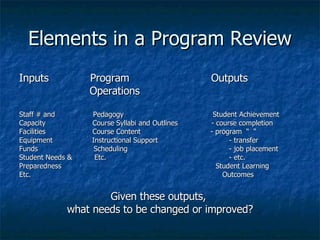
Elements in a Program Review Inputs   Program  Outputs   Operations Staff # and  Pedagogy   Student Achievement Capacity  Course Syllabi and Outlines  - course completion Facilities  Course Content   - program  “  “  Equipment   Instructional Support   - transfer Funds   Scheduling   - job placement Student Needs &   Etc.   - etc. Preparedness   Student Learning  Etc.    Outcomes  Given these outputs,  what needs to be changed or improved?
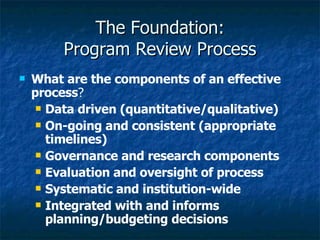
The Foundation: Program Review Process What are the components of an effective process ? Data driven (quantitative/qualitative) On-going and consistent (appropriate timelines) Governance and research components Evaluation and oversight of process Systematic and institution-wide Integrated with and informs planning/budgeting decisions
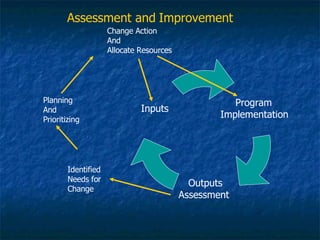
Identified  Needs for  Change  Planning And  Prioritizing  Change Action  And  Allocate Resources  Assessment and   Improvement Program   Implementation Outputs Assessment  Inputs
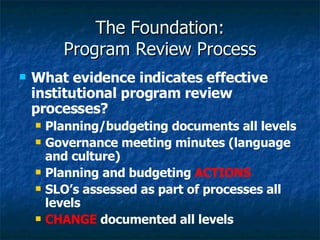
The Foundation: Program Review Process What evidence indicates effective institutional program review processes? Planning/budgeting documents all levels Governance meeting minutes (language and culture) Planning and budgeting  ACTIONS SLO’s assessed as part of processes all levels CHANGE  documented all levels
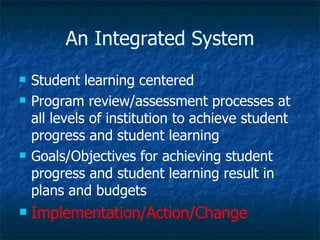
An Integrated System Student learning centered Program review/assessment processes at all levels of institution to achieve student progress and student learning Goals/Objectives for achieving student progress and student learning result in plans and budgets Implementation/Action/Change
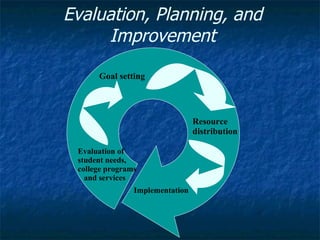
Evaluation, Planning, and Improvement Evaluation of student needs, college programs  and services  Goal setting Resource distribution  Implementation
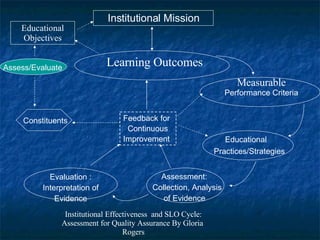
Institutional Mission Educational Objectives Feedback for  Continuous Improvement Institutional Effectiveness  and SLO Cycle: Assessment for Quality Assurance By Gloria  Rogers Learning Outcomes Measurable  Performance Criteria Assess/Evaluate Educational  Practices/Strategies Assessment: Collection, Analysis of Evidence Evaluation : Interpretation of Evidence Constituents
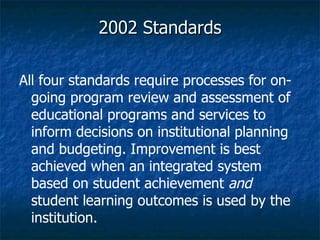
2002 Standards All four standards require processes for on-going program review and assessment of educational programs and services to inform decisions on institutional planning and budgeting. Improvement is best achieved when an integrated system based on student achievement  and  student learning outcomes is used by the institution.
How did we do?
Learning Outcomes for Today’s Discussion Understand the evolution of program review (Commission Standards and Institutional Processes) Identify a viable program review process Recognize an effective integrated system of program review and planning processes at the institutional level which lead to institutional improvement

Program Review ACCJC Presentation

  • 1.
    Accrediting Commission for Community and Junior Colleges of the Western Association of Schools and Colleges
  • 2.
    Program Review: TheFoundation for Institutional Planning and Improvement March 2008
  • 3.
    Learning Outcomes forToday’s Discussion Understand the evolution of program review (Commission Standards and Institutional Processes) Identify a viable program review process Recognize an effective integrated system of program review and planning processes at the institutional level which lead to institutional improvement
  • 4.
    Suggestions for otherlearning outcomes Others you would you like to add?
  • 5.
    Institutional Evaluation, Planningand Improvement: Meeting the integrated assessment requirements of accreditation
  • 6.
    To provide qualityassurance to the public through assessment of institutional quality and making public the general results of that assessment. To stimulate institutional improvement through team recommendations given to the institution through the accreditation review process. To provide a vehicle for institutional self-assessment against a set of standards of good practice. Purposes of Accreditation
  • 7.
    Evolving Requirements ofAccreditation Standards
  • 8.
    Initial Accreditation StandardsInitial accreditation (early 1960’s) required basic structures and processes to be in place and minimal resources to be available. Institutions had to have reasonable academic processes and curriculum that met the expectations of peers in “higher education” but were offered in the context of the institution’s unique mission.
  • 9.
    What was happeningat the institutional level (1960’s – 1980’s)? Informal internal processes, limited planning, tremendous growth, emphasis on curriculum and programs, limited assessment Mid 1980’s some institutions added research functions Course objectives, standard outlines, transfer of credits Teaching Improvement: measurable objectives, technology
  • 10.
    In the 1990’sInstitutions had to have processes for self-assessment, planning, and improvement. The idea of “continuous improvement” in educational quality became a core principle of accreditation processes, with the continuous improvement driven by changing accreditation standards. Accreditation required assessment of institutional effectiveness; program review became the phrase used to describe the review of the effectiveness of educational programs.
  • 11.
    What was happeningat the institutional level 1990’s? Development of formal program review processes (mainly instructional programs) Development of institutional plans and processes Addition of research functions and use of student achievement data Lots of discussion on models, processes, and program improvement
  • 12.
    The 1996 StandardsRequired program review to incorporate data and analyses of how well students moved through courses, programs, degrees, and other discrete educational experiences. Institutions were asked to develop program review for all programs, and to present summative data at the institutional level in the Self Study Report, Introduction, as well as in FACT Books and on web sites .
  • 13.
    What was happeningat the institutional level after 1996 Standards? Discussions on definitions and effective processes for measuring/assessing student progress, student achievement, and institutional effectiveness Program review processes expanded to include student services and support services Integration of program review with institutional planning
  • 14.
    What was happeningat the institutional level after 1996 Standards? continued Planning processes connected to budgeting Importance of research function and use of data analysis, trends, assessment to inform decision making within governance processes Shift of focus from teaching to learning, classroom assessment
  • 15.
    What was happeningat the institutional level after 1996 Standards? continued Uneven adoption of all of the above!
  • 16.
    In 2002 To the previous standards, the 2002 Standards add the focus on what students have learned as a result of attending college--- student learning outcomes . (SLO’s)
  • 17.
    Student Learning Outcomes The standards place student learning outcomes (SLO’s) at center of accreditation review process. Institutions must identify SLO’s at course, program and degree level, and measure their achievement, and Institutions must use the assessment of learning outcomes to plan and implement improvements to educational quality
  • 18.
    What are StudentLearning Outcomes? Knowledge Skills Abilities Understanding Attitudes Beliefs Opinions Values SLO’s are defined in the context of each college’s mission, populations and programs, as well as the values of “higher education.”
  • 19.
    2002 Standards Whatare we finding now at the institutional level? Issues surrounding a six-year cycle and self study process Snapshot of on-going systems and processes versus “getting ready for accreditation” Ability to meet standards with existence of previous deficiencies The importance of program review/on-going assessment processes integrated with institutional planning/budgeting
  • 20.
    2002 Standards Whatare we finding now at the institutional level? continued The importance of a strong research and planning function Issues on assessment of student learning outcomes at the course, program, and institutional level
  • 21.
    Taken together, theStandards of Accreditation call for: Ongoing Assessment of Quality, Planning and Improvement Designed to Improve Educational Effectiveness
  • 22.
    Elements in aProgram Review Inputs Program Outputs Operations Staff # and Pedagogy Student Achievement Capacity Course Syllabi and Outlines - course completion Facilities Course Content - program “ “ Equipment Instructional Support - transfer Funds Scheduling - job placement Student Needs & Etc. - etc. Preparedness Student Learning Etc. Outcomes Given these outputs, what needs to be changed or improved?
  • 23.
    The Foundation: ProgramReview Process What are the components of an effective process ? Data driven (quantitative/qualitative) On-going and consistent (appropriate timelines) Governance and research components Evaluation and oversight of process Systematic and institution-wide Integrated with and informs planning/budgeting decisions
  • 24.
    Identified Needsfor Change Planning And Prioritizing Change Action And Allocate Resources Assessment and Improvement Program Implementation Outputs Assessment Inputs
  • 25.
    The Foundation: ProgramReview Process What evidence indicates effective institutional program review processes? Planning/budgeting documents all levels Governance meeting minutes (language and culture) Planning and budgeting ACTIONS SLO’s assessed as part of processes all levels CHANGE documented all levels
  • 26.
    An Integrated SystemStudent learning centered Program review/assessment processes at all levels of institution to achieve student progress and student learning Goals/Objectives for achieving student progress and student learning result in plans and budgets Implementation/Action/Change
  • 27.
    Evaluation, Planning, andImprovement Evaluation of student needs, college programs and services Goal setting Resource distribution Implementation
  • 28.
    Institutional Mission EducationalObjectives Feedback for Continuous Improvement Institutional Effectiveness and SLO Cycle: Assessment for Quality Assurance By Gloria Rogers Learning Outcomes Measurable Performance Criteria Assess/Evaluate Educational Practices/Strategies Assessment: Collection, Analysis of Evidence Evaluation : Interpretation of Evidence Constituents
  • 29.
    2002 Standards Allfour standards require processes for on-going program review and assessment of educational programs and services to inform decisions on institutional planning and budgeting. Improvement is best achieved when an integrated system based on student achievement and student learning outcomes is used by the institution.
  • 30.
  • 31.
    Learning Outcomes forToday’s Discussion Understand the evolution of program review (Commission Standards and Institutional Processes) Identify a viable program review process Recognize an effective integrated system of program review and planning processes at the institutional level which lead to institutional improvement